
Genesis 16:2

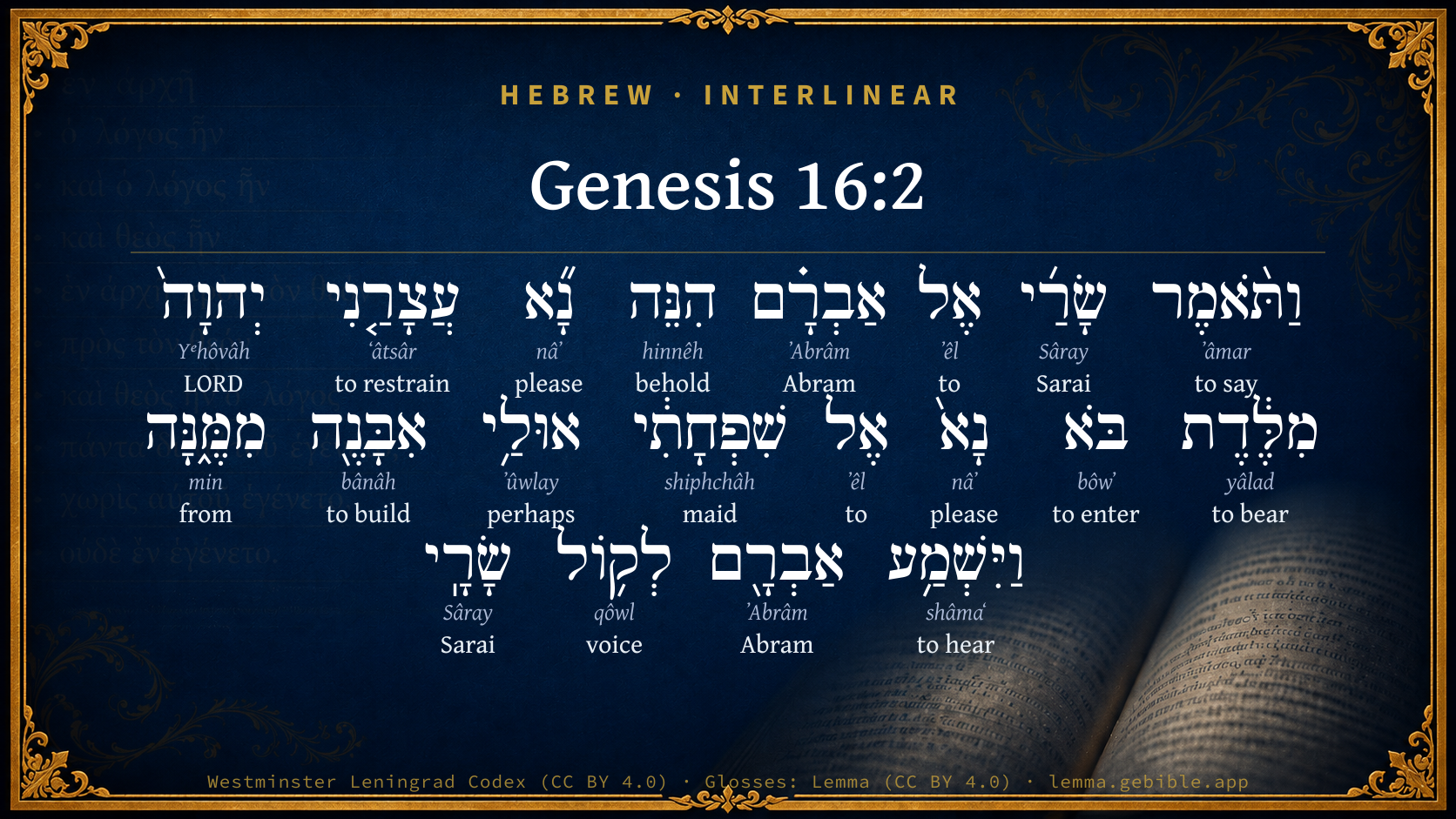
Hebrew (Westminster Leningrad Codex) Genesis 16:2 appears in the Hebrew Old Testament. The text above is from the Westminster Leningrad Codex. Each word links to its Strong’s number, a concise gloss, and parsing drawn from the Open Scriptures Hebrew Bible morphology. Click any word for its full Brown-Driver-Briggs (BDB) entry.
Download image
Cite this verse

Genesis 16:2 (World English Bible). Public Domain. Lemma interlinear Bible study tool, https://lemma.gebible.app/v/genesis/16/2.

Show BibTeX & RIS
BibTeX
RIS
English Translation
Sarai said to Abram," See now, Yahweh has restrained me from bearing. Please go in to my handmaid. It may be that I will obtain children by her." Abram listened to the voice of Sarai.
World English Bible · Public Domain
Highlights
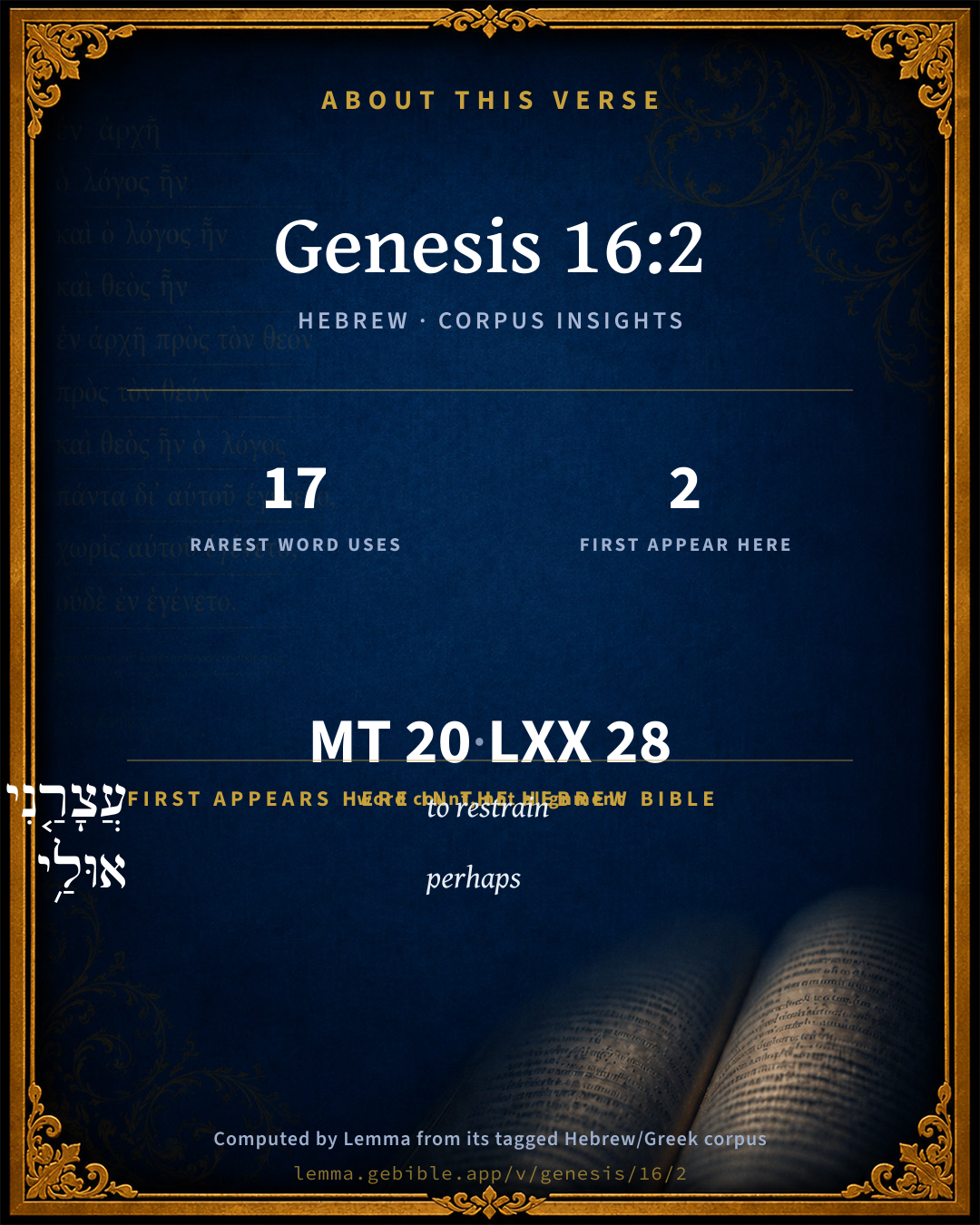
  • 2 first appearances in the Hebrew Bible
Full analysis ↓
Download a study sheet

One document with this verse’s original text, its word-by-word gloss line, the meaning frame, cross-references with their text, attributed commentary, and full source and license credits — printable, and it pastes into notes with its structure intact.

This verse Autodidact and up

Study sheet (.html) Plain text (.txt)

A passage Seminary Student

Up to 50 verses in one chapter. A passage sheet keeps up to 6 commentary sources and 12 cross-references per verse, in the order this page ranks them, and says so on the sheet whenever that leaves anything out. Ask for a single verse and you get the Autodidact verse sheet above.

Everything on this page stays free to read, with no account — the sheet is a download of what is already on screen, not access to it.

Want to remove ads? Support Godless Engineer
Compare translations 3

The same verse in 3 English versions, stacked beneath the original-language interlinear above. Click any original word for its lexicon entry.

Each is an independent rendering of the whole verse — the interlinear is not word-aligned to these translations.

Highlighted words mark where these versions differ — a whole-verse word diff, not a word-by-word alignment.

  • World English Bible Public Domain
    Sarai said to Abram," See now, Yahweh has restrained me from bearing. Please go in to my handmaid. It may be that I will obtain children by her." Abram listened to the voice of Sarai.
  • King James Version Public Domain
    And Sarai said unto Abram, Behold now, the LORD hath restrained me from bearing: I pray thee, go in unto my maid; it may be that I may obtain children by her. And Abram hearkened to the voice of Sarai.
  • unfoldingWord Literal Text CC BY-SA 4.0
    So Sarai said to Abram, “Behold please, Yahweh has prevented me from bearing. Please go to my maidservant. Perhaps I can be built up from her.” And Abram listened to the voice of Sarai.

unfoldingWord Literal Text — © unfoldingWord, licensed CC BY-SA 4.0. Word-aligned USFM3 via Door43 (git.door43.org/unfoldingWord/en_ult).

Versions to compare (up to 4)

3 of 4 selected

Show all 18 translations

Every available English version of this verse, each an independent rendering of the whole verse.

  • World English Bible Public Domain
    Sarai said to Abram," See now, Yahweh has restrained me from bearing. Please go in to my handmaid. It may be that I will obtain children by her." Abram listened to the voice of Sarai.
  • Berean Standard Bible Public Domain
    So Sarai said to Abram, “Look now, the LORD has prevented me from bearing children. Please go to my maidservant; perhaps I can build a family by her.” And Abram listened to the voice of Sarai.
  • Majority Standard Bible Public Domain
    So Sarai said to Abram, “Look now, the LORD has prevented me from bearing children. Please go to my maidservant; perhaps I can build a family by her.” And Abram listened to the voice of Sarai.
  • King James Version Public Domain
    And Sarai said unto Abram, Behold now, the LORD hath restrained me from bearing: I pray thee, go in unto my maid; it may be that I may obtain children by her. And Abram hearkened to the voice of Sarai.
  • American Standard Version (1901) Public Domain
    And Sarai said unto Abram, Behold now, Jehovah hath restrained me from bearing; go in, I pray thee, unto my handmaid; it may be that I shall obtain children by her. And Abram hearkened to the voice of Sarai.
  • Revised Version (1885) Public Domain
    And Sarai said unto Abram, Behold now, the LORD hath restrained me from bearing; go in, I pray thee, unto my handmaid; it may be that I shall obtain children by her. And Abram hearkened to the voice of Sarai.
  • Geneva Bible (1599) Public Domain
    And Sarai said vnto Abram, Beholde now, the Lord hath restrained me from childe bearing. I pray thee goe in vnto my maide: it may be that I shall receiue a childe by her. And Abram obeyed the voyce of Sarai.
  • Douay-Rheims (1899) Public Domain
    She said to her husband: Behold, the Lord hath restrained me from bearing: go in unto my handmaid, it may be I may have children of her at least. And when he agreed to her request,
  • Young's Literal Translation Public Domain
    and Sarai saith unto Abram, `Lo, I pray thee, Jehovah hath restrained me from bearing, go in, I pray thee, unto my handmaid; perhaps I am built up from her;' and Abram hearkeneth to the voice of Sarai.
  • Literal Standard Version CC BY-SA 4.0
    and Sarai says to Abram, “Now behold, YHWH has restrained me from bearing, please go in to my handmaid; perhaps I am built up from her”; and Abram listens to the voice of Sarai.
  • Unlocked Literal Bible CC BY-SA 4.0
    So Sarai said to Abram, “See, Yahweh has kept me from having children. Go sleep with my servant. It may be that I will have children by her.” Abram listened to the voice of Sarai.
  • unfoldingWord Literal Text CC BY-SA 4.0
    So Sarai said to Abram, “Behold please, Yahweh has prevented me from bearing. Please go to my maidservant. Perhaps I can be built up from her.” And Abram listened to the voice of Sarai.
  • Darby Bible Public Domain
    And Sarai said to Abram, Behold now, Jehovah has shut me up, that I do not bear. Go in, I pray thee, to my maidservant: it may be that I shall be built up by her. And Abram hearkened to the voice of Sarai.
  • World Messianic Bible Public Domain
    Sarai said to Abram, “See now, the LORD has restrained me from bearing. Please go in to my servant. It may be that I will obtain children by her.” Abram listened to the voice of Sarai.
  • Webster's Bible Public Domain
    And Sarai said to Abram, Behold, now, the LORD hath restrained me from bearing: I pray thee go in to my maid; it may be that I may obtain children by her. And Abram hearkened to the voice of Sarai.
  • Free Bible Version CC BY-SA 4.0
    so Sarai said to Abram, “Please listen to me. The Lord hasn't let me have any children. So please go and sleep with my slave. Maybe I can have a family through her.” Abram agreed to what Sarai had suggested.
  • Bible in Basic English Public Domain
    And Sarai said to Abram, See, the Lord has not let me have children; go in to my servant, for I may get a family through her. And Abram did as Sarai said.
  • JPS Tanakh (1917) Public Domain
    And Sarai said unto Abram: 'Behold now, the LORD hath restrained me from bearing; go in, I pray thee, unto my handmaid; it may be that I shall be builded up through her.' And Abram hearkened to the voice of Sarai.

Literal Standard Version (2020), Covenant Press — licensed CC BY-SA 4.0. Text via the HelloAO Bible API (eBible.org). Unlocked Literal Bible (unfoldingWord) — licensed CC BY-SA 4.0. Text via the HelloAO Bible API (eBible.org). unfoldingWord Literal Text — © unfoldingWord, licensed CC BY-SA 4.0. Word-aligned USFM3 via Door43 (git.door43.org/unfoldingWord/en_ult). Free Bible Version, Dr. Jonathan Gallagher — licensed CC BY-SA 4.0. Text via the HelloAO Bible API (eBible.org).

Word by word

More ways to search: Search by grammar → Find every occurrence → Compare this word →

Practice this passage: Drill this verse → Learn its vocabulary →

שָׂרַ֜י
Sâray
H8297
“Sarai”
Noun, Proper
Part of Speech
Noun
Type
Proper
Full BDB Definition

Origin: from H8269

TWOT: None

Sarai = "princess" - original name of Sarah the wife of Abram or Abraham
  1. וַתֹּ֨אמֶר ʼâmar H559 “and · to say” Conjunction + Verb, Qal, Sequential Imperfect, 3rd Person, Feminine, Singular
  2. אֶל ʼêl H413 “to” Preposition
  3. אַבְרָ֗ם ʼAbrâm H87 “Abram” Noun, Proper
  4. הִנֵּה hinnêh H2009 “behold” Particle, Demonstrative
  5. נָ֞א nâʼ H4994 “please” Particle, Exhortation
  6. עֲצָרַ֤נִי ʻâtsâr H6113 “to restrain · me” Verb, Qal, Perfect, 3rd Person, Masculine, Singular + Suffix, Personal, 1st Person, Common, Singular
  7. יְהוָה֙ Yᵉhôvâh H3068 “LORD” Noun, Proper
  8. מִלֶּ֔דֶת yâlad H3205 “from · to bear” Preposition + Verb, Qal, Infinitive Construct
  9. בֹּא bôwʼ H935 “enter” Verb, Qal, Imperative, 2nd Person, Masculine, Singular
  10. נָא֙ nâʼ H4994 “please” Particle, Exhortation
  11. אֶל ʼêl H413 “to” Preposition
  12. שִׁפְחָתִ֔י shiphchâh H8198 “maid · my” Noun, Common, Feminine, Singular, Construct + Suffix, Personal, 1st Person, Common, Singular
  13. אוּלַ֥י ʼûwlay H194 “perhaps” Adverb
  14. אִבָּנֶ֖ה bânâh H1129 “to build” Verb, Niphal, Imperfect, 1st Person, Common, Singular
  15. מִמֶּ֑נָּה min H4480 “from · her” Preposition + Suffix, Personal, 3rd Person, Feminine, Singular
  16. וַיִּשְׁמַ֥ע shâmaʻ H8085 “and · to hear” Conjunction + Verb, Qal, Sequential Imperfect, 3rd Person, Masculine, Singular
  17. אַבְרָ֖ם ʼAbrâm H87 “Abram” Noun, Proper
  18. לְק֥וֹל qôwl H6963 “to/for · voice of” Preposition + Noun, Common, Masculine, Singular, Construct
  19. שָׂרָֽי Sâray H8297 “Sarai” Noun, Proper

About this verse

These counts appear in no published source. They are computed here, from the morphology-tagged text and Lemma’s own curated glosses. What Lemma adds →

20
words
16
distinct lemmas
Pentateuch
section

Notable vocabulary

The rarest word here is שָׂרַ֜י Sarai H8297 — appearing just 17 times in the whole Hebrew Bible.

First appearance in Scripture

These words make their first canonical appearance in the Hebrew Bible here:

  • עֲצָרַ֤נִי to restrain H6113
  • אוּלַ֥י perhaps H194

Shared distinctive vocabulary

שָׂרַ֜י Sarai H8297 occurs in 13 verses of the Hebrew Bible. Also found in:

Grammatical profile

  • 6 verbs
  • 7 nouns
  • 3 prepositions
  • 1 adverb
  • 3 particles

Verb forms

  • וַתֹּ֨אמֶר Qal · Sequential Imperfect
  • עֲצָרַ֤נִי Qal · Perfect
  • מִלֶּ֔דֶת Qal · Infinitive Construct
  • בֹּא Qal · Imperative
  • אִבָּנֶ֖ה Niphal · Imperfect
  • וַיִּשְׁמַ֥ע Qal · Sequential Imperfect

Repetition

Words recur within this verse — often emphatic in Hebrew:

  • שָׂרַ֜י Sarai H8297 ×2
  • אַבְרָ֗ם Abram H87 ×2
  • נָ֞א please H4994 ×2
  • אֶל to H413 ×2

Hebrew & Septuagint length

In English translation the verse runs 35 words from the Hebrew and 36 from the Septuagint (LXX English) — closely comparable.

A rough comparison of the two English renderings, which tokenize alike — not a word-level alignment.

Word counts can differ between the Hebrew and the Greek without any difference in meaning — e.g. the Hebrew direct-object marker אֵת has no separate Greek word, and Greek often adds the article ὁ.

In the original languages it is 20 Hebrew tokens and 28 Greek tokens — but the two are counted differently (Hebrew bundles its prefixes and suffixes into one token; the Greek is in lemma form), so that isn’t a like-for-like length.

Cross-references

14

Topical passages linked to Genesis 16:2 in the Treasury of Scripture Knowledge — connected by theme and wording, ordered by reader-vote popularity; previews shown in the World English Bible.

  • Genesis 3:17 To Adam he said, "Because you have listened to your wife's voice, and have eaten of the tree, of which I commanded you, saying, 'You shall not eat of it,' cursed is the ground for your sake. In toil you will eat of it all the days of your life.
  • Genesis 18:10 He said, "I will certainly return to you when the season comes round. Behold, Sarah your wife will have a son." Sarah heard in the tent door, which was behind him.
  • Exodus 21:4 If his master gives him a wife and she bears him sons or daughters, the wife and her children shall be her master's, and he shall go out by himself.
  • Genesis 3:1–6 Now the serpent was more subtle than any animal of the field which Yahweh God had made. He said to the woman, "Yes, has God said, 'You shall not eat of any tree of the garden?'"
  • Genesis 3:12 The man said, "The woman whom you gave to be with me, she gave me of the tree, and I ate."
  • Genesis 17:16 I will bless her, and moreover I will give you a son by her. Yes, I will bless her, and she will be a mother of nations. Kings of peoples will come from her."
  • Genesis 20:18 For Yahweh had closed up tight all the wombs of the house of Abimelech, because of Sarah, Abraham's wife.
  • Genesis 25:21 Isaac entreated Yahweh for his wife, because she was barren. Yahweh was entreated by him, and Rebekah his wife conceived.
  • Genesis 30:2–4 Jacob's anger was kindled against Rachel, and he said, "Am I in God's place, who has withheld from you the fruit of the womb?"
  • Genesis 30:9–10 When Leah saw that she had finished bearing, she took Zilpah, her handmaid, and gave her to Jacob as a wife.
  • Genesis 30:22 God remembered Rachel, and God listened to her, and opened her womb.
  • Psalms 127:3 Behold, children are a heritage of Yahweh. The fruit of the womb is his reward.
  • Genesis 30:6 Rachel said, "God has judged me, and has also heard my voice, and has given me a son." Therefore called she his name Dan.
  • Ruth 4:11 All the people who were in the gate, and the elders, said, We are witnesses. Yahweh make the woman who has come into your house like Rachel and like Leah, which two built the house of Israel: and do you worthily in Ephrathah, and be famous in Bethlehem:

Cross-references courtesy of OpenBible.info (CC BY 4.0).

Hebrew and Greek witnesses Masoretic Hebrew ↔ Greek Septuagint

The same verse in the two great witnesses to the Old Testament, shown verse-for-verse.

These are two independent witnesses, not word-aligned to each other, and the Septuagint is shown in lemma (dictionary) form.

Hebrew Genesis 16:2 Masoretic · Westminster Leningrad Codex

וַתֹּ֨אמֶר שָׂרַ֜י אֶל אַבְרָ֗ם הִנֵּה נָ֞א עֲצָרַ֤נִי יְהוָה֙ מִלֶּ֔דֶת בֹּא נָא֙ אֶל שִׁפְחָתִ֔י אוּלַ֥י אִבָּנֶ֖ה מִמֶּ֑נָּה וַיִּשְׁמַ֥ע אַבְרָ֖ם לְק֥וֹל שָׂרָֽי

Sarai said to Abram," See now, Yahweh has restrained me from bearing. Please go in to my handmaid. It may be that I will obtain children by her." Abram listened to the voice of Sarai.

World English Bible · Public Domain

Greek LXX Genesis 16:2 Septuagint · lemma form

εἶπον δέ σαρα πρός αβραμ ἰδού συνκλείω ἐγώ κύριος ὁ μή τίκτω εἰςἔρχομαι οὖν πρός ὁ παιδίσκη ἐγώ ἵνα τεκνοποιέω ἐκ αὐτός ὑποἀκούω δέ αβραμ ὁ φωνή σαρα

And Sara said to Abram, Behold, the Lord has restrained me from bearing, go therefore in to my maid, that I may get children for myself through her. And Abram listened to the voice of Sara.

LXX2012 (modern English Septuagint) · Public Domain

On this verse, The Pulpit Commentary discusses the Septuagint’s reading. Read the note in Commentary ↓

Hebrew: Westminster Leningrad Codex (CC BY 4.0). Greek: Septuagint (public domain); English from LXX2012 (modern English Septuagint) (Public Domain). How the Septuagint differs from the Hebrew →

Targum (Aramaic paraphrase)

2

The Targum is the ancient Jewish Aramaic paraphrase of the Hebrew Scriptures — an interpretive translation, not the Hebrew text itself. Onkelos (literal) and Pseudo-Jonathan (expansive) render the Torah, and Jonathan the Prophets. Coverage is partial: where no permissively-licensed English translation exists for a verse, only the Aramaic is shown. This is verse-level text, not a word-by-word alignment to the Hebrew.

  1. Targum Onkelos Torah (Genesis–Deuteronomy)
    וַאֲמַרַת שָׂרַי לְאַבְרָם הָא כְעַן מַנְעֲנִי יְיָ מִלְמֵילַד עוּל כְּעַן לְוַת אַמְתִי מָאִים אִתְבְּנֵי מִנַהּ וְקַבִּיל אַבְרָם לְמֵימַר שָׂרָי

    (no public-domain English translation for this verse)

    Targum Onkelos — Aramaic: “Onkelos Genesis” (public domain); “Onkelos Exodus” (public domain); “Onkelos Leviticus” (public domain); “Onkelos Numbers” (public domain); “Onkelos Deuteronomy” (public domain). English: “Sefaria Community Translation” (CC0 1.0 (public-domain dedication)); “J.W. Etheridge. The Targums of Onkelos and Jonathan Ben Uzziel on the Pentateuch. London: Longmans, Green, 1862” (public domain). Text via Sefaria.

  2. Targum Pseudo-Jonathan Torah (Genesis–Deuteronomy)
    וַאֲמָרַת שָרַי לְאַבְרָם הָא כְּדֵין מְנָעֲנִי יְיָ מִלְמֵלַד עוּל לְוַת אַמְתִי וְאַחְרְרִינָהּ מָאִים אִיתְבְּנֵי מִינָהּ וְקַבֵּל אַבְרָם לְמֵימַר שָרָי

    And Sara said to Abram, Behold, now, the Lord hath restrained me from bearing, go to my handmaid and set her free; perhaps I may be builded by her. And Abram hearkened to the word of Sara.

    Targum Pseudo-Jonathan — Aramaic: “Targum Jonathan on Genesis” (public domain); “Targum Jonathan on Exodus” (public domain); “Targum Jonathan on Leviticus” (public domain); “Targum Jonathan on Numbers” (public domain); “Targum Jonathan on Deuteronomy” (public domain). English: “The Targum of Jonathan ben Uzziel, trans. J. W. Etheridge, London, 1862” (public domain). Text via Sefaria.

Commentary

Notes on Genesis 16:2 from classic Christian and Jewish commentators (each source and its license shown beneath its notes). The classic Christian expositions comment on the surrounding passage and are grouped to its opening verse, so a note may address several verses; the Jewish commentaries on the Tanakh (Rashi and others) are per-verse, so they appear only where the commentator wrote on this verse.

Lemma curates 59 commentaries, every one of them public domain or Creative Commons licensed, each selected and text-cleaned for this edition rather than reprinted as found. About our sources →

Trapp's Complete Commentary

John Trapp

Gen 16:2 And Sarai said unto Abram, Behold now, the LORD hath restrained me from bearing: I pray thee, go in unto my maid; it may be that I may obtain children by her. And Abram hearkened to the voice of Sarai.

Ver. 2. The Lord hath restrained me.] She faults herself, not her husband, as many a cranky dame would have done.

It may be that I may obtain children by her.] Heb., Be builded by her; as God "made the midwives’ houses," that is, gave them children, for their mercy to the poor children,and {Exo 1:21} as he promised to make David a house, {2Sa 7:11-12} that is, to give him seed to sit upon his throne. Sarai’s aim was good here, but the means she used naught. She was too hasty; Abram too facile; both to blame, for want of faith, and violation of wedlock. Albeit this might be a sin of ignorance in them, as was also polygamy. God had promised a seed to Abram, but not expressly as yet unto Sarai. Now, by the law, {a} bondservants’ children were their master’s. {Exo 21:4} And among the heathens, Stratonice, the wife of King Diotarus, being barren, gave secretly her maid Electra unto her husband, by whom she had an heir to the crown. {b}

{a} Ainsworth.

{b} Plutarch.

John Trapp, A Commentary or Exposition upon All the Books of the Old and New Testament (1647–1656) — public domain. Text from a community e-Sword module.

Geneva Bible (1599)

Geneva Bible translators

Or, peradventure.

Hebrew, be built by her.

She faileth in binding God’s power to the common order of nature, as though God could not give her children in her old age.

Geneva Bible (1599) marginal notes — public domain. Text via Bolls.life.

Adam Clarke's Commentary

Verse 2. Go in unto my maid.] It must not be forgotten that female slaves constituted a part of the private patrimony or possessions of a wife, and that she had a right, according to the usages of those times, to dispose of them as she pleased, the husband having no authority in the case.

I may obtain children by her.] The slave being the absolute property of the mistress, not only her person, but the fruits of her labour, with all her children, were her owner's property also.

The children, therefore, which were born of the slave, were considered as the children of the mistress. It was on this ground that Sarai gave her slave to Abram; and we find, what must necessarily be the consequence in all cases of polygamy, that strifes and contentions took place.

Adam Clarke's Commentary on the Bible (1810–1826) — public domain. Text from a community e-Sword/MySword module.

John Calvin's Commentaries

2. That I may obtain children by her This is a Hebrew phrase, which signifies to become a mother. Some however, expound the word as simply meaning, to have a son. And certainly בן (ben,) which, among the Hebrews, signifies son, corresponds with the verb here used. But since sons are so called metaphorically as being the maintainers of the race, and thus building up the family, therefore the primary signification of the word is to be retained. But Sarai claims for herself by right of dominion, the child which Hagar shall bring forth: because handmaids do not bring forth for themselves, since they have not power over their own body. By first speaking to her husband, she does not barely allow of a concubine, who should be as a harlot; but introduces and obtrudes one. And hence it appears, that when persons are wiser in their own eyes than they ought to be, they easily fall into the snare of trying illicit means. The desire of Sarai proceeds from the zeal of faith; but because it is not so subjected to God as to wait his time, she immediately has recourse to polygamy, which is nothing else than the corruption of lawful marriage. Moreover, since Sarai, that holy woman, yet fanned in her husband the same flame of impatience with which she burned, we may hence learn, how diligently we ought to be on our guard, lest Satan should surprise us by any secret fraud. For not only does he induce wicked and ungodly men openly to oppose our faith; but sometimes, privately and by stealth, he assails us through the medium of good and simple men, that he may overcome us unawares. On every side, therefore, we must be on our guard against his wiles; lest by any means he should undermine us.

And Abram hearkened to the voice of Sarai. Truly the faith of Abram wavers, when he deviates from the word of God, and suffers himself to be borne away by the persuasion of his wife, to seek a remedy which was divinely prohibited. He, however, retains the foundation, because he does not doubt that he shall, at length, perceive that God is true. By which example we are taught, that there is no reason why we should despond, if, at any time, Satan should shake our faith; provided that the truth of God be not overthrown in our hearts. Meanwhile, when we see Abram, who, through so many years, had bravely contended like an invincible combatant, and had surmounted so many obstacles, now yielding, in a single moment, to temptation; who among us will not fear for himself in similar danger? Therefore, although we may have stood long and firmly in the faith, we must daily pray, that God would not lead us into temptation.

John Calvin's Commentaries (1540-1563) — public domain. Text from the Calvin Translation Society English edition (1840s-50s) via the Christian Classics Ethereal Library (ccel.org). Calvin's coverage is partial (roughly two-thirds of the Bible); uncommented books and verses are honest gaps, never fabricated. The 19th-century editor's footnotes and remarks are omitted so the notes are faithfully Calvin's own voice.

Ellicott's Commentary for English Readers

(2) That I may obtain children by her.—Heb., that I may be builded by her. The words, ben=a son, bath (originally banth)=a daughter, baith (banith) =a house, and bânâh=to build, all belong to the same root in Hebrew, the idea being that the children build the house, and give a man the pledge of continuance. Until late times the tent was the habitation, while the house was the family (Gen_7:1). Thus the phrase “to build a man a sure house” meant, to give him lasting prosperity (1Sa_2:35). Hence, too, the close connection between building and the bestowal of children in Psalms 127. As then the children of a woman bestowed by her mistress upon the husband were regarded as belonging to the wife (Gen_30:3), Sarah, despairing of bearing a son herself, as she was now seventy-five, and had been ten years in Canaan, concluded that her heir was to be born of a substitute.

As regards the morality of the act, we find that marriage with one wife was the original law (Gen_2:24), and that when polygamy was introduced it was coupled by the inspired narrator with violence and licence (Gen_4:19). Monogamy was the rule, as we see in the households of Noah, Terah, Isaac, and others; but many, like Esau and Jacob, allowed themselves a greater latitude. In so doing, their conduct falls below the level of Christian morality, but everyone’s actions are strongly influenced by the general views of the people among whom he lives; and in Abram’s case it must be said in his defence that, with so much depending on his having offspring, he took no steps to obtain another wife, but remained content with the barren Sarai. When he did take Hagar it was at his wife’s request, and for a reason which seemed to them adequate, and even religious. Rachel subsequently did the same for a much lower motive. The consent of the wife was in such cases all-important; and so in India, in ancient times, it was necessary to make a second marriage valid (see Wilson’s Hindu Theatre, i. 179).

A Bible Commentary for English Readers, edited by Charles John Ellicott (1878–1897) — public domain. Text from a community e-Sword module.

The Cambridge Bible for Schools and Colleges

gen. ed. J. J. S. Perowne

2. it may be that I shall obtain children by her] Heb. lit. be builded by her; the same expression occurs in Gen_30:3; the idea is that of the building up of a house (cf. Rth_4:11, Deu_25:9). The suggestion which Sarai here makes, may be illustrated from Gen_30:3-4; Gen_30:9. Childlessness was, and still is, in the East, a great reproach (cf. 1Sa_1:2-20). It was the custom also in Babylonia, as is shewn by the Code of Hammurabi, that “if a man’s wife was childless, he was allowed to take a concubine and bring her into his house, but he was not to place her upon an equal footing with the wife. Or, the wife might give her husband a maidservant (amtu), and, if she brought up children, he was forbidden to take in addition a concubine” (S. A. Cook, The Laws of Moses and the Code of Hammurabi, p. iii).

by her] By the adoption of Hagar’s children as her own.

The Cambridge Bible for Schools and Colleges (gen. ed. J. J. S. Perowne; Cambridge University Press, 1878–1918) — public domain. Text from a community e-Sword module.

John Gill's Exposition

And Sarai said unto Abram, behold now, the Lord hath restrained me from bearing,.... Or, "hath shut me up" (d); that is, her womb, as were the wombs of the house of Abimelech, Gen 20:18; so that she could not conceive and bear children; she now at this age despaired of having children, perceiving very probably that it ceased to be with her after the manner of women; and this she refers to the will and power of God; for, as children are his gift, and an heritage from him, Psa 127:3, so it is his will and pleasure sometimes to withhold this blessing from those who are very desirous of them:

I pray thee go in unto my maid; Hagar, the Egyptian before mentioned; her meaning is, that he would take her to wife, and use her as such:

it may be that I may obtain children by her; for whatsoever were born of her handmaid, and in her house, were her own, and so she should account them, and especially as they would be her husband's, see Exo 21:4; or, "may be builded by her" (e); for women, by bearing children, build up an house, see Rut 4:11; hence a son in Hebrew is called "ben", from "banah", to build:

and Abram hearkened to the voice of Sarai; without consulting God about it, the proposal being agreeable to the flesh, which may be imputed to the infirmity of the good man; though it does not appear to arise from previous lust predominant in him; but both Sarai's proposal, and his compliance with it, might be owing to the eager desire of each after the promised seed; they both believed the promise, but did not know it, being not as yet revealed, that Abram should have a son by Sarai; so that Sarai knowing her own case and circumstances, might conclude it was to be by another, and by her handmaid; and Abram might reason and judge after the same manner, which inclined him to listen to her: Josephus (f) says, indeed, that Sarai moved this to Abram by the direction and order of God himself; and the Jewish writers say (g), that Abram hearkened to the Holy Spirit of God that was in her.

(d) "couclusit me", V. L. Pagninus, Montanus, Vatablus, Drusius, Schmidt; "occlusit me", Junius & Tremellius, Piscator, Cocceius. (e) "aedificatur", Montanus, Piscator, Cocceius, Schmidt, Cartwright; so Ainsworth. (f) Antiqu. l. 1. c. 10. sect. 4. (g) Jarchi in loc. Bereshit Rabba, ut supra. (sect. 45. fol. 2.)

John Gill's Exposition of the Whole Bible (1746–1763) — public domain (CC PDM 1.0). Text via the HelloAO Bible API.

Haydock's Catholic Bible Commentary

May have. Hebrew, "may be built up," a metaphorical expression: so God is said to have built up houses for the Egyptian midwives, Exodus i. 21. (Menochius)

George Leo Haydock (1774–1849), Haydock's Catholic Family Bible and Commentary, 1859 edition — public domain. Excludes Psalms (Douay-Rheims chapter numbering differs from Protestant) and Deuterocanonical books (Catholic canon only).

Matthew Poole's English Annotations

She reckons the children of her bond-woman (as Hagar was, Gal 4:22) would be accounted her children. See Gen 30:3; Exo 21:4; 2Sa 21:8; Est 2:7.

Abram hearkened to the voice of Sarai; supposing that God would accomplish his promise of a seed to come out of his loins by this way; and knowing that Sarai was not yet mentioned in the promise, as the person by whom he should have that seed; and not consulting with God, which he should have done.

Matthew Poole's English Annotations on the Holy Bible (1683–1685) — public domain. Text from a community e-Sword/MySword module.

Whedon's Commentary on the Bible

Daniel D. Whedon

2. It may be that I may obtain children by her — Hebrews, Perhaps I shall be builded from her. The word rendered obtain children is בנה, to build, from which comes the Hebrew word בן, ben, son. Hence to be builded means, to become a house; to beget a family. See Rth_4:11, note. Sarai’s expedient to obtain offspring was according to an ancient custom still prevalent in the East. Comp. Gen_30:3. The child of her waiting-maid, thus given to her husband, she might call her own, and her impatient haste to see the word of God fulfilled urges Abram into this unholy measure. Sarai’s zeal, like Eve’s hasty and mistaken expectation of the promised seed, (Gen_4:1, note,) is a fitting type of the impatience and feverish excitement of New Testament times touching the promised millennial kingdom.

Daniel D. Whedon (gen. ed.), Commentary on the Old and New Testaments (1874–1909) — public domain. Text from a community e-Sword module.

The Pulpit Commentary

And Sarai said unto Abram, Behold now, the Lord hath restrained us from bearing. Literally, hath shut me up (i.e. my womb, kleise (Gen_20:18; sune me, LXX) from bearing. Her advancing age was rendering this every day more and more apparent. I pray thee go in unto my maid (cf. Gen_30:3, Gen_30:9) It is so far satisfactory that the proposal to make a secondary wife of Hagar did not originate with Abram; though, as Sarai"s guilt in making it cannot altogether. be excused, so neither can Abram be entirely freed from fault in yielding to her solicitations. It may be that I may obtain children by her. Literally, be built up by her; from banah, to build, whence ben, a son (Deu_25:9; Rth_4:11) Calvin notes that Sarai s desire of offspring was not prompted by natural impulse, but by the zeal of faith which made her wish to secure the promised benediction. As yet it had not been clearly intimated that Sarai was to be the mother of Abram"s child; and hence her recourse to what was a prevalent practice of the times, while unjustifiable in itself, was a signal proof of her humility, of her devotion to her husband, and perhaps also of her faith in God. And Abram hearkened to the voice of Sarai. "The faith of both was defective; not indeed with regard to the substance of the premise, but with regard to the method in which they proceeded" (Calvin).

The Pulpit Commentary (1880–1919), ed. H.D.M. Spence-Jones & Joseph S. Exell — public domain. Text from a community e-Sword module.

Rashi

Rabbi Shlomo Yitzchaki (Rashi)

אולי אבנה ממנה IT MAY BE THAT I SHALL BE BUILDED UP THROUGH HER — This statement of Sarah teaches that a person who has no children is not firmly established (literally, built up: his name and future are not perpetuated) but is unstable (lit, demolished) (Genesis Rabbah 45:2).

אבנה ממנה I SHALL BE BUILDED UP THROUGH HER— through the merit that I admit her as a rival into my house.

לקול שרי TO THE VOICE OF SARAI— to the Holy (prophetic) Spirit that was in her (Genesis Rabbah 45:2).

Rashi on the Tanakh — English translations: “The Judaica Press complete Tanach with Rashi, translated by A. J. Rosenberg” (CC BY 4.0); “Pentateuch with Rashi's commentary by M. Rosenbaum and A.M. Silbermann, 1929-1934” (public domain); “The Metsudah Tanach series, Lakewood, N.J” (CC BY 4.0); and “The Book of Joshua, Metsudah Publications, 1997” (CC BY 4.0). Text via Sefaria.

Ramban (Nachmanides)

Rabbi Moshe ben Nachman (Ramban / Nachmanides)

AND ABRAM HEARKENED TO THE VOICE OF SARAI. Scripture does not state, “And he did so.” Rather it says that he hearkened to the voice of Sarai, thus indicating that even though Abram was very desirous of having children, he did not do so without permission of Sarai. Even now it was not his intention to build up a family from Hagar, and that his children be from her. His intent was merely to do Sarai’s will so that she may build a family from Hagar for she will find satisfaction in her handmaid’s children, or that by the merit of this act she will become worthy to have children, as our Rabbis have said. Scripture further says, And Sarai took, to inform us that Abram did not hurry the matter until Sarai took Hagar and gave her to him. Again, Scripture mentions Sarai Abram’s wife… to Abram her husband, to allude that Sarah did not despair of Abraham and that she did not render herself distant from him as she was his wife and he her husband, but she wanted that Hagar also be his wife. This is why the verse states, And she gave her to Abram her husband to be his wife, meaning that she was not to be as a concubine but as a woman married to him. All this reflects the ethical conduct of Sarah and her respect towards her husband.

Ramban (Nachmanides) on the Tanakh — English translation: “Commentary on the Torah by Ramban (Nachmanides). Translated and annotated by Charles B. Chavel. New York, Shilo Pub. House, 1971-1976” (CC BY 4.0). Text via Sefaria.

Radak

Rabbi David Kimhi (Radak)

ותאמר... עצרני ה' מלדת, she meant that seeing that G'd had prevented her from giving birth during all these years, she had now abandoned hope of ever bearing a child as she had aged in the interval.

אבנה, the son from this union would be called אבנה, "I shall be built up." All children are a building consisting of genetic input by father and mother. Sarai said that any son from this union with her husband would be accepted by her as if he were part of her biological family. She would treat him as her own son.

וישמע אברם, he agreed with Sarai's plan, preferring not to wait any longer for G'd to fulfill His promise in giving him children from Sarai as he had understood this promise up until now. He decided that since Sarai had stopped menstruating she would not be able to become pregnant. As a result, he reasoned that G'd's promise to him was to be fulfilled via Hagar who would become the mother of any children of his. Seeing that even Sarai had arrived as such an interpretation of G'd's promise, he had no reason to disagree with her. This is why Avram did not pray to G'd asking Him to make Sarai bear him a son, as opposed to his son Yitzchok later on who did pray to G'd for Rivkah to bear him a son. It is also possible that Avram did pray concerning this matter, but that he had concluded that G'd had seen fit to deny his request. In that event, we must understand G'd's delay in answering Avram's prayer as being designed to show that He could make even a ninety year old barren woman become pregnant and give birth to a healthy child.

Radak on the Tanakh — English translations: “Sefaria Community Translation” (CC0 1.0 (public-domain dedication)); “Eliyahu Munk, HaChut Hameshulash” (CC BY 4.0); “Rabbi Mike Feuer, Jerusalem Anthology” (CC BY 4.0); and “R. David Kimhi on the first book of Psalms, Translated by R.G. Finch, London, 1919” (public domain). Text via Sefaria.

Lesson kit

Teaching starters — assembled from the data on this page, not authored interpretation. Every prompt links to the verse data it draws on. Edit before teaching.

Genesis, in the Pentateuch, opens this verse with 20 words (16 distinct Hebrew lemmas). Its most distinctive word is Sâray (“Sarai”). A historical commentator’s framing appears above. Read the whole chapter for the surrounding context.

Discussion questions

  1. How does “Sarai” (Sâray) shape what this verse is saying?
  2. 2 words make their first appearance in Scripture here. What does this debut establish?
  3. How does Genesis 11:29, which shares the word «Sarai», read alongside this verse?
  4. What does the repetition of “Sarai” (2× in this one verse) do in this verse?
  5. These translations render this verse differently; the difference is in the English rendering, not the original. What questions does that raise?
  6. «וַתֹּ֨אמֶר» is a Qal Sequential Imperfect verb. How does that grammatical form shape the action described?
  7. Compare how Trapp's Complete Commentary and Geneva Bible (1599) read this verse. Where do they agree or differ?

Things to notice

Reading settings

Reading text

Shown beneath each verse's original-language words.

Old Testament
Old Testament edition

Read the OT as the Masoretic Hebrew (MT) or the Greek Septuagint (LXX).

English shown for the Greek Septuagint (in the Hebrew ↔ Greek comparison).

Comparing translations? Open the Compare panel on any verse page to stack up to four side by side.