
Genesis 47:14

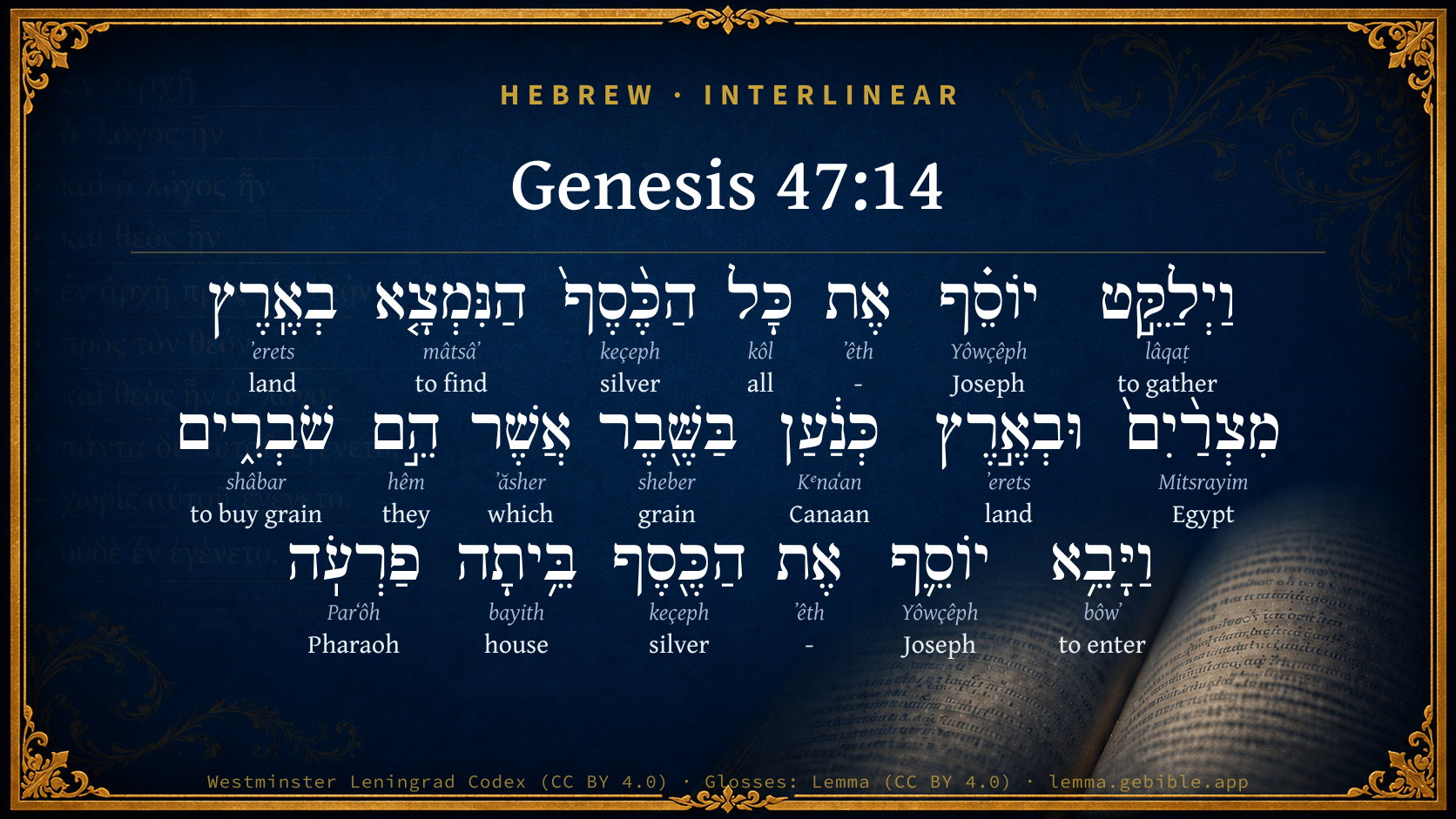
Hebrew (Westminster Leningrad Codex) Genesis 47:14 appears in the Hebrew Old Testament. The text above is from the Westminster Leningrad Codex. Each word links to its Strong’s number, a concise gloss, and parsing drawn from the Open Scriptures Hebrew Bible morphology. Click any word for its full Brown-Driver-Briggs (BDB) entry.
Download image
Cite this verse

Genesis 47:14 (World English Bible). Public Domain. Lemma interlinear Bible study tool, https://lemma.gebible.app/v/genesis/47/14.

Show BibTeX & RIS
BibTeX
RIS
English Translation
Joseph gathered up all the money that was found in the land of Egypt, and in the land of Canaan, for the grain which they bought: and Joseph brought the money into Pharaoh's house.
World English Bible · Public Domain
Download a study sheet

One document with this verse’s original text, its word-by-word gloss line, the meaning frame, cross-references with their text, attributed commentary, and full source and license credits — printable, and it pastes into notes with its structure intact.

This verse Autodidact and up

Study sheet (.html) Plain text (.txt)

A passage Seminary Student

Up to 50 verses in one chapter. A passage sheet keeps up to 6 commentary sources and 12 cross-references per verse, in the order this page ranks them, and says so on the sheet whenever that leaves anything out. Ask for a single verse and you get the Autodidact verse sheet above.

Everything on this page stays free to read, with no account — the sheet is a download of what is already on screen, not access to it.

Want to remove ads? Support Godless Engineer
Compare translations 3

The same verse in 3 English versions, stacked beneath the original-language interlinear above. Click any original word for its lexicon entry.

Each is an independent rendering of the whole verse — the interlinear is not word-aligned to these translations.

Highlighted words mark where these versions differ — a whole-verse word diff, not a word-by-word alignment.

  • World English Bible Public Domain
    Joseph gathered up all the money that was found in the land of Egypt, and in the land of Canaan, for the grain which they bought: and Joseph brought the money into Pharaoh's house.
  • King James Version Public Domain
    And Joseph gathered up all the money that was found in the land of Egypt, and in the land of Canaan, for the corn which they bought: and Joseph brought the money into Pharaoh's house.
  • unfoldingWord Literal Text CC BY-SA 4.0
    And Joseph collected all the silver that was found in the land of Egypt and in the land of Canaan for the grain which they were buying, and Joseph brought the silver to the house of Pharaoh.

unfoldingWord Literal Text — © unfoldingWord, licensed CC BY-SA 4.0. Word-aligned USFM3 via Door43 (git.door43.org/unfoldingWord/en_ult).

Versions to compare (up to 4)

3 of 4 selected

Show all 18 translations

Every available English version of this verse, each an independent rendering of the whole verse.

  • World English Bible Public Domain
    Joseph gathered up all the money that was found in the land of Egypt, and in the land of Canaan, for the grain which they bought: and Joseph brought the money into Pharaoh's house.
  • Berean Standard Bible Public Domain
    Joseph collected all the money to be found in the land of Egypt and the land of Canaan in exchange for the grain they were buying, and he brought it into Pharaoh’s palace.
  • Majority Standard Bible Public Domain
    Joseph collected all the money to be found in the land of Egypt and the land of Canaan in exchange for the grain they were buying, and he brought it into Pharaoh’s palace.
  • King James Version Public Domain
    And Joseph gathered up all the money that was found in the land of Egypt, and in the land of Canaan, for the corn which they bought: and Joseph brought the money into Pharaoh's house.
  • American Standard Version (1901) Public Domain
    And Joseph gathered up all the money that was found in the land of Egypt, and in the land of Canaan, for the grain which they bought: and Joseph brought the money into Pharaoh's house.
  • Revised Version (1885) Public Domain
    And Joseph gathered up all the money that was found in the land of Egypt, and in the land of Canaan, for the corn which they bought: and Joseph brought the money into Pharaoh’s house.
  • Geneva Bible (1599) Public Domain
    And Ioseph gathered all the money, that was found in the land of Egypt, and in the land of Canaan, for the corne which they bought, and Ioseph layd vp the money in Pharaohs house.
  • Douay-Rheims (1899) Public Domain
    Out of which he gathered up all the money for the corn which they bought, and brought it into the king's treasure.
  • Young's Literal Translation Public Domain
    and Joseph gathereth all the silver that is found in the land of Egypt, and in the land of Canaan, for the corn that they are buying, and Joseph bringeth the silver into the house of Pharaoh.
  • Literal Standard Version CC BY-SA 4.0
    and Joseph gathers all the silver that is found in the land of Egypt and in the land of Canaan, for the grain that they are buying, and Joseph brings the silver into the house of Pharaoh.
  • Unlocked Literal Bible CC BY-SA 4.0
    Joseph gathered all the money that was in the land of Egypt and in the land of Canaan, by selling grain to the inhabitants. Then Joseph brought the money to Pharaoh's palace.
  • unfoldingWord Literal Text CC BY-SA 4.0
    And Joseph collected all the silver that was found in the land of Egypt and in the land of Canaan for the grain which they were buying, and Joseph brought the silver to the house of Pharaoh.
  • Darby Bible Public Domain
    And Joseph gathered up all the money that was found in the land of Egypt, and in the land of Canaan, for the grain which they bought; and Joseph brought the money into Pharaoh's house.
  • World Messianic Bible Public Domain
    Joseph gathered up all the money that was found in the land of Egypt, and in the land of Canaan, for the grain which they bought: and Joseph brought the money into Pharaoh’s house.
  • Webster's Bible Public Domain
    And Joseph gathered all the money that was found in the land of Egypt, and in the land of Canaan, for the corn which they bought: and Joseph brought the money into Pharaoh's house.
  • Free Bible Version CC BY-SA 4.0
    By selling grain Joseph collected all the money in Egypt and Canaan, and placed it in Pharaoh's treasury.
  • Bible in Basic English Public Domain
    And all the money in Egypt and in the land of Canaan which had been given for grain, came into the hands of Joseph: and he put it in Pharaoh's house.
  • JPS Tanakh (1917) Public Domain
    And Joseph gathered up all the money that was found in the land of Egypt, and in the land of Canaan, for the corn which they bought; and Joseph brought the money into Pharaoh's house.

Literal Standard Version (2020), Covenant Press — licensed CC BY-SA 4.0. Text via the HelloAO Bible API (eBible.org). Unlocked Literal Bible (unfoldingWord) — licensed CC BY-SA 4.0. Text via the HelloAO Bible API (eBible.org). unfoldingWord Literal Text — © unfoldingWord, licensed CC BY-SA 4.0. Word-aligned USFM3 via Door43 (git.door43.org/unfoldingWord/en_ult). Free Bible Version, Dr. Jonathan Gallagher — licensed CC BY-SA 4.0. Text via the HelloAO Bible API (eBible.org).

Word by word

More ways to search: Search by grammar → Find every occurrence → Compare this word →

Practice this passage: Drill this verse → Learn its vocabulary →

בַּשֶּׁ֖בֶר
sheber
H7668
“in/at the · grain”
Preposition, Determined + Noun, Common, Masculine, Singular, Absolute
Part of Speech
Preposition + Noun
Type
Common
Gender
Masculine
Number
Singular
State
Absolute
Full BDB Definition

Origin: the same as H7667

TWOT: 2322a

grain, corn (as foodstuff)
  1. וַיְלַקֵּ֣ט lâqaṭ H3950 “and · to gather” Conjunction + Verb, Piel, Sequential Imperfect, 3rd Person, Masculine, Singular
  2. יוֹסֵ֗ף Yôwçêph H3130 “Joseph” Noun, Proper
  3. אֶת ʼêth H853 “-” Particle, Direct Object
  4. כָּל kôl H3605 “all of” Noun, Common, Masculine, Singular, Construct
  5. הַכֶּ֨סֶף֙ keçeph H3701 “the · silver” Particle, Definite Article + Noun, Common, Masculine, Singular, Absolute
  6. הַנִּמְצָ֤א mâtsâʼ H4672 “the · finding” Particle, Definite Article + Verb, Niphal, Participle Active, Masculine, Singular, Absolute
  7. בְאֶֽרֶץ ʼerets H776 “in/at · land of” Preposition + Noun, Common, Both, Singular, Construct
  8. מִצְרַ֨יִם֙ Mitsrayim H4714 “Egypt” Noun, Proper
  9. וּבְאֶ֣רֶץ ʼerets H776 “and · in/at · land of” Conjunction + Preposition + Noun, Common, Both, Singular, Construct
  10. כְּנַ֔עַן Kᵉnaʻan H3667 “Canaan” Noun, Proper
  11. אֲשֶׁר ʼăsher H834 “which” Particle, Relative
  12. הֵ֣ם hêm H1992 “they” Pronoun, Personal, 3rd Person, Masculine, Plural
  13. שֹׁבְרִ֑ים shâbar H7666 “buying grain” Verb, Qal, Participle Active, Masculine, Plural, Absolute
  14. וַיָּבֵ֥א bôwʼ H935 “and · to enter” Conjunction + Verb, Hiphil, Sequential Imperfect, 3rd Person, Masculine, Singular
  15. יוֹסֵ֛ף Yôwçêph H3130 “Joseph” Noun, Proper
  16. אֶת ʼêth H853 “-” Particle, Direct Object
  17. הַכֶּ֖סֶף keçeph H3701 “the · silver” Particle, Definite Article + Noun, Common, Masculine, Singular, Absolute
  18. בֵּ֥יתָה bayith H1004 “house · toward” Noun, Common, Masculine, Singular, Construct + Suffix, Demonstrative
  19. פַרְעֹֽה Parʻôh H6547 “Pharaoh” Noun, Proper

About this verse

These counts appear in no published source. They are computed here, from the morphology-tagged text and Lemma’s own curated glosses. What Lemma adds →

20
words
16
distinct lemmas
Pentateuch
section

Notable vocabulary

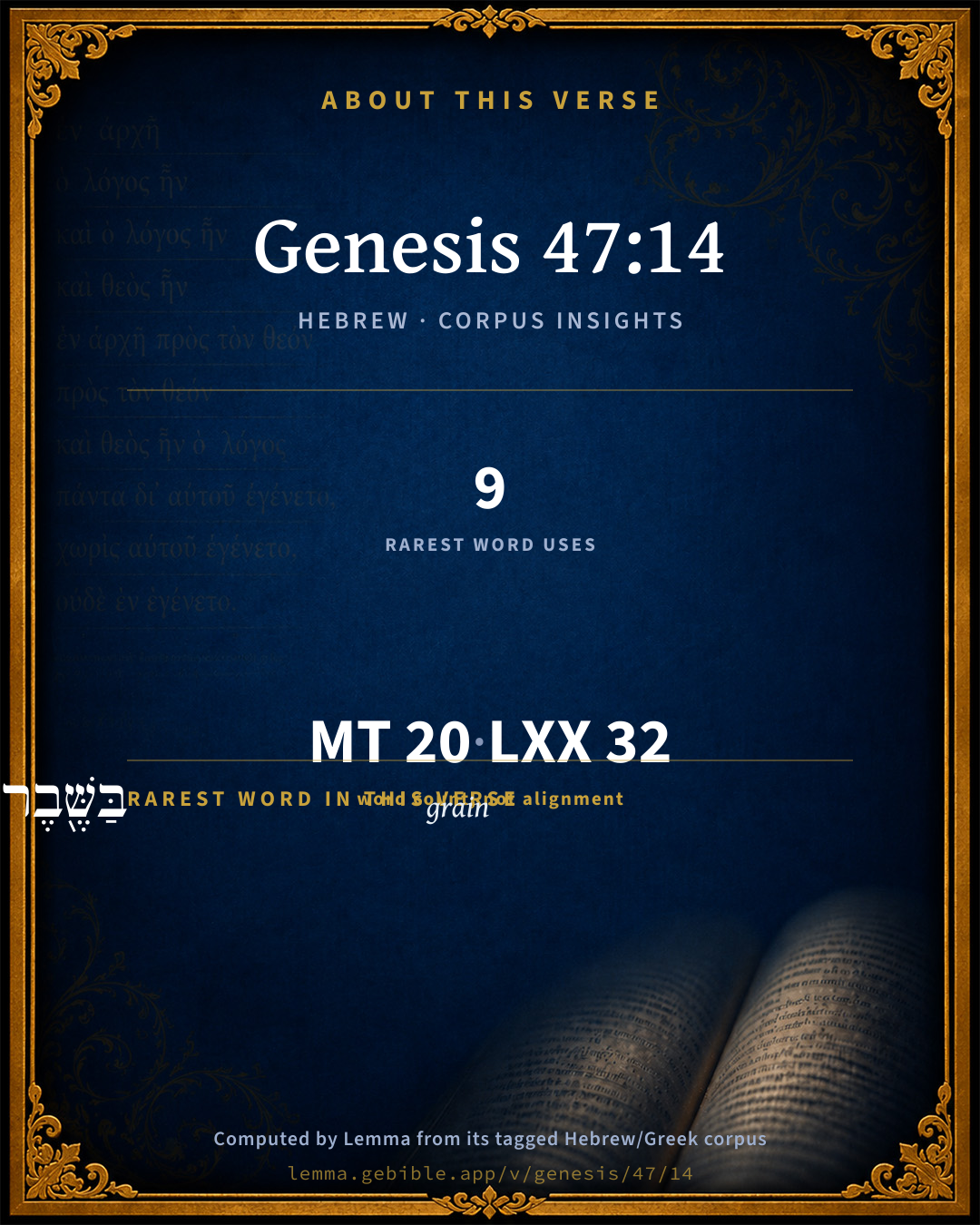
The rarest word here is בַּשֶּׁ֖בֶר grain H7668 — appearing just 9 times in the whole Hebrew Bible.

Shared distinctive vocabulary

בַּשֶּׁ֖בֶר grain H7668 occurs in 9 verses of the Hebrew Bible. Also found in:

Grammatical profile

  • 4 verbs
  • 12 nouns
  • 1 pronoun
  • 3 particles

Verb forms

  • וַיְלַקֵּ֣ט Piel · Sequential Imperfect
  • הַנִּמְצָ֤א Niphal · Participle Active
  • שֹׁבְרִ֑ים Qal · Participle Active
  • וַיָּבֵ֥א Hiphil · Sequential Imperfect

Repetition

Words recur within this verse — often emphatic in Hebrew:

  • יוֹסֵ֗ף Joseph H3130 ×2
  • הַכֶּ֨סֶף֙ silver H3701 ×2
  • בְאֶֽרֶץ land H776 ×2

Hebrew & Septuagint length

In English translation the verse runs 34 words from the Hebrew and 44 from the Septuagint (LXX English) — closely comparable.

A rough comparison of the two English renderings, which tokenize alike — not a word-level alignment.

Word counts can differ between the Hebrew and the Greek without any difference in meaning — e.g. the Hebrew direct-object marker אֵת has no separate Greek word, and Greek often adds the article ὁ.

In the original languages it is 20 Hebrew tokens and 32 Greek tokens — but the two are counted differently (Hebrew bundles its prefixes and suffixes into one token; the Greek is in lemma form), so that isn’t a like-for-like length.

Cross-references

5

Topical passages linked to Genesis 47:14 in the Treasury of Scripture Knowledge — connected by theme and wording, ordered by reader-vote popularity; previews shown in the World English Bible.

  • Genesis 41:56 The famine was over all the surface of the earth. Joseph opened all the store-houses, and sold to the Egyptians. The famine was severe in the land of Egypt.
  • Luke 16:10–12 He who is faithful in a very little is faithful also in much. He who is dishonest in a very little is also dishonest in much.
  • Luke 16:1–2 He also said to his disciples, "There was a certain rich man who had a manager. An accusation was made to him that this man was wasting his possessions.
  • 1 Corinthians 4:2 Here, moreover, it is required of stewards, that they be found faithful.
  • 1 Peter 4:10 According as each has received a gift, be ministering it among yourselves, as good stewards of the grace of God in its various forms.

Cross-references courtesy of OpenBible.info (CC BY 4.0).

Hebrew and Greek witnesses Masoretic Hebrew ↔ Greek Septuagint

The same verse in the two great witnesses to the Old Testament, shown verse-for-verse.

These are two independent witnesses, not word-aligned to each other, and the Septuagint is shown in lemma (dictionary) form.

Hebrew Genesis 47:14 Masoretic · Westminster Leningrad Codex

וַיְלַקֵּ֣ט יוֹסֵ֗ף אֶת כָּל הַכֶּ֨סֶף֙ הַנִּמְצָ֤א בְאֶֽרֶץ מִצְרַ֨יִם֙ וּבְאֶ֣רֶץ כְּנַ֔עַן בַּשֶּׁ֖בֶר אֲשֶׁר הֵ֣ם שֹׁבְרִ֑ים וַיָּבֵ֥א יוֹסֵ֛ף אֶת הַכֶּ֖סֶף בֵּ֥יתָה פַרְעֹֽה

Joseph gathered up all the money that was found in the land of Egypt, and in the land of Canaan, for the grain which they bought: and Joseph brought the money into Pharaoh's house.

World English Bible · Public Domain

Greek LXX Genesis 47:14 Septuagint · lemma form

συνἄγω δέ ιωσηφ πᾶς ὁ ἀργύριον ὁ εὑρίσκω ἐν γῆ αἴγυπτος καί ἐν γῆ χανααν ὁ σῖτος ὅς ἀγοράζω καί σιτομετρέω αὐτός καί εἰςφέρω ιωσηφ πᾶς ὁ ἀργύριον εἰς ὁ οἶκος φαραώ

And Joseph gathered all the money that was found in the land of Egypt, and the land of Chanaan, in return for the corn which they bought, and he distributed corn to them; and Joseph brought all the money into the house of Pharao.

LXX2012 (modern English Septuagint) · Public Domain

Hebrew: Westminster Leningrad Codex (CC BY 4.0). Greek: Septuagint (public domain); English from LXX2012 (modern English Septuagint) (Public Domain). How the Septuagint differs from the Hebrew →

Targum (Aramaic paraphrase)

2

The Targum is the ancient Jewish Aramaic paraphrase of the Hebrew Scriptures — an interpretive translation, not the Hebrew text itself. Onkelos (literal) and Pseudo-Jonathan (expansive) render the Torah, and Jonathan the Prophets. Coverage is partial: where no permissively-licensed English translation exists for a verse, only the Aramaic is shown. This is verse-level text, not a word-by-word alignment to the Hebrew.

  1. Targum Onkelos Torah (Genesis–Deuteronomy)
    וְלַקִּיט יוֹסֵף יָת כָּל כַּסְפָּא דְּאִשְׁתְּכַח בְּאַרְעָא דְמִצְרַיִם וּבְאַרְעָא דִּכְנַעַן בְּעִיבוּרָא דִּי אִנּוּן זָבְנִין וְאַיְתִי יוֹסֵף יָת כַּסְפָּא לְבֵית פַּרְעֹה

    (no public-domain English translation for this verse)

    Targum Onkelos — Aramaic: “Onkelos Genesis” (public domain); “Onkelos Exodus” (public domain); “Onkelos Leviticus” (public domain); “Onkelos Numbers” (public domain); “Onkelos Deuteronomy” (public domain). English: “Sefaria Community Translation” (CC0 1.0 (public-domain dedication)); “J.W. Etheridge. The Targums of Onkelos and Jonathan Ben Uzziel on the Pentateuch. London: Longmans, Green, 1862” (public domain). Text via Sefaria.

  2. Targum Pseudo-Jonathan Torah (Genesis–Deuteronomy)
    וּלְקֵיט יוֹסֵף יַת כָּל כַּסְפָּא דְאִישְׁתַּכַּח בְּאַרְעָא דְמִצְרַיִם וּבְאַרְעָא דִכְנָעַן בְּעִיבּוּרָא דְהִינוּן זַבְּנִין וְאַיְיתֵי יוֹסֵף יַת כַּסְפָּא בְּבֵית הִיפְתֵּיקָא דְפַרְעה

    And Joseph collected all the money which was found in the land of Mizraim, and in the land of Kenaan, for the corn which he sold to them; and Joseph brought the money into the treasure--house of Pharoh.

    Targum Pseudo-Jonathan — Aramaic: “Targum Jonathan on Genesis” (public domain); “Targum Jonathan on Exodus” (public domain); “Targum Jonathan on Leviticus” (public domain); “Targum Jonathan on Numbers” (public domain); “Targum Jonathan on Deuteronomy” (public domain). English: “The Targum of Jonathan ben Uzziel, trans. J. W. Etheridge, London, 1862” (public domain). Text via Sefaria.

Commentary

Notes on Genesis 47:14 from classic Christian and Jewish commentators (each source and its license shown beneath its notes). The classic Christian expositions comment on the surrounding passage and are grouped to its opening verse, so a note may address several verses; the Jewish commentaries on the Tanakh (Rashi and others) are per-verse, so they appear only where the commentator wrote on this verse.

Lemma curates 59 commentaries, every one of them public domain or Creative Commons licensed, each selected and text-cleaned for this edition rather than reprinted as found. About our sources →

Trapp's Complete Commentary

John Trapp

Gen 47:14 And Joseph gathered up all the money that was found in the land of Egypt, and in the land of Canaan, for the corn which they bought: and Joseph brought the money into Pharaoh’s house.

Ver. 14. And Joseph gathered up all the money.] There is something, then, besides grace, that is better than money: though misers will as easily part with their blood, {a} as with their good. Constantinople was lost through the citizens’ covetousness. The like is reported of Heidelberg. Worthy they were, in this name, to have been served as the great Caliph of Babylon was by the great Cham of Tartary. He was set in the midst of those infinite treasures which he and his predecessors had most covetously amassed; and bidden to eat of that gold, silver, and precious stones, what he pleased, and make no spare. In which order, the covetous catiff kept for certain days, miserably died for hunger. {b} Money is a baser thing than "food and raiment": these if we have, "let us be content." {1Ti 6:8}

{a} Chaldaei nummum דמ, id est, Sanguinem, appellant.

{b} Turk. Hist., fol. 113.

John Trapp, A Commentary or Exposition upon All the Books of the Old and New Testament (1647–1656) — public domain. Text from a community e-Sword module.

Geneva Bible (1599)

Geneva Bible translators

Wherein he both declareth his fidelity toward the King, and his mind free from covetousness.

Geneva Bible (1599) marginal notes — public domain. Text via Bolls.life.

Adam Clarke's Commentary

Verse 14. Gathered up all the money] i. e., by selling corn out of the public stores to the people; and this he did till the money failed, Ge 47:15, till all the money was exchanged for corn, and brought into Pharaoh's treasury. Be sides the fifth part of the produce of the seven plentiful years, Joseph had bought additional corn with Pharaoh's money to lay up against the famine that was to prevail in the seven years of dearth; and it is very likely that this was sold out at the price for which it was bought, and the fifth part, which belonged to Pharaoh, sold out at the same price. And as money at that time could not be plentiful, the cash of the whole nation was thus exhausted as far as that had circulated among the common people.

Adam Clarke's Commentary on the Bible (1810–1826) — public domain. Text from a community e-Sword/MySword module.

John Calvin's Commentaries

14. And Joseph gathered up all the money. Moses first declares that the Egyptian king had acted well and wisely, in committing the work of providing corn to the sole care and authority of Joseph. He then commends the sincere and faithful administration of Joseph himself. We know how few persons can touch the money of kings without defiling themselves by peculation. Amid such vast heaps of money, the opportunity of plundering was not less than the difficulty of self-restraint. But Moses says, that whatever money Joseph collected, he brought into the house of the king. It was a rare and unparalleled integrity, to keep the hands pure amidst such heaps of gold. And he would not have been able to conduct himself with such moderation, unless his divine calling had proved as a bridle to hold him in; for they who are restrained from thefts and rapaciousness by worldly motives alone, would immediately put forth their hand to the prey, unless they feared the eyes and the judgments of men. But inasmuch as Joseph might have sinned without a witness of his fault; it follows that the true fear of God flourished in his breast. Plausible and well coloured pretexts, in excuse of the theft, would doubtless present themselves. “When you are serving a tyrant, why may it not be lawful for you to apply some part of the gain to your own advantage?” So much the more does it appear that he was fortified by downright honesty; since he repelled all temptations, lest he should desire fraudulently to enrich himself at the expense of another.

John Calvin's Commentaries (1540-1563) — public domain. Text from the Calvin Translation Society English edition (1840s-50s) via the Christian Classics Ethereal Library (ccel.org). Calvin's coverage is partial (roughly two-thirds of the Bible); uncommented books and verses are honest gaps, never fabricated. The 19th-century editor's footnotes and remarks are omitted so the notes are faithfully Calvin's own voice.

The Cambridge Bible for Schools and Colleges

gen. ed. J. J. S. Perowne

14. gathered up] Joseph’s policy of State granaries was completely successful. He accumulated vast wealth for his master, the King of Egypt.

Pharaoh’s house] i.e. the royal treasury, “the White House,” as it was known in Egypt. Cf. Gen_41:40.

The Cambridge Bible for Schools and Colleges (gen. ed. J. J. S. Perowne; Cambridge University Press, 1878–1918) — public domain. Text from a community e-Sword module.

John Gill's Exposition

And when money failed in the land of Egypt, and in the land of Canaan,.... It had been all spent in the third, fourth, and fifth years of the famine; for it seems to be at the end of the fifth, or beginning of the sixth year of the famine, that this was the case, since we after read of a second or following year, which was very plainly the last, since seed was given them to sow the land with, which shows the time of drought to be near at an end:

all the Egyptians came unto Joseph, and said, give us bread; freely, for nothing, since they had no money to buy any with: no mention is made of the Canaanites, who could not presume to come and ask for corn on such a footing:

for why should we die in thy presence? before his eyes, he not relieving them when it was in his power to do it; they knew such an argument as this would work upon a mind so humane, tender, and generous as was Joseph's:

for the money faileth; all was gone, they had none left to purchase corn with; or they suggest they should not have desired to have had it at free cost.

John Gill's Exposition of the Whole Bible (1746–1763) — public domain (CC PDM 1.0). Text via the HelloAO Bible API.

Haydock's Catholic Bible Commentary

Treasure, reserving nothing for himself. (Philo)

George Leo Haydock (1774–1849), Haydock's Catholic Family Bible and Commentary, 1859 edition — public domain. Excludes Psalms (Douay-Rheims chapter numbering differs from Protestant) and Deuterocanonical books (Catholic canon only).

Matthew Poole's English Annotations

Wherein he did no more than any of the subjects might have done; he bought great store of corn in the plentiful years with the king’s money, and kept it till a time of famine, and sold it at a rate which was agreeable to the Season.

Matthew Poole's English Annotations on the Holy Bible (1683–1685) — public domain. Text from a community e-Sword/MySword module.

The Pulpit Commentary

And Joseph gathered up the verb, used only here of collecting money, usually signifies to gather things lying on the ground, as, e.g., ears of corn, (Rth_2:3) stones, (Gen_31:46) manna, (Exo_16:14) flowers (Son_6:2) all the money (literally, silver) that was found in the land of Egypt, and in the land of Canaan, for the corn which they bought: and Joseph (who in this matter was simply Pharaoh"s steward) brought the money into Pharaoh"s house (i.e. deposited it in the royal treasury).

The Pulpit Commentary (1880–1919), ed. H.D.M. Spence-Jones & Joseph S. Exell — public domain. Text from a community e-Sword module.

Rashi

Rabbi Shlomo Yitzchaki (Rashi)

בשבר אשר הם שוברים FOR THE CORN WHICH THEY BOUGHT — they gave him the money.

Rashi on the Tanakh — English translations: “The Judaica Press complete Tanach with Rashi, translated by A. J. Rosenberg” (CC BY 4.0); “Pentateuch with Rashi's commentary by M. Rosenbaum and A.M. Silbermann, 1929-1934” (public domain); “The Metsudah Tanach series, Lakewood, N.J” (CC BY 4.0); and “The Book of Joshua, Metsudah Publications, 1997” (CC BY 4.0). Text via Sefaria.

Ramban (Nachmanides)

Rabbi Moshe ben Nachman (Ramban / Nachmanides)

AND JOSEPH GATHERED UP ALL THE MONEY, etc. Scripture relates this and goes on to complete the subject in this entire section in order to make known Joseph’s excellence in wisdom, in understanding, and in knowledge, and that he was a faithful man in that he brought all money into Pharaoh’s house and did not accumulate for himself treasures of money and secret hiding places for wealth in the land of Egypt, or send it to the land of Canaan. Instead, he gave all money to the king who trusted him and purchased the land for him, and even the bodies of the Egyptians. Through this endeavor, he found grace even in the eyes of the people, for it is G-d Who causes those who fear Him to prosper.

Ramban (Nachmanides) on the Tanakh — English translation: “Commentary on the Torah by Ramban (Nachmanides). Translated and annotated by Charles B. Chavel. New York, Shilo Pub. House, 1971-1976” (CC BY 4.0). Text via Sefaria.

Radak

Rabbi David Kimhi (Radak)

וילקט יוסף, he did this at the end of the first two years of the famine and during the remaining years of the famine At the beginning of the famine people were mostly eating from private stores they had accumulated during the years of plenty. Subsequently, they used their money to purchase food until their money ran out. Yaakov came to Egypt during the second year as Joseph had said to him: כי זה שנתים הרעב, “for these two years have been famine.” (45,6)

ויבא יוסף, in order to demonstrate his integrity. He did not need to do this and could have stored it in the granaries. Pharaoh had never demanded an accounting from Joseph, knowing that he was absolutely trustworthy. Nonetheless, Joseph was concerned not to allow anyone to suspect him of pocketing anything for his own private purposes.

Radak on the Tanakh — English translations: “Sefaria Community Translation” (CC0 1.0 (public-domain dedication)); “Eliyahu Munk, HaChut Hameshulash” (CC BY 4.0); “Rabbi Mike Feuer, Jerusalem Anthology” (CC BY 4.0); and “R. David Kimhi on the first book of Psalms, Translated by R.G. Finch, London, 1919” (public domain). Text via Sefaria.

Lesson kit

Teaching starters — assembled from the data on this page, not authored interpretation. Every prompt links to the verse data it draws on. Edit before teaching.

Genesis, in the Pentateuch, opens this verse with 20 words (16 distinct Hebrew lemmas). Its most distinctive word is sheber (“grain”). A historical commentator’s framing appears above. Read the whole chapter for the surrounding context.

Discussion questions

  1. How does “grain” (sheber) shape what this verse is saying?
  2. Genesis 42:1 shares the word «grain» with this verse. How do the two illuminate each other?
  3. “Joseph” occurs 2× in this one verse. What is the effect of the repetition?
  4. The translations on this page render this verse differently — a whole-verse word diff, not a word-by-word alignment. What might account for the different wordings?
  5. The verb «וַיְלַקֵּ֣ט» is Piel Sequential Imperfect. How does its form color the action?
  6. Reading how Trapp's Complete Commentary and Geneva Bible (1599) read this verse, where do the two commentators agree and where do they part?

Things to notice

Reading settings

Reading text

Shown beneath each verse's original-language words.

Old Testament
Old Testament edition

Read the OT as the Masoretic Hebrew (MT) or the Greek Septuagint (LXX).

English shown for the Greek Septuagint (in the Hebrew ↔ Greek comparison).

Comparing translations? Open the Compare panel on any verse page to stack up to four side by side.