
Judges 6:4

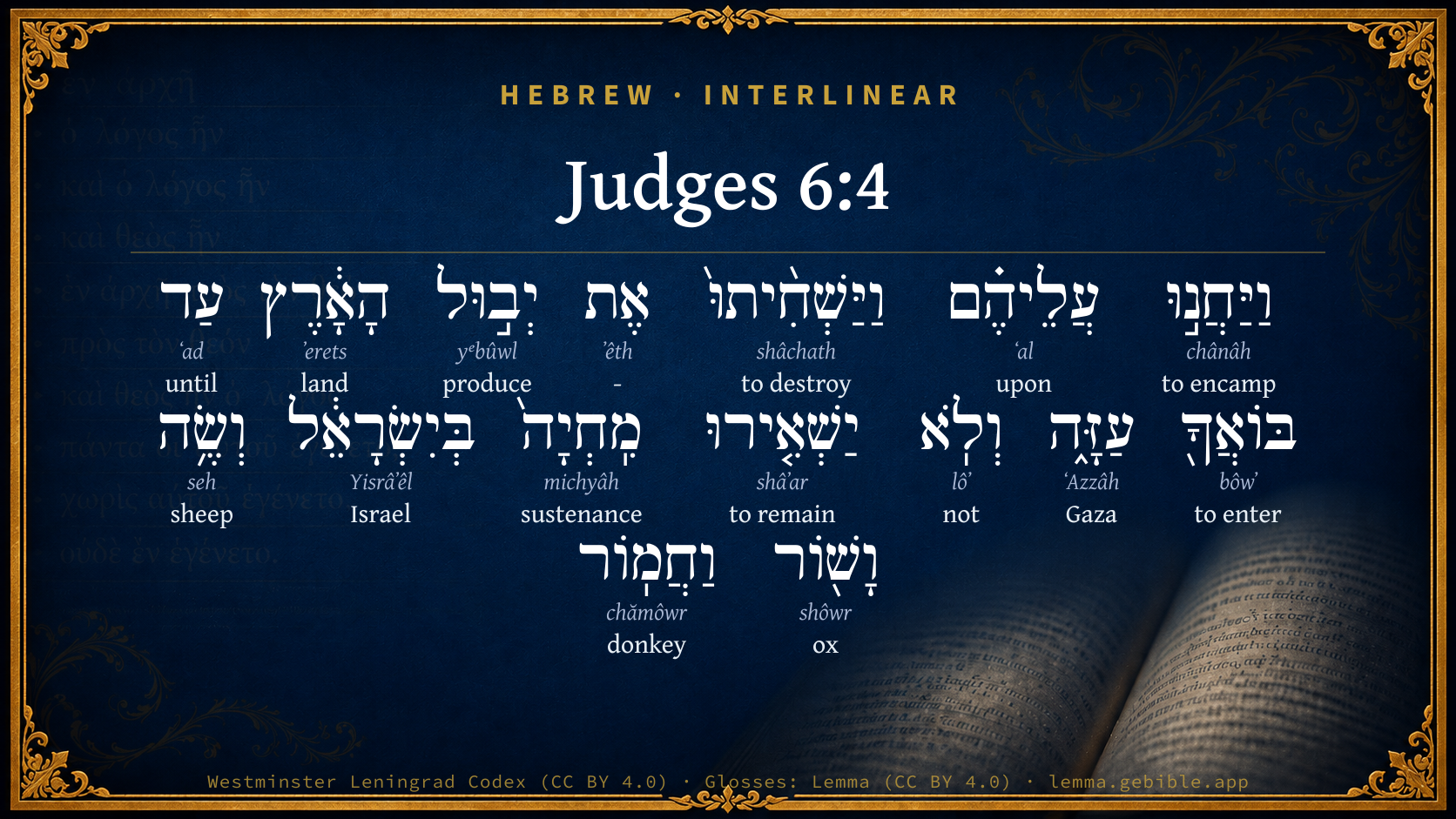
Hebrew (Westminster Leningrad Codex) Judges 6:4 appears in the Hebrew Old Testament. The text above is from the Westminster Leningrad Codex. Each word links to its Strong’s number, a concise gloss, and parsing drawn from the Open Scriptures Hebrew Bible morphology. Click any word for its full Brown-Driver-Briggs (BDB) entry.
Download image
Cite this verse

Judges 6:4 (World English Bible). Public Domain. Lemma interlinear Bible study tool, https://lemma.gebible.app/v/judges/6/4.

Show BibTeX & RIS
BibTeX
RIS
English Translation
and they encamped against them, and destroyed the increase of the earth, until you come to Gaza, and left no sustenance in Israel, neither sheep, nor ox, nor donkey.
World English Bible · Public Domain
Download a study sheet

One document with this verse’s original text, its word-by-word gloss line, the meaning frame, cross-references with their text, attributed commentary, and full source and license credits — printable, and it pastes into notes with its structure intact.

This verse Autodidact and up

Study sheet (.html) Plain text (.txt)

A passage Seminary Student

Up to 50 verses in one chapter. A passage sheet keeps up to 6 commentary sources and 12 cross-references per verse, in the order this page ranks them, and says so on the sheet whenever that leaves anything out. Ask for a single verse and you get the Autodidact verse sheet above.

Everything on this page stays free to read, with no account — the sheet is a download of what is already on screen, not access to it.

Want to remove ads? Support Godless Engineer
Compare translations 3

The same verse in 3 English versions, stacked beneath the original-language interlinear above. Click any original word for its lexicon entry.

Each is an independent rendering of the whole verse — the interlinear is not word-aligned to these translations.

Highlighted words mark where these versions differ — a whole-verse word diff, not a word-by-word alignment.

  • World English Bible Public Domain
    and they encamped against them, and destroyed the increase of the earth, until you come to Gaza, and left no sustenance in Israel, neither sheep, nor ox, nor donkey.
  • King James Version Public Domain
    And they encamped against them, and destroyed the increase of the earth, till thou come unto Gaza, and left no sustenance for Israel, neither sheep, nor ox, nor ass.
  • unfoldingWord Literal Text CC BY-SA 4.0
    And they encamped among them, and they ruined the produce of the land until your coming Gaza. And they did not leave sustenance in Israel or sheep or ox or donkey.

unfoldingWord Literal Text — © unfoldingWord, licensed CC BY-SA 4.0. Word-aligned USFM3 via Door43 (git.door43.org/unfoldingWord/en_ult).

Versions to compare (up to 4)

3 of 4 selected

Show all 18 translations

Every available English version of this verse, each an independent rendering of the whole verse.

  • World English Bible Public Domain
    and they encamped against them, and destroyed the increase of the earth, until you come to Gaza, and left no sustenance in Israel, neither sheep, nor ox, nor donkey.
  • Berean Standard Bible Public Domain
    encamping against them as far as Gaza and destroying the produce of the land. They left Israel with no sustenance, neither sheep nor oxen nor donkeys.
  • Majority Standard Bible Public Domain
    encamping against them as far as Gaza and destroying the produce of the land. They left Israel with no sustenance, neither sheep nor oxen nor donkeys.
  • King James Version Public Domain
    And they encamped against them, and destroyed the increase of the earth, till thou come unto Gaza, and left no sustenance for Israel, neither sheep, nor ox, nor ass.
  • American Standard Version (1901) Public Domain
    and they encamped against them, and destroyed the increase of the earth, till thou come unto Gaza, and left no sustenance in Israel, neither sheep, nor ox, nor ass.
  • Revised Version (1885) Public Domain
    and they encamped against them, and destroyed the increase of the earth, till thou come unto Gaza, and left no sustenance in Israel, neither sheep, nor ox, nor ass.
  • Geneva Bible (1599) Public Domain
    And camped by them, and destroyed the fruite of the earth, euen til thou come vnto Azzah, and left no foode for Israel, neither sheepe, nor oxe, nor asse.
  • Douay-Rheims (1899) Public Domain
    And when Israel had sown, Madian and Amalec, and the rest of the eastern nations came up:
  • Young's Literal Translation Public Domain
    and encamp against them, and destroy the increase of the land till thine entering Gaza; and they leave no sustenance in Israel, either sheep, or ox, or ass;
  • Literal Standard Version CC BY-SA 4.0
    and encamp against them, and destroy the increase of the land until your entering Gaza; and they leave no sustenance in Israel, either sheep, or ox, or donkey;
  • Unlocked Literal Bible CC BY-SA 4.0
    They would set up their army on the land and destroy the crops, all the way to Gaza. They would leave no food in Israel, and no sheep, nor cattle or donkeys.
  • unfoldingWord Literal Text CC BY-SA 4.0
    And they encamped among them, and they ruined the produce of the land until your coming Gaza. And they did not leave sustenance in Israel or sheep or ox or donkey.
  • Darby Bible Public Domain
    they would encamp against them and destroy the produce of the land, as far as the neighborhood of Gaza, and leave no sustenance in Israel, and no sheep or ox or ass.
  • World Messianic Bible Public Domain
    They encamped against them, and destroyed the increase of the earth, until you come to Gaza. They left no sustenance in Israel, and no sheep, ox, or donkey.
  • Webster's Bible Public Domain
    And they encamped against them, and destroyed the increase of the earth, till thou comest to Gaza; and left no sustenance for Israel, neither sheep, nor ox, nor ass.
  • Free Bible Version CC BY-SA 4.0
    They would set up their camps and destroy the country's crops as far away as Gaza. They didn't leave anything to eat in the whole of Israel, and they took for themselves all the sheep, cattle, and donkeys.
  • Bible in Basic English Public Domain
    And put their army in position against them; and they took all the produce of the earth as far as Gaza, till there was no food in Israel, or any sheep or oxen or asses.
  • JPS Tanakh (1917) Public Domain
    and they encamped against them, and destroyed the produce of the earth, till thou come unto Gaza, and left no sustenance in Israel, neither sheep, nor ox, nor ass.

Literal Standard Version (2020), Covenant Press — licensed CC BY-SA 4.0. Text via the HelloAO Bible API (eBible.org). Unlocked Literal Bible (unfoldingWord) — licensed CC BY-SA 4.0. Text via the HelloAO Bible API (eBible.org). unfoldingWord Literal Text — © unfoldingWord, licensed CC BY-SA 4.0. Word-aligned USFM3 via Door43 (git.door43.org/unfoldingWord/en_ult). Free Bible Version, Dr. Jonathan Gallagher — licensed CC BY-SA 4.0. Text via the HelloAO Bible API (eBible.org).

Word by word

More ways to search: Search by grammar → Find every occurrence → Compare this word →

Practice this passage: Drill this verse → Learn its vocabulary →

מִֽחְיָה֙
michyâh
H4241
“sustenance”
Noun, Common, Feminine, Singular, Absolute
Part of Speech
Noun
Type
Common
Gender
Feminine
Number
Singular
State
Absolute
Full BDB Definition

Origin: from H2421

TWOT: 644h

preservation of life, sustenance - preservation of life - sustenance - reviving - the quick of the flesh, live flesh, tender or raw flesh
  1. וַיַּחֲנ֣וּ chânâh H2583 “and · to encamp” Conjunction + Verb, Qal, Sequential Imperfect, 3rd Person, Masculine, Plural
  2. עֲלֵיהֶ֗ם ʻal H5921 “upon · them” Preposition + Suffix, Personal, 3rd Person, Masculine, Plural
  3. וַיַּשְׁחִ֨יתוּ֙ shâchath H7843 “and · to destroy” Conjunction + Verb, Hiphil, Sequential Imperfect, 3rd Person, Masculine, Plural
  4. אֶת ʼêth H853 “-” Particle, Direct Object
  5. יְב֣וּל yᵉbûwl H2981 “produce of” Noun, Common, Masculine, Singular, Construct
  6. הָאָ֔רֶץ ʼerets H776 “the · land” Particle, Definite Article + Noun, Common, Both, Singular, Absolute
  7. עַד ʻad H5704 “until” Preposition
  8. בּוֹאֲךָ֖ bôwʼ H935 “to enter · you” Verb, Qal, Infinitive Construct + Suffix, Personal, 2nd Person, Masculine, Singular
  9. עַזָּ֑ה ʻAzzâh H5804 “Gaza” Noun, Proper
  10. וְלֹֽא lôʼ H3808 “and · not” Conjunction + Particle, Negative
  11. יַשְׁאִ֤ירוּ shâʼar H7604 “to remain” Verb, Hiphil, Imperfect, 3rd Person, Masculine, Plural
  12. בְּיִשְׂרָאֵ֔ל Yisrâʼêl H3478 “in/at · Israel” Preposition + Noun, Proper
  13. וְשֶׂ֥ה seh H7716 “and · sheep” Conjunction + Noun, Common, Both, Singular, Absolute
  14. וָשׁ֖וֹר shôwr H7794 “and · ox” Conjunction + Noun, Common, Masculine, Singular, Absolute
  15. וַחֲמֽוֹר chămôwr H2543 “and · donkey” Conjunction + Noun, Common, Both, Singular, Absolute

About this verse

These counts appear in no published source. They are computed here, from the morphology-tagged text and Lemma’s own curated glosses. What Lemma adds →

16
words
16
distinct lemmas
Historical
section

Notable vocabulary

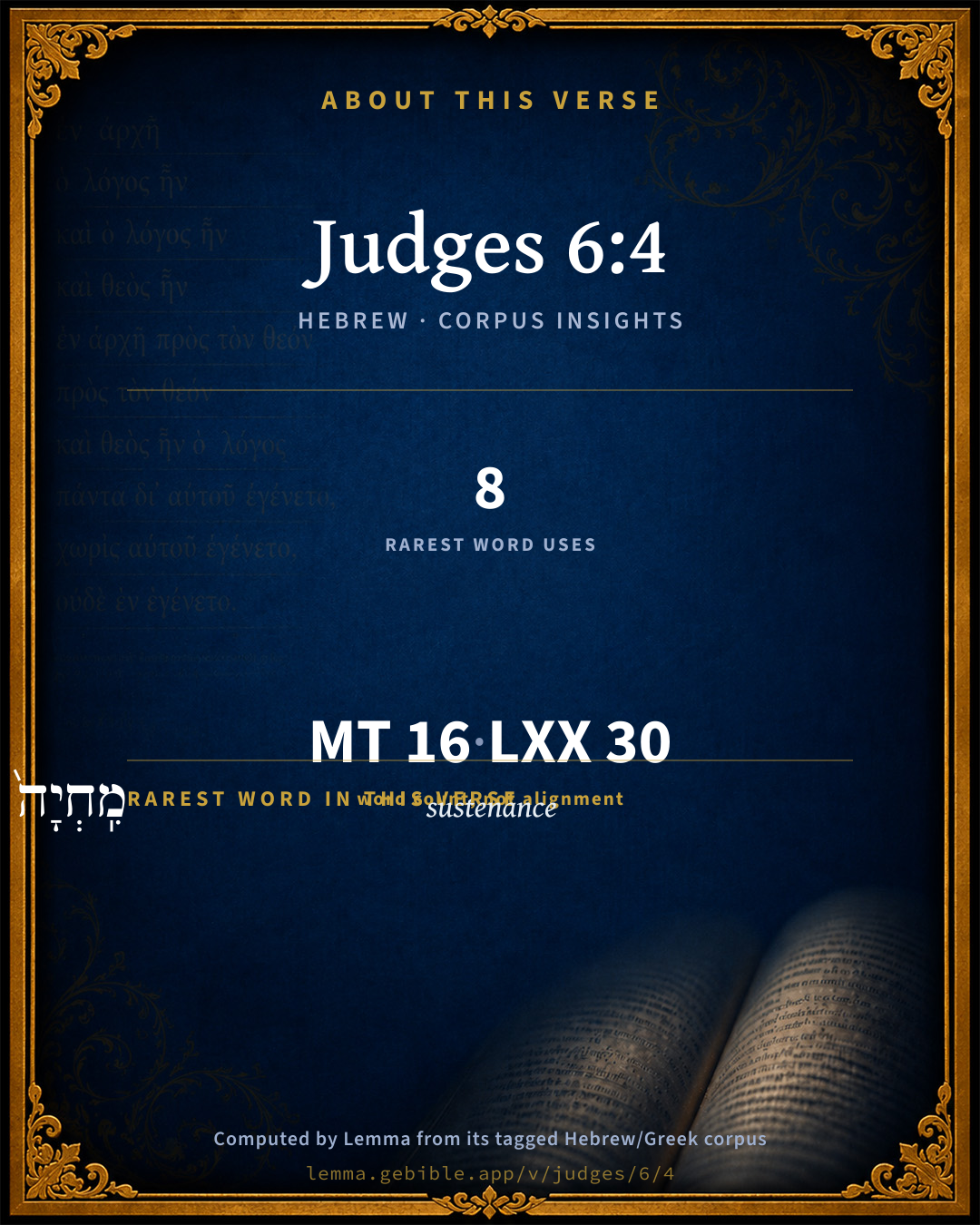
The rarest word here is מִֽחְיָה֙ sustenance H4241 — appearing just 8 times in the whole Hebrew Bible.

Shared distinctive vocabulary

מִֽחְיָה֙ sustenance H4241 occurs in 8 verses of the Hebrew Bible. Also found in:

Grammatical profile

  • 4 verbs
  • 8 nouns
  • 2 prepositions
  • 2 particles

Verb forms

  • וַיַּחֲנ֣וּ Qal · Sequential Imperfect
  • וַיַּשְׁחִ֨יתוּ֙ Hiphil · Sequential Imperfect
  • בּוֹאֲךָ֖ Qal · Infinitive Construct
  • יַשְׁאִ֤ירוּ Hiphil · Imperfect

Hebrew & Septuagint length

In English translation the verse runs 29 words from the Hebrew and 35 from the Septuagint (LXX English) — closely comparable.

A rough comparison of the two English renderings, which tokenize alike — not a word-level alignment.

Word counts can differ between the Hebrew and the Greek without any difference in meaning — e.g. the Hebrew direct-object marker אֵת has no separate Greek word, and Greek often adds the article ὁ.

In the original languages it is 16 Hebrew tokens and 30 Greek tokens — but the two are counted differently (Hebrew bundles its prefixes and suffixes into one token; the Greek is in lemma form), so that isn’t a like-for-like length.

Cross-references

10

Topical passages linked to Judges 6:4 in the Treasury of Scripture Knowledge — connected by theme and wording, ordered by reader-vote popularity; previews shown in the World English Bible.

  • Leviticus 26:16 I also will do this to you: I will appoint terror over you, even consumption and fever, that shall consume the eyes, and make the soul to pine away; and you will sow your seed in vain, for your enemies will eat it.
  • Deuteronomy 28:51 and shall eat the fruit of your cattle, and the fruit of your ground, until you are destroyed; that also shall not leave you grain, new wine, or oil, the increase of your cattle, or the young of your flock, until they have caused you to perish.
  • Micah 6:15 You will sow, but won't reap. You will tread the olives, but won't anoint yourself with oil; And crush grapes, but won't drink the wine.
  • Deuteronomy 28:33 The fruit of your ground, and all your labors, shall a nation which you don't know eat up; and you shall be only oppressed and crushed always;
  • Jeremiah 49:9–10 If grape-gatherers came to you, would they not leave some gleaning grapes? if thieves by night, wouldn't they destroy until they had enough?
  • Genesis 10:19 The border of the Canaanites was from Sidon, as you go toward Gerar, to Gaza; as you go toward Sodom, Gomorrah, Admah, and Zeboiim, to Lasha.
  • Genesis 13:10 Lot lifted up his eyes, and saw all the plain of the Jordan, that it was well watered every where, before Yahweh destroyed Sodom and Gomorrah, like the garden of Yahweh, like the land of Egypt, as you go to Zoar.
  • Deuteronomy 28:30–31 You shall betroth a wife, and another man shall lie with her: you shall build a house, and you shall not dwell therein: you shall plant a vineyard, and shall not use the fruit of it.
  • Proverbs 28:3 A needy man who oppresses the poor Is like a driving rain which leaves no crops.
  • Obadiah 1:5 If thieves came to you, if robbers by night-- oh, what disaster awaits you--wouldn't they only steal until they had enough? If grape pickers came to you, wouldn't they leave some gleaning grapes?

Cross-references courtesy of OpenBible.info (CC BY 4.0).

Hebrew and Greek witnesses Masoretic Hebrew ↔ Greek Septuagint

The same verse in the two great witnesses to the Old Testament, shown verse-for-verse.

These are two independent witnesses, not word-aligned to each other, and the Septuagint is shown in lemma (dictionary) form.

Hebrew Judges 6:4 Masoretic · Westminster Leningrad Codex

וַיַּחֲנ֣וּ עֲלֵיהֶ֗ם וַיַּשְׁחִ֨יתוּ֙ אֶת יְב֣וּל הָאָ֔רֶץ עַד בּוֹאֲךָ֖ עַזָּ֑ה וְלֹֽא יַשְׁאִ֤ירוּ מִֽחְיָה֙ בְּיִשְׂרָאֵ֔ל וְשֶׂ֥ה וָשׁ֖וֹר וַחֲמֽוֹר

and they encamped against them, and destroyed the increase of the earth, until you come to Gaza, and left no sustenance in Israel, neither sheep, nor ox, nor donkey.

World English Bible · Public Domain

Greek LXX Judges 6:4 Septuagint · lemma form

καί παρα ἐνβάλλω εἰς αὐτός καί καταφθείρω ὁ καρπός αὐτός ἕως ἔρχομαι εἰς γάζα καί οὐ καταλείπω ὑπόστασις ζωή ἐν ὁ γῆ ἰσραήλ οὐδέ ἐν ὁ ποίμνιον ταῦρος καί ὄνος

And they encamped against them, and destroyed their fruits until they came to Gaza; and they left not the support of life in the land of Israel, not even ox or ass among the herds.

LXX2012 (modern English Septuagint) · Public Domain

Hebrew: Westminster Leningrad Codex (CC BY 4.0). Greek: Septuagint (public domain); English from LXX2012 (modern English Septuagint) (Public Domain). How the Septuagint differs from the Hebrew →

Targum (Aramaic paraphrase)

1

The Targum is the ancient Jewish Aramaic paraphrase of the Hebrew Scriptures — an interpretive translation, not the Hebrew text itself. Onkelos (literal) and Pseudo-Jonathan (expansive) render the Torah, and Jonathan the Prophets. Coverage is partial: where no permissively-licensed English translation exists for a verse, only the Aramaic is shown. This is verse-level text, not a word-by-word alignment to the Hebrew.

  1. Targum Jonathan Prophets (Joshua–Malachi)
    וּשְׁרוֹ עֲלֵיהוֹן וּמְחַבְּלִין יַת עֲלַלְתָּא דְאַרְעָא עַד מַעְלָנָא דְעַזָה וְלָא מְשַׁאֲרִין מָזוֹן לְקַיָימָא נְפַשׁ בְּיִשְׂרָאֵל וְאִמַר וְתוֹר וַחֲמָר:

    (no public-domain English translation for this verse)

    Targum Jonathan — Aramaic: “Mikraot Gedolot” (public domain). English: “Sefaria Community Translation” (CC0 1.0 (public-domain dedication)); “London "Chaldee Paraphrase," 1871” (public domain). Text via Sefaria.

Commentary

Notes on Judges 6:4 from classic Christian and Jewish commentators (each source and its license shown beneath its notes). The classic Christian expositions comment on the surrounding passage and are grouped to its opening verse, so a note may address several verses; the Jewish commentaries on the Tanakh (Rashi and others) are per-verse, so they appear only where the commentator wrote on this verse.

Lemma curates 59 commentaries, every one of them public domain or Creative Commons licensed, each selected and text-cleaned for this edition rather than reprinted as found. About our sources →

Trapp's Complete Commentary

John Trapp

Jdg 6:4 And they encamped against them, and destroyed the increase of the earth, till thou come unto Gaza, and left no sustenance for Israel, neither sheep, nor ox, nor ass.

Ver. 4. And destroyed the increase of the earth.] A stratagem that was afterwards also used by Halyattes against the Milesians, {a} and is still by the great Turk, that scourge of Christendom and waster of the world.

Till thou come unto Gaza,] i.e., The whole length of the land: for Gaza was a city of the Philistines, bounding the land of Israel southward.

And left no sustenance for Israel.] None, to speak of: they became like a sweeping rain that leaveth no food, {Pro 28:3} living on the spoil as long as it lasted, or as they listed. This was a sad case, but nothing so sad as theirs that suffer a famine of the word, as do at this day the Africans, Grecians, those seven churches of Asia, and many others, once famous and flourishing.

{a} Herod., lib. i.

John Trapp, A Commentary or Exposition upon All the Books of the Old and New Testament (1647–1656) — public domain. Text from a community e-Sword module.

Geneva Bible (1599)

Geneva Bible translators

Even almost the whole country.

Geneva Bible (1599) marginal notes — public domain. Text via Bolls.life.

Adam Clarke's Commentary

Verse 4. Encamped against them] Wandering hordes of Midianites, Amalekites, and Ishmaelites came, in the times of harvest and autumn, and carried away their crops, their fruit, and their cattle. And they appear to have come early, encamped in the plains, and watched the crops till they were ready to be carried off. This is frequently the case even to the present day.

Till thou come unto Gaza] That is, the whole breadth of the land, from Jordan to the coast of the Mediterranean Sea. Thus the whole land was ravaged, and the inhabitants deprived of the necessaries of life.

Adam Clarke's Commentary on the Bible (1810–1826) — public domain. Text from a community e-Sword/MySword module.

Ellicott's Commentary for English Readers

(4) They encamped against them.—It is not implied that there were any battles. The Israelites were too wretched and helpless to offer any resistance. These Arabs would swarm over the Jordan, at the fords of Bethshean, about harvest-time, and would sweep away the produce of the rich plain of Jezreel and the whole Shephelah, even as far south as Gaza. (Comp. the Scythian invasion, alluded to in Zep_2:5-6.)

Destroyed the increase of the earth.—“Ye shall sow your seed in vain, for your enemies shall eat it” (Lev_26:16). (Comp. Deu_28:30; Deu_28:51; Mic_6:15.)

No sustenance for Israel.—No support of life, or, as some render the word, “nothing alive.”

Sheep.—The margin has, “or goat.” The word means “smaller cattle.”

A Bible Commentary for English Readers, edited by Charles John Ellicott (1878–1897) — public domain. Text from a community e-Sword module.

The Cambridge Bible for Schools and Colleges

gen. ed. J. J. S. Perowne

4. Gaza] in the far south-west, near the coast; a long way from the Manassite district.

The Cambridge Bible for Schools and Colleges (gen. ed. J. J. S. Perowne; Cambridge University Press, 1878–1918) — public domain. Text from a community e-Sword module.

John Gill's Exposition

And they encamped against them,.... Formed a camp, from whence they sent out parties to plunder the people; or"they were fixing their tents among them,''as the Vulgate Latin version; and so the Targum,"they dwelt by them,''or fixed their habitations by them; for they seem not to have come as a regular army, but as a sort of banditti to pillage, and plunder, and destroy the fruits of the earth; and the Midianites and Arabians dwelt in tents chiefly:

and destroyed the increase of the earth; the corn and grass before they were well ripe, and fit to cut down; this they did, and gave it to their cattle, and the rest they carried off:

till thou come unto Gaza; a principality of the Philistines, which lay in the western part of Canaan, on the shore of the Mediterranean sea; so that as these people came out of the east, and entered the eastern part, they went through the whole land from east to west, cutting down all the fruits of the earth for forage for their cattle:

and left no sustenance for Israel; nothing to support life with, cutting down their corn and their grass, their vines and olives, so that they had nothing to live upon:

neither sheep, nor ox, nor ass; not anything for those creatures to live upon, nor did not leave any of them, but carried them all away.

John Gill's Exposition of the Whole Bible (1746–1763) — public domain (CC PDM 1.0). Text via the HelloAO Bible API.

Albert Barnes' Notes on the Bible

Gaza indicates the extreme point south to which they spread their devastations, crossing the Jordan near Bethshan (Scythopolls), and entering by the valley of Jezreel, and sweeping along the whole of the maritime plain or Shephelah.

Albert Barnes' Notes on the Bible (1834–1885) — public domain. Text from a community e-Sword/MySword module.

Haydock's Catholic Bible Commentary

Blade. Hebrew, "the increase of the earth." They waited till the corn was almost ripe, and what they could not carry off they destroyed. (Calmet) --- It seems they had allowed Gedeon time to gather in some corn, (ver. 11.) and other Israelites would seize their opportunity, and perhaps cut the corn before it was perfectly ripe, which the Vulgate may insinuate by mentioning the blade. --- Gaza. They ravaged the whole country from east to west. (Haydock) --- This method of warfare is, in effect, more cruel than any other. --- Asses. They left no cattle, nor animals that they could take, wherewith the Isrealites might cultivate the earth. (Calmet) --- In the extremity of famine, the flesh of asses would have been used to sustain life, as the text insinuates. (Haydock)

George Leo Haydock (1774–1849), Haydock's Catholic Family Bible and Commentary, 1859 edition — public domain. Excludes Psalms (Douay-Rheims chapter numbering differs from Protestant) and Deuterocanonical books (Catholic canon only).

Matthew Poole's English Annotations

Till thou come unto Gaza, i.e. from the east, on which side they entered, to the west, where Gaza was near the sea; so they destroyed the whole land.

Matthew Poole's English Annotations on the Holy Bible (1683–1685) — public domain. Text from a community e-Sword/MySword module.

Whedon's Commentary on the Bible

Daniel D. Whedon

4. Till thou come unto Gaza — Even to the southwestern quarter of the land. “As the enemy invaded the land with their camels and flocks, and on repeated occasions encamped in the Valley of Jezreel, (Jdg_6:33,) they must have entered by the main road which connects the countries on the east with Palestine on the west, crossing the Jordan near Beisan, and passing through the Plain of Jezreel; and from this point they spread over Palestine to the seacoast of Gaza.” — Keil. Hence it was that the Manassites, to whom Gideon belonged, and whose lot on the west of the Jordan lay in the Plain of Jezreel, were special sufferers from these invasions.

Daniel D. Whedon (gen. ed.), Commentary on the Old and New Testaments (1874–1909) — public domain. Text from a community e-Sword module.

The Pulpit Commentary

Left no sustenance, etc., i.e. neither grass, nor corn, nor fruit. It is added, neither sheep, nor ox, nor ass. These all either died for want of food or were seized by the Midianites. The next verse explains that the enormous multitudes of their cattle and camels consumed the whole produce of the ground.

The Pulpit Commentary (1880–1919), ed. H.D.M. Spence-Jones & Joseph S. Exell — public domain. Text from a community e-Sword module.

John Wesley's Explanatory Notes

Unto Gaza - That is, from the east, on which side they entered, to the well, where Gaza was, near the sea: so they destroyed the whole land.

John Wesley, Explanatory Notes Upon the Whole Bible (1754–1765) — public domain. Text via the GEBible commentary corpus.

Lesson kit

Teaching starters — assembled from the data on this page, not authored interpretation. Every prompt links to the verse data it draws on. Edit before teaching.

Judges, in the Historical, opens this verse with 16 words (16 distinct Hebrew lemmas). Its most distinctive word is michyâh (“sustenance”). A historical commentator’s framing appears above. Read the whole chapter for the surrounding context.

Discussion questions

  1. How does “sustenance” (michyâh) shape what this verse is saying?
  2. Genesis 45:5 shares the word «sustenance» with this verse. How do the two illuminate each other?
  3. These translations render this verse differently; the difference is in the English rendering, not the original. What questions does that raise?
  4. The verb «וַיַּחֲנ֣וּ» is Qal Sequential Imperfect. How does its form color the action?
  5. Reading how Trapp's Complete Commentary and Geneva Bible (1599) read this verse, where do the two commentators agree and where do they part?

Things to notice

Reading settings

Reading text

Shown beneath each verse's original-language words.

Old Testament
Old Testament edition

Read the OT as the Masoretic Hebrew (MT) or the Greek Septuagint (LXX).

English shown for the Greek Septuagint (in the Hebrew ↔ Greek comparison).

Comparing translations? Open the Compare panel on any verse page to stack up to four side by side.