Genesis 16:4

Hebrew (Westminster Leningrad Codex) Genesis 16:4 appears in the Hebrew Old Testament. The text above is from the Westminster Leningrad Codex. Each word links to its Strong’s number, a concise gloss, and parsing drawn from the Open Scriptures Hebrew Bible morphology. Click any word for its full Brown-Driver-Briggs (BDB) entry.
Download image
Cite this verse

Genesis 16:4 (World English Bible). Public Domain. Lemma interlinear Bible study tool, https://lemma.gebible.app/v/genesis/16/4.

Show BibTeX & RIS
BibTeX
RIS
English Translation
He went in to Hagar, and she conceived. When she saw that she had conceived, her mistress was despised in her eyes.
World English Bible · Public Domain
Highlights
  • 1 first appearance in the Hebrew Bible
Full analysis ↓
Download a study sheet

One document with this verse’s original text, its word-by-word gloss line, the meaning frame, cross-references with their text, attributed commentary, and full source and license credits — printable, and it pastes into notes with its structure intact.

This verse Autodidact and up

Study sheet (.html) Plain text (.txt)

A passage Seminary Student

Up to 50 verses in one chapter. A passage sheet keeps up to 6 commentary sources and 12 cross-references per verse, in the order this page ranks them, and says so on the sheet whenever that leaves anything out. Ask for a single verse and you get the Autodidact verse sheet above.

Everything on this page stays free to read, with no account — the sheet is a download of what is already on screen, not access to it.

Want to remove ads? Support Godless Engineer
Compare translations 3

The same verse in 3 English versions, stacked beneath the original-language interlinear above. Click any original word for its lexicon entry.

Each is an independent rendering of the whole verse — the interlinear is not word-aligned to these translations.

Highlighted words mark where these versions differ — a whole-verse word diff, not a word-by-word alignment.

  • World English Bible Public Domain
    He went in to Hagar, and she conceived. When she saw that she had conceived, her mistress was despised in her eyes.
  • King James Version Public Domain
    And he went in unto Hagar, and she conceived: and when she saw that she had conceived, her mistress was despised in her eyes.
  • unfoldingWord Literal Text CC BY-SA 4.0
    Then he went to Hagar, and she conceived. And she saw that she had conceived, and her mistress was despised in her eyes.

unfoldingWord Literal Text — © unfoldingWord, licensed CC BY-SA 4.0. Word-aligned USFM3 via Door43 (git.door43.org/unfoldingWord/en_ult).

Versions to compare (up to 4)

3 of 4 selected

Show all 18 translations

Every available English version of this verse, each an independent rendering of the whole verse.

  • World English Bible Public Domain
    He went in to Hagar, and she conceived. When she saw that she had conceived, her mistress was despised in her eyes.
  • Berean Standard Bible Public Domain
    And he slept with Hagar, and she conceived. But when Hagar realized that she was pregnant, she began to despise her mistress.
  • Majority Standard Bible Public Domain
    And he slept with Hagar, and she conceived. But when Hagar realized that she was pregnant, she began to despise her mistress.
  • King James Version Public Domain
    And he went in unto Hagar, and she conceived: and when she saw that she had conceived, her mistress was despised in her eyes.
  • American Standard Version (1901) Public Domain
    And he went in unto Hagar, and she conceived: and when she saw that she had conceived, her mistress was despised in her eyes.
  • Revised Version (1885) Public Domain
    And he went in unto Hagar, and she conceived: and when she saw that she had conceived, her mistress was despised in her eyes.
  • Geneva Bible (1599) Public Domain
    And he went in vnto Hagar, and she conceiued. and when she sawe that she had conceiued, her dame was despised in her eyes.
  • Douay-Rheims (1899) Public Domain
    And he went in to her. But she, perceiving that she was with child, despised her mistress.
  • Young's Literal Translation Public Domain
    and he goeth in unto Hagar, and she conceiveth, and she seeth that she hath conceived, and her mistress is lightly esteemed in her eyes.
  • Literal Standard Version CC BY-SA 4.0
    and he goes in to Hagar, and she conceives, and she sees that she has conceived, and her mistress is lightly esteemed in her eyes.
  • Unlocked Literal Bible CC BY-SA 4.0
    So he had relations with Hagar, and she conceived. When she saw that she had conceived, she looked with contempt on her mistress.
  • unfoldingWord Literal Text CC BY-SA 4.0
    Then he went to Hagar, and she conceived. And she saw that she had conceived, and her mistress was despised in her eyes.
  • Darby Bible Public Domain
    And he went in to Hagar, and she conceived. And when she saw that she had conceived, her mistress was lightly esteemed in her eyes.
  • World Messianic Bible Public Domain
    He went in to Hagar, and she conceived. When she saw that she had conceived, her mistress was despised in her eyes.
  • Webster's Bible Public Domain
    And he went in to Hagar, and she conceived: and when she saw that she had conceived, her mistress was despised in her eyes.
  • Free Bible Version CC BY-SA 4.0
    Abram slept with Hagar and she became pregnant. When she realized she was pregnant, she treated her mistress with contempt.
  • Bible in Basic English Public Domain
    And he went in to Hagar and she became with child, and when she saw that she was with child, she no longer had any respect for her master's wife.
  • JPS Tanakh (1917) Public Domain
    And he went in unto Hagar, and she conceived; and when she saw that she had conceived, her mistress was despised in her eyes.

Literal Standard Version (2020), Covenant Press — licensed CC BY-SA 4.0. Text via the HelloAO Bible API (eBible.org). Unlocked Literal Bible (unfoldingWord) — licensed CC BY-SA 4.0. Text via the HelloAO Bible API (eBible.org). unfoldingWord Literal Text — © unfoldingWord, licensed CC BY-SA 4.0. Word-aligned USFM3 via Door43 (git.door43.org/unfoldingWord/en_ult). Free Bible Version, Dr. Jonathan Gallagher — licensed CC BY-SA 4.0. Text via the HelloAO Bible API (eBible.org).

Word by word

More ways to search: Search by grammar → Find every occurrence → Compare this word →

Practice this passage: Drill this verse → Learn its vocabulary →

גְּבִרְתָּ֖הּ
gᵉbereth
H1404
“queen · her”
Noun, Common, Feminine, Singular, Construct + Suffix, Personal, 3rd Person, Feminine, Singular
Part of Speech
Noun
Type
Common
Gender
Feminine
Number
Singular
State
Construct
Full BDB Definition

Origin: from H1376

TWOT: 310e

lady, queen - mistress (of servants)
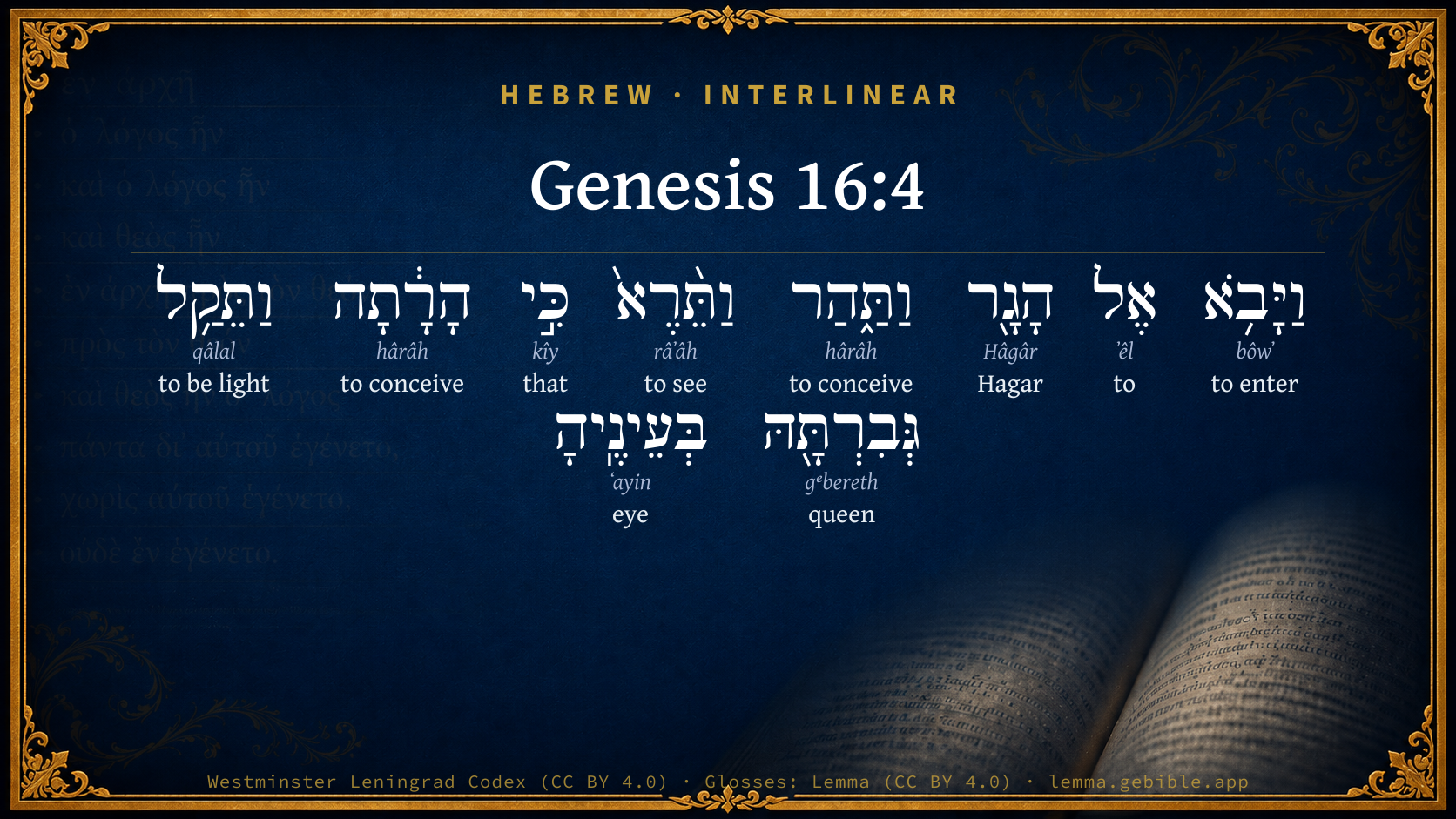
  1. וַיָּבֹ֥א bôwʼ H935 “and · to enter” Conjunction + Verb, Qal, Sequential Imperfect, 3rd Person, Masculine, Singular
  2. אֶל ʼêl H413 “to” Preposition
  3. הָגָ֖ר Hâgâr H1904 “Hagar” Noun, Proper
  4. וַתַּ֑הַר hârâh H2029 “and · to conceive” Conjunction + Verb, Qal, Sequential Imperfect, 3rd Person, Feminine, Singular
  5. וַתֵּ֨רֶא֙ râʼâh H7200 “and · to see” Conjunction + Verb, Qal, Sequential Imperfect, 3rd Person, Feminine, Singular
  6. כִּ֣י kîy H3588 “that” Conjunction
  7. הָרָ֔תָה hârâh H2029 “to conceive” Verb, Qal, Perfect, 3rd Person, Feminine, Singular
  8. וַתֵּקַ֥ל qâlal H7043 “and · to be light” Conjunction + Verb, Qal, Sequential Imperfect, 3rd Person, Feminine, Singular
  9. בְּעֵינֶֽיהָ ʻayin H5869 “in/at · eyes · her” Preposition + Noun, Common, Both, Dual, Construct + Suffix, Personal, 3rd Person, Feminine, Singular

About this verse

These counts appear in no published source. They are computed here, from the morphology-tagged text and Lemma’s own curated glosses. What Lemma adds →

10
words
9
distinct lemmas
Pentateuch
section

Notable vocabulary

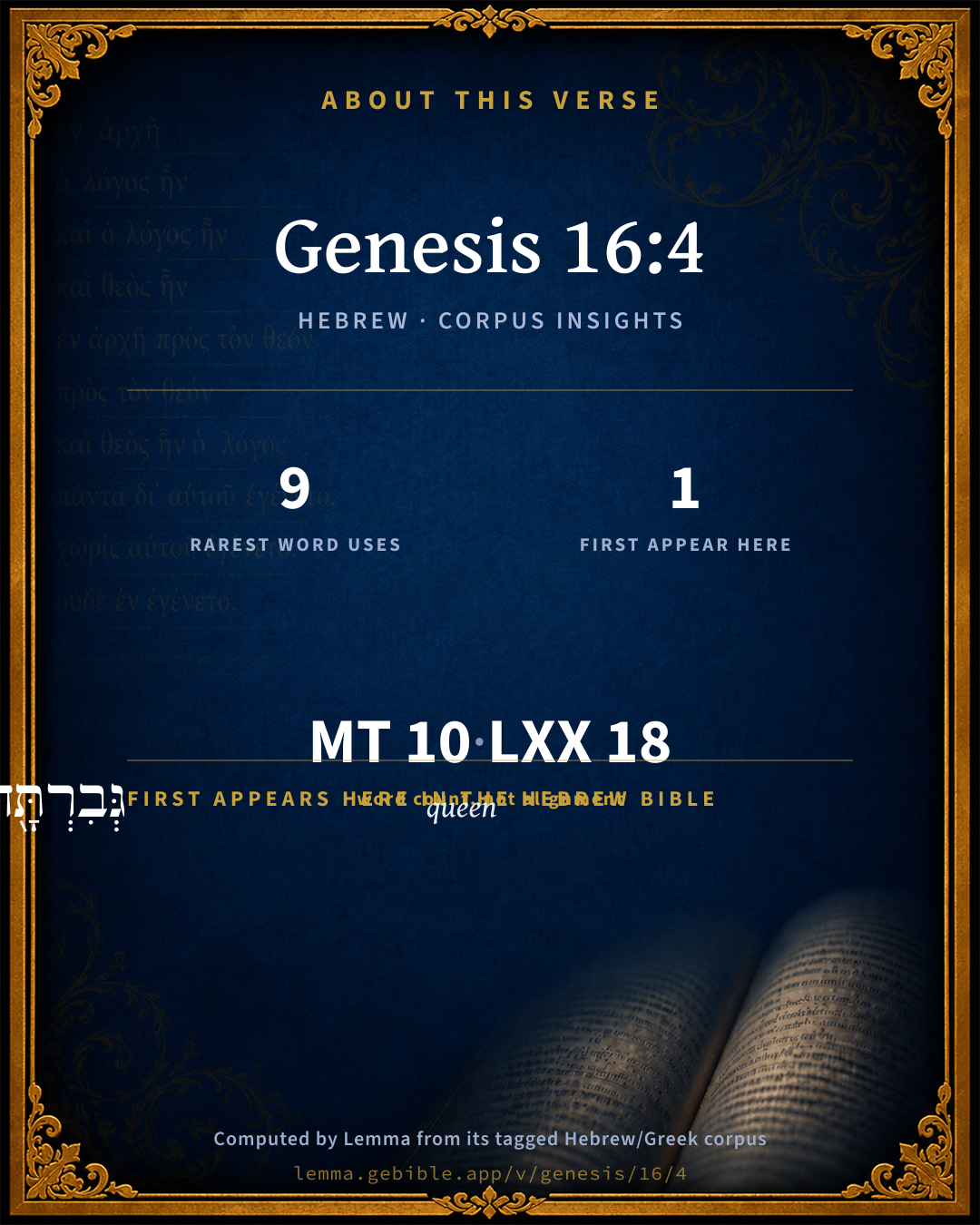
The rarest word here is גְּבִרְתָּ֖הּ queen H1404 — appearing just 9 times in the whole Hebrew Bible.

First appearance in Scripture

This word makes its first canonical appearance in the Hebrew Bible here:

  • גְּבִרְתָּ֖הּ queen H1404

Shared distinctive vocabulary

גְּבִרְתָּ֖הּ queen H1404 occurs in 9 verses of the Hebrew Bible. Also found in:

Grammatical profile

  • 5 verbs
  • 3 nouns
  • 1 preposition
  • 1 conjunction

Verb forms

  • וַיָּבֹ֥א Qal · Sequential Imperfect
  • וַתַּ֑הַר Qal · Sequential Imperfect
  • וַתֵּ֨רֶא֙ Qal · Sequential Imperfect
  • הָרָ֔תָה Qal · Perfect
  • וַתֵּקַ֥ל Qal · Sequential Imperfect

Repetition

A word recurs within this verse — often emphatic in Hebrew:

  • וַתַּ֑הַר to conceive H2029 ×2

Hebrew & Septuagint length

In English translation the verse runs 22 words from the Hebrew and 23 from the Septuagint (LXX English) — closely comparable.

A rough comparison of the two English renderings, which tokenize alike — not a word-level alignment.

Word counts can differ between the Hebrew and the Greek without any difference in meaning — e.g. the Hebrew direct-object marker אֵת has no separate Greek word, and Greek often adds the article ὁ.

In the original languages it is 10 Hebrew tokens and 18 Greek tokens — but the two are counted differently (Hebrew bundles its prefixes and suffixes into one token; the Greek is in lemma form), so that isn’t a like-for-like length.

Cross-references

6

Topical passages linked to Genesis 16:4 in the Treasury of Scripture Knowledge — connected by theme and wording, ordered by reader-vote popularity; previews shown in the World English Bible.

  • 2 Samuel 6:16 It was so, as the ark of Yahweh came into the city of David, that Michal the daughter of Saul looked out at the window, and saw king David leaping and dancing before Yahweh; and she despised him in her heart.
  • Proverbs 30:23 For an unloved woman when she is married; And a handmaid who is heir to her mistress.
  • 1 Samuel 1:6–8 Her rival provoked her sore, to make her fret, because Yahweh had shut up her womb.
  • Proverbs 30:20–21 So is the way of an adulterous woman: She eats and wipes her mouth, And says, 'I have done nothing wrong.'
  • 1 Corinthians 4:6 Now these things, brothers, I have in a figure transferred to myself and Apollos for your sakes, that in us you might learn not to think beyond the things which are written, that none of you be puffed up against one another.
  • 1 Corinthians 13:4–5 Love is patient and is kind; love doesn't envy. Love doesn't brag, is not proud,

Cross-references courtesy of OpenBible.info (CC BY 4.0).

Hebrew and Greek witnesses Masoretic Hebrew ↔ Greek Septuagint

The same verse in the two great witnesses to the Old Testament, shown verse-for-verse.

These are two independent witnesses, not word-aligned to each other, and the Septuagint is shown in lemma (dictionary) form.

Hebrew Genesis 16:4 Masoretic · Westminster Leningrad Codex

וַיָּבֹ֥א אֶל הָגָ֖ר וַתַּ֑הַר וַתֵּ֨רֶא֙ כִּ֣י הָרָ֔תָה וַתֵּקַ֥ל גְּבִרְתָּ֖הּ בְּעֵינֶֽיהָ

He went in to Hagar, and she conceived. When she saw that she had conceived, her mistress was despised in her eyes.

World English Bible · Public Domain

Greek LXX Genesis 16:4 Septuagint · lemma form

καί εἰςἔρχομαι πρός αγαρ καί συνλαμβάνω καί ὁράω ὅτι ἐν γαστήρ ἔχω καί ἀτιμάζω ὁ κυρία ἐναντίον αὐτός

And he went in to Agar, and she conceived, and saw that she was with child, and her mistress was dishonored before her.

LXX2012 (modern English Septuagint) · Public Domain

Hebrew: Westminster Leningrad Codex (CC BY 4.0). Greek: Septuagint (public domain); English from LXX2012 (modern English Septuagint) (Public Domain). How the Septuagint differs from the Hebrew →

Targum (Aramaic paraphrase)

2

The Targum is the ancient Jewish Aramaic paraphrase of the Hebrew Scriptures — an interpretive translation, not the Hebrew text itself. Onkelos (literal) and Pseudo-Jonathan (expansive) render the Torah, and Jonathan the Prophets. Coverage is partial: where no permissively-licensed English translation exists for a verse, only the Aramaic is shown. This is verse-level text, not a word-by-word alignment to the Hebrew.

  1. Targum Onkelos Torah (Genesis–Deuteronomy)
    וְעַל לְוַת הָגָר וְעַדִיאַת וַחֲזַת אֲרֵי עֲדִיאַת וּקְלַת רִבָּנְתַּהּ בְּעֵינָהַהּ

    (no public-domain English translation for this verse)

    Targum Onkelos — Aramaic: “Onkelos Genesis” (public domain); “Onkelos Exodus” (public domain); “Onkelos Leviticus” (public domain); “Onkelos Numbers” (public domain); “Onkelos Deuteronomy” (public domain). English: “Sefaria Community Translation” (CC0 1.0 (public-domain dedication)); “J.W. Etheridge. The Targums of Onkelos and Jonathan Ben Uzziel on the Pentateuch. London: Longmans, Green, 1862” (public domain). Text via Sefaria.

  2. Targum Pseudo-Jonathan Torah (Genesis–Deuteronomy)
    וְעָאל לְוַת הָגָר וְאַעֲדִיאַת וַחֲמַת אֲרוּם אַעֲדִיאַת וְזִלְזִלַת אֵיקַר רִבּוֹנְתָּהָא בְעֵינָהָא

    And he went unto Hagar, and she conceived; and she saw that she had conceived, and the honour of her mistress was despised in her eyes.

    Targum Pseudo-Jonathan — Aramaic: “Targum Jonathan on Genesis” (public domain); “Targum Jonathan on Exodus” (public domain); “Targum Jonathan on Leviticus” (public domain); “Targum Jonathan on Numbers” (public domain); “Targum Jonathan on Deuteronomy” (public domain). English: “The Targum of Jonathan ben Uzziel, trans. J. W. Etheridge, London, 1862” (public domain). Text via Sefaria.

Commentary

Notes on Genesis 16:4 from classic Christian and Jewish commentators (each source and its license shown beneath its notes). The classic Christian expositions comment on the surrounding passage and are grouped to its opening verse, so a note may address several verses; the Jewish commentaries on the Tanakh (Rashi and others) are per-verse, so they appear only where the commentator wrote on this verse.

Lemma curates 59 commentaries, every one of them public domain or Creative Commons licensed, each selected and text-cleaned for this edition rather than reprinted as found. About our sources →

Matthew Henry's Commentary

We have here the immediate bad consequences of Abram's unhappy marriage to Hagar. A great deal of mischief it made quickly. When we do not well both sin and trouble lie at the door; and we may thank ourselves for the guilt and grief that follow us when we go out of the way of our duty. See it in this story.

I. Sarai is despised, and thereby provoked and put into a passion, Gen 16:4. Hagar no sooner perceives herself with child by her master than she looks scornfully upon her mistress, upbraids her perhaps with her barrenness, insults over her, to make her to fret (as Sa1 1:6), and boasts of the prospect she had of bringing an heir to Abram, to that good land, and to the promise. Now she thinks herself a better woman than Sarai, more favoured by Heaven, and likely to be better beloved by Abram; and therefore she will not submit as she has done. Note, 1. Mean and servile spirits, when favoured and advanced either by God or man, are apt to grow haughty and insolent, and to forget their place and origin. See Pro 29:21; Pro 30:21-23. It is a hard thing to bear honour aright. 2. We justly suffer by those whom we have sinfully indulged, and it is a righteous thing with God to make those instruments of our trouble whom we have made instruments of our sin, and to ensnare us in our own evil counsels: this stone will return upon him that rolleth it.

II. Abram is clamoured upon, and cannot be easy while Sarai is out of humour; she upbraids him vehemently, and very unjustly charges him with the injury (Gen 16:5): My wrong be upon thee, with a most unreasonable jealousy suspecting that he countenanced Hagar's insolence; and, as one not willing to hear what Abram had to say for the rectifying of the mistake and the clearing of himself, she rashly appeals to God in the case: The Lord judge between me and thee; as if Abram had refused to right her. Thus does Sarai, in her passion, speak as one of the foolish women speaketh. Note, 1. It is an absurdity which passionate people are often guilty of to quarrel with others for that of which they themselves must bear the blame. Sarai could not but own that she had given her maid to Abram, and yet she cries out, My wrong be upon thee, when she should have said, What a fool was I to do so! That is never said wisely which pride and anger have the inditing of; when passion is upon the throne, reason is out of doors, and is neither heard nor spoken. 2. Those are not always in the right who are most loud and forward in appealing to God. Rash and bold imprecations are commonly evidences of guilt and a bad cause.

III. Hagar is afflicted, and driven from the house, Gen 16:6. Observe, 1. Abram's meekness resigns the matter of the maid-servant to Sarai, whose proper province it was to rule that part of the family: Thy maid is in thy hand. Though she was his wife, he would not countenance nor protect her in any thing that was disrespectful to Sarai, for whom he still retained the same affection that ever he had. Note, Those who would keep up peace and love must return soft answers to hard accusations. Husbands and wives particularly should agree, and endeavour not to be both angry together. Yielding pacifies great offenses. See Pro 15:1. 2. Sarai's passion will be revenged upon Hagar: She dealt hardly with her, not only confining her to her usual place and work as a servant, but probably making her to serve with rigour. Note, God takes notice of, and is displeased with, the hardships which harsh masters unreasonably put upon their servants. They ought to forbear threatening, with Job's thought, Did not he that made me make him? Job 31:15. 3. Hagar's pride cannot bear it, her high spirit having become impatient of rebuke: She fled from her face. She not only avoided her wrath for the present, as David did Saul's, but she totally deserted her service, and ran away from the house, forgetting, (1.) What wrong she hereby did to her mistress, whose servant she was, and to her master, whose wife she was. Note, Pride will hardly be restrained by any bonds of duty, no, not by many. (2.) That she herself had first given the provocation, by despising her mistress. Note, Those that suffer for their faults ought to bear their sufferings patiently, Pe1 2:20.

Matthew Henry's Commentary on the Whole Bible (1708–1710) — public domain (CC PDM 1.0). Text via the HelloAO Bible API.

Trapp's Complete Commentary

John Trapp

Gen 16:4 And he went in unto Hagar, and she conceived: and when she saw that she had conceived, her mistress was despised in her eyes.

Ver. 4. Her mistress was despised in her eyes.] Heb., Allevata est, sive elevata est :and so she was beaten with her own rod, and yet complains. Neither is it any wonder; for, "for three things the earth is disquieted," saith Agur, and two of them are, "for an odious woman when she is married, and a handmaid that is heir to her mistress". {Pro 30:21; Pro 30:23} Asperius nihil est humili dum surgit in altum . Set a beggar on horseback, and there’s no hoe with him.

John Trapp, A Commentary or Exposition upon All the Books of the Old and New Testament (1647–1656) — public domain. Text from a community e-Sword module.

The Biblical Illustrator

Joseph S. Exell

Gen_16:4-6

When she saw that she had conceived, her mistress was despised in her eyed

The evils of abolishing social distinctions

I.

THOSE WHO ARE SUDDENLY RAISED IN THE SOCIAL SCALE ARE TEMPTED TO PRIDE AND INSOLENCE.

II. THOSE WHO HAVE TAKEN PART IN THE ABOLISHING OF SUCH DISTINCTIONS ARE THE FIRST TO COMPLAIN OF THE EVILS CAUSED THEREBY.

1. They complain of their troubles so as to excuse themselves.

2. They often make rash appeals to Divine justice.

III. THE RECOGNITION OF ORIGINAL RIGHTS IS THE BEST WAY OF DEALING WITH SUCH EVILS.

1. This is a better course than the immediate imputation of such evils to those who have caused them.

2. Meek submission becomes true might in the end.

IV. THE EVILS BROUGHT ABOUT BY SUDDEN AND VIOLENT CHANGES IN THE SOCIAL STATE ARE NEVER FULLY REMEDIED. (T. H. Leale.)

Lessons

1. Nothing more proud than a beggar set on horseback, and a very ape, if you place him up aloft, begins to bridle the matter and take upon him marvellously.

2. It teacheth that adversity is better borne than prosperity of many one.

3. It showeth the end of evil counsel, Sarah is beaten with her own rod. (Bp. Babington.)

The Biblical Illustrator, edited by Joseph S. Exell (c. 1880s–1900s) — public domain. Text from a community e-Sword module.

Joseph Benson's Commentary

Gen 16:4. Her mistress was despised in her eyes — Thus began the ill consequences of Abram’s marriage to Hagar: much mischief it made presently. Hagar no sooner perceives herself with child, but she looks scornfully upon her mistress; upbraids her, perhaps, with her barrenness, and insults over her. Sarai falls upon Abram, and very unjustly charges him with the injury, suspecting that he countenanced Hagar’s insolence: and as one not willing to hear what Abram had to say, she rashly appeals to God. Those are not always in the right that are most forward in appealing to God. Rash and bold imprecations are commonly evidences of guilt and a bad cause.

Joseph Benson's Commentary on the Old and New Testaments (1811–1818) — public domain. Text from a community e-Sword module.

The Preacher's Complete Homiletical Commentary

Joseph S. Exell (gen. ed.)

MAIN HOMILETICS OF THE PARAGRAPH.—Gen_16:4-6

THE EVILS OF ABOLISHING SOCIAL DISTINCTIONS

By the elevation of Hagar from the condition of a bond-servant to that of a wife, her relation to Abram’s family was changed. This sudden advancement to a superior position brought new complications into the patriarch’s household. The evils of abolishing social distinctions receive a sad illustration in this narrative. The same great principles which are at work here apply to all times, though the external facts which spring from them are endlessly varied. All sudden and violent changes which disturb the foundations of human society are fraught with manifold inconveniencies and dangers. Some of these may be seen in this history.

I. Those who are suddenly raised in the social scale are tempted to pride and insolence. Sarai makes the complaint to her husband: “I have given my maid into thy bosom; and when she saw that she had conceived, I was despised in her eyes.” Hagar’s new position in the household, and her possession of that fruitfulness which was denied to her mistress, made her boastful of the superior advantage, and she became proud and insolent. She reproaches the very person who had been the means of her advancement. Those who are not fitted by natural endowment and training for the higher stations of life are injured and exposed to many temptations by being suddenly forced into them. By a healthy ambition, plodding industry, and laborious self-culture, a man may greatly raise himself in the social scale. But this is a different case from that of those who are suddenly raised by the action of others whose aim is to make all men equal by means of violent changes in human society. Such forces directed towards the new adjustment of the social state can never maintain it in a condition of equilibrium. It is like the attempt to cause the surface of water to assume that of an inclined plane; when the constraining force is removed the water falls back to its original level. Human experience has proved that, in many cases, the morals of men have been entirely changed by their sudden exaltation to place, power, or wealth. They become full of conceit, and are scornful and reproachful towards others. The position of Hagar was not given her from any particular regard for herself, but in order to serve a special purpose. She mistook the grounds of the favours bestowed upon her. This has ever been the delusion of those who have been advanced from humble stations by the artificial regenerators of society, who only cared to serve their own selfish ends, and have but regarded the poor and lowly as steps along which they might climb to power and importance.

II. Those who have taken part in the abolishing of such distinctions are the first to complain of the evils caused thereby. Sarah herself proposed the elevation of Hagar to this honour, and she is the first to complain of the bitter evils which this false step had brought upon her. This has often been repeated in the history of mankind. Men have been forgetful of God’s order, and have tried to reconstruct society upon a new basis. Then they find that they have plunged themselves into unforeseen complications and troubles, and like Sarah—

1. They complain of their troubles so as to excuse themselves. Sarah throws the blame upon her husband. “And Sarai said unto Abram, My wrong be upon thee.” Men cling to the consolation that the evils from which they suffer are not due to their own conduct. The last thing they can be brought to do is to charge their evils upon themselves. Thus sinners who reap the reward of their own doings peevishly blame Heaven for their misfortunes. When a man by his own folly has perverted his way, then his heart fretteth against the Lord.

2. They often make rash appeals to divine justice. “The Lord judge between me and thee,” said Sarah to her husband. There is an appeal to Eternal Justice which is quite becoming in pure and strong souls when the oppression of human injustice lies heavy upon them. Job could appeal to his Vindicator on high, who would redress his wrongs and assert his integrity. But rash appeals to Heaven are mostly the sign of a weak cause. Men hide their own evils from themselves and others, and seek a passing comfort by claiming the consolations of the just. To invoke God seems, for the time, to put an end to all strife and to leave the matter with Him. Thus religion is used by some as a sanctuary whither they flee in the time of trouble. They use it only in emergencies. Many of those who have tried to anticipate God’s time by precipitating His purposes towards humanity, have to the last appealed to Heaven in vindication of the justice of their cause.

III. The recognition of original rights is the best way of dealing with such evils. Abram does not dispute the matter with his wife, but meekly says, “Behold, thy maid is in thy hand; do to her as it pleaseth thee.” (Gen_16:6.) He takes no side, nor does he defend, as he might consistently have done, the just rights of Hagar in her new position. He refers back to Sarah’s original rights as mistress of the household, as his wife entitled to his affection, and as one who had the sole disposal of a servant who was still her property. Times have changed since then, the paid servant having succeeded the bond servant; still, the policy of Abram may be recommended to those who are called upon to act in similar domestic and social complications.

1. This is a better course than the immediate imputation of such evils to those who have caused them. It is sometimes better to quiet such disorders by presently using gentle means. To go at once to the bottom of the evil, and to apportion blame to those to whom it properly belongs, may cause irritation. Even a righteous reproof may be given at a wrong time, and in circumstances unfavourable to its success. Peace is sometimes better than vindication.

2. Meek submission becomes true might in the end. Meekness was the only treatment which was suited to a mind enduring the tortures of self-reproach. The time for calm reason would come, when that meek spirit which endures evils rather than give offence would gain the true victory.

IV. The evils brought about by sudden and violent changes in the social state are never fully remedied. Abram by his yielding spirit appeased the anger of his wife, and cut off all further occasion of quarrel. But he yielded too much. Hagar, indeed, was the bondmaid of Sarah, and, according to the usage then prevailing, her property; still she was in some sense the wife of Abram, and entitled to his protection. He ought not to have given her up entirely to the will of a passionate and jealous woman. But things could not be exactly as they were before in Abram’s household. A false step had been taken, and though the evils it caused might be mitigated yet they could not be wholly undone. When once social usages and relations are disturbed, the reformation of the evils caused thereby can only be partial.

SUGGESTIVE COMMENTS ON THE VERSES

Gen_16:4. The success of our schemes in gaining our own immediate ends is no sure indication that God approves of them.

The most abject, when placed in positions where their natural advantages give them a superiority over others, are the most tempted to pride.

The results of our own presumptuous anticipation of God’s time and purposes soon show themselves. By our short-sighted wisdom we often set a snare by which our own feet are taken.

Solomon says that “an handmaid that is heir to her mistress” is one of those things for which the “earth is disquieted” (Pro_30:23).

If carnal strength succeeds in bearing any fruit, the immediate result is contempt of better things. For the flesh can achieve nothing without being exalted. Sarai, therefore, instead of being “built up,” as she hoped, by Hagar, reaps through her fresh humiliation.—(Jukes: “Types of Genesis.”)

The jealousies, the heart-burnings, and mutual reproaches which we now find disturbing the peace of his pious family, are such as might have been anticipated from the course of policy unhappily pursued. That the Egyptian bondmaid, so strangely and suddenly honoured, taken out of her due place and station and admitted to the rank and privileges of a spouse, should forget herself and become high-minded, was precisely such conduct as might have been expected on the part of a slave treated as Hagar was, and having a temper unsubdued and a mind uninstructed, as Hagar’s probably were. She could not enter into the plan which the heads of the house had formed, or into the reasons and motives which led them to form it. To their servant, if not to themselves, it must have been fraught with a vitiating and corrupting tendency; and assuredly it did prove to her a temptation to insolence and insubordination stronger than she could withstand. Hence Abram and Sarai had the greater sin. There was a cruel want of consideration in what they did. Even if they felt that they were at liberty, so far as they themselves were concerned, to do it, and that they were safe in doing it, were they not bound to ask how it might affect their dependent, whom they made a party in the transaction? Is not this the duty of all heads of families? Alas! how is it discharged! Do parents and masters—do the heads and members of households among Christians—duly weigh and recognise their responsibility in this particular? Do you, we might say to them, in all affection—do you, with special reference to this consideration, apply the maxim, “All things are lawful unto me, but all things edify not?”—(Candlish.)

Gen_16:5. There is often a sad reaction which follows an over-strained zeal. Those who have been driven to adopt insane schemes of policy, when their own failures are brought home to them wildly impute the blame to others.

We cannot disturb the settled order of society, even when the end proposed is good, without producing serious evils.

We are too ready to blame others for those misfortunes in which we have taken the chief part in bringing upon ourselves. Passion dulls the moral perceptions of the soul.

Being now made to reap according to that she had sown, she begins, when it is too late, to repent of her rashness. But instead of condemning her own conduct, and confessing that her folly had recoiled upon herself, she turns the edge of her resentment against her husband. Had the good man formed a deliberate design of injuring and insulting her, she could not have employed harsher language. Indeed, her conduct throughout was that of a peevish, unreasonable, and disappointed woman; and its weakness and wickedness are aggravated by her appealing to God in a case where she was clearly and consciously in the wrong. As if she had taken it for granted that her husband would not hear her, she exclaims: “The Lord judge between me and thee!” Such hasty and passionate appeals to heaven, instead of indicating a good cause, are commonly the marks of a bad one. A truly serious spirit will pause before interposing the name of God on any occasion, and will shudder at the thought of employing it on a false or frivolous one.—(Bush.)

When evils come upon us, we often regret them merely because of their sad consequences to ourselves. There may even be a sorrow for sin which is not “after a godly sort.”

We can only retain our true dignity and power by quietly waiting for God’s time.

He must not be sent for all in haste to decide the controversy, who, if He had come, you may soon see which of them would have had the worst of it. The best, we see, have their domestic contentions; some household words will now and then pass betwixt them; we match not with angels, but men and women. Two flints may as soon smite together, and not fire come forth, as two persons meet in marriage and not offences fall out. Publius Rubius Celer was held a happy man among the Romans, that commanded it to be engraven upon his gravestone that he had lived three and forty years and eight months with C. Ennia, his wife, sine querela, without the least quarrel. (Trapp.)

We may with confidence appeal to God when our conscience is clear and our cause is just; but to do so in the spirit of rashness and peevishness, in order to relieve our passionate temper, is impiety.

Gen_16:6. As Abram’s faith was tried on other occasions, so here is a trial to his spirit of meekness—to the power of Divine grace within him in maintaining his temper amidst the provocations of domestic life.

How to meet quarrels.

1. By a calm demeanour. To catch the contagion of the passion and rage of others is to impair the accuracy of our judgment, and to make ourselves partakers of their evils.

2. By recognising whatever rights those who quarrel with us may have on their side. Abram acknowledged the fact that Hagar belonged to her mistress and was entirely at her disposal.

3. By meekly yielding to the weak when there is no prospect of bringing them to a rational mind. Sarah was the “weaker vessel,” and it was of no use, in that state of her temper, to reason with her upon the whole question. It is better to turn away wrath by a soft answer than to prolong a hopeless struggle.

Abram is tempted to carry too far his indulgence towards one who is apparently to realise his anxious longing; and under this natural feeling, has he become less sensitive than otherwise he would have been in regard to her whom he should honour, and more tolerant of disrespect or insult shown to her? We may gather this from Sarai’s complaint; for she would not probably upbraid her husband without a cause. And if it were so, how sad an instance we have here of the difficulty of stopping short when a single doubtful step is once taken! Abram, when he consented to the specious proposal made to him, thought that he was acting disinterestedly and for the best. But other and less worthy motives began to mingle with his better purposes; and, at all events, he is now entangled in a net of his own making. He is no longer free; he is a slave of circumstances; and he is compelled to make the best he can of a painful perplexity and hard necessity; to do violence to his feelings, perhaps even to his convictions of duty; and to consent, at last, to the degradation and disgrace of one whom now, after what had passed, he is surely bound, not less in duty than in the current opinion of the age, to consider as having claims upon his regard.—(Candlish.)

Abram seems to have been brought into a situation wherein he was at a loss what to do; and thus, as Sarai is punished for tempting him, he also is punished with a disordered house for having yielded to the temptation. And now Sarai, incited by revenge, deals hardly with Hagar—much more so, it is likely, than she ought—for though the young woman might have acted vainly and sinfully, yet her mistress is far from being a proper judge of the punishment which she deserved. The consequence is, as might be expected, she leaves the family and goes into a wilderness. Indeed, it were “better to dwell in a wilderness than with a contentious and angry woman.”—(Fuller.)

Sarai deals hardly with the bondmaid, who therefore flees the house. If through faith’s impatience the principle of law is exalted out of its place, and thus dishonour is done to the free woman, a re-action follows, for Sarai is best loved, and though barren never loses her rightful empire over the believing heart. The spirit of faith at once gives Hagar up, and for a season the bond-maid is lost to Abram’s house; the elect permits her to be so abused that for awhile she flees and is lost sight of. Who that knows this path but has seen how the affection of law, when contempt has through it been poured upon a higher principle, is ejected even from that place, where as hand-maid it might be most useful. So does legality lead to antinomianism, and this when law as yet cannot be dispensed with. The time comes, indeed, after Isaac is born, when there is no further need for the bond-maid, and she is cast out for ever. At present the bond-maid is needed. She is therefore sent back by the Lord to her true place as Sarai’s maid. For “the law is good if it be used lawfully.” (1Ti_1:8.) The sorrow comes from exalting it out of its proper place.—(Jukes: “Types of Genesis.”)

The Preacher's Complete Homiletical Commentary (gen. ed. Joseph S. Exell; Funk & Wagnalls, c. 1892) — public domain (pre-1929). A full-Bible homiletical/sermon-outline anthology covering 65 of 66 books (2 John is absent from the source module). Text from a community e-Sword module.

Tyndale Open Study Notes

Tyndale Open Resources

16:4-6 Perhaps Hagar expected to become the favored wife instead of Sarai (cp. Prov 30:21-23).

Tyndale Open Study Notes — © Tyndale Open Resources, licensed CC BY-SA 4.0. Text via the HelloAO Bible API.

Geneva Bible (1599)

Geneva Bible translators

This punishment declareth what they gain that attempt anything against the word of God.

Geneva Bible (1599) marginal notes — public domain. Text via Bolls.life.

John Calvin's Commentaries

4. Her mistress was despised in her eyes. Here Moses relates that the punishment of excessive precipitancy quickly followed. The chief blame, indeed, rested with Sarai; yet because Abram had proved himself too credulous, God chastises both as they deserve. Sarai is grievously and bitterly tried, by the proud contempt of her handmaid; Abram is harassed by unjust complaints; thus we see that both pay the penalty of their levity, and that the contrivance devised by Sarai, and too eagerly embraced by Abram, fails of success. Meanwhile, in Hagar, an instance of ingratitude is set before us; because she, having been treated with singular kindness and honor, begins to hold her mistress in contempt. Since, however, this is an exceedingly common disease of the mind, let the faithful accustom themselves to the endurance of it; if, at any time, a return so unjust be made to them, for their acts of kindness. But especially, let the infirmity of Sarai move us thus to act, since she was unable to bear the contempt of her maid.

John Calvin's Commentaries (1540-1563) — public domain. Text from the Calvin Translation Society English edition (1840s-50s) via the Christian Classics Ethereal Library (ccel.org). Calvin's coverage is partial (roughly two-thirds of the Bible); uncommented books and verses are honest gaps, never fabricated. The 19th-century editor's footnotes and remarks are omitted so the notes are faithfully Calvin's own voice.

Ellicott's Commentary for English Readers

(4) Her mistress was despised.—Hagar, we are told in Gen_16:3, was to be, not Abram’s concubine, but his wife. She was to be Sarai’s representative, and though now she would hold the highest place in the household next to Sarai, because of this relation to Abram, yet she would continue to be Sarai’s maid. But no sooner had she conceived, than, proud of her superiority over her mistress, she wished to overthrow this arrangement, and, at all events, acted as if she was Abram’s wife absolutely, and thrust Sarai aside.

A Bible Commentary for English Readers, edited by Charles John Ellicott (1878–1897) — public domain. Text from a community e-Sword module.

The Cambridge Bible for Schools and Colleges

gen. ed. J. J. S. Perowne

4. was despised in her eyes] Compare the story in 1 Samuel 1, where the two wives are both “free,” and one is childless. Here the “free” wife, the mistress (gebéreth), gives her own maidservant (âmâh) to her husband; and is then jealous for her own dignity.

The Cambridge Bible for Schools and Colleges (gen. ed. J. J. S. Perowne; Cambridge University Press, 1878–1918) — public domain. Text from a community e-Sword module.

John Gill's Exposition

And he went in unto Hagar, and she conceived,.... The formality of the marriage being over, he enjoyed her as his wife, and she immediately conceived by him:

and when she saw that she had conceived; when she perceived that she was with child:

her mistress was despised in her eyes; she thought herself above her, and treated her as her inferior, with contempt, and reproached her for her barrenness, as Peninnah did Hannah, Sa1 1:6; and it was the more ungrateful, as it was at the motion of her mistress that she was given to Abram for wife.

John Gill's Exposition of the Whole Bible (1746–1763) — public domain (CC PDM 1.0). Text via the HelloAO Bible API.

Matthew Poole's English Annotations

For barrenness in itself was a reproach, and especially to Sarai, who seemed to be a person rejected by God, as one whom he would not honour with being the mother of that Seed; and Hagar being suddenly made Sarai’s partner in the privilege of Abram’s bed, and superior to her in respect of that great blessing of child-bearing, it is no wonder if she grew insolent upon it, especially being advanced so highly from so low a condition.

Matthew Poole's English Annotations on the Holy Bible (1683–1685) — public domain. Text from a community e-Sword/MySword module.

Whedon's Commentary on the Bible

Daniel D. Whedon

4. Her mistress was despised — Sarai is thus the first to feel the natural curse of the adulterous union. “Among the Hebrews barrenness was esteemed a reproach, (see Gen_19:31; Gen_30:1; Gen_30:23; Lev_20:20,) and fecundity a special honour and blessing of God, (chapter 21:6, 24:60; Exo_23:26; Deu_7:14;) and such is still the feeling in the East. But very probably Hagar may have thought that now Abram would love and honour her more than he did her mistress. Comp. Gen_29:33.” — Speaker’s Com.

Daniel D. Whedon (gen. ed.), Commentary on the Old and New Testaments (1874–1909) — public domain. Text from a community e-Sword module.

The Pulpit Commentary

And he went in unto Hagar. Ala, awOB, a linguistic peculiarity of the Jehovist, occurring; (Gen_29:21, 30 30:3, 4 38:2, 9, 16) (Vaihinger, Davidson) but by some partitionists Genesis 29. and 30. are assigned to the Elohist (Tuch, Bleek, De Wette). And she conceived: and when she saw that she had conceived, her mistress was despised in her eyes. As Hannah by Peninnah; (1Sa_1:6) barrenness among the Hebrews having been regarded as a dishonor and reproach (Gen_19:31 Gen_30:1, Gen_30:23; Lev_20:20) and fecundity as a special mark of the Divine favor (Gen_21:6 Gen_24:60 Exo_23:26; Deu_7:14) Whether Hagar imagined Sarai to be through her barrenness "tanquam a Divino promisso repudiatam" (Lyra), or anticipated Sarai"s displacement from her position as Abram s wife (Inglis), she, immediately on perceiving her condition, became insolent (cf. Pro_30:23)

The Pulpit Commentary (1880–1919), ed. H.D.M. Spence-Jones & Joseph S. Exell — public domain. Text from a community e-Sword module.

John Wesley's Explanatory Notes

We have here the ill consequences of Abram's marriage to Hagar: a deal of mischief it made presently. Hagar no sooner perceives herself with child, but she looks scornfully upon her mistress; upbraids her perhaps with her barrenness, and insults over her. Sarai falls upon Abram, and very unjustly charges him with the injury, suspecting that he countenanced Hagar's insolence: and as one not willing to hear what Abram had to say she rashly appeals to God. The Lord judge between me and thee, as if Abram had refused to right her. When passion is upon the throne, reason is out of doors, and is neither heard nor spoken. Those are not always in the right that are most forward in appealing to God. Rash and bold imprecations are commonly evidences of guilt and a bad cause.

John Wesley, Explanatory Notes Upon the Whole Bible (1754–1765) — public domain. Text via the GEBible commentary corpus.

Kretzmann's Popular Commentary

Paul E. Kretzmann

Hagar’s Pride and Flight

v. 4. And he went in unto Hagar, and she conceived; and when she saw that she had conceived, her mistress was despised in her eyes. The plan of Sarai to which Abram had consented was decidedly human and did not have the divine approval. Hagar having conceived, her mistress was looked down upon in her eyes. The Jews, like the Orientals in general, regarded barrenness as a great evil and a divine punishment, Lev 20:20, and fruitfulness as a great good and a divine blessing, Exo 23:26; Deu 7:14. Still, the attitude of Hagar was a presumption, since she was not Abram’s second wife, but retained her subordinate position throughout.

v. 5. And Sarai said unto Abram, My wrong be upon thee; I have given my maid into thy bosom; and when she saw that she had conceived, I was despised in her eyes. The Lord judge between me and thee. This outburst on the part of Sarai was altogether unjustified; what she was suffering came upon her in consequence of her interference with God’s plans. Yet she wanted the wrong and injury which had been heaped upon her to be blamed upon her husband, and even called upon Jehovah to be the judge between them. Sarai’s outburst of temper was probably due to the very indifference which Abram showed with regard to the slave woman, for she wanted him to have seen and rebuked the latter’s insolence, whereas he held that the relations in the household had in no way been altered by the consequence of Sarai’s plan.

v. 6. But Abram said unto Sarai, Behold, thy maid is in thy hand; do to her as it pleaseth thee. This was not evading the responsibility, but insisting upon its remaining where it had been during the entire incident: Hagar was still the slave of Sarai, who might use force in making her conscious of her subordinate position. And when Sarai dealt hardly with her, she fled from her face. The mistress took measures to make the slave woman feel her power, probably by demanding that the latter perform the most menial services in the household, whereas Hagar seems to have occupied a position of some importance before. The proud spirit of the slave refusing to yield to such treatment, she fled from Hebron, willing rather to brave the wilderness than to submit to Sarai’s harsh treatment. Thus the sins and weaknesses of the saints are openly narrated in Scriptures, the story forming a mirror in which we may see our own hearts.

Paul E. Kretzmann, Popular Commentary of the Bible (1921–1924) — public domain. Text from a community e-Sword module.

Rashi

Rabbi Shlomo Yitzchaki (Rashi)

ויבא אל הגר ותהר AND HE CAME UNTO HAGAR AND SHE CONCEIVED from the first union (Genesis Rabbah 45:4).

ותקל גברתה בעיניה HER MISTRESS WAS SLIGHTED IN HER EYES — She said, “As regards this woman Sarai, her conduct in private can certainly not be like that in public: she pretends to be a righteous woman, but she cannot really be righteous since all these years she has not been privileged to have children, whilst I have had that blessing from the first union” (Genesis Rabbah 45:4).

Rashi on the Tanakh — English translations: “The Judaica Press complete Tanach with Rashi, translated by A. J. Rosenberg” (CC BY 4.0); “Pentateuch with Rashi's commentary by M. Rosenbaum and A.M. Silbermann, 1929-1934” (public domain); “The Metsudah Tanach series, Lakewood, N.J” (CC BY 4.0); and “The Book of Joshua, Metsudah Publications, 1997” (CC BY 4.0). Text via Sefaria.

Radak

Rabbi David Kimhi (Radak)

ויבא... ותקל גבירתה, she thought that now that it was clear that Avram's seed would be from her she would become the top ranking wife of Avram. As a result, she refused to carry out instructions given to her by Sarai.

Radak on the Tanakh — English translations: “Sefaria Community Translation” (CC0 1.0 (public-domain dedication)); “Eliyahu Munk, HaChut Hameshulash” (CC BY 4.0); “Rabbi Mike Feuer, Jerusalem Anthology” (CC BY 4.0); and “R. David Kimhi on the first book of Psalms, Translated by R.G. Finch, London, 1919” (public domain). Text via Sefaria.

Lesson kit

Teaching starters — assembled from the data on this page, not authored interpretation. Every prompt links to the verse data it draws on. Edit before teaching.

Genesis, in the Pentateuch, opens this verse with 10 words (9 distinct Hebrew lemmas). Its most distinctive word is gᵉbereth (“queen”). A historical commentator’s framing appears above. Read the whole chapter for the surrounding context.

Discussion questions

  1. What does “queen” (gᵉbereth) contribute to the verse as a whole?
  2. This is the first place “queen” appears in Scripture (first appears here). What does its debut here establish?
  3. How does Genesis 16:8, which shares the word «queen», read alongside this verse?
  4. What does the repetition of “to conceive” (2× in this one verse) do in this verse?
  5. The translations on this page render this verse differently — a whole-verse word diff, not a word-by-word alignment. What might account for the different wordings?
  6. «וַיָּבֹ֥א» is a Qal Sequential Imperfect verb. How does that grammatical form shape the action described?
  7. Compare how Matthew Henry's Commentary and Trapp's Complete Commentary read this verse. Where do they agree or differ?

Things to notice

Reading settings

Reading text

Shown beneath each verse's original-language words.

Old Testament
Old Testament edition

Read the OT as the Masoretic Hebrew (MT) or the Greek Septuagint (LXX).

English shown for the Greek Septuagint (in the Hebrew ↔ Greek comparison).

Comparing translations? Open the Compare panel on any verse page to stack up to four side by side.