
Genesis 32:6

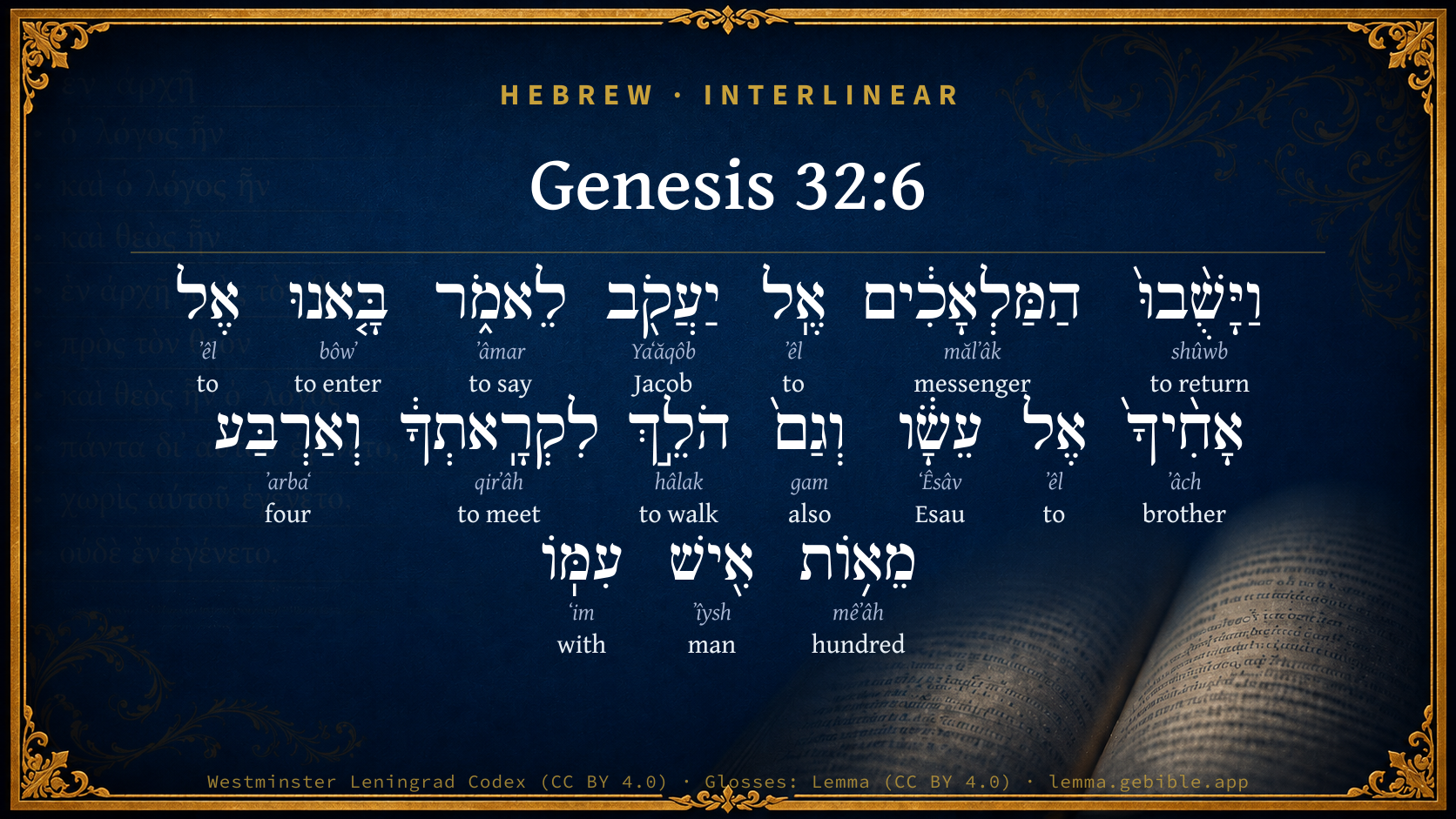
Hebrew (Westminster Leningrad Codex) Genesis 32:6 appears in the Hebrew Old Testament. The text above is from the Westminster Leningrad Codex. Each word links to its Strong’s number, a concise gloss, and parsing drawn from the Open Scriptures Hebrew Bible morphology. Click any word for its full Brown-Driver-Briggs (BDB) entry.
Download image
Cite this verse

Genesis 32:6 (World English Bible). Public Domain. Lemma interlinear Bible study tool, https://lemma.gebible.app/v/genesis/32/6.

Show BibTeX & RIS
BibTeX
RIS
English Translation
The messengers returned to Jacob, saying, "We came to your brother Esau. Not only that, but he comes to meet you, and four hundred men with him."
World English Bible · Public Domain
Download a study sheet

One document with this verse’s original text, its word-by-word gloss line, the meaning frame, cross-references with their text, attributed commentary, and full source and license credits — printable, and it pastes into notes with its structure intact.

This verse Autodidact and up

Study sheet (.html) Plain text (.txt)

A passage Seminary Student

Up to 50 verses in one chapter. A passage sheet keeps up to 6 commentary sources and 12 cross-references per verse, in the order this page ranks them, and says so on the sheet whenever that leaves anything out. Ask for a single verse and you get the Autodidact verse sheet above.

Everything on this page stays free to read, with no account — the sheet is a download of what is already on screen, not access to it.

Want to remove ads? Support Godless Engineer
Compare translations 3

The same verse in 3 English versions, stacked beneath the original-language interlinear above. Click any original word for its lexicon entry.

Each is an independent rendering of the whole verse — the interlinear is not word-aligned to these translations.

Highlighted words mark where these versions differ — a whole-verse word diff, not a word-by-word alignment.

  • World English Bible Public Domain
    The messengers returned to Jacob, saying, "We came to your brother Esau. Not only that, but he comes to meet you, and four hundred men with him."
  • King James Version Public Domain
    And the messengers returned to Jacob, saying, We came to thy brother Esau, and also he cometh to meet thee, and four hundred men with him.
  • unfoldingWord Literal Text CC BY-SA 4.0
    Then the messengers returned to Jacob, saying, “We went to your brother, to Esau. And also, he is coming to meet you, and 400 men with him!”

unfoldingWord Literal Text — © unfoldingWord, licensed CC BY-SA 4.0. Word-aligned USFM3 via Door43 (git.door43.org/unfoldingWord/en_ult).

Versions to compare (up to 4)

3 of 4 selected

Show all 18 translations

Every available English version of this verse, each an independent rendering of the whole verse.

  • World English Bible Public Domain
    The messengers returned to Jacob, saying, "We came to your brother Esau. Not only that, but he comes to meet you, and four hundred men with him."
  • Berean Standard Bible Public Domain
    When the messengers returned to Jacob, they said, “We went to your brother Esau, and now he is coming to meet you—he and four hundred men with him.”
  • Majority Standard Bible Public Domain
    When the messengers returned to Jacob, they said, “We went to your brother Esau, and now he is coming to meet you—he and four hundred men with him.”
  • King James Version Public Domain
    And the messengers returned to Jacob, saying, We came to thy brother Esau, and also he cometh to meet thee, and four hundred men with him.
  • American Standard Version (1901) Public Domain
    And the messengers returned to Jacob, saying, We came to thy brother Esau, and moreover he cometh to meet thee, and four hundred men with him.
  • Revised Version (1885) Public Domain
    And the messengers returned to Jacob, saying, We came to thy brother Esau, and moreover he cometh to meet thee, and four hundred men with him.
  • Geneva Bible (1599) Public Domain
    So ye messengers came againe to Iaakob, saying, We came vnto thy brother Esau, and hee also commeth against thee and foure hundreth men with him.
  • Douay-Rheims (1899) Public Domain
    And the messengers returned to Jacob, saying: We came to Esau thy brother, and behold he cometh with speed to meet thee with four hundred men.
  • Young's Literal Translation Public Domain
    And the messengers turn back unto Jacob, saying, `We came in unto thy brother, unto Esau, and he also is coming to meet thee, and four hundred men with him;'
  • Literal Standard Version CC BY-SA 4.0
    And the messengers return to Jacob, saying, “We came to your brother, to Esau, and he is also coming to meet you, and four hundred men with him”;
  • Unlocked Literal Bible CC BY-SA 4.0
    The messengers returned to Jacob and said, “We went to your brother Esau. He is coming to meet you, and four hundred men are with him.”
  • unfoldingWord Literal Text CC BY-SA 4.0
    Then the messengers returned to Jacob, saying, “We went to your brother, to Esau. And also, he is coming to meet you, and 400 men with him!”
  • Darby Bible Public Domain
    And the messengers returned to Jacob, saying, We came to thy brother, to Esau; and he also is coming to meet thee, and four hundred men with him.
  • World Messianic Bible Public Domain
    The messengers returned to Jacob, saying, “We came to your brother Esau. He is coming to meet you, and four hundred men are with him.”
  • Webster's Bible Public Domain
    And the messengers returned to Jacob, saying, We came to thy brother Esau, and also he is coming to meet thee, and four hundred men with him.
  • Free Bible Version CC BY-SA 4.0
    The messengers returned to Jacob and told him, “Your brother Esau is coming to meet you with 400 armed men!”
  • Bible in Basic English Public Domain
    When the servants came back they said, We have seen your brother Esau and he is coming out to you, and four hundred men with him.
  • JPS Tanakh (1917) Public Domain
    (32-7) And the messengers returned to Jacob, saying: 'We came to thy brother Esau, and moreover he cometh to meet thee, and four hundred men with him.'

Literal Standard Version (2020), Covenant Press — licensed CC BY-SA 4.0. Text via the HelloAO Bible API (eBible.org). Unlocked Literal Bible (unfoldingWord) — licensed CC BY-SA 4.0. Text via the HelloAO Bible API (eBible.org). unfoldingWord Literal Text — © unfoldingWord, licensed CC BY-SA 4.0. Word-aligned USFM3 via Door43 (git.door43.org/unfoldingWord/en_ult). Free Bible Version, Dr. Jonathan Gallagher — licensed CC BY-SA 4.0. Text via the HelloAO Bible API (eBible.org).

Word by word

More ways to search: Search by grammar → Find every occurrence → Compare this word →

Practice this passage: Drill this verse → Learn its vocabulary →

עֵשָׂ֔ו
ʻÊsâv
H6215
“Esau”
Noun, Proper
Part of Speech
Noun
Type
Proper
Full BDB Definition

Origin: apparently a form of the pass. part. of H6213 in the original sense of handling

TWOT: None

Esau = "hairy" - eldest son of Isaac and Rebecca and twin brother of Jacob; sold the birthright for food when he was hungry and the divine blessing went to Jacob; progenitor of the Arab peoples
  1. וַיָּשֻׁ֨בוּ֙ shûwb H7725 “and · to return” Conjunction + Verb, Qal, Sequential Imperfect, 3rd Person, Masculine, Plural
  2. הַמַּלְאָכִ֔ים mălʼâk H4397 “the · messengers” Particle, Definite Article + Noun, Common, Masculine, Plural, Absolute
  3. אֶֽל ʼêl H413 “to” Preposition
  4. יַעֲקֹ֖ב Yaʻăqôb H3290 “Jacob” Noun, Proper
  5. לֵאמֹ֑ר ʼâmar H559 “to say” Preposition + Verb, Qal, Infinitive Construct
  6. בָּ֤אנוּ bôwʼ H935 “to enter” Verb, Qal, Perfect, 1st Person, Common, Plural
  7. אֶל ʼêl H413 “to” Preposition
  8. אָחִ֨יךָ֙ ʼâch H251 “brother · your” Noun, Common, Masculine, Singular, Construct + Suffix, Personal, 2nd Person, Masculine, Singular
  9. אֶל ʼêl H413 “to” Preposition
  10. וְגַם֙ gam H1571 “and · also” Conjunction + Particle, Accusative
  11. הֹלֵ֣ךְ hâlak H1980 “walking” Verb, Qal, Participle Active, Masculine, Singular, Absolute
  12. לִקְרָֽאתְךָ֔ qirʼâh H7125 “to meet · you” Preposition + Verb, Qal, Infinitive Construct + Suffix, Personal, 2nd Person, Masculine, Singular
  13. וְאַרְבַּע ʼarbaʻ H702 “and · four” Conjunction + Adjective, Cardinal number, Feminine, Singular, Absolute
  14. מֵא֥וֹת mêʼâh H3967 “hundred” Adjective, Cardinal number, Both, Plural, Absolute
  15. אִ֖ישׁ ʼîysh H376 “man” Noun, Common, Masculine, Singular, Absolute
  16. עִמּֽוֹ ʻim H5973 “with · him” Preposition + Suffix, Personal, 3rd Person, Masculine, Singular

About this verse

These counts appear in no published source. They are computed here, from the morphology-tagged text and Lemma’s own curated glosses. What Lemma adds →

17
words
15
distinct lemmas
Pentateuch
section

Grammatical profile

  • 5 verbs
  • 5 nouns
  • 2 adjectives
  • 4 prepositions
  • 1 particle

Verb forms

  • וַיָּשֻׁ֨בוּ֙ Qal · Sequential Imperfect
  • לֵאמֹ֑ר Qal · Infinitive Construct
  • בָּ֤אנוּ Qal · Perfect
  • הֹלֵ֣ךְ Qal · Participle Active
  • לִקְרָֽאתְךָ֔ Qal · Infinitive Construct

Repetition

A word recurs within this verse — often emphatic in Hebrew:

  • אֶֽל to H413 ×3

Hebrew & Septuagint length

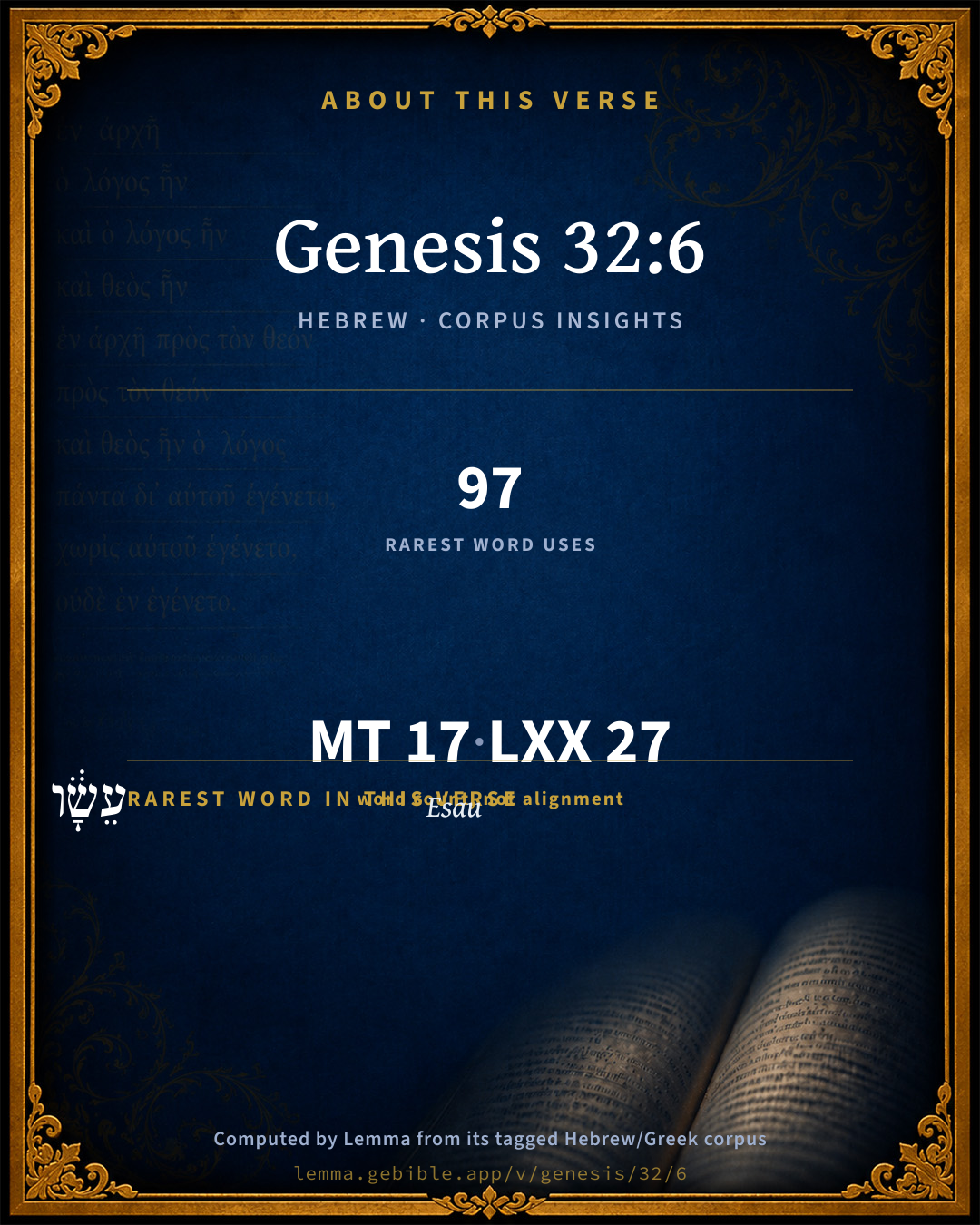
In English translation the verse runs 27 words from the Hebrew and 26 from the Septuagint (LXX English) — closely comparable.

A rough comparison of the two English renderings, which tokenize alike — not a word-level alignment.

Word counts can differ between the Hebrew and the Greek without any difference in meaning — e.g. the Hebrew direct-object marker אֵת has no separate Greek word, and Greek often adds the article ὁ.

In the original languages it is 17 Hebrew tokens and 27 Greek tokens — but the two are counted differently (Hebrew bundles its prefixes and suffixes into one token; the Greek is in lemma form), so that isn’t a like-for-like length.

Cross-references

5

Topical passages linked to Genesis 32:6 in the Treasury of Scripture Knowledge — connected by theme and wording, ordered by reader-vote popularity; previews shown in the World English Bible.

  • Genesis 33:1 Jacob lifted up his eyes, and looked, and, behold, Esau was coming, and with him four hundred men. He divided the children between Leah, Rachel, and to the two handmaids.
  • Genesis 27:40–41 By your sword will you live, and you will serve your brother. It will happen, when you will break loose, That you shall shake his yoke from off your neck."
  • Genesis 32:8 and he said, "If Esau comes to the one company, and strikes it, then the company which is left will escape."
  • Genesis 32:11 Please deliver me from the hand of my brother, from the hand of Esau: for I fear him, lest he come and strike me, and the mothers with the children.
  • Amos 5:19 As if a man fled from a lion, And a bear met him; Or he went into the house and leaned his hand on the wall, And a snake bit him.

Cross-references courtesy of OpenBible.info (CC BY 4.0).

Hebrew and Greek witnesses Masoretic Hebrew ↔ Greek Septuagint

The same verse in the two great witnesses to the Old Testament, shown verse-for-verse.

These are two independent witnesses, not word-aligned to each other, and the Septuagint is shown in lemma (dictionary) form.

Hebrew Genesis 32:6 Masoretic · Westminster Leningrad Codex

וַיָּשֻׁ֨בוּ֙ הַמַּלְאָכִ֔ים אֶֽל יַעֲקֹ֖ב לֵאמֹ֑ר בָּ֤אנוּ אֶל אָחִ֨יךָ֙ אֶל עֵשָׂ֔ו וְגַם֙ הֹלֵ֣ךְ לִקְרָֽאתְךָ֔ וְאַרְבַּע מֵא֥וֹת אִ֖ישׁ עִמּֽוֹ

The messengers returned to Jacob, saying, "We came to your brother Esau. Not only that, but he comes to meet you, and four hundred men with him."

World English Bible · Public Domain

Greek LXX Genesis 32:6 Septuagint · lemma form

καί γίγνομαι ἐγώ βοῦς καί ὄνος καί πρόβατον καί παῖς καί παιδίσκη καί ἀποστέλλω ἀναἀγγέλλω ὁ κύριος ἐγώ ησαυ ἵνα εὑρίσκω ὁ παῖς σύ χάρις ἐναντίον σύ

And the messengers returned to Jacob, saying, We came to your brother Esau, and behold! he comes to meet you, and four hundred men with him.

LXX2012 (modern English Septuagint) · Public Domain

Hebrew: Westminster Leningrad Codex (CC BY 4.0). Greek: Septuagint (public domain); English from LXX2012 (modern English Septuagint) (Public Domain). How the Septuagint differs from the Hebrew →

Targum (Aramaic paraphrase)

2

The Targum is the ancient Jewish Aramaic paraphrase of the Hebrew Scriptures — an interpretive translation, not the Hebrew text itself. Onkelos (literal) and Pseudo-Jonathan (expansive) render the Torah, and Jonathan the Prophets. Coverage is partial: where no permissively-licensed English translation exists for a verse, only the Aramaic is shown. This is verse-level text, not a word-by-word alignment to the Hebrew.

  1. Targum Onkelos Torah (Genesis–Deuteronomy)
    וַהֲוָה לִי תּוֹרִין וַחֲמָרִין עָאן וְעַבְדִּין וְאַמְהָן וּשְׁלָחִית לְחַוָּאָה לְרִבּוֹנִי לְאַשְׁכָּחָא רַחֲמִין בְּעֵינָךְ

    (no public-domain English translation for this verse)

    Targum Onkelos — Aramaic: “Onkelos Genesis” (public domain); “Onkelos Exodus” (public domain); “Onkelos Leviticus” (public domain); “Onkelos Numbers” (public domain); “Onkelos Deuteronomy” (public domain). English: “Sefaria Community Translation” (CC0 1.0 (public-domain dedication)); “J.W. Etheridge. The Targums of Onkelos and Jonathan Ben Uzziel on the Pentateuch. London: Longmans, Green, 1862” (public domain). Text via Sefaria.

  2. Targum Pseudo-Jonathan Torah (Genesis–Deuteronomy)
    וּמִכָּל מַה דִבְרִיךְ יָתִי אַבָּא לֵית בְּיָדִי אֱלָהֵין הֲווֹ לִי כִזְעֵיר תּוֹרִין וְחַמְרִין עָאן וְעַבְדִין וְאַמְהָן וְשַׁדָרִית לְתַנָאָה לְרִבּוֹנִי דְלָא אָהַנְיַית לִי בִּרְכָתָא הַהוּא לְאַשְׁכָּחָא רַחֲמִין בְּעֵינָךְ דְלָא תִינְטוֹר לִי בָּבִין עֲלָהּ

    And of all that in which my father blessed me there is nothing in my hand; but I have a few oxen and asses, sheep, and servants and handmaids; and I have sent to tell my lord that that blessing hath not profited me; that I may find mercy in thine eyes and that thou mayest not maintain (enmity) against me on account thereof.

    Targum Pseudo-Jonathan — Aramaic: “Targum Jonathan on Genesis” (public domain); “Targum Jonathan on Exodus” (public domain); “Targum Jonathan on Leviticus” (public domain); “Targum Jonathan on Numbers” (public domain); “Targum Jonathan on Deuteronomy” (public domain). English: “The Targum of Jonathan ben Uzziel, trans. J. W. Etheridge, London, 1862” (public domain). Text via Sefaria.

Commentary

Notes on Genesis 32:6 from classic Christian and Jewish commentators (each source and its license shown beneath its notes). The classic Christian expositions comment on the surrounding passage and are grouped to its opening verse, so a note may address several verses; the Jewish commentaries on the Tanakh (Rashi and others) are per-verse, so they appear only where the commentator wrote on this verse.

Lemma curates 59 commentaries, every one of them public domain or Creative Commons licensed, each selected and text-cleaned for this edition rather than reprinted as found. About our sources →

Trapp's Complete Commentary

John Trapp

Gen 32:6 And the messengers returned to Jacob, saying, We came to thy brother Esau, and also he cometh to meet thee, and four hundred men with him.

Ver. 6. And four hundred men with him.] Four hundred cut-throats, as appears, Gen 32:8. And here, good Jacob is brought again into the briars. When he was well rid of his father-in-law, he thought all safe; and his joy was completed by the sight of that army of angels. Presently upon this, he is so damped and terrified with this sad message of Esau’s approach and hostile intentions, that he knows not what course to take to. Out of heaven he is thrust suddenly, as it were, into hell, saith Pareus. {a} This is the godly man’s case while here. Fluctus fluclum trudit: one trouble follows in the neck of another. {b} Ripen we apace, and so get to heaven, if we would be out of the gunshot, The ark was transportative, till settled in Solomon’s Temple; so, till we come to heaven, shall we be tossed up and down and turmoiled: "within" will be "fears, without fightings," {2Co 7:5} while we are in hoc exilio, in hoc ergastulo, in hac peregrinatione, in hac valle lachrymarum , as Bernard hath it; in this exile, in this purgatory, in this pilgrimage, in this vale of tears.

{a} Ex coelo repente quasi in infernum detruditur.

{b} Pονος πονω πονον φερει

John Trapp, A Commentary or Exposition upon All the Books of the Old and New Testament (1647–1656) — public domain. Text from a community e-Sword module.

Joseph Benson's Commentary

Gen 32:6-7. He cometh to meet thee, and four hundred men with him — He is now weary of waiting for the days of mourning for his father, and before they come resolves to slay thee. Then was Jacob greatly afraid and distressed — He was conscious how deeply he had offended his brother, and remembered the enmity which his brother cherished against him, and hence was not without an apprehension that he might now execute the threatened revenge. We see here how a consciousness of sin tends to weaken faith, and to produce fear and dread. For, notwithstanding the repeated experience Jacob had had of the divine protection; though he had just seen himself surrounded with a host of guardian angels; though he had undertaken his journey in obedience to God’s express command, and had God’s renewed promise to assure him of a safe return, (Gen 28:15; Gen 31:13,) yet a consciousness of having injured his brother, and of his brother’s having it in his power, should God permit him, to avenge himself, damps his faith, and fills him with the most painful and distressing apprehensions. A lively sense of danger, however, may very well consist with a degree of confidence in God’s power and goodness.

Joseph Benson's Commentary on the Old and New Testaments (1811–1818) — public domain. Text from a community e-Sword module.

Jamieson, Fausset & Brown

Robert Jamieson, A. R. Fausset & David Brown

The messengers returned to Jacob--Their report left Jacob in painful uncertainty as to what was his brother's views and feelings. Esau's studied reserve gave him reason to dread the worst. Jacob was naturally timid; but his conscience told him that there was much ground for apprehension, and his distress was all the more aggravated that he had to provide for the safety of a large and helpless family.

Jamieson, Fausset & Brown — Commentary Critical and Explanatory on the Whole Bible (1871) — public domain (CC PDM 1.0). Text via the HelloAO Bible API.

Adam Clarke's Commentary

Verse 6. Esau - cometh - and four hundred men with him.] Jacob, conscious that he had injured his brother, was now apprehensive that he was coming with hostile intentions, and that he had every evil to fear from his displeasure. Conscience is a terrible accuser. It was a fine saying of a heathen, --

_____Hic murus aheneus esto,

Nil conscire sibi, nulla pallescere culpa.

HOR. Ep., l. i., E. i., v. 60.

Be this thy brazen bulwark of defence,

Still to preserve thy conscious innocence,

Nor e'er turn pale with guilt. FRANCIS.

In other words, He that has a good conscience has a brazen wall for his defence; for a guilty conscience needs no accuser; sooner or later it will tell the truth, and not only make the man turn pale who has it, but also cause him to tremble even while his guilt is known only to himself and God.

It does not appear that Esau in this meeting had any hostile intention, but was really coming with a part of his servants or tribe to do his brother honour. If he had had any contrary intention, God had removed it; and the angelic host which Jacob met with before might have inspired him with sufficient confidence in God's protection. But we find that when he needed faith most, he appears to have derived but little benefit from its influence, partly from the sense he had of the injury he had done to his brother, and partly from not attending sufficiently to the assurance which God had given him of his gracious protection.

Adam Clarke's Commentary on the Bible (1810–1826) — public domain. Text from a community e-Sword/MySword module.

John Calvin's Commentaries

6. And the messengers returned. Esau advances to meet his brother with a feeling of benevolence: but Jacob, reflecting on his cruel ferocity, inflated spirits, and savage threats, expects no humanity from him. And the Lord willed that the mind of his servant should be oppressed by this anxiety for a time, although without any real cause, in order the more to excite the fervor of his prayer. For we know what coldness, on this point, security engenders. Therefore, lest our faith, being stirred up by no stimulants, should become torpid, God often suffers us to fear things which are not terrible in themselves. For although he anticipates our wishes, and opposes our evils, he yet conceals his remedies until he has exercised our faith. Meanwhile it is to be noted, that the sons of God are never endued with a constancy so steadfast, that the infirmity of the flesh does not betray itself in them. For they who fancy that faith is exempt from all fear, have had no experience of the true nature of faith. For God does not promise that he will be present with us for the purpose of removing the sense of our dangers, but in order that fear may not prevail, and overwhelm us in despair. Moreover our faith is never so firm at every point, as to repel wicked doubts and sinful fears, in the way that might be wished.

John Calvin's Commentaries (1540-1563) — public domain. Text from the Calvin Translation Society English edition (1840s-50s) via the Christian Classics Ethereal Library (ccel.org). Calvin's coverage is partial (roughly two-thirds of the Bible); uncommented books and verses are honest gaps, never fabricated. The 19th-century editor's footnotes and remarks are omitted so the notes are faithfully Calvin's own voice.

The Cambridge Bible for Schools and Colleges

gen. ed. J. J. S. Perowne

6. four hundred men] Where Esau was, and how he had become the head of a force of four hundred men, is not related, but may have formed part of another narrative. His intentions, if not hostile, are suspicious (cf. Gen_33:4).

The Cambridge Bible for Schools and Colleges (gen. ed. J. J. S. Perowne; Cambridge University Press, 1878–1918) — public domain. Text from a community e-Sword module.

John Gill's Exposition

And the messengers returned to Jacob,.... After they had delivered their message, with the answer they brought back:

saying, we came to thy brother Esau; which, though not expressed, is implied in these words, and is still more manifest by what follows:

and also he cometh to meet thee; and pay a friendly visit, as they supposed:

and four hundred men with him; partly to show his grandeur, and partly out of respect to Jacob, and to do honour to him; though some think this was done with an ill design upon him, and which indeed seems probable; and it is certain Jacob so understood it, as is evident by the distress it gave him, and by the methods he took for his safety, and by the gracious appearance of God unto him, and the strength he gave him on this occasion, not only to pray to and wrestle with him, but to prevail both with God and men, as the following account shows. The Targums of Jonathan and Jerusalem call these four hundred men leaders or generals of armies, which is not probable; they were most likely Esau's subjects, his tenants and servants.

John Gill's Exposition of the Whole Bible (1746–1763) — public domain (CC PDM 1.0). Text via the HelloAO Bible API.

Haydock's Catholic Bible Commentary

Men. Jonathan has Polemarchoi; officers or warriors, either to punish Jacob, (Wisdom x. 12.) as the latter feared, ver. 11; or to do him honour, as Esau protested, chap. xxxiii. 15. (Calmet)

George Leo Haydock (1774–1849), Haydock's Catholic Family Bible and Commentary, 1859 edition — public domain. Excludes Psalms (Douay-Rheims chapter numbering differs from Protestant) and Deuterocanonical books (Catholic canon only).

Matthew Poole's English Annotations

Esau gave them but an imperfect and a doubtful answer, as appears from Jacob’s fear, Gen 32:7. He brought

four hundred men with him; either as his usual guard, he being then a great man in those parts; or in ostentation of his power and greatness, in spite of all the injury which his father or brother did him; or because at first he designed mischief to Jacob, as may seem by his dismissing of his messengers without any testimony of his favour, though afterwards, upon Jacob’s prayer, God changed his mind.

Matthew Poole's English Annotations on the Holy Bible (1683–1685) — public domain. Text from a community e-Sword/MySword module.

The Pulpit Commentary

And the messengers returned to Jacob, saying, We came to thy brother Esau, and also he cometh to meet thee, (vide Gen_33:1) and four hundred men with him. That Esau was attended by 400 armed followers was a proof that he had grown to be a powerful chieftain. If the hypothesis be admissible that he had already begun to live by the, (Gen_27:40) and was now invading the territory of the Horites, which he afterwards occupied (Delitzsch, Keil, Kurtz), it will serve to explain his appearance in the land of Seir, while as yet he had not finally retired from Canaan. That he came with such a formidable force to meet his brother has been set down to personal vanity, or a desire to show how powerful a prince he had become (Lyra, Menochius); to fraternal kindness, which prompted him to do honor to his brother (Peele, Calvin, Clarke), to a distinctly hostile intention (Willet, Ainsworth, Candlish), at least if circumstances should seem to call for vengeance (Keil), though it is probable that Esau"s mind, on first hearing of his brother"s nearness, was simply excited, and "in that wavering state which the slightest incident might soothe into good will, or rouse into vengeance" (Murphy).

The Pulpit Commentary (1880–1919), ed. H.D.M. Spence-Jones & Joseph S. Exell — public domain. Text from a community e-Sword module.

John Wesley's Explanatory Notes

He cometh to meet thee, and four hundred men with him - He is now weary of waiting for the days of mourning for his father, and before those come resolves to slay his brother. Out he marches with four hundred men, probably such as used to hunt with him, armed no doubt, ready to execute the word of command.

John Wesley, Explanatory Notes Upon the Whole Bible (1754–1765) — public domain. Text via the GEBible commentary corpus.

unfoldingWord translationNotes

Door43 World Missions Community

four hundred men

"400 men" (See: Numbers)

afraid

This refers to the unpleasant feeling a person has when there is a threat of harm to himself or others.

upset

distressed, troubled

to one camp and attacks it, then the camp that is left will escape

Here "camp" refers to the people. AT: "to attack the people in one camp, then the people in the other camp will escape" (See: Metonymy)

translationWords

Esau

fear

flocks

camel

unfoldingWord translationNotes — © Distant Shores Media and the Door43 World Missions Community, licensed CC BY-SA 4.0. Source: git.door43.org/Door43/en_tn.

Rashi

Rabbi Shlomo Yitzchaki (Rashi)

ויהי לי שור וחמור AND I HAVE OXEN AND ASSES — Our father promised me, (27:28) “[God will give thee] of the dew of heaven and of the fat places of the earth” — these are neither of the heaven nor of the earth

שור וחמור (literally, an ox and an ass) — It is the customary thing to speak of many oxen as an ox (Genesis Rabbah 75:6) — a man says to his fellow, “During the night the cock crowed”; he does not say “the cocks crowed”

ואשלחה להגיד לאדוני AND I HAVE SENT TO TELL MY LORD — to announce that I am coming to you.

למצא חן בעיניך THAT I MAY FIND FAVOUR IN THY EYES, for I am at peace with you and seek your friendship.

Rashi on the Tanakh — English translations: “The Judaica Press complete Tanach with Rashi, translated by A. J. Rosenberg” (CC BY 4.0); “Pentateuch with Rashi's commentary by M. Rosenbaum and A.M. Silbermann, 1929-1934” (public domain); “The Metsudah Tanach series, Lakewood, N.J” (CC BY 4.0); and “The Book of Joshua, Metsudah Publications, 1997” (CC BY 4.0). Text via Sefaria.

Ramban (Nachmanides)

Rabbi Moshe ben Nachman (Ramban / Nachmanides)

AND I HAVE SENT TO TELL MY LORD. I.e., “to announce that I am coming to you. That I may find favour in thy sight for I am at peace with you and seek your friendship.” These are Rashi’s words. Rashi’s intent is that the verse; I have sent to tell my lord, does not refer to the previous verse, I have sojourned with Laban, etc. but, instead, it says, “And I have sent to tell my lord that I have come to find favour in thy sight and to do whatever my lord will command.”But it is more correct to say that it refers to the verse above: “And I have sent to tell my lord that I have wealth, belongings, and precious things, to do with them according to your desire and will.” He thus hinted to him that he would send him a present from them, or that Esau may take from him whatever he desires. And so, when Esau asked Jacob, What meanest thou by all this camp which I met? he [Jacob] said: To find favour in the sight of my lord.

Ramban (Nachmanides) on the Tanakh — English translation: “Commentary on the Torah by Ramban (Nachmanides). Translated and annotated by Charles B. Chavel. New York, Shilo Pub. House, 1971-1976” (CC BY 4.0). Text via Sefaria.

Radak

Rabbi David Kimhi (Radak)

ויהי לי שור וחמור. All the types of possessions Yaakov mentioned are not to be understood as single items but as categories of possessions. We find similar constructions in Kings II 7,10 כי אם הסוס אסור, which does not mean that a single horse had been tethered, but that the horses belonging to the army of the Aramites were tethered, the soldiers having fled. Similarly, Samuel I 14,24 where the words ואיש ישראל נגש do not mean that a single Israelite was distressed, but that a contingent of Israelites was in a depressed state of mind.

Radak on the Tanakh — English translations: “Sefaria Community Translation” (CC0 1.0 (public-domain dedication)); “Eliyahu Munk, HaChut Hameshulash” (CC BY 4.0); “Rabbi Mike Feuer, Jerusalem Anthology” (CC BY 4.0); and “R. David Kimhi on the first book of Psalms, Translated by R.G. Finch, London, 1919” (public domain). Text via Sefaria.

Lesson kit

Teaching starters — assembled from the data on this page, not authored interpretation. Every prompt links to the verse data it draws on. Edit before teaching.

Genesis, in the Pentateuch, opens this verse with 17 words (15 distinct Hebrew lemmas). Its most distinctive word is ʻÊsâv (“Esau”). A historical commentator’s framing appears above. Read the whole chapter for the surrounding context.

Discussion questions

  1. The word ʻÊsâv carries the sense “Esau.” How does it shape the verse?
  2. How does Genesis 33:1, which shares this passage’s theme, read alongside this verse?
  3. What does the repetition of “to” (3× in this one verse) do in this verse?
  4. These translations render this verse differently; the difference is in the English rendering, not the original. What questions does that raise?
  5. «וַיָּשֻׁ֨בוּ֙» is a Qal Sequential Imperfect verb. How does that grammatical form shape the action described?
  6. Compare how Trapp's Complete Commentary and Joseph Benson's Commentary read this verse. Where do they agree or differ?

Things to notice

Reading settings

Reading text

Shown beneath each verse's original-language words.

Old Testament
Old Testament edition

Read the OT as the Masoretic Hebrew (MT) or the Greek Septuagint (LXX).

English shown for the Greek Septuagint (in the Hebrew ↔ Greek comparison).

Comparing translations? Open the Compare panel on any verse page to stack up to four side by side.