
Genesis 6:4

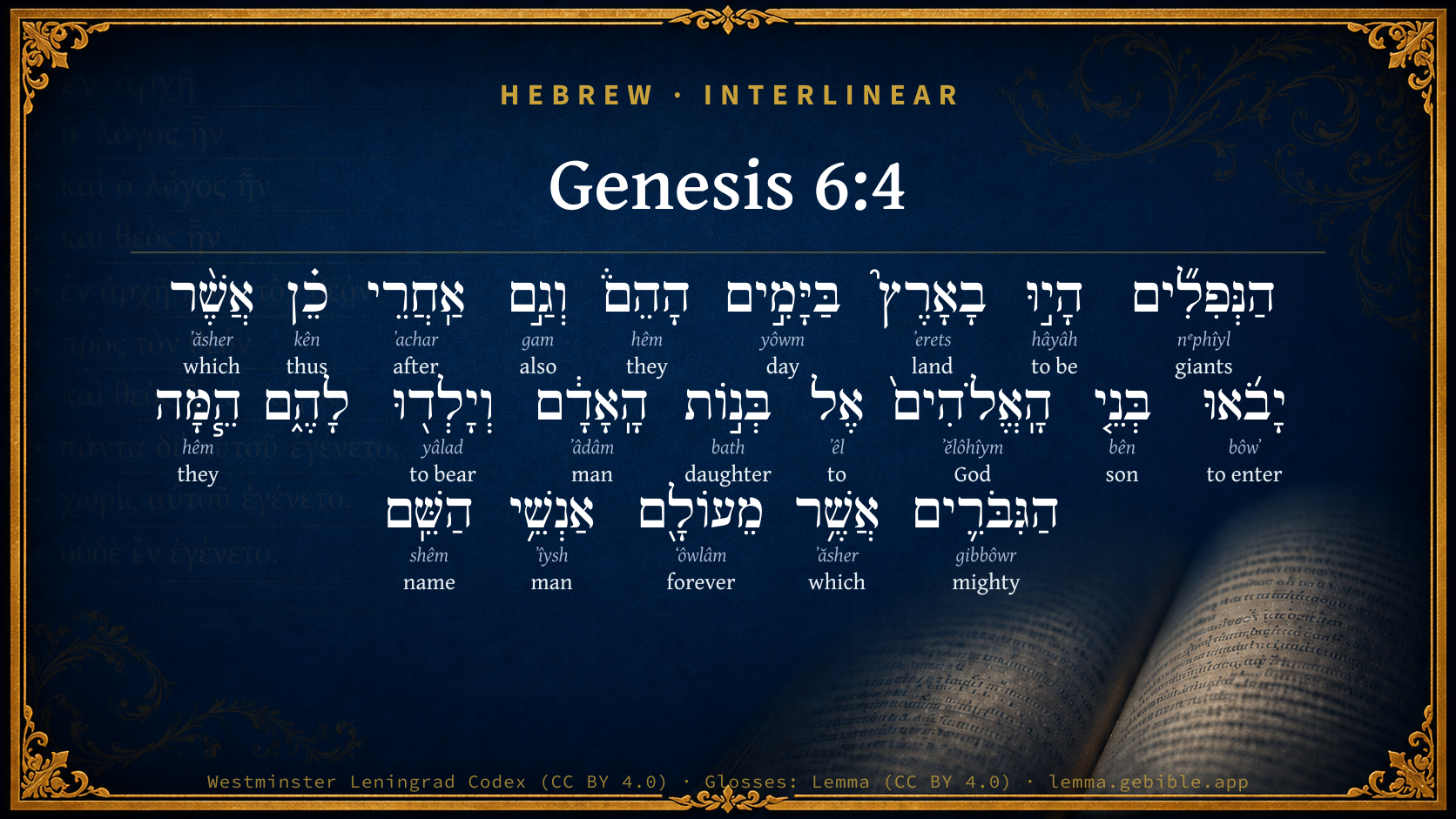
Hebrew (Westminster Leningrad Codex) Genesis 6:4 appears in the Hebrew Old Testament. The text above is from the Westminster Leningrad Codex. Each word links to its Strong’s number, a concise gloss, and parsing drawn from the Open Scriptures Hebrew Bible morphology. Click any word for its full Brown-Driver-Briggs (BDB) entry.
Download image
Cite this verse

Genesis 6:4 (World English Bible). Public Domain. Lemma interlinear Bible study tool, https://lemma.gebible.app/v/genesis/6/4.

Show BibTeX & RIS
BibTeX
RIS
English Translation
The Nephilim were in the earth in those days, and also after that, when God's sons came to men's daughters. They bore children to them: the same were the mighty men who were of old, men of renown.
World English Bible · Public Domain
Highlights
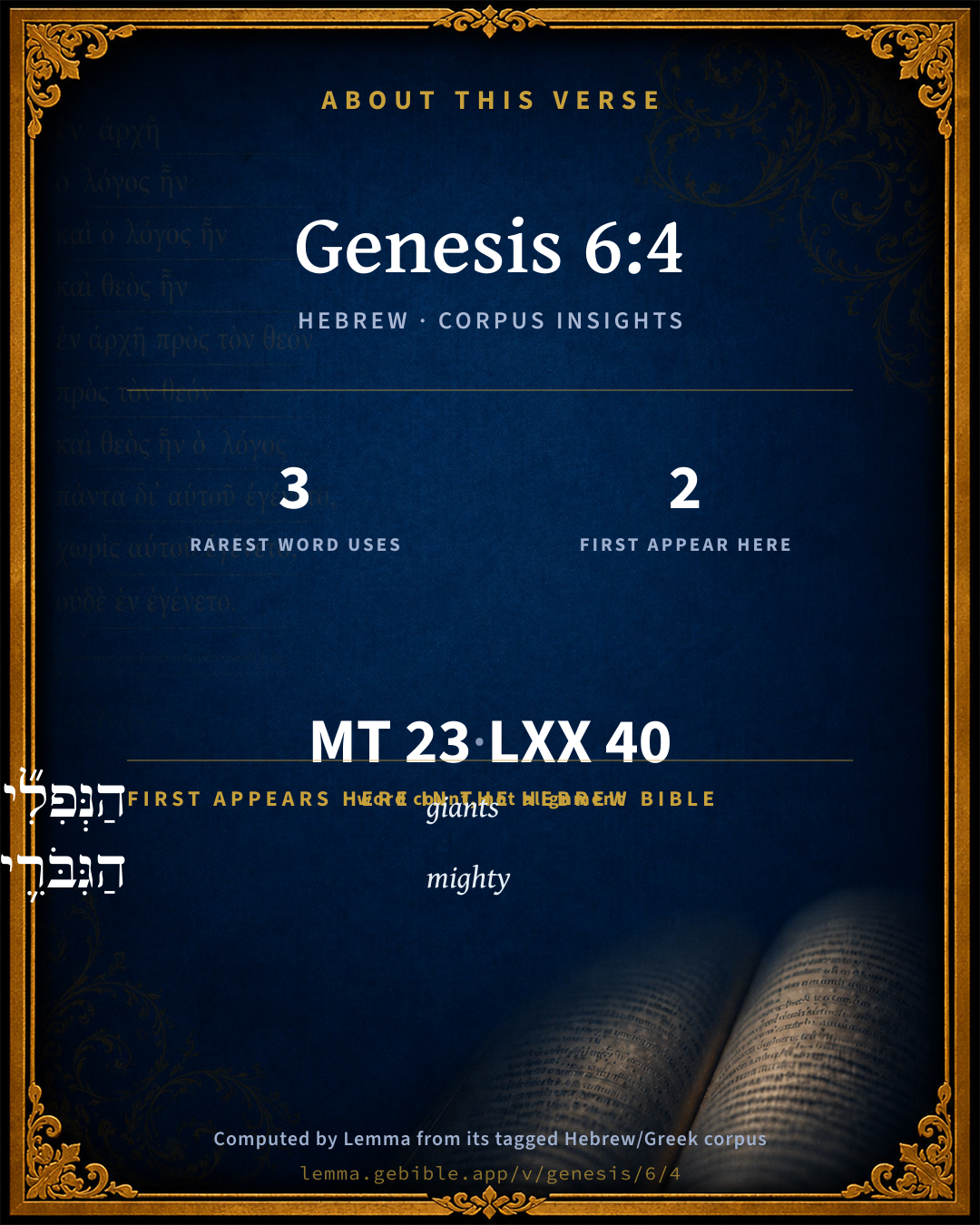
  • 2 first appearances in the Hebrew Bible
Full analysis ↓
Download a study sheet

One document with this verse’s original text, its word-by-word gloss line, the meaning frame, cross-references with their text, attributed commentary, and full source and license credits — printable, and it pastes into notes with its structure intact.

This verse Autodidact and up

Study sheet (.html) Plain text (.txt)

A passage Seminary Student

Up to 50 verses in one chapter. A passage sheet keeps up to 6 commentary sources and 12 cross-references per verse, in the order this page ranks them, and says so on the sheet whenever that leaves anything out. Ask for a single verse and you get the Autodidact verse sheet above.

Everything on this page stays free to read, with no account — the sheet is a download of what is already on screen, not access to it.

Want to remove ads? Support Godless Engineer
Compare translations 3

The same verse in 3 English versions, stacked beneath the original-language interlinear above. Click any original word for its lexicon entry.

Each is an independent rendering of the whole verse — the interlinear is not word-aligned to these translations.

Highlighted words mark where these versions differ — a whole-verse word diff, not a word-by-word alignment.

  • World English Bible Public Domain
    The Nephilim were in the earth in those days, and also after that, when God's sons came to men's daughters. They bore children to them: the same were the mighty men who were of old, men of renown.
  • King James Version Public Domain
    There were giants in the earth in those days; and also after that, when the sons of God came in unto the daughters of men, and they bare children to them, the same became mighty men which were of old, men of renown.
  • unfoldingWord Literal Text CC BY-SA 4.0
    The Nephilim were on the earth in those days and also after that, when the sons of God went to the daughters of mankind, and they bore children for them. They the mighty who from long ago, the men of renown.

unfoldingWord Literal Text — © unfoldingWord, licensed CC BY-SA 4.0. Word-aligned USFM3 via Door43 (git.door43.org/unfoldingWord/en_ult).

Versions to compare (up to 4)

3 of 4 selected

Show all 18 translations

Every available English version of this verse, each an independent rendering of the whole verse.

  • World English Bible Public Domain
    The Nephilim were in the earth in those days, and also after that, when God's sons came to men's daughters. They bore children to them: the same were the mighty men who were of old, men of renown.
  • Berean Standard Bible Public Domain
    The Nephilim were on the earth in those days—and afterward as well—when the sons of God had relations with the daughters of men. And they bore them children who became the mighty men of old, men of renown.
  • Majority Standard Bible Public Domain
    The Nephilim were on the earth in those days—and afterward as well—when the sons of God had relations with the daughters of men. And they bore them children who became the mighty men of old, men of renown.
  • King James Version Public Domain
    There were giants in the earth in those days; and also after that, when the sons of God came in unto the daughters of men, and they bare children to them, the same became mighty men which were of old, men of renown.
  • American Standard Version (1901) Public Domain
    The Nephilim were in the earth in those days, and also after that, when the sons of God came unto the daughters of men, and they bare children to them: the same were the mighty men that were of old, the men of renown.
  • Revised Version (1885) Public Domain
    The Nephilim were in the earth in those days, and also after that, when the sons of God came in unto the daughters of men, and they bare children to them: the same were the mighty men which were of old, the men of renown.
  • Geneva Bible (1599) Public Domain
    There were gyants in the earth in those dayes: yea, and after that the sonnes of God came vnto the daughters of men, and they had borne them children, these were mightie men, which in olde time were men of renoume.
  • Douay-Rheims (1899) Public Domain
    Now giants were upon the earth in those days. For after the sons of God went in to the daughters of men and they brought forth children, these are the mighty men of old, men of renown.
  • Young's Literal Translation Public Domain
    The fallen ones were in the earth in those days, and even afterwards when sons of God come in unto daughters of men, and they have borne to them -- they `are' the heroes, who, from of old, `are' the men of name.
  • Literal Standard Version CC BY-SA 4.0
    The giants were in the earth in those days, and even afterward, when sons of God come in to the daughters of men, and they have borne to them those who [were] the mighty from of old, the men of renown.
  • Unlocked Literal Bible CC BY-SA 4.0
    Giants were on the earth in those days, and also afterward. This happened when the sons of God married daughters of men, and they had children with them. These were the mighty men of old, men of renown.
  • unfoldingWord Literal Text CC BY-SA 4.0
    The Nephilim were on the earth in those days and also after that, when the sons of God went to the daughters of mankind, and they bore children for them. They the mighty who from long ago, the men of renown.
  • Darby Bible Public Domain
    In those days were the giants on the earth, and also afterwards, when the sons of God had come in to the daughters of men, and they had borne [children] to them; these were the heroes, who of old were men of renown.
  • World Messianic Bible Public Domain
    The Nephilim were in the earth in those days, and also after that, when God’s sons came in to men’s daughters and had children with them. Those were the mighty men who were of old, men of renown.
  • Webster's Bible Public Domain
    There were giants in the earth in those days; and also after that, when the sons of God came in to the daughters of men, and they bore children to them: the same became mighty men, who were of old, men of renown.
  • Free Bible Version CC BY-SA 4.0
    There were giants on earth in those days, and also later on. They were born after the sons of God slept with the daughters of these people. Their sons became the great warriors and famous men of ancient times.
  • Bible in Basic English Public Domain
    There were men of great strength and size on the earth in those days; and after that, when the sons of God had connection with the daughters of men, they gave birth to children: these were the great men of old days, the men of great name.
  • JPS Tanakh (1917) Public Domain
    The Nephilim were in the earth in those days, and also after that, when the sons of God came in unto the daughters of men, and they bore children to them; the same were the mighty men that were of old, the men of renown.

Literal Standard Version (2020), Covenant Press — licensed CC BY-SA 4.0. Text via the HelloAO Bible API (eBible.org). Unlocked Literal Bible (unfoldingWord) — licensed CC BY-SA 4.0. Text via the HelloAO Bible API (eBible.org). unfoldingWord Literal Text — © unfoldingWord, licensed CC BY-SA 4.0. Word-aligned USFM3 via Door43 (git.door43.org/unfoldingWord/en_ult). Free Bible Version, Dr. Jonathan Gallagher — licensed CC BY-SA 4.0. Text via the HelloAO Bible API (eBible.org).

Word by word

More ways to search: Search by grammar → Find every occurrence → Compare this word →

Practice this passage: Drill this verse → Learn its vocabulary →

הַנְּפִלִ֞ים
nᵉphîyl
H5303
“the · giants”
Particle, Definite Article + Noun, Common, Masculine, Plural, Absolute
Part of Speech
Particle + Noun
Type
Common
Gender
Masculine
Number
Plural
State
Absolute
Full BDB Definition

Origin: from H5307

TWOT: 1393a

giants, the Nephilim
  1. הָי֣וּ hâyâh H1961 “to be” Verb, Qal, Perfect, 3rd Person, Common, Plural
  2. בָאָרֶץ֮ ʼerets H776 “in/at the · land” Preposition, Determined + Noun, Common, Both, Singular, Absolute
  3. בַּיָּמִ֣ים yôwm H3117 “in/at the · days” Preposition, Determined + Noun, Common, Masculine, Plural, Absolute
  4. הָהֵם֒ hêm H1992 “the · they” Particle, Definite Article + Pronoun, Personal, 3rd Person, Masculine, Plural
  5. וְגַ֣ם gam H1571 “and · also” Conjunction + Particle, Accusative
  6. אַֽחֲרֵי ʼachar H310 “after” Preposition
  7. כֵ֗ן kên H3651 “thus” Adverb
  8. אֲשֶׁ֨ר ʼăsher H834 “which” Particle, Relative
  9. יָבֹ֜אוּ bôwʼ H935 “to enter” Verb, Qal, Imperfect, 3rd Person, Masculine, Plural
  10. בְּנֵ֤י bên H1121 “sons of” Noun, Common, Masculine, Plural, Construct
  11. הָֽאֱלֹהִים֙ ʼĕlôhîym H430 “the · God(s)” Particle, Definite Article + Noun, Common, Masculine, Plural, Absolute
  12. אֶל ʼêl H413 “to” Preposition
  13. בְּנ֣וֹת bath H1323 “daughters of” Noun, Common, Feminine, Plural, Construct
  14. הָֽאָדָ֔ם ʼâdâm H120 “the · man” Particle, Definite Article + Noun, Common, Masculine, Singular, Absolute
  15. וְיָלְד֖וּ yâlad H3205 “and · to bear” Conjunction + Verb, Qal, Sequential Perfect, 3rd Person, Common, Plural
  16. הֵ֧מָּה hêm H1992 “they” Pronoun, Personal, 3rd Person, Masculine, Plural
  17. הַגִּבֹּרִ֛ים gibbôwr H1368 “the · mighty” Particle, Definite Article + Adjective, Adjective, Masculine, Plural, Absolute
  18. אֲשֶׁ֥ר ʼăsher H834 “which” Particle, Relative
  19. מֵעוֹלָ֖ם ʻôwlâm H5769 “from · forever” Preposition + Noun, Common, Masculine, Singular, Absolute
  20. אַנְשֵׁ֥י ʼîysh H376 “men of” Noun, Common, Masculine, Plural, Construct
  21. הַשֵּֽׁם shêm H8034 “the · name” Particle, Definite Article + Noun, Common, Masculine, Singular, Absolute

About this verse

These counts appear in no published source. They are computed here, from the morphology-tagged text and Lemma’s own curated glosses. What Lemma adds →

23
words
20
distinct lemmas
Pentateuch
section

Notable vocabulary

The rarest word here is הַנְּפִלִ֞ים giants H5303 — appearing just 3 times in the whole Hebrew Bible.

First appearance in Scripture

These words make their first canonical appearance in the Hebrew Bible here:

  • הַנְּפִלִ֞ים giants H5303
  • הַגִּבֹּרִ֛ים mighty H1368

Shared distinctive vocabulary

הַנְּפִלִ֞ים giants H5303 occurs in 2 verses of the Hebrew Bible. Also found in:

Grammatical profile

  • 3 verbs
  • 10 nouns
  • 1 adjective
  • 2 pronouns
  • 3 prepositions
  • 1 adverb
  • 3 particles

Verb forms

  • הָי֣וּ Qal · Perfect
  • יָבֹ֜אוּ Qal · Imperfect
  • וְיָלְד֖וּ Qal · Sequential Perfect

Repetition

Words recur within this verse — often emphatic in Hebrew:

  • הָהֵם֒ they H1992 ×2
  • אֲשֶׁ֨ר which H834 ×2

Hebrew & Septuagint length

In English translation the verse runs 38 words from the Hebrew and 43 from the Septuagint (LXX English) — closely comparable.

A rough comparison of the two English renderings, which tokenize alike — not a word-level alignment.

Word counts can differ between the Hebrew and the Greek without any difference in meaning — e.g. the Hebrew direct-object marker אֵת has no separate Greek word, and Greek often adds the article ὁ.

In the original languages it is 23 Hebrew tokens and 40 Greek tokens — but the two are counted differently (Hebrew bundles its prefixes and suffixes into one token; the Greek is in lemma form), so that isn’t a like-for-like length.

Cross-references

6

Topical passages linked to Genesis 6:4 in the Treasury of Scripture Knowledge — connected by theme and wording, ordered by reader-vote popularity; previews shown in the World English Bible.

  • Numbers 13:33 There we saw the Nephilim, the sons of Anak, who come of the Nephilim: and we were in our own sight as grasshoppers, and so we were in their sight.
  • Deuteronomy 3:11 (For only Og king of Bashan remained of the remnant of the Rephaim; behold, his bedstead was a bedstead of iron; isn't it in Rabbah of the children of Ammon? nine cubits was the length of it, and four cubits the breadth of it, after the cubit of a man.)
  • 1 Samuel 17:4 There went out a champion out of the camp of the Philistines, named Goliath, of Gath, whose height was six cubits and a span.
  • 2 Samuel 21:15–22 The Philistines had war again with Israel; and David went down, and his servants with him, and fought against the Philistines. David grew faint;
  • Deuteronomy 2:20–21 (That also is accounted a land of Rephaim: Rephaim lived therein before; but the Ammonites call them Zamzummim,
  • Numbers 16:2 and they rose up before Moses, with certain of the children of Israel, two hundred fifty princes of the congregation, called to the assembly, men of renown;

Cross-references courtesy of OpenBible.info (CC BY 4.0).

Hebrew and Greek witnesses Masoretic Hebrew ↔ Greek Septuagint

The same verse in the two great witnesses to the Old Testament, shown verse-for-verse.

These are two independent witnesses, not word-aligned to each other, and the Septuagint is shown in lemma (dictionary) form.

Hebrew Genesis 6:4 Masoretic · Westminster Leningrad Codex

הַנְּפִלִ֞ים הָי֣וּ בָאָרֶץ֮ בַּיָּמִ֣ים הָהֵם֒ וְגַ֣ם אַֽחֲרֵי כֵ֗ן אֲשֶׁ֨ר יָבֹ֜אוּ בְּנֵ֤י הָֽאֱלֹהִים֙ אֶל בְּנ֣וֹת הָֽאָדָ֔ם וְיָלְד֖וּ לָהֶ֑ם הֵ֧מָּה הַגִּבֹּרִ֛ים אֲשֶׁ֥ר מֵעוֹלָ֖ם אַנְשֵׁ֥י הַשֵּֽׁם

The Nephilim were in the earth in those days, and also after that, when God's sons came to men's daughters. They bore children to them: the same were the mighty men who were of old, men of renown.

World English Bible · Public Domain

Greek LXX Genesis 6:4 Septuagint · lemma form

ὁ δέ γίγας εἰμί ἐπί ὁ γῆ ἐν ὁ ἡμέρα ἐκεῖνος καί μετά ἐκεῖνος ὡς ἄν εἰςπορεύομαι ὁ υἱός ὁ θεός πρός ὁ θυγάτηρ ὁ ἄνθρωπος καί γεννάω ἑαυτοῦ ἐκεῖνος εἰμί ὁ γίγας ὁ ἀπό αἰών ὁ ἄνθρωπος ὁ ὀνομαστός

Now the giants were upon the earth in those days; and after that when the sons of God were wont to go in to the daughters of men, they bore children to them, those were the giants of old, the men of renown.

LXX2012 (modern English Septuagint) · Public Domain

On this verse, Adam Clarke's Commentary discusses the Septuagint’s reading. Read the note in Commentary ↓

Hebrew: Westminster Leningrad Codex (CC BY 4.0). Greek: Septuagint (public domain); English from LXX2012 (modern English Septuagint) (Public Domain). How the Septuagint differs from the Hebrew →

Targum (Aramaic paraphrase)

2

The Targum is the ancient Jewish Aramaic paraphrase of the Hebrew Scriptures — an interpretive translation, not the Hebrew text itself. Onkelos (literal) and Pseudo-Jonathan (expansive) render the Torah, and Jonathan the Prophets. Coverage is partial: where no permissively-licensed English translation exists for a verse, only the Aramaic is shown. This is verse-level text, not a word-by-word alignment to the Hebrew.

  1. Targum Onkelos Torah (Genesis–Deuteronomy)
    גִּבָּרַיָּא הֲווֹ בְאַרְעָא בְּיוֹמַיָּא הָאִנּוּן וְאַף בָּתַר כֵּן דִּי יַעֲלוּן בְּנֵי רַבְרְבַיָּא לְוַת בְּנַת אֱנָשָׁא וִילִידָן לְהוֹן אִנוּן גִּבָּרַיָּא דִּמֵעָלְמָא אֱנָשִׁין דִּשְׁמָא

    Giants were in the earth in those days; and also when, after that the sons of the mighty had gone in unto the daughters of men, there were born from them giants who from of old were men of name.

    Targum Onkelos — Aramaic: “Onkelos Genesis” (public domain); “Onkelos Exodus” (public domain); “Onkelos Leviticus” (public domain); “Onkelos Numbers” (public domain); “Onkelos Deuteronomy” (public domain). English: “Sefaria Community Translation” (CC0 1.0 (public-domain dedication)); “J.W. Etheridge. The Targums of Onkelos and Jonathan Ben Uzziel on the Pentateuch. London: Longmans, Green, 1862” (public domain). Text via Sefaria.

  2. Targum Pseudo-Jonathan Torah (Genesis–Deuteronomy)
    שַׁמְחַזָאֵי וְעוּזִיאֵל הִינוּן נְפִילִין מִן שְׁמַיָא וַהֲווֹ בְּאַרְעָא בְּיוֹמַיָא הָאִינוּן וְאוּף בָּתַר כֵּן דַעֲלוּן בְּנֵי רַבְרְבַיָא לְוַת בְּנַת אֱנָשָׁא וִילִידַן לְהוֹן וְהִינוּן מִתְקְרִין גַבְרִין דִמְעַלְמָא אִינְשֵׁי שְׁמָהָן

    Schamchazai and Uzziel, who fell from heaven, were on the earth in those days; and also, after the sons of the Great had gone in with the daughters of men, they bare to them: and these are they who are called men who are of the world, men of names.

    Targum Pseudo-Jonathan — Aramaic: “Targum Jonathan on Genesis” (public domain); “Targum Jonathan on Exodus” (public domain); “Targum Jonathan on Leviticus” (public domain); “Targum Jonathan on Numbers” (public domain); “Targum Jonathan on Deuteronomy” (public domain). English: “The Targum of Jonathan ben Uzziel, trans. J. W. Etheridge, London, 1862” (public domain). Text via Sefaria.

Commentary

Notes on Genesis 6:4 from classic Christian and Jewish commentators (each source and its license shown beneath its notes). The classic Christian expositions comment on the surrounding passage and are grouped to its opening verse, so a note may address several verses; the Jewish commentaries on the Tanakh (Rashi and others) are per-verse, so they appear only where the commentator wrote on this verse.

Lemma curates 59 commentaries, every one of them public domain or Creative Commons licensed, each selected and text-cleaned for this edition rather than reprinted as found. About our sources →

Trapp's Complete Commentary

John Trapp

Gen 6:4 There were giants in the earth in those days; and also after that, when the sons of God came in unto the daughters of men, and they bare [children] to them, the same [became] mighty men which [were] of old, men of renown.

Ver. 4. There were giants.] Gigantes, quasi Gηγενεις, earth-sprung. They were "of the earth, they spake of the earth," {Joh 3:31} and the earth heard them; heard them, I say, and fell before them; as the beasts of the field do before the roaring lion. Hence they are called in Hebrew, Nephilim; such as being fallen from God, fell upon men, {Job 1:15} and by fear and force, made others fall before them. Thus they sought to renown and raise themselves, by depressing others, and doing violence. But this was not the way; for now they lie shrouded in the sheet of shame. To "do worthily in Ephrata," is to "be famous in Bethlehem". {Rth 4:11} To be patiently perseverant "in well-doing," is to "seek for glory and honour"; yea, to attain "immortality and eternal life" {Rom 2:7}

John Trapp, A Commentary or Exposition upon All the Books of the Old and New Testament (1647–1656) — public domain. Text from a community e-Sword module.

The Biblical Illustrator

Joseph S. Exell

Gen_6:4

Giants in the earth

Giants

Story of Jack the Giant Killer: written to teach children that they have got to fight giants.

I. The first giant you have to overcome is ILL-TEMPER. Look out for him when told to do something you dont want to do. The time to beat him is right at the beginning.

II. The next giant you have to meet is SELFISHNESS. We have only one mouth because we dont have to eat for anybody else; but two ears, eyes, hands, because we have to help other people. This giant has only one ear, eye, hand--just enough to do for himself and nothing more.

III. The third giant is UNTRUTHFULNESS. He is a big liar. The most dangerous of all the giants. Sin has many tools, but a lie is the handle that fits them all.

IV. DISOBEDIENCE.

V. SELF-SUFFICIENCY. Whenever this giant moves you to sneer at the honest beliefs of others, or to set your opinion and wisdom against that of the world, there is but one thing that will suffice to conquer him, and that is faith. (J. M. Pullman.)

Giants of strength

In the early days of which we read in the Bible men seemed to have been stronger and taller, and to have lived to a greater age than now. But it is not of these giants of strength of whom I would speak to you, but of giants in character, in faith, in holiness, and endurance, who may serve us feeble folk as examples how to live and die. Let us take Noah as an example of a giant in faith. He believed Gods promise that He would destroy the world, though there were no signs of the coming flood. And when the flood came, Noah was saved and the laughers destroyed. Again, take Abraham as an example of a giant of faith. Take Job as an example of patience: he lost health and home, and money and children, at one stroke, and he said, The Lord gave, and the Lord hath taken away, blessed be the name of the Lord. We, like them, may be giants of strength if we trust in Him whose grace is sufficient for us. Let me now tell you of some who have been giants of strength in their death, and let their dying words be a sermon to us. Let us hear Simeon, the old man who had grown grey waiting for the consolation of Israel; his dim eyes looked on the Son of God, his feeble arms held Him, and he went to his rest, saying, Lord, now lettest, etc. May we all likewise die the death of the righteous, and may our last end be like his! St. Stephen sank beneath the cruel stones, crying, Lord Jesus, receive my spirit; etc. St. Paul, when his work was nearly over, said, I have fought a good fight, etc. Listen to Ignatius on his way to Rome to die for Jesus, My Lord was crucified for me. St. Polycarp, the white-haired bishop of Smyrna, is in the hands of his enemies, they bid him abjure the faith of Christ, or be cast to the lions, and the brave old man makes answer, We Christians change no better for worse, but change from bad to better, and so goes to the lions. John Huss is being bound to the stake and he cries, Welcome this chain for Christs sake. The dying Luther murmurs, Into thy hands I commend my spirit, for Thou hast redeemed me, O Lord God of Truth. When Melancthon was near his end, they asked him if he wanted aught, and he answered, Nothing but heaven. The poet Goethe said with his last breath, Let the light enter, and so passed away to where all things are made clear. When the learned Grotius was dying they brought young people to his bedside to hear his parting advice; he gave it in two words, Be serious. Beethoven, the great composer, was too deaf to hear his own sweet music, but on his death bed he said, smiling, I shall hear in heaven. Yes, the best music, the unending praises of the Lamb of God! From these giants let us learn how to die. Many of them were weak, and old, and sickly, some were women and tender children; only let us be strong in the Lord and in the power of His might, and the feeblest feet among us shall climb to heaven, the tiniest hands shall beat down the tempter, the sickliest bodies shall be glorified. (H. J.Wilmot Buxton, M. A.)

The Biblical Illustrator, edited by Joseph S. Exell (c. 1880s–1900s) — public domain. Text from a community e-Sword module.

Joseph Benson's Commentary

Gen 6:4. There were giants — Men so called partly for their high stature, but principally for their great strength and force, whereby they oppressed and tyrannised over others. For this is mentioned as another sin and cause of the flood.

Joseph Benson's Commentary on the Old and New Testaments (1811–1818) — public domain. Text from a community e-Sword module.

Scofield Reference Notes

C. I. Scofield

sons of God

Some hold that these "sons of God" were the "angels which kept not their first estate" Jud 1:6. It is asserted that the title is in the O.T. exclusively used of angels. But this is an error Isa 43:6. Angels are spoken of in a sexless way. No female angels are mentioned in Scripture, and we are expressly told that marriage is unknown among angels. Mat 22:30.

The uniform Hebrew and Christian interpretation has been that verse Gen 6:2 marks the breaking down of the separation between the godly line of Seth and the godless line of Cain, and so the failure of the testimony to Jehovah committed to the line of Seth Gen 4:26. For apostasy there is no remedy but judgment; Isa 1:2-7; Isa 1:24; Isa 1:25; Heb 6:4-8; Heb 10:26-31. Noah, "a preacher of righteousness," is given 120 years, but he won no convert, and the judgment predicted by his great- grandfather fell; Jud 1:14; Jud 1:15; Gen 7:11.

The Scofield Reference Bible (1917 edition), notes by C. I. Scofield — public domain. Text from a community e-Sword module.

Tyndale Open Study Notes

Tyndale Open Resources

6:4 giant Nephilites (Hebrew nepilim): The term may mean “fallen ones.” The context implies that they were the offspring of the “sons of God” and would be destroyed in the flood. Numbers 13:31-33 uses the same term to describe other giants who were hostile toward God’s people and would also be destroyed (see also Deut 2:11, which connects the Anakite nepilim with another group called the repa’im).

Tyndale Open Study Notes — © Tyndale Open Resources, licensed CC BY-SA 4.0. Text via the HelloAO Bible API.

Geneva Bible (1599)

Geneva Bible translators

Which usurped authority over others, and did degenerate from that simplicity, wherein their fathers lived.

Or, tyrants.

Geneva Bible (1599) marginal notes — public domain. Text via Bolls.life.

Matthew Henry's Commentary

We have here a further account of the corruption of the old world. When the sons of God had matched with the daughters of men, though it was very displeasing to God, yet he did not immediately cut them off, but waited to see what would be the issue of these marriages, and which side the children would take after; and it proved (as usually it does), that they took after the worst side. Here is,

I. The temptation they were under to oppress and do violence. They were giants, and they were men of renown; they became too hard for all about them, and carried all before them, 1. With their great bulk, as the sons of Anak, Num 13:33. 2. With their great name, as the king of Assyria, Isa 37:11. These made them the terror of the mighty in the land of the living; and, thus armed, they daringly insulted the rights of all their neighbours and trampled upon all that is just and sacred. Note, Those that have so much power over others as to be able to oppress them have seldom so much power over themselves as not to oppress; great might is a very great snare to many. This degenerate race slighted the honour their ancestors had obtained by virtue and religion, and made themselves a great name by that which was the perpetual ruin of their good name.

II. The charge exhibited and proved against them, Gen 6:5. The evidence produced was incontestable. God saw it, and that was instead of a thousand witnesses. God sees all the wickedness that is among the children of men; it cannot be concealed from him now, and, if it be not repented of, it shall not be concealed by him shortly. Now what did God take notice of? 1. He observed that the streams of sin that flowed along in men's lives, and the breadth and depth of those streams: He saw that the wickedness of man was great in the earth. Observe the connection of this with what goes before: the oppressors were mighty men and men of renown; and, then, God saw that the wickedness of man was great. Note, The wickedness of a people is great indeed when the most notorious sinners are men of renown among them. Things are bad when bad men are not only honoured notwithstanding their wickedness, but honoured for their wickedness, and the vilest men exalted. Wickedness is then great when great men are wicked. Their wickedness was great, that is, abundance of sin was committed in all places, by all sorts of people; and such sin as was in its own nature most gross, and heinous, and provoking; it was committed daringly, and with a defiance of heaven, nor was any care taken by those that had power in their hands to restrain and punish it. This God saw. Note, All the sins of sinners are known to God the Judge. Those that are most conversant in the world, though they see much wickedness in it, yet they see but little of that which is; but God sees all, and judges aright concerning it, how great it is, nor can he be deceived in his judgment. 2. He observed the fountain of sin that was in men's hearts. Any one might see that the wickedness of man was great, for they declared their sin as Sodom; but God's eye went further: He saw that every imagination of the thoughts of his heart was only evil continually - a sad sight, and very offensive to God's holy eye! This was the bitter root, the corrupt spring: all the violence and oppression, all the luxury and wantonness, that were in the world, proceeded from the corruption of nature; lust conceived them, Jam 1:15. See Mat 15:19. (1.) The heart was naught; it was deceitful and desperately wicked. The principles were corrupt, and the habits and dispositions evil. (2.) The thoughts of the heart were so. Thought is sometimes taken for the settled judgment or opinion, and this was bribed, and biased, and misled; sometimes it signifies the workings of the fancy, and these were always either vain or vile, either weaving the spider's web or hatching the cockatrice's egg. (3.) The imagination of the thoughts of the heart was so, that is, their designs and devices were wicked. They did not do evil through mere carelessness, as those that walk at all adventures, not heeding what they do; but they did evil deliberately and designedly, contriving how to do mischief. It was bad indeed; for it was only evil, continually evil, and every imagination was so. There was no good to be found among them, no, not at any time: the stream of sin was full, and strong, and constant; and God saw it; see Psa 14:1-3.

Matthew Henry's Commentary on the Whole Bible (1708–1710) — public domain (CC PDM 1.0). Text via the HelloAO Bible API.

Jamieson, Fausset & Brown

Robert Jamieson, A. R. Fausset & David Brown

giants--The term in Hebrew implies not so much the idea of great stature as of reckless ferocity, impious and daring characters, who spread devastation and carnage far and wide.

Jamieson, Fausset & Brown — Commentary Critical and Explanatory on the Whole Bible (1871) — public domain (CC PDM 1.0). Text via the HelloAO Bible API.

Adam Clarke's Commentary

Verse 4. There were giants in the earth] נפלים nephilim, from נפל naphal, "he fell." Those who had apostatized or fallen from the true religion. The Septuagint translate the original word by γιγαντες, which literally signifies earth-born, and which we, following them, term giants, without having any reference to the meaning of the word, which we generally conceive to signify persons of enormous stature. But the word when properly understood makes a very just distinction between the sons of men and the sons of God; those were the nephilim, the fallen earth-born men, with the animal and devilish mind. These were the sons of God, who were born from above; children of the kingdom, because children of God. Hence we may suppose originated the different appellatives given to sinners and saints; the former were termed γιγαντες, earth-born, and the latter, αγιοι, i.e. saints, persons not of the earth, or separated from the earth.

The same became mighty men - men of renown.] גברים gibborim, which we render mighty men, signifies properly conquerors, heroes, from גבר gabar, "he prevailed, was victorious." and אנשי השם anshey hashshem, "men of the name," ανθρωποι ονομαστπι, Septuagint; the same as we render men of renown, renominati, twice named, as the word implies, having one name which they derived from their fathers, and another which they acquired by their daring exploits and enterprises.

It may be necessary to remark here that our translators have rendered seven different Hebrew words by the one term giants, viz., nephilim, gibborim, enachim, rephaim, emim, and zamzummim; by which appellatives are probably meant in general persons of great knowledge, piety, courage, wickedness, &c., and not men of enormous stature, as is generally conjectured.

Adam Clarke's Commentary on the Bible (1810–1826) — public domain. Text from a community e-Sword/MySword module.

John Calvin's Commentaries

4. There were giants in the earth. Among the innumerable kinds of corruptions with which the earth was filled, Moses especially records one in this place; namely that giants practiced great violence and tyranny. I do not, however, suppose, that he speaks of all the men of this age; but of certain individuals, who, being stronger than the rest, and relying on their own might and power, exalted themselves unlawfully, and without measure. As to the Hebrew noun, נפלים (nefilim,) its origin is known to be from the verb נפל (naphal,) which is to fall ; but grammarians do not agree concerning its etymology. Some think that they were so called because they exceeded the common stature; others, because the countenance of men fell at the sight of them, on account of the enormous size of their body; or, because all fell prostrate through terror of their magnitude. To me there seems more truth in the opinion of those who say, that a similitude is taken from a torrent, or an impetuous tempest; for as a storm and torrent, violently falling, lays waste and destroys the fields, so these robbers brought destruction and desolation into the world. Moses does not indeed say, that they were of extraordinary stature, but only that they were robust. Elsewhere, I acknowledge, the same word denotes vastness of stature, which was formidable to those who explored the land of Canaan, (Numbers 13:33.) But Moses does not distinguish those of whom he speaks in this place, from other men, so much by the size of their bodies, as by their robberies and their lust of dominion. In the context, the particle וגם (vegam,) which is interposed, is emphatical. Jerome, after whom certain other interpreters have blundered, has rendered this passage in the worst possible manner. For it is literally rendered thus, ‘And even after the sons of God had gone in to the daughters of men;’ as if he had said, Moreover, or, ‘And at this time.’ For in the first place, Moses relates that there were giants; then he subjoins, that there were also others from among that promiscuous offspring, which was produced when the sons of God mingled themselves with the daughters of men. It would not have been wonderful if such outrage had prevailed among the posterity of Cain; but the universal pollution is more clearly evident from this, that the holy seed was defiled by the same corruption. That a contagion so great should have spread through the few families which ought to have constituted the sanctuary of God, is no slight aggravation of the evil. The giants, then, had a prior origin; but afterwards those who were born of promiscuous marriages imitated their example.

The same became mighty men which were of old The word ‘age’ is commonly understood to mean antiquity : as if Moses had said, that they who first exercised tyranny or power in the world, together with an excessive licentiousness and an unbridled lust of dominion, had begun from this race. Yet there are those who expound the expression, ‘from the age,’ to mean, in the presence of the world : for the Hebrew word עולם (olam,) has also this signification. Some think that this was spoken proverbially; because the age immediately posterior to the deluge had produced none like them. The first exposition is the more simple; the sum of the whole, however, is, that they were ferocious tyrants, who separated themselves from the common rank. Their first fault was pride; because, relying on their own strength, they arrogated to themselves more than was due. Pride produced contempt of God, because, being inflated by arrogance, they began to shake off every yoke. At the same time, they were also disdainful and cruel towards men; because it is not possible that they, who would not bear to yield obedience to God, should have acted with moderation towards men. Moses adds they were “men of renown;” by which he intimates that they boasted of their wickedness, and were what are called, honorable robbers. Nor is it to be doubted, that they had something more excellent than the common people, which procured for them favor and glory in the world. Nevertheless, under the magnificent title of heroes, they cruelly exercised dominion, and acquired power and fame for themselves, by injuring and oppressing their brethren. And this was the first nobility of the world. Lest any one should too greatly delight himself in a long and dingy line of ancestry; this, I repeat, was the nobility, which raised itself on high, by pouring contempt and disgrace on others. Celebrity of name is not in itself condemned; since it is necessary that they whom the Lord has adorned with peculiar gifts should be preeminent among others; and it is advantageous that there should be distinction of ranks in the world. But as ambition is always vicious and more especially so when joined with a tyrannical ferocity, which causes the more powerful to insult the weak, the evil becomes intolerable. It is, however, much worse, when wicked men gain honor by their crimes; and when, the more audacious any one is in doing injury, the more insolently he boasts of the empty smoke of titles. Moreover, as Satan is an ingenious contriver of falsehoods, by which he would corrupt the truth of God, and in this manner render it suspected, the poets have invented many fables concerning the giants; who are called by them the sons of the Earth, for this reason, as it appears to me, because they rushed forward to acquire dominions without any example of their ancestors.

John Calvin's Commentaries (1540-1563) — public domain. Text from the Calvin Translation Society English edition (1840s-50s) via the Christian Classics Ethereal Library (ccel.org). Calvin's coverage is partial (roughly two-thirds of the Bible); uncommented books and verses are honest gaps, never fabricated. The 19th-century editor's footnotes and remarks are omitted so the notes are faithfully Calvin's own voice.

Ellicott's Commentary for English Readers

(4) Giants.—Heb., Nephilim, mentioned again in Num_13:33, and apparently a race of great physical strength and stature. Nothing is more probable than that, at a time when men lived for centuries, human vigour should also show itself in producing not merely individuals, but a race of more than ordinary height. They were apparently of the Cainite stock, and the text carefully distinguishes them from the offspring of the mixed marriages. The usual derivation of the name is from a root signifying to fall; but Lenormant (Origines de l’Histoire, p. 344) prefers pâlâ, which means “to be wonderful,” and compares the Assyrian naptû, “unique in size,” often found in the cuneiform inscriptions as the denomination of an ogre.

The same became mighty men.—Heb., They were the mighty men that were of old, men of name. “Gibborim,” mighty men (see Gen_10:8), has nothing to do with stature, but means heroes, warriors. It is also generally used in a good sense. The children of these mixed marriages were a race of brave fighting men, who by their martial deeds won for themselves reputation.

A Bible Commentary for English Readers, edited by Charles John Ellicott (1878–1897) — public domain. Text from a community e-Sword module.

The Cambridge Bible for Schools and Colleges

gen. ed. J. J. S. Perowne

4. The Nephilim] i.e. giants. It is natural to refer to Num_13:33, “And there we saw the Nephilim (Or, giants), the sons of Anak, which come of the Nephilim; and we were in our own sight as grasshoppers, and so we were in their sight.” The tradition that the Nephilim existed at the time of the Exodus was therefore quite strongly held. The precise meaning of the name has been lost. The passage in Numbers shews clearly that it denoted men of gigantic stature. The etymology very probably goes back to primitive times; and its origin is lost with the dialects that disappeared when the Israelites finally occupied Palestine. It was natural to connect the word with the Hebrew naphal, “to fall”; hence arose the renderings of Aquila, οἱ ἐπιπίπτοντες, “the assailants,” and of Symmachus, οἱ βιαῖοι, “the violent,” while among Patristic commentators the word was connected with “the fallen angels.” But these are merely guesses; and we must be content to leave the etymology of “the Nephilim,” like that of “the Rephaim” and “the Anakim,” unexplained.

and also after that] These words are introduced very awkwardly; and were very probably added as a gloss, in order to shew that the Nephilim existed not only in primitive ages, but also at the time of the Exodus from Egypt, as would be implied by Num_13:33. The continuance of the Nephilim in later times seems to contradict the account of the destruction of all the dwellers on the earth by the Flood. This contradiction is to be explained on the supposition, mentioned above, that the present passage is a fragment of a tradition in which the Flood was not recorded.

the mighty men, &c.] That is to say, “the well-known giants of old-world time,” familiar personages in Israelite folk-lore. To this class belong such names as “Nimrod,” Gen_10:8, and “Og,” Deu_3:11.

the men of renown] Literally, “the men of name,” as in Num_16:2, “men of renown,” Lat. viri famosi, viz. famous for deeds of prowess and audacity.

The Cambridge Bible for Schools and Colleges (gen. ed. J. J. S. Perowne; Cambridge University Press, 1878–1918) — public domain. Text from a community e-Sword module.

John Gill's Exposition

There were giants in the earth in those days,.... That is, in the days before the sons of God took the daughters of men for wives, in such a general manner as before declared, or before the declension and apostasy became so universal; even in the times of Jared, as the Arabic writers (n) understand it, who say that these giants were begotten on the daughters of Cain by the children of Seth, who went down from the mountain to them in the days of Jared, see Gen 5:20 the word "Nephilim" comes from a word which signifies to fall; and these might be so called, either because they made their fear to fall upon men, or men, through fear, to fall before them, because of their height and strength; or rather because they fell and rushed on men with great violence, and oppressed them in a cruel and tyrannical manner; or, as some think, because they fell off and were apostates from the true religion, which is much better than to understand them of apostate angels, whom the Targum of Jonathan mentions by name, and calls them Schanchazai and Uziel, who fell from heaven, and were in the earth in those days:

and also after that, which shows that the preceding clause respects giants in former times:

when the sons of God came in unto the daughters of men, came into their houses and chambers, and lay with them:

and they bare children unto them, or giants unto them, as may be supplied from the former clause; for the sense is, as there were giants before this general defection, so there were at this time, when there was a mixture of the Cainites and Sethites; which were the offspring of the sons of God, or posterity of Seth, mixing with the daughters of men, or the posterity of Cain; for this is not to be understood after the flood, as Aben Ezra, Ben Melech; and so they are described in the following words:

the same became mighty men; for tallness and strength, for power and dominion, for tyranny and oppression:

which were of old: like those that were of old before; or who in after times were spoken of, as in the days of old:

men of renown, or "of name" (o); whose names were often made mention of, both for their size and for their wickedness; they were much talked of, and extolled for their exploits, and even wicked ones: they were famous men, or rather infamous; for some men get a name in the world, not for their goodness, but for their greatness, and sometimes for their great wickedness; which sense is countenanced by what follows: that there were giants in these early times is confirmed by the testimony of many Heathen writers; such were the Titans that made war against Saturn, begotten by Ouranus, who were not only of bulky bodies, but of invincible strength, as Apollodorus (p) relates, and Berosus (q) speaks of a city about Lebanon, called Enos, which was a city of giants, who were men of vast bodies, and of great strength, inventors of arms and music, were cannibals, and exceedingly debauched.

(n) Elmacinus & Patricides apud Hottinger, p. 235, 236. (o) "viri nominis", Montanus. (p) De Origine Deorum, l. 1. p. 14. (q) Antiqu. l. 1. fol. 5. 2. vid. Horat. Carmin, l. 2. Ode. 19. Ovid Metamorph. l. 1. Fab. 1.

John Gill's Exposition of the Whole Bible (1746–1763) — public domain (CC PDM 1.0). Text via the HelloAO Bible API.

Haydock's Catholic Bible Commentary

Giants. It is likely the generality of men before the flood were of a gigantic stature, in comparison with what men now are. But these here spoken of, are called giants, as being not only tall in stature, but violent and savage in their dispositions, and mere monsters of cruelty and lust. (Challoner) --- Yet we need not imagine, that they were such as the poets describe, tearing up mountains, and hurling them against heaven. Being offspring of men, who had lived hitherto with great temperance, but now gave full scope to their passions, and the love of the fair daughters whom they chose, we need not wonder that they should be amazingly strong and violent. Nephilim, rushing on, as Ag. translates. That there have been giants of an unusual size, all historians testify. Og, Goliah[Goliath], &c. are mentioned in Scripture, and the sons of Enac are represented as much above the common size, as the Hebrews were greater than grasshoppers, Numbers xiii. 34. If we should suppose they were four or five times our size, would that be more wonderful that they should live nine or ten times as long as we do? See St. Augustine, City of God xv. 9, 23; Calmet’s Dissert. &c. Delrio affirms, that in 1572 he saw at Rouen, a native of Piedmont, above nine feet high. (Haydock) --- Of old. The corruption of morals had commenced many ages ago, and some of the sons of Seth had given way to their lusts; so that we are not to suppose, that these giants were all born within a hundred years of the flood, as some might suppose from their being mentioned here, after specifying the age of Noe, chap. v. 31. (Haydock)

George Leo Haydock (1774–1849), Haydock's Catholic Family Bible and Commentary, 1859 edition — public domain. Excludes Psalms (Douay-Rheims chapter numbering differs from Protestant) and Deuterocanonical books (Catholic canon only).

Matthew Poole's English Annotations

Giants; men so called, partly from their high stature, but principally for their great strength and force, whereby they oppressed and tyrannized over others: for this is mentioned as another sin, and cause of the flood; and therefore they seem to be here noted, not for the height of their stature, which is no crime, but for their violence, which also is expressed beneath, Gen 6:11,13.

After that time there arose a new generation or succession of that sort of men, when the sons of God came in, were united and incorporated with them. A modest expression of the conjugal state and act, as Gen 16:2; 35:3; Jdg 15:2.

Which were of old, which were proper to the first ages of the world; for the succeeding generations were generally less in stature and strength of body, and therefore not so famous for personal exploits. Or these words may be thus joined with the following, which were of old, i.e. among the men of that first and wicked world,

men of renown, i.e. famous in their generations; when indeed they should have been infamous for the abuse of their stature and strength to tyranny and cruelty.

Matthew Poole's English Annotations on the Holy Bible (1683–1685) — public domain. Text from a community e-Sword/MySword module.

Whedon's Commentary on the Bible

Daniel D. Whedon

4. Giants in the earth — Literally, The Nephilim were in the land in those days, and also after that, (or specially after that,) when the sons of God came in unto the daughters of man, and they bare children to them, these are the heroes (Gibborim) who from the olden time were the men of name — renowned, notorious men. There is no authority in the Hebrew for the translation giants. The word comes from the Sept., which renders Nephilim, γιγαντες, earth born, from which it has been supposed that the Nephilim were men of immense size and stature, Nephilim is derived from נפל, to fall, (fallo, σφαλλω,) and this fall may be understood physically or morally. Some (Kimchi) understand it to mean those who caused men to fall, (through fear;) others, (Aq., Symm., Ges., Keil,) understand those who fell upon men, (επιπιπτοντες,) fierce and violent men. The word occurs in but one other passage, (Num_13:33,) where it is applied by the terrified spies to the sons of Anak. The word vividly pictures scenes of violence and bloodshed in the antediluvian world. Lewis supposes another derivation, making it mean famous men, corresponding to the Gibborim, who afterward arose from the marriage of the “sons of God” and the “daughters of men,” and who, in the last clause of the verse, are called men of name.

Of old — That is, in the old or ancient time; applied to the warlike heroes of the antediluvian epoch.

It is noteworthy that no mention is made of kings, rulers, or civil government of any kind in this antediluvian era. In this respect the record presents a remarkable contrast to all profane histories. The eye of the author was upon the moral rather than upon the political condition of man; he surveys the world not from a political or scientific, but from a spiritual, point of view.

Daniel D. Whedon (gen. ed.), Commentary on the Old and New Testaments (1874–1909) — public domain. Text from a community e-Sword module.

The Pulpit Commentary

There were. Not became, or arose, as if the giants were the fruit of the previously-mentioned misalliances; but already existed contemporaneously with the sons of God (cf. Keil, Havernick, and Lange). Giants. Nephilim, from naphal, to fall; hence supposed to describe the offspring of the daughters of men and the fallen angels (Hoffman, Delitzsch). The LXX, translate by gigantev; whence the "giants" of the A.V and Vulgate, which Luther rejects as fabulous; but Kalisch, on the strength of Num_13:33, accepts as the certain import of the term. More probable is the interpretation which understands them as men of violence, roving, lawless gallants, "who fall on others;" robbers, or tyrants (Aquila, Rosenm Gesenius, Luther, Calvin, Kurtz, Keil,. Murphy, "Speaker"s Commentary That they were "monsters, prodigies" (Tueh, Knobel), may be rejected, though it is not unlikely they were men of large physical stature, like the Anakim, Rephaim, and others (cf. Num_13:33) In the earth. Not merely on it, but largely occupying the populated region. In those days. Previously referred to, i.e. of the mixed marriages. And alsoi.e. in addition to these nephilim after that, i.e. after their up-risingwhen the sons of God came in unto the daughters of men, and they bare children to them, the same became mighty men. Hagibborim, literally, the strong, impetuous, heroes (cf. Gen_10:8) "They were probably more refined in manners and exalted in thought than their predecessors of pure Cainite descent" (Murphy). Which were of old. Not "of the world," as a note of character, taking olam as equivalent aijwn to but a note of time, the narrator reporting from his own standpoint. Men of renown. Literally, men of the name; "the first nobility of the world, honorable robbers, who boasted of their wickedness" (Calvin) or gallants, whose names were often in men"s mouths (Murphy). For contrary phrase, "men of no name," see Job_30:8.

The Pulpit Commentary (1880–1919), ed. H.D.M. Spence-Jones & Joseph S. Exell — public domain. Text from a community e-Sword module.

John Wesley's Explanatory Notes

There were giants, and men of renown - They carried all before them,

1. With their great bulk, as the sons of Anak, Num. xiii, 33, and,

2. With their great name, as the king of Assyria, Isaiah xxxvii, 11. Thus armed, they daringly insulted the rights of all their neighbours, and trampled upon all that is just and sacred.

John Wesley, Explanatory Notes Upon the Whole Bible (1754–1765) — public domain. Text via the GEBible commentary corpus.

unfoldingWord translationNotes

Door43 World Missions Community

Giants

very tall, large people

This happened when

"The giants were born because"

sons of God

See how you translated this in Genesis 6:2.

These were the mighty men of old

"These giants were the mighty men who lived long ago" or "These children grew to become the powerful fighters who lived long ago"

mighty men

men who are courageous and victorious in battle

men of renown

"famous men"

translationWords

giant

sons of God

might

renown

unfoldingWord translationNotes — © Distant Shores Media and the Door43 World Missions Community, licensed CC BY-SA 4.0. Source: git.door43.org/Door43/en_tn.

Rashi

Rabbi Shlomo Yitzchaki (Rashi)

הנפילים THE GIANTS — Thy were called נפילים because they fell (נפלו) and caused the downfall of (הפילו) the world (Genesis Rabbah 26:7).

In Hebrew the giants are usually called בימים ההם.ענקים IN THOSE DAYS — In the days of the generations of Enosh and the sons of Cain (Genesis Rabbah 26:7).

וגם אחרי כן AND ALSO AFTER THAT — Although they witnessed the destruction of the generation of Enosh when the Ocean rose and flooded a third part of the world, yet the generation of the Flood did not humble itself and take a lesson from them (Genesis Rabbah 26).

אשר יבאו WHEN [THE SONS OF GOD] CAME IN, they (the women) bore children, giants like them (the fathers) (Genesis Rabbah 26:7).

הגבורים MIGHTY — in rebellion against God.

אנשי שם MEN OF RENOWN (literally, men of name) — Men who bore distinctive names: עירד, מחויאל, מתושאל being so named because these names have reference to their destruction, for they were wiped out and torn out from the world (מחוי-אל would signify “wiped-out-by-God”, מתושאל “Torn-out-by-God). Another explanation is that they were men of devastation (אנשי שם-מון) — who devastated the world (Genesis Rabbah 26:7).

Rashi on the Tanakh — English translations: “The Judaica Press complete Tanach with Rashi, translated by A. J. Rosenberg” (CC BY 4.0); “Pentateuch with Rashi's commentary by M. Rosenbaum and A.M. Silbermann, 1929-1934” (public domain); “The Metsudah Tanach series, Lakewood, N.J” (CC BY 4.0); and “The Book of Joshua, Metsudah Publications, 1997” (CC BY 4.0). Text via Sefaria.

Ramban (Nachmanides)

Rabbi Moshe ben Nachman (Ramban / Nachmanides)

THE NEPHILIM. Rashi comments: “[They were called nephilim because] they fell (naphlu) and caused the downfall (hipilu) of the world.” This is found in Bereshith Rabbah. The masters of language say that they [the Nephilim] were so called because the heart of man fell from fear of them. The same applies to the word ha’eimim. means terror. The Eimim thus induced terror into the hearts of those who saw them.

IN THOSE DAYS. Rashi comments: “in the days of the generation of Enosh. AND ALSO AFTER THAT. Although they witnessed the destruction of the generation of Enosh when the ocean rose and flooded a third of the world, still they did not humble themselves and take a lesson from them.”Rabbi Abraham ibn Ezra explained: “also after the flood, since the sons of Anak were of the family of bnei ha’elohim.” If so, we must say that either the wives of Noah’s sons were of their [the Nephilim’s] descendants and resembled them or that ibn Ezra will accept the statement of the Rabbi who advanced the interpretation that Og (Genesis 14:13); i.e., escaped from the flood. escaped from the flood, to which Rabbi Abraham will add that others too escaped with him [since the verse states: “The ‘Nephilim’ — (in the plural) — were in the earth…and also after that”, which Ibn Ezra interprets as meaning after the flood].The correct interpretation appears to me to be that Adam and his wife are called bnei ha’elohim because they were G-d’s handiwork and He was their father; they had no father besides Him. And he [Adam] begot many children, as it is written, And he begot sons and daughters. Now these men, first to be born of a father and mother, were of great perfection in height and strength because they were born in the likeness of their father, as it is written concerning Seth, And he [Adam] begot a son in his own likeness, after his image., Verse 3. And it is possible that all the children of the first generations — Adam, Seth, Enosh — were called bnei ha’elohim because these three men were in the likeness of G-d. But then the worship of idols commenced, and there came upon men a weakness and slackness.And so they said in Bereshith Rabbah: “This is the book of the generations of Adam. Are not the first ones toldoth (offspring)! But what are they? [They are in the image and likeness of] G-d. They raised a question before Aba Kohen Bardela: ‘Adam, Seth, Enosh?’ At first, he was silent, but then he said to them: ‘Up to here [Seth] they were in the image and likeness of G-d; after that, Kenan, vexers.’”. Enosh’s son was Kenan (Above, 5:9), which name is interpreted as having the same root as the word kanteir (he who makes himself disagreeable).Now when men began to multiply and daughters were born to them, the men of these first generations were in their strength, and because of their great desire they would choose the beautiful women of tall stature and good health. Now first Scripture tells that by force they took them unto themselves as wives, and afterwards it tells that they came in a promiscuous manner to the daughters of men who were not of that high degree, and the matter was not known until they begot children for them, and everyone recognized that they were not the offspring of other people but that they had been born to these bnei ha’elohim because these children were very tall. They were, however, inferior to their fathers in height and strength, [This is the meaning of the name Nephilim — inferior ones], just as the word Nephilim is used in the expression: I am not ‘nophel’ (inferior) to you. Still they were mighty men in comparison with the rest of the people. And Scripture tells that this happened in the first generation to those who were called bnei ha’elohim because they were of absolute perfection, and it is they who caused the daughters of men to beget nephilim (inferior ones); and also after that, for the nephilim themselves begot nephilim from them.The meaning of the expression, that were of old, is that after the flood, the men, upon seeing the mighty, would remember these nephilim and say: “There have already been mightier men than these in the ages which were before us.” They were the men of renown in all generations afterward. This is a fitting explanation of this chapter. But the Midrash of Rabbi Eliezer the Great, in the chapters concerning the angels that fell from their place of holiness in heaven — as is mentioned in the Gemara of Tractate Yoma — fits into the language of the verse more than all other interpretations. But it would necessitate delving at length into the secret of this subject.

Ramban (Nachmanides) on the Tanakh — English translation: “Commentary on the Torah by Ramban (Nachmanides). Translated and annotated by Charles B. Chavel. New York, Shilo Pub. House, 1971-1976” (CC BY 4.0). Text via Sefaria.

Radak

Rabbi David Kimhi (Radak)

הנפילין, this verse must be understood as attached to the previous verse (2) in which the mating habits of the בני האלוהים had been discussed. After the Torah had criticised the manner in which the physically stronger males grabbed their women, G’d now gave them another 120 years and no more to improve their ways. The people described as נפילים were a group of giants. The reason why they are not described as such, but as “fallen,” is that people who took one look at these giants were apt to fall down ((נפל in sheer fright of such powerful potential opponents. Examples of similar use of the root נפל can be found in Job 14,18 ואולם הר נופל, “even if the mountain were to fall” a truly frightening experience. The Torah simply relates that during these latter days before the deluge there were people of gigantic size These were just a few individuals.

וגם אחרי כן אשר יבואו בני האלוהים אל בנות האדם, and also after the elite had made a point of mating with the physically attractive בנות האדם there were even more numerous such giants who reflected the genes of their fathers in size and the allure of their mothers in beauty. והמה הגבורים אשר מעולם, these were the ones always remembered in later times as the heroic people of their time אשר מעולם אנשי שם, people whose reputation survived their disappearance from the earth. After the deluge survivors realised that it had been displeasing in the eyes of G’d for those people to have devoted themselves to all the physical pleasures of the world and to aim at enlarging the size of their bodies as well as aiming to increase the number of years they lived on earth. [After all they had perished, and normal sized individuals, such as Noach’s family had survived. Ed.] The physical desires of the survivors of the deluge were far less powerful than that of their forebears so that gradually also their lifespan diminished, i.e. their entire hold on matters physical became a less dominant concern. People in the generations after the deluge, in spite of their other failings, gradually resumed a lifestyle that had been normal before the excesses that the בני אלוהים had indulged in. When the Israelites came to the land of Canaan there were only a very few of the former giants still surviving, mostly concentrated around Hebron (Joshua 15,14) Our sages have a tradition that there were only four such giants still alive at that time. (Joshua 14,15) In the time of David there appear to have been a few such men in Gat (Samuel II 21,15) Concerning Og, the King of Bashan, the Bible testifies that he had been a remnant of this race of these antediluvian giants (Joshua 13,12). It is possible that those survivors still practiced a lifestyle reminiscent of their antediluvian forebears.

Radak on the Tanakh — English translations: “Sefaria Community Translation” (CC0 1.0 (public-domain dedication)); “Eliyahu Munk, HaChut Hameshulash” (CC BY 4.0); “Rabbi Mike Feuer, Jerusalem Anthology” (CC BY 4.0); and “R. David Kimhi on the first book of Psalms, Translated by R.G. Finch, London, 1919” (public domain). Text via Sefaria.

Lesson kit

Teaching starters — assembled from the data on this page, not authored interpretation. Every prompt links to the verse data it draws on. Edit before teaching.

Genesis, in the Pentateuch, opens this verse with 23 words (20 distinct Hebrew lemmas). Its most distinctive word is nᵉphîyl (“giants”). A historical commentator’s framing appears above. Read the whole chapter for the surrounding context.

Discussion questions

  1. What does “giants” (nᵉphîyl) contribute to the verse as a whole?
  2. 2 words here appear for the first time in Scripture. What is being introduced at this debut?
  3. Numbers 13:33 shares the word «giants» with this verse. How do the two illuminate each other?
  4. “they” occurs 2× in this one verse. What is the effect of the repetition?
  5. The translations on this page render this verse differently — a whole-verse word diff, not a word-by-word alignment. What might account for the different wordings?
  6. The verb «הָי֣וּ» is Qal Perfect. How does its form color the action?
  7. Reading how Trapp's Complete Commentary and The Biblical Illustrator read this verse, where do the two commentators agree and where do they part?

Things to notice

Reading settings

Reading text

Shown beneath each verse's original-language words.

Old Testament
Old Testament edition

Read the OT as the Masoretic Hebrew (MT) or the Greek Septuagint (LXX).

English shown for the Greek Septuagint (in the Hebrew ↔ Greek comparison).

Comparing translations? Open the Compare panel on any verse page to stack up to four side by side.