Genesis 27:14

Hebrew (Westminster Leningrad Codex) Genesis 27:14 appears in the Hebrew Old Testament. The text above is from the Westminster Leningrad Codex. Each word links to its Strong’s number, a concise gloss, and parsing drawn from the Open Scriptures Hebrew Bible morphology. Click any word for its full Brown-Driver-Briggs (BDB) entry.
Download image
Cite this verse

Genesis 27:14 (World English Bible). Public Domain. Lemma interlinear Bible study tool, https://lemma.gebible.app/v/genesis/27/14.

Show BibTeX & RIS
BibTeX
RIS
English Translation
He went, and got them, and brought them to his mother. His mother made savory food, such as his father loved.
World English Bible · Public Domain
Download a study sheet

One document with this verse’s original text, its word-by-word gloss line, the meaning frame, cross-references with their text, attributed commentary, and full source and license credits — printable, and it pastes into notes with its structure intact.

This verse Autodidact and up

Study sheet (.html) Plain text (.txt)

A passage Seminary Student

Up to 50 verses in one chapter. A passage sheet keeps up to 6 commentary sources and 12 cross-references per verse, in the order this page ranks them, and says so on the sheet whenever that leaves anything out. Ask for a single verse and you get the Autodidact verse sheet above.

Everything on this page stays free to read, with no account — the sheet is a download of what is already on screen, not access to it.

Want to remove ads? Support Godless Engineer
Compare translations 3

The same verse in 3 English versions, stacked beneath the original-language interlinear above. Click any original word for its lexicon entry.

Each is an independent rendering of the whole verse — the interlinear is not word-aligned to these translations.

Highlighted words mark where these versions differ — a whole-verse word diff, not a word-by-word alignment.

  • World English Bible Public Domain
    He went, and got them, and brought them to his mother. His mother made savory food, such as his father loved.
  • King James Version Public Domain
    And he went, and fetched, and brought them to his mother: and his mother made savory meat, such as his father loved.
  • unfoldingWord Literal Text CC BY-SA 4.0
    So he went and got and brought to his mother. Then his mother prepared tasty food such as his father loved.

unfoldingWord Literal Text — © unfoldingWord, licensed CC BY-SA 4.0. Word-aligned USFM3 via Door43 (git.door43.org/unfoldingWord/en_ult).

Versions to compare (up to 4)

3 of 4 selected

Show all 18 translations

Every available English version of this verse, each an independent rendering of the whole verse.

  • World English Bible Public Domain
    He went, and got them, and brought them to his mother. His mother made savory food, such as his father loved.
  • Berean Standard Bible Public Domain
    So Jacob went and got two goats and brought them to his mother, who made the tasty food his father loved.
  • Majority Standard Bible Public Domain
    So Jacob went and got two goats and brought them to his mother, who made the tasty food his father loved.
  • King James Version Public Domain
    And he went, and fetched, and brought them to his mother: and his mother made savory meat, such as his father loved.
  • American Standard Version (1901) Public Domain
    And he went, and fetched, and brought them to his mother. And his mother made savory food, such as his father loved.
  • Revised Version (1885) Public Domain
    And he went, and fetched, and brought them to his mother: and his mother made savoury meat, such as his father loved.
  • Geneva Bible (1599) Public Domain
    So he went and set them, and brought them to his mother: and his mother made pleasant meat, such as his father loued.
  • Douay-Rheims (1899) Public Domain
    He went, and brought, and gave them to his mother. She dressed meats, such as she knew his father liked.
  • Young's Literal Translation Public Domain
    And he goeth, and taketh, and bringeth to his mother, and his mother maketh tasteful things, `such' as his father hath loved;
  • Literal Standard Version CC BY-SA 4.0
    And he goes, and takes, and brings to his mother, and his mother makes tasteful things, [such] as his father has loved;
  • Unlocked Literal Bible CC BY-SA 4.0
    So Jacob went and got the young goats and brought them to his mother, and his mother made delicious food, just like his father loved.
  • unfoldingWord Literal Text CC BY-SA 4.0
    So he went and got and brought to his mother. Then his mother prepared tasty food such as his father loved.
  • Darby Bible Public Domain
    And he went, and fetched and brought [them] to his mother. And his mother prepared a savoury dish such as his father loved.
  • World Messianic Bible Public Domain
    He went, and got them, and brought them to his mother. His mother made savory food, such as his father loved.
  • Webster's Bible Public Domain
    And he went, and took, and brought them to his mother: and his mother made savory meat, such as his father loved.
  • Free Bible Version CC BY-SA 4.0
    So Jacob went and got them and took them to his mother, and she made some tasty food, the way his father loved.
  • Bible in Basic English Public Domain
    So he went and got them and took them to his mother: and she made a meal to his father's taste.
  • JPS Tanakh (1917) Public Domain
    And he went, and fetched, and brought them to his mother; and his mother made savoury food, such as his father loved.

Literal Standard Version (2020), Covenant Press — licensed CC BY-SA 4.0. Text via the HelloAO Bible API (eBible.org). Unlocked Literal Bible (unfoldingWord) — licensed CC BY-SA 4.0. Text via the HelloAO Bible API (eBible.org). unfoldingWord Literal Text — © unfoldingWord, licensed CC BY-SA 4.0. Word-aligned USFM3 via Door43 (git.door43.org/unfoldingWord/en_ult). Free Bible Version, Dr. Jonathan Gallagher — licensed CC BY-SA 4.0. Text via the HelloAO Bible API (eBible.org).

Word by word

More ways to search: Search by grammar → Find every occurrence → Compare this word →

Practice this passage: Drill this verse → Learn its vocabulary →

מַטְעַמִּ֔ים
maṭʻam
H4303
“dainties”
Noun, Common, Masculine, Plural, Absolute
Part of Speech
Noun
Type
Common
Gender
Masculine
Number
Plural
State
Absolute
Full BDB Definition

Origin: from H2938

TWOT: 815b

tasty or savory food, delectable food, dainties
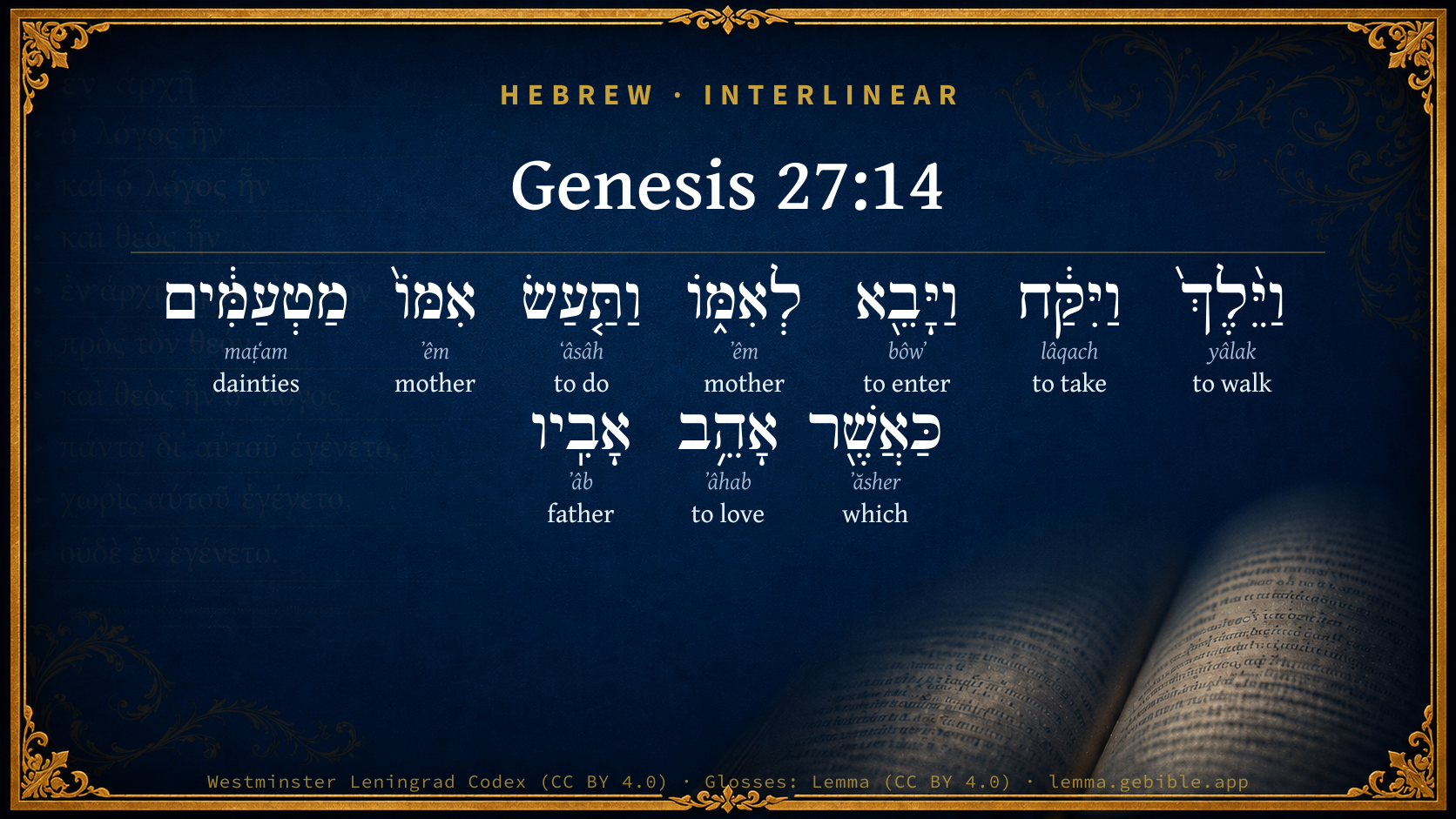
  1. וַיֵּ֨לֶךְ֙ yâlak H3212 “and · to walk” Conjunction + Verb, Qal, Sequential Imperfect, 3rd Person, Masculine, Singular
  2. וַיִּקַּ֔ח lâqach H3947 “and · to take” Conjunction + Verb, Qal, Sequential Imperfect, 3rd Person, Masculine, Singular
  3. וַיָּבֵ֖א bôwʼ H935 “and · to enter” Conjunction + Verb, Hiphil, Sequential Imperfect, 3rd Person, Masculine, Singular
  4. לְאִמּ֑וֹ ʼêm H517 “to/for · mother · his” Preposition + Noun, Common, Feminine, Singular, Construct + Suffix, Personal, 3rd Person, Masculine, Singular
  5. וַתַּ֤עַשׂ ʻâsâh H6213 “and · to do” Conjunction + Verb, Qal, Sequential Imperfect, 3rd Person, Feminine, Singular
  6. אִמּוֹ֙ ʼêm H517 “mother · his” Noun, Common, Feminine, Singular, Construct + Suffix, Personal, 3rd Person, Masculine, Singular
  7. כַּאֲשֶׁ֖ר ʼăsher H834 “like/as · which” Preposition + Particle, Relative
  8. אָהֵ֥ב ʼâhab H157 “to love” Verb, Qal, Perfect, 3rd Person, Masculine, Singular
  9. אָבִֽיו ʼâb H1 “father · his” Noun, Common, Masculine, Singular, Construct + Suffix, Personal, 3rd Person, Masculine, Singular

About this verse

These counts appear in no published source. They are computed here, from the morphology-tagged text and Lemma’s own curated glosses. What Lemma adds →

10
words
9
distinct lemmas
Pentateuch
section

Notable vocabulary

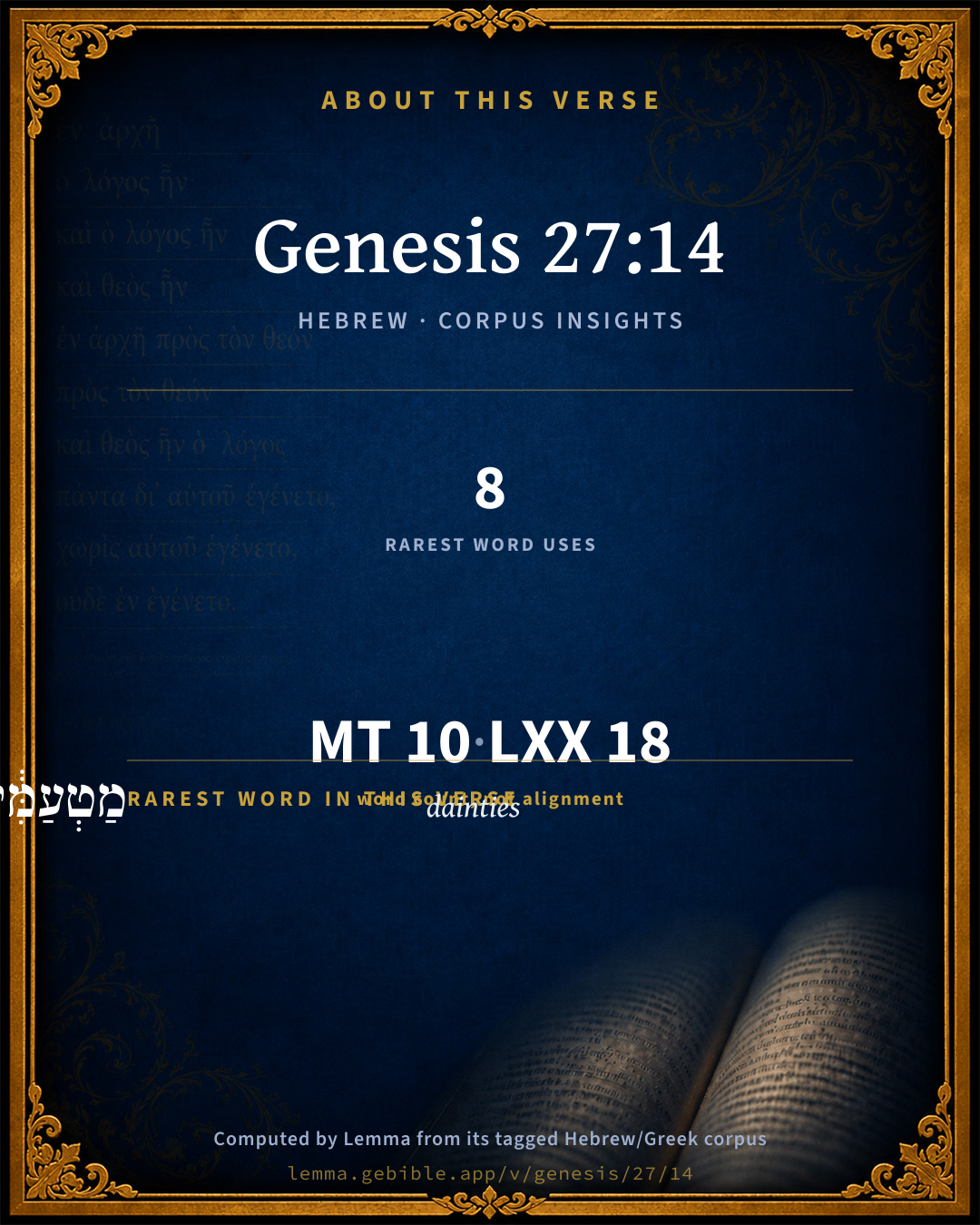
The rarest word here is מַטְעַמִּ֔ים dainties H4303 — appearing just 8 times in the whole Hebrew Bible.

Shared distinctive vocabulary

מַטְעַמִּ֔ים dainties H4303 occurs in 8 verses of the Hebrew Bible. Also found in:

Grammatical profile

  • 5 verbs
  • 4 nouns
  • 1 particle

Verb forms

  • וַיֵּ֨לֶךְ֙ Qal · Sequential Imperfect
  • וַיִּקַּ֔ח Qal · Sequential Imperfect
  • וַיָּבֵ֖א Hiphil · Sequential Imperfect
  • וַתַּ֤עַשׂ Qal · Sequential Imperfect
  • אָהֵ֥ב Qal · Perfect

Repetition

A word recurs within this verse — often emphatic in Hebrew:

  • לְאִמּ֑וֹ mother H517 ×2

Hebrew & Septuagint length

In English translation the verse runs 21 words from the Hebrew and 21 from the Septuagint (LXX English) — the same length.

A rough comparison of the two English renderings, which tokenize alike — not a word-level alignment.

Word counts can differ between the Hebrew and the Greek without any difference in meaning — e.g. the Hebrew direct-object marker אֵת has no separate Greek word, and Greek often adds the article ὁ.

In the original languages it is 10 Hebrew tokens and 18 Greek tokens — but the two are counted differently (Hebrew bundles its prefixes and suffixes into one token; the Greek is in lemma form), so that isn’t a like-for-like length.

Cross-references

9

Topical passages linked to Genesis 27:14 in the Treasury of Scripture Knowledge — connected by theme and wording, ordered by reader-vote popularity; previews shown in the World English Bible.

  • Genesis 25:28 Now Isaac loved Esau, because he ate his venison. Rebekah loved Jacob.
  • Genesis 27:4 Make me savory food, such as I love, and bring it to me, that I may eat, and that my soul may bless you before I die."
  • Genesis 27:7 'Bring me venison, and make me savory food, that I may eat, and bless you before Yahweh before my death.'
  • Genesis 27:9 Go now to the flock, and get me from there two good kids of the goats. I will make them savory food for your father, such as he loves.
  • Genesis 27:17 She gave the savory food and the bread, which she had prepared, into the hand of her son Jacob.
  • Genesis 27:31 He also made savory food, and brought it to his father. He said to his father, "Let my father arise, and eat of his son's venison, that your soul may bless me."
  • Psalms 141:4 Don't incline my heart to any evil thing, To practice deeds of wickedness with men who work iniquity. Don't let me eat of their delicacies.
  • Proverbs 23:2–3 Put a knife to your throat, If you are a man given to appetite.
  • Luke 21:34 "So be careful, or your hearts will be loaded down with carousing, drunkenness, and cares of this life, and that day will come on you suddenly.

Cross-references courtesy of OpenBible.info (CC BY 4.0).

Hebrew and Greek witnesses Masoretic Hebrew ↔ Greek Septuagint

The same verse in the two great witnesses to the Old Testament, shown verse-for-verse.

These are two independent witnesses, not word-aligned to each other, and the Septuagint is shown in lemma (dictionary) form.

Hebrew Genesis 27:14 Masoretic · Westminster Leningrad Codex

וַיֵּ֨לֶךְ֙ וַיִּקַּ֔ח וַיָּבֵ֖א לְאִמּ֑וֹ וַתַּ֤עַשׂ אִמּוֹ֙ מַטְעַמִּ֔ים כַּאֲשֶׁ֖ר אָהֵ֥ב אָבִֽיו

He went, and got them, and brought them to his mother. His mother made savory food, such as his father loved.

World English Bible · Public Domain

Greek LXX Genesis 27:14 Septuagint · lemma form

πορεύομαι δέ λαμβάνω καί φέρω ὁ μήτηρ καί ποιέω ὁ μήτηρ αὐτός ἔδεσμα καθά φιλέω ὁ πατήρ αὐτός

So he went and took and brought them to his mother; and his mother made meats, as his father liked them.

LXX2012 (modern English Septuagint) · Public Domain

Hebrew: Westminster Leningrad Codex (CC BY 4.0). Greek: Septuagint (public domain); English from LXX2012 (modern English Septuagint) (Public Domain). How the Septuagint differs from the Hebrew →

Targum (Aramaic paraphrase)

2

The Targum is the ancient Jewish Aramaic paraphrase of the Hebrew Scriptures — an interpretive translation, not the Hebrew text itself. Onkelos (literal) and Pseudo-Jonathan (expansive) render the Torah, and Jonathan the Prophets. Coverage is partial: where no permissively-licensed English translation exists for a verse, only the Aramaic is shown. This is verse-level text, not a word-by-word alignment to the Hebrew.

  1. Targum Onkelos Torah (Genesis–Deuteronomy)
    וַאֲזַל וּנְסִיב וְאַיְתִי לְאִמֵּהּ וַעֲבָדַת אִמֵּהּ תַּבְשִׁילִין כְּמָא דִּרְחֵם אֲבוּהִי

    (no public-domain English translation for this verse)

    Targum Onkelos — Aramaic: “Onkelos Genesis” (public domain); “Onkelos Exodus” (public domain); “Onkelos Leviticus” (public domain); “Onkelos Numbers” (public domain); “Onkelos Deuteronomy” (public domain). English: “Sefaria Community Translation” (CC0 1.0 (public-domain dedication)); “J.W. Etheridge. The Targums of Onkelos and Jonathan Ben Uzziel on the Pentateuch. London: Longmans, Green, 1862” (public domain). Text via Sefaria.

  2. Targum Pseudo-Jonathan Torah (Genesis–Deuteronomy)
    וַאֲזַל וּנְסֵיב וְאַיְיתֵי לְאִמֵיהּ וַעֲבָדַת אִמֵיהּ תַּבְשִׁילִין הֵיכְמָא דְרָחֵם אָבוֹי

    And he went and took, and brought to his mother; and his mother made food such as his father loved.

    Targum Pseudo-Jonathan — Aramaic: “Targum Jonathan on Genesis” (public domain); “Targum Jonathan on Exodus” (public domain); “Targum Jonathan on Leviticus” (public domain); “Targum Jonathan on Numbers” (public domain); “Targum Jonathan on Deuteronomy” (public domain). English: “The Targum of Jonathan ben Uzziel, trans. J. W. Etheridge, London, 1862” (public domain). Text via Sefaria.

Commentary

Notes on Genesis 27:14 from classic Christian and Jewish commentators (each source and its license shown beneath its notes). The classic Christian expositions comment on the surrounding passage and are grouped to its opening verse, so a note may address several verses; the Jewish commentaries on the Tanakh (Rashi and others) are per-verse, so they appear only where the commentator wrote on this verse.

Lemma curates 59 commentaries, every one of them public domain or Creative Commons licensed, each selected and text-cleaned for this edition rather than reprinted as found. About our sources →

Trapp's Complete Commentary

John Trapp

Gen 27:14 And he went, and fetched, and brought [them] to his mother: and his mother made savoury meat, such as his father loved.

Ver. 14. And he went, and fetched.] Herein he was over obsequious to his mother. It was an act of faith in her to seek to transfer the patriarchal blessing upon Jacob: it was likewise an act of faith in him to seek to get that blessing. Sed fides utriusque impegit in via; But they took not a right course for the compassing of it.

John Trapp, A Commentary or Exposition upon All the Books of the Old and New Testament (1647–1656) — public domain. Text from a community e-Sword module.

The Biblical Illustrator

Joseph S. Exell

Gen_27:14-24

And he went, and fetched, and brought them to his mother

Rebekahs cunning plot accepted and carried out by Jacob

I.

REVEALS SOME QUALITIES OF JACOBS CHARACTER.

1. He was a weak and pliable man.

2. He lacked the power of self-determination.

3. He was fearful of consequences.

4. He could long indulge the thought of that which was forbidden.

II. REVEALS THE GRADUAL DEBASEMENT OF JACOBS CHARACTER.

1. He overcomes difficulties in the way of sin.

2. He learns to act a falsehood.

3. He proceeds to the direct falsehood.

4. He allows himself to be led into sin under the idea that he is carrying out the purpose of God. (T. H. Leale.)

The stolen blessing

I. THE TEMPTATION ORIGINATED IN A SENSUOUS REQUEST OF ISAAC.

II. THIS TEMPTATION WAS PRESENTED TO JACOB THROUGH THE UNSCRUPULOUS LOVE OF REBEKAH. We cannot but admire her love. But it was not based upon principle.

III. THIS TEMPTATION WAS GREEDILY RESPONDED TO BY THE WEAK AND CRAFTY NATURE OF JACOB. (F. B. Meyer, B.A.)

Sharp practice

I. JACOBS CONDUCT UNFOLDS THE STRENGTH OF EARLY PREFERENCES.

II. JACOBS CONDUCT SHOWS PROGRESS IN A WRONG DIRECTION.

III. JACOBS CONDUCT LETS US SEE SOME OF THE INFLUENCES WHICH IMPEL MEN TO GREATER EVIL.

1. One is that of relationship.

2. Another influence worked in the man himself. Jacob had a vehement craving for the blessing.

IV. JACOBS CONDUCT PROVES THAT THERE MAY BE MORE RELIGION ON THE LIPS THAN IN THE LIFE (Gen_27:20). (D. G. Watt, M. A.)

The supplanter

I. THE POWER OF PARENTAL INFLUENCE AND THE DANGER OF PARENTAL PARTIALITY.

II. THE PROGRESS OF MORAL DETERIORATION. This is seen--

1. In Isaac.

2. In Rebekah.

3. In Esau.

4. Especially in Jacob.

Lessons:

1. That mere fondness is not affection.

2. To beware of encouraging or countenancing the appearance of untruth.

3. That no righteous purpose can justify an unrighteous act.

4. To avoid the beginning, the very appearance of evil.

5. To beware what thoughts we cherish.

6. Success does not avert the moral consequences of wrong-doing. (A. F.Joscelyne, B. A.)

The blessing fraudulently obtained

I. THE SPIRIT OF DOUBT AND MISTRUST LEADS MEN TO PRACTICE DECEIT.

1. It was deceiving a relative.

2. Deceiving an infirm relative.

3. Deceiving an infirm relative in spiritual matters.

II. IT DEADENS MENS MORAL SENSIBILITIES.

1. It creates indifference to mans moral culture.

2. It renders one insensible to the greatest danger.

III. IT INVOLVES PAIN.

1. Loss of peace.

2. Instability.

3. Humiliation. (Homilist.)

The blessing obtained by fraud

1. Many of the most serious evils in life must be traced to parental mismanagement.

2. No end, however good, will sanction bad ways of accomplishing it.

3. Our history illustrates the prolific nature of sin. The commission of one crime makes another necessary, in order to supply what is lacking in the first.

4. The sins of youth have often a long and lasting influence. (A. McClelland, D. D.)

Duplicity

I. THE CONSPIRACY.

1. Its nature.

2. Its cause.

(1) Precariousness of Isaacs life.

(2) Rebekahs fear that patriarchal blessing would be bestowed on Esau, though God had declared that it should be given to Jacob.

(3) The nature and importance of the patriarchal blessing.

II. THE DISCOVERY.

1. Its suddenness.

2. Its effect. Practical lessons:

1. That sad consequences ever follow the practice of duplicity, whether in the family or elsewhere.

2. That a mother should teach a son to deceive his father is full of warning.

3. That such wrong should be perpetrated in the name and for the promotion of religion suggests the importance of scrutinizing our motives.

4. That the consciences of pious persons should allow them to justify themselves in such conduct suggests the blinding power of unbelief that God will fulfil what He has promised. (D. C. Hughes, M. A.)

The sin of Isaac and his family

I. Look at ISAAC.

1. His sin lay in aiming at a wrong object--he wanted to set aside the will of God.

2. Mark the punishment of Isaac. It was two-fold. First, his object was defeated--Esau lost the blessing. And man will always be defeated when man struggles with his Maker. He vindicates His authority in an unexpected moment and by unexpected means, and then where and what are we? Our schemes, and efforts, and hopes, are all laid low; and worse than this--they are all turned against ourselves. And so was it here; for notice another part of Isaacs punishment--not only was his object defeated, but in aiming at it, he brought much sin on his family and much anguish on himself.

II. We may turn now to REBEKAH.

1. Her sin was altogether different in its character from Isaacs. It consisted in aiming at a right object by sinful means.

2. The punishment of Rebekah may appear slight, and yet to a fond mother like her, it must have been deeply painful. The curse was indeed on her, and it came in a form she little anticipated--she lost the son for whom she had plotted and sinned. Her example speaks plainly and solemnly also to all who are parents amongst us. It tells us that children are easily led into sin. Deceit and falsehood are bound up in the heart of every child that breathes, and it is as easy to call them into action as to get their tongues to speak or their feet to move. It is easy also to find motives that seem good, for prompting the lie, or sanctioning the lie, or concealing the lie; but as surely as there is a God living in heaven, the evil we prompt or encourage or tolerate in our children will come down in the end on our own heads. The curse of it will be on us. The blow may at first strike others, but in the end it will recoil on ourselves. Our poor children may themselves sting us to the quick; or if not so, the hand of God may be on them. We may see in their undoing at once our own punishment and our own sin.

III. Let us turn now to JACOB. The instant we look at him, we are struck with this fact, that the nearer a man is to God, the more God is displeased with any iniquity He sees in him, and the more openly and severely He punishes it. Of all this family, Jacob was the most beloved by Him, but yet, as far as regards this world, he appears to have suffered from this transaction the most bitterly.

1. His sin was of a complicated character. To a hasty observer, it might appear light. Certainly much might be said in palliation of it. He was not first in the transgression. The idea of it did not originate with him. His feelings revolted at it when it was proposed to him. He remonstrated against it. Besides, it was a parent who urged him on, a fond and tender mother. And we must remember, too, that all those motives which led Rebekah to form this plot would operate also in Jacobs mind to lead him to execute it. It was furthering the will of God, it was saving a father from sin. Let young persons see here what a single deviation from truth can do. In one short hour it made the pious Jacob appear and act like one of the worst of men.

2. As for the punishment of Jacobs sin, we must read the history of his life to see the extent of it. It followed him almost to his dying hour. He was successful in his treachery; it obtained from his deceived father the desired birthright; but what fruit had he from his success? We might say none at all, or rather he sowed the wind and he reaped the whirlwind. His fears were realized; he did bring a curse on him and not a blessing.

IV. We come now to the case of Esau. Alive to the present and reckless of the future, he preferred to it the momentary gratification of a sensual appetite. (C. Bradley, M. A.)

How Jacob stole his blessing

I. ISAACS OBSTINATE PARTIALITY.

II. REBEKAHS CRAFTINESS, AND JACOBS FRAUD.

III. THE CONSEQUENCES OF THE FRAUD. Isaacs vain regret. Esaus murderous malice. Rebekahs fear for her favourite son. Jacobs hasty banishment. Conclusion: What may we especially learn for ourselves?

1. Not to resist Gods will, like Isaac. We may sometimes think we know what is best; yet, if we listened to Gods word, we should not do the very thing we perhaps most like to do.

2. Not to forfeit Gods favour and blessing, like Esau. It was Esaus own recklessness and worldliness that led to his being rejected, and to the blessing being withheld from him. He had shown himself to be incapable of deeper thoughts and religious faith.

3. Not to do wrong that good may come, like Rebekah and Jacob. Gods promises will be fulfilled in due time. But we must neither murmur, nor be hasty (comp. Heb_2:3). (W. S. Smith, B. D.)

The wily supplanter

Jacob, whose nature was at this time true to his name.

1. Receives a hint from his mother. Sad that her maternal love should have prompted such an act. Esau, as much her son as Jacob. She was equally bound by natural obligations to care far one as the other. No apologies seem to be a sufficient vindication of conduct that was in its very essence wrong.

2. Closes with his mothers recommendation. He ought to have resented it; to have expostulated, and over-ruled it. He rather suggests difficulties (Gen_27:11) to prompt her ingenuity.

3. Adopts the disguise she prepared, and followed her directions. Deception; and self-deception the worst of all. Perhaps thought it well, even by such means, to gain the blessing.

4. Repeated falsehoods. Again and again assured his father that he was Esau.

5. Obtained the blessing. Yet how could that bless which had been so obtained? God, in His mercy, ultimately brought good out of the evil Otherwise the fathers blessing, so obtained, must have been a curse. (J. C. Gray.)

Appearances often deceptive

The voice is Jacobs voice, but the hands are the hands of Esau. We cannot always depend upon appearances. When, at the time of the gunpowder plot, the Parliament houses were searched, only coals and fagots were found in the cellars beneath. But, on a more careful search, barrels of gunpowder were found under the coals and wood, as well as Guy Fawkes with his preparations to blow up the king and his parliament. Many a fine-looking tree is rotten at the core; some who are very healthy in appearance are secretly and fatally diseased; gilding or paint sometimes covers really worthless rubbish; so the lives of some who profess to be the epistles of Christ are really a forgery, for they are not what they profess to be. Many who speak in religious services, or at other times and places, with Jacobs voice, or as saints, really have the hands of Esau, for they are living in the practice of wickedness. (G. Hughes, B. D.)

The deception of Isaac

It is often forgotten that Jacob was divinely appointed to be the inheritor of the blessing. The omission from the calculation or thought of that one fact is likely to lead not only to mental perplexity but to moral confusion. You find the proof of the assertion in Gen_25:23. The Lord said unto Rebekah, in view of the birth of her children, The one people shall be stronger than the other people; and the elder shall serve the younger. The mystery, therefore, is Divine. Jacob was a destined man; Jacob was destined before he was born; what, then, was his error? Not in feeling, how mysteriously soever, the pressure of his destiny, but in prematurely taking it into his own hands. We must not force Providence. Is there not an appointed time to man upon the earth, in a much wider sense than in the sense of marking out the day of his death? Is there not a time for the rising of the sun and the going down of the same? Is there not a seed time in the year, as well as a harvest day? We are tempted to force Providence, thus to do the right thing in the wrong way, and at the wrong time. Right is not a question of a mere point; it gathers up into its mystery all the points of the case, so that it is not enough to be going in the right road; we must have come into that road through the right door, at the right hour, and by direct intervention and sanction of God. It is tempting to natures like ours to help ourselves by trickery. We do like to meddle with God. Granted that the mother saw the religious aspect of this whole case, and knew the destiny of the boys, she had no right to force Divine Providence. Was Rebekah moved by the consciousness of destiny, or was she excited by the spirit of revenge? It is easy for us to mistake our revenge for religion. Some men pray out of spite; some men preach Christ out of envy; it is possible to build a church upon the devils foundation, and to light an altar with the devils fire. Jacob was pre-eminently a destined child, a man with a special mark upon him: how he will come out of this we shall see; but God will be King and Master, and right shall be done. What, then, is to be our attitude under the consciousness of destiny, and under the suggestion of tempting events? Our attitude is to be one of perfect resignation. (J. Parker, D. D.)

The temptation of destiny

Although the prediction of the fact did not entitle her or her son to bring about its fulfilment, yet it makes some slight difference in the case. For we see even now that when a nation or a man once feels that it is manifest destiny to do a certain thing--predetermined--he feels free to do that thing, no matter how unjust it is.

We see the same delusion in a thousand other cases. Shakespeare recognizes it in the great drama of Macbeth. The prediction, Thou shalt be king hereafter, did not justify the murder, but it seemed to give to it a certain supernatural countenance, marshalling the murderer the way that he was going. If this can be the case when the supernatural soliciting comes from below, how much more strong when it was felt to come from above--from God Himself! Then remember, besides, that there was somethingnot altogether evil in Jacobs passionate coveting of the birthright. For it was a sacred good, and eagerly to appreciate it as he did was itself a sign of some fitness for it; while to despise it as Esau did marked the man as unworthy of it. (A. G. Mercer.)

The selection of Jacob

But now hear me for a moment in defence of that Divine Providence which allowed the substitution of this particular man, Jacob, in the place of this particular man, Esau, as the third of the patriarchs. The importance of a right choice here is not easily over-rated. For several reasons the character of the patriarchs was to influence and mould the character of the Hebrew race more than could be done by any of the whole line of law-givers, princes, prophets, and warriors--Moses, perhaps, excepted, To have the right man, then, was indeed important. But was Jacob he? or, at least, was he more fit than Esau? He was. What was Jacob? Let us see. A man may be described by three things--whether he has ends--what they are--and how he reaches them.

1. Whether he has ends. Esau had not, He was one of a class of characters who live without any distant ends to reach--who live very much from day to day, working perhaps energetically for their little daily plans, or floating from interest to interest. Jacob was, above all things else, a man of purpose.

2. The next question about a man is, What are his ends? Two traits in a mans ends lift up the man--the remoteness and the generosity of his ends. If very remote--that is, if a man takes into his vision the whole scope of his life, and with a masterly power brings under his whole existence to that far-oft end--that man, even though his ends are selfish, is a superior person. Now Jacob was certainly that man. Show me such a man anywhere, and I will show you his equal here. Seven years of the hardest service he served for Rachel, and counted them but as seven days--and then seven more. He wore through twenty years of the hardest life,carrying on his design that he should be the successor and heir of Isaac, and though he was of a timid nature, never yielding that purpose, even when he stood in the presence of the avenger Esau himself. Never was there a more patient, tenacious soul. This was singular, for remember that primitive men may be persistent in passions, but not in purposes, save in that one passion and purpose--revenge. But Jacob had all the calmness and tenacity of an advanced age. His end, however, may have been a selfish one. Self-advancement? Yes. But, considering the age and place, self-advancement was one of the higher forms of virtue, especially when we know that the end Jacob sought had a certain sacredness about it--the hope, namely, that he should be in the line of Gods special favours--should take eminent place as His servant.

3. The third test of a man is the means he uses to reach his ends. Jacobs were bad enough. Remember, however, that the rule, the end does not justify the means, was unknown to Jacob--is, in fact, a great and modern discovery in morals, not fully known even yet. And remember, besides, that whatever his means were, they were always effective, and never gratuitously wicked. On the whole, then, here was a mixed character as to its excellence, but a high character as to its ability. Nay, besides--this very mixture, the very defects of character, made Jacob a fit instrument of the Divine purposes. He was, even in his weakest points, far better fitted to lay the foundations of a family and kingdom than the impulsive and purposeless Esau. Had he been a more purely excellent man, he would have been less fitted. A style of character purely excellent cannot lay a permanent grasp upon the men of early ages, or men of any age not high enough to receive it. The powerful great man is the one who is at once above and yet along-side of his fellows. Hence we see, as a matter of fact, that among the patriarchs, though Abraham is most revered, Jacob has been the truly influential man with the Jewish masses. He has moulded the mass of the Jewish people into his own image. I regard this as specially providential. Thus the purer and higher were led to God and held to God through the high spirit that was in Abraham; the body were held to God and their religion through the lower soul of Jacob. They could be inferior Jacobs when they could not be properly children of Abraham.

So, through lower and higher instruments, the purposes of God are worked out.

1. Among the thoughts suggested by the subject, notice first the effect of success in the judgment of character. Esau, once gone under, holds no place.

2. Notice, again, how poorly we judge of mixed characters. The same Jacob who over-reached his father, his brother, and I might say destiny itself, the supplanter, the robber, who from a shelf the precious diadem stole, and put it in his pocket, was yet the same who wrestled all night with God. Truly we are all of different natures, marvellously mixed--a worm, a god! This should teach me at least some things, such as humility to myself. I know by this that the statues of the demi-gods stand on clay feet--that my best moments, my best feelings, are but a part of me--that I have a whole world of things to repent of, and to be ashamed of, before God. That, and nothing of soul growth, was especially the fact with Jacob. His character was unlike that of the other patriarchs in this: Abraham and Isaac, such as we see them at first, are very much such as we see them at last. But Jacob only becomes his real, that is, his higher self at the last. At the bottom of his young and eager ambition and selfishness there was at the very first, as I have said, something good, the root of a great tree of right--namely, the real sense that Gods blessing and favour were above allvalue--and so in his blind, but most earnest way, he went to work to grasp them.

3. There is one test every man should solemnly try himself by, one test of what our ultimate selves and our ultimate destiny will be--Does the good part of our characters grow? (A. G. Mercer.)

The Biblical Illustrator, edited by Joseph S. Exell (c. 1880s–1900s) — public domain. Text from a community e-Sword module.

John Calvin's Commentaries

14. And he went and fetched. Although it is probable that Jacob was not only influenced by a desire to yield obedience to the authority of his mother, but was also persuaded by her seasonings, he yet sinned by overstepping the bounds of his vocation. When Rebekah had taken the blame upon herself, she told him, doubtless, that injury was done to no one: because Jacob was not stealing away another’s right, but only seeking the blessing which was decreed to him by the celestial oracle. It seemed a fair and probable excuse for the fraud, that Isaac, unless he should be imposed upon, was prepared to invalidate the election of God. Therefore Jacob, instead of simply declining from what was right in submission to his mother, was rather obeying the word of God. In the meantime (as I have said) this particular error was not free from blame: because the truth of God was not to be aided by such falsehoods. The paternal benediction was a seal of God’s grace, I confess it; but she ought rather to have waited till God should bring relief from heaven, by changing the mind and guiding the tongue of Isaac, than have attempted what was unlawful. For if Balaam, who prostituted his venal tongue, was constrained by the Spirit, contrary to his own wish, to bless the elect people, whom he would rather have devoted to destruction, (Numbers 22:12,) how much more powerfully would the same spirit have influenced the tongue of holy Isaac, who was not a mercenary man, but one who desired faithfully to obey God, and was only hurried by an error in a contrary direction? Therefore, although in the main, faith shone preeminently in holy Jacob, yet in this respect he bears the blame of rashness, in that he was distrustful of the providence of God, and fraudulently gained possession of his father’s blessing.

John Calvin's Commentaries (1540-1563) — public domain. Text from the Calvin Translation Society English edition (1840s-50s) via the Christian Classics Ethereal Library (ccel.org). Calvin's coverage is partial (roughly two-thirds of the Bible); uncommented books and verses are honest gaps, never fabricated. The 19th-century editor's footnotes and remarks are omitted so the notes are faithfully Calvin's own voice.

John Gill's Exposition

And he went and fetched and brought them to his mother,.... Being satisfied with what his mother had said, he went to the field where the flock was, and took out of it two young kids, and brought them to his mother; and thus far he did right to obey her commands:

and his mother made savoury meat, such as his father loved; by picking out proper pieces, and seasoning them well, it was as grateful to him as if it had really been venison, such as he loved.

John Gill's Exposition of the Whole Bible (1746–1763) — public domain (CC PDM 1.0). Text via the HelloAO Bible API.

The Pulpit Commentary

And he went (sc. to the flock), and fetched, or, rather, took (sc. the two kids as directed) and brought them (after slaughter, of course) to his mother: and his mother made savory meat, such as his father loved. All this implies that Rebekah reckoned on Esau"s absence for a considerable time, perhaps throughout the entire day.

The Pulpit Commentary (1880–1919), ed. H.D.M. Spence-Jones & Joseph S. Exell — public domain. Text from a community e-Sword module.

Lesson kit

Teaching starters — assembled from the data on this page, not authored interpretation. Every prompt links to the verse data it draws on. Edit before teaching.

Genesis, in the Pentateuch, opens this verse with 10 words (9 distinct Hebrew lemmas). Its most distinctive word is maṭʻam (“dainties”). A historical commentator’s framing appears above. Read the whole chapter for the surrounding context.

Discussion questions

  1. How does “dainties” (maṭʻam) shape what this verse is saying?
  2. Genesis 27:4 shares the word «dainties» with this verse. How do the two illuminate each other?
  3. “mother” occurs 2× in this one verse. What is the effect of the repetition?
  4. These translations render this verse differently; the difference is in the English rendering, not the original. What questions does that raise?
  5. The verb «וַיֵּ֨לֶךְ֙» is Qal Sequential Imperfect. How does its form color the action?
  6. Reading how Trapp's Complete Commentary and The Biblical Illustrator read this verse, where do the two commentators agree and where do they part?

Things to notice

Reading settings

Reading text

Shown beneath each verse's original-language words.

Old Testament
Old Testament edition

Read the OT as the Masoretic Hebrew (MT) or the Greek Septuagint (LXX).

English shown for the Greek Septuagint (in the Hebrew ↔ Greek comparison).

Comparing translations? Open the Compare panel on any verse page to stack up to four side by side.