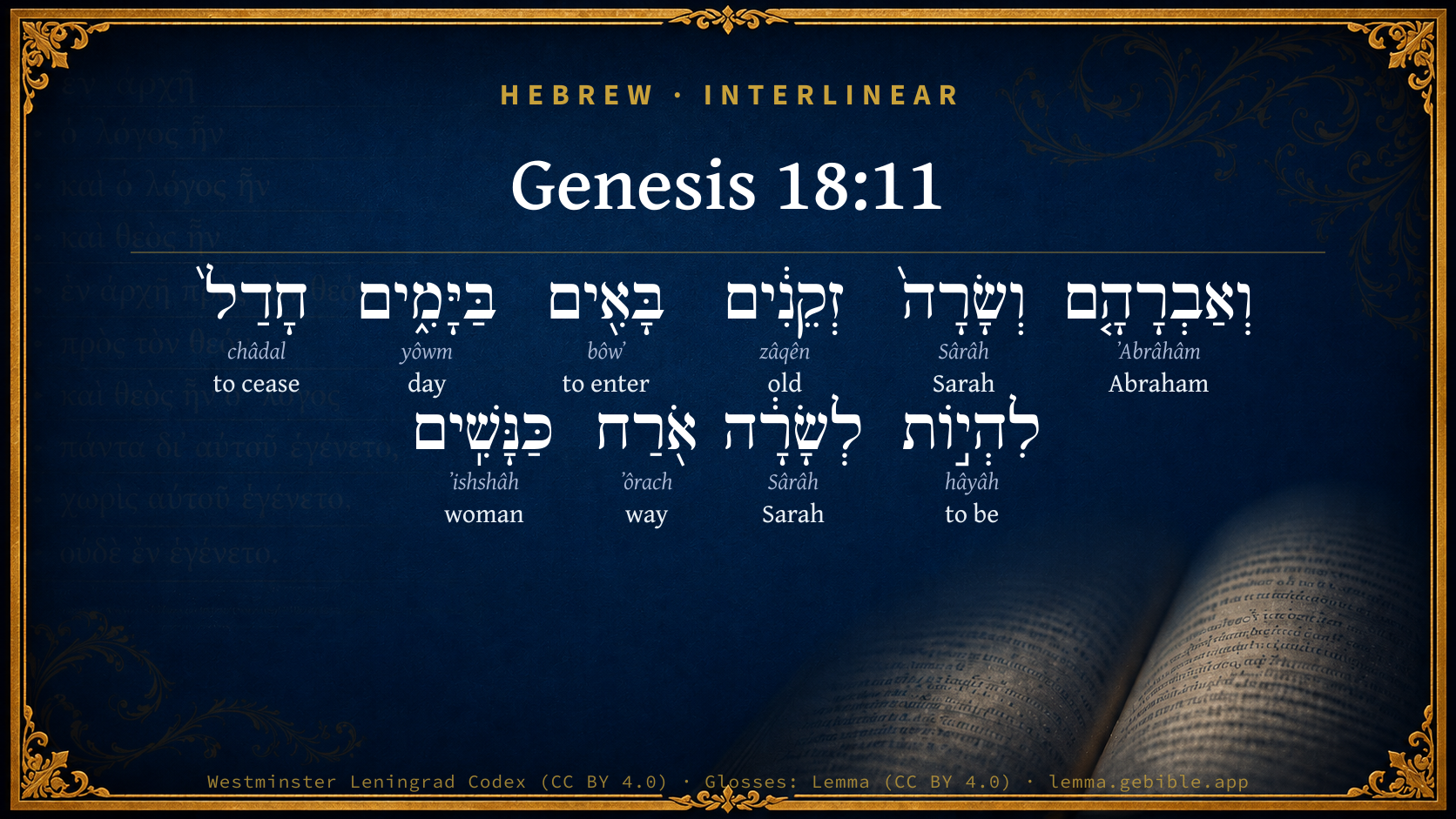
Genesis 18:11

Hebrew (Westminster Leningrad Codex) Genesis 18:11 appears in the Hebrew Old Testament. The text above is from the Westminster Leningrad Codex. Each word links to its Strong’s number, a concise gloss, and parsing drawn from the Open Scriptures Hebrew Bible morphology. Click any word for its full Brown-Driver-Briggs (BDB) entry.
Download image
Cite this verse

Genesis 18:11 (World English Bible). Public Domain. Lemma interlinear Bible study tool, https://lemma.gebible.app/v/genesis/18/11.

Show BibTeX & RIS
BibTeX
RIS
English Translation
Now Abraham and Sarah were old, well advanced in age. It had ceased to be with Sarah after the manner of women.
World English Bible · Public Domain
Highlights
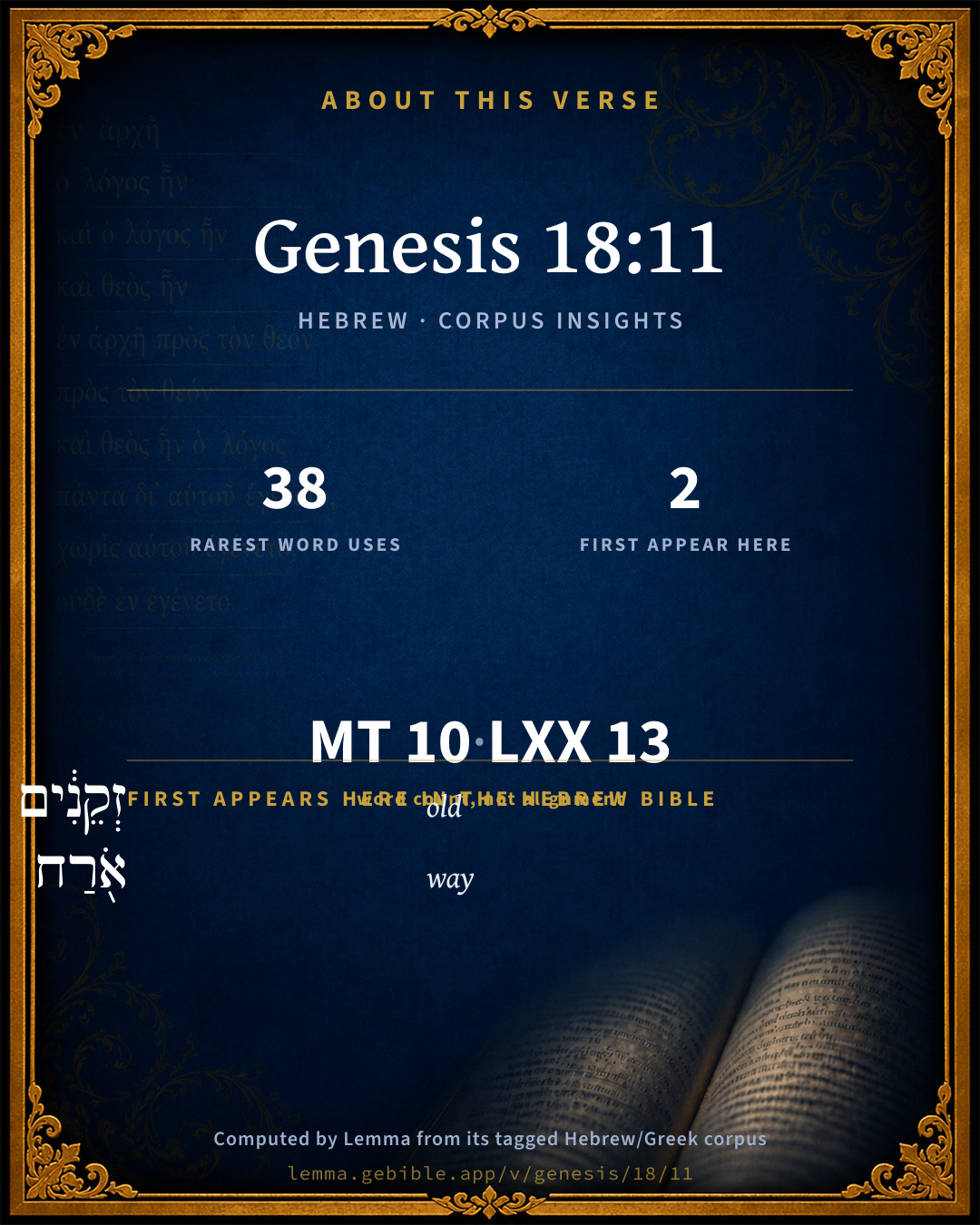
  • 2 first appearances in the Hebrew Bible
Full analysis ↓
Download a study sheet

One document with this verse’s original text, its word-by-word gloss line, the meaning frame, cross-references with their text, attributed commentary, and full source and license credits — printable, and it pastes into notes with its structure intact.

This verse Autodidact and up

Study sheet (.html) Plain text (.txt)

A passage Seminary Student

Up to 50 verses in one chapter. A passage sheet keeps up to 6 commentary sources and 12 cross-references per verse, in the order this page ranks them, and says so on the sheet whenever that leaves anything out. Ask for a single verse and you get the Autodidact verse sheet above.

Everything on this page stays free to read, with no account — the sheet is a download of what is already on screen, not access to it.

Want to remove ads? Support Godless Engineer
Compare translations 3

The same verse in 3 English versions, stacked beneath the original-language interlinear above. Click any original word for its lexicon entry.

Each is an independent rendering of the whole verse — the interlinear is not word-aligned to these translations.

Highlighted words mark where these versions differ — a whole-verse word diff, not a word-by-word alignment.

  • World English Bible Public Domain
    Now Abraham and Sarah were old, well advanced in age. It had ceased to be with Sarah after the manner of women.
  • King James Version Public Domain
    Now Abraham and Sarah were old and well stricken in age; and it ceased to be with Sarah after the manner of women.
  • unfoldingWord Literal Text CC BY-SA 4.0
    Now Abraham and Sarah old, advanced in days; the way of women had ceased to be with Sarah.

unfoldingWord Literal Text — © unfoldingWord, licensed CC BY-SA 4.0. Word-aligned USFM3 via Door43 (git.door43.org/unfoldingWord/en_ult).

Versions to compare (up to 4)

3 of 4 selected

Show all 18 translations

Every available English version of this verse, each an independent rendering of the whole verse.

  • World English Bible Public Domain
    Now Abraham and Sarah were old, well advanced in age. It had ceased to be with Sarah after the manner of women.
  • Berean Standard Bible Public Domain
    And Abraham and Sarah were already old and well along in years; Sarah had passed the age of childbearing.
  • Majority Standard Bible Public Domain
    And Abraham and Sarah were already old and well along in years; Sarah had passed the age of childbearing.
  • King James Version Public Domain
    Now Abraham and Sarah were old and well stricken in age; and it ceased to be with Sarah after the manner of women.
  • American Standard Version (1901) Public Domain
    Now Abraham and Sarah were old, `and' well stricken in age; it had ceased to be with Sarah after the manner of women.
  • Revised Version (1885) Public Domain
    Now Abraham and Sarah were old, and well stricken in age; it had ceased to be with Sarah after the manner of women.
  • Geneva Bible (1599) Public Domain
    (Nowe Abraham and Sarah were old and striken in age, and it ceased to be with Sarah after the maner of women)
  • Douay-Rheims (1899) Public Domain
    And he said to him: I will return and come to thee at this time, life accompanying and Sara thy wife shall have a son. Which when Sara heard, she laughed behind the door of the tent.
  • Young's Literal Translation Public Domain
    And Sarah is hearkening at the opening of the tent, which is behind him;
  • Literal Standard Version CC BY-SA 4.0
    and Abraham and Sarah [are] aged, entering into days—the way of women has ceased to be to Sarah;
  • Unlocked Literal Bible CC BY-SA 4.0
    Now Abraham and Sarah were old, very advanced in age, and Sarah had passed the age when women could bear children.
  • unfoldingWord Literal Text CC BY-SA 4.0
    Now Abraham and Sarah old, advanced in days; the way of women had ceased to be with Sarah.
  • Darby Bible Public Domain
    Now Abraham and Sarah were old [and] advanced in age: it had ceased to be with Sarah after the manner of women.
  • World Messianic Bible Public Domain
    Now Abraham and Sarah were old, well advanced in age. Sarah had passed the age of childbearing.
  • Webster's Bible Public Domain
    Now Abraham and Sarah were old and far advanced in age; and it ceased to be with Sarah after the manner of women.
  • Free Bible Version CC BY-SA 4.0
    Abraham and Sarah were old, getting on in years. Sarah was well past the age of having children.
  • Bible in Basic English Public Domain
    Now Abraham and Sarah were very old, and Sarah was past the time for giving birth.
  • JPS Tanakh (1917) Public Domain
    Now Abraham and Sarah were old, and well stricken in age; it had ceased to be with Sarah after the manner of women. —

Literal Standard Version (2020), Covenant Press — licensed CC BY-SA 4.0. Text via the HelloAO Bible API (eBible.org). Unlocked Literal Bible (unfoldingWord) — licensed CC BY-SA 4.0. Text via the HelloAO Bible API (eBible.org). unfoldingWord Literal Text — © unfoldingWord, licensed CC BY-SA 4.0. Word-aligned USFM3 via Door43 (git.door43.org/unfoldingWord/en_ult). Free Bible Version, Dr. Jonathan Gallagher — licensed CC BY-SA 4.0. Text via the HelloAO Bible API (eBible.org).

Word by word

More ways to search: Search by grammar → Find every occurrence → Compare this word →

Practice this passage: Drill this verse → Learn its vocabulary →

About this verse

These counts appear in no published source. They are computed here, from the morphology-tagged text and Lemma’s own curated glosses. What Lemma adds →

10
words
9
distinct lemmas
Pentateuch
section

First appearance in Scripture

These words make their first canonical appearance in the Hebrew Bible here:

  • זְקֵנִ֔ים old H2205
  • אֹ֖רַח way H734

Shared distinctive vocabulary

וְשָׂרָה֙ Sarah H8283 occurs in 32 verses of the Hebrew Bible. Also found in:

Grammatical profile

  • 3 verbs
  • 6 nouns
  • 1 adjective

Verb forms

  • בָּאִ֖ים Qal · Participle Active
  • חָדַל֙ Qal · Perfect
  • לִהְי֣וֹת Qal · Infinitive Construct

Repetition

A word recurs within this verse — often emphatic in Hebrew:

  • וְשָׂרָה֙ Sarah H8283 ×2

Hebrew & Septuagint length

In English translation the verse runs 22 words from the Hebrew and 17 from the Septuagint (LXX English) — closely comparable.

A rough comparison of the two English renderings, which tokenize alike — not a word-level alignment.

Word counts can differ between the Hebrew and the Greek without any difference in meaning — e.g. the Hebrew direct-object marker אֵת has no separate Greek word, and Greek often adds the article ὁ.

In the original languages it is 10 Hebrew tokens and 13 Greek tokens — but the two are counted differently (Hebrew bundles its prefixes and suffixes into one token; the Greek is in lemma form), so that isn’t a like-for-like length.

Cross-references

10

Topical passages linked to Genesis 18:11 in the Treasury of Scripture Knowledge — connected by theme and wording, ordered by reader-vote popularity; previews shown in the World English Bible.

  • Genesis 17:17 Then Abraham fell on his face, and laughed, and said in his heart, "Will a child be born to him who is one hundred years old? Will Sarah, who is ninety years old, give birth?"
  • Hebrews 11:11–12 By faith, even Sarah herself received power to conceive, and she bore a child when she was past age, since she counted him faithful who had promised.
  • Luke 1:36 Behold, Elizabeth, your relative, also has conceived a son in her old age; and this is the sixth month with her who was called barren.
  • Romans 4:18–21 Who in hope believed against hope, to the end that he might become a father of many nations, according to that which had been spoken, "So will your seed be."
  • Genesis 17:24 Abraham was ninety-nine years old, when he was circumcised in the flesh of his foreskin.
  • Leviticus 15:19 "'If a woman has a discharge, and her discharge in her flesh is blood, she shall be in her impurity seven days: and whoever touches her shall be unclean until the evening.
  • Luke 1:7 But they had no child, because Elizabeth was barren, and they both were well advanced in years.
  • Luke 1:18 Zacharias said to the angel, "How can I be sure of this? For I am an old man, and my wife is well advanced in years."
  • Hebrews 11:19 accounting that God is able to raise up even from the dead. Figuratively speaking, he also did receive him back from the dead.
  • Genesis 31:35 She said to her father, "Don't let my lord be angry that I can't rise up before you; for the manner of women is on me." He searched, but didn't find the teraphim.

Cross-references courtesy of OpenBible.info (CC BY 4.0).

Hebrew and Greek witnesses Masoretic Hebrew ↔ Greek Septuagint

The same verse in the two great witnesses to the Old Testament, shown verse-for-verse.

These are two independent witnesses, not word-aligned to each other, and the Septuagint is shown in lemma (dictionary) form.

Hebrew Genesis 18:11 Masoretic · Westminster Leningrad Codex

וְאַבְרָהָ֤ם וְשָׂרָה֙ זְקֵנִ֔ים בָּאִ֖ים בַּיָּמִ֑ים חָדַל֙ לִהְי֣וֹת לְשָׂרָ֔ה אֹ֖רַח כַּנָּשִֽׁים

Now Abraham and Sarah were old, well advanced in age. It had ceased to be with Sarah after the manner of women.

World English Bible · Public Domain

Greek LXX Genesis 18:11 Septuagint · lemma form

αβρααμ δέ καί σαρρα πρεσβύτερος προβαίνω ἡμέρα ἐκλείπω δέ σαρρα γίγνομαι ὁ γυναικεῖος

And Abraam and Sarrha were old, advanced in days, and the custom of women ceased with Sarrha.

LXX2012 (modern English Septuagint) · Public Domain

On this verse, The Cambridge Bible for Schools and Colleges discusses the Septuagint’s reading. Read the note in Commentary ↓

Hebrew: Westminster Leningrad Codex (CC BY 4.0). Greek: Septuagint (public domain); English from LXX2012 (modern English Septuagint) (Public Domain). How the Septuagint differs from the Hebrew →

Targum (Aramaic paraphrase)

2

The Targum is the ancient Jewish Aramaic paraphrase of the Hebrew Scriptures — an interpretive translation, not the Hebrew text itself. Onkelos (literal) and Pseudo-Jonathan (expansive) render the Torah, and Jonathan the Prophets. Coverage is partial: where no permissively-licensed English translation exists for a verse, only the Aramaic is shown. This is verse-level text, not a word-by-word alignment to the Hebrew.

  1. Targum Onkelos Torah (Genesis–Deuteronomy)
    וְאַבְרָהָם וְשָׂרָה סִיבוּ עַלּוּ בְיוֹמִין פְּסַק מִלְּמֶהֱוֵי לְשָׂרָה אוֹרַח כִּנְשַׁיָּא

    (no public-domain English translation for this verse)

    Targum Onkelos — Aramaic: “Onkelos Genesis” (public domain); “Onkelos Exodus” (public domain); “Onkelos Leviticus” (public domain); “Onkelos Numbers” (public domain); “Onkelos Deuteronomy” (public domain). English: “Sefaria Community Translation” (CC0 1.0 (public-domain dedication)); “J.W. Etheridge. The Targums of Onkelos and Jonathan Ben Uzziel on the Pentateuch. London: Longmans, Green, 1862” (public domain). Text via Sefaria.

  2. Targum Pseudo-Jonathan Torah (Genesis–Deuteronomy)
    וְאַבְרָהָם וְשָרָה סָבִין עָלוּ בְּיוֹמֵי פָּסַק מִלְמֶהֱוֵי לְשָרָה אוֹרַח סוּבְתָּא כִּנְשַׁיָא

    But Abraham and Sarah were old, they had mounted (alu) in days, and with Sarah the way of women had ceased.

    Targum Pseudo-Jonathan — Aramaic: “Targum Jonathan on Genesis” (public domain); “Targum Jonathan on Exodus” (public domain); “Targum Jonathan on Leviticus” (public domain); “Targum Jonathan on Numbers” (public domain); “Targum Jonathan on Deuteronomy” (public domain). English: “The Targum of Jonathan ben Uzziel, trans. J. W. Etheridge, London, 1862” (public domain). Text via Sefaria.

Commentary

Notes on Genesis 18:11 from classic Christian and Jewish commentators (each source and its license shown beneath its notes). The classic Christian expositions comment on the surrounding passage and are grouped to its opening verse, so a note may address several verses; the Jewish commentaries on the Tanakh (Rashi and others) are per-verse, so they appear only where the commentator wrote on this verse.

Lemma curates 59 commentaries, every one of them public domain or Creative Commons licensed, each selected and text-cleaned for this edition rather than reprinted as found. About our sources →

Trapp's Complete Commentary

John Trapp

Gen 18:11 Now Abraham and Sarah [were] old [and] well stricken in age; [and] it ceased to be with Sarah after the manner of women.

Ver. 11. Now Abraham and Sarah were old.] So, when we were altogether "without strength," according to the time of life, "Christ died for the ungodly". {Rom 5:6}

John Trapp, A Commentary or Exposition upon All the Books of the Old and New Testament (1647–1656) — public domain. Text from a community e-Sword module.

Adam Clarke's Commentary

Verse 11. It ceased to be with Sarah after the manner of women.] And consequently, naturally speaking, conception could not take place; therefore if she have a son it must be in a supernatural or miraculous way.

Adam Clarke's Commentary on the Bible (1810–1826) — public domain. Text from a community e-Sword/MySword module.

John Calvin's Commentaries

11. Were old, and well stricken in age Moses inserts this verse to inform us that what the angel was saying, justly appeared improbable to Sarah. For it is contrary to nature that children should be promised to decrepit old men. A doubt, however, may be entertained on this point, respecting Abraham: because men are sometimes endued with strength to have children, even in extreme old age: and especially in that period, such an occurrence was not uncommon. But Moses here speaks comparatively: for since Abraham, during the vigor of his life, had remained with his wife childless; it was scarcely possible for him, now that his body was half dead, to have children; he had indeed begotten Ishmael in his old age, which was contrary to expectation. But that now, twelve years afterwards, it should be possible to become a father, through his aged wife, was scarcely credible. Moses however chiefly insists upon the case of Sarah; because the greatest impediment was with her. It ceased, he says, to be with Sarah after the manner of women. With this expression, he soberly speaks about the monthly stream of the women. At the same moment with this, the possibility of conceiving ceases.

John Calvin's Commentaries (1540-1563) — public domain. Text from the Calvin Translation Society English edition (1840s-50s) via the Christian Classics Ethereal Library (ccel.org). Calvin's coverage is partial (roughly two-thirds of the Bible); uncommented books and verses are honest gaps, never fabricated. The 19th-century editor's footnotes and remarks are omitted so the notes are faithfully Calvin's own voice.

The Cambridge Bible for Schools and Colleges

gen. ed. J. J. S. Perowne

11. well stricken in age] An Old English expression for well-advanced in years: cf. “… his noble queen Well struck in years” (Shakespeare, Rich. III, i. 1). Heb. “entered into days,” LXX προβεβηκότες, Lat. provectae aetatis. Cf. Luk_1:7; Heb_11:11-12.

The Cambridge Bible for Schools and Colleges (gen. ed. J. J. S. Perowne; Cambridge University Press, 1878–1918) — public domain. Text from a community e-Sword module.

John Gill's Exposition

Now Abraham and Sarah were old, and well stricken in age,.... The one being ninety nine years of age, and the other eighty nine; and which is observed to make it the more surprising that they should have a son at such an age; and what follows still makes it more so:

and it ceased to be with Sarah after the manner of women; her monthly visitors had left her, so that she was unfit for conception, and there could be no hope of it in a natural way; though the philosopher (w) intimates, that there are some, that it is possible, may conceive without them.

(w) Aristot. Hist. Animal. l. 7. c. 2.

John Gill's Exposition of the Whole Bible (1746–1763) — public domain (CC PDM 1.0). Text via the HelloAO Bible API.

Matthew Poole's English Annotations

As to those monthly effluviums peculiar to her sex, which are necessary to conception, compare Gen 31:35.

Matthew Poole's English Annotations on the Holy Bible (1683–1685) — public domain. Text from a community e-Sword/MySword module.

The Pulpit Commentary

Now Abraham and Sarah were old and well stricken in age. Literally, gone into days, i.e. into years. This was the first natural impediment to the accomplishment of Jehovah"s premise; the second was peculiar to Sarah. And it ceased to be with Sarah after the manner of women (vide. Lev_15:19, Lev_15:25)

The Pulpit Commentary (1880–1919), ed. H.D.M. Spence-Jones & Joseph S. Exell — public domain. Text from a community e-Sword module.

unfoldingWord translationNotes

Door43 World Missions Community

After I am worn-out and my master is old, will I now have this pleasure?

You may want to add "of having a baby." Sarah used this rhetorical question because she did not believe that she could have a child. AT: "I cannot believe that I will experience the joy of having a child. My master is also too old" (See: Rhetorical Question)

my master is old

This means "since my husband is also old."

my master

This is a title of respect that Sarah gave to her husband Abraham.

translationWords

Abraham

Sarah

unfoldingWord translationNotes — © Distant Shores Media and the Door43 World Missions Community, licensed CC BY-SA 4.0. Source: git.door43.org/Door43/en_tn.

Ramban (Nachmanides)

Rabbi Moshe ben Nachman (Ramban / Nachmanides)

‘BA’IM BAYAMIM’ (ADVANCED IN DAYS). In his youthful days a man is called “standing in days,” and they are referred to as “his days” because they belong to him, just as in verse The number of thy days will I fulfill. But when he gets old and has lived longer than most people of his generation, it is said of him that he is ba bayamim, [literally, “came into days”], because it is as if he came into another land, travelling from and arriving in a city each and every day.

IT HAD CEASED TO BE WITH SARAH AFTER THE MANNER OF WOMEN. This is the time of pregnancy, for after menstruation has ceased due to old age, a woman will not become pregnant.

Ramban (Nachmanides) on the Tanakh — English translation: “Commentary on the Torah by Ramban (Nachmanides). Translated and annotated by Charles B. Chavel. New York, Shilo Pub. House, 1971-1976” (CC BY 4.0). Text via Sefaria.

Radak

Rabbi David Kimhi (Radak)

ואברהם, this line has been written only in order to account for the reason of Sarah’s laughter.

באים בימים, this is the standard mode in which the Torah describes people who feel that aging has affected their general physique and imposed limitations on them. What the Torah means is that both Avraham and Sarah had reached the years when other people are subject to the limitations of old age. These are the years when the soul begins to separate from the body.

אורח כנשים, the signal of old age for women, i.e. cessation of their menstrual cycle. The Torah uses a euphemism to describe that phenomenon. Rachel used the same euphemism when she explained to her father Lavan why she could not let him search her camel (Genesis 31,35). During old age, due to the body drying out, the flow of blood stops, i.e. a woman no longer ovulates. Our sages in Ketuvot 10 relate that the volume of such a flow of blood is in direct relation to the number of children a woman is likely to bear. There was a well known family by the name of Dorkaty in those days, whose female members never experienced either menstrual blood, nor the blood associated with the puncturing of the hymen. This is why the family was named Dorkaty, meaning that something was radically wrong. None of the females in that family ever had children, the reason being attributed to this abnormal condition of their not menstruating.

Radak on the Tanakh — English translations: “Sefaria Community Translation” (CC0 1.0 (public-domain dedication)); “Eliyahu Munk, HaChut Hameshulash” (CC BY 4.0); “Rabbi Mike Feuer, Jerusalem Anthology” (CC BY 4.0); and “R. David Kimhi on the first book of Psalms, Translated by R.G. Finch, London, 1919” (public domain). Text via Sefaria.

Lesson kit

Teaching starters — assembled from the data on this page, not authored interpretation. Every prompt links to the verse data it draws on. Edit before teaching.

Genesis, in the Pentateuch, opens this verse with 10 words (9 distinct Hebrew lemmas). Its most distinctive word is Sârâh (“Sarah”). A historical commentator’s framing appears above. Read the whole chapter for the surrounding context.

Discussion questions

  1. How does “Sarah” (Sârâh) shape what this verse is saying?
  2. 2 words make their first appearance in Scripture here. What does this debut establish?
  3. How does Genesis 17:15, which shares the word «Sarah», read alongside this verse?
  4. What does the repetition of “Sarah” (2× in this one verse) do in this verse?
  5. The translations on this page render this verse differently — a whole-verse word diff, not a word-by-word alignment. What might account for the different wordings?
  6. «בָּאִ֖ים» is a Qal Participle Active verb. How does that grammatical form shape the action described?
  7. Compare how Trapp's Complete Commentary and Adam Clarke's Commentary read this verse. Where do they agree or differ?

Things to notice

Reading settings

Reading text

Shown beneath each verse's original-language words.

Old Testament
Old Testament edition

Read the OT as the Masoretic Hebrew (MT) or the Greek Septuagint (LXX).

English shown for the Greek Septuagint (in the Hebrew ↔ Greek comparison).

Comparing translations? Open the Compare panel on any verse page to stack up to four side by side.