
Genesis 37:14

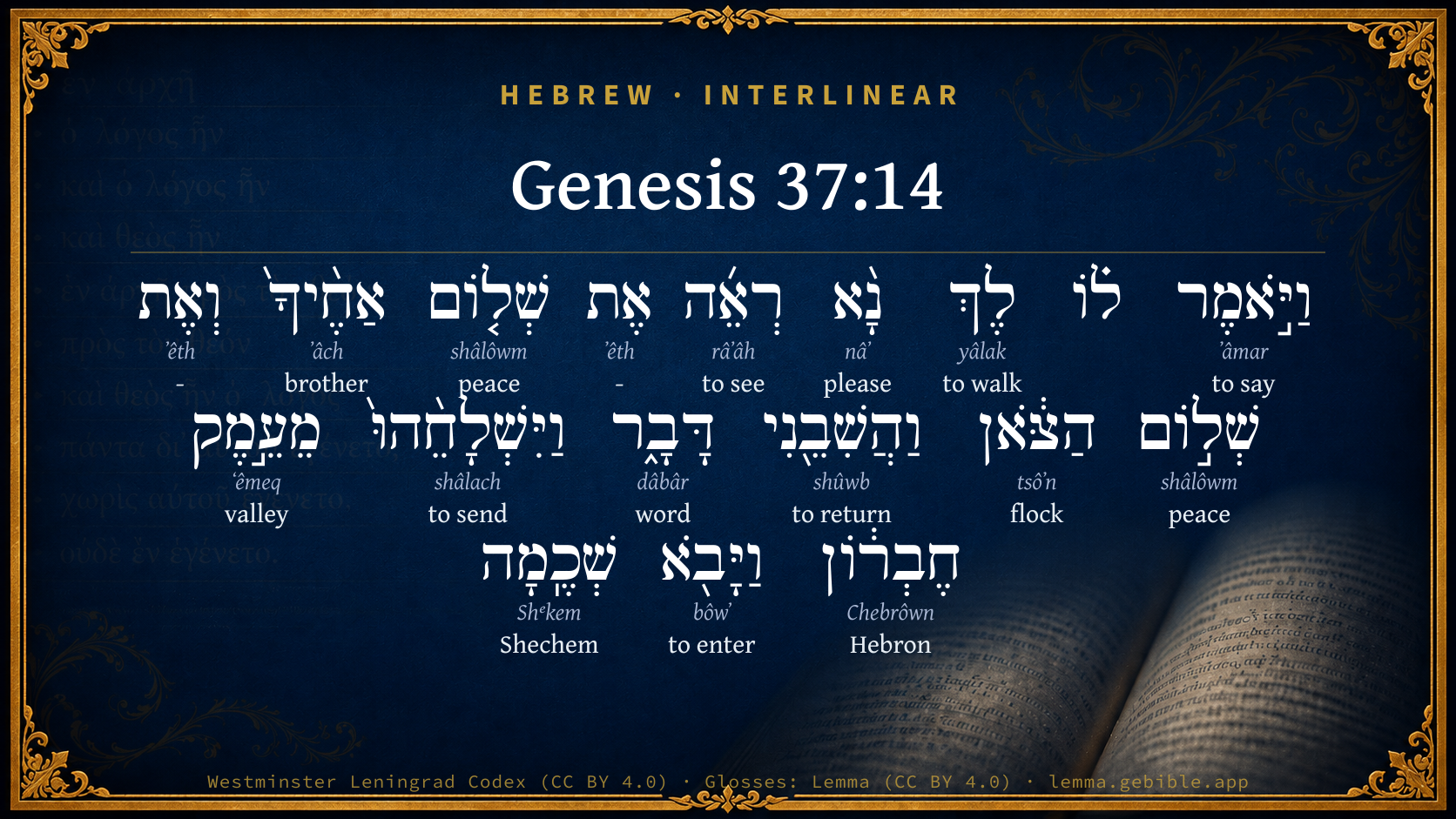
Hebrew (Westminster Leningrad Codex) Genesis 37:14 appears in the Hebrew Old Testament. The text above is from the Westminster Leningrad Codex. Each word links to its Strong’s number, a concise gloss, and parsing drawn from the Open Scriptures Hebrew Bible morphology. Click any word for its full Brown-Driver-Briggs (BDB) entry.
Download image
Cite this verse

Genesis 37:14 (World English Bible). Public Domain. Lemma interlinear Bible study tool, https://lemma.gebible.app/v/genesis/37/14.

Show BibTeX & RIS
BibTeX
RIS
English Translation
He said to him, "Go now, see whether it is well with your brothers, and well with the flock; and bring me word again." So he sent him out of the valley of Hebron, and he came to Shechem.
World English Bible · Public Domain
Download a study sheet

One document with this verse’s original text, its word-by-word gloss line, the meaning frame, cross-references with their text, attributed commentary, and full source and license credits — printable, and it pastes into notes with its structure intact.

This verse Autodidact and up

Study sheet (.html) Plain text (.txt)

A passage Seminary Student

Up to 50 verses in one chapter. A passage sheet keeps up to 6 commentary sources and 12 cross-references per verse, in the order this page ranks them, and says so on the sheet whenever that leaves anything out. Ask for a single verse and you get the Autodidact verse sheet above.

Everything on this page stays free to read, with no account — the sheet is a download of what is already on screen, not access to it.

Want to remove ads? Support Godless Engineer
Compare translations 3

The same verse in 3 English versions, stacked beneath the original-language interlinear above. Click any original word for its lexicon entry.

Each is an independent rendering of the whole verse — the interlinear is not word-aligned to these translations.

Highlighted words mark where these versions differ — a whole-verse word diff, not a word-by-word alignment.

  • World English Bible Public Domain
    He said to him, "Go now, see whether it is well with your brothers, and well with the flock; and bring me word again." So he sent him out of the valley of Hebron, and he came to Shechem.
  • King James Version Public Domain
    And he said to him, Go, I pray thee, see whether it be well with thy brethren, and well with the flocks; and bring me word again. So he sent him out of the vale of Hebron, and he came to Shechem.
  • unfoldingWord Literal Text CC BY-SA 4.0
    Then he said to him, “Please go and see the well-being of your brothers and the well-being of the flock, and bring me word.” So he sent him from the valley of Hebron, and he went to Shechem.

unfoldingWord Literal Text — © unfoldingWord, licensed CC BY-SA 4.0. Word-aligned USFM3 via Door43 (git.door43.org/unfoldingWord/en_ult).

Versions to compare (up to 4)

3 of 4 selected

Show all 18 translations

Every available English version of this verse, each an independent rendering of the whole verse.

  • World English Bible Public Domain
    He said to him, "Go now, see whether it is well with your brothers, and well with the flock; and bring me word again." So he sent him out of the valley of Hebron, and he came to Shechem.
  • Berean Standard Bible Public Domain
    Then Israel told him, “Go now and see how your brothers and the flocks are faring, and bring word back to me.” So he sent him off from the Valley of Hebron. And when Joseph arrived in Shechem,
  • Majority Standard Bible Public Domain
    Then Israel told him, “Go now and see how your brothers and the flocks are faring, and bring word back to me.” So he sent him off from the Valley of Hebron. And when Joseph arrived in Shechem,
  • King James Version Public Domain
    And he said to him, Go, I pray thee, see whether it be well with thy brethren, and well with the flocks; and bring me word again. So he sent him out of the vale of Hebron, and he came to Shechem.
  • American Standard Version (1901) Public Domain
    And he said to him, Go now, see whether it is well with thy brethren, and well with the flock; and bring me word again. So he sent him out of the vale of Hebron, and he came to Shechem.
  • Revised Version (1885) Public Domain
    And he said to him, Go now, see whether it be well with thy brethren, and well with the flock; and bring me word again. So he sent him out of the vale of Hebron, and he came to Shechem.
  • Geneva Bible (1599) Public Domain
    And he answered him, I am here. Then he saide vnto him, Goe now, see whether it bee well with thy brethren, and how the flocks prosper, and bring me word againe. so hee sent him from the vale of Hebron, and he came to Shechem.
  • Douay-Rheims (1899) Public Domain
    I am ready: he said to him: Go, and see if all things be well with thy brethren, and the cattle: and bring me word again what is doing. So being sent from the vale of Hebron, he came to Sichem:
  • Young's Literal Translation Public Domain
    and he saith to him, `Go, I pray thee, see the peace of thy brethren, and the peace of the flock, and bring me back word;' and he sendeth him from the valley of Hebron, and he cometh to Shechem.
  • Literal Standard Version CC BY-SA 4.0
    and he says to him, “Now go see the peace of your brothers, and the peace of the flock, and bring me back word”; and he sends him from the Valley of Hebron, and he comes to Shechem.
  • Unlocked Literal Bible CC BY-SA 4.0
    He said to him, “Go now, see whether it is well with your brothers and well with the flock, and bring me word.” So Jacob sent him out of the Valley of Hebron, and Joseph went to Shechem.
  • unfoldingWord Literal Text CC BY-SA 4.0
    Then he said to him, “Please go and see the well-being of your brothers and the well-being of the flock, and bring me word.” So he sent him from the valley of Hebron, and he went to Shechem.
  • Darby Bible Public Domain
    And he said to him, Go, I pray thee, see after the welfare of thy brethren, and after the welfare of the flock; and bring me word again. And he sent him out of the vale of Hebron; and he came towards Shechem.
  • World Messianic Bible Public Domain
    He said to him, “Go now, see whether it is well with your brothers, and well with the flock; and bring me word again.” So he sent him out of the valley of Hebron, and he came to Shechem.
  • Webster's Bible Public Domain
    And he said to him, Go, I pray thee, see whether it is well with thy brethren, and well with the flocks; and bring me word again. So he sent him from the vale of Hebron, and he came to Shechem.
  • Free Bible Version CC BY-SA 4.0
    So he told him, “Off you go and see how your brothers and the flocks are doing, and come back and let me know.” So he sent him off. Joseph set out from the Hebron Valley,
  • Bible in Basic English Public Domain
    And he said to him, Go now, and see if your brothers are well and how the flock is; then come back and give me word. So he sent him out of the valley of Hebron, and he came to Shechem.
  • JPS Tanakh (1917) Public Domain
    And he said to him: 'Go now, see whether it is well with thy brethren, and well with the flock; and bring me back word.' So he sent him out of the vale of Hebron, and he came to Shechem.

Literal Standard Version (2020), Covenant Press — licensed CC BY-SA 4.0. Text via the HelloAO Bible API (eBible.org). Unlocked Literal Bible (unfoldingWord) — licensed CC BY-SA 4.0. Text via the HelloAO Bible API (eBible.org). unfoldingWord Literal Text — © unfoldingWord, licensed CC BY-SA 4.0. Word-aligned USFM3 via Door43 (git.door43.org/unfoldingWord/en_ult). Free Bible Version, Dr. Jonathan Gallagher — licensed CC BY-SA 4.0. Text via the HelloAO Bible API (eBible.org).

Word by word

More ways to search: Search by grammar → Find every occurrence → Compare this word →

Practice this passage: Drill this verse → Learn its vocabulary →

שְׁכֶֽמָה
Shᵉkem
H7927
“Shechem · toward”
Noun, Proper + Suffix, Demonstrative
Part of Speech
Noun
Type
Proper
Full BDB Definition

Origin: the same as H7926

TWOT: 2386b

Shechem = "back" or " shoulder" - son of Hamor, the chieftain of the Hivites at Shechem at the time of Jacob's arrival (noun proper masculine) - a city in Manasseh; located in a valley between Mount Ebal and Mount Gerizim, 34 miles (54 kilometers) north of Jerusalem and 7 miles (noun proper locative)
  1. וַיֹּ֣אמֶר ʼâmar H559 “and · to say” Conjunction + Verb, Qal, Sequential Imperfect, 3rd Person, Masculine, Singular
  2. לֶךְ yâlak H3212 “walk” Verb, Qal, Imperative, 2nd Person, Masculine, Singular
  3. נָ֨א nâʼ H4994 “please” Particle, Exhortation
  4. רְאֵ֜ה râʼâh H7200 “see” Verb, Qal, Imperative, 2nd Person, Masculine, Singular
  5. אֶת ʼêth H853 “-” Particle, Direct Object
  6. שְׁל֤וֹם shâlôwm H7965 “peace of” Noun, Common, Masculine, Singular, Construct
  7. אַחֶ֨יךָ֙ ʼâch H251 “brothers · your” Noun, Common, Masculine, Plural, Construct + Suffix, Personal, 2nd Person, Masculine, Singular
  8. וְאֶת ʼêth H853 “and · -” Conjunction + Particle, Direct Object
  9. שְׁל֣וֹם shâlôwm H7965 “peace of” Noun, Common, Masculine, Singular, Construct
  10. הַצֹּ֔אן tsôʼn H6629 “the · flock” Particle, Definite Article + Noun, Common, Both, Singular, Absolute
  11. וַהֲשִׁבֵ֖נִי shûwb H7725 “and · return · me” Conjunction + Verb, Hiphil, Imperative, 2nd Person, Masculine, Singular + Suffix, Personal, 1st Person, Common, Singular
  12. דָּבָ֑ר dâbâr H1697 “word” Noun, Common, Masculine, Singular, Absolute
  13. וַיִּשְׁלָחֵ֨הוּ֙ shâlach H7971 “and · to send · him” Conjunction + Verb, Qal, Sequential Imperfect, 3rd Person, Masculine, Singular + Suffix, Personal, 3rd Person, Masculine, Singular
  14. מֵעֵ֣מֶק ʻêmeq H6010 “from · valley of” Preposition + Noun, Common, Masculine, Singular, Construct
  15. חֶבְר֔וֹן Chebrôwn H2275 “Hebron” Noun, Proper
  16. וַיָּבֹ֖א bôwʼ H935 “and · to enter” Conjunction + Verb, Qal, Sequential Imperfect, 3rd Person, Masculine, Singular

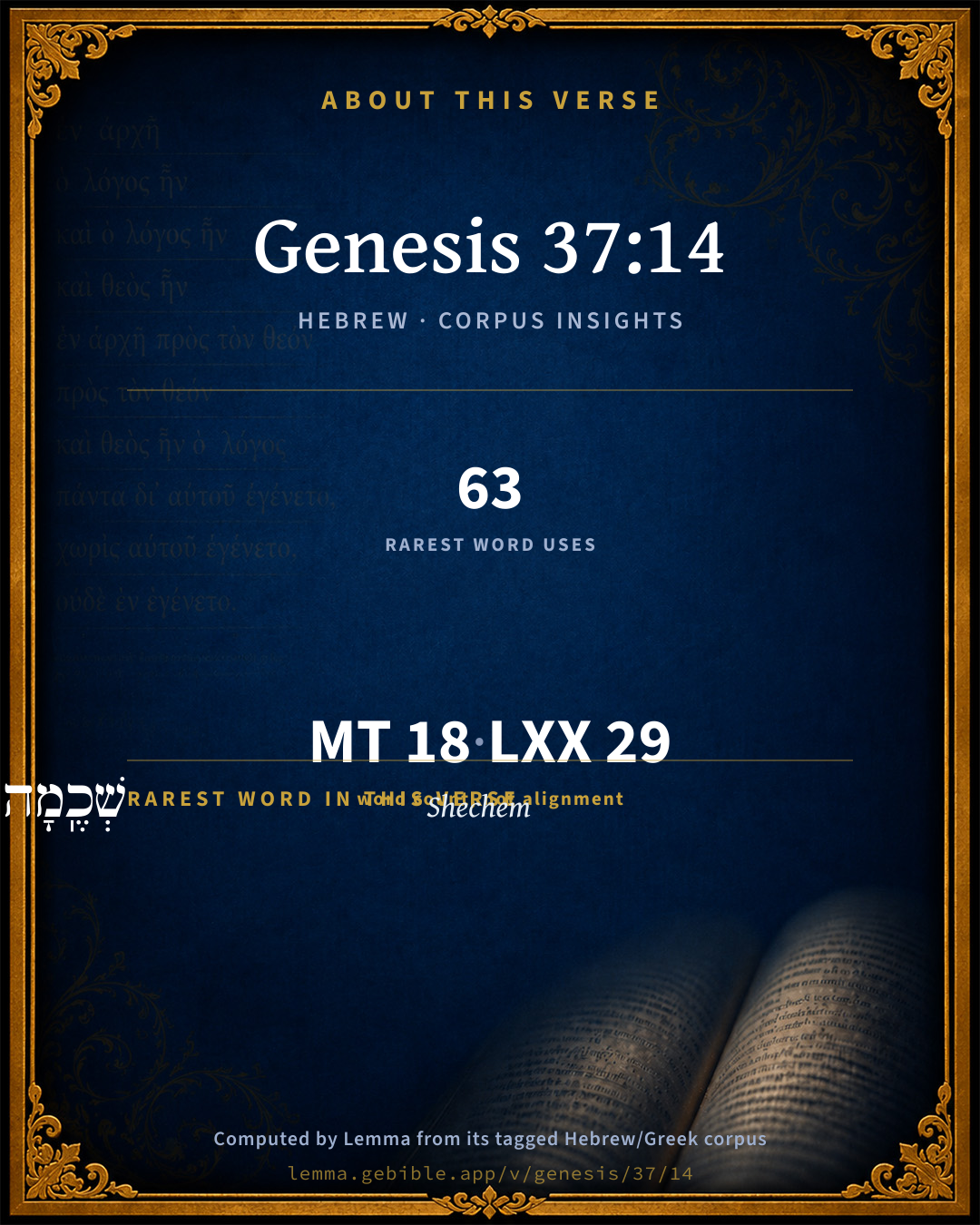
About this verse

These counts appear in no published source. They are computed here, from the morphology-tagged text and Lemma’s own curated glosses. What Lemma adds →

18
words
15
distinct lemmas
Pentateuch
section

Grammatical profile

  • 6 verbs
  • 8 nouns
  • 1 preposition
  • 3 particles

Verb forms

  • וַיֹּ֣אמֶר Qal · Sequential Imperfect
  • לֶךְ Qal · Imperative
  • רְאֵ֜ה Qal · Imperative
  • וַהֲשִׁבֵ֖נִי Hiphil · Imperative
  • וַיִּשְׁלָחֵ֨הוּ֙ Qal · Sequential Imperfect
  • וַיָּבֹ֖א Qal · Sequential Imperfect

Repetition

A word recurs within this verse — often emphatic in Hebrew:

  • שְׁל֤וֹם peace H7965 ×2

Hebrew & Septuagint length

In English translation the verse runs 39 words from the Hebrew and 35 from the Septuagint (LXX English) — closely comparable.

A rough comparison of the two English renderings, which tokenize alike — not a word-level alignment.

Word counts can differ between the Hebrew and the Greek without any difference in meaning — e.g. the Hebrew direct-object marker אֵת has no separate Greek word, and Greek often adds the article ὁ.

In the original languages it is 18 Hebrew tokens and 29 Greek tokens — but the two are counted differently (Hebrew bundles its prefixes and suffixes into one token; the Greek is in lemma form), so that isn’t a like-for-like length.

Cross-references

14

Topical passages linked to Genesis 37:14 in the Treasury of Scripture Knowledge — connected by theme and wording, ordered by reader-vote popularity; previews shown in the World English Bible.

  • Genesis 35:27 Jacob came to Isaac his father, to Mamre, to Kiriath Arba (the same is Hebron), where Abraham and Isaac lived as foreigners.
  • Psalms 125:5 But as for those who turn aside to their crooked ways, Yahweh will lead them away with the workers of iniquity. Peace be on Israel.
  • Luke 19:42 saying, "If you, even you, had known today the things which belong to your peace! But now, they are hidden from your eyes.
  • Genesis 13:18 Abram moved his tent, and came and lived by the oaks of Mamre, which are in Hebron, and built an altar there to Yahweh.
  • Genesis 23:2 Sarah died in Kiriath Arba (the same is Hebron), in the land of Canaan. Abraham came to mourn for Sarah, and to weep for her.
  • Genesis 29:6 He said to them, "Is it well with him?" They said, "It is well. See, Rachel, his daughter, is coming with the sheep."
  • Genesis 41:16 Joseph answered Pharaoh, saying, "It isn't in me. God will give Pharaoh an answer of peace."
  • Numbers 13:22 They went up by the South, and came to Hebron; and Ahiman, Sheshai, and Talmai, the children of Anak, were there. (Now Hebron was built seven years before Zoan in Egypt.)
  • Joshua 14:13 Joshua blessed him; and he gave Hebron to Caleb the son of Jephunneh for an inheritance.
  • 1 Samuel 17:17–18 Jesse said to David his son, Take now for your brothers an ephah of this parched grain, and these ten loaves, and carry [them] quickly to the camp to your brothers;
  • 2 Samuel 18:32 The king said to the Cushite, Is it well with the young man Absalom? The Cushite answered, The enemies of my lord the king, and all who rise up against you to do you hurt, be as that young man is.
  • 1 Kings 2:33 So shall their blood return on the head of Joab, and on the head of his seed forever: but to David, and to his seed, and to his house, and to his throne, shall there be peace for ever from Yahweh.
  • Jeremiah 29:7 Seek the peace of the city where I have caused you to be carried away captive, and pray to Yahweh for it; for in the peace of it shall you have peace.
  • Joshua 14:15 Now the name of Hebron before was Kiriath Arba; [which Arba was] the greatest man among the Anakim. The land had rest from war.

Cross-references courtesy of OpenBible.info (CC BY 4.0).

Hebrew and Greek witnesses Masoretic Hebrew ↔ Greek Septuagint

The same verse in the two great witnesses to the Old Testament, shown verse-for-verse.

These are two independent witnesses, not word-aligned to each other, and the Septuagint is shown in lemma (dictionary) form.

Hebrew Genesis 37:14 Masoretic · Westminster Leningrad Codex

וַיֹּ֣אמֶר ל֗וֹ לֶךְ נָ֨א רְאֵ֜ה אֶת שְׁל֤וֹם אַחֶ֨יךָ֙ וְאֶת שְׁל֣וֹם הַצֹּ֔אן וַהֲשִׁבֵ֖נִי דָּבָ֑ר וַיִּשְׁלָחֵ֨הוּ֙ מֵעֵ֣מֶק חֶבְר֔וֹן וַיָּבֹ֖א שְׁכֶֽמָה

He said to him, "Go now, see whether it is well with your brothers, and well with the flock; and bring me word again." So he sent him out of the valley of Hebron, and he came to Shechem.

World English Bible · Public Domain

Greek LXX Genesis 37:14 Septuagint · lemma form

εἶπον δέ αὐτός ἰσραήλ πορεύομαι ὁράω εἰ ὑγιαίνω ὁ ἀδελφός σύ καί ὁ πρόβατον καί ἀναἀγγέλλω ἐγώ καί ἀποστέλλω αὐτός ἐκ ὁ κοιλάς ὁ χεβρων καί ἔρχομαι εἰς συχεμ

And Israel said to him, Go and see if your brethren and the sheep are well, and bring me word; and he sent him out of the valley of Chebron, and he came to Sychem.

LXX2012 (modern English Septuagint) · Public Domain

Hebrew: Westminster Leningrad Codex (CC BY 4.0). Greek: Septuagint (public domain); English from LXX2012 (modern English Septuagint) (Public Domain). How the Septuagint differs from the Hebrew →

Targum (Aramaic paraphrase)

2

The Targum is the ancient Jewish Aramaic paraphrase of the Hebrew Scriptures — an interpretive translation, not the Hebrew text itself. Onkelos (literal) and Pseudo-Jonathan (expansive) render the Torah, and Jonathan the Prophets. Coverage is partial: where no permissively-licensed English translation exists for a verse, only the Aramaic is shown. This is verse-level text, not a word-by-word alignment to the Hebrew.

  1. Targum Onkelos Torah (Genesis–Deuteronomy)
    וַאֲמַר לֵהּ אִיזֵל כְּעַן חֲזֵי יָת שְׁלָמָא דְאָחוּךְ וְיָת שְׁלָמָא דְעָנָא וַאֲתֶבְנִי פִּתְגָמָא וְשַׁלְחֵהּ מִמֵישַׁר חֶבְרוֹן וַאֲתָא לִשְׁכֶם

    (no public-domain English translation for this verse)

    Targum Onkelos — Aramaic: “Onkelos Genesis” (public domain); “Onkelos Exodus” (public domain); “Onkelos Leviticus” (public domain); “Onkelos Numbers” (public domain); “Onkelos Deuteronomy” (public domain). English: “Sefaria Community Translation” (CC0 1.0 (public-domain dedication)); “J.W. Etheridge. The Targums of Onkelos and Jonathan Ben Uzziel on the Pentateuch. London: Longmans, Green, 1862” (public domain). Text via Sefaria.

  2. Targum Pseudo-Jonathan Torah (Genesis–Deuteronomy)
    וַאֲמַר לֵיהּ אִיזֵל כְּדוֹן חָמֵי יַת שְׁלַם אָחָךְ וְיַת שְׁלַם עָנָא וַאֲתֵיבְנִי פִּתְגָמָא וְשַׁדְרֵיהּ עַל עֵיטָא עֲמִיקְתָּא דְאִתְמַלֵל עִם אַבְרָהָם בְּחֶבְרוֹן וּבְהַהוּא יוֹמָא הֲוָה שָׁרוּי גָלוּתָא דְמִצְרַיִם וְקָם וְאָתָא יוֹסֵף לִשְׁכֶם

    And he said, Go, see the welfare of Your brethren, and the welfare of the flock, and return me word to the deep Counsel. But he sent him according to the deep counsel which was spoken to Abraham in Hebron; for on that day began the cativity of Mizraim. And Joseph arose, and came to Shekem.

    Targum Pseudo-Jonathan — Aramaic: “Targum Jonathan on Genesis” (public domain); “Targum Jonathan on Exodus” (public domain); “Targum Jonathan on Leviticus” (public domain); “Targum Jonathan on Numbers” (public domain); “Targum Jonathan on Deuteronomy” (public domain). English: “The Targum of Jonathan ben Uzziel, trans. J. W. Etheridge, London, 1862” (public domain). Text via Sefaria.

Commentary

Notes on Genesis 37:14 from classic Christian and Jewish commentators (each source and its license shown beneath its notes). The classic Christian expositions comment on the surrounding passage and are grouped to its opening verse, so a note may address several verses; the Jewish commentaries on the Tanakh (Rashi and others) are per-verse, so they appear only where the commentator wrote on this verse.

Lemma curates 59 commentaries, every one of them public domain or Creative Commons licensed, each selected and text-cleaned for this edition rather than reprinted as found. About our sources →

Trapp's Complete Commentary

John Trapp

Gen 37:14 And he said to him, Go, I pray thee, see whether it be well with thy brethren, and well with the flocks; and bring me word again. So he sent him out of the vale of Hebron, and he came to Shechem.

Ver. 14. Well with thy brethren, and well with the flocks.] His first care is for the welfare of his children. Many a Laban is more solicitous of his flock than of his family. It were better being Herod’s swine than his son, said Augustus. Hawks and hounds are better tended and tutored in some great houses than children. Or if they be taught manners, and handsome behaviour, that is all that is cared for. But piety must be principally planted, where God’s blessing upon posterity is expected: the promise whereof is therefore’specially annexed to the second commandment. {a}

{a} Macrob.

John Trapp, A Commentary or Exposition upon All the Books of the Old and New Testament (1647–1656) — public domain. Text from a community e-Sword module.

Tyndale Open Study Notes

Tyndale Open Resources

37:14-17 The brothers ranged far and wide. Shechem was about fifty miles from Hebron, and Dothan another fifteen miles beyond Shechem.

Tyndale Open Study Notes — © Tyndale Open Resources, licensed CC BY-SA 4.0. Text via the HelloAO Bible API.

Adam Clarke's Commentary

Verse 14. Go - see whether it be well with thy brethren] Literally, Go, I beseech thee, and see the peace of thy brethren, and the peace of the flock. Go and see whether they are all in prosperity. See Clarke on Ge 37:4. As Jacob's sons were now gone to feed the flock on the parcel of ground they had bought from the Shechemites, (see Ge 33:19,) and where they had committed such a horrible slaughter, their father might feel more solicitous about their welfare, lest the neighbouring tribes should rise against them, and revenge the murder of the Shechemites.

As Jacob appears to have been at this time in the vale of Hebron, it is supposed that Shechem was about sixty English miles distant from it, and that Dothan was about eight miles farther. But I must again advertise my readers that all these calculations are very dubious; for we do not even know that the same place is intended, as there are many proofs that different places went by the same names.

Adam Clarke's Commentary on the Bible (1810–1826) — public domain. Text from a community e-Sword/MySword module.

Ellicott's Commentary for English Readers

(14) Whether it be well with thy brethren.—Jacob might well fear lest the natives should form a confederacy against his sons, and take vengeance upon them for their cruelty. They were too fierce themselves to have any such alarm, but Jacob was of a far more timid disposition.

The vale of Hebron.—The flocks and herds which formed the portion of Jacob’s cattle which pastured nearest home, occupied the country immediately to the north of Hebron as far as the tower of Eder; but he would no doubt pitch his own tent as near as possible to that of his father

A Bible Commentary for English Readers, edited by Charles John Ellicott (1878–1897) — public domain. Text from a community e-Sword module.

The Cambridge Bible for Schools and Colleges

gen. ed. J. J. S. Perowne

14. the vale of Hebron] The residence of Jacob; cf. Gen_35:27.

The Cambridge Bible for Schools and Colleges (gen. ed. J. J. S. Perowne; Cambridge University Press, 1878–1918) — public domain. Text from a community e-Sword module.

John Gill's Exposition

And a certain man found him,.... Many of the Jewish writers (l) say, this was an angel, the angel Gabriel, in the likeness of a man; but according to Aben Ezra, it was a traveller he met on the road; but it is more probable, as Schimidt observes, that it was some man at work in the field that came upon him and took notice of him:

and, behold, he was wandering in the field; in some field near Shechem, perhaps the same his father Jacob had purchased, and where he expected to have found his brethren, and was looking out for them, going to and fro in search of them; which the labouring man in the field observed:

and the man asked him, saying, what seekest thou? seeing him walking about, and first looking one way, and then another, concluded he was in search of something, either of some man or of some creature, a sheep or an ox that was lost; and therefore put this question to him, with a view to give him what direction and assistance he could.

(l) Pirke Eliezer, c. 38. Targum Jon. & Jarchi in loc.

John Gill's Exposition of the Whole Bible (1746–1763) — public domain (CC PDM 1.0). Text via the HelloAO Bible API.

Haydock's Catholic Bible Commentary

Bring me. He was afraid of letting him remain with them, and retained him mostly at home for company, and to protect him from danger.

George Leo Haydock (1774–1849), Haydock's Catholic Family Bible and Commentary, 1859 edition — public domain. Excludes Psalms (Douay-Rheims chapter numbering differs from Protestant) and Deuterocanonical books (Catholic canon only).

The Pulpit Commentary

And he (Jacob) said to him, Go, I pray thee, see whether it be well with thy brethren (literally, see the place of thy brethren), and well with the flocks (literally, and the peace of the flock); and bring me word again. So (literally, and) he sent him out of the vale of Hebron, (Gen_35:27) and he same to Shechem a distance of sixty miles.

HOMILIES BY F. HASTINGS Vers. 14, 15.

Joseph leaving home.

I pray thee, see whether," &c. Joseph left home unexpectedly. He knew not when he left it to seek his brethren that he would never come back again. After a longer journey than he anticipated Joseph finds his brethren. ;

I Like many leaving home, Joseph MET WITH FAITHFUL GUIDES. There are generally companions, teachers, ministers to help.

II Like many leaving home, Joseph FELL INTO SNARES. He could not help himself. The snares were not such as were willingly entered. The wicked entrapped him. On his youth, far from home, defenseless, and kindly-intentioned, nine cowardly men fell.

III Like many away from home, Joseph FOUND THAT GOD CARED FOR HIM WHEN HIS EARTHLY FATHER COULD NOT. Reuben was the means of saving him from death. Sold into slavery, he was still on the highway to eminence. We have to beware of hateful and murderous thoughts, remembering "that he that hateth his brother is" (so far as intent goes) "a murderer." In all journeyings we have to commit our way unto the Lord, and he will guide and defend. H.

The Pulpit Commentary (1880–1919), ed. H.D.M. Spence-Jones & Joseph S. Exell — public domain. Text from a community e-Sword module.

Rashi

Rabbi Shlomo Yitzchaki (Rashi)

מעמק חברון FROM THE VALE OF HEBRON — But was not Hebron situated on a hill, as it is said (Numbers 13:22) “And they went up into the South and they came unto Hebron” why then does it state that Jacob sent him from the עמק, (the vale, the deep part) of Hebron? But the meaning is that Jacob sent him in consequence of the necessity of bringing into operation the profound (עמוקה) thought of the righteous man who was buried in Hebron (Midrash Tanchuma, Vayera 22) — in order that there might be fulfilled that which was spoken to Abraham when the Covenant was made ‘between the parts” (cf. 15:13), “thy seed shall be a stranger etc.”

ויבא שכמה AND HE CAME TO SHECHEM — A spot foredestined to be the scene of misfortunes: there the sons of Jacob sinned (by selling Joseph), there Dinah was maltreated, there the kingdom of the House of David was divided, as it said (1 Kings 12:1) “And Rehoboam went to Shechem etc.” (Sanhedrin 102a).

Rashi on the Tanakh — English translations: “The Judaica Press complete Tanach with Rashi, translated by A. J. Rosenberg” (CC BY 4.0); “Pentateuch with Rashi's commentary by M. Rosenbaum and A.M. Silbermann, 1929-1934” (public domain); “The Metsudah Tanach series, Lakewood, N.J” (CC BY 4.0); and “The Book of Joshua, Metsudah Publications, 1997” (CC BY 4.0). Text via Sefaria.

Ramban (Nachmanides)

Rabbi Moshe ben Nachman (Ramban / Nachmanides)

AND HE SENT HIM OUT OF THE VALLEY OF HEBRON. Scripture mentions the place from which Joseph was sent, in order to indicate that there was a great distance between father and son, and that this was the reason why the brothers did him evil: they were distant far from their father. It also serves to relate that Joseph, out of respect for his father, strengthened himself to go after them to a distant place, and he did not say, “How shall I go when they hate me?”. Our Rabbis yet have a Midrash concerning this matter, in which they say, “It was to fulfill the profound thought of the ‘seemly companion’ (Hebron) as if it consisted of the two words: chever na’eh (seemly companion). Thus it refers to Abraham who walked before G-d (above 17:1). The Midrash is in Bereshith Rabbah 84:13. who was buried in Hebron.”

Ramban (Nachmanides) on the Tanakh — English translation: “Commentary on the Torah by Ramban (Nachmanides). Translated and annotated by Charles B. Chavel. New York, Shilo Pub. House, 1971-1976” (CC BY 4.0). Text via Sefaria.

Radak

Rabbi David Kimhi (Radak)

ויאמר...ואת שלום הצאן, in Bereshit Rabbah 84,13 the instruction by Yaakov to Joseph that he was to enquire not only about their personal well being, but also about the well being of their property, their flocks, teaches us that one must always display concern not only for the health, etc., of people one meets but also about their economic well being.

מעמק חברון, since when is Chevron in a valley? We always associate it with being located on a mountain! The Torah alludes to a profound understanding between G’d and Avraham who had been interred in Chevron. The Torah now alludes to the prediction by G’d to Avraham, that his descendants would for a long time be strangers in a land not theirs (Genesis 15,13)

Radak on the Tanakh — English translations: “Sefaria Community Translation” (CC0 1.0 (public-domain dedication)); “Eliyahu Munk, HaChut Hameshulash” (CC BY 4.0); “Rabbi Mike Feuer, Jerusalem Anthology” (CC BY 4.0); and “R. David Kimhi on the first book of Psalms, Translated by R.G. Finch, London, 1919” (public domain). Text via Sefaria.

Lesson kit

Teaching starters — assembled from the data on this page, not authored interpretation. Every prompt links to the verse data it draws on. Edit before teaching.

Genesis, in the Pentateuch, opens this verse with 18 words (15 distinct Hebrew lemmas). Its most distinctive word is Shᵉkem (“Shechem”). A historical commentator’s framing appears above. Read the whole chapter for the surrounding context.

Discussion questions

  1. What does “Shechem” (Shᵉkem) contribute to the verse as a whole?
  2. How does Genesis 35:27, which shares this passage’s theme, read alongside this verse?
  3. What does the repetition of “peace” (2× in this one verse) do in this verse?
  4. The translations on this page render this verse differently — a whole-verse word diff, not a word-by-word alignment. What might account for the different wordings?
  5. «וַיֹּ֣אמֶר» is a Qal Sequential Imperfect verb. How does that grammatical form shape the action described?
  6. Compare how Trapp's Complete Commentary and Tyndale Open Study Notes read this verse. Where do they agree or differ?

Things to notice

Reading settings

Reading text

Shown beneath each verse's original-language words.

Old Testament
Old Testament edition

Read the OT as the Masoretic Hebrew (MT) or the Greek Septuagint (LXX).

English shown for the Greek Septuagint (in the Hebrew ↔ Greek comparison).

Comparing translations? Open the Compare panel on any verse page to stack up to four side by side.