
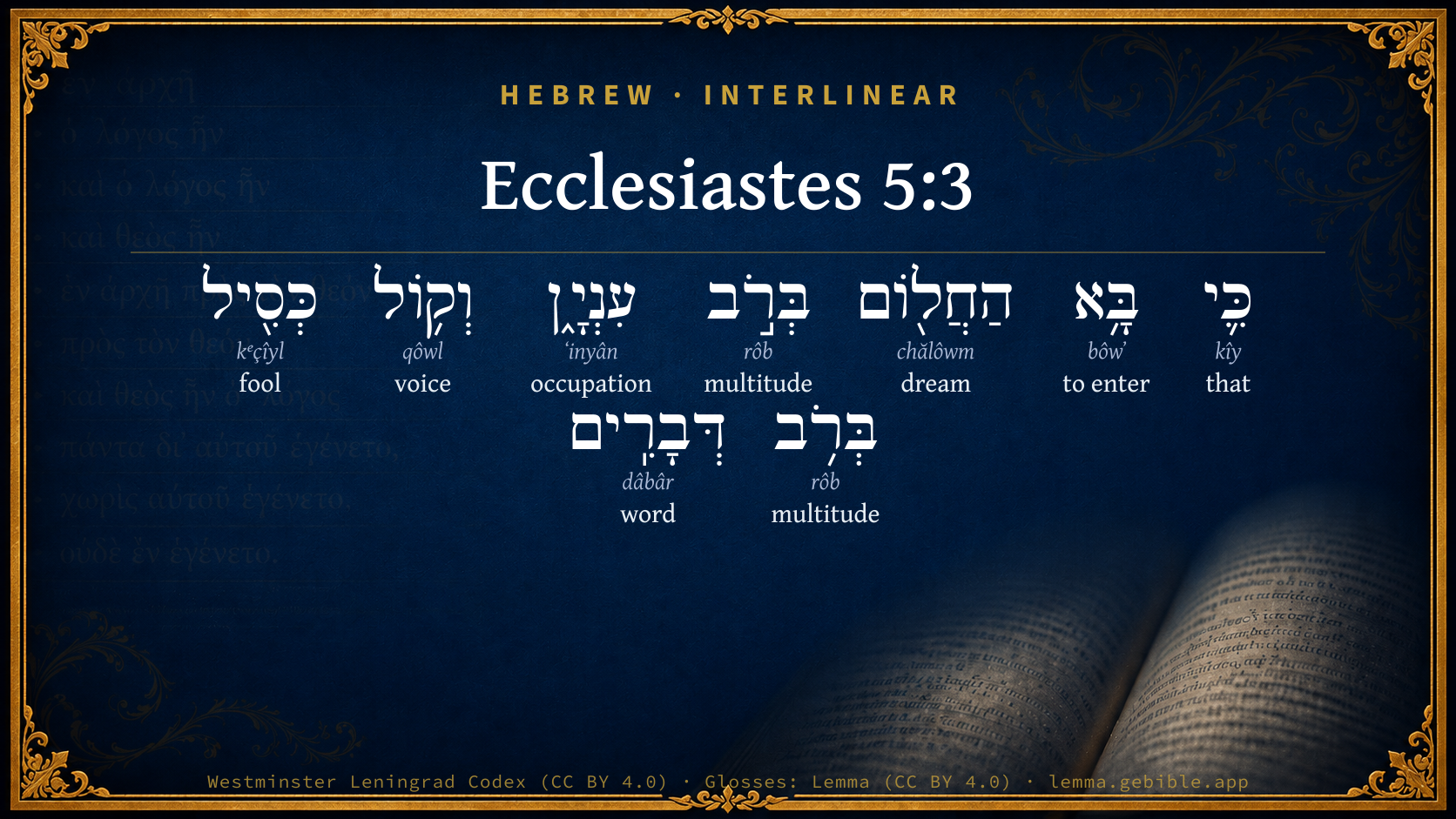
Ecclesiastes 5:3

Hebrew (Westminster Leningrad Codex) Ecclesiastes 5:3 appears in the Hebrew Old Testament. The text above is from the Westminster Leningrad Codex. Each word links to its Strong’s number, a concise gloss, and parsing drawn from the Open Scriptures Hebrew Bible morphology. Click any word for its full Brown-Driver-Briggs (BDB) entry.
Download image
Cite this verse

Ecclesiastes 5:3 (World English Bible). Public Domain. Lemma interlinear Bible study tool, https://lemma.gebible.app/v/ecclesiastes/5/3.

Show BibTeX & RIS
BibTeX
RIS
English Translation
For as a dream comes with a multitude of cares, so a fool's speech with a multitude of words.
World English Bible · Public Domain
Download a study sheet

One document with this verse’s original text, its word-by-word gloss line, the meaning frame, cross-references with their text, attributed commentary, and full source and license credits — printable, and it pastes into notes with its structure intact.

This verse Autodidact and up

Study sheet (.html) Plain text (.txt)

A passage Seminary Student

Up to 50 verses in one chapter. A passage sheet keeps up to 6 commentary sources and 12 cross-references per verse, in the order this page ranks them, and says so on the sheet whenever that leaves anything out. Ask for a single verse and you get the Autodidact verse sheet above.

Everything on this page stays free to read, with no account — the sheet is a download of what is already on screen, not access to it.

Want to remove ads? Support Godless Engineer
Compare translations 3

The same verse in 3 English versions, stacked beneath the original-language interlinear above. Click any original word for its lexicon entry.

Each is an independent rendering of the whole verse — the interlinear is not word-aligned to these translations.

Highlighted words mark where these versions differ — a whole-verse word diff, not a word-by-word alignment.

  • World English Bible Public Domain
    For as a dream comes with a multitude of cares, so a fool's speech with a multitude of words.
  • King James Version Public Domain
    For a dream cometh through the multitude of business; and a fool's voice is known by multitude of words.
  • unfoldingWord Literal Text CC BY-SA 4.0
    For the dream comes with much business, and the voice of a fool with many words.

unfoldingWord Literal Text — © unfoldingWord, licensed CC BY-SA 4.0. Word-aligned USFM3 via Door43 (git.door43.org/unfoldingWord/en_ult).

Versions to compare (up to 4)

3 of 4 selected

Show all 18 translations

Every available English version of this verse, each an independent rendering of the whole verse.

  • World English Bible Public Domain
    For as a dream comes with a multitude of cares, so a fool's speech with a multitude of words.
  • Berean Standard Bible Public Domain
    As a dream comes through many cares, so the speech of a fool comes with many words.
  • Majority Standard Bible Public Domain
    As a dream comes through many cares, so the speech of a fool comes with many words.
  • King James Version Public Domain
    For a dream cometh through the multitude of business; and a fool's voice is known by multitude of words.
  • American Standard Version (1901) Public Domain
    For a dream cometh with a multitude of business, and a fool's voice with a multitude of words.
  • Revised Version (1885) Public Domain
    For a dream cometh with a multitude of business; and a fool’s voice with a multitude of words.
  • Geneva Bible (1599) Public Domain
    When thou hast vowed a vowe to God, deferre not to pay it: for he deliteth not in fooles: pay therefore that thou hast vowed.
  • Douay-Rheims (1899) Public Domain
    If thou hast vowed any thing to God, defer not to pay it: for an unfaithful and foolish promise displeaseth him: but whatsoever thou hast vowed, pay it.
  • Young's Literal Translation Public Domain
    For the dream hath come by abundance of business, and the voice of a fool by abundance of words.
  • Literal Standard Version CC BY-SA 4.0
    For the dream has come by abundance of business, and the voice of a fool by abundance of words.
  • Unlocked Literal Bible CC BY-SA 4.0
    If you have too many things to do and worry about, you will probably have bad dreams. The more words you speak, the more foolish things you will probably say.
  • unfoldingWord Literal Text CC BY-SA 4.0
    For the dream comes with much business, and the voice of a fool with many words.
  • Darby Bible Public Domain
    For a dream cometh through the multitude of business, and a fool's voice through a multitude of words.
  • World Messianic Bible Public Domain
    For as a dream comes with a multitude of cares, so a fool’s speech with a multitude of words.
  • Webster's Bible Public Domain
    \\5:4\\When thou vowest a vow to God, defer not to pay it; for he hath no pleasure in fools: pay that which thou hast vowed.
  • Free Bible Version CC BY-SA 4.0
    When you worry too much, you get nightmares; when you talk too much, you say foolish things.
  • Bible in Basic English Public Domain
    When you take an oath before God, put it quickly into effect, because he has no pleasure in the foolish; keep the oath you have taken.
  • JPS Tanakh (1917) Public Domain
    (5-2) For a dream cometh through a multitude of business; and a fool's voice through a multitude of words.

Literal Standard Version (2020), Covenant Press — licensed CC BY-SA 4.0. Text via the HelloAO Bible API (eBible.org). Unlocked Literal Bible (unfoldingWord) — licensed CC BY-SA 4.0. Text via the HelloAO Bible API (eBible.org). unfoldingWord Literal Text — © unfoldingWord, licensed CC BY-SA 4.0. Word-aligned USFM3 via Door43 (git.door43.org/unfoldingWord/en_ult). Free Bible Version, Dr. Jonathan Gallagher — licensed CC BY-SA 4.0. Text via the HelloAO Bible API (eBible.org).

Word by word

More ways to search: Search by grammar → Find every occurrence → Compare this word →

Practice this passage: Drill this verse → Learn its vocabulary →

About this verse

These counts appear in no published source. They are computed here, from the morphology-tagged text and Lemma’s own curated glosses. What Lemma adds →

9
words
8
distinct lemmas
Wisdom
section

Notable vocabulary

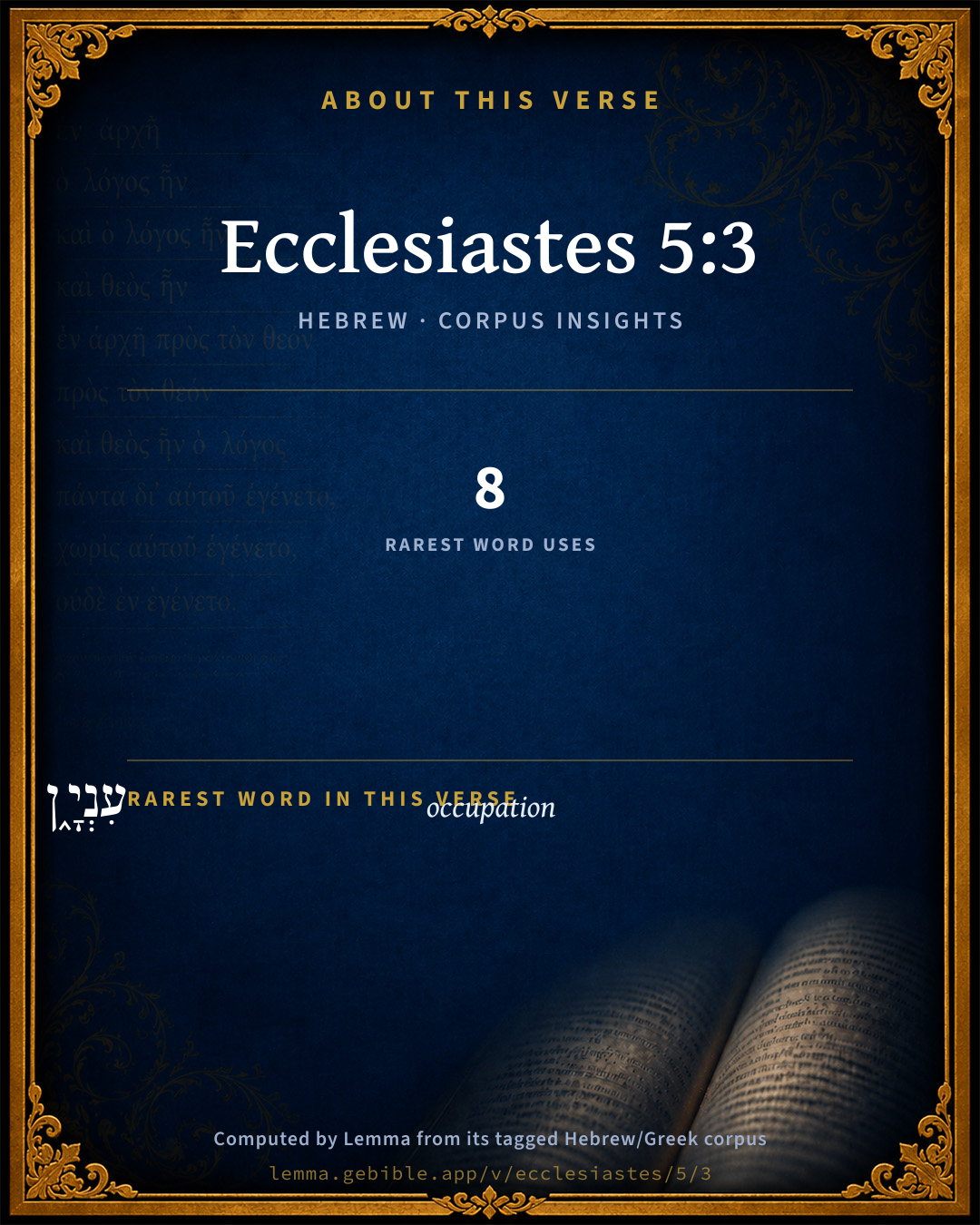
The rarest word here is עִנְיָ֑ן occupation H6045 — appearing just 8 times in the whole Hebrew Bible.

Shared distinctive vocabulary

עִנְיָ֑ן occupation H6045 occurs in 8 verses of the Hebrew Bible. Also found in:

Grammatical profile

  • 1 verb
  • 6 nouns
  • 1 adjective
  • 1 conjunction

Verb forms

  • בָּ֥א Qal · Perfect

Repetition

A word recurs within this verse — often emphatic in Hebrew:

  • בְּרֹ֣ב multitude H7230 ×2

Hebrew & Septuagint length

In English translation the verse runs 19 words from the Hebrew and 28 from the Septuagint (LXX English) — the Septuagint runs noticeably longer here. See the side-by-side →

A rough comparison of the two English renderings, which tokenize alike — not a word-level alignment.

Word counts can differ between the Hebrew and the Greek without any difference in meaning — e.g. the Hebrew direct-object marker אֵת has no separate Greek word, and Greek often adds the article ὁ.

Cross-references

4

Topical passages linked to Ecclesiastes 5:3 in the Treasury of Scripture Knowledge — connected by theme and wording, ordered by reader-vote popularity; previews shown in the World English Bible.

  • Proverbs 15:2 The tongue of the wise commends knowledge, But the mouth of fools gush out folly.
  • Proverbs 10:19 In the multitude of words there is no lack of disobedience, But he who restrains his lips does wisely.
  • Ecclesiastes 10:12–14 The words of a wise man's mouth are gracious; but a fool is swallowed by his own lips.
  • Job 11:2 "Shouldn't the multitude of words be answered? Should a man full of talk be justified?

Cross-references courtesy of OpenBible.info (CC BY 4.0).

Hebrew and Greek witnesses Masoretic Hebrew ↔ Greek Septuagint

The same verse in the two great witnesses to the Old Testament, shown verse-for-verse.

Here the Septuagint runs noticeably longer than the Hebrew — LXX2012 (modern English Septuagint) 28 words vs World English Bible 19. A rough length comparison of the two English translations, not a word-level alignment — read both below.

These are two independent witnesses, not word-aligned to each other, and the Septuagint is shown in lemma (dictionary) form.

Hebrew Ecclesiastes 5:3 Masoretic · Westminster Leningrad Codex

כִּ֛י בָּ֥א הַחֲל֖וֹם בְּרֹ֣ב עִנְיָ֑ן וְק֥וֹל כְּסִ֖יל בְּרֹ֥ב דְּבָרִֽים

For as a dream comes with a multitude of cares, so a fool's speech with a multitude of words.

World English Bible · Public Domain

Greek LXX Ecclesiastes 5:3 Septuagint · lemma form

καθώς ἄν εὔχομαι εὐχή ὁ θεός μή χρονίζω ὁ ἀποδίδωμι αὐτός ὅτι οὐ εἰμί θέλημα ἐν ἄφρων σύν ὅσος ἐάν εὔχομαι ἀποδίδωμι

Whenever you shall vow a vow to God, defer not to pay it; for he has no pleasure in fools: pay you therefore whatever you shall have vowed.

LXX2012 (modern English Septuagint) · Public Domain

On this verse, The Pulpit Commentary discusses the Septuagint’s reading. Read the note in Commentary ↓

Hebrew: Westminster Leningrad Codex (CC BY 4.0). Greek: Septuagint (public domain); English from LXX2012 (modern English Septuagint) (Public Domain). How the Septuagint differs from the Hebrew →

Commentary

Notes on Ecclesiastes 5:3 from classic Christian and Jewish commentators (each source and its license shown beneath its notes). The classic Christian expositions comment on the surrounding passage and are grouped to its opening verse, so a note may address several verses; the Jewish commentaries on the Tanakh (Rashi and others) are per-verse, so they appear only where the commentator wrote on this verse.

Lemma curates 59 commentaries, every one of them public domain or Creative Commons licensed, each selected and text-cleaned for this edition rather than reprinted as found. About our sources →

Trapp's Complete Commentary

John Trapp

Ecc 5:3 For a dream cometh through the multitude of business; and a fool’s voice [is known] by multitude of words.

Ver. 3. For a dream cometh through the multitude of business.] When all the rest of the senses are bound up by sleep, the soul entereth into the shop of the fancy, and operates there usually according to the businesses and employments of the day past; et fieri videntur quae fieri tamen non videntur, saith Tertullian, {a} those things seem to be done in a dream, which yet are not seen to be done at all: these are but vanae iactationes negotiosae animae, the idle tossings of a busy mind. In like sort a fool, a heartless, sapless fellow, that being sensual and void of "the spirit of grace and supplications," hath neither the affections nor expressions of holy prayer, "multiplies words without knowledge," thinks to make out in words what he wants in worth, being λαλειν αριστος, λεγειν δε αδυνατωτατος, as Plutarch saith of Alcibiades, one that could talk much but speak little: "His voice is known by multitude of words." It is but a "voice" that is heard, it is but a sound that is made, like the uncertain sound of a trumpet, that none can tell what it meaneth, what to make of it. Corniculas citius in Africa, quam res rationesque solidus in Turriani scriptis reperias, saith one, {b} so here if there be any worth of matter in the fool’s words, it is but by chance, as Aristotle saith, {c} that dreams do by chance foretell those things that come to pass. Let it be our care to shun as much as may be all lavish and superfluous talkativeness and tediousness, but especially in prayer, lest we "offer the sacrifice of fools," and God be angry with us. For as it is not the loudness of a preacher’s voice, but the weight and holiness of his matter, and the spirit of the preacher, that moves a wise and intelligent hearer, so it is not the labour of the lips, but the travail of the heart that prevails with God. The Baalites’ prayer was not more tedious than Elijah’s short, yet more pithy than short. And it was Elijah that spake loud and sped in heaven. Let the fool learn, therefore, to show more wit in his discourse than words, lest being known by his voice, he meet, as the nightingale did, with some Laconian that will not let to tell him, Vox tu es, praeterea nihil, Thou art a voice, and that’s all.

{a} Tertull., De Anima, cap. 49.

{b} Beringer., Contra Idol. cum Salut. Angel.

{c} Aristot., De Divinat. per Insom.

John Trapp, A Commentary or Exposition upon All the Books of the Old and New Testament (1647–1656) — public domain. Text from a community e-Sword module.

Joseph Benson's Commentary

Ecc 5:3. For a dream cometh, &c. — When men’s minds are distracted and oppressed with too much business in the day, they are frequently disturbed with confused and perplexed dreams in the night. And as such dreams proceed from, and are the evidence of, a hurry of business filling the head, so many and hasty words flow from, and are a proof of, folly reigning in the heart.

Joseph Benson's Commentary on the Old and New Testaments (1811–1818) — public domain. Text from a community e-Sword module.

Tyndale Open Study Notes

Tyndale Open Resources

5:3 Too much activity . . . too many words: Moderation should characterize our efforts and words (cp. Prov 10:19).

Tyndale Open Study Notes — © Tyndale Open Resources, licensed CC BY-SA 4.0. Text via the HelloAO Bible API.

Geneva Bible (1599)

Geneva Bible translators

He speaketh of vows, which are approved by God’s word, and serve to his glory.

Geneva Bible (1599) marginal notes — public domain. Text via Bolls.life.

Jamieson, Fausset & Brown

Robert Jamieson, A. R. Fausset & David Brown

As much "business," engrossing the mind, gives birth to incoherent "dreams," so many words, uttered inconsiderately in prayer, give birth to and betray "a fool's speech" (Ecc 10:14), [HOLDEN and WEISS]. But Ecc 5:7 implies that the "dream" is not a comparison, but the vain thoughts of the fool (sinner, Psa 73:20), arising from multiplicity of (worldly) "business." His "dream" is that God hears him for his much speaking (Mat 6:7), independently of the frame of mind [English Version and MAURER].

fool's voice--answers to "dream" in the parallel; it comes by the many "words" flowing from the fool's "dream."

Jamieson, Fausset & Brown — Commentary Critical and Explanatory on the Whole Bible (1871) — public domain (CC PDM 1.0). Text via the HelloAO Bible API.

Adam Clarke's Commentary

Verse 3. For a dream cometh] That is, as dreams are generally the effect of the business in which we have been engaged during the day; so a multitude of words evidence the feeble workings of the foolish heart.

Adam Clarke's Commentary on the Bible (1810–1826) — public domain. Text from a community e-Sword/MySword module.

The Cambridge Bible for Schools and Colleges

gen. ed. J. J. S. Perowne

3. For a dream cometh through the multitude of business] The one psychological fact is meant to illustrate the other. The mind that has lost the power to re-collect itself, haunted and harassed by the cares of many things, cannot enjoy the sweet and calm repose of a dreamless slumber, and that fevered state with its hot thoughts and wild fancies is but too faithful a picture of the worshipper who pours out a multitude of wishes in a “multitude of words.” His very prayers are those of a dreamer. It seems obvious, from the particle that connects this with the preceding verse, that the maxim refers specially to these utterances of the fool and not merely to the folly of his speech in general. The words “is known,” as the italics shew, have nothing answering to them in the Hebrew. The same verb was meant to serve for both the clauses.

The Cambridge Bible for Schools and Colleges (gen. ed. J. J. S. Perowne; Cambridge University Press, 1878–1918) — public domain. Text from a community e-Sword module.

John Gill's Exposition

For a dream cometh through the multitude of business,.... Or, "for as a dream" (q), so Aben Ezra; as that comes through a multiplicity of business in the daytime, in which the mind has been busied, and the body employed; and this brings on dreams in the night season, which are confused and incoherent; sometimes the fancy is employed about one thing, and sometimes another, and all unprofitable and useless, as well as vain and foolish;

and a fool's voice is known by multitude of words; either his voice in conversation, for a fool is full of words, and pours out his foolishness in a large profusion of them; or his voice in prayer, being like a man's dream, confused, incoherent, and rambling. The supplement, "is known", may be left out.

(q) "ut prodit somnium", Junius & Tremellius; "nam ut venit", Piscator; "quia sicut venit", Mercerus, Ramabachius, so Broughton.

John Gill's Exposition of the Whole Bible (1746–1763) — public domain (CC PDM 1.0). Text via the HelloAO Bible API.

Haydock's Catholic Bible Commentary

Pay it. Deuteronomy xxiii. Vows must be fulfilled. (Worthington) --- God requires that we should keep the commandments; (Luke x. 28.) and if we engage ourselves to perform some work of supererogation, he expects that we should be faithful. To vow is of counsel; but to comply with it is of precept. An abuse too common among the Jews is here condemned. (Calmet)

George Leo Haydock (1774–1849), Haydock's Catholic Family Bible and Commentary, 1859 edition — public domain. Excludes Psalms (Douay-Rheims chapter numbering differs from Protestant) and Deuterocanonical books (Catholic canon only).

Matthew Poole's English Annotations

When men’s minds are distracted and oppressed with too much business in the day, they dream of it in the night.

A fool’s voice is known; it discovers the man to be a foolish, and rash, and inconsiderate man.

By multitude of words; either,

1. In prayer. Or,

2. In vowing, i.e. by making many rash vows, of which he speaks in Ecc 5:4-6, and then returns to the mention of multitude of dreams and many words, Ecc 5:7, which verse may be a comment upon this, and which makes it probable that both that and this verse are to be understood of vows rather than of prayers.

Matthew Poole's English Annotations on the Holy Bible (1683–1685) — public domain. Text from a community e-Sword/MySword module.

Whedon's Commentary on the Bible

Daniel D. Whedon

3. A dream cometh — When the mind is crowded with many things the devotions come to have the incoherency of a dream, the thoughts being rambling and disconnected; the whole exercise is thus rendered unprofitable. The is known would be better omitted, as the words are not in the Hebrew. The word “cometh” is naturally supplied. Thus, a fool’s voice — that is, unmeaning talk — cometh by multitude of words. Vain repetitions will ensue, and the worshipper may think himself heard for his much speaking. The preceding verse enforced seriousness and brevity of speech before God, from the consideration of his high majesty: this verse enjoins it because the lack of it confuses and dissipates the mind of the worshipper.

Daniel D. Whedon (gen. ed.), Commentary on the Old and New Testaments (1874–1909) — public domain. Text from a community e-Sword module.

The Pulpit Commentary

The first clause illustrates the second, the mark of comparison being simply the copula, mere juxtaposition being deemed sufficient to denote the similitude, as in Ecc_7:1; Pro_17:3 Pro_27:21. For a dream cometh through ( in consequence of) the multitude of business. The verse is meant to confirm the injunction against vain babbling in prayer. Cares and anxieties in business or other matters occasion disturbed sleep, murder the dreamless repose of the healthy laborer, and produce all kinds of sick fancies and imaginations. Septuagint, "A dream cometh in abundance of trial (peirasmou);" Vulgate, Multas curas sequuntur somnia. And a fool"s voice is known by multitude of words. The verb should be supplied from the first clause, and not a new one introduced, as in the Authorized Version, "And the voice of a fool (cometh) in consequence of many words." As surely as excess of business produces fevered dreams, so excess of words, especially in addresses to God, produces a fool"s voice, i.e. foolish speech. St. Gregory points out the many ways in which the mind is affected by images from dreams. "Sometimes," he says, "dreams are engendered of fullness or emptiness of the belly, sometimes of illusion, sometimes of illusion and thought combined, sometimes of revelation, while sometimes they are engendered of imagination, thought, and revelation together" ("Moral.," 8:42).

The Pulpit Commentary (1880–1919), ed. H.D.M. Spence-Jones & Joseph S. Exell — public domain. Text from a community e-Sword module.

John Wesley's Explanatory Notes

A dream - When men are oppressed with business in the day, they dream of it in the night. Is known - It discovers the man to be a foolish, and rash, and inconsiderate man. Of words - Either in prayer, or in vowing, by making many rash vows, of which he speaks ver. 4, 5, 6, and then returns to the mention of multitude of dreams and many words, ver.

7, which verse may be a comment upon this, and which makes it probable that both that and this verse are to be understood of vows rather than of prayers.

John Wesley, Explanatory Notes Upon the Whole Bible (1754–1765) — public domain. Text via the GEBible commentary corpus.

Rashi

Rabbi Shlomo Yitzchaki (Rashi)

He has no pleasure in fools The Holy One, blessed be He, has no pleasure in the wicked who vow and do not pay.

Rashi on the Tanakh — English translations: “The Judaica Press complete Tanach with Rashi, translated by A. J. Rosenberg” (CC BY 4.0); “Pentateuch with Rashi's commentary by M. Rosenbaum and A.M. Silbermann, 1929-1934” (public domain); “The Metsudah Tanach series, Lakewood, N.J” (CC BY 4.0); and “The Book of Joshua, Metsudah Publications, 1997” (CC BY 4.0). Text via Sefaria.

Lesson kit

Teaching starters — assembled from the data on this page, not authored interpretation. Every prompt links to the verse data it draws on. Edit before teaching.

Ecclesiastes, in the Wisdom, opens this verse with 9 words (8 distinct Hebrew lemmas). Its most distinctive word is ʻinyân (“occupation”). The Greek Septuagint runs longer here. A historical commentator’s framing appears above. Read the whole chapter for the surrounding context.

Discussion questions

  1. The word ʻinyân carries the sense “occupation.” How does it shape the verse?
  2. Ecclesiastes 1:13 shares the word «occupation» with this verse. How do the two illuminate each other?
  3. “multitude” occurs 2× in this one verse. What is the effect of the repetition?
  4. Compared with the Hebrew, the Septuagint runs longer here. What questions does that raise?
  5. These translations render this verse differently; the difference is in the English rendering, not the original. What questions does that raise?
  6. The verb «בָּ֥א» is Qal Perfect. How does its form color the action?
  7. Reading how Trapp's Complete Commentary and Joseph Benson's Commentary read this verse, where do the two commentators agree and where do they part?

Things to notice

  • These translations choose different wording for 13 words in this verse.
  • “multitude” occurs 2× in this single verse.
  • 8 distinct Hebrew lemmas span 9 words in this verse.

Reading settings

Reading text

Shown beneath each verse's original-language words.

Old Testament
Old Testament edition

Read the OT as the Masoretic Hebrew (MT) or the Greek Septuagint (LXX).

English shown for the Greek Septuagint (in the Hebrew ↔ Greek comparison).

Comparing translations? Open the Compare panel on any verse page to stack up to four side by side.