
Amos 8:2

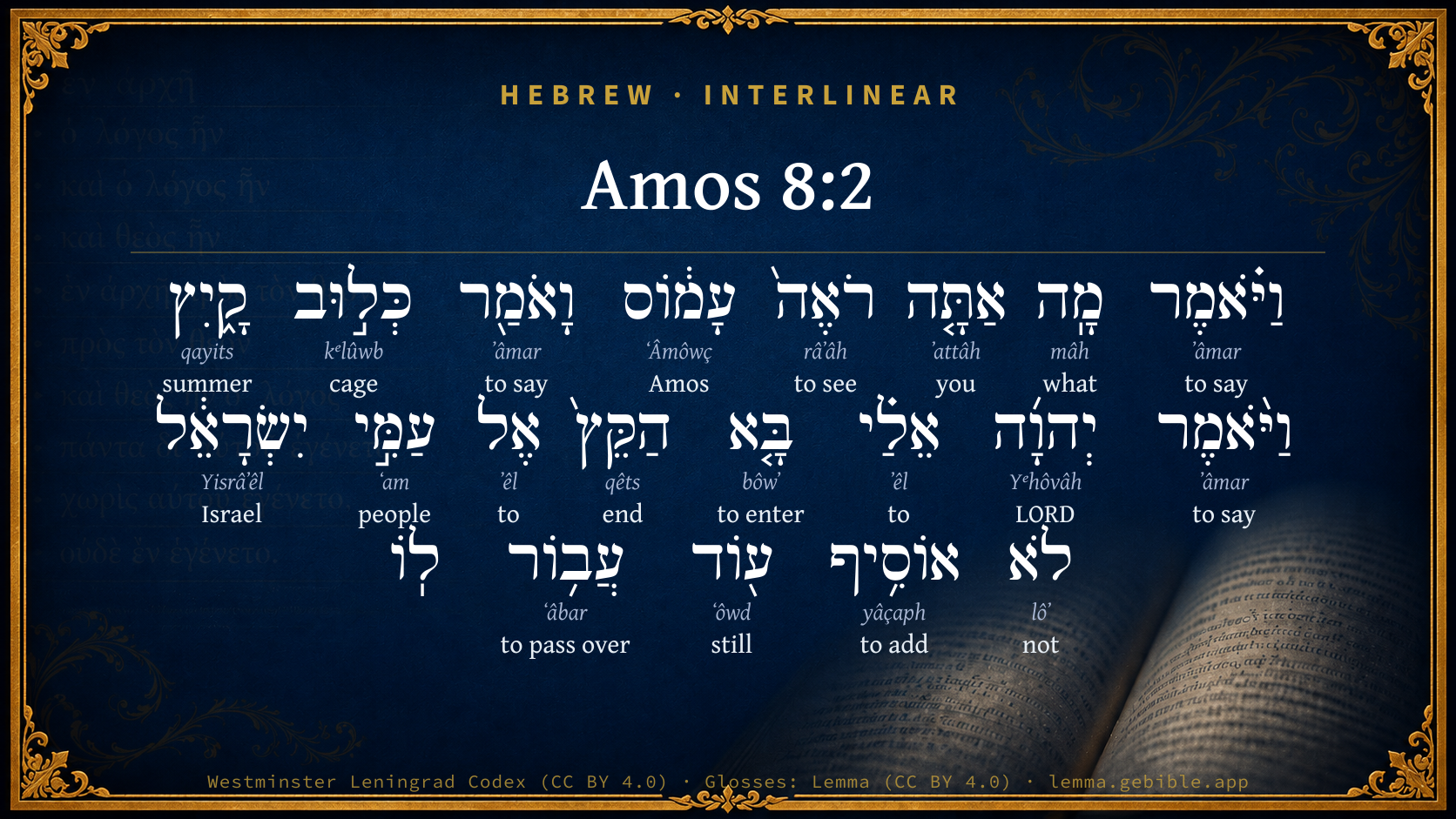
Hebrew (Westminster Leningrad Codex) Amos 8:2 appears in the Hebrew Old Testament. The text above is from the Westminster Leningrad Codex. Each word links to its Strong’s number, a concise gloss, and parsing drawn from the Open Scriptures Hebrew Bible morphology. Click any word for its full Brown-Driver-Briggs (BDB) entry.
Download image
Cite this verse

Amos 8:2 (World English Bible). Public Domain. Lemma interlinear Bible study tool, https://lemma.gebible.app/v/amos/8/2.

Show BibTeX & RIS
BibTeX
RIS
English Translation
He said, "Amos, what do you see?" I said, "A basket of summer fruit." Then Yahweh said to me, "The end has come on my people Israel. I will not again pass by them any more.
World English Bible · Public Domain
Download a study sheet

One document with this verse’s original text, its word-by-word gloss line, the meaning frame, cross-references with their text, attributed commentary, and full source and license credits — printable, and it pastes into notes with its structure intact.

This verse Autodidact and up

Study sheet (.html) Plain text (.txt)

A passage Seminary Student

Up to 50 verses in one chapter. A passage sheet keeps up to 6 commentary sources and 12 cross-references per verse, in the order this page ranks them, and says so on the sheet whenever that leaves anything out. Ask for a single verse and you get the Autodidact verse sheet above.

Everything on this page stays free to read, with no account — the sheet is a download of what is already on screen, not access to it.

Want to remove ads? Support Godless Engineer
Compare translations 3

The same verse in 3 English versions, stacked beneath the original-language interlinear above. Click any original word for its lexicon entry.

Each is an independent rendering of the whole verse — the interlinear is not word-aligned to these translations.

Highlighted words mark where these versions differ — a whole-verse word diff, not a word-by-word alignment.

  • World English Bible Public Domain
    He said, "Amos, what do you see?" I said, "A basket of summer fruit." Then Yahweh said to me, "The end has come on my people Israel. I will not again pass by them any more.
  • King James Version Public Domain
    And he said, Amos, what seest thou? And I said, A basket of summer fruit. Then said the LORD unto me, The end is come upon my people of Israel; I will not again pass by them any more.
  • unfoldingWord Literal Text CC BY-SA 4.0
    He said, “What do you see, Amos?” I said, “A basket of summer fruit.” Then Yahweh said to me, “The end has come for my people Israel; I will spare them no longer.

unfoldingWord Literal Text — © unfoldingWord, licensed CC BY-SA 4.0. Word-aligned USFM3 via Door43 (git.door43.org/unfoldingWord/en_ult).

Versions to compare (up to 4)

3 of 4 selected

Show all 18 translations

Every available English version of this verse, each an independent rendering of the whole verse.

  • World English Bible Public Domain
    He said, "Amos, what do you see?" I said, "A basket of summer fruit." Then Yahweh said to me, "The end has come on my people Israel. I will not again pass by them any more.
  • Berean Standard Bible Public Domain
    “Amos, what do you see?” He asked. “A basket of summer fruit,” I replied. So the LORD said to me, “The end has come for My people Israel; I will no longer spare them.”
  • Majority Standard Bible Public Domain
    “Amos, what do you see?” He asked. “A basket of summer fruit,” I replied. So the LORD said to me, “The end has come for My people Israel; I will no longer spare them.”
  • King James Version Public Domain
    And he said, Amos, what seest thou? And I said, A basket of summer fruit. Then said the LORD unto me, The end is come upon my people of Israel; I will not again pass by them any more.
  • American Standard Version (1901) Public Domain
    And he said, Amos, what seest thou? And I said, A basket of summer fruit. Then said Jehovah unto me, The end is come upon my people Israel; I will not again pass by them any more.
  • Revised Version (1885) Public Domain
    And he said, Amos, what seest thou? And I said, A basket of summer fruit. Then said the LORD unto me, The end is come upon my people Israel; I will not again pass by them any more.
  • Geneva Bible (1599) Public Domain
    And he said, Amos, what seest thou? And I sayd, A basket of sommer fruite. Then sayd the Lord vnto me, The ende is come vpon my people of Israel, I wil passe by them no more.
  • Douay-Rheims (1899) Public Domain
    And he said: What seest thou, Amos? And I said: A hook to draw down fruit. And the Lord said to me: The end is come upon my people Israel: I will not again pass by them any more.
  • Young's Literal Translation Public Domain
    And He saith, `What art thou seeing, Amos?' and I say, `A basket of summer-fruit.' And Jehovah saith unto me: `The end hath come unto My people Israel, I do not add any more to pass over to it.
  • Literal Standard Version CC BY-SA 4.0
    And He says, “What are you seeing, Amos?” And I say, “A basket of summer-fruit.” And YHWH says to me: “The end has come to My people Israel, || I no longer pass over to it anymore.
  • Unlocked Literal Bible CC BY-SA 4.0
    He said, “What do you see, Amos?” I said, “A basket of summer fruit.” Then Yahweh said to me, “The end has come for my people Israel; I will spare them no longer.
  • unfoldingWord Literal Text CC BY-SA 4.0
    He said, “What do you see, Amos?” I said, “A basket of summer fruit.” Then Yahweh said to me, “The end has come for my people Israel; I will spare them no longer.
  • Darby Bible Public Domain
    And he said, Amos, what seest thou? And I said, A basket of summer-fruit. And Jehovah said unto me, The end is come upon my people Israel: I will not again pass by them any more.
  • World Messianic Bible Public Domain
    He said, “Amos, what do you see?” I said, “A basket of summer fruit.” Then the LORD said to me, “The end has come on my people Israel. I will not again pass by them any more.
  • Webster's Bible Public Domain
    And he said, Amos, what seest thou? And I said, A basket of summer fruit. Then said the LORD to me, The end is come upon my people of Israel; I will not again pass by them any more.
  • Free Bible Version CC BY-SA 4.0
    He asked me, “What do you see, Amos?” I said, “A basket of fruit.” Then the Lord told me, “This is the end of my people Israel! I won't ignore their sins anymore.
  • Bible in Basic English Public Domain
    And he said, Amos, what do you see? And I said, A basket of summer fruit. Then the Lord said to me, The end has come to my people Israel; never again will my eyes be shut to their sin.
  • JPS Tanakh (1917) Public Domain
    And He said: 'Amos, what seest thou?' And I said: 'A basket of summer fruit.' Then said the LORD unto me: The end is come upon My people Israel; I will not again pardon them any more.

Literal Standard Version (2020), Covenant Press — licensed CC BY-SA 4.0. Text via the HelloAO Bible API (eBible.org). Unlocked Literal Bible (unfoldingWord) — licensed CC BY-SA 4.0. Text via the HelloAO Bible API (eBible.org). unfoldingWord Literal Text — © unfoldingWord, licensed CC BY-SA 4.0. Word-aligned USFM3 via Door43 (git.door43.org/unfoldingWord/en_ult). Free Bible Version, Dr. Jonathan Gallagher — licensed CC BY-SA 4.0. Text via the HelloAO Bible API (eBible.org).

Word by word

More ways to search: Search by grammar → Find every occurrence → Compare this word →

Practice this passage: Drill this verse → Learn its vocabulary →

כְּל֣וּב
kᵉlûwb
H3619
“cage of”
Noun, Common, Masculine, Singular, Construct
Part of Speech
Noun
Type
Common
Gender
Masculine
Number
Singular
State
Construct
Full BDB Definition

Origin: from the same as H3611

TWOT: 981b

cage, basket, dog cage
  1. וַיֹּ֗אמֶר ʼâmar H559 “and · to say” Conjunction + Verb, Qal, Sequential Imperfect, 3rd Person, Masculine, Singular
  2. מָֽה mâh H4100 “what” Particle, Interrogative
  3. אַתָּ֤ה ʼattâh H859 “you” Pronoun, Personal, 2nd Person, Masculine, Singular
  4. רֹאֶה֙ râʼâh H7200 “seeing” Verb, Qal, Participle Active, Masculine, Singular, Absolute
  5. עָמ֔וֹס ʻÂmôwç H5986 “Amos” Noun, Proper
  6. וָאֹמַ֖ר ʼâmar H559 “and · to say” Conjunction + Verb, Qal, Sequential Imperfect, 1st Person, Common, Singular
  7. קָ֑יִץ qayits H7019 “summer” Noun, Common, Masculine, Singular, Absolute
  8. וַיֹּ֨אמֶר ʼâmar H559 “and · to say” Conjunction + Verb, Qal, Sequential Imperfect, 3rd Person, Masculine, Singular
  9. יְהוָ֜ה Yᵉhôvâh H3068 “LORD” Noun, Proper
  10. אֵלַ֗י ʼêl H413 “to · me” Preposition + Suffix, Personal, 1st Person, Common, Singular
  11. בָּ֤א bôwʼ H935 “to enter” Verb, Qal, Perfect, 3rd Person, Masculine, Singular
  12. הַקֵּץ֙ qêts H7093 “the · end” Particle, Definite Article + Noun, Common, Masculine, Singular, Absolute
  13. אֶל ʼêl H413 “to” Preposition
  14. עַמִּ֣י ʻam H5971 “people · my” Noun, Common, Masculine, Singular, Construct + Suffix, Personal, 1st Person, Common, Singular
  15. יִשְׂרָאֵ֔ל Yisrâʼêl H3478 “Israel” Noun, Proper
  16. לֹא lôʼ H3808 “not” Particle, Negative
  17. אוֹסִ֥יף yâçaph H3254 “to add” Verb, Hiphil, Imperfect, 1st Person, Common, Singular
  18. ע֖וֹד ʻôwd H5750 “still” Adverb
  19. עֲב֥וֹר ʻâbar H5674 “to pass over” Verb, Qal, Infinitive Construct

About this verse

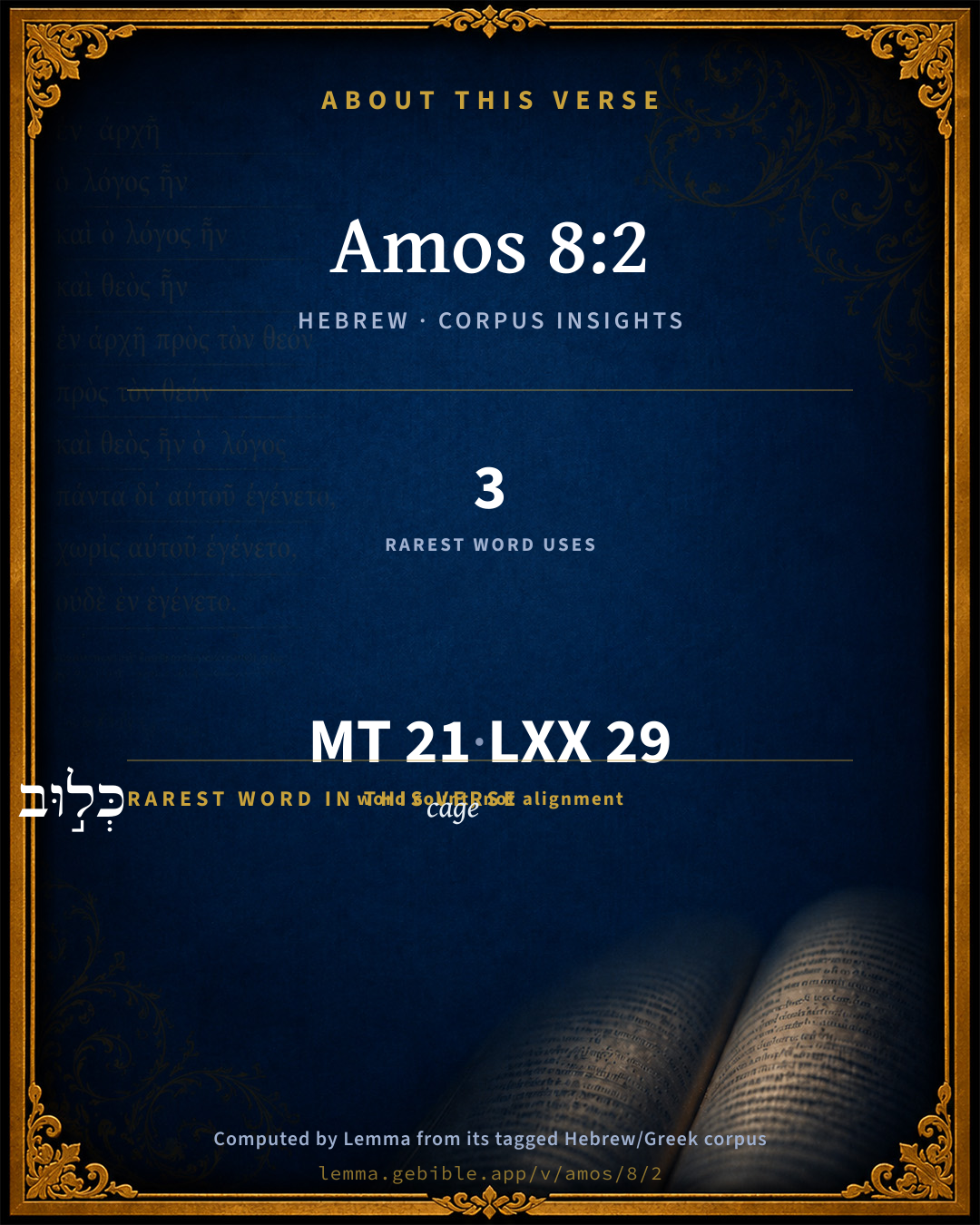
These counts appear in no published source. They are computed here, from the morphology-tagged text and Lemma’s own curated glosses. What Lemma adds →

21
words
17
distinct lemmas
Prophets
section

Notable vocabulary

The rarest word here is כְּל֣וּב cage H3619 — appearing just 3 times in the whole Hebrew Bible.

Shared distinctive vocabulary

כְּל֣וּב cage H3619 occurs in 3 verses of the Hebrew Bible. Also found in:

Grammatical profile

  • 7 verbs
  • 7 nouns
  • 1 pronoun
  • 3 prepositions
  • 1 adverb
  • 2 particles

Verb forms

  • וַיֹּ֗אמֶר Qal · Sequential Imperfect
  • רֹאֶה֙ Qal · Participle Active
  • וָאֹמַ֖ר Qal · Sequential Imperfect
  • וַיֹּ֨אמֶר Qal · Sequential Imperfect
  • בָּ֤א Qal · Perfect
  • אוֹסִ֥יף Hiphil · Imperfect
  • עֲב֥וֹר Qal · Infinitive Construct

Repetition

Words recur within this verse — often emphatic in Hebrew:

  • וַיֹּ֗אמֶר to say H559 ×3
  • אֵלַ֗י to H413 ×2

Hebrew & Septuagint length

In English translation the verse runs 36 words from the Hebrew and 35 from the Septuagint (LXX English) — closely comparable.

A rough comparison of the two English renderings, which tokenize alike — not a word-level alignment.

Word counts can differ between the Hebrew and the Greek without any difference in meaning — e.g. the Hebrew direct-object marker אֵת has no separate Greek word, and Greek often adds the article ὁ.

In the original languages it is 21 Hebrew tokens and 29 Greek tokens — but the two are counted differently (Hebrew bundles its prefixes and suffixes into one token; the Greek is in lemma form), so that isn’t a like-for-like length.

Cross-references

22

Topical passages linked to Amos 8:2 in the Treasury of Scripture Knowledge — connected by theme and wording, ordered by reader-vote popularity; previews shown in the World English Bible.

  • Amos 7:8 Yahweh said to me, "Amos, what do you see?" I said, "A plumb line." Then the Lord said, "Behold, I will set a plumb line in the midst of my people Israel. I will not again pass by them any more.
  • Lamentations 4:18 They hunt our steps, so that we can't go in our streets: Our end is near, our days are fulfilled; for our end is come.
  • Jeremiah 1:11–14 Moreover the word of Yahweh came to me, saying, Jeremiah, what see you? I said, I see a rod of an almond tree.
  • Micah 7:1 Misery is mine! Indeed, I am like one who gathers the summer fruits, as gleanings of the vinyard: There is no cluster of grapes to eat. My soul desires to eat the early fig.
  • Deuteronomy 26:1–4 It shall be, when you are come in to the land which Yahweh your God gives you for an inheritance, and possess it, and dwell therein,
  • 2 Samuel 16:1–2 When David was a little past the top [of the ascent], behold, Ziba the servant of Mephibosheth met him, with a couple of donkeys saddled, and on them two hundred loaves of bread, and one hundred clusters of raisins, and one hundred summer fruits, and a bottle of wine.
  • Isaiah 28:4 and the fading flower of his glorious beauty, which is on the head of the fat valley, shall be as the first-ripe fig before the summer; which when he who looks on it sees, while it is yet in his hand he eats it up.
  • Jeremiah 5:31 the prophets prophesy falsely, and the priests bear rule by their means; and my people love to have it so: and what will you do in the end of it?
  • Jeremiah 24:1–3 Yahweh shown me, and, behold, two baskets of figs set before the temple of Yahweh, after that Nebuchadrezzar king of Babylon had carried away captive Jeconiah the son of Jehoiakim, king of Judah, and the princes of Judah, with the craftsmen and smiths, from Jerusalem, and had brought them to Babylon.
  • Jeremiah 40:10 As for me, behold, I will dwell at Mizpah, to stand before the Chaldeans who shall come to us: but you, gather you wine and summer fruits and oil, and put them in your vessels, and dwell in your cities that you have taken.
  • Ezekiel 3:7 But the house of Israel will not listen to you; for they will not listen to me: for all the house of Israel are of hard forehead and of a stiff heart.
  • Ezekiel 3:10 Moreover he said to me, Son of man, all my words that I shall speak to you receive in your heart, and hear with your ears.
  • Ezekiel 7:2–3 You, son of man, thus says the Lord Yahweh to the land of Israel, An end: the end is come on the four corners of the land.
  • Ezekiel 7:6 An end is come, the end is come; it awakes against you; behold, it comes.
  • Ezekiel 8:6 He said to me, Son of man, see you what they do? even the great abominations that the house of Israel do commit here, that I should go far off from my sanctuary? but you shall again see yet other great abominations.
  • Ezekiel 8:12 Then said he to me, Son of man, have you seen what the elders of the house of Israel do in the dark, every man in his chambers of imagery? for they say, Yahweh doesn't see us; Yahweh has forsaken the land.
  • Ezekiel 8:17 Then he said to me, Have you seen [this], son of man? Is it a light thing to the house of Judah that they commit the abominations which they commit here? for they have filled the land with violence, and have turned again to provoke me to anger: and, behold, they put the branch to their nose.
  • Ezekiel 12:23 Tell them therefore, Thus says the Lord Yahweh: I will make this proverb to cease, and they shall no more use it as a proverb in Israel; but tell them, The days are at hand, and the fulfillment of every vision.
  • Zechariah 1:18–21 I lifted up my eyes, and saw, and, behold, four horns.
  • Zechariah 5:2 He said to me, "What do you see?" I answered, "I see a flying scroll; its length is twenty cubits, and its breadth ten cubits."
  • Zechariah 5:5–6 Then the angel who talked with me came forward, and said to me, "Lift up now your eyes, and see what is this that is appearing."
  • Ezekiel 29:8 Therefore thus says the Lord Yahweh: Behold, I will bring a sword on you, and will cut off from you man and animal.

Cross-references courtesy of OpenBible.info (CC BY 4.0).

Hebrew and Greek witnesses Masoretic Hebrew ↔ Greek Septuagint

The same verse in the two great witnesses to the Old Testament, shown verse-for-verse.

These are two independent witnesses, not word-aligned to each other, and the Septuagint is shown in lemma (dictionary) form.

Hebrew Amos 8:2 Masoretic · Westminster Leningrad Codex

וַיֹּ֗אמֶר מָֽה אַתָּ֤ה רֹאֶה֙ עָמ֔וֹס וָאֹמַ֖ר כְּל֣וּב קָ֑יִץ וַיֹּ֨אמֶר יְהוָ֜ה אֵלַ֗י בָּ֤א הַקֵּץ֙ אֶל עַמִּ֣י יִשְׂרָאֵ֔ל לֹא אוֹסִ֥יף ע֖וֹד עֲב֥וֹר לֽוֹ

He said, "Amos, what do you see?" I said, "A basket of summer fruit." Then Yahweh said to me, "The end has come on my people Israel. I will not again pass by them any more.

World English Bible · Public Domain

Greek LXX Amos 8:2 Septuagint · lemma form

καί εἶπον τίς σύ βλέπω αμως καί εἶπον ἄγγος ἰξευτής καί εἶπον κύριος πρός ἐγώ ἥκω ὁ πέρας ἐπί ὁ λαός ἐγώ ἰσραήλ οὐκέτι μή προςτίθημι ὁ παραἔρχομαι αὐτός

And he said, What see you, Amos? And I said, A fowler's basket. And the Lord said to me, The end is come upon my people Israel; I will not pass by them any more.

LXX2012 (modern English Septuagint) · Public Domain

Hebrew: Westminster Leningrad Codex (CC BY 4.0). Greek: Septuagint (public domain); English from LXX2012 (modern English Septuagint) (Public Domain). How the Septuagint differs from the Hebrew →

Targum (Aramaic paraphrase)

1

The Targum is the ancient Jewish Aramaic paraphrase of the Hebrew Scriptures — an interpretive translation, not the Hebrew text itself. Onkelos (literal) and Pseudo-Jonathan (expansive) render the Torah, and Jonathan the Prophets. Coverage is partial: where no permissively-licensed English translation exists for a verse, only the Aramaic is shown. This is verse-level text, not a word-by-word alignment to the Hebrew.

  1. Targum Jonathan Prophets (Joshua–Malachi)
    וַאֲמַר מָא אַתְּ חָזֵי עָמוֹס וַאֲמָרֵית מָן מְלֵי סְיוּפֵי קַיְטָא וַאֲמַר יְיָ לִי מְטַת פּוּרְעֲנוּת קִצָא לְמֵיתֵי עַל עַמִי יִשְׂרָאֵל לָא אוֹסִיף עוֹד לְמִשְׁבַּק לְהוֹן:

    (no public-domain English translation for this verse)

    Targum Jonathan — Aramaic: “Mikraot Gedolot” (public domain). English: “Sefaria Community Translation” (CC0 1.0 (public-domain dedication)); “London "Chaldee Paraphrase," 1871” (public domain). Text via Sefaria.

Commentary

Notes on Amos 8:2 from classic Christian and Jewish commentators (each source and its license shown beneath its notes). The classic Christian expositions comment on the surrounding passage and are grouped to its opening verse, so a note may address several verses; the Jewish commentaries on the Tanakh (Rashi and others) are per-verse, so they appear only where the commentator wrote on this verse.

Lemma curates 59 commentaries, every one of them public domain or Creative Commons licensed, each selected and text-cleaned for this edition rather than reprinted as found. About our sources →

Trapp's Complete Commentary

John Trapp

Amo 8:2 And he said, Amos, what seest thou? And I said, A basket of summer fruit. Then said the LORD unto me, The end is come upon my people of Israel; I will not again pass by them any more.

Ver. 2. Amos, what seest thou?] This the Lord asketh, to stir up attention and affection in the prophet; who might haply need as much to be aroused, as Zechariah in like case did, Amo 4:1, with whom it fared as with a drowsy person, who though awaked and set to work, is ready to sleep at it.

And I said, A basket of summer fruit] Apples, saith Jerome; figs, say others; and why not as well grapes ripened in the summer sunshine? Whereby the Holy Ghost in the Revelation, Rev 14:20; Rev 19:15, describeth such as are ready ripe for the wine-press of God’s wrath? Nahum compareth them to stubble, laid out in the sun drying, that it may burn the better, Nah 1:10.

The end is come upon my people] An elegance in the original beyond translation into English: קץ χιυ, the Latin interpreters have (some of them) assayed the like, but they fall far short of it. The Old Testament is full of such surnames; and God seemeth delighted with them. See Jer 1:11-12; Jer 48:2; Jer 49:23-24 Lam 3:47 Amo 5:5 Mic 1:10; Mic 1:14 Zep 2:5 Exo 2:10 Gen 3:20; Gen 4:1; Gen 4:25; Gen 5:29; Gen 17:5; Gen 21:5-6, &c. There is a pedantic style and a majestic; an effeminate eloquence and a manly. This latter is lawful, and may very well become the man of God; who yet must not wit-wanton it in weightiest matters; but shun those more gay and lighter flashes and flourishes, wherewith the emptiest cells affect to be most fraught; as they, who for want of wares in their shops, set up painted blocks to fill up vacant shelves, as one well expresseth it.

The end is come upon my people] Exitus et exitium. As the summer is the end of the year and the time of ripening fruits; so, now that this people are ripe for ruin, "An end is come, is come, is come: it watcheth for them; behold, it is come," Eze 7:6-7, even the precise time and term of their final overthrow.

I will not again pass by them any more] See Amo 7:1-17 Amo 8:1-14. God can pass by, that is, pardon, his people better than any other, Mic 7:18 (like as they that are born of God, and partake of the Divine nature, can bear wrongs best of any; compel them to go a mile they will be content, if it may do good, to go two; yea, as far as the shoes of the preparation of the gospel of peace will carry them). But as the saints of God may not be therefore injured (which was Julian’s jeering cruelty) because they are meek: so must not God be presumed upon and provoked because he is merciful. "There is mercy with him, that he may be feared," saith the Psalmist; for abused mercy turneth into fury, and opportunities of grace are often so headlong, that if once past they are irrecoverable. Woe be to that people or person to whom God shall say, "I will not again pass by you any more."

John Trapp, A Commentary or Exposition upon All the Books of the Old and New Testament (1647–1656) — public domain. Text from a community e-Sword module.

Tyndale Open Study Notes

Tyndale Open Resources

8:2 ripe for punishment (literally the end has come): Amos makes a play on words between ripe fruit (Hebrew qayits) and the end has come (Hebrew ba’ haqqets). The end had come for God’s people, Israel, because they were ripe fruit, ready to be harvested in judgment.

Tyndale Open Study Notes — © Tyndale Open Resources, licensed CC BY-SA 4.0. Text via the HelloAO Bible API.

Geneva Bible (1599)

Geneva Bible translators

Which signified the ripeness of their sins, and the readiness of God’s judgments.

Geneva Bible (1599) marginal notes — public domain. Text via Bolls.life.

Jamieson, Fausset & Brown

Robert Jamieson, A. R. Fausset & David Brown

end-- (Eze 7:2, Eze 7:6).

Jamieson, Fausset & Brown — Commentary Critical and Explanatory on the Whole Bible (1871) — public domain (CC PDM 1.0). Text via the HelloAO Bible API.

Adam Clarke's Commentary

Verse 2. A basket of summer fruit] כלוב קיץ kelub kayits; the end is come - בא הקץ ba hakkets: here is a paronomasia or play upon the words kayits, summer fruit, and kets, the end, both coming from similar roots. See Clarke on Eze 7:2, where there is a similar play on the same word.

I will not again pass by them any more.] I will be no longer their Guardian.

Adam Clarke's Commentary on the Bible (1810–1826) — public domain. Text from a community e-Sword/MySword module.

John Calvin's Commentaries

Now follows the exposition of the vision, Jehovah said to me, Come has the end on my people Israel We perceive, then, the meaning of the Prophet to be, — that the people had hitherto been warned by moderate punishments; but that as they had become hardened, extreme vengeance was nigh at hand, when God would no longer perform the part of a father or of a physician, but would utterly destroy those whom he had long borne with. We indeed know that most grievous calamities had happened to the people of Israel, even before this time; but whenever God showed forbearance, he ever allured them to true penitence. Lest, then, they should promise such a treatment to themselves hereafter, and by self flatteries protract time, as hypocrites are wont to do, the Prophet declares here expressly, that the end had come; as though he said, “Your iniquity is ripe: now then gather the fruit; for ye cannot proceed farther, no, not even for one day. Fruit will indeed come to you of itself.” The end then is come, and I will no more add to pass by them. To pass by, as we have already explained, is to be referred to punishment. For why does God chastise his people, except that he is solicitous for their salvation? He says, then, that he would make an end, that he would not spend labor hereafter in correcting the people, for he saw that nothing availed. Hence, I will not pass by them, that is, I will execute my extreme vengeance: Il n’y faudra plus retourner, as we commonly say. It follows —

John Calvin's Commentaries (1540-1563) — public domain. Text from the Calvin Translation Society English edition (1840s-50s) via the Christian Classics Ethereal Library (ccel.org). Calvin's coverage is partial (roughly two-thirds of the Bible); uncommented books and verses are honest gaps, never fabricated. The 19th-century editor's footnotes and remarks are omitted so the notes are faithfully Calvin's own voice.

The Cambridge Bible for Schools and Colleges

gen. ed. J. J. S. Perowne

2. The question is asked for the same purpose as in Amo_7:8.

The end] Amos answers, “A basket of ḳaitz”: Jehovah replies, “Ḳêtz—an ‘end’—is come upon my people Israel.” The last vision had declared that the approaching judgement was certain; this, that it was final, and also close at hand.

I will not again pardon it any more] The same words as Amo_7:8.

The Cambridge Bible for Schools and Colleges (gen. ed. J. J. S. Perowne; Cambridge University Press, 1878–1918) — public domain. Text from a community e-Sword module.

John Gill's Exposition

And he said, Amos, what seest thou?.... To quicken his attention, who might disregard it as a common thing; and in order to lead him into the design of it, and show him what it was an emblem of:

and I said, a basket of summer fruit; some render it "a hook" (w), such as they pull down branches with to gather the fruit; and the word so signifies in the Arabic language (x); but the other is the more received sense of the word:

then said the Lord unto me; by way of explanation of the vision: the end is come upon my people Israel: the end of the kingdom of Israel; of their commonwealth and church state; of all their outward happiness and glory; their "summer was ended", and they "not saved", Jer 8:20; all their prosperity was over; and, as the Targum, their

"final punishment was come,''

the last destruction threatened them (y):

I will not again pass by them any more; pass by their offences, and forgive their sins; or pass by their persons, without taking notice of them, so as to afflict and punish them for their iniquities: or, "pass through them and more" (z) now making an utter end of them; See Gill on Amo 7:8.

(w) "unicuus", V. L. (x) "ferramentum incurvum, seu uncus ex quo de sella commeatum suspendit viator", Giggeius apud Golium, col. 2055. (y) There is an elegant play on words in the words "summer", and "the end". (z) So Mercerus, Grotius.

John Gill's Exposition of the Whole Bible (1746–1763) — public domain (CC PDM 1.0). Text via the HelloAO Bible API.

Matthew Poole's English Annotations

Amos, what seest thou? the like question you have Amo 7:8, which see.

A basket of summer fruit: see Amo 8:1. Then said the Lord unto me: the meaning of this hieroglyphic not being very plain in itself, the Lord doth here explain it in the following words.

The end of God’s patience towards Israel, of their peace, growth, and glory; the end of their ripening, they are now as fruit fully ripe, in the end of the year, fit to be gathered.

My people Israel; so they were once, so they boast themselves, so the nations about them account Israel to be the people of God.

I will not again pass by them any more: see Amo 7:8. God had with admirable patience spared and tried, but now he will with just severity punish, neither pardon nor spare.

Matthew Poole's English Annotations on the Holy Bible (1683–1685) — public domain. Text from a community e-Sword/MySword module.

The Pulpit Commentary

The end (kets). This is very like the word for "fruit" (kaits). Pass by. (see note on Amo_7:8)

My people.

The occurrence of this expression in such a connection as this is very amazing and very encouraging. Even when, by the mouth of his prophet, the Lord is uttering language of regretful denunciation, the prediction of sore chastisement, he still calls Israel his own! God"s ways are indeed higher than our ways, and his thoughts than our thoughts.

I THIS LANGUAGE IN A REMINISCENCE OF PAST ELECTION. God called Israel his people, because he had chosen them from among the nations of the earth, to be the depositary of his truth, the recipients of his Law, the instrument of his purposes among men. As early associations are strong amongst men, as we always retain a tender interest in those whom we have watched over, befriended, and benefited from their childhood, so the Lord represents himself as cherishing kindness for the people whom he had called as it were in their childhood, and nursed into maturity. He did not forget the days "when Israel was a child.

II THIS LANGUAGE IS PROOF OF PRESENT KINDNESS. tie does not say, "Ye were my people;" for they are his people still.

Mine is an unchanging love, Higher than the heights above; Deeper than the depths beneath; Free and faithful, strong as death.

Even in carrying out his threats of punishment, Jehovah does not act in anger and vindictiveness. He is the Father chastening the child whom he loveth. He does not abandon the disobedient; he subjects them to discipline which may restore them to submission and to filial love.

III THIS LANGUAGE IS PREDICTIVE OF FUTURE RECONCILIATION. As long as God says, "My people," there is hope for the future. He has not abandoned; he will not abandon. The city may be razed, but it shall be built again. There shall be captivity; but he deviseth means whereby his banished ones shall return. Wounds shall be healed. The grave shall give up her dead. The wanderer shall return, and shall be clasped to the Father"s patient, yearning, rejoicing heart. "My people" are mine forever.

APPLICATION. God in the midst of wrath remembers mercy. When sin is recognized and realized as such, when chastening has answered its purpose, when the disobedient are penitent and the rebellious are submissive, then is there hope. Not in any excellence connected with man"s repentance, but in the grace of the Father"s heart, in the faithfulness of the Father"s promises. Not Israel alone, but mankind at large, are designated by the Eternal "my people." Therefore he who sent his Son to seek and to save that which is lost is described as "the Saviour of all men, specially of them that believe. T.

The Pulpit Commentary (1880–1919), ed. H.D.M. Spence-Jones & Joseph S. Exell — public domain. Text from a community e-Sword module.

John Wesley's Explanatory Notes

The end - Of God's patience towards Israel, the end of their ripening, they are now fully ripe, fit to be gathered. Pass by them - God had with admirable patience spared, but now he will no more pardon or spare.

John Wesley, Explanatory Notes Upon the Whole Bible (1754–1765) — public domain. Text via the GEBible commentary corpus.

Lesson kit

Teaching starters — assembled from the data on this page, not authored interpretation. Every prompt links to the verse data it draws on. Edit before teaching.

Amos, in the Prophets, opens this verse with 21 words (17 distinct Hebrew lemmas). Its most distinctive word is kᵉlûwb (“cage”). A historical commentator’s framing appears above. Read the whole chapter for the surrounding context.

Discussion questions

  1. The word kᵉlûwb carries the sense “cage.” How does it shape the verse?
  2. Jeremiah 5:27 shares the word «cage» with this verse. How do the two illuminate each other?
  3. “to say” occurs 3× in this one verse. What is the effect of the repetition?
  4. These translations render this verse differently. What is at stake in choosing one wording over another?
  5. The verb «וַיֹּ֗אמֶר» is Qal Sequential Imperfect. How does its form color the action?
  6. Reading how Trapp's Complete Commentary and Tyndale Open Study Notes read this verse, where do the two commentators agree and where do they part?

Things to notice

Reading settings

Reading text

Shown beneath each verse's original-language words.

Old Testament
Old Testament edition

Read the OT as the Masoretic Hebrew (MT) or the Greek Septuagint (LXX).

English shown for the Greek Septuagint (in the Hebrew ↔ Greek comparison).

Comparing translations? Open the Compare panel on any verse page to stack up to four side by side.