
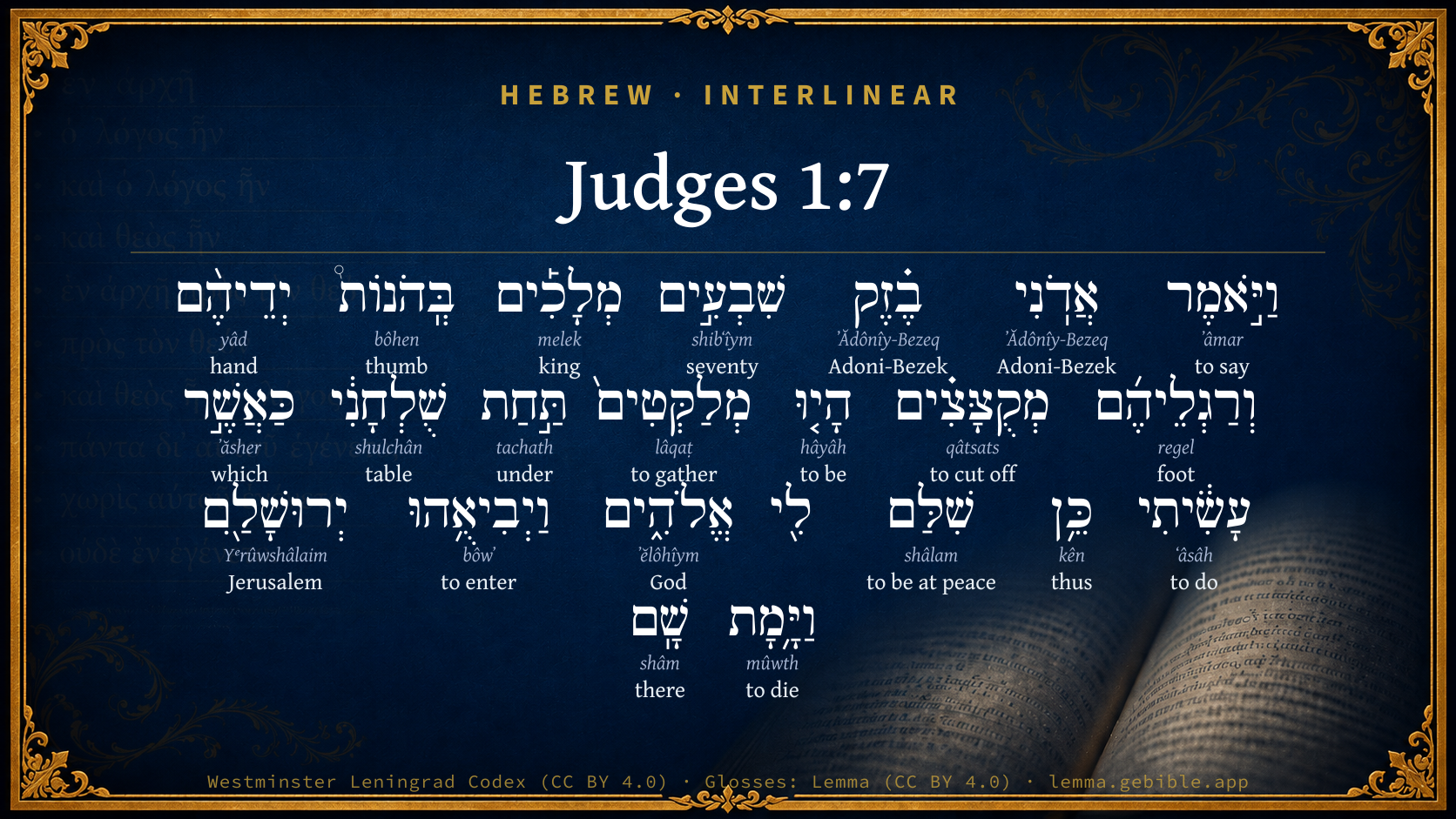
Judges 1:7

Hebrew (Westminster Leningrad Codex) Judges 1:7 appears in the Hebrew Old Testament. The text above is from the Westminster Leningrad Codex. Each word links to its Strong’s number, a concise gloss, and parsing drawn from the Open Scriptures Hebrew Bible morphology. Click any word for its full Brown-Driver-Briggs (BDB) entry.
Download image
Cite this verse

Judges 1:7 (World English Bible). Public Domain. Lemma interlinear Bible study tool, https://lemma.gebible.app/v/judges/1/7.

Show BibTeX & RIS
BibTeX
RIS
English Translation
Adoni-bezek said, "Seventy kings, having their thumbs and their great toes cut off, gathered [their food] under my table: as I have done, so God has requited me." They brought him to Jerusalem, and he died there.
World English Bible · Public Domain
Download a study sheet

One document with this verse’s original text, its word-by-word gloss line, the meaning frame, cross-references with their text, attributed commentary, and full source and license credits — printable, and it pastes into notes with its structure intact.

This verse Autodidact and up

Study sheet (.html) Plain text (.txt)

A passage Seminary Student

Up to 50 verses in one chapter. A passage sheet keeps up to 6 commentary sources and 12 cross-references per verse, in the order this page ranks them, and says so on the sheet whenever that leaves anything out. Ask for a single verse and you get the Autodidact verse sheet above.

Everything on this page stays free to read, with no account — the sheet is a download of what is already on screen, not access to it.

Want to remove ads? Support Godless Engineer
Compare translations 3

The same verse in 3 English versions, stacked beneath the original-language interlinear above. Click any original word for its lexicon entry.

Each is an independent rendering of the whole verse — the interlinear is not word-aligned to these translations.

Highlighted words mark where these versions differ — a whole-verse word diff, not a word-by-word alignment.

  • World English Bible Public Domain
    Adoni-bezek said, "Seventy kings, having their thumbs and their great toes cut off, gathered [their food] under my table: as I have done, so God has requited me." They brought him to Jerusalem, and he died there.
  • King James Version Public Domain
    And Adonibezek said, Threescore and ten kings, having their thumbs and their great toes cut off, gathered their meat under my table: as I have done, so God hath requited me. And they brought him to Jerusalem, and there he died.
  • unfoldingWord Literal Text CC BY-SA 4.0
    And Adoni-Bezek said, “70 kings the thumbs of their hands and their feet cut off were gathering beneath my table. According to what I have done, so God has repaid to me.” Then they brought him Jerusalem, and he died there.

unfoldingWord Literal Text — © unfoldingWord, licensed CC BY-SA 4.0. Word-aligned USFM3 via Door43 (git.door43.org/unfoldingWord/en_ult).

Versions to compare (up to 4)

3 of 4 selected

Show all 18 translations

Every available English version of this verse, each an independent rendering of the whole verse.

  • World English Bible Public Domain
    Adoni-bezek said, "Seventy kings, having their thumbs and their great toes cut off, gathered [their food] under my table: as I have done, so God has requited me." They brought him to Jerusalem, and he died there.
  • Berean Standard Bible Public Domain
    Then Adoni-bezek said, “Seventy kings with their thumbs and big toes cut off have gathered the scraps under my table. As I have done to them, so God has repaid me.” And they brought him to Jerusalem, where he died.
  • Majority Standard Bible Public Domain
    Then Adoni-bezek said, “Seventy kings with their thumbs and big toes cut off have gathered the scraps under my table. As I have done to them, so God has repaid me.” And they brought him to Jerusalem, where he died.
  • King James Version Public Domain
    And Adonibezek said, Threescore and ten kings, having their thumbs and their great toes cut off, gathered their meat under my table: as I have done, so God hath requited me. And they brought him to Jerusalem, and there he died.
  • American Standard Version (1901) Public Domain
    And Adoni-bezek said, Threescore and ten kings, having their thumbs and their great toes cut off, gathered `their food' under my table: as I have done, so God hath requited me. And they brought him to Jerusalem, and he died there.
  • Revised Version (1885) Public Domain
    And Adoni-bezek said, Threescore and ten kings, having their thumbs and their great toes cut off, gathered their meat under my table: as I have done, so God hath requited me. And they brought him to Jerusalem, and he died there.
  • Geneva Bible (1599) Public Domain
    And Adoni-bezek said, Seuentie Kings hauing the thumbes of their hands and of their feete cut off, gathered bread vnder my table: as I haue done, so God hath rewarded me. so they brought him to Ierusalem, and there he died.
  • Douay-Rheims (1899) Public Domain
    And Adonibezec said: Seventy kings having their fingers and toes cut off, gathered up the leavings of the meat under my table: as I have done, so hath God requited me. And they brought him to Jerusalem, and he died there.
  • Young's Literal Translation Public Domain
    and Adoni-Bezek saith, `Seventy kings -- their thumbs and their great toes cut off -- have been gathering under my table; as I have done so hath God repaid to me;' and they bring him in to Jerusalem, and he dieth there.
  • Literal Standard Version CC BY-SA 4.0
    and Adoni-Bezek says, “Seventy kings—their thumbs and their great toes cut off—have been gathering under my table; as I have done so God has repaid to me”; and they bring him to Jerusalem, and he dies there.
  • Unlocked Literal Bible CC BY-SA 4.0
    Adoni-Bezek said, “Seventy kings, who had their thumbs and their big toes cut off, gathered their food from under my table. As I have done, even so God has done to me.” They brought him to Jerusalem, and he died there.
  • unfoldingWord Literal Text CC BY-SA 4.0
    And Adoni-Bezek said, “70 kings the thumbs of their hands and their feet cut off were gathering beneath my table. According to what I have done, so God has repaid to me.” Then they brought him Jerusalem, and he died there.
  • Darby Bible Public Domain
    And Ado'ni-be'zek said, "Seventy kings with their thumbs and their great toes cut off used to pick up scraps under my table; as I have done, so God has requited me." And they brought him to Jerusalem, and he died there.
  • World Messianic Bible Public Domain
    Adoni-Bezek said, “Seventy kings, having their thumbs and their big toes cut off, scavenged under my table. As I have done, so God has done to me.” They brought him to Jerusalem, and he died there.
  • Webster's Bible Public Domain
    And Adoni-bezek said, seventy kings, having their thumbs and their great toes cut off, gathered their food under my table; as I have done, so God hath requited me. And they brought him to Jerusalem, and there he died.
  • Free Bible Version CC BY-SA 4.0
    Adoni-bezek said, “I had seventy kings with their thumbs and big toes cut off picking up left-overs from under my table. Now God has paid me back in the same way what I did to them.” They took him to Jerusalem where he died.
  • Bible in Basic English Public Domain
    And Adoni-zedek said, Seventy kings, whose thumbs and great toes had been cut off, got broken meat under my table: as I have done, so has God done to me in full. And they took him to Jerusalem, and he came to his end there.
  • JPS Tanakh (1917) Public Domain
    And Adoni-bezek said: 'Threescore and ten kings, having their thumbs and their great toes cut off, gathered food under my table; as I have done, so God hath requited me.' And they brought him to Jerusalem, and he died there.

Literal Standard Version (2020), Covenant Press — licensed CC BY-SA 4.0. Text via the HelloAO Bible API (eBible.org). Unlocked Literal Bible (unfoldingWord) — licensed CC BY-SA 4.0. Text via the HelloAO Bible API (eBible.org). unfoldingWord Literal Text — © unfoldingWord, licensed CC BY-SA 4.0. Word-aligned USFM3 via Door43 (git.door43.org/unfoldingWord/en_ult). Free Bible Version, Dr. Jonathan Gallagher — licensed CC BY-SA 4.0. Text via the HelloAO Bible API (eBible.org).

Word by word

More ways to search: Search by grammar → Find every occurrence → Compare this word →

Practice this passage: Drill this verse → Learn its vocabulary →

אֲדֹֽנִי
ʼĂdônîy-Bezeq
H137
“Adoni-Bezek”
Noun, Proper
Part of Speech
Noun
Type
Proper
Full BDB Definition

Origin: from H113 and H966

TWOT: None

Adoni-Bezek = "my lord is Besek" - king of the Canaanite city of Bezek, killed by Israelites
  1. וַיֹּ֣אמֶר ʼâmar H559 “and · to say” Conjunction + Verb, Qal, Sequential Imperfect, 3rd Person, Masculine, Singular
  2. בֶ֗זֶק ʼĂdônîy-Bezeq H137 “Adoni-Bezek” Noun, Proper
  3. שִׁבְעִ֣ים shibʻîym H7657 “seventy” Adjective, Cardinal number, Both, Plural, Absolute
  4. מְלָכִ֡ים melek H4428 “kings” Noun, Common, Masculine, Plural, Absolute
  5. בְּֽהֹנוֹת֩ bôhen H931 “thumbs of” Noun, Common, Feminine, Plural, Construct
  6. יְדֵיהֶ֨ם yâd H3027 “hands · their” Noun, Common, Both, Dual, Construct + Suffix, Personal, 3rd Person, Masculine, Plural
  7. וְרַגְלֵיהֶ֜ם regel H7272 “and · feet · their” Conjunction + Noun, Common, Feminine, Dual, Construct + Suffix, Personal, 3rd Person, Masculine, Plural
  8. מְקֻצָּצִ֗ים qâtsats H7112 “cut off” Verb, Pual, Participle Passive, Masculine, Plural, Absolute
  9. הָי֤וּ hâyâh H1961 “to be” Verb, Qal, Perfect, 3rd Person, Common, Plural
  10. מְלַקְּטִים֙ lâqaṭ H3950 “gathering” Verb, Piel, Participle Active, Masculine, Plural, Absolute
  11. תַּ֣חַת tachath H8478 “under” Preposition
  12. שֻׁלְחָנִ֔י shulchân H7979 “table · my” Noun, Common, Masculine, Singular, Construct + Suffix, Personal, 1st Person, Common, Singular
  13. כַּאֲשֶׁ֣ר ʼăsher H834 “like/as · which” Preposition + Particle, Relative
  14. עָשִׂ֔יתִי ʻâsâh H6213 “to do” Verb, Qal, Perfect, 1st Person, Common, Singular
  15. כֵּ֥ן kên H3651 “thus” Particle, Demonstrative
  16. שִׁלַּם shâlam H7999 “to be at peace” Verb, Piel, Perfect, 3rd Person, Masculine, Singular
  17. אֱלֹהִ֑ים ʼĕlôhîym H430 “God(s)” Noun, Common, Masculine, Plural, Absolute
  18. וַיְבִיאֻ֥הוּ bôwʼ H935 “and · to enter · him” Conjunction + Verb, Hiphil, Sequential Imperfect, 3rd Person, Masculine, Plural + Suffix, Personal, 3rd Person, Masculine, Singular
  19. יְרוּשָׁלִַ֖ם Yᵉrûwshâlaim H3389 “Jerusalem” Noun, Proper
  20. וַיָּ֥מָת mûwth H4191 “and · to die” Conjunction + Verb, Qal, Sequential Imperfect, 3rd Person, Masculine, Singular
  21. שָֽׁם shâm H8033 “there” Adverb

About this verse

These counts appear in no published source. They are computed here, from the morphology-tagged text and Lemma’s own curated glosses. What Lemma adds →

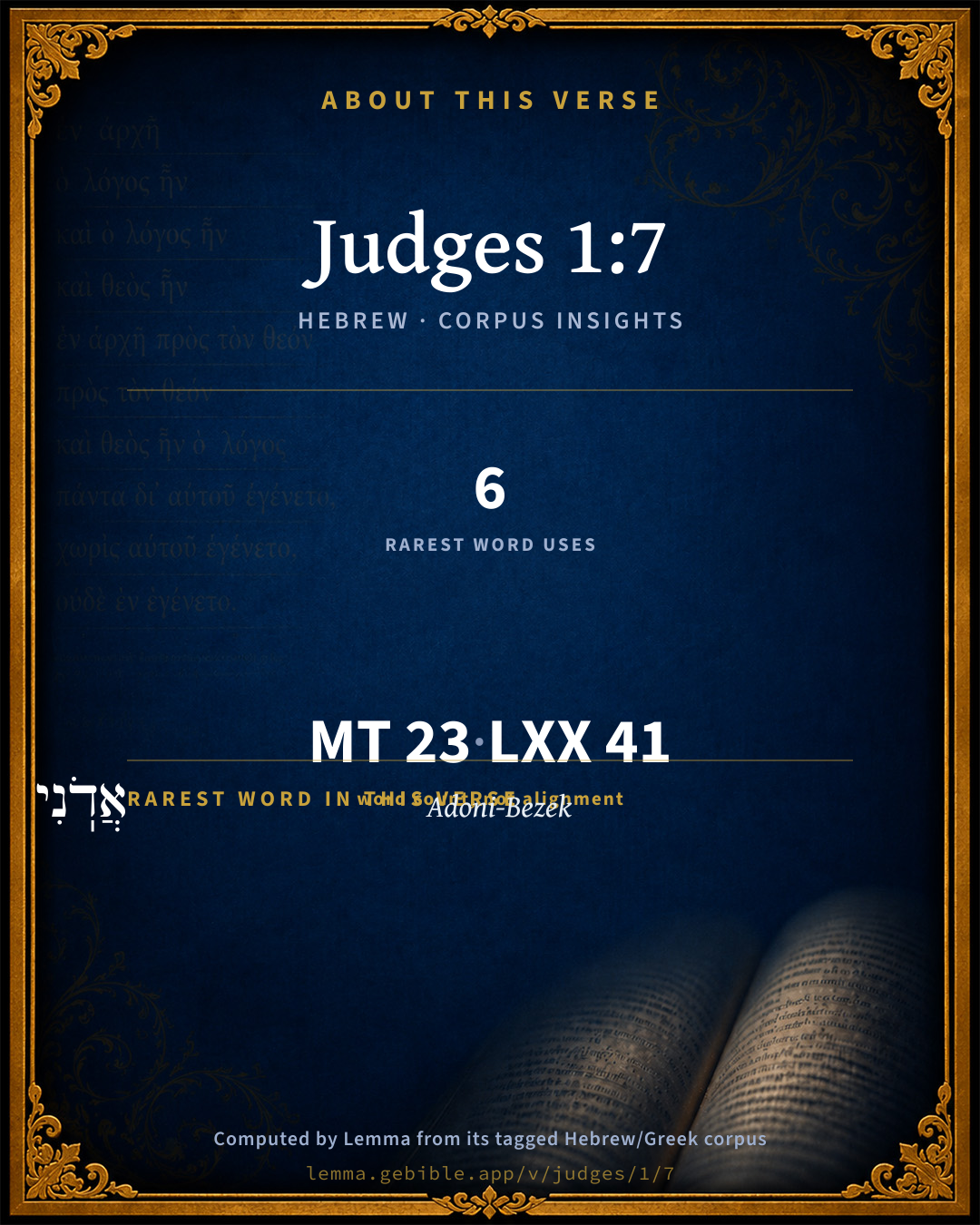
23
words
21
distinct lemmas
Historical
section

Notable vocabulary

The rarest word here is אֲדֹֽנִי Adoni-Bezek H137 — appearing just 6 times in the whole Hebrew Bible.

Shared distinctive vocabulary

אֲדֹֽנִי Adoni-Bezek H137 occurs in 3 verses of the Hebrew Bible. Also found in:

Grammatical profile

  • 8 verbs
  • 9 nouns
  • 1 adjective
  • 2 prepositions
  • 1 adverb
  • 2 particles

Verb forms

  • וַיֹּ֣אמֶר Qal · Sequential Imperfect
  • מְקֻצָּצִ֗ים Pual · Participle Passive
  • הָי֤וּ Qal · Perfect
  • מְלַקְּטִים֙ Piel · Participle Active
  • עָשִׂ֔יתִי Qal · Perfect
  • שִׁלַּם Piel · Perfect
  • וַיְבִיאֻ֥הוּ Hiphil · Sequential Imperfect
  • וַיָּ֥מָת Qal · Sequential Imperfect

Repetition

A word recurs within this verse — often emphatic in Hebrew:

  • אֲדֹֽנִי Adoni-Bezek H137 ×2

Hebrew & Septuagint length

In English translation the verse runs 37 words from the Hebrew and 40 from the Septuagint (LXX English) — closely comparable.

A rough comparison of the two English renderings, which tokenize alike — not a word-level alignment.

Word counts can differ between the Hebrew and the Greek without any difference in meaning — e.g. the Hebrew direct-object marker אֵת has no separate Greek word, and Greek often adds the article ὁ.

In the original languages it is 23 Hebrew tokens and 41 Greek tokens — but the two are counted differently (Hebrew bundles its prefixes and suffixes into one token; the Greek is in lemma form), so that isn’t a like-for-like length.

Cross-references

10

Topical passages linked to Judges 1:7 in the Treasury of Scripture Knowledge — connected by theme and wording, ordered by reader-vote popularity; previews shown in the World English Bible.

  • Revelation 13:10 If anyone has captivity, he will go. If anyone is with the sword, he must be killed. Here is the endurance and the faith of the saints.
  • 1 Samuel 15:33 Samuel said, As your sword has made women childless, so shall your mother be childless among women. Samuel hewed Agag in pieces before Yahweh in Gilgal.
  • Leviticus 24:19–21 If anyone injures his neighbor; as he has done, so shall it be done to him:
  • Luke 6:37–38 Don't judge, And you won't be judged. Don't condemn, And you won't be condemned. Set free, And you will be set free.
  • James 2:13 For judgment is without mercy to him who has shown no mercy. Mercy triumphs over judgment.
  • Exodus 21:23–25 But if any harm follows, then you must take life for life,
  • Matthew 7:1–2 "Don't judge, so that you won't be judged.
  • Romans 2:15 in that they show the work of the law written in their hearts, their conscience testifying with them, and their thoughts among themselves accusing or else excusing them)
  • Isaiah 33:1 Woe to you who destroy, and you weren't destroyed; and deal treacherously, and they didn't deal treacherously with you! When you have ceased to destroy, you shall be destroyed; and when you have made an end of dealing treacherously, they shall deal treacherously with you.
  • Revelation 16:6 For they poured out the blood of the saints and the prophets, and you have given them blood to drink. They deserve this."

Cross-references courtesy of OpenBible.info (CC BY 4.0).

Hebrew and Greek witnesses Masoretic Hebrew ↔ Greek Septuagint

The same verse in the two great witnesses to the Old Testament, shown verse-for-verse.

These are two independent witnesses, not word-aligned to each other, and the Septuagint is shown in lemma (dictionary) form.

Hebrew Judges 1:7 Masoretic · Westminster Leningrad Codex

וַיֹּ֣אמֶר אֲדֹֽנִי בֶ֗זֶק שִׁבְעִ֣ים מְלָכִ֡ים בְּֽהֹנוֹת֩ יְדֵיהֶ֨ם וְרַגְלֵיהֶ֜ם מְקֻצָּצִ֗ים הָי֤וּ מְלַקְּטִים֙ תַּ֣חַת שֻׁלְחָנִ֔י כַּאֲשֶׁ֣ר עָשִׂ֔יתִי כֵּ֥ן שִׁלַּם לִ֖י אֱלֹהִ֑ים וַיְבִיאֻ֥הוּ יְרוּשָׁלִַ֖ם וַיָּ֥מָת שָֽׁם

Adoni-bezek said, "Seventy kings, having their thumbs and their great toes cut off, gathered [their food] under my table: as I have done, so God has requited me." They brought him to Jerusalem, and he died there.

World English Bible · Public Domain

Greek LXX Judges 1:7 Septuagint · lemma form

καί εἶπον αδωνιβεζεκ ἑβδομήκοντα βασιλεύς ὁ ἄκρος ὁ χείρ αὐτός καί ὁ ἄκρος ὁ πούς αὐτός ἀποκόπτω εἰμί συνλέγω ὁ ὑποκάτω ὁ τράπεζα ἐγώ καθώς οὖν ποιέω οὕτως ἀντι ἀποδίδωμι ἐγώ ὁ θεός καί ἄγω αὐτός εἰς ἰερουσαλήμ καί ἀποθνήσκω ἐκεῖ

And Adonibezek said, Seventy kings, having their thumbs and their great toes cut off, gathered their food under my table: as I therefore have done, so God has recompensed me: and they brought him to Jerusalem, and he died there.

LXX2012 (modern English Septuagint) · Public Domain

On this verse, Ellicott's Commentary for English Readers discusses the Septuagint’s reading. Read the note in Commentary ↓

Hebrew: Westminster Leningrad Codex (CC BY 4.0). Greek: Septuagint (public domain); English from LXX2012 (modern English Septuagint) (Public Domain). How the Septuagint differs from the Hebrew →

Targum (Aramaic paraphrase)

1

The Targum is the ancient Jewish Aramaic paraphrase of the Hebrew Scriptures — an interpretive translation, not the Hebrew text itself. Onkelos (literal) and Pseudo-Jonathan (expansive) render the Torah, and Jonathan the Prophets. Coverage is partial: where no permissively-licensed English translation exists for a verse, only the Aramaic is shown. This is verse-level text, not a word-by-word alignment to the Hebrew.

  1. Targum Jonathan Prophets (Joshua–Malachi)
    וַאֲמַר אֲדֹנִי בֶזֶק שַׁבְעִין מַלְכִין קַרְסֻלֵי יְדֵיהוֹן וְרַגְלֵיהוֹן מְקַצְצִין הֲווֹ מְלַקְטִין לַחְמָא תְּחוֹת פָּתוֹרִי כְּמָא דְעַבְדִית כֵּן שַׁלֵים לִי יְיָ וְאַיְתוֹהִי לִירוּשְׁלֵם וּמִית תַּמָן:

    (no public-domain English translation for this verse)

    Targum Jonathan — Aramaic: “Mikraot Gedolot” (public domain). English: “Sefaria Community Translation” (CC0 1.0 (public-domain dedication)); “London "Chaldee Paraphrase," 1871” (public domain). Text via Sefaria.

Commentary

Notes on Judges 1:7 from classic Christian and Jewish commentators (each source and its license shown beneath its notes). The classic Christian expositions comment on the surrounding passage and are grouped to its opening verse, so a note may address several verses; the Jewish commentaries on the Tanakh (Rashi and others) are per-verse, so they appear only where the commentator wrote on this verse.

Lemma curates 59 commentaries, every one of them public domain or Creative Commons licensed, each selected and text-cleaned for this edition rather than reprinted as found. About our sources →

The Cambridge Bible for Schools and Colleges

gen. ed. J. J. S. Perowne

7. Threescore and ten kings] Seventy is a round number; the sheikhs of the Canaanite towns were numerous, and they were continually fighting. Adoni-zedek was evidently a powerful and important chief among them, as is also implied by Jos_10:1 ff. His words are not so much a savage boast as an acknowledgment of the irony of fate, and of the divine justice of the lex talionis.

gathered their meat] used to pick up scraps, like dogs (St Mat_15:27; Odyss. xvii. 309), while the master sat on the ground, or, as in Saul’s time, on a seat by the wall, 1Sa_20:25. The captives were not, of course, actually under the table, which was a low stand supporting a round wooden or metal tray for the food.

And they brought him to Jerusalem] The subject is naturally the same as in Jdg_1:6, i.e. the men of Judah, implying that Jerusalem was already in their hands; but Jdg_1:21 (see Jos_15:63) expressly states that this was not the case. Though the context does not favour such a construction, the subject may be taken as indefinite, ‘men brought him,’ ‘he was brought,’ i.e. by his servants. According to Joshua 10 Adoni-zedek was king of Jerusalem; his title may have been omitted in Jdg_1:5, as noted above.

In the original narrative Jdg_1:7 was probably followed by Jdg_1:19; Jdg_1:21 (corrected), which continue the history of Judah, and therefore should precede the accounts of the subordinate clans (Jdg_1:10-17; Jdg_1:20). After Jerusalem (Jdg_1:21), the next important place to be attacked would be Hebron (Jdg_1:10).

The Cambridge Bible for Schools and Colleges (gen. ed. J. J. S. Perowne; Cambridge University Press, 1878–1918) — public domain. Text from a community e-Sword module.

Trapp's Complete Commentary

John Trapp

Jdg 1:7 And Adonibezek said, Threescore and ten kings, having their thumbs and their great toes cut off, gathered [their meat] under my table: as I have done, so God hath requited me. And they brought him to Jerusalem, and there he died.

Ver. 7. And Adonibezek said.] Perhaps he repented a little, as did afterwards Antiochus, Licinius, and other tyrants, who yet acknowledged that God’s heavy hand was just upon them; but surely a fame of ingenuity he hath gotten him, for confessing God’s art of justicing in that most exact way of counter-passion or retaliation, such as did Adamussim aequiparare, et in librili perpendere, as Favorinus speaketh: {a} the scales were even: his cruelty in the one, his punishment in the other. This if he had thought on, and taken up in time, he might have haply redeemed his present sorrows and sufferings. Sethon king of Egypt

“ Qui Pharios currus regum cervicibus egit, ”

made his tributary kings draw his chariot by turns, till one time he espied one of those kings to look back earnestly on the wheel, and demanding the reason thereof, was answered by him, that with much comfort he beheld the lowest spokes turn uppermost by course. Whereupon, apprehending the moral, he left off that proud and barbarous custom. {b}

Having their thumbs and their great toes cut off.] That they might be disabled for fighting any more. The Latins call the thumb pollex, ab eo quod pollet, from its power and great usefulness. The Greeks call it αντιχειρ, that is, another hand. Further he might exercise this cruelty, Ut suas victorias ostentaret, et animum exhilararet; For a trophy of his victories, as did Sesostris or Sethon, forementioned; or to make himself sport, as Pope Clement V used Dandalus, the Venetian ambassador, whom he made to wallow under his table with dogs, that he might laugh at him. Man’s heart, saith Mr Perkins, {c} is a palace of satanical pride: it is like unto the table of Adonibezek, at which he sat in a chair of state, and made others, even kings, to eat meat like dogs under his feet, with their thumbs cut off. Such a one is every man by nature: he lifteth up himself, saying, I am the man, and treadeth his brother underfoot, as nobody to him.

Gathered their meat under my table.] Meat they had then, though in a base way. This was better usage yet than our Richard II met with here in his own kingdom. For although his food was served in at Pomfret Castle, and set before him in the wonted princely manner, yet he was not suffered to taste or touch thereof, but was tantalised and starved to death. {d} So were the cruel Duke of Alva’s prisoners, whom he told, that though he gave them quarter for their lives, yet he never promised them food in prison to keep them alive. About the year 1159, Frederick I, Emperor, sent Guafalgus Duke of Milan prisoner into Germany, and for three days together held him under his table as a dog, and caused him to be whipped with a dog whip. {e}

As I have done, so God hath requited me.] God loveth to retaliate, as were easy to instance. Phalaris was burnt in his own brasen bull:

“ Neque enim lex iustior ulla est,

Quam necis artifices arte perire sua. ” - Ovid.

Constantine the Emperor put out his uncle’s eyes, and five years after had his own eyes put out by his own mother Irene. {f} Phocas, the traitor, had his arms, feet, and genitals cut off in like manner as himself had served his sovereign Mauricius. Archbishop Arundel and Stephen Gardiner were smitten in their tongues and famished, as they had silenced preachers, spoken swelling words against the professors of the truth, and brought a famine of the word. {g} Charles IX of France, author of the Parisian massacre, {h} and Felix, earl of Wartenburg, {i} who threatened to ride up to the spurs in the blood of the Lutherans, were stewed in their own broth, choked in their own blood: they had "blood given them to drink, for they were worthy." What wouldst thou have done with me, said Tamerlane to Bajazet, if it had been my fortune to have fallen into thy hands? I would, said Bajazet, have enclosed thee in a cage of iron, and so in triumph have carried thee up and down my kingdom: even so, said Tamerlane, shalt thou be served. {j}

And there he died,] viz., Of his wounds, little care being taken of his cure, because he was a proscribed person.

{a} Gell., lib. xx. cap. 1.

{b} Isaacson, Chron., p. 61.

{c} Perk., Of Man’s Imagin.

{d} Speed, p. 766.

{e} Naucler. Gen. xxix.

{f} Bucholc.

{g} Act. and Mon.

{h} Annal. Gall.

{i} Flac. Illyr.

{j} Turk. Hist., p. 220.

7 Even as Sodom and Gomorrha, and the cities about them in like manner, giving themselves over to fornication, and going after strange flesh, are set forth for an example, suffering the vengeance of eternal fire.

Ver. 7. Giving themselves over] In scortationem effusae, wearying and wearing themselves out with that beastly sin, εκπορνευσασαι εκ επιτασιν habet; as did Proculus, Messalina, and Lais, who died in the act of uncleanness. (απεθανε βινουμενη, Athen. xiii.) The word here used signifies, saith Aretius, Scortationi immori, et contabescere illius desiderio, To waste and consume with that cursed concupiscence. Such a one was that filthy lecher mentioned by Luther, who desired no other heaven than to live always here, and be carried from one stews to another. He died between a couple of notorious strumpets.

And going after strange flesh] {See Trapp on "Gen 19:5"}

Are set forth] Gr. προκεινται, are thrown forth.

For an example] Herodotus saith the like of the destruction of Troy, that the ruins and rubbish thereof are set forth for an example of this rule, των μεγαλων αδικηματων μεγαλαι εισι και αι τιμωριαι παρα του Θεου, that God greatly punisheth great offences.

John Trapp, A Commentary or Exposition upon All the Books of the Old and New Testament (1647–1656) — public domain. Text from a community e-Sword module.

Joseph Benson's Commentary

Jdg 1:7. Threescore and ten kings — Anciently each ruler of a city or great town was called a king, and had kingly power in that place; and many such kings we meet with in Canaan; and it is probable that, some years before, kings had been more numerous there, till the greater destroyed many of the less. Add to this, that it is likely some of these seventy kings had reigned in one and the same place, and had successively opposed him. Have gathered their meat under my table — An act of barbarous inhumanity, thus to insult over the miserable, joined with abominable luxury. So that it appears, by his own confession, he had been proud and insolent, as well as cruel, to a most high degree; and therefore what befell him may well be considered, which indeed he acknowledges, as a just punishment inflicted upon him by the order of Divine Providence. As I have done, so hath God requited me — This, his acknowledgment of God’s justice in his punishment, hath made some think he became a penitent and convert to the true religion. He speaks not of gods, as was customary with the heathen, but of God, in the singular number; and this appearance of penitence and faith in the true God might possibly be the reason why the Israelites spared his life.

Joseph Benson's Commentary on the Old and New Testaments (1811–1818) — public domain. Text from a community e-Sword module.

Jamieson, Fausset & Brown

Robert Jamieson, A. R. Fausset & David Brown

Threescore and ten kings--So great a number will not appear strange, when it is considered that anciently every ruler of a city or large town was called a king. It is not improbable that in that southern region of Canaan, there might, in earlier times, have been even more till a turbulent chief like Adoni-bezek devoured them in his insatiable ambition.

Jamieson, Fausset & Brown — Commentary Critical and Explanatory on the Whole Bible (1871) — public domain (CC PDM 1.0). Text via the HelloAO Bible API.

Adam Clarke's Commentary

Verse 7. Threescore and ten kinds] Chieftains, heads of tribes, or military officers. For the word king cannot be taken here in its proper and usual sense.

Having their thumbs and their great toes cut off] That this was an ancient mode of treating enemies we learn from AElian, who tells us, Var. Hist. l. ii., c. 9, that "the Athenians, at the instigation of Cleon, son of Cleaenetus, made a decree that all the inhabitants of the island of AEgina should have the thumb cut off from the right hand, so that they might ever after be disabled from holding a spear, yet might handle an oar." This is considered by AElian an act of great cruelty; and he wishes to Minerva, the guardian of the city, to Jupiter Eleutherius, and all the gods of Greece, that the Athenians had never done such things. It was a custom among those Romans who did not like a military life, to cut off their own thumbs, that they might not be capable of serving in the army. Sometimes the parents cut off the thumbs of their children, that they might not be called into the army. According to Suetonius, in Vit. August., c. 24, a Roman knight, who had cut off the thumbs of his two sons to prevent them from being called to a military life was, by the order of Augustus, publicly sold, both he and his property. These are the words of Suetonius: Equitem Romanum, quod duobus filis adolescentibus, causa detractandi sacramenti, pollices amputasset, ipsum bonaque subjecit hastae. Calmet remarks that the Italian language has preserved a term, poltrone, which signifies one whose thumb is cut off, to designate a soldier destitute of courage and valour. We use poltroon to signify a dastardly fellow, without considering the import of the original. There have been found frequent instances of persons maiming themselves, that they might be incapacitated for military duty. I have heard an instance in which a knavish soldier discharged his gun through his hand, that he might be discharged from his regiment. The cutting off of the thumbs was probably designed for a double purpose:

1. To incapacitate them for war; and,

2. To brand them as cowards.

Gathered their meat under my table] I think this was a proverbial mode of expression, to signify reduction to the meanest servitude; for it is not at all likely that seventy kings, many of whom must have been contemporaries, were placed under the table of the king of Bezek, and there fed; as in the houses of poor persons the dogs are fed with crumbs and offal, under the table of their owners.

So God hath requited me.] The king of Bezek seems to have had the knowledge of the true God, and a proper notion of a Divine providence. He now feels himself reduced to that state to which he had cruelly reduced others. Those acts in him were acts of tyrannous cruelty; the act towards him was an act of retributive justice.

And there he died.] He continued at Jerusalem in a servile and degraded condition till the day of his death. How long he lived after his disgrace we know not.

Adam Clarke's Commentary on the Bible (1810–1826) — public domain. Text from a community e-Sword/MySword module.

Ellicott's Commentary for English Readers

(7) Threescore and ten kings.—The number might seem incredible, were it not that the title “king” was freely given to every petty Emir, and even to village Sheykhs. The “seventy” kings may have been the rulers of the towns which Adoni-bezek had taken in extending the territory of Bezek. Josephus says seventy-two kings (Antt. v. 2, § 2), and this common variation is found in some MSS. of the LXX. The Persians treated their Greek captives in this way (Curtius, v. 5,6). Mutilation in the East was so common that it was hardly accounted cruel (Xen. Anab. i. 9-13). Cutting off the hand or foot was the prescribed Mohammedan punishment for theft in British India (Mill, iii. 447), and many mutilated persons are still to be seen in Northern Scinde (see Grote’s Greece, xii. 235).

Gathered their meat under my table.—The words “their meat” are wanting in the original. Adoni-bezek, with cruel insolence, treated these subject Sheykhs like dogs “which eat of the fragments that fall from the table of their lords” (Mat_15:27). Posidonius says that the king of Parthia used to fling food to his courtiers, who seized it like dogs (Athen. 4:152). The existence of these feuds among the Canaanites would render the task of the Israelites more easy.

As I have done, so God hath requited me.—Comp. Jdg_8:19; 1Sa_15:33, “As thy sword hath made women childless, so shall thy mother be childless among women;” Jdg_15:11, “As they (the Philistines) did unto me, so have 1 (Samson) done unto them;” Jer_51:56, “The Lord God of recompences shall surely requite thee;” Exo_18:11, “For the thing wherein they sinned came upon them.” (See Mat_7:2; Gal_6:7; Jas_2:13.) The word used for God is Elohim. In Greek theology this punishment of like by like is called “the retribution of Neoptolemus,” who murdered Priam at an altar, and was himself murdered at an altar (Pausan. v. 17, 3). The fate of Phalaris, burnt in his own brazen bull (Ovid, De Art. Am. i. 653), and of Dionysius (Ælian, Var. Hist. ix. 8), were also prominent illustrations of the law. We must not suppose that this Canaanite prince worshipped Jehovah, but only that he recognised generally that a Divine retribution had overtaken him. It is one of the commonest facts of history that

“Even-handed justice

Commends the ingredients of the poisoned chalice

To our own lips.”

This truth, “that wherewithal a man sinneth, by the same also shall he be punished,” is magnificently, if somewhat fancifully, worked out in Wisdom 11, 17, 18

They brought him to Jerusalem.—Rabbi Tanchum, author of the celebrated traditional Midrash (or “exposition”), says that this notice must be prospective, i.e., it must refer to a time subsequent to the conquest of Jerusalem mentioned in the next verse. It may, however, merely mean that they kept him with them in their camp when they advanced to the siege of Jerusalem; or the “they” may refer to his own people. The Israelites may have contemptuously spared his life, and suffered him to join his own people, as a living monument of God’s vengeance. In any case the name Jerusalem is used by anticipation, for it seems to have been called Jebus till the days of David. As it is also called Jebusi (i.e., “the Jebusite”) in Jos_15:8; Jos_18:16, probably the name of the town comes from that of the tribe, and the derivation of it is unknown. The meaning “dry” suggested by Ewald is very uncertain.

A Bible Commentary for English Readers, edited by Charles John Ellicott (1878–1897) — public domain. Text from a community e-Sword module.

John Gill's Exposition

And Adonibezek said,.... To the men of Judah, after his thumbs and toes were cut off, his conscience accusing him for what he had done to others, and being obliged to acknowledge he was righteously dealt with:

threescore and ten kings, having their thumbs and their great toes cut off; that is, by him, or by his orders, whom he had conquered and made captives; according to Josephus (g), they were seventy two; the number may be accounted for by observing, that in those times, as appears by the preceding book, every city had a king over it; and besides, these seventy kings might not be such who had had the government of so many cities, but many of them such who had reigned successively in the same city, and had fallen into the hands of this cruel and tyrannical king, one after another, and their sons also with them might be so called: and these he says

gathered their meat under my table: were glad to eat of the crumbs and scraps which fell from thence, and might in their turns be put there at times for his sport and pleasure, and there be fed with the offal of his meat, as Bajazet the Turk was served by Tamerlane, who put him into an iron cage, and carried him about in it, and used him as his footstool to mount his horse, and at times fed him like a dog with crumbs from his table (h):

as I have done, so God hath requited me; whether he had any knowledge of the true God, and of his justice in dealing with him according to his deserts, and had a real sense of his sin, and true repentance for it, is not certain; since the word for God is in the plural number, and sometimes used of Heathen deities, as it may be here by him; however, the righteous judgment of God clearly appears in this instance:

and they brought him to Jerusalem; to that part of Jerusalem which belonged to the tribe of Judah; see Jos 15:8; here they brought him alive, and dying, buried him, as Josephus (i) says; which might be their view in carrying him thither, perceiving he was a dying man; or they had him thither to expose him as a trophy of victory, and as an example of divine justice:

and there he died: whether through grief and vexation, or of the wounds he had received, or by the immediate hand of God, or by the hands of the Israelites, is not said; neither are improbable.

(g) Antiqu. l. 5. c. 2. sect. 2. (h) Such dogs are called , in Homer. Iliad. 23. ver. 173. & Odyss. 17. ver. 227. (i) Antiqu. l. 5. c. 2. sect. 2.

John Gill's Exposition of the Whole Bible (1746–1763) — public domain (CC PDM 1.0). Text via the HelloAO Bible API.

Albert Barnes' Notes on the Bible

Threescore and ten kings - We may infer from this number of conquered kings, that the intestine wars of the Canaanites were among the causes which, under God’s Providence, weakened their resistance to the Israelites. Adoni-Bezek’s cruelty to the subject kings was the cause of his receiving (compare the marginal references) this chastisement. The loss of the thumb would make a man unfit to handle a sword or a bow; the loss of his big toe would impede his speed.

Albert Barnes' Notes on the Bible (1834–1885) — public domain. Text from a community e-Sword/MySword module.

Haydock's Catholic Bible Commentary

Table, at different times. (Haydock) --- These were probably princes of some cities of Chanaan, who had been conquered by the tyrant. He obliged them to feed, like dogs, of what he threw down from his splendid table. Thus Sesostris made the kings whom he had overcome, drag his chariot. Sapor forced the Emperor Valerian to serve as a footstool, when he got on horseback. Tamberlane fed Bajazet in a cage, like a wild beast. (Jovius, &c.) (Calmet) --- Me. So true is that Wisdom (xi. 17,) by what things a man sinneth, by the same also he is tormented. (Menochius)

George Leo Haydock (1774–1849), Haydock's Catholic Family Bible and Commentary, 1859 edition — public domain. Excludes Psalms (Douay-Rheims chapter numbering differs from Protestant) and Deuterocanonical books (Catholic canon only).

Matthew Poole's English Annotations

Threescore and ten kings; which is not strange in those times and places; for these might be either, first, kings successively, and so there might be divers of those kings in one place, and so in others; or, secondly, contemporary kings. For it is well known that anciently each ruler of a city, or great town, was called a king, and had kingly power in that place; and many such kings we meet with in Canaan; and it is probable that some years before kings were more numerous there, till the greater devoured many of the less.

Having their thumbs cut off, that so their hands might be unable to manage weapons of war.

Gathered their meat under my table; an act of barbarous inhumanity thus to insult over the miserable, joined with abominable luxury.

God hath requited me: he acknowledgeth the providence and vindictive justice of God, which also Pharaoh did, and others too, without any true sense of piety.

They brought him; they carried him in triumph, as a monument of God’s righteous vengeance.

To Jerusalem; it being the metropolis of the nation.

Matthew Poole's English Annotations on the Holy Bible (1683–1685) — public domain. Text from a community e-Sword/MySword module.

Whedon's Commentary on the Bible

Daniel D. Whedon

7. Threescore and ten kings — The chief of every petty village was styled a king. This accounts for the number of maimed wretches who scrambled or cravenly begged for the crumbs beneath this brutal conqueror’s table. We need not understand that all these seventy kings were under his table at one time, but during his reign. “Conceive,” says Kitto, “what must have been the state of the country and people among whom such a scene could exist. What wars had been waged, what cruel ravages committed! Those are certainly very much in the wrong who picture to themselves the Canaanites as ‘a happy family,’ disturbed in their peaceful homes by the Hebrew barbarians from the wilderness!”

God hath requited me — The guilty conscience, goaded to confession by signal retribution, quickly finds for its woe a moral cause. So the guilty sons of Jacob remembered their sin against Joseph when they found themselves involved in distress in Egypt. Gen_42:21. So Herod was ready to see in the wonder-working Jesus the murdered John Baptist risen from the dead. Mat_14:2.

They brought him to Jerusalem — That is, his own people brought him thither, for Jerusalem was yet in the hands of the Canaanites. The Israelites could have had no worthy object in carrying off with them the mutilated king, and the next sentence, commencing with the subject the children of Israel, indicates that the verb brought, in this verse has a different subject.

Accordingly, the next verse shows how Judah followed up his victory, and proceeded to attack Jerusalem, whither the defeated Canaanites had fled.

Daniel D. Whedon (gen. ed.), Commentary on the Old and New Testaments (1874–1909) — public domain. Text from a community e-Sword module.

The Pulpit Commentary

Correspondence of crime and requital.

The crime of Adoni-bezek was against not any special national law, but humanity. It was one calculated to create and foster the most cruel disposition, the moral sense being rendered callous by habituation to a spectacle of abjectness and suffering dishonouring to our common nature. Frequent amongst the heathen nations of the East, it was all the more necessary that it should be punished in an emphatic and exemplary manner. "Thumbs were cut off to incapacitate the hand from using the bow; great toes to render the gait uncertain." The circumstance stands forth here as an ancient "instance" of an eternal law, which may be thus expressed:

I THERE IS A CLOSE CONNECTION BETWEEN EVERY SIN AND ITS PUNISHMENT. This may be taken as a conviction more universal in its influence than religion itself. Yet it is not wholly reducible to experience. It is as truly rooted in faith as any other axiom of the spiritual life. In order to reinforce it we have

(1) what may be termed pictorial illustrations of it. The traditions and histories of the world are full of these. Neoptolemus murdered at the altar, and at the altar he was murdered ("Pausanias," 4:17, 3); Phaleris roasted men in a brazen bull, and in like manner was he himself punished ("Cesta Romans," 48.). Bajazet carried about by Tamerlane in an iron cage, as he intended to have done Tamerlane. Cardinal Beaton, upon whom Wishart"s sufferings were avenged in a violent death, etc., etc. This affects the popular imagination more powerfully than any direct proof; and hence the crowd of real or fancied instances that have been recorded. It is in the light of this conception probably that Exo_18:11 is to be interpreted.

(2) The principle reveals itself it, the history of nations and individuals. Ishmael is the grand type of this. The story of the mutineers of the Bounty is still fresh in memory. And how many family records would show the family likeness of sins and their Nemesis, and the natural connection and development of the one from the other! In Judas the betrayer it shines with tragic grandeur.

(3) The confessions of sinners themselves strengthen the belief.

II THE JUSTICE OF GOD IS FAITHFUL AND EXACT. "When the Olympian," says Homer, "does not speedily punish, he still does it later" ("Iliad," 4:160). "The Almighty may not punish this week or next, my Lord Cardinal," said Anne of Austria to Richelieu, "but at the last he punishes." In the incidents of human life we seem to see links of an almost invisible chain connecting sin with judgment, as cause with effect. And if in the few cases we know the punishment is so finely, even dramatically, adjusted, are we not justified in believing that beneath the surface there is even a finer and more inevitable equivalency observed? It is here too we have another evidence of the superior moral influence of the doctrine of providence as compared with fate. Both are inevitable, but the former rationally and rectorially so.

III BUT BY AWAKING REFLECTION AND REPENTANCE OUR PUNISHMENT MAY BECOME OUR SALVATION. There is a gleam of something more than fatalism in Adoni-bezek"s confession. It is just possible that it betrays an unfeigned repentance. The higher law of grace may step in to rescue us from the law of vengeance. Many a soul has drawn back before the hideous vision of "sin when it bringeth forth. M.

The Pulpit Commentary (1880–1919), ed. H.D.M. Spence-Jones & Joseph S. Exell — public domain. Text from a community e-Sword module.

John Wesley's Explanatory Notes

Threescore and ten - Which is not strange in those times and places. For it is well known, that anciently each ruler of a city, or great town, was called a king, and had kingly power in that place; and many such kings we meet with in Canaan: and it is probable, that some years before, kings were more numerous there, 'till the greater devoured many of the less. Under my table - An act of barbarous inhumanity thus to insult over the miserable, joined with abominable luxury.

John Wesley, Explanatory Notes Upon the Whole Bible (1754–1765) — public domain. Text via the GEBible commentary corpus.

Rashi

Rabbi Shlomo Yitzchaki (Rashi)

Seventy kings. From here we learn of the eminence and affluence of the Canaanite potentates, for Adoni-bezek was not worthy of being listed among the Canaanite monarchs by the title "king", yet this is written of him.

They brought him to Yerushalayim. They proceeded from there to do battle at Yerushalayim.

Rashi on the Tanakh — English translations: “The Judaica Press complete Tanach with Rashi, translated by A. J. Rosenberg” (CC BY 4.0); “Pentateuch with Rashi's commentary by M. Rosenbaum and A.M. Silbermann, 1929-1934” (public domain); “The Metsudah Tanach series, Lakewood, N.J” (CC BY 4.0); and “The Book of Joshua, Metsudah Publications, 1997” (CC BY 4.0). Text via Sefaria.

Lesson kit

Teaching starters — assembled from the data on this page, not authored interpretation. Every prompt links to the verse data it draws on. Edit before teaching.

Judges, in the Historical, opens this verse with 23 words (21 distinct Hebrew lemmas). Its most distinctive word is ʼĂdônîy-Bezeq (“Adoni-Bezek”). A historical commentator’s framing appears above. Read the whole chapter for the surrounding context.

Discussion questions

  1. How does “Adoni-Bezek” (ʼĂdônîy-Bezeq) shape what this verse is saying?
  2. Judges 1:5 shares the word «Adoni-Bezek» with this verse. How do the two illuminate each other?
  3. “Adoni-Bezek” occurs 2× in this one verse. What is the effect of the repetition?
  4. The translations on this page render this verse differently — a whole-verse word diff, not a word-by-word alignment. What might account for the different wordings?
  5. The verb «וַיֹּ֣אמֶר» is Qal Sequential Imperfect. How does its form color the action?
  6. Reading how The Cambridge Bible for Schools and Colleges and Trapp's Complete Commentary read this verse, where do the two commentators agree and where do they part?

Things to notice

Reading settings

Reading text

Shown beneath each verse's original-language words.

Old Testament
Old Testament edition

Read the OT as the Masoretic Hebrew (MT) or the Greek Septuagint (LXX).

English shown for the Greek Septuagint (in the Hebrew ↔ Greek comparison).

Comparing translations? Open the Compare panel on any verse page to stack up to four side by side.