
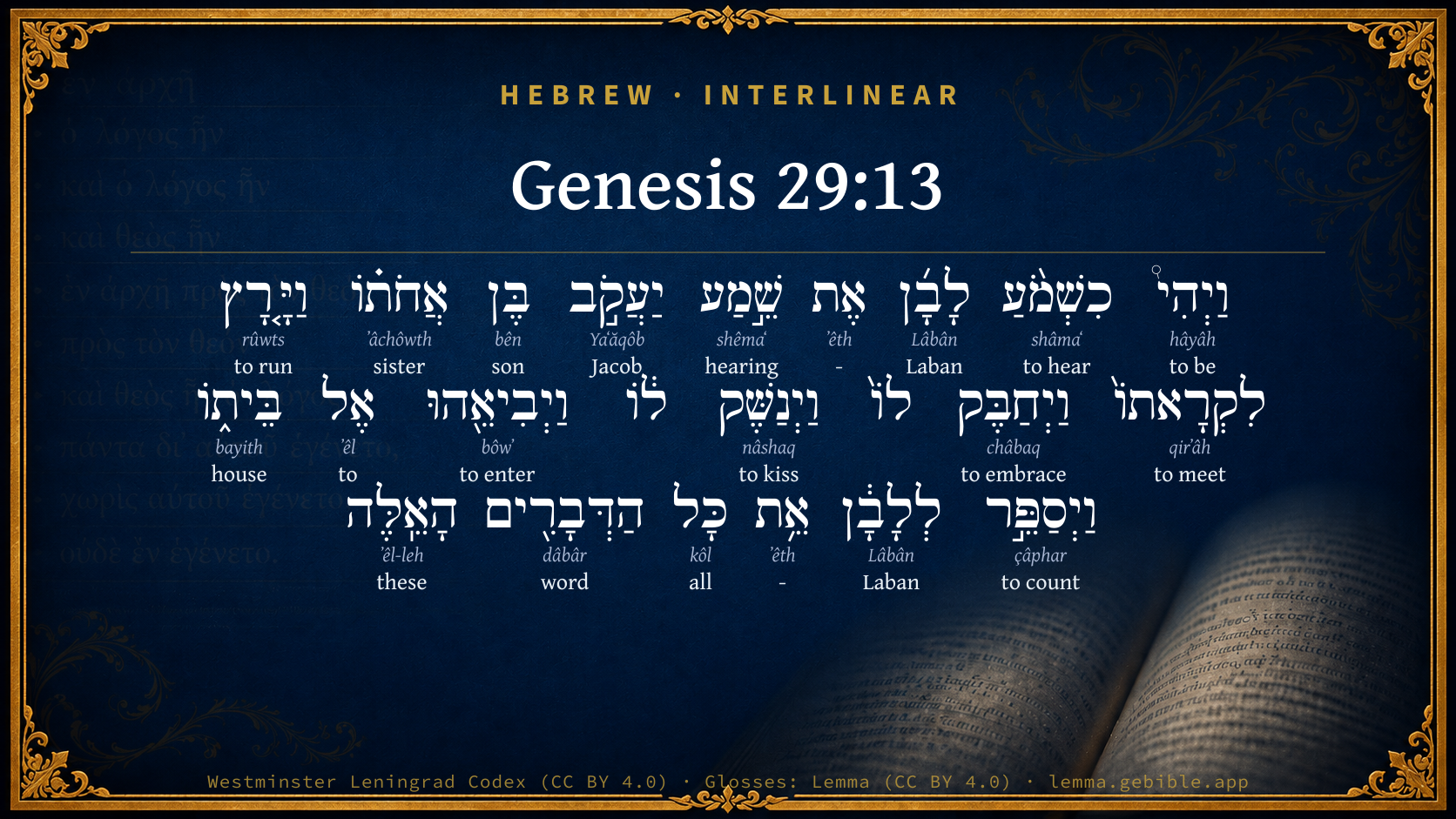
Genesis 29:13

Hebrew (Westminster Leningrad Codex) Genesis 29:13 appears in the Hebrew Old Testament. The text above is from the Westminster Leningrad Codex. Each word links to its Strong’s number, a concise gloss, and parsing drawn from the Open Scriptures Hebrew Bible morphology. Click any word for its full Brown-Driver-Briggs (BDB) entry.
Download image
Cite this verse

Genesis 29:13 (World English Bible). Public Domain. Lemma interlinear Bible study tool, https://lemma.gebible.app/v/genesis/29/13.

Show BibTeX & RIS
BibTeX
RIS
English Translation
It happened, when Laban heard the news of Jacob, his sister's son, that he ran to meet Jacob, and embraced him, and kissed him, and brought him to his house. Jacob told Laban all these things.
World English Bible · Public Domain
Highlights
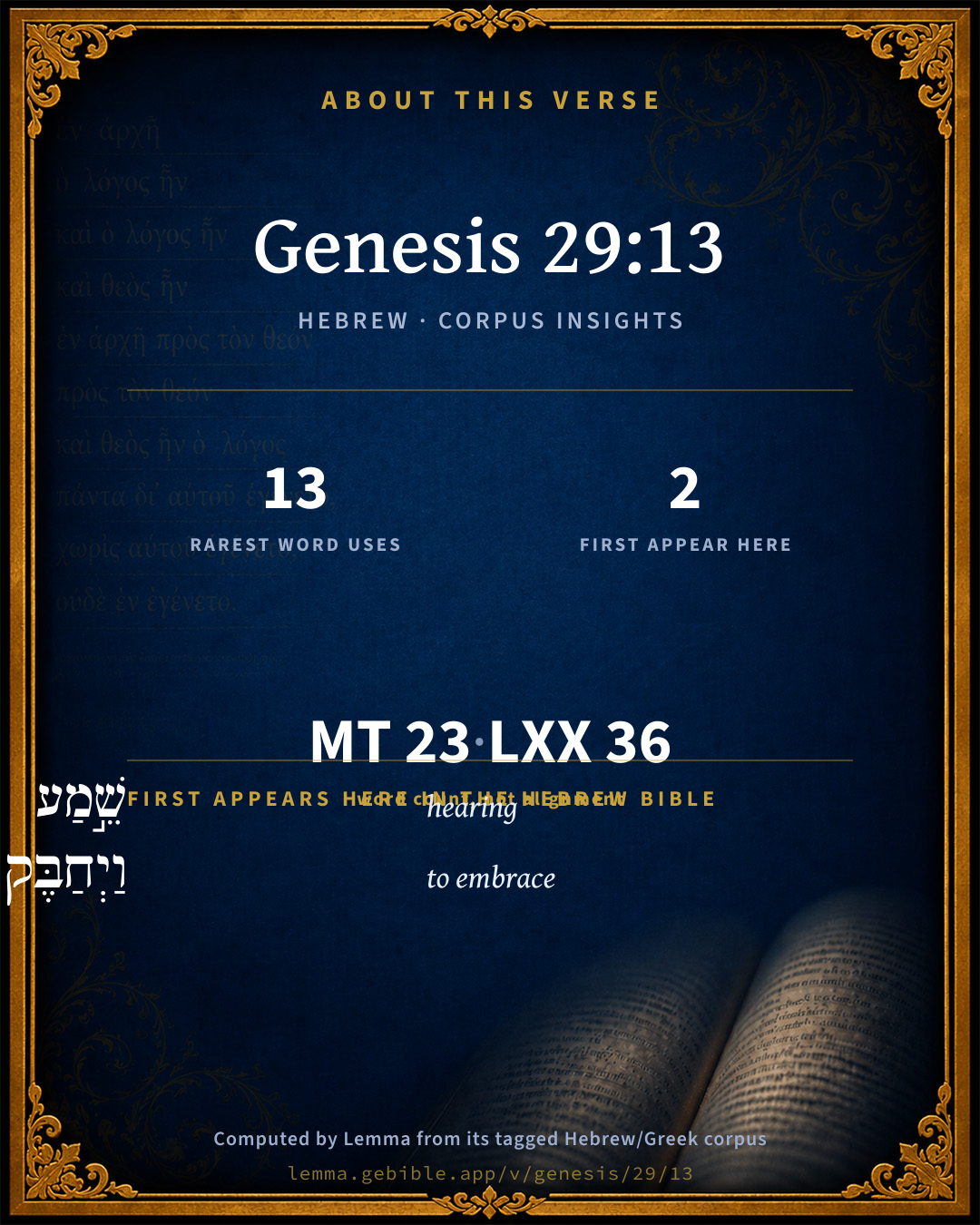
  • 2 first appearances in the Hebrew Bible
Full analysis ↓
Download a study sheet

One document with this verse’s original text, its word-by-word gloss line, the meaning frame, cross-references with their text, attributed commentary, and full source and license credits — printable, and it pastes into notes with its structure intact.

This verse Autodidact and up

Study sheet (.html) Plain text (.txt)

A passage Seminary Student

Up to 50 verses in one chapter. A passage sheet keeps up to 6 commentary sources and 12 cross-references per verse, in the order this page ranks them, and says so on the sheet whenever that leaves anything out. Ask for a single verse and you get the Autodidact verse sheet above.

Everything on this page stays free to read, with no account — the sheet is a download of what is already on screen, not access to it.

Want to remove ads? Support Godless Engineer
Compare translations 3

The same verse in 3 English versions, stacked beneath the original-language interlinear above. Click any original word for its lexicon entry.

Each is an independent rendering of the whole verse — the interlinear is not word-aligned to these translations.

Highlighted words mark where these versions differ — a whole-verse word diff, not a word-by-word alignment.

  • World English Bible Public Domain
    It happened, when Laban heard the news of Jacob, his sister's son, that he ran to meet Jacob, and embraced him, and kissed him, and brought him to his house. Jacob told Laban all these things.
  • King James Version Public Domain
    And it came to pass, when Laban heard the tidings of Jacob his sister's son, that he ran to meet him, and embraced him, and kissed him, and brought him to his house. And he told Laban all these things.
  • unfoldingWord Literal Text CC BY-SA 4.0
    And it happened, when Laban heard the news about Jacob the son of his sister, then he ran to meet him. Then he embraced him and kissed him and brought him to his house. Then he told Laban all these things,

unfoldingWord Literal Text — © unfoldingWord, licensed CC BY-SA 4.0. Word-aligned USFM3 via Door43 (git.door43.org/unfoldingWord/en_ult).

Versions to compare (up to 4)

3 of 4 selected

Show all 18 translations

Every available English version of this verse, each an independent rendering of the whole verse.

  • World English Bible Public Domain
    It happened, when Laban heard the news of Jacob, his sister's son, that he ran to meet Jacob, and embraced him, and kissed him, and brought him to his house. Jacob told Laban all these things.
  • Berean Standard Bible Public Domain
    When Laban heard the news about his sister’s son Jacob, he ran out to meet him. He embraced him and kissed him and brought him to his home, where Jacob told him all that had happened.
  • Majority Standard Bible Public Domain
    When Laban heard the news about his sister’s son Jacob, he ran out to meet him. He embraced him and kissed him and brought him to his home, where Jacob told him all that had happened.
  • King James Version Public Domain
    And it came to pass, when Laban heard the tidings of Jacob his sister's son, that he ran to meet him, and embraced him, and kissed him, and brought him to his house. And he told Laban all these things.
  • American Standard Version (1901) Public Domain
    And it came to pass, when Laban heard the tidings of Jacob his sister's son, that he ran to meet him, and embraced him, and kissed him, and brought him to his house. And he told Laban all these things.
  • Revised Version (1885) Public Domain
    And it came to pass, when Laban heard the tidings of Jacob his sister’s son, that he ran to meet him, and embraced him, and kissed him, and brought him to his house. And he told Laban all these things.
  • Geneva Bible (1599) Public Domain
    And when Laban heard tell of Iaakob his sisters sonne, he ranne to meete him, and embraced him and kissed him, and brought him to his house: and he tolde Laban all these things.
  • Douay-Rheims (1899) Public Domain
    Who, when he heard that Jacob his sister's son was come, ran forth to meet him; and embracing him, and heartily kissing him, brought him into his house. And when he had heard the causes of his journey,
  • Young's Literal Translation Public Domain
    And it cometh to pass, when Laban heareth the report of Jacob his sister's son, that he runneth to meet him, and embraceth him, and kisseth him, and bringeth him in unto his house; and he recounteth to Laban all these things,
  • Literal Standard Version CC BY-SA 4.0
    And it comes to pass, when Laban hears the report of his sister’s son Jacob, that he runs to meet him, and embraces him, and kisses him, and brings him into his house; and he recounts to Laban all these things,
  • Unlocked Literal Bible CC BY-SA 4.0
    When Laban heard the news about Jacob his sister's son, he ran to meet him, embraced him, kissed him, and brought him to his house. Jacob told Laban all these things.
  • unfoldingWord Literal Text CC BY-SA 4.0
    And it happened, when Laban heard the news about Jacob the son of his sister, then he ran to meet him. Then he embraced him and kissed him and brought him to his house. Then he told Laban all these things,
  • Darby Bible Public Domain
    And it came to pass when Laban heard the tidings of Jacob his sister's son, that he ran to meet him, and embraced him, and kissed him, and brought him to his house; and he told Laban all these things.
  • World Messianic Bible Public Domain
    When Laban heard the news of Jacob, his sister’s son, he ran to meet Jacob, and embraced him, and kissed him, and brought him to his house. Jacob told Laban all these things.
  • Webster's Bible Public Domain
    And it came to pass when Laban heard the tidings of Jacob his sister's son, that he ran to meet him, and embraced him, and kissed him, and brought him to his house. And he told Laban all these things.
  • Free Bible Version CC BY-SA 4.0
    As soon as Laban heard the news about Jacob he ran out to meet him. He hugged him and kissed him, and took him home. After Jacob had explained everything to Laban,
  • Bible in Basic English Public Domain
    And Laban, hearing news of Jacob, his sister's son, came running, and took Jacob in his arms, and kissing him, made him come into his house. And Jacob gave him news of everything.
  • JPS Tanakh (1917) Public Domain
    And it came to pass, when Laban heard the tidings of Jacob his sister's son, that he ran to meet him, and embraced him, and kissed him, and brought him to his house. And he told Laban all these things.

Literal Standard Version (2020), Covenant Press — licensed CC BY-SA 4.0. Text via the HelloAO Bible API (eBible.org). Unlocked Literal Bible (unfoldingWord) — licensed CC BY-SA 4.0. Text via the HelloAO Bible API (eBible.org). unfoldingWord Literal Text — © unfoldingWord, licensed CC BY-SA 4.0. Word-aligned USFM3 via Door43 (git.door43.org/unfoldingWord/en_ult). Free Bible Version, Dr. Jonathan Gallagher — licensed CC BY-SA 4.0. Text via the HelloAO Bible API (eBible.org).

Word by word

More ways to search: Search by grammar → Find every occurrence → Compare this word →

Practice this passage: Drill this verse → Learn its vocabulary →

וַיְחַבֶּק
châbaq
H2263
“and · to embrace”
Conjunction + Verb, Piel, Sequential Imperfect, 3rd Person, Masculine, Singular
Part of Speech
Conjunction + Verb
Stem
Piel
Form
Sequential Imperfect
Person
3rd Person
Gender
Masculine
Number
Singular
Full BDB Definition

Origin: a primitive root

TWOT: 597

to embrace, clasp - (Qal) - to embrace - to fold one's hands in idleness (figuratively) - (Piel) to embrace
  1. וַיְהִי֩ hâyâh H1961 “and · to be” Conjunction + Verb, Qal, Sequential Imperfect, 3rd Person, Masculine, Singular
  2. כִשְׁמֹ֨עַ shâmaʻ H8085 “like/as · to hear” Preposition + Verb, Qal, Infinitive Construct
  3. לָבָ֜ן Lâbân H3837 “Laban” Noun, Proper
  4. אֶת ʼêth H853 “-” Particle, Direct Object
  5. שֵׁ֣מַע shêmaʻ H8088 “hearing of” Noun, Common, Masculine, Singular, Construct
  6. יַעֲקֹ֣ב Yaʻăqôb H3290 “Jacob” Noun, Proper
  7. בֶּן bên H1121 “son of” Noun, Common, Masculine, Singular, Construct
  8. אֲחֹת֗וֹ ʼâchôwth H269 “sister · his” Noun, Common, Feminine, Singular, Construct + Suffix, Personal, 3rd Person, Masculine, Singular
  9. וַיָּ֤רָץ rûwts H7323 “and · to run” Conjunction + Verb, Qal, Sequential Imperfect, 3rd Person, Masculine, Singular
  10. לִקְרָאתוֹ֙ qirʼâh H7125 “to meet · him” Preposition + Verb, Qal, Infinitive Construct + Suffix, Personal, 3rd Person, Masculine, Singular
  11. וַיְנַשֶּׁק nâshaq H5401 “and · to kiss” Conjunction + Verb, Piel, Sequential Imperfect, 3rd Person, Masculine, Singular
  12. וַיְבִיאֵ֖הוּ bôwʼ H935 “and · to enter · him” Conjunction + Verb, Hiphil, Sequential Imperfect, 3rd Person, Masculine, Singular + Suffix, Personal, 3rd Person, Masculine, Singular
  13. אֶל ʼêl H413 “to” Preposition
  14. בֵּית֑וֹ bayith H1004 “house · his” Noun, Common, Masculine, Singular, Construct + Suffix, Personal, 3rd Person, Masculine, Singular
  15. וַיְסַפֵּ֣ר çâphar H5608 “and · to count” Conjunction + Verb, Piel, Sequential Imperfect, 3rd Person, Masculine, Singular
  16. לְלָבָ֔ן Lâbân H3837 “to/for · Laban” Preposition + Noun, Proper
  17. אֵ֥ת ʼêth H853 “-” Particle, Direct Object
  18. כָּל kôl H3605 “all of” Noun, Common, Masculine, Singular, Construct
  19. הַדְּבָרִ֖ים dâbâr H1697 “the · words” Particle, Definite Article + Noun, Common, Masculine, Plural, Absolute
  20. הָאֵֽלֶּה ʼêl-leh H428 “the · these” Particle, Definite Article + Pronoun, Demonstrative, Common, Plural

About this verse

These counts appear in no published source. They are computed here, from the morphology-tagged text and Lemma’s own curated glosses. What Lemma adds →

23
words
19
distinct lemmas
Pentateuch
section

Notable vocabulary

The rarest word here is וַיְחַבֶּק to embrace H2263 — appearing just 13 times in the whole Hebrew Bible.

First appearance in Scripture

These words make their first canonical appearance in the Hebrew Bible here:

  • שֵׁ֣מַע hearing H8088
  • וַיְחַבֶּק to embrace H2263

Shared distinctive vocabulary

וַיְחַבֶּק to embrace H2263 occurs in 12 verses of the Hebrew Bible. Also found in:

Grammatical profile

  • 8 verbs
  • 9 nouns
  • 1 pronoun
  • 3 prepositions
  • 2 particles

Verb forms

  • וַיְהִי֩ Qal · Sequential Imperfect
  • כִשְׁמֹ֨עַ Qal · Infinitive Construct
  • וַיָּ֤רָץ Qal · Sequential Imperfect
  • לִקְרָאתוֹ֙ Qal · Infinitive Construct
  • וַיְחַבֶּק Piel · Sequential Imperfect
  • וַיְנַשֶּׁק Piel · Sequential Imperfect
  • וַיְבִיאֵ֖הוּ Hiphil · Sequential Imperfect
  • וַיְסַפֵּ֣ר Piel · Sequential Imperfect

Repetition

A word recurs within this verse — often emphatic in Hebrew:

  • לָבָ֜ן Laban H3837 ×2

Hebrew & Septuagint length

In English translation the verse runs 36 words from the Hebrew and 38 from the Septuagint (LXX English) — closely comparable.

A rough comparison of the two English renderings, which tokenize alike — not a word-level alignment.

Word counts can differ between the Hebrew and the Greek without any difference in meaning — e.g. the Hebrew direct-object marker אֵת has no separate Greek word, and Greek often adds the article ὁ.

In the original languages it is 23 Hebrew tokens and 36 Greek tokens — but the two are counted differently (Hebrew bundles its prefixes and suffixes into one token; the Greek is in lemma form), so that isn’t a like-for-like length.

Cross-references

9

Topical passages linked to Genesis 29:13 in the Treasury of Scripture Knowledge — connected by theme and wording, ordered by reader-vote popularity; previews shown in the World English Bible.

  • Genesis 24:29 Rebekah had a brother, and his name was Laban. Laban ran out to the man, to the spring.
  • Genesis 45:15 He kissed all his brothers, and wept on them. After that his brothers talked with him.
  • Exodus 4:27 Yahweh said to Aaron, "Go into the wilderness to meet Moses." He went, and met him on God's mountain, and kissed him.
  • Exodus 18:7 Moses went out to meet his father-in-law, and bowed and kissed him. They asked each other of their welfare, and they came into the tent.
  • 2 Samuel 19:39 All the people went over the Jordan, and the king went over: and the king kissed Barzillai, and blessed him; and he returned to his own place.
  • Luke 7:45 You gave me no kiss, but she, since the time I came in, has not ceased to kiss my feet.
  • Acts 20:37 They all wept a lot, and fell on Paul's neck and kissed him,
  • Romans 16:16 Greet one another with a holy kiss. The assemblies of Christ greet you.
  • Colossians 4:5 Walk in wisdom toward those who are outside, redeeming the time.

Cross-references courtesy of OpenBible.info (CC BY 4.0).

Hebrew and Greek witnesses Masoretic Hebrew ↔ Greek Septuagint

The same verse in the two great witnesses to the Old Testament, shown verse-for-verse.

These are two independent witnesses, not word-aligned to each other, and the Septuagint is shown in lemma (dictionary) form.

Hebrew Genesis 29:13 Masoretic · Westminster Leningrad Codex

וַיְהִי֩ כִשְׁמֹ֨עַ לָבָ֜ן אֶת שֵׁ֣מַע יַעֲקֹ֣ב בֶּן אֲחֹת֗וֹ וַיָּ֤רָץ לִקְרָאתוֹ֙ וַיְחַבֶּק לוֹ֙ וַיְנַשֶּׁק ל֔וֹ וַיְבִיאֵ֖הוּ אֶל בֵּית֑וֹ וַיְסַפֵּ֣ר לְלָבָ֔ן אֵ֥ת כָּל הַדְּבָרִ֖ים הָאֵֽלֶּה

It happened, when Laban heard the news of Jacob, his sister's son, that he ran to meet Jacob, and embraced him, and kissed him, and brought him to his house. Jacob told Laban all these things.

World English Bible · Public Domain

Greek LXX Genesis 29:13 Septuagint · lemma form

γίγνομαι δέ ὡς ἀκούω λαβαν ὁ ὄνομα ἰακώβ ὁ υἱός ὁ ἀδελφή αὐτός τρέχω εἰς συνάντησις αὐτός καί περιλαμβάνω αὐτός φιλέω καί εἰςἄγω αὐτός εἰς ὁ οἶκος αὐτός καί διαἡγέομαι ὁ λαβαν πᾶς ὁ λόγος οὗτος

And it came to pass when Laban heard the name of Jacob, his sister's son, he ran to meet him, and embraced and kissed him, and brought him into his house; and he told Laban all these sayings.

LXX2012 (modern English Septuagint) · Public Domain

On this verse, The Cambridge Bible for Schools and Colleges discusses the Septuagint’s reading. Read the note in Commentary ↓

Hebrew: Westminster Leningrad Codex (CC BY 4.0). Greek: Septuagint (public domain); English from LXX2012 (modern English Septuagint) (Public Domain). How the Septuagint differs from the Hebrew →

Targum (Aramaic paraphrase)

2

The Targum is the ancient Jewish Aramaic paraphrase of the Hebrew Scriptures — an interpretive translation, not the Hebrew text itself. Onkelos (literal) and Pseudo-Jonathan (expansive) render the Torah, and Jonathan the Prophets. Coverage is partial: where no permissively-licensed English translation exists for a verse, only the Aramaic is shown. This is verse-level text, not a word-by-word alignment to the Hebrew.

  1. Targum Onkelos Torah (Genesis–Deuteronomy)
    וַהֲוָה כַּד שְׁמַע לָבָן יָת שֵׁמַע יַעֲקֹב בַּר אֲחָתֵהּ וּרְהַט לְקַדָמוּתֵהּ וְגַפֵּף לֵהּ וְנַשִׁיק לֵהּ וְאַעֲלֵהּ לְבֵיתֵהּ וְאִשְׁתָּעִי לְלָבָן יָת כָּל פִּתְגָמַיָּא הָאִלֵּין

    (no public-domain English translation for this verse)

    Targum Onkelos — Aramaic: “Onkelos Genesis” (public domain); “Onkelos Exodus” (public domain); “Onkelos Leviticus” (public domain); “Onkelos Numbers” (public domain); “Onkelos Deuteronomy” (public domain). English: “Sefaria Community Translation” (CC0 1.0 (public-domain dedication)); “J.W. Etheridge. The Targums of Onkelos and Jonathan Ben Uzziel on the Pentateuch. London: Longmans, Green, 1862” (public domain). Text via Sefaria.

  2. Targum Pseudo-Jonathan Torah (Genesis–Deuteronomy)
    וַהֲוָה כְּמִשְׁמַע לָבָן יַת שְׁמַע גְבוּרְתֵּיהּ וַחֲסִידוּתֵיהּ דְיַעֲקב בַּר אַחֲתֵיהּ הֵיךְ נְסֵיב יַת בְּכֵירוּתָא וְיַת סְדַר בִּרְכָתָא מִן יַד אָחוֹי וְהֵיךְ אִתְגְלֵי לֵיהּ יְיָ בְּבֵית אֵל וְהֵיךְ גָדַר יַת אַבְנָא וְהֵיךְ טָפַת בֵּירָא וּסְלֵיקַת לְאַנְפּוֹי וּרְהַט לִקְדָמוּתֵיהּ וְגָפֵיף לֵיהּ וּנְשֵׁיק לֵיהּ וְאַעֲלֵיהּ לְבֵיתֵיהּ וְתָנֵי לְלָבָן יַת כָּל פִּתְגָמַיָא הָאִילֵין

    And it was when Laban heard the account of the strength and piety of Jakob the son of his sister; how he had taken the birthright and the order of blessing from the hand of his brother, and how the Lord had revealed Himself to him at Bethel; how the stone had been removed, and how the well had upflowed and risen to the brink; he ran to meet him and embrace him, and kissed him and led him into his house; and he related to Laban all these things.

    Targum Pseudo-Jonathan — Aramaic: “Targum Jonathan on Genesis” (public domain); “Targum Jonathan on Exodus” (public domain); “Targum Jonathan on Leviticus” (public domain); “Targum Jonathan on Numbers” (public domain); “Targum Jonathan on Deuteronomy” (public domain). English: “The Targum of Jonathan ben Uzziel, trans. J. W. Etheridge, London, 1862” (public domain). Text via Sefaria.

Commentary

Notes on Genesis 29:13 from classic Christian and Jewish commentators (each source and its license shown beneath its notes). The classic Christian expositions comment on the surrounding passage and are grouped to its opening verse, so a note may address several verses; the Jewish commentaries on the Tanakh (Rashi and others) are per-verse, so they appear only where the commentator wrote on this verse.

Lemma curates 59 commentaries, every one of them public domain or Creative Commons licensed, each selected and text-cleaned for this edition rather than reprinted as found. About our sources →

Trapp's Complete Commentary

John Trapp

Gen 29:13 And it came to pass, when Laban heard the tidings of Jacob his sister’s son, that he ran to meet him, and embraced him, and kissed him, and brought him to his house. And he told Laban all these things.

Ver. 13. He ran to meet him, and embraced him.] All in hypocrisy, as the Hebrews hold. There be many Labans: hot at first, cold at last; friendly in the beginning, froward in the end. A free friend at first, a kind friend to the last, is rara avis in terris ." Trust not in a friend, put not confidence in a brother," &c. {Mic 7:5} Look rather unto the Lord, as the Church doth there: he is the only one dependable, as they say, and will never fail us; when the world, as Laban, will show itself at parting, if not before.

He told Laban all these things.] Why and how he came so poorly to him, whereas Abram’s servant, coming upon a like errand, came far better attended and appointed; which was the thing that Laban likely looked after when he ran out to meet Jacob.

John Trapp, A Commentary or Exposition upon All the Books of the Old and New Testament (1647–1656) — public domain. Text from a community e-Sword module.

Joseph Benson's Commentary

Gen 29:13. He told Laban all these things — About his journey, and the cause of it, and what he saw in the way.

Joseph Benson's Commentary on the Old and New Testaments (1811–1818) — public domain. Text from a community e-Sword module.

Geneva Bible (1599)

Geneva Bible translators

That is, the cause why he departed from his father’s house, and what he saw in the way.

Geneva Bible (1599) marginal notes — public domain. Text via Bolls.life.

John Calvin's Commentaries

13. And he told Laban all these things. Since Laban had previously seen one of Abraham’s servants replenished with great wealth, an unfavourable opinion of his nephew might instantly enter into his mind: it was therefore necessary for holy Jacob to explain the causes of his own departure, and the reason why he had been sent away so contemptibly clothed. It is also probable that he had been instructed by his mother respecting the signs and marks by which he might convince them of his relationship: therefore Laban exclaims, Surely thou art my bone and my flesh; intimating that he was fully satisfied, and that he was induced by indubitable tokens to acknowledge Jacob as his nephew. This knowledge inclines him to humanity; for the sense of nature dictates that they who are united by ties of blood should endeavor to assist each other; but though the bond between relatives is closer, yet our kindness ought to extend more widely, so that it may diffuse itself through the whole human race. If, however, all the sons of Adam are thus joined together, that spiritual relationship which God produces between the faithful, and than which there is no holier bond of mutual benevolence, ought to be much more effectual.

John Calvin's Commentaries (1540-1563) — public domain. Text from the Calvin Translation Society English edition (1840s-50s) via the Christian Classics Ethereal Library (ccel.org). Calvin's coverage is partial (roughly two-thirds of the Bible); uncommented books and verses are honest gaps, never fabricated. The 19th-century editor's footnotes and remarks are omitted so the notes are faithfully Calvin's own voice.

Ellicott's Commentary for English Readers

(13) Laban . . . ran to meet him, and embraced him.—Rachel told her father, because it was a matter simply of the hospitable reception of a relative, and not such news as Rebekah had run to tell those of her mother’s house. And to Laban the tidings must have been most welcome, as he called to mind now, seventy-seven years ago, he had seen his dear sister depart to marry the son of the distant sheik. It seems strange, however, that the daughters of this old man should be so young. Either they must have been the children of a wife of his old age, or his granddaughters, but regarded as his own because their father was dead. As Laban’s sons are not mentioned till Gen_31:1, probably on account of their youth, the former is the more probable explanation.

A Bible Commentary for English Readers, edited by Charles John Ellicott (1878–1897) — public domain. Text from a community e-Sword module.

The Cambridge Bible for Schools and Colleges

gen. ed. J. J. S. Perowne

13. Laban] According to the P narrative, Gen_26:34, it was over forty years since Laban had said farewell to his sister Rebekah. He now effusively greets and welcomes her son. Perhaps he recollects the gifts of Rebekah’s dowry (Gen_24:30), and also perceives in Jacob a strong and capable worker.

the tidings] LXX τὸ ὄνομα = “the name,” with the omission of one letter in the original (shêm for shêma‘).

kissed] The Hebrew verb expresses the warmth of the salutation.

The Cambridge Bible for Schools and Colleges (gen. ed. J. J. S. Perowne; Cambridge University Press, 1878–1918) — public domain. Text from a community e-Sword module.

John Gill's Exposition

And it came to pass, when Laban heard the tidings of Jacob his sister's son,.... That there was such a man at the well, thus related to him, and what he had done there, had rolled away the stone, and watered his flock. The Jewish writers (l) make this report chiefly to respect his great strength showed in the above instance, with other things:

that he ran to meet him, and embraced him, and kissed him, and brought him to his house; Jarchi and other interpreters represent this as done with avaricious views, and that he expected Jacob had brought presents with him, as pieces of gold, pearls and jewels, and such like precious things Abraham's servant brought and gave him when he came for Rebekah, Gen 24:53; but I see not why we may not take all this to be hearty, sincere, and affectionate, arising from nearness of relation, and a sense of it:

and he told Laban all these things; how he was sent hither by his parents on account of the hatred of his brother Esau, because he had got the birthright and blessing from him; how God had appeared to him at Luz, and the promises he had made him; how providentially he had met with Rachel at the well, and perhaps might him at, if he did not openly declare, the end of his coming thither for a wife.

(l) Targ. Jon. in loc. Pirke Eliezer, ut supra. (c. 36.)

John Gill's Exposition of the Whole Bible (1746–1763) — public domain (CC PDM 1.0). Text via the HelloAO Bible API.

Matthew Poole's English Annotations

The tidings of Jacob; the report of his father’s family, of the cause of his coming in so mean circumstances, of the occurrences in his journey, and of his providential meeting with Rachel at the well.

Matthew Poole's English Annotations on the Holy Bible (1683–1685) — public domain. Text from a community e-Sword/MySword module.

Whedon's Commentary on the Bible

Daniel D. Whedon

13. Told Laban all — All about his journey and its object, the commands of Isaac and Rebekah, and the desire of his own heart.

Daniel D. Whedon (gen. ed.), Commentary on the Old and New Testaments (1874–1909) — public domain. Text from a community e-Sword module.

The Pulpit Commentary

And it came to pass, when Laban heard the tidings (literally, heard the hearing, or thing heard, i.e. the report of the arrival) of Jacob his sister"s son, he acted very much as he did ninety-seven years before, when Abraham"s servant came to woo his sister (Gen_14:20) that (literally, and) he ran to meet him, and embraced him, so afterwards Esau did Jacob, (Gen_33:4) and Jacob the two sons of Joseph (Gen_48:10) and kissed him, and brought him to his house thus evincing the same kindness and hospitality that had characterized him on the previous occasion. And he (Jacob) told Laban all these things what his mother bad instructed him to say to attest his kinship (Calvin); the things related in the immediate context (Keil); more likely the entire story of his life, and in particular of his exile from home, with its cause and object (Rosenm Kalisch, Lange).

The Pulpit Commentary (1880–1919), ed. H.D.M. Spence-Jones & Joseph S. Exell — public domain. Text from a community e-Sword module.

unfoldingWord translationNotes

Door43 World Missions Community

his sister's son

"his nephew"

embraced him

"hugged him"

kissed him

In ancient Near East, it is common to greet a relative with a kiss. However, it is normally done between men. If your language has an affectionate greeting for a relative, use that. If not, use what is appropriate.

Jacob told Laban all these things

"then Jacob told Laban everything he told Rachel"

my bone and my flesh

This phrase means they are directly related. AT: "my relative" or "a member of my family" (See: Metonymy)

translationWords

Laban

kiss

month

unfoldingWord translationNotes — © Distant Shores Media and the Door43 World Missions Community, licensed CC BY-SA 4.0. Source: git.door43.org/Door43/en_tn.

Rashi

Rabbi Shlomo Yitzchaki (Rashi)

וירץ לקראתו HE RAN TOWARDS HIM — thinking that he was laden with money, for the servant of that household (Eliezer) had come there with ten camels fully laden (Bereishit Rabbah 70:13).

ויחבק AND EMBRACED HIM — When he saw that he had nothing with him, he thought, “Perhaps he has brought gold coins and they are hidden away in his bosom!”

וינשק לו HE KISSED HIM — he thought, “Perhaps he has brought pearls (or precious stones, in general) and they are in his mouth!” (Genesis Rabbah 70:13)

ויספר ללבן HE TOLD LABAN that he had come only because he was forced to do so by his brother, and that all his money had been taken from him.

Rashi on the Tanakh — English translations: “The Judaica Press complete Tanach with Rashi, translated by A. J. Rosenberg” (CC BY 4.0); “Pentateuch with Rashi's commentary by M. Rosenbaum and A.M. Silbermann, 1929-1934” (public domain); “The Metsudah Tanach series, Lakewood, N.J” (CC BY 4.0); and “The Book of Joshua, Metsudah Publications, 1997” (CC BY 4.0). Text via Sefaria.

Radak

Rabbi David Kimhi (Radak)

ויהי כשמוע...ויספר ללבן את כל הדברים האלה, he revealed the reason why he had left his father’s home and that he had done so at the command of both his father and his mother.

Radak on the Tanakh — English translations: “Sefaria Community Translation” (CC0 1.0 (public-domain dedication)); “Eliyahu Munk, HaChut Hameshulash” (CC BY 4.0); “Rabbi Mike Feuer, Jerusalem Anthology” (CC BY 4.0); and “R. David Kimhi on the first book of Psalms, Translated by R.G. Finch, London, 1919” (public domain). Text via Sefaria.

Lesson kit

Teaching starters — assembled from the data on this page, not authored interpretation. Every prompt links to the verse data it draws on. Edit before teaching.

Genesis, in the Pentateuch, opens this verse with 23 words (19 distinct Hebrew lemmas). Its most distinctive word is châbaq (“to embrace”). A historical commentator’s framing appears above. Read the whole chapter for the surrounding context.

Discussion questions

  1. The word châbaq carries the sense “to embrace.” How does it shape the verse?
  2. 2 words make their first appearance in Scripture here. What does this debut establish?
  3. How does Genesis 33:4, which shares the word «to embrace», read alongside this verse?
  4. What does the repetition of “Laban” (2× in this one verse) do in this verse?
  5. The translations on this page render this verse differently — a whole-verse word diff, not a word-by-word alignment. What might account for the different wordings?
  6. «וַיְהִי֩» is a Qal Sequential Imperfect verb. How does that grammatical form shape the action described?
  7. Compare how Trapp's Complete Commentary and Joseph Benson's Commentary read this verse. Where do they agree or differ?

Things to notice

Reading settings

Reading text

Shown beneath each verse's original-language words.

Old Testament
Old Testament edition

Read the OT as the Masoretic Hebrew (MT) or the Greek Septuagint (LXX).

English shown for the Greek Septuagint (in the Hebrew ↔ Greek comparison).

Comparing translations? Open the Compare panel on any verse page to stack up to four side by side.