Esther 5:10

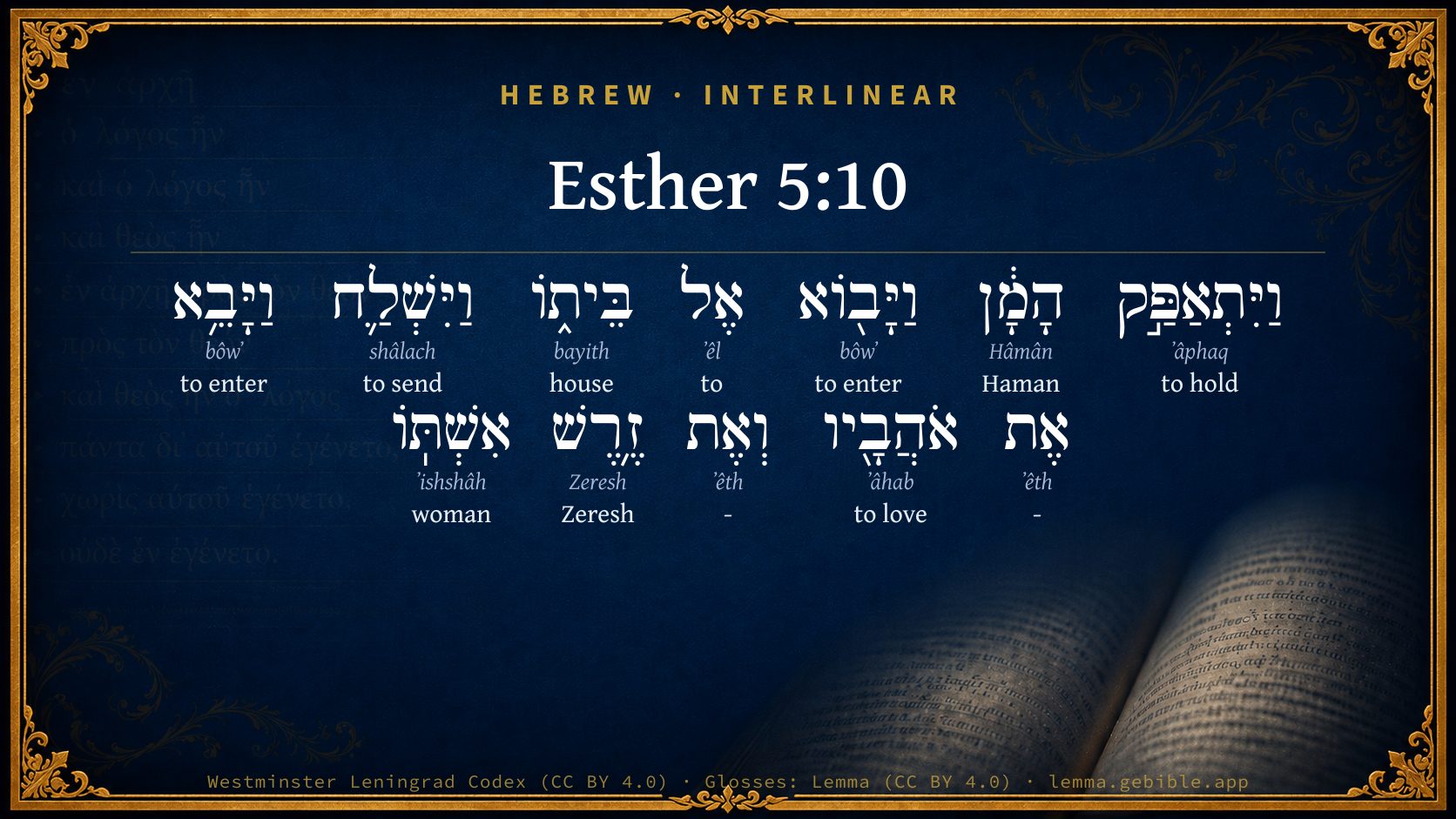
Hebrew (Westminster Leningrad Codex) Esther 5:10 appears in the Hebrew Old Testament. The text above is from the Westminster Leningrad Codex. Each word links to its Strong’s number, a concise gloss, and parsing drawn from the Open Scriptures Hebrew Bible morphology. Click any word for its full Brown-Driver-Briggs (BDB) entry.
Download image
Cite this verse

Esther 5:10 (World English Bible). Public Domain. Lemma interlinear Bible study tool, https://lemma.gebible.app/v/esther/5/10.

Show BibTeX & RIS
BibTeX
RIS
English Translation
Nevertheless Haman refrained himself, and went home; and he sent and fetched his friends and Zeresh his wife.
World English Bible · Public Domain
Highlights
  • 1 first appearance in the Hebrew Bible
Full analysis ↓
Download a study sheet

One document with this verse’s original text, its word-by-word gloss line, the meaning frame, cross-references with their text, attributed commentary, and full source and license credits — printable, and it pastes into notes with its structure intact.

This verse Autodidact and up

Study sheet (.html) Plain text (.txt)

A passage Seminary Student

Up to 50 verses in one chapter. A passage sheet keeps up to 6 commentary sources and 12 cross-references per verse, in the order this page ranks them, and says so on the sheet whenever that leaves anything out. Ask for a single verse and you get the Autodidact verse sheet above.

Everything on this page stays free to read, with no account — the sheet is a download of what is already on screen, not access to it.

Want to remove ads? Support Godless Engineer
Compare translations 3

The same verse in 3 English versions, stacked beneath the original-language interlinear above. Click any original word for its lexicon entry.

Each is an independent rendering of the whole verse — the interlinear is not word-aligned to these translations.

Highlighted words mark where these versions differ — a whole-verse word diff, not a word-by-word alignment.

  • World English Bible Public Domain
    Nevertheless Haman refrained himself, and went home; and he sent and fetched his friends and Zeresh his wife.
  • King James Version Public Domain
    Nevertheless Haman refrained himself: and when he came home, he sent and called for his friends, and Zeresh his wife.
  • unfoldingWord Literal Text CC BY-SA 4.0
    But Haman restrained himself and went to his house. Then he sent and brought his friends and Zeresh his wife.

unfoldingWord Literal Text — © unfoldingWord, licensed CC BY-SA 4.0. Word-aligned USFM3 via Door43 (git.door43.org/unfoldingWord/en_ult).

Versions to compare (up to 4)

3 of 4 selected

Show all 18 translations

Every available English version of this verse, each an independent rendering of the whole verse.

  • World English Bible Public Domain
    Nevertheless Haman refrained himself, and went home; and he sent and fetched his friends and Zeresh his wife.
  • Berean Standard Bible Public Domain
    Nevertheless, Haman restrained himself and went home. And calling for his friends and his wife Zeresh,
  • Majority Standard Bible Public Domain
    Nevertheless, Haman restrained himself and went home. And calling for his friends and his wife Zeresh,
  • King James Version Public Domain
    Nevertheless Haman refrained himself: and when he came home, he sent and called for his friends, and Zeresh his wife.
  • American Standard Version (1901) Public Domain
    Nevertheless Haman refrained himself, and went home; and he sent and fetched his friends and Zeresh his wife.
  • Revised Version (1885) Public Domain
    Nevertheless Haman refrained himself, and went home; and he sent and fetched his friends and Zeresh his wife.
  • Geneva Bible (1599) Public Domain
    Neuerthelesse Haman refrayned himselfe: and when he came home, he sent, and called for his friends, and Zeresh his wife.
  • Douay-Rheims (1899) Public Domain
    But dissembling his anger, and returning into his house, he called together to him his friends, and Zares his wife:
  • Young's Literal Translation Public Domain
    And Haman forceth himself, and cometh in unto his house, and sendeth, and bringeth in his friends, and Zeresh his wife,
  • Literal Standard Version CC BY-SA 4.0
    And Haman forces himself, and comes into his house, and sends, and brings in his friends, and his wife Zeresh,
  • Unlocked Literal Bible CC BY-SA 4.0
    Nevertheless, Haman restrained himself and went to his own house. He sent for his friends and gathered them together, with Zeresh his wife.
  • unfoldingWord Literal Text CC BY-SA 4.0
    But Haman restrained himself and went to his house. Then he sent and brought his friends and Zeresh his wife.
  • Darby Bible Public Domain
    But Haman controlled himself, and came home; and he sent and called for his friends, and Zeresh his wife.
  • World Messianic Bible Public Domain
    Nevertheless Haman restrained himself, and went home. There, he sent and called for his friends and Zeresh his wife.
  • Webster's Bible Public Domain
    Nevertheless, Haman refrained himself: and when he came home, he sent and called for his friends, and Zeresh his wife.
  • Free Bible Version CC BY-SA 4.0
    However, Haman controlled himself and he went home. There he invited his friends over. Once they and his wife Zeresh had gathered,
  • Bible in Basic English Public Domain
    But controlling himself, he went to his house; and he sent for his friends and Zeresh, his wife.
  • JPS Tanakh (1917) Public Domain
    Nevertheless Haman refrained himself, and went home; and he sent and fetched his friends and Zeresh his wife.

Literal Standard Version (2020), Covenant Press — licensed CC BY-SA 4.0. Text via the HelloAO Bible API (eBible.org). Unlocked Literal Bible (unfoldingWord) — licensed CC BY-SA 4.0. Text via the HelloAO Bible API (eBible.org). unfoldingWord Literal Text — © unfoldingWord, licensed CC BY-SA 4.0. Word-aligned USFM3 via Door43 (git.door43.org/unfoldingWord/en_ult). Free Bible Version, Dr. Jonathan Gallagher — licensed CC BY-SA 4.0. Text via the HelloAO Bible API (eBible.org).

Word by word

More ways to search: Search by grammar → Find every occurrence → Compare this word →

Practice this passage: Drill this verse → Learn its vocabulary →

זֶ֥רֶשׁ
Zeresh
H2238
“Zeresh”
Noun, Proper
Part of Speech
Noun
Type
Proper
Full BDB Definition

Origin: of Persian origin

TWOT: None

Zeresh = "gold" - the wife of Haman, the Agagite
  1. וַיִּתְאַפַּ֣ק ʼâphaq H662 “and · to hold” Conjunction + Verb, Hithpael, Sequential Imperfect, 3rd Person, Masculine, Singular
  2. הָמָ֔ן Hâmân H2001 “Haman” Noun, Proper
  3. וַיָּב֖וֹא bôwʼ H935 “and · to enter” Conjunction + Verb, Qal, Sequential Imperfect, 3rd Person, Masculine, Singular
  4. אֶל ʼêl H413 “to” Preposition
  5. בֵּית֑וֹ bayith H1004 “house · his” Noun, Common, Masculine, Singular, Construct + Suffix, Personal, 3rd Person, Masculine, Singular
  6. וַיִּשְׁלַ֛ח shâlach H7971 “and · to send” Conjunction + Verb, Qal, Sequential Imperfect, 3rd Person, Masculine, Singular
  7. וַיָּבֵ֥א bôwʼ H935 “and · to enter” Conjunction + Verb, Hiphil, Sequential Imperfect, 3rd Person, Masculine, Singular
  8. אֶת ʼêth H853 “-” Particle, Direct Object
  9. אֹהֲבָ֖יו ʼâhab H157 “loving · him” Verb, Qal, Participle Active, Masculine, Plural, Construct + Suffix, Personal, 3rd Person, Masculine, Singular
  10. וְאֶת ʼêth H853 “and · -” Conjunction + Particle, Direct Object
  11. אִשְׁתּֽוֹ ʼishshâh H802 “woman · his” Noun, Common, Feminine, Singular, Construct + Suffix, Personal, 3rd Person, Masculine, Singular

About this verse

These counts appear in no published source. They are computed here, from the morphology-tagged text and Lemma’s own curated glosses. What Lemma adds →

12
words
10
distinct lemmas
Historical
section

Notable vocabulary

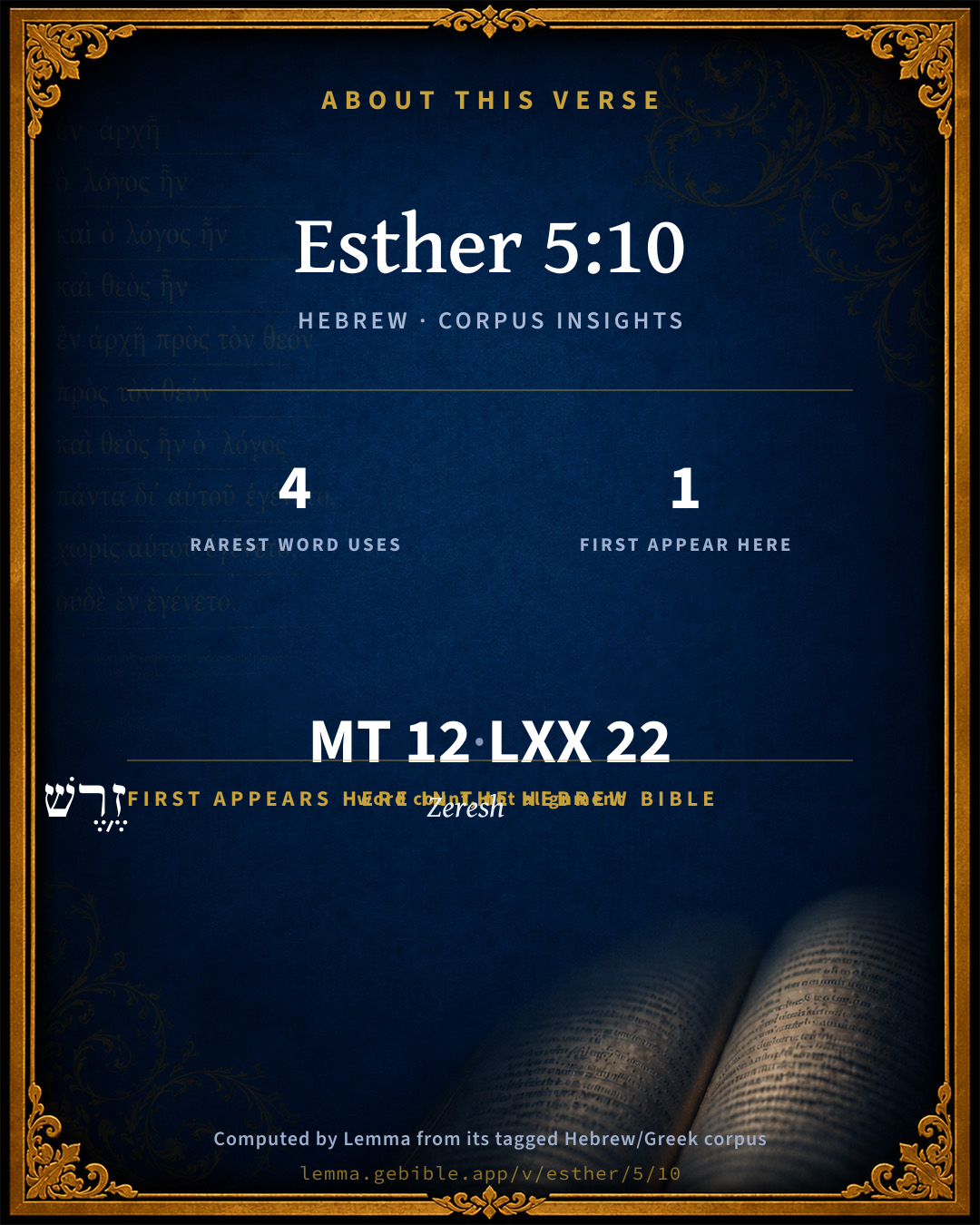
The rarest word here is זֶ֥רֶשׁ Zeresh H2238 — appearing just 4 times in the whole Hebrew Bible.

First appearance in Scripture

This word makes its first canonical appearance in the Hebrew Bible here:

  • זֶ֥רֶשׁ Zeresh H2238

Shared distinctive vocabulary

זֶ֥רֶשׁ Zeresh H2238 occurs in 3 verses of the Hebrew Bible. Also found in:

Grammatical profile

  • 5 verbs
  • 4 nouns
  • 1 preposition
  • 2 particles

Verb forms

  • וַיִּתְאַפַּ֣ק Hithpael · Sequential Imperfect
  • וַיָּב֖וֹא Qal · Sequential Imperfect
  • וַיִּשְׁלַ֛ח Qal · Sequential Imperfect
  • וַיָּבֵ֥א Hiphil · Sequential Imperfect
  • אֹהֲבָ֖יו Qal · Participle Active

Repetition

A word recurs within this verse — often emphatic in Hebrew:

  • וַיָּב֖וֹא to enter H935 ×2

Hebrew & Septuagint length

In English translation the verse runs 18 words from the Hebrew and 15 from the Septuagint (LXX English) — closely comparable.

A rough comparison of the two English renderings, which tokenize alike — not a word-level alignment.

Word counts can differ between the Hebrew and the Greek without any difference in meaning — e.g. the Hebrew direct-object marker אֵת has no separate Greek word, and Greek often adds the article ὁ.

In the original languages it is 12 Hebrew tokens and 22 Greek tokens — but the two are counted differently (Hebrew bundles its prefixes and suffixes into one token; the Greek is in lemma form), so that isn’t a like-for-like length.

Cross-references

5

Topical passages linked to Esther 5:10 in the Treasury of Scripture Knowledge — connected by theme and wording, ordered by reader-vote popularity; previews shown in the World English Bible.

  • Esther 6:13 Haman recounted to Zeresh his wife and all his friends everything that had happened to him. Then his wise men and Zeresh his wife said to him, If Mordecai, before whom you have begun to fall, be of the seed of the Jews, you shall not prevail against him, but shall surely fall before him.
  • Ecclesiastes 7:9 Don't be hasty in your spirit to be angry, for anger rests in the bosom of fools.
  • Genesis 43:30–31 Joseph made haste; for his heart yearned over his brother: and he sought a place to weep; and he entered into his room, and wept there.
  • Genesis 45:1 Then Joseph couldn't control himself before all those who stood before him, and he cried, "Cause every man to go out from me!" There stood no man with him, while Joseph made himself known to his brothers.
  • 2 Samuel 13:22–23 Absalom spoke to Amnon neither good nor bad; for Absalom hated Amnon, because he had forced his sister Tamar.

Cross-references courtesy of OpenBible.info (CC BY 4.0).

Hebrew and Greek witnesses Masoretic Hebrew ↔ Greek Septuagint

The same verse in the two great witnesses to the Old Testament, shown verse-for-verse.

These are two independent witnesses, not word-aligned to each other, and the Septuagint is shown in lemma (dictionary) form.

Hebrew Esther 5:10 Masoretic · Westminster Leningrad Codex

וַיִּתְאַפַּ֣ק הָמָ֔ן וַיָּב֖וֹא אֶל בֵּית֑וֹ וַיִּשְׁלַ֛ח וַיָּבֵ֥א אֶת אֹהֲבָ֖יו וְאֶת זֶ֥רֶשׁ אִשְׁתּֽוֹ

Nevertheless Haman refrained himself, and went home; and he sent and fetched his friends and Zeresh his wife.

World English Bible · Public Domain

Greek LXX Esther 5:10 Septuagint · lemma form

καί εἶπον αμαν οὐ καλέω ὁ βασίλισσα μετά ὁ βασιλεύς οὐδείς εἰς ὁ δοχή ἀλλά ἤ ἐγώ καί εἰς ὁ αὔριον καλέω

And having gone into his own house, he called his friends, and his wife Zosara.

LXX2012 (modern English Septuagint) · Public Domain

Hebrew: Westminster Leningrad Codex (CC BY 4.0). Greek: Septuagint (public domain); English from LXX2012 (modern English Septuagint) (Public Domain). How the Septuagint differs from the Hebrew →

Commentary

Notes on Esther 5:10 from classic Christian and Jewish commentators (each source and its license shown beneath its notes). The classic Christian expositions comment on the surrounding passage and are grouped to its opening verse, so a note may address several verses; the Jewish commentaries on the Tanakh (Rashi and others) are per-verse, so they appear only where the commentator wrote on this verse.

Lemma curates 59 commentaries, every one of them public domain or Creative Commons licensed, each selected and text-cleaned for this edition rather than reprinted as found. About our sources →

Trapp's Complete Commentary

John Trapp

Est 5:10 Nevertheless Haman refrained himself: and when he came home, he sent and called for his friends, and Zeresh his wife.

Ver. 10. Nevertheless Haman refrained himself] Much ado he had to forbear mischieving him; he was fain to force himself thereunto, as the word signifieth; for his fingers even itched to be having him by the ears, or to be bathing in his blood. This he did not, haply because he dared not, because Mordecai was the king’s servant, his doorkeeper, as it is thought, and so went under his protection. It would therefore have reflected upon the king himself, if he should lay violent hands on him. Most sure it is, that God held his hands, and preserved Mordecai for further good to his Church. Precious in the sight of the Lord is the death of his saints; neither will he send them to bed till they have done their work.

And when he came home, he sent and called for his friends] This had been a wise man’s part, if he had done it for any good purpose. But as he was in an ill case to consult, as being full of rage, so he minded nothing but revenge, and therefore advised with none but such as would say with him, and thereby hasten his downfall.

And Zeresh his wife] Ut consiliariornm primam et praecipuam. That she was wise above her sex, see Est 6:13. But had she been as wise as Pilate’s wife was she would not have given here such pestilent counsel, but have warned her husband of meddling with just men. Have these workers of iniquity no knowledge, that they eat up God’s people as they eat bread? that they make account to make but a breakfast of them? Psa 14:4.

John Trapp, A Commentary or Exposition upon All the Books of the Old and New Testament (1647–1656) — public domain. Text from a community e-Sword module.

The Biblical Illustrator

Joseph S. Exell

Est_5:10

Nevertheless Haman refrained himself.

Self-restraint possible

Haman refrained himself. It is a circumstance not unworthy of notice, that even those persons who are habitually self-willed, and destitute of the power of self-government, can nevertheless, when occasion requires it, exercise a wonderful control over both their speech and their passions. Thus, for example, a man who is addicted to the sin of profane swearing will be found to put such guard upon his words in the presence of a superior who detests that sin, that not one oath will escape from his lips. A man who has no command of his temper at ordinary times will appear smooth and unruffled in his intercourse with those on whom he is dependent, or whose good opinion he desires to gain. A man given to excess in the indulgence of his appetites will be careful not to transgress in company where it would be accounted shameful. Now there is an important principle involved in all this, deeply affecting the moral responsibility of such men for all their conduct. For if they can lay themselves under such restraint--when it serves their purpose--that long-formed habits can be checked and mastered, then we think that even they themselves must admit that they are deprived of all excuse when they suffer themselves to be usually governed by these habits. And if regard for the opinions and feelings of their fellow-men exerts a power over them which the law of God does not possess, then manifestly they are chargeable with the guilt of standing more in awe of men than of God. (A. B. Davidson, D. D.)

And when he came home.

Home with a bad man

It is not pleasant to go home with Haman; but God thinks it good for us to see the inside of a bad mans heart. We shall understand the irony of His providence the better. (T. McCrie.)

The Biblical Illustrator, edited by Joseph S. Exell (c. 1880s–1900s) — public domain. Text from a community e-Sword module.

Joseph Benson's Commentary

Est 5:10. Nevertheless, Haman refrained himself — From taking present vengeance upon Mordecai, which he might easily have effected, either by his own, or any of his servants’ hands, without any fear of inconvenience to himself. But herein God’s wise and powerful providence appeared in disposing Haman’s heart, contrary to his own inclination, and making him, as it were, to put fetters upon his own hands.

Joseph Benson's Commentary on the Old and New Testaments (1811–1818) — public domain. Text from a community e-Sword module.

Ellicott's Commentary for English Readers

(10) Zeresh.—A name probably derived from an old Persian word for “gold.” According to the Targum she was the daughter of Tatnai, “the governour on this side the river,” i.e., of that part of the Persian Empire which lay beyond the Euphrates ( Ezr_5:3).

A Bible Commentary for English Readers, edited by Charles John Ellicott (1878–1897) — public domain. Text from a community e-Sword module.

The Cambridge Bible for Schools and Colleges

gen. ed. J. J. S. Perowne

10. Haman also on his side uses circumspection in carrying out his vengeful design. Instead of ordering immediate punishment to be inflicted upon his enemy, an act which we may safely assume would in virtue of his position be easy of accomplishment, he consults his wife and his friends.

Zeresh] The name is probably the Hebraised form of the Persian zaris, gilt or golden. Cp. the Greek Chryses, Chrysçis.

The Cambridge Bible for Schools and Colleges (gen. ed. J. J. S. Perowne; Cambridge University Press, 1878–1918) — public domain. Text from a community e-Sword module.

John Gill's Exposition

And Haman told them of the glory of his riches,.... Of the multitude of them; which he did partly in a way of ostentation, and partly, if he could, to make his mind easy under the mortification he received from Mordecai; and, it may be, chiefly to aggravate his rudeness and ill behaviour towards him, a man of so much wealth: and the multitude of his children; he had ten, as we learn from Est 9:10, but the former Targum enlarges them, beyond credit, to the number of two hundred and eight, besides his ten sons, and Shimshai the scribe; such were had in great esteem with the Persians who had many children; to such the king used to send gifts annually (k):

and all the things wherein the king had promoted him; the high offices of honour and trust he had put him into:

and how he had advanced him above the princes and servants of the king. See Est 3:1.

(k) Herodot, Clio, sive, l. 1. c. 136. Strabo. Geograph. l. 15. p. 504.

John Gill's Exposition of the Whole Bible (1746–1763) — public domain (CC PDM 1.0). Text via the HelloAO Bible API.

Albert Barnes' Notes on the Bible

Zeresh - This name is probably connected with the Zend zara, “gold.” Compare the Greek “Chrysis.”

Albert Barnes' Notes on the Bible (1834–1885) — public domain. Text from a community e-Sword/MySword module.

Matthew Poole's English Annotations

Haman refrained himself from taking present vengeance upon Mordecai, to which he was strongly inclined, and which he might easily have effected, either by his own or any of his servants’ hands, without any expectation or fear of inconvenience to himself, who having obtained license to destroy a whole nation, could easily get a pardon for having killed one obscure and infamous member of it. Herein therefore God’s wise and powerful providence appeared in disposing Haman’s heart, contrary to his own inclination and interest, and making him, as it were, to put fetters upon his own hands.

Matthew Poole's English Annotations on the Holy Bible (1683–1685) — public domain. Text from a community e-Sword/MySword module.

Whedon's Commentary on the Bible

Daniel D. Whedon

10. His friends — His intimate associates and companions — diviners and wise men (Est_3:7; Est_6:13) — with whom he met in councils and in festivities.

Daniel D. Whedon (gen. ed.), Commentary on the Old and New Testaments (1874–1909) — public domain. Text from a community e-Sword module.

The Pulpit Commentary

Haman refrained himself. That is to say, so far as speech and act went. He said nothing; he did not strike his insulter; he did not order his servants to drag the fellow outside the gate and give him the bastinado. But he did not "refrain his heart. " He allowed the affront that he had received to remain in his mind and rankle there. It poisoned his happiness, marred all his enjoyment, filled him with hatred and rage. When he came home, he sent and called for his friends. It was not so much to be partners in his joy that Haman called his friends around him as to be companions in his grief. It is true that his speech to them was chiefly occupied with boasts; but the true intention of the discourse is seen in its close this availeth me nothing," etc.

The Pulpit Commentary (1880–1919), ed. H.D.M. Spence-Jones & Joseph S. Exell — public domain. Text from a community e-Sword module.

John Wesley's Explanatory Notes

Refrained - From taking present vengeance upon Mordecai, which he might easily have effected, either by his own, or any of his servants hands, without any fear of inconveniency to himself. But herein God's wise and powerful providence appeared, in disposing Haman's heart, contrary to his own inclination, and making him, as it were, to put fetters upon his own hands.

John Wesley, Explanatory Notes Upon the Whole Bible (1754–1765) — public domain. Text via the GEBible commentary corpus.

Rashi

Rabbi Shlomo Yitzchaki (Rashi)

restrained himself He strengthened himself to control his anger because he was afraid to take revenge without the sanction of the king. וַיִתְאַפַּק is eseretint in Old French, and he controlled himself.

Rashi on the Tanakh — English translations: “The Judaica Press complete Tanach with Rashi, translated by A. J. Rosenberg” (CC BY 4.0); “Pentateuch with Rashi's commentary by M. Rosenbaum and A.M. Silbermann, 1929-1934” (public domain); “The Metsudah Tanach series, Lakewood, N.J” (CC BY 4.0); and “The Book of Joshua, Metsudah Publications, 1997” (CC BY 4.0). Text via Sefaria.

Lesson kit

Teaching starters — assembled from the data on this page, not authored interpretation. Every prompt links to the verse data it draws on. Edit before teaching.

Esther, in the Historical, opens this verse with 12 words (10 distinct Hebrew lemmas). Its most distinctive word is Zeresh (“Zeresh”). A historical commentator’s framing appears above. Read the whole chapter for the surrounding context.

Discussion questions

  1. The word Zeresh carries the sense “Zeresh.” How does it shape the verse?
  2. This is the first place “Zeresh” appears in Scripture (first appears here). What does its debut here establish?
  3. How does Esther 5:14, which shares the word «Zeresh», read alongside this verse?
  4. What does the repetition of “to enter” (2× in this one verse) do in this verse?
  5. These translations render this verse differently; the difference is in the English rendering, not the original. What questions does that raise?
  6. «וַיִּתְאַפַּ֣ק» is a Hithpael Sequential Imperfect verb. How does that grammatical form shape the action described?
  7. Compare how Trapp's Complete Commentary and The Biblical Illustrator read this verse. Where do they agree or differ?

Things to notice

Reading settings

Reading text

Shown beneath each verse's original-language words.

Old Testament
Old Testament edition

Read the OT as the Masoretic Hebrew (MT) or the Greek Septuagint (LXX).

English shown for the Greek Septuagint (in the Hebrew ↔ Greek comparison).

Comparing translations? Open the Compare panel on any verse page to stack up to four side by side.