
Micah 1:15

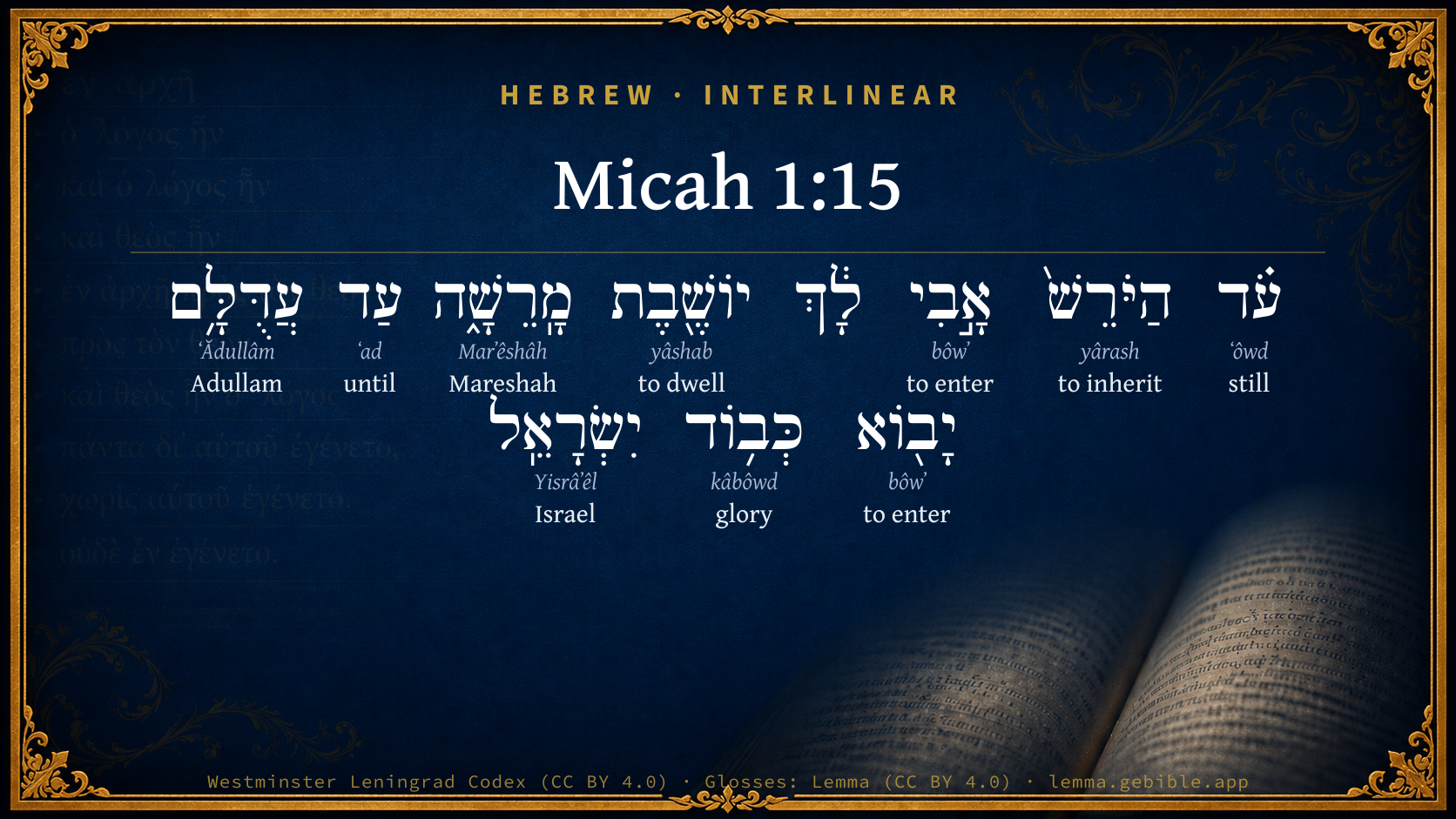
Hebrew (Westminster Leningrad Codex) Micah 1:15 appears in the Hebrew Old Testament. The text above is from the Westminster Leningrad Codex. Each word links to its Strong’s number, a concise gloss, and parsing drawn from the Open Scriptures Hebrew Bible morphology. Click any word for its full Brown-Driver-Briggs (BDB) entry.
Download image
Cite this verse

Micah 1:15 (World English Bible). Public Domain. Lemma interlinear Bible study tool, https://lemma.gebible.app/v/micah/1/15.

Show BibTeX & RIS
BibTeX
RIS
English Translation
I will yet bring to you, inhabitant of Mareshah, He who is the glory of Israel will come to Adullam.
World English Bible · Public Domain
Download a study sheet

One document with this verse’s original text, its word-by-word gloss line, the meaning frame, cross-references with their text, attributed commentary, and full source and license credits — printable, and it pastes into notes with its structure intact.

This verse Autodidact and up

Study sheet (.html) Plain text (.txt)

A passage Seminary Student

Up to 50 verses in one chapter. A passage sheet keeps up to 6 commentary sources and 12 cross-references per verse, in the order this page ranks them, and says so on the sheet whenever that leaves anything out. Ask for a single verse and you get the Autodidact verse sheet above.

Everything on this page stays free to read, with no account — the sheet is a download of what is already on screen, not access to it.

Want to remove ads? Support Godless Engineer
Compare translations 3

The same verse in 3 English versions, stacked beneath the original-language interlinear above. Click any original word for its lexicon entry.

Each is an independent rendering of the whole verse — the interlinear is not word-aligned to these translations.

Highlighted words mark where these versions differ — a whole-verse word diff, not a word-by-word alignment.

  • World English Bible Public Domain
    I will yet bring to you, inhabitant of Mareshah, He who is the glory of Israel will come to Adullam.
  • King James Version Public Domain
    Yet will I bring an heir unto thee, O inhabitant of Mareshah: he shall come unto Adullam the glory of Israel.
  • unfoldingWord Literal Text CC BY-SA 4.0
    Also a possessor I will bring to you, dweller of Mareshah. The glory of Israel will come to Adullam.

unfoldingWord Literal Text — © unfoldingWord, licensed CC BY-SA 4.0. Word-aligned USFM3 via Door43 (git.door43.org/unfoldingWord/en_ult).

Versions to compare (up to 4)

3 of 4 selected

Show all 18 translations

Every available English version of this verse, each an independent rendering of the whole verse.

  • World English Bible Public Domain
    I will yet bring to you, inhabitant of Mareshah, He who is the glory of Israel will come to Adullam.
  • Berean Standard Bible Public Domain
    I will again bring a conqueror against you, O dweller of Mareshah. The glory of Israel will come to Adullam.
  • Majority Standard Bible Public Domain
    I will again bring a conqueror against you, O dweller of Mareshah. The glory of Israel will come to Adullam.
  • King James Version Public Domain
    Yet will I bring an heir unto thee, O inhabitant of Mareshah: he shall come unto Adullam the glory of Israel.
  • American Standard Version (1901) Public Domain
    I will yet bring unto thee, O inhabitant of Mareshah, him that shall possess thee: the glory of Israel shall come even unto Adullam.
  • Revised Version (1885) Public Domain
    I will yet bring unto thee, O inhabitant of Mareshah, him that shall possess thee: the glory of Israel shall come even unto Adullam.
  • Geneva Bible (1599) Public Domain
    Yet will I bring an heire vnto thee, O inhabitant of Mareshah, he shall come vnto Adullam, the glorie of Israel.
  • Douay-Rheims (1899) Public Domain
    Yet will I bring an heir to thee that dwellest in Maresa: even to Odollam shall the glory of Israel come.
  • Young's Literal Translation Public Domain
    Yet the possessor I do bring in to thee, O inhabitant of Mareshah, To Adullam come in doth the honour of Israel.
  • Literal Standard Version CC BY-SA 4.0
    Yet I bring the possessor to you, O inhabitant of Mareshah, || The glory of Israel comes to Adullam.
  • Unlocked Literal Bible CC BY-SA 4.0
    I will again bring a conqueror to you, inhabitants of Mareshah; the splendor of Israel will come to Adullam.
  • unfoldingWord Literal Text CC BY-SA 4.0
    Also a possessor I will bring to you, dweller of Mareshah. The glory of Israel will come to Adullam.
  • Darby Bible Public Domain
    I will yet bring unto thee an heir, O inhabitress of Mareshah; the glory of Israel shall come even unto Adullam.
  • World Messianic Bible Public Domain
    I will yet bring a conqueror to you, inhabitants of Mareshah. The glory of Israel will come to Adullam.
  • Webster's Bible Public Domain
    Yet will I bring an heir to thee, O inhabitant of Mareshah: he shall come to Adullam the glory of Israel.
  • Free Bible Version CC BY-SA 4.0
    I will bring a conqueror to attack you, people of Moresheth. The leaders of Israel will go to Adullam.
  • Bible in Basic English Public Domain
    Even now will the taker of your heritage come to you, you who are living in Mareshah: the glory of Israel will come to destruction for ever.
  • JPS Tanakh (1917) Public Domain
    I will yet bring unto thee, O inhabitant of Mareshah, him that shall possess thee; the glory of Israel shall come even unto Adullam.

Literal Standard Version (2020), Covenant Press — licensed CC BY-SA 4.0. Text via the HelloAO Bible API (eBible.org). Unlocked Literal Bible (unfoldingWord) — licensed CC BY-SA 4.0. Text via the HelloAO Bible API (eBible.org). unfoldingWord Literal Text — © unfoldingWord, licensed CC BY-SA 4.0. Word-aligned USFM3 via Door43 (git.door43.org/unfoldingWord/en_ult). Free Bible Version, Dr. Jonathan Gallagher — licensed CC BY-SA 4.0. Text via the HelloAO Bible API (eBible.org).

Word by word

More ways to search: Search by grammar → Find every occurrence → Compare this word →

Practice this passage: Drill this verse → Learn its vocabulary →

About this verse

These counts appear in no published source. They are computed here, from the morphology-tagged text and Lemma’s own curated glosses. What Lemma adds →

11
words
9
distinct lemmas
Prophets
section

Notable vocabulary

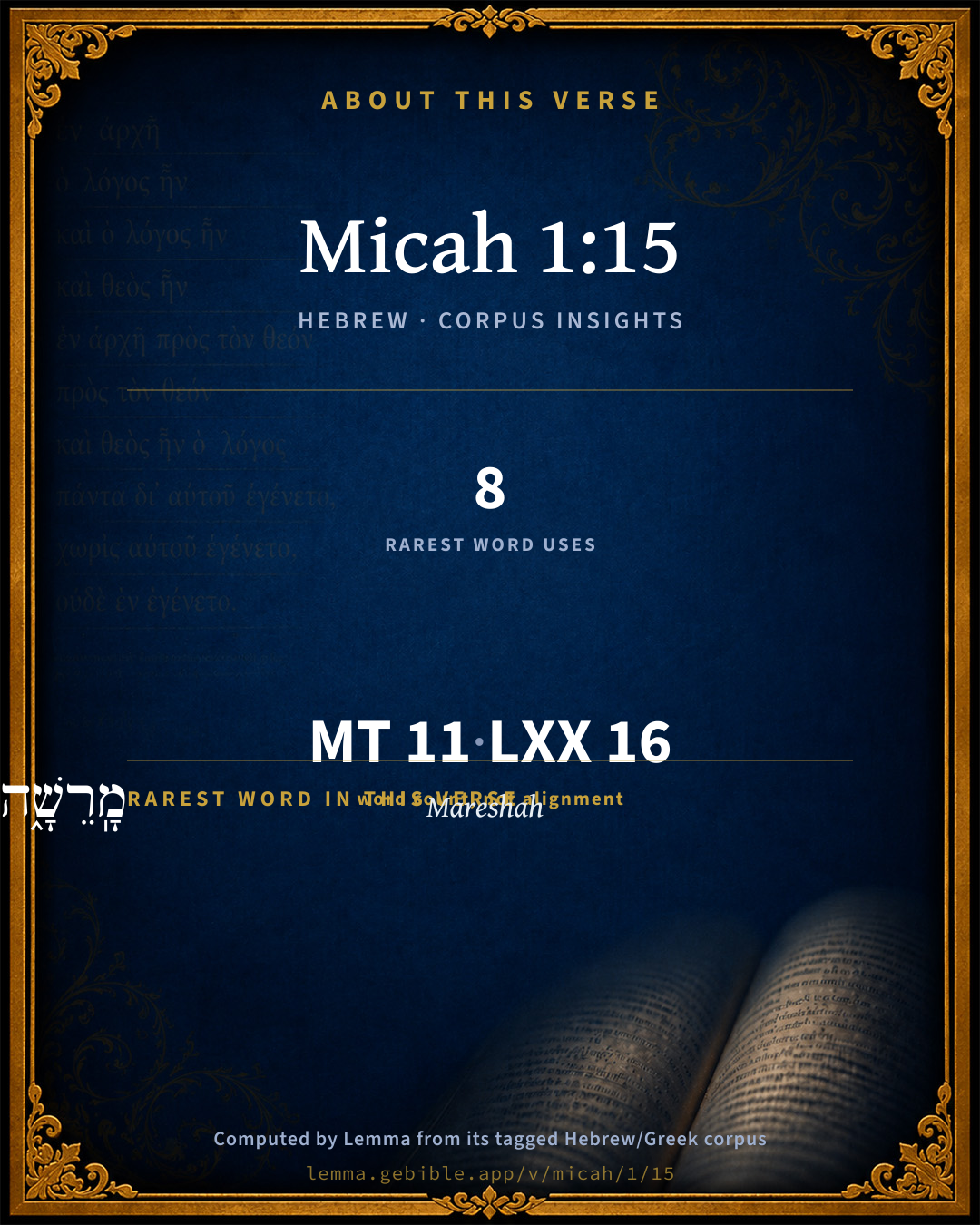
The rarest word here is מָֽרֵשָׁ֑ה Mareshah H4762 — appearing just 8 times in the whole Hebrew Bible.

Shared distinctive vocabulary

מָֽרֵשָׁ֑ה Mareshah H4762 occurs in 8 verses of the Hebrew Bible. Also found in:

Grammatical profile

  • 4 verbs
  • 4 nouns
  • 2 prepositions
  • 1 adverb

Verb forms

  • הַיֹּרֵשׁ֙ Qal · Participle Active
  • אָ֣בִי Hiphil · Imperfect
  • יוֹשֶׁ֖בֶת Qal · Participle Active
  • יָב֖וֹא Qal · Imperfect

Repetition

A word recurs within this verse — often emphatic in Hebrew:

  • אָ֣בִי to enter H935 ×2

Hebrew & Septuagint length

In English translation the verse runs 20 words from the Hebrew and 23 from the Septuagint (LXX English) — closely comparable.

A rough comparison of the two English renderings, which tokenize alike — not a word-level alignment.

Word counts can differ between the Hebrew and the Greek without any difference in meaning — e.g. the Hebrew direct-object marker אֵת has no separate Greek word, and Greek often adds the article ὁ.

In the original languages it is 11 Hebrew tokens and 16 Greek tokens — but the two are counted differently (Hebrew bundles its prefixes and suffixes into one token; the Greek is in lemma form), so that isn’t a like-for-like length.

Cross-references

9

Topical passages linked to Micah 1:15 in the Treasury of Scripture Knowledge — connected by theme and wording, ordered by reader-vote popularity; previews shown in the World English Bible.

  • Joshua 15:44 and Keilah, and Achzib, and Mareshah; nine cities with their villages.
  • 1 Samuel 22:1 David therefore departed there, and escaped to the cave of Adullam: and when his brothers and all his father's house heard it, they went down there to him.
  • Joshua 15:35 Jarmuth, and Adullam, Socoh, and Azekah,
  • Joshua 12:15 the king of Libnah, one; the king of Adullam, one;
  • 2 Chronicles 11:7 Beth Zur, and Soco, and Adullam,
  • Isaiah 7:17–25 Yahweh will bring on you, on your people, and on your father's house, days that have not come, from the day that Ephraim departed from Judah; even the king of Assyria.
  • Isaiah 10:3 What will you do in the day of visitation, and in the desolation which shall come from far? to whom will you flee for help? and where will you leave your glory?
  • Isaiah 10:5–6 Ho Assyrian, the rod of my anger, the staff in whose hand is my indignation!
  • Jeremiah 49:1 Of the children of Ammon. Thus says Yahweh: Has Israel no sons? has he no heir? why then does Malcam possess Gad, and his people well in the cities of it?

Cross-references courtesy of OpenBible.info (CC BY 4.0).

Hebrew and Greek witnesses Masoretic Hebrew ↔ Greek Septuagint

The same verse in the two great witnesses to the Old Testament, shown verse-for-verse.

These are two independent witnesses, not word-aligned to each other, and the Septuagint is shown in lemma (dictionary) form.

Hebrew Micah 1:15 Masoretic · Westminster Leningrad Codex

עֹ֗ד הַיֹּרֵשׁ֙ אָ֣בִי לָ֔ךְ יוֹשֶׁ֖בֶת מָֽרֵשָׁ֑ה עַד עֲדֻּלָּ֥ם יָב֖וֹא כְּב֥וֹד יִשְׂרָאֵֽל

I will yet bring to you, inhabitant of Mareshah, He who is the glory of Israel will come to Adullam.

World English Bible · Public Domain

Greek LXX Micah 1:15 Septuagint · lemma form

ἕως ὁ κληρονόμος ἄγω σύ καταοἰκέω λαχις κληρονομία ἕως οδολλαμ ἥκω ὁ δόξα ὁ θυγάτηρ ἰσραήλ

until they bring the heirs, O inhabitant of Lachis: the inheritance shall reach to Odollam, even the glory of the daughter of Israel.

LXX2012 (modern English Septuagint) · Public Domain

On this verse, The Pulpit Commentary discusses the Septuagint’s reading. Read the note in Commentary ↓

Hebrew: Westminster Leningrad Codex (CC BY 4.0). Greek: Septuagint (public domain); English from LXX2012 (modern English Septuagint) (Public Domain). How the Septuagint differs from the Hebrew →

Targum (Aramaic paraphrase)

1

The Targum is the ancient Jewish Aramaic paraphrase of the Hebrew Scriptures — an interpretive translation, not the Hebrew text itself. Onkelos (literal) and Pseudo-Jonathan (expansive) render the Torah, and Jonathan the Prophets. Coverage is partial: where no permissively-licensed English translation exists for a verse, only the Aramaic is shown. This is verse-level text, not a word-by-word alignment to the Hebrew.

  1. Targum Jonathan Prophets (Joshua–Malachi)
    עוֹד מַחְסְנִין אַיְתֵי עֲלֵיכוֹן דְיַתְבִין בְּמָרֵשָׁה עַד עֲדֻלָם יִסְקוּן וְיַעֲלוּן בִּתְחוּם אַרְעָא דְיִשְׂרָאֵל:

    (no public-domain English translation for this verse)

    Targum Jonathan — Aramaic: “Mikraot Gedolot” (public domain). English: “Sefaria Community Translation” (CC0 1.0 (public-domain dedication)); “London "Chaldee Paraphrase," 1871” (public domain). Text via Sefaria.

Commentary

Notes on Micah 1:15 from classic Christian and Jewish commentators (each source and its license shown beneath its notes). The classic Christian expositions comment on the surrounding passage and are grouped to its opening verse, so a note may address several verses; the Jewish commentaries on the Tanakh (Rashi and others) are per-verse, so they appear only where the commentator wrote on this verse.

Lemma curates 59 commentaries, every one of them public domain or Creative Commons licensed, each selected and text-cleaned for this edition rather than reprinted as found. About our sources →

Trapp's Complete Commentary

John Trapp

Mic 1:15 Yet will I bring an heir unto thee, O inhabitant of Mareshah: he shall come unto Adullam the glory of Israel.

Ver. 15. Yet will I bring an heir unto thee] Or, a possessor, who shall lay claim to thee, as by right of inheritance. This heir was the Assyrian, and those colonies brought by him into the cities of Israel, 2Ki 17:34. These took upon them as heirs and owners of the country, till turned out afterwards by Josiah, King of Judah, 2Ki 23:4; 2Ki 23:8. Here is another elegant allusion, as this chapter is full of them, for Mareshah signifieth an inheritance or possession. And if it were Micah’s own country, as many think, we may see the prophet’s integrity in not bearing with his best friends; but taking the same liberty to tell them of their sins and dangers that they did to commit the one and to incur the other. "Physician, heal thyself," said they to our Saviour, Luk 4:23, that is, thine own country, as it is there explained.

He shall come unto Adullam, the glory of Israel] Haply so called, because David was once there hidden and housed, and the place thereby renowned. Or, because it was a stronghold, wherein Israel gloried and trusted, but in vain, since the enemies should come to it, and surprise it. Some think poor Adullam is called "the glory of Israel" ironically, and by way of scorn. Some read it thus, O glory of Israel (to wit, then lost and overthrown); and they make it to be a deep sigh of the prophet, sent from the bottom of his heart; whereby he witnesseth that he is greatly sorry for the ruin of the Israelites; that he might move them also to mourn in like manner. This he further presseth them to in the next words.

John Trapp, A Commentary or Exposition upon All the Books of the Old and New Testament (1647–1656) — public domain. Text from a community e-Sword module.

Whedon's Commentary on the Bible

Daniel D. Whedon

Mic_1:15 contains the last play upon words, Mareshah and Yoresh, “the possessor,” translated in A.V. “heir,” in R.V. “him that shall possess.”

Mareshah — Jos_15:44, implies that this place is located near Achzib; it is generally identified with a ruin Merash, one mile south of Beit-Jibrin. The Israelites took the city from the Canaanites, but they will be displaced by a new possessor sent by Jehovah.

Adullam — The reference is to the “cave of Adullam,” where David hid himself (1Sa_22:1 ff.). In that out-of-the-way place the “glory,” that is, the nobility (Isa_5:13-14), will be compelled to seek refuge, or, the wealth and possessions must be hidden, because the rest of the land is overrun by the enemy. Adullam was in the lowland of Judah (Jos_15:35), but its exact location is uncertain, though it has been identified with several modern ruins. Clermont-Ganneau identified it with the modern Aid-el-ma, a steep hill covered with ruins, about three miles southeast of Soco and about eight miles northeast of Mareshah. The suggestion has been made to separate the original for Adullam into two words and, with changed vocalization, to translate “forever”; the whole sentence, “the glory of Israel shall set forever.” Elhorst thinks that in the text of 15b, which he considers corrupt, another play upon words is hidden; he restores it and translates, “The inhabitants of Adullam shall go under the yoke,” that is, into exile.

The above interpretation of 8-15 is based, with few exceptions, upon the present Hebrew text. It must be admitted, however, that in several instances the uncertainty is very great, and many modern scholars treat the Hebrew text with much greater freedom.

With Mic_1:16 the prophet’s lament closes. Judah, conceived as a mother, is urged to mourn for her children, because they are doomed to exile.

Delicate — R.V., “of thy delight”; they are very dear to Judah.

Baldness — Artificial baldness was a symbol of mourning (Amo_8:10; Isa_3:24); in Lev_19:27-28; Deu_14:1, it is prohibited, probably on account of its heathen associations. The appeal is repeated, in slightly different language, three times for the sake of emphasis.

Eagle — Better, R.V. margin, “vulture.” Baldness is not a mark of the eagle, but it is of the vulture. The prophet probably has in mind the carrion vulture, common in Egypt and in Palestine, the front part of whose head is entirely bald, while the back part has only a thin covering.

Daniel D. Whedon (gen. ed.), Commentary on the Old and New Testaments (1874–1909) — public domain. Text from a community e-Sword module.

Tyndale Open Study Notes

Tyndale Open Resources

1:15 the leaders (literally the glory): The leaders of Israel should have been Israel’s “glory” by setting examples of moral excellence and wise, caring leadership. Instead, God’s shepherds corrupted their nation. • Adullam was destroyed by Assyria in 701 BC.

Tyndale Open Study Notes — © Tyndale Open Resources, licensed CC BY-SA 4.0. Text via the HelloAO Bible API.

Geneva Bible (1599)

Geneva Bible translators

For so they thought themselves for the strength of their city.

He prophesieth against his own city: and because it signified an heritage, he saith that God would send an heir to possess it.

Geneva Bible (1599) marginal notes — public domain. Text via Bolls.life.

Jamieson, Fausset & Brown

Robert Jamieson, A. R. Fausset & David Brown

Yet will I bring an heir unto thee--rather, "the heir." As thou art now occupied by possessors who expelled the former inhabitants, so will I bring "yet" again the new possessor, namely, the Assyrian foe. Other heirs will supplant us in every inheritance but that of heaven. There is a play upon the meaning of Mareshah, "an inheritance": there shall come the new heir of the inheritance.

Adullam the glory of Israel--so called as being superior in situation; when it and the neighboring cities fell, Israel's glory was gone. MAURER, as the Margin, translates, "the glory of Israel" (her chief citizens: answering to "thy delicate children," Mic 1:16) "shall come in flight to Adullam." English Version better preserves the parallelism, "the heir" in the first clause answering to "he" in the second.

Jamieson, Fausset & Brown — Commentary Critical and Explanatory on the Whole Bible (1871) — public domain (CC PDM 1.0). Text via the HelloAO Bible API.

Adam Clarke's Commentary

Verse 15. Yet will I bring an heir unto thee, O - Mareshah] Here is another instance, הירש haigeresh, to bring an heir, and מרשה mareshah, the city, the name of which signifies heirship. And so of the above proper names.

Adullam the glory of Israel.] This was a fenced city in the south of Judah (see 2Ch 11:7) towards the Dead Sea.

There is much obscurity in the concluding verses of this chapter. They undoubtedly refer to the captivity of Israel, and to circumstances of distress, &c., which are not mentioned in any of the historical books, and therefore their reference and meaning can only be conjectured.

Adam Clarke's Commentary on the Bible (1810–1826) — public domain. Text from a community e-Sword/MySword module.

John Calvin's Commentaries

The Prophet here threatens his own birth place, as he had done other cities; for, as we have stated, he sprung from this city. He does not now spare his own kindred: for as God is no respecter of persons, so also God’s servants ought, as with closed eyes, to deal impartially with all, so as not to be turned here and there either by favor or by hatred, but to follows without any change, whatever the Lord commands them. We see that Micah was endued with this spirit, for he reproved his own kindred, as he had hitherto reproved others.

There is a peculiar meaning in the word, Mareshah, for it is derived from ירש, iresh, and it means possession. The Prophet now says, I will send to thee הורש, euresh, a possessor; the word is from the same root. But he means that the Morasthites would come into the power of their enemies no less than their neighbors, of whom he had spoken before. He says, to Adullam This was also a city in the tribe of Judah, as it is well known. But some would have “enemy” to be here understood and they put כבוד, cabud, in the genitive case: The enemy of the glory of Israel shall come to Adullam; but this is strained. Others understand the passage thus that the glory of Israel would come to disgrace; for Adullam, we know, was a cave. Since then it an obscure place, the Prophet here, as they think, declares that the whole glory of Israel would be covered with dishonor, because the dignity and wealth, in which they gloried would lose their pristine fixate, so that they would differ nothing from an ignoble cave. If any approve of this meaning, I will not oppose them. Yet others think that the Prophet speaks ironically and that the Assyrian is thus called because the whole glory and dignity of Israel would by him be taken away. But there is no need of confining this to enemies; we may then take a simpler view, and yet regard the expression as ironical, — that the glory, that is, the disgrace or the devastation of Israel, would come to Adullam. But what if we read it, in apposition, He shall come to Adullam, the glory of Israel? For Adullam was not obscure, as those interpreters imagine, whom I have mentioned, but it is named among the most celebrated cities after the return and restoration of the people. When, therefore, the whole country was laid waste, this city, with a few others, remained, as we read in the Nehemiah 11. It might then be, that the Prophet called Adullam the glory of Israel; for it was situated in a safe place, and the inhabitants thought that they were fortified by a strong defense, and thus were not open to the violence of enemies. This meaning also may be probable; but still, as the glory of Israel may be taken ironically for calamity or reproach if any one approves more of this interpretation, it may be followed. I am, however, inclined to another, — that the Prophet say, that the enemy would come to Adullam, which was the glory of Israel, because that city was as it were in the recesses of Judea, so that an access to it by enemies was difficult. It may be also that some may think, that the recollection of its ancient history is here revived; for David concealed himself in its cave, and had it as his fortress. The place no doubt had, from that time, attained some fame; then this celebrity, as I have said, may be alluded to, when Adullam is said to be the glory of Israel. It follows —

John Calvin's Commentaries (1540-1563) — public domain. Text from the Calvin Translation Society English edition (1840s-50s) via the Christian Classics Ethereal Library (ccel.org). Calvin's coverage is partial (roughly two-thirds of the Bible); uncommented books and verses are honest gaps, never fabricated. The 19th-century editor's footnotes and remarks are omitted so the notes are faithfully Calvin's own voice.

Ellicott's Commentary for English Readers

(15) Yet will I bring an heir.—Rather, the possessor, one who shall take it by force—i.e., Sennacherib.

Mareshah was a city in the plain of Judah, near the prophet’s native place, Moresheth-gath. It was fortified by Rehoboam, and became the scene of Asa’s victory over the immense host of Zerah the Ethiopian. Dr. Robinson is of opinion that after its destruction the town of Eleutheropolis was built out of its materials.

Adullam the glory of Israel.—Adullam, in the neighbourhood of Mareshah, was situated at the base of the hills, and gave its name to the famous cave in which David took refuge. Joshua mentions a king of Adullam in the list of those conquered by the Israelites. This, now the last refuge of the glory of Israel, shall be seized by the invader.

A Bible Commentary for English Readers, edited by Charles John Ellicott (1878–1897) — public domain. Text from a community e-Sword module.

The Cambridge Bible for Schools and Colleges

gen. ed. J. J. S. Perowne

15. Yet will I bring, &c.] Rather, Moreover unto thee will I bring him that shall possess thee (viz. Sargon and his Assyrians). ‘Mareshah’ was near Achzib (Jos_15:44). There is an allusion to its possible meaning of ‘possession.’

he shall come unto Adullam, &c.] Rather, the glory of Israel shall come even unto Adullam. The nobility of Israel are to take refuge in the cave which once harboured David and his band (1Sa_22:1-2). These limestone caverns are of great extent; some of them, says Dr Pusey, will hold thousands of men. A second meaning may be implied by a paronomasia, ‘The glory of Israel shall set for ever’ (as if Adullam meant ‘for ever,’ Hebr. ad olam). Adullam was a fortified town in the Shephélah, Jos_15:35.

The Cambridge Bible for Schools and Colleges (gen. ed. J. J. S. Perowne; Cambridge University Press, 1878–1918) — public domain. Text from a community e-Sword module.

John Gill's Exposition

Yet will I bring an heir unto thee, O inhabitant of Mareshah,.... Another city in the tribe of Judah, mentioned with Achzib in Jos 15:44; and by many thought to be the birth place of this prophet; and, if so, his faithfulness may be observed in declaring the whole counsel of God, though against his own fire place; and this must be an aggravation of the sin of the inhabitants of it, that they had such a prophet that arose from them, and they regarded him not. There is a beautiful allusion in the word "heir" to Mareshah (s), which signifies an "inheritance"; and here were an "heir" or heirs for it, as the Targum; not the Persians, as some in Aben Ezra, and in an Agadah mentioned by Jarchi, who descended from Elam the firstborn of Shem; and so had a right of inheritance, as those interpreters suppose; but the king of Assyria, who should invade the land, and seize upon this place among others, and possess it, as if it was his by right of inheritance, having obtained it by conquest: and this being by the permission and according to the will of God, he is said to be brought by him to it. Capellus thinks, on the contrary, that Hezekiah and his posterity are meant:

he shall come unto Adullam the glory of Israel; another city in the tribe of Judah, a royal one, Jos 15:35; said by Jerom to be in his time no small village, and to be about ten miles from Eleutheropolis; called the "glory of Israel", having been a royal city in Joshua's time, Jos 12:15; and a fenced city in the times of Rehoboam, Ch2 11:7; and Eusebius says it was a large town; and Jerom says it was not a small one in his time; though some think Jerusalem is meant, the metropolis of the nation, Israel being put for Judah, as in Mic 1:14; and to be read, "he that is the enemy and heir shall come to Adullam, yea, to the glory of Israel" (t); even to Jerusalem, the most glorious city in all the tribes; though others are of opinion that this is the character of the enemy or heir that should come thither, called so by way of contradiction, as coming to the reproach and disgrace of Israel; or, ironically, whom Israel before gloried in, when they had recourse to him for help. The margin of our Bible reads, "the glory of Israel shall come to Adullam"; that is, the great men, the princes and heads of the people, shall flee to the cave of Adullam (u), to hide them from the enemy, where David was hid from Saul; see Sa1 22:1. Burkius (w), a very late commentator, takes Adullam for an appellative, and with Hillerus (x) renders it, "the perpetuity of the yoke"; and the whole thus, "at the perpetuity of the yoke, the glory of Israel shall come"; that is, when all things shall seem to tend to this, that the yoke once laid on Israel by the Gentiles shall become perpetual, without any hope of deliverance, then shall come the Deliverer, that is, Jesus, the Glory of Israel; and, adds he, God forbid we should think of any other subject here; and so he interprets the "heir" in the preceding clause of the Messiah; and which is a sense far from being despicable.

(s) & (t) So Piscator, Juuius, Drusius. (u) "Ad Adullam veniet gloria Israelis", Cocceius. (w) He published Annotations on the twelve minor Prophets at Heilbronn, 1753, which he calls a Gnomon, written in imitation of Bengelius's Gnomon of the New Testament, whose son-in-law it seems he is, and by whom his work is prefaced. (x) Onomast. Sacr. p. 739.

John Gill's Exposition of the Whole Bible (1746–1763) — public domain (CC PDM 1.0). Text via the HelloAO Bible API.

Albert Barnes' Notes on the Bible

Yet will I bring an heir - (the heir, him whom God had appointed to be the heir, Sennacherib) unto thee, O inhabitant of Mareshah Mareshah, (as the original form of its name denotes, lay on the summit of a hill. “Its ruins only were still seen,” in the time of Eusebius and Jerome, “in the second mile from Eleutheropolis” (Onomasticon). : “Foundations still remain on the south-eastern part of the remarkable Tell, south of Beth-Jibrin.” Rehoboam fortified it also 2Ch 11:8. Zerah the Aethiopian had come to (2Ch 14:9 ff) it, probably to besiege it, when Asa met him, and God smote the AEthiopians before him, in the valley of Zephathah thereat. In the wars of the Maccabees, it was in the hands of the Edomites . Its capture and that of Adora are mentioned as the last act of the war, before the Edomites submitted to John Hyrcanus, and were incorporated in Israel. It was a powerful city , when the Parthians took it. As Micah writes the name, it looked nearer to the word “inheritance.” Mareshah (inheritance) shall yet have the heir of God’s appointment, the enemy. It shall not inherit the land, as promised to the faithful, but shall itself be inherited, its people dispossessed. While it, (and so also the soul now) held fast to God, they were the heritage of the Lord, by His gifts and grace; when, of their own free-will, those, once God’s heritage, become slaves of sin, they passed and still pass, against their will, into the possession of another master, the Assyrian or Satan.

He (that is, the heir, the enemy) shall come unto Adullam, the glory of Israel - . that is, he who shall dispossess Mareshah, shall come quite unto Adullam, where, as in a place of safety, the glory of Israel, all in which she gloried, should be laid up. Adullum was a very ancient city, being mentioned in the history of the patriarch Judah Gen 38:1, Gen 38:12, Gen 38:20, a royal city Jos 12:15. It too lay in the Shephelah Jos 15:35; it was said to be 10 (Eusebius) or 12 (Jerome) miles East of Eleutheropolis; but for this, there seems to be scarcely place in the Shephelah. It was one of the 15 cities fortified by Rehoboam 2Ch 11:7; one of the 16 towns, in which (with their dependent villages) Judah settled after the captivity Neh 11:30. It contained the whole army of Judas Maccabaeus (1 Macc. 12:38).

Like Lachish, it had probably the double advantages of the neighborhood of the hills and of the plain, seated perhaps at the roots of the hills, since near it doubtless was the large cave of Adullam named from it. The line of caves, fit for human habitation, which extended from Eleutheropolis to Petra , began westward of it. : “The valley which runs up from Eleutheropolis Eastward, is full of large caves; some would hold thousands of men. They are very extensive, and some of them had evidently been inhabited.” : “The outer chamber of one cavern was 270 feet long by 126 wide; and behind this were recesses and galleries, probably leading to other chambers which we could not explore. The massive roof was supported by misshaped pieces of the native limestone left for that purpose, and at some places was domed quite through to the surface, admitting both light and air by the roof.” The name of Adullam suggested the memory of that cave, the refuge of the Patriarch David, the first of their line of kings, in extreme isolation and peril of his life. There, the refuge now of the remaining glory of Israel, its wealth, its trust, its boast - the foe should come. And so there only remained one common dirge for all.

Albert Barnes' Notes on the Bible (1834–1885) — public domain. Text from a community e-Sword/MySword module.

Haydock's Catholic Bible Commentary

Heir. Maresa (which was the name of a city of Juda) signifies inheritance: but here God by his prophet tells the Jews, that he will bring them an heir to take possession of their inheritance: and that the glory of Israel shall be obliged to give place, and to retire even to Odollam, a city in the extremity of their dominions. And therefore he exhorts them to penance in the following verse. (Challoner) --- Maresa shall fall a prey to the king of Assyria. Micheas was a native of this town, and he ironically addresses his countrymen. (Calmet) --- Glory. Thus he denotes "the misery" of Israel, which shall be extended to the last town in Juda. (Worthington) --- Hebrew means also "burden." Odolla was taken by Sennacherib, (Calmet) with the other towns around Jerusalem. (Haydock)

George Leo Haydock (1774–1849), Haydock's Catholic Family Bible and Commentary, 1859 edition — public domain. Excludes Psalms (Douay-Rheims chapter numbering differs from Protestant) and Deuterocanonical books (Catholic canon only).

Matthew Poole's English Annotations

Yet will I bring; the Lord will cause the Assyrian to rise up and prosper in his wars, to the subduing and possessing of the cities of Israel and the Philistines.

An heir; the Assyrian, who in the right of conquest shall possess, and account himself heir of what he possesseth.

Mareshah; most think the prophet speaks of Mareshah in his own country, but I think the Assyrian did not inherit that, though he might inherit that of the Philistines.

Adullam; famous for its strength, say some; but I rather think it better known for the cave where David lay hid, 1Sa 22:1. It was made a town of defence by Rehoboam, 2Ch 11:7. It was once a royal city, and had several villages belonging to it, Jos 12:15.

The glory of Israel; ironically (say some) called thus, minatorily threatening that the glory of Israel should be brought as low, into as mean condition, as Adullam. Others think it should be read, and to the glory of Israel, that is, Jerusalem; so there should be an ellipsis of (וצד) the particle conjunctive. Others think it is the prophet’s deep sigh at the thoughts how the glory of Israel is laid in the dust. Others think it was then considerable enough at that time to be called the glory of Israel, though we know not how.

Matthew Poole's English Annotations on the Holy Bible (1683–1685) — public domain. Text from a community e-Sword/MySword module.

The Pulpit Commentary

Yet will I bring an heir unto thee, O inhabitant of Mareshah. "Mareshah" sounds like Morashah, the Hebrew word for "inheritance;" so the play is, "I will bring an inheritor who shall claim your Heritage town." The "heir" is the Assyrian king, Sargon, into whose possession the city shall pass. Mareshah (Jos_15:44 2Ch_14:9) was near Achzib, one mile southcast of Beit Jibrin, and is now called Mer"ash. He shall come, etc.; better, the glory of Israel shall come to Adullam; i.e. the nobility (comp. Isa_5:13) of Israel shall fly for refuge to such places as the cave of Adullam, David"s asylum. (1Sa_22:1, 1Sa_22:2) So the Vulgate. The LXX has, Klhronomia ewv Odullaxa thv yugatrol . "The inheritance shall come to Odullam, even the glory of the daughter of Israel." But Rosenmuller, Henderson, Pusey, and others take the sentence as in the Authorized Version, making "the glory of Israel" in apposition with "Adullam," and understanding by "he" the heir or enemy. One knows no reason why Aduliam should be honoured with the above-named title; so the rendering given above is preferable. There is probably a paronomasia intended, "The glory of the Lord shall set (ad olam) forever." The city of Adullam, hod. Aid-el-Mah, lay in the valley of Elah, ten miles northwest of Hebron, halfway between Sochoh and Keilah. It was of great antiquity, being mentioned as the birthplace of Hirah, the friend of Judah, (Gen_38:12) and one of the cities fortified by Rehoboam. (2Ch_11:7) In its neighbourhood is the celebrated cave, Mugha et Khureitun, which is pointed out as the traditional hold of David, and which has been carefully explored by Mr. Tyrwhitt Drake, of the Palestine Exploration Fund (see Thomson, "Land and the Book," pp. 332, etc.).

The Pulpit Commentary (1880–1919), ed. H.D.M. Spence-Jones & Joseph S. Exell — public domain. Text from a community e-Sword module.

John Wesley's Explanatory Notes

An heir - The Assyrian, who in the right of conquest shall possess thee. Mareshah - A town of the Philistines. Adullam - Perhaps this city was considerable enough at that time, to be the glory of Israel.

John Wesley, Explanatory Notes Upon the Whole Bible (1754–1765) — public domain. Text via the GEBible commentary corpus.

unfoldingWord translationNotes

Door43 World Missions Community

I will again bring

Here "I" refers to Yahweh.

Mareshah

You may want to make a footnote saying, "The name of this village sounds like the Hebrew word for 'conqueror.'" (See: How to Translate Names)

Adullam

This is the name of a royal city in Philistia. (See: How to Translate Names)

Shave your head and cut off your hair

Israelites who were mourning would shave bald spots on their heads. Possible meanings are 1) "Shave larger spots than usual on your heads" or 2) "Cut off all your hair and shave your heads," stating the events in the order in which they were to occur. (See: Symbolic Action)

eagles

This word can also be translated "vultures."

translationWords

Israel

children

eagle

exile

unfoldingWord translationNotes — © Distant Shores Media and the Door43 World Missions Community, licensed CC BY-SA 4.0. Source: git.door43.org/Door43/en_tn.

Rashi

Rabbi Shlomo Yitzchaki (Rashi)

I will yet bring the possessor to you—The enemies, who will possess you, you who dwell in Mareshah. The possessor (הַיוֹרֵש) to Mareshah (מָרֵשָה) -another play on words.

up to Adullam—(which is within the border) will the glory of Israel retreat and come, for the enemies shall conquer from their border up to Adullam. So did Jonathan render: Until Adullam shall they go up and enter the border of the land of Israel. And I heard a Midrash Aggadah in the name of Rabbi Menachem: I will yet bring the heir—The children of Elam were fit to inherit the land of Israel - for he [Elam] was the firstborn of the sons of Shem - but because of love for your forefathers I transferred it to the children of Arphachshad. Now I will bring the Chaldeans and the Elamites upon them.

Rashi on the Tanakh — English translations: “The Judaica Press complete Tanach with Rashi, translated by A. J. Rosenberg” (CC BY 4.0); “Pentateuch with Rashi's commentary by M. Rosenbaum and A.M. Silbermann, 1929-1934” (public domain); “The Metsudah Tanach series, Lakewood, N.J” (CC BY 4.0); and “The Book of Joshua, Metsudah Publications, 1997” (CC BY 4.0). Text via Sefaria.

Lesson kit

Teaching starters — assembled from the data on this page, not authored interpretation. Every prompt links to the verse data it draws on. Edit before teaching.

Micah, in the Prophets, opens this verse with 11 words (9 distinct Hebrew lemmas). Its most distinctive word is Marʼêshâh (“Mareshah”). A historical commentator’s framing appears above. Read the whole chapter for the surrounding context.

Discussion questions

  1. What does “Mareshah” (Marʼêshâh) contribute to the verse as a whole?
  2. How does Joshua 15:44, which shares the word «Mareshah», read alongside this verse?
  3. What does the repetition of “to enter” (2× in this one verse) do in this verse?
  4. The translations on this page render this verse differently — a whole-verse word diff, not a word-by-word alignment. What might account for the different wordings?
  5. «הַיֹּרֵשׁ֙» is a Qal Participle Active verb. How does that grammatical form shape the action described?
  6. Compare how Trapp's Complete Commentary and Whedon's Commentary on the Bible read this verse. Where do they agree or differ?

Things to notice

Reading settings

Reading text

Shown beneath each verse's original-language words.

Old Testament
Old Testament edition

Read the OT as the Masoretic Hebrew (MT) or the Greek Septuagint (LXX).

English shown for the Greek Septuagint (in the Hebrew ↔ Greek comparison).

Comparing translations? Open the Compare panel on any verse page to stack up to four side by side.