
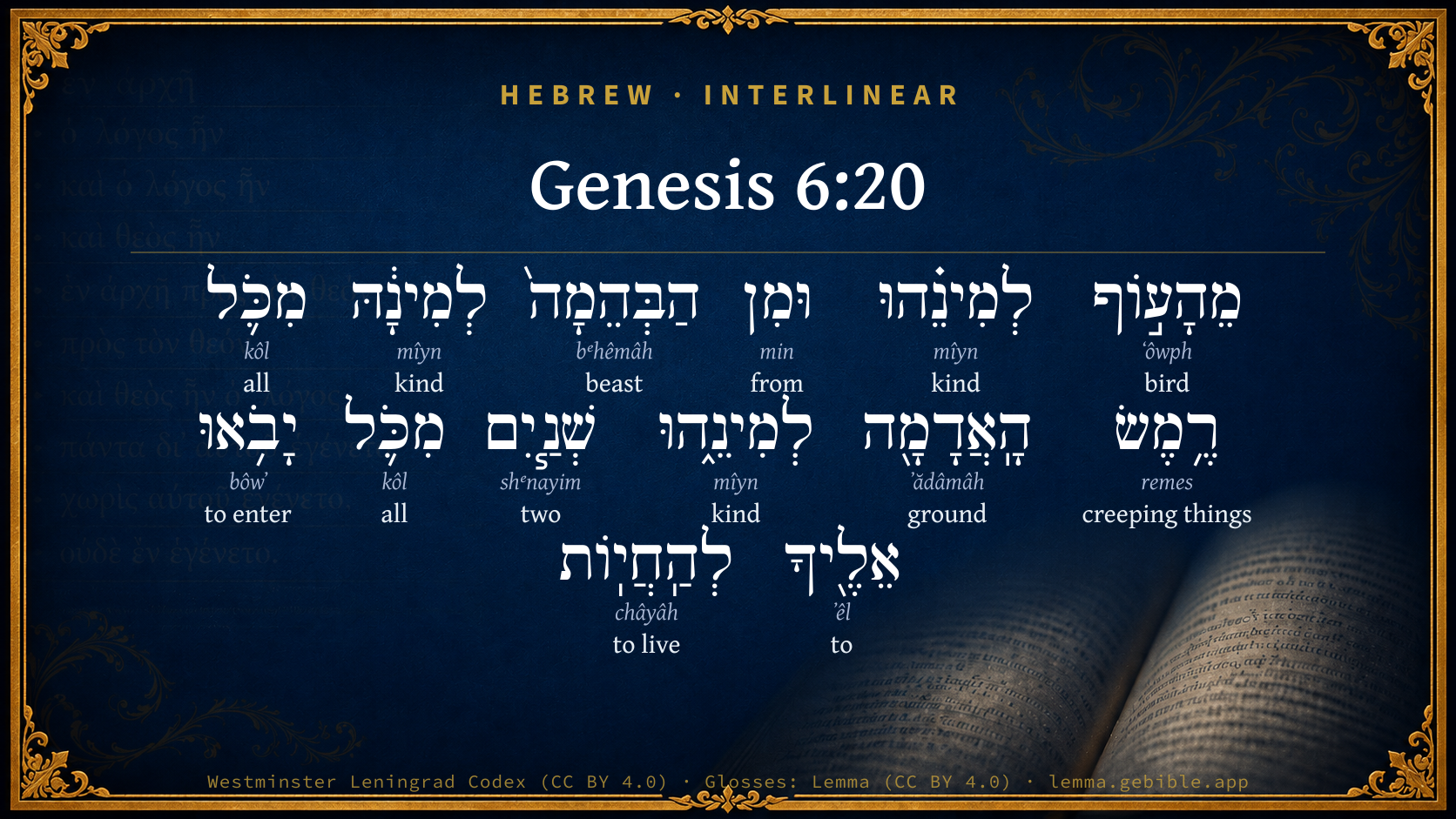
Genesis 6:20

Hebrew (Westminster Leningrad Codex) Genesis 6:20 appears in the Hebrew Old Testament. The text above is from the Westminster Leningrad Codex. Each word links to its Strong’s number, a concise gloss, and parsing drawn from the Open Scriptures Hebrew Bible morphology. Click any word for its full Brown-Driver-Briggs (BDB) entry.
Download image
Cite this verse

Genesis 6:20 (World English Bible). Public Domain. Lemma interlinear Bible study tool, https://lemma.gebible.app/v/genesis/6/20.

Show BibTeX & RIS
BibTeX
RIS
English Translation
Of the birds after their kind, of the cattle after their kind, of every creeping thing of the ground after its kind, two of every sort shall come to you, to keep them alive.
World English Bible · Public Domain
Download a study sheet

One document with this verse’s original text, its word-by-word gloss line, the meaning frame, cross-references with their text, attributed commentary, and full source and license credits — printable, and it pastes into notes with its structure intact.

This verse Autodidact and up

Study sheet (.html) Plain text (.txt)

A passage Seminary Student

Up to 50 verses in one chapter. A passage sheet keeps up to 6 commentary sources and 12 cross-references per verse, in the order this page ranks them, and says so on the sheet whenever that leaves anything out. Ask for a single verse and you get the Autodidact verse sheet above.

Everything on this page stays free to read, with no account — the sheet is a download of what is already on screen, not access to it.

Want to remove ads? Support Godless Engineer
Compare translations 3

The same verse in 3 English versions, stacked beneath the original-language interlinear above. Click any original word for its lexicon entry.

Each is an independent rendering of the whole verse — the interlinear is not word-aligned to these translations.

Highlighted words mark where these versions differ — a whole-verse word diff, not a word-by-word alignment.

  • World English Bible Public Domain
    Of the birds after their kind, of the cattle after their kind, of every creeping thing of the ground after its kind, two of every sort shall come to you, to keep them alive.
  • King James Version Public Domain
    Of fowls after their kind, and of cattle after their kind, of every creeping thing of the earth after his kind, two of every sort shall come unto thee, to keep them alive.
  • unfoldingWord Literal Text CC BY-SA 4.0
    From the birds according to their kinds, and from the animals according to their kinds, from every moving creature of the ground according to its kind, two from every will come to you to keep alive.

unfoldingWord Literal Text — © unfoldingWord, licensed CC BY-SA 4.0. Word-aligned USFM3 via Door43 (git.door43.org/unfoldingWord/en_ult).

Versions to compare (up to 4)

3 of 4 selected

Show all 18 translations

Every available English version of this verse, each an independent rendering of the whole verse.

  • World English Bible Public Domain
    Of the birds after their kind, of the cattle after their kind, of every creeping thing of the ground after its kind, two of every sort shall come to you, to keep them alive.
  • Berean Standard Bible Public Domain
    Two of every kind of bird and animal and crawling creature will come to you to be kept alive.
  • Majority Standard Bible Public Domain
    Two of every kind of bird and animal and crawling creature will come to you to be kept alive.
  • King James Version Public Domain
    Of fowls after their kind, and of cattle after their kind, of every creeping thing of the earth after his kind, two of every sort shall come unto thee, to keep them alive.
  • American Standard Version (1901) Public Domain
    Of the birds after their kind, and of the cattle after their kind, of every creeping thing of the ground after its kind, two of every sort shall come unto thee, to keep them alive.
  • Revised Version (1885) Public Domain
    Of the fowl after their kind, and of the cattle after their kind, of every creeping thing of the ground after its kind, two of every sort shall come unto thee, to keep them alive.
  • Geneva Bible (1599) Public Domain
    Of the foules, after their kinde, and of the cattell after their kind, of euery creeping thing of the earth after his kinde, two of euery sort shall come vnto thee, that thou mayest keepe them aliue.
  • Douay-Rheims (1899) Public Domain
    Of fowls according to their kind, and of beasts in their kind, and of every thing that creepeth on earth according to its kind; two of every sort shall go in with thee, that they may live.
  • Young's Literal Translation Public Domain
    Of the fowl after its kind, and of the cattle after their kind, of every creeping thing of the ground after its kind, two of every `sort' they come in unto thee, to keep alive.
  • Literal Standard Version CC BY-SA 4.0
    From the bird after its kind, and from the livestock after its kind, [and] from every creeping thing of the ground after its kind, two of every [kind] they come to you, to keep alive.
  • Unlocked Literal Bible CC BY-SA 4.0
    Of the birds after their kind, and of the larger animals after their kind, of every creeping thing of the ground after its kind, two of every sort will come to you, to keep them alive.
  • unfoldingWord Literal Text CC BY-SA 4.0
    From the birds according to their kinds, and from the animals according to their kinds, from every moving creature of the ground according to its kind, two from every will come to you to keep alive.
  • Darby Bible Public Domain
    Of fowl after their kind, and of the cattle after their kind, of every creeping thing of the ground after its kind, two of each shall go in to thee, to keep [them] alive.
  • World Messianic Bible Public Domain
    Of the birds after their kind, of the livestock after their kind, of every creeping thing of the ground after its kind, two of every sort will come to you, to keep them alive.
  • Webster's Bible Public Domain
    Of fowls after their kind, and of cattle after their kind, of every creeping animal of the earth after its kind, two of every sort shall come to thee, to keep them alive.
  • Free Bible Version CC BY-SA 4.0
    The same applies to every kind of bird, livestock, and the creatures that run along the ground—a pair of every kind will come to you so they can be kept alive.
  • Bible in Basic English Public Domain
    Two of every sort of bird and cattle and of every sort of living thing which goes on the earth will you take with you to keep them from destruction.
  • JPS Tanakh (1917) Public Domain
    Of the fowl after their kind, and of the cattle after their kind, of every creeping thing of the ground after its kind, two of every sort shall come unto thee, to keep them alive.

Literal Standard Version (2020), Covenant Press — licensed CC BY-SA 4.0. Text via the HelloAO Bible API (eBible.org). Unlocked Literal Bible (unfoldingWord) — licensed CC BY-SA 4.0. Text via the HelloAO Bible API (eBible.org). unfoldingWord Literal Text — © unfoldingWord, licensed CC BY-SA 4.0. Word-aligned USFM3 via Door43 (git.door43.org/unfoldingWord/en_ult). Free Bible Version, Dr. Jonathan Gallagher — licensed CC BY-SA 4.0. Text via the HelloAO Bible API (eBible.org).

Word by word

More ways to search: Search by grammar → Find every occurrence → Compare this word →

Practice this passage: Drill this verse → Learn its vocabulary →

רֶ֥מֶשׂ
remes
H7431
“creeping things of”
Noun, Common, Masculine, Singular, Construct
Part of Speech
Noun
Type
Common
Gender
Masculine
Number
Singular
State
Construct
Full BDB Definition

Origin: from H7430

TWOT: 2177a

creeping things, moving things, creeping organism - creeping things - gliding things (of sea animals) - moving things (of all animals)
  1. מֵהָע֣וֹף ʻôwph H5775 “from · the · bird” Preposition + Particle, Definite Article + Noun, Common, Masculine, Singular, Absolute
  2. לְמִינֵ֗הוּ mîyn H4327 “to/for · kind · his” Preposition + Noun, Common, Masculine, Singular, Construct + Suffix, Personal, 3rd Person, Masculine, Singular
  3. וּמִן min H4480 “and · from” Conjunction + Preposition
  4. הַבְּהֵמָה֙ bᵉhêmâh H929 “the · beast” Particle, Definite Article + Noun, Common, Feminine, Singular, Absolute
  5. לְמִינָ֔הּ mîyn H4327 “to/for · kind · her” Preposition + Noun, Common, Masculine, Singular, Construct + Suffix, Personal, 3rd Person, Feminine, Singular
  6. מִכֹּ֛ל kôl H3605 “from · all of” Preposition + Noun, Common, Masculine, Singular, Construct
  7. הָֽאֲדָמָ֖ה ʼădâmâh H127 “the · ground” Particle, Definite Article + Noun, Common, Feminine, Singular, Absolute
  8. לְמִינֵ֑הוּ mîyn H4327 “to/for · kind · his” Preposition + Noun, Common, Masculine, Singular, Construct + Suffix, Personal, 3rd Person, Masculine, Singular
  9. שְׁנַ֧יִם shᵉnayim H8147 “two” Adjective, Cardinal number, Masculine, Dual, Absolute
  10. מִכֹּ֛ל kôl H3605 “from · all” Preposition + Noun, Common, Masculine, Singular, Absolute
  11. יָבֹ֥אוּ bôwʼ H935 “to enter” Verb, Qal, Imperfect, 3rd Person, Masculine, Plural
  12. אֵלֶ֖יךָ ʼêl H413 “to · you” Preposition + Suffix, Personal, 2nd Person, Masculine, Singular
  13. לְהַֽחֲיֽוֹת châyâh H2421 “to live” Preposition + Verb, Hiphil, Infinitive Construct

About this verse

These counts appear in no published source. They are computed here, from the morphology-tagged text and Lemma’s own curated glosses. What Lemma adds →

14
words
11
distinct lemmas
Pentateuch
section

Notable vocabulary

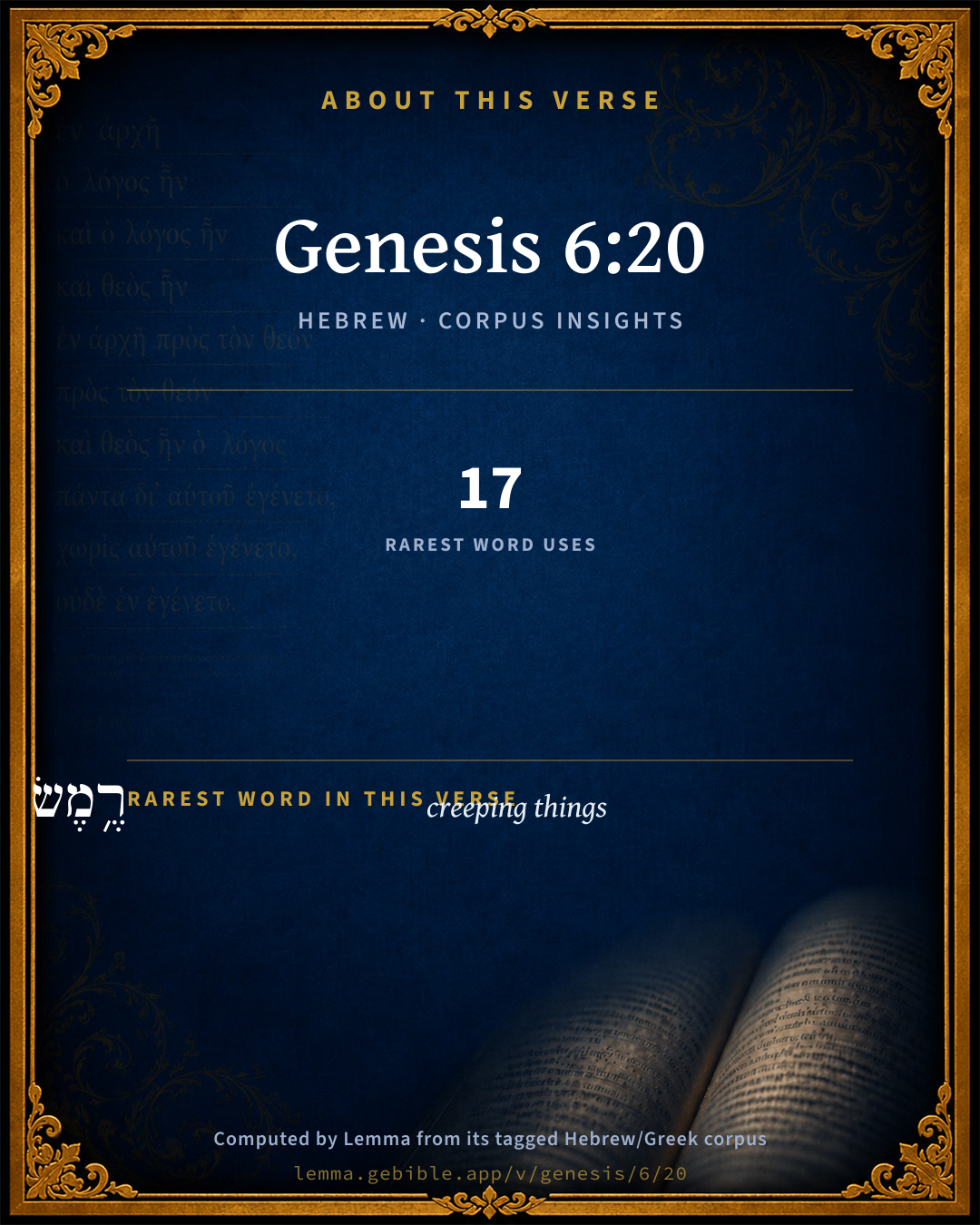
The rarest word here is רֶ֥מֶשׂ creeping things H7431 — appearing just 17 times in the whole Hebrew Bible.

Shared distinctive vocabulary

רֶ֥מֶשׂ creeping things H7431 occurs in 17 verses of the Hebrew Bible. Also found in:

Grammatical profile

  • 2 verbs
  • 9 nouns
  • 1 adjective
  • 2 prepositions

Verb forms

  • יָבֹ֥אוּ Qal · Imperfect
  • לְהַֽחֲיֽוֹת Hiphil · Infinitive Construct

Repetition

Words recur within this verse — often emphatic in Hebrew:

  • לְמִינֵ֗הוּ kind H4327 ×3
  • מִכֹּ֛ל all H3605 ×2

Hebrew & Septuagint length

In English translation the verse runs 34 words from the Hebrew and 41 from the Septuagint (LXX English) — closely comparable.

A rough comparison of the two English renderings, which tokenize alike — not a word-level alignment.

Word counts can differ between the Hebrew and the Greek without any difference in meaning — e.g. the Hebrew direct-object marker אֵת has no separate Greek word, and Greek often adds the article ὁ.

Cross-references

6

Topical passages linked to Genesis 6:20 in the Treasury of Scripture Knowledge — connected by theme and wording, ordered by reader-vote popularity; previews shown in the World English Bible.

  • Genesis 2:19 Out of the ground Yahweh God formed every animal of the field, and every bird of the sky, and brought them to the man to see what he would call them. Whatever the man called every living creature, that was its name.
  • Acts 10:11–12 He saw heaven opened and a certain container descending to him, like a great sheet let down by four corners on the earth,
  • Genesis 1:20–24 God said, "Let the waters swarm with swarms of living creatures, and let birds fly above the earth in the open expanse of sky."
  • Genesis 7:8–16 Clean animals, animals that are not clean, birds, and everything that creeps on the ground
  • John 5:40 Yet you will not come to me, that you may have life.
  • Genesis 1:28 God blessed them. God said to them, "Be fruitful, multiply, fill the earth, and subdue it. Have dominion over the fish of the sea, over the birds of the sky, and over every living thing that moves on the earth."

Cross-references courtesy of OpenBible.info (CC BY 4.0).

Hebrew and Greek witnesses Masoretic Hebrew ↔ Greek Septuagint

The same verse in the two great witnesses to the Old Testament, shown verse-for-verse.

These are two independent witnesses, not word-aligned to each other, and the Septuagint is shown in lemma (dictionary) form.

Hebrew Genesis 6:20 Masoretic · Westminster Leningrad Codex

מֵהָע֣וֹף לְמִינֵ֗הוּ וּמִן הַבְּהֵמָה֙ לְמִינָ֔הּ מִכֹּ֛ל רֶ֥מֶשׂ הָֽאֲדָמָ֖ה לְמִינֵ֑הוּ שְׁנַ֧יִם מִכֹּ֛ל יָבֹ֥אוּ אֵלֶ֖יךָ לְהַֽחֲיֽוֹת

Of the birds after their kind, of the cattle after their kind, of every creeping thing of the ground after its kind, two of every sort shall come to you, to keep them alive.

World English Bible · Public Domain

Greek LXX Genesis 6:20 Septuagint · lemma form

ἀπό πᾶς ὁ ὄρνεον ὁ πετεινόν κατά γένος καί ἀπό πᾶς ὁ κτῆνος κατά γένος καί ἀπό πᾶς ὁ ἑρπετόν ὁ ἕρπω ἐπί ὁ γῆ κατά γένος αὐτός δύο δύο ἀπό πᾶς εἰςἔρχομαι πρός σύ τρέφω μετά σύ ἄρσην καί θῆλυς

Of all winged birds after their kind, and of all cattle after their kind, and of all reptiles creeping upon the earth after their kind, pairs of all shall come in to you, male and female to be fed with you.

LXX2012 (modern English Septuagint) · Public Domain

On this verse, The Cambridge Bible for Schools and Colleges discusses the Septuagint’s reading. Read the note in Commentary ↓

Hebrew: Westminster Leningrad Codex (CC BY 4.0). Greek: Septuagint (public domain); English from LXX2012 (modern English Septuagint) (Public Domain). How the Septuagint differs from the Hebrew →

Targum (Aramaic paraphrase)

2

The Targum is the ancient Jewish Aramaic paraphrase of the Hebrew Scriptures — an interpretive translation, not the Hebrew text itself. Onkelos (literal) and Pseudo-Jonathan (expansive) render the Torah, and Jonathan the Prophets. Coverage is partial: where no permissively-licensed English translation exists for a verse, only the Aramaic is shown. This is verse-level text, not a word-by-word alignment to the Hebrew.

  1. Targum Onkelos Torah (Genesis–Deuteronomy)
    מֵעוֹפָא לִזְנוֹהִי וּמִן בְּעִירָא לִזְנַהּ וּמִכֹּל רִחֲשָׁא דְאַרְעָא לִזְנוֹהִי תְּרֵין מִכֹּלָּא יַעֲלוּן לְוָתָךְ לְקַיָּמָא

    Of fowl according to its kind, and of cattle according to her kind, and of every creeping thing of the earth after his kind, two of all shall enter with thee to abide.

    Targum Onkelos — Aramaic: “Onkelos Genesis” (public domain); “Onkelos Exodus” (public domain); “Onkelos Leviticus” (public domain); “Onkelos Numbers” (public domain); “Onkelos Deuteronomy” (public domain). English: “Sefaria Community Translation” (CC0 1.0 (public-domain dedication)); “J.W. Etheridge. The Targums of Onkelos and Jonathan Ben Uzziel on the Pentateuch. London: Longmans, Green, 1862” (public domain). Text via Sefaria.

  2. Targum Pseudo-Jonathan Torah (Genesis–Deuteronomy)
    מֵעוֹפָא לִזְנֵיהּ וּמִבְּעִירָה לִזְנֵיהּ וּמִכָּל רִיחֲשָׁא דְאַרְעָא לִזְנֵיהּ תְּרֵין מִכּוֹלָא יַעֲלוּן לְוָותָךְ עַל יַד מַלְאָכָא דְאָחַד וּמֵיעַל יַתְהוֹן לָךְ לְקַיְימָא

    Of the fowl after its kind, and of all cattle after its kind, and of every reptile of the earth after its kind, two of every (sort) shall enter to thee by the hand of the angel, who will take and cause them to enter to thee, to be preserved.

    Targum Pseudo-Jonathan — Aramaic: “Targum Jonathan on Genesis” (public domain); “Targum Jonathan on Exodus” (public domain); “Targum Jonathan on Leviticus” (public domain); “Targum Jonathan on Numbers” (public domain); “Targum Jonathan on Deuteronomy” (public domain). English: “The Targum of Jonathan ben Uzziel, trans. J. W. Etheridge, London, 1862” (public domain). Text via Sefaria.

Commentary

Notes on Genesis 6:20 from classic Christian and Jewish commentators (each source and its license shown beneath its notes). The classic Christian expositions comment on the surrounding passage and are grouped to its opening verse, so a note may address several verses; the Jewish commentaries on the Tanakh (Rashi and others) are per-verse, so they appear only where the commentator wrote on this verse.

Lemma curates 59 commentaries, every one of them public domain or Creative Commons licensed, each selected and text-cleaned for this edition rather than reprinted as found. About our sources →

Trapp's Complete Commentary

John Trapp

Gen 6:20 Of fowls after their kind, and of cattle after their kind, of every creeping thing of the earth after his kind, two of every [sort] shall come unto thee, to keep [them] alive.

Ver. 20. Two of every sort shall come unto thee.] "For they are all thy servants," saith David; {Psa 119:91} they wait upon thy word. This Noah might make good use of; and did, no doubt. See how sequacious these poor creatures are to God their centurion. If he bid them come, they come; if go, they go. And shall not I obey God, and follow his call, be there never so many lions in my way?

John Trapp, A Commentary or Exposition upon All the Books of the Old and New Testament (1647–1656) — public domain. Text from a community e-Sword module.

The Cambridge Bible for Schools and Colleges

gen. ed. J. J. S. Perowne

20. Of the fowl, &c.] The order in which the animals are here mentioned is deserving of notice; first the fowls, then the cattle, and finally the creeping things. What is the reason of this order? Probably the order of the account of the Creation in chap. 1 is followed, where the creation of the fowls is recorded in Gen_1:20-22, and of the cattle and creeping things in Gen_1:24. The same order is maintained in Gen_1:26.

kind] The same word as in Gen_1:12 (P).

cattle] as in Gen_1:24, denoting domestic animals generally. The only group of animals mentioned in Gen_1:21; Gen_1:24, which is here omitted, is “the beast of the earth,” i.e. “the wild beast.” Is this intentional? The LXX adds, after “every creeping thing,” καὶ ἀπὸ πάντων τῶν θηρίων = “and of every wild beast.”

creeping thing] See note on Gen_1:24. The exact phrase “everything that creepeth upon the ground after its kind” is reproduced from Gen_1:25.

The Cambridge Bible for Schools and Colleges (gen. ed. J. J. S. Perowne; Cambridge University Press, 1878–1918) — public domain. Text from a community e-Sword module.

John Gill's Exposition

Thus did Noah,.... Or "and" or "therefore Noah made" (o) the ark; and "all things", as the Septuagint and Vulgate Latin versions:

according to all that God commanded him, so did he; he made the ark according to the pattern God gave him, he gathered together food for himself and family, and for all the creatures, and laid it up in the ark as God directed him; and when the time was come, he and they not only entered into it, but he took with him all the creatures he was ordered, as after related; in this we have an instance of his fear of God, of his faith in his word, and of his obedience to his will, see Heb 11:7 in all which he was a type of Christ, the builder of his church the ark was a figure of, and the pilot of it through the tempestuous sea of this world, and the provider of all good things for it, for the sustenance of it, and of those who are in it.

(o) "et fecit", Pagninus, Montanus; "fecit itaque", Schmidt.

Next: Genesis Chapter 7

John Gill's Exposition of the Whole Bible (1746–1763) — public domain (CC PDM 1.0). Text via the HelloAO Bible API.

Matthew Poole's English Annotations

After their kind, i.e. according to their several kinds. They

shall come unto thee of their own accord, by my impulse, or by the conduct of angels, as Gen 2:19.

Matthew Poole's English Annotations on the Holy Bible (1683–1685) — public domain. Text from a community e-Sword/MySword module.

unfoldingWord translationNotes

Door43 World Missions Community

after their kind

"of each different kind"

creeping thing of the ground

This refers to small animals that move on the ground .

two of every sort

This refers to two of every kind of bird and animal.

to keep them alive

"so you can keep them alive"

to you ... yourself ... you

These refer to Noah and are singular. (See: Forms of You)

food that is eaten

"food that people and animals eat"

So Noah did this. According to all that God commanded him, so he did

These two sentences mean the same thing. The second sentence explains the first and emphasizes that Noah obeyed God. These parallel sentences can be combined into one. AT: "So Noah did everything that God commanded him to do" (See: Parallelism)

translationWords

Noah

God

command

unfoldingWord translationNotes — © Distant Shores Media and the Door43 World Missions Community, licensed CC BY-SA 4.0. Source: git.door43.org/Door43/en_tn.

Rashi

Rabbi Shlomo Yitzchaki (Rashi)

מהעוף למינהו OF THE FOWLS AFTER THEIR KIND— those that had kept to their own species and had not corrupted their way (taking the words to mean, “of the fowls that had kept to their own kind”). All these came of their own accord, but only those which the Ark was allowing to pass in did Noah permit to enter (Sanhedrin 108b).

Rashi on the Tanakh — English translations: “The Judaica Press complete Tanach with Rashi, translated by A. J. Rosenberg” (CC BY 4.0); “Pentateuch with Rashi's commentary by M. Rosenbaum and A.M. Silbermann, 1929-1934” (public domain); “The Metsudah Tanach series, Lakewood, N.J” (CC BY 4.0); and “The Book of Joshua, Metsudah Publications, 1997” (CC BY 4.0). Text via Sefaria.

Ramban (Nachmanides)

Rabbi Moshe ben Nachman (Ramban / Nachmanides)

TWO OF EVERY SORT SHALL COME UNTO THEE, TO KEEP THEM ALIVE. G-d thus informed Noah that two of every sort would come of their own accord, and he would not find it necessary to hunt for them in the mountains and distant lands, and he would bring them into the ark after that. At the actual narration [of their coming, Scripture] explains that they came male and female; this is implied here. After that, He commanded him to take seven and seven of every clean beast., 7:2. Concerning these, G-d did not say that they would come of their own accord but that Noah should take them.. Noah brought sacrifices after the flood from the clean beasts and fowl. (See Chapter 8, Verse 20.) The reason for this is that those who came to be saved and to keep their seed alive did come of their own accord, but for those who were to be sacrificed as whole offerings, G-d did not decree that they come of their own accord to be slaughtered. Rather, Noah took them since the purpose of the command to take seven and seven was that Noah bring a sacrifice from them after the flood.The meaning of the word “clean” is that the Holy One, blessed be He, explained to Noah the signs of ritual cleanliness for beast and fowl. Scripture, however, refers to it briefly by saying, “clean,” in accordance with the Torah. But Rashi wrote: “Clean, meaning that which in the future will be permitted to Israel as clean; we thus learn that Noah studied the Torah.”From here we derive that the sacrifices of the sons of Noah, Note 222. must also be only of the clean beast and the clean fowl. So also it is said of the sacrifice of Abel: of the first-born of his flock and of the fat thereof. However, all clean species are permissible for them to bring as sacrifices as it is written: And he took of every clean beast, and of every clean fowl, and offered burnt-offerings on the altar. [Later, when the Torah was given, G-d] added a commandment to Israel that all their sacrifices be only of the beasts and of the herd, of the turtledoves and of the young pigeons., Verse 14.Of the fowl also of the heaven, seven and seven — this means the clean fowl for the verse is a continuation of the verse above: [Of every ‘clean’ beast shalt thou take to thee seven and seven]., Verse 2.

Ramban (Nachmanides) on the Tanakh — English translation: “Commentary on the Torah by Ramban (Nachmanides). Translated and annotated by Charles B. Chavel. New York, Shilo Pub. House, 1971-1976” (CC BY 4.0). Text via Sefaria.

Radak

Rabbi David Kimhi (Radak)

מהעוף למחנהו, some from each species;

ומן הבהמה למינה, this includes the free-roaming beasts.

יבאו, they will come on their own to the proximity of the ark, from where you will bring in the ones which qualify.

להחיות, we already explained the meaning of this word.

Radak on the Tanakh — English translations: “Sefaria Community Translation” (CC0 1.0 (public-domain dedication)); “Eliyahu Munk, HaChut Hameshulash” (CC BY 4.0); “Rabbi Mike Feuer, Jerusalem Anthology” (CC BY 4.0); and “R. David Kimhi on the first book of Psalms, Translated by R.G. Finch, London, 1919” (public domain). Text via Sefaria.

Lesson kit

Teaching starters — assembled from the data on this page, not authored interpretation. Every prompt links to the verse data it draws on. Edit before teaching.

Genesis, in the Pentateuch, opens this verse with 14 words (11 distinct Hebrew lemmas). Its most distinctive word is remes (“creeping things”). A historical commentator’s framing appears above. Read the whole chapter for the surrounding context.

Discussion questions

  1. The word remes carries the sense “creeping things.” How does it shape the verse?
  2. Genesis 1:24 shares the word «creeping things» with this verse. How do the two illuminate each other?
  3. “kind” occurs 3× in this one verse. What is the effect of the repetition?
  4. These translations render this verse differently; the difference is in the English rendering, not the original. What questions does that raise?
  5. The verb «יָבֹ֥אוּ» is Qal Imperfect. How does its form color the action?
  6. Reading how Trapp's Complete Commentary and The Cambridge Bible for Schools and Colleges read this verse, where do the two commentators agree and where do they part?

Things to notice

Reading settings

Reading text

Shown beneath each verse's original-language words.

Old Testament
Old Testament edition

Read the OT as the Masoretic Hebrew (MT) or the Greek Septuagint (LXX).

English shown for the Greek Septuagint (in the Hebrew ↔ Greek comparison).

Comparing translations? Open the Compare panel on any verse page to stack up to four side by side.