
Genesis 39:14

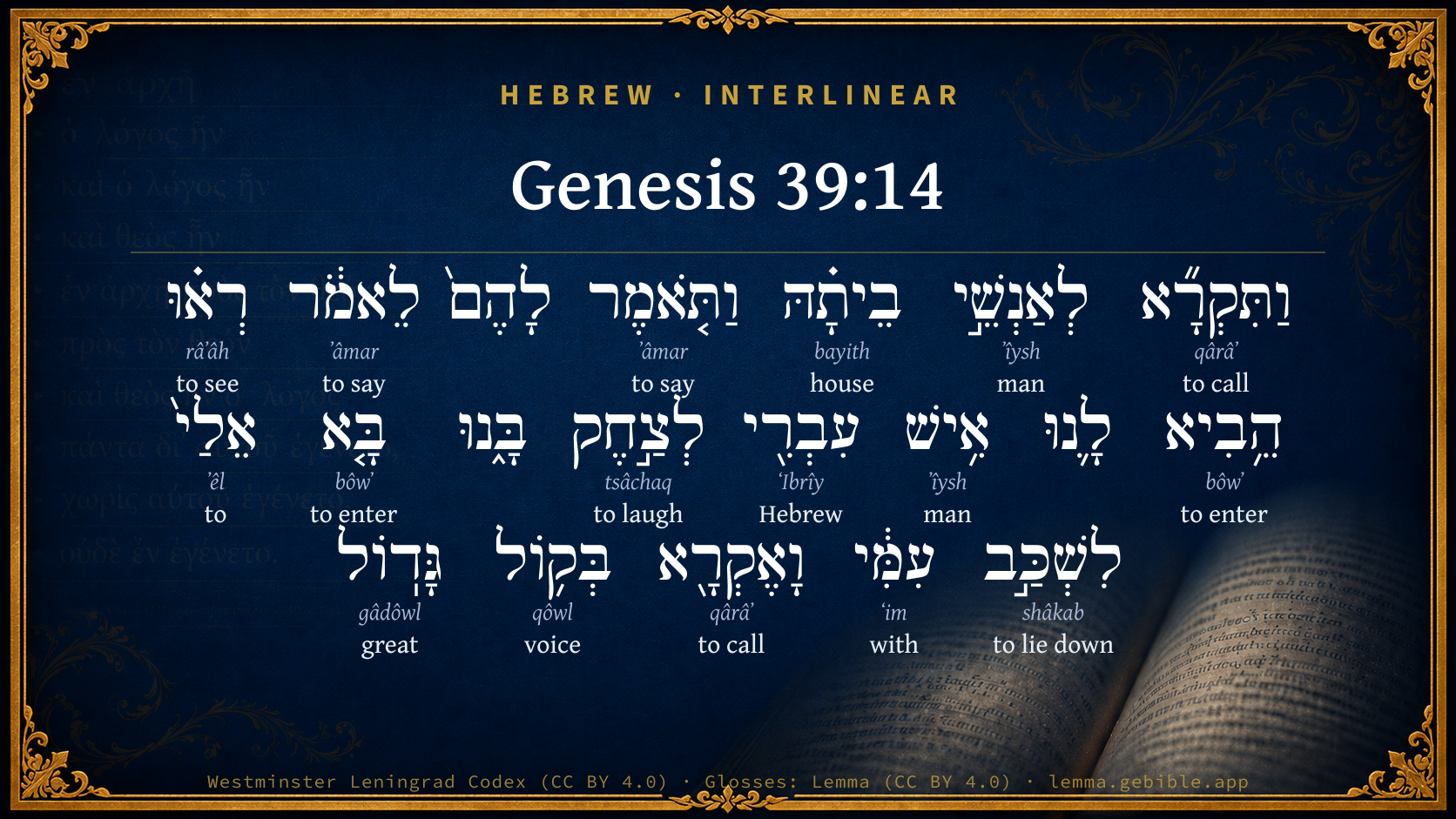
Hebrew (Westminster Leningrad Codex) Genesis 39:14 appears in the Hebrew Old Testament. The text above is from the Westminster Leningrad Codex. Each word links to its Strong’s number, a concise gloss, and parsing drawn from the Open Scriptures Hebrew Bible morphology. Click any word for its full Brown-Driver-Briggs (BDB) entry.
Download image
Cite this verse

Genesis 39:14 (World English Bible). Public Domain. Lemma interlinear Bible study tool, https://lemma.gebible.app/v/genesis/39/14.

Show BibTeX & RIS
BibTeX
RIS
English Translation
that she called to the men of her house, and spoke to them, saying, "Behold, he has brought in a Hebrew to us to mock us. He came in to me to lie with me, and I cried with a loud voice.
World English Bible · Public Domain
Download a study sheet

One document with this verse’s original text, its word-by-word gloss line, the meaning frame, cross-references with their text, attributed commentary, and full source and license credits — printable, and it pastes into notes with its structure intact.

This verse Autodidact and up

Study sheet (.html) Plain text (.txt)

A passage Seminary Student

Up to 50 verses in one chapter. A passage sheet keeps up to 6 commentary sources and 12 cross-references per verse, in the order this page ranks them, and says so on the sheet whenever that leaves anything out. Ask for a single verse and you get the Autodidact verse sheet above.

Everything on this page stays free to read, with no account — the sheet is a download of what is already on screen, not access to it.

Want to remove ads? Support Godless Engineer
Compare translations 3

The same verse in 3 English versions, stacked beneath the original-language interlinear above. Click any original word for its lexicon entry.

Each is an independent rendering of the whole verse — the interlinear is not word-aligned to these translations.

Highlighted words mark where these versions differ — a whole-verse word diff, not a word-by-word alignment.

  • World English Bible Public Domain
    that she called to the men of her house, and spoke to them, saying, "Behold, he has brought in a Hebrew to us to mock us. He came in to me to lie with me, and I cried with a loud voice.
  • King James Version Public Domain
    That she called unto the men of her house, and spake unto them, saying, See, he hath brought in an Hebrew unto us to mock us; he came in unto me to lie with me, and I cried with a loud voice:
  • unfoldingWord Literal Text CC BY-SA 4.0
    then she called for the men of her house and said to them, saying, “Look! He brought to us a Hebrew man to laugh at us! He came to me to lie with me, but I called out with a loud voice!

unfoldingWord Literal Text — © unfoldingWord, licensed CC BY-SA 4.0. Word-aligned USFM3 via Door43 (git.door43.org/unfoldingWord/en_ult).

Versions to compare (up to 4)

3 of 4 selected

Show all 18 translations

Every available English version of this verse, each an independent rendering of the whole verse.

  • World English Bible Public Domain
    that she called to the men of her house, and spoke to them, saying, "Behold, he has brought in a Hebrew to us to mock us. He came in to me to lie with me, and I cried with a loud voice.
  • Berean Standard Bible Public Domain
    she called her household servants. “Look,” she said, “this Hebrew has been brought to us to make sport of us. He came to me so he could sleep with me, but I screamed as loud as I could.
  • Majority Standard Bible Public Domain
    she called her household servants. “Look,” she said, “this Hebrew has been brought to us to make sport of us. He came to me so he could sleep with me, but I screamed as loud as I could.
  • King James Version Public Domain
    That she called unto the men of her house, and spake unto them, saying, See, he hath brought in an Hebrew unto us to mock us; he came in unto me to lie with me, and I cried with a loud voice:
  • American Standard Version (1901) Public Domain
    that she called unto the men of her house, and spake unto them, saying, See, he hath brought in a Hebrew unto us to mock us: he came in unto me to lie with me, and I cried with a loud voice:
  • Revised Version (1885) Public Domain
    that she called unto the men of her house, and spake unto them, saying, See, he hath brought in an Hebrew unto us to mock us; he came in unto me to lie with me, and I cried with a loud voice:
  • Geneva Bible (1599) Public Domain
    She called vnto the men of her house, and tolde them, saying, Beholde, he hath brought in an Ebrewe vnto vs to mocke vs: who came in to me for to haue slept with me: but I cryed with a loude voyce.
  • Douay-Rheims (1899) Public Domain
    And she catching the skirt of his garment, said: Lie with me. But he leaving the garment in her hand, fled, and went out.
  • Young's Literal Translation Public Domain
    that she calleth for the men of her house, and speaketh to them, saying, `See, he hath brought in to us a man, a Hebrew, to play with us; he hath come in unto me, to lie with me, and I call with a loud voice,
  • Literal Standard Version CC BY-SA 4.0
    that she calls for the men of her house, and speaks to them, saying, “See, he has brought a man to us, a Hebrew, to play with us; he has come in to me, to lie with me, and I call with a loud voice,
  • Unlocked Literal Bible CC BY-SA 4.0
    that she called to the men of her house and told them, “See, Potiphar has brought in a Hebrew to mock us. He came in to me to sleep with me, and I screamed.
  • unfoldingWord Literal Text CC BY-SA 4.0
    then she called for the men of her house and said to them, saying, “Look! He brought to us a Hebrew man to laugh at us! He came to me to lie with me, but I called out with a loud voice!
  • Darby Bible Public Domain
    that she called to the men of her house, and spoke to them, saying, See, he has brought in a Hebrew man to us, to mock us: he came in to me, to lie with me; and I cried with a loud voice;
  • World Messianic Bible Public Domain
    she called to the men of her house, and spoke to them, saying, “Behold, he has brought a Hebrew in to us to mock us. He came in to me to lie with me, and I cried with a loud voice.
  • Webster's Bible Public Domain
    That she called to the men of her house, and spoke to them, saying, See, he hath brought in a Hebrew to us to mock us: he came in to me to lie with me, and I cried with a loud voice:
  • Free Bible Version CC BY-SA 4.0
    she shouted out to her servants, “Look at this! He brought this Hebrew slave here to dishonor us! This man came to try and rape me, but I screamed at the top of my voice.
  • Bible in Basic English Public Domain
    She sent for the men of her house and said to them, See, he has let a Hebrew come here and make sport of us; he came to my bed, and I gave a loud cry;
  • JPS Tanakh (1917) Public Domain
    that she called unto the men of her house, and spoke unto them, saying: 'See, he hath brought in a Hebrew unto us to mock us; he came in unto me to lie with me, and I cried with a loud voice.

Literal Standard Version (2020), Covenant Press — licensed CC BY-SA 4.0. Text via the HelloAO Bible API (eBible.org). Unlocked Literal Bible (unfoldingWord) — licensed CC BY-SA 4.0. Text via the HelloAO Bible API (eBible.org). unfoldingWord Literal Text — © unfoldingWord, licensed CC BY-SA 4.0. Word-aligned USFM3 via Door43 (git.door43.org/unfoldingWord/en_ult). Free Bible Version, Dr. Jonathan Gallagher — licensed CC BY-SA 4.0. Text via the HelloAO Bible API (eBible.org).

Word by word

More ways to search: Search by grammar → Find every occurrence → Compare this word →

Practice this passage: Drill this verse → Learn its vocabulary →

לְצַ֣חֶק
tsâchaq
H6711
“to laugh”
Preposition + Verb, Piel, Infinitive Construct
Part of Speech
Preposition + Verb
Stem
Piel
Form
Infinitive Construct
Full BDB Definition

Origin: a primitive root

TWOT: 1905

to laugh, mock, play - (Qal) to laugh - (Piel) - to jest - to sport, play, make sport, toy with, make a toy of
  1. וַתִּקְרָ֞א qârâʼ H7121 “and · to call” Conjunction + Verb, Qal, Sequential Imperfect, 3rd Person, Feminine, Singular
  2. לְאַנְשֵׁ֣י ʼîysh H376 “to/for · men of” Preposition + Noun, Common, Masculine, Plural, Construct
  3. בֵיתָ֗הּ bayith H1004 “house · her” Noun, Common, Masculine, Singular, Construct + Suffix, Personal, 3rd Person, Feminine, Singular
  4. וַתֹּ֤אמֶר ʼâmar H559 “and · to say” Conjunction + Verb, Qal, Sequential Imperfect, 3rd Person, Feminine, Singular
  5. לֵאמֹ֔ר ʼâmar H559 “to say” Preposition + Verb, Qal, Infinitive Construct
  6. רְא֗וּ râʼâh H7200 “see” Verb, Qal, Imperative, 2nd Person, Masculine, Plural
  7. הֵ֥בִיא bôwʼ H935 “to enter” Verb, Hiphil, Perfect, 3rd Person, Masculine, Singular
  8. אִ֥ישׁ ʼîysh H376 “man” Noun, Common, Masculine, Singular, Absolute
  9. עִבְרִ֖י ʻIbrîy H5680 “Hebrew” Noun, Gentilic, Masculine, Singular, Absolute
  10. בָּ֤א bôwʼ H935 “to enter” Verb, Qal, Perfect, 3rd Person, Masculine, Singular
  11. אֵלַי֙ ʼêl H413 “to · me” Preposition + Suffix, Personal, 1st Person, Common, Singular
  12. לִשְׁכַּ֣ב shâkab H7901 “to lie down” Preposition + Verb, Qal, Infinitive Construct
  13. עִמִּ֔י ʻim H5973 “with · me” Preposition + Suffix, Personal, 1st Person, Common, Singular
  14. וָאֶקְרָ֖א qârâʼ H7121 “and · to call” Conjunction + Verb, Qal, Sequential Imperfect, 1st Person, Common, Singular
  15. בְּק֥וֹל qôwl H6963 “in/at · voice” Preposition + Noun, Common, Masculine, Singular, Absolute
  16. גָּדֽוֹל gâdôwl H1419 “great” Adjective, Adjective, Masculine, Singular, Absolute

About this verse

These counts appear in no published source. They are computed here, from the morphology-tagged text and Lemma’s own curated glosses. What Lemma adds →

20
words
13
distinct lemmas
Pentateuch
section

Notable vocabulary

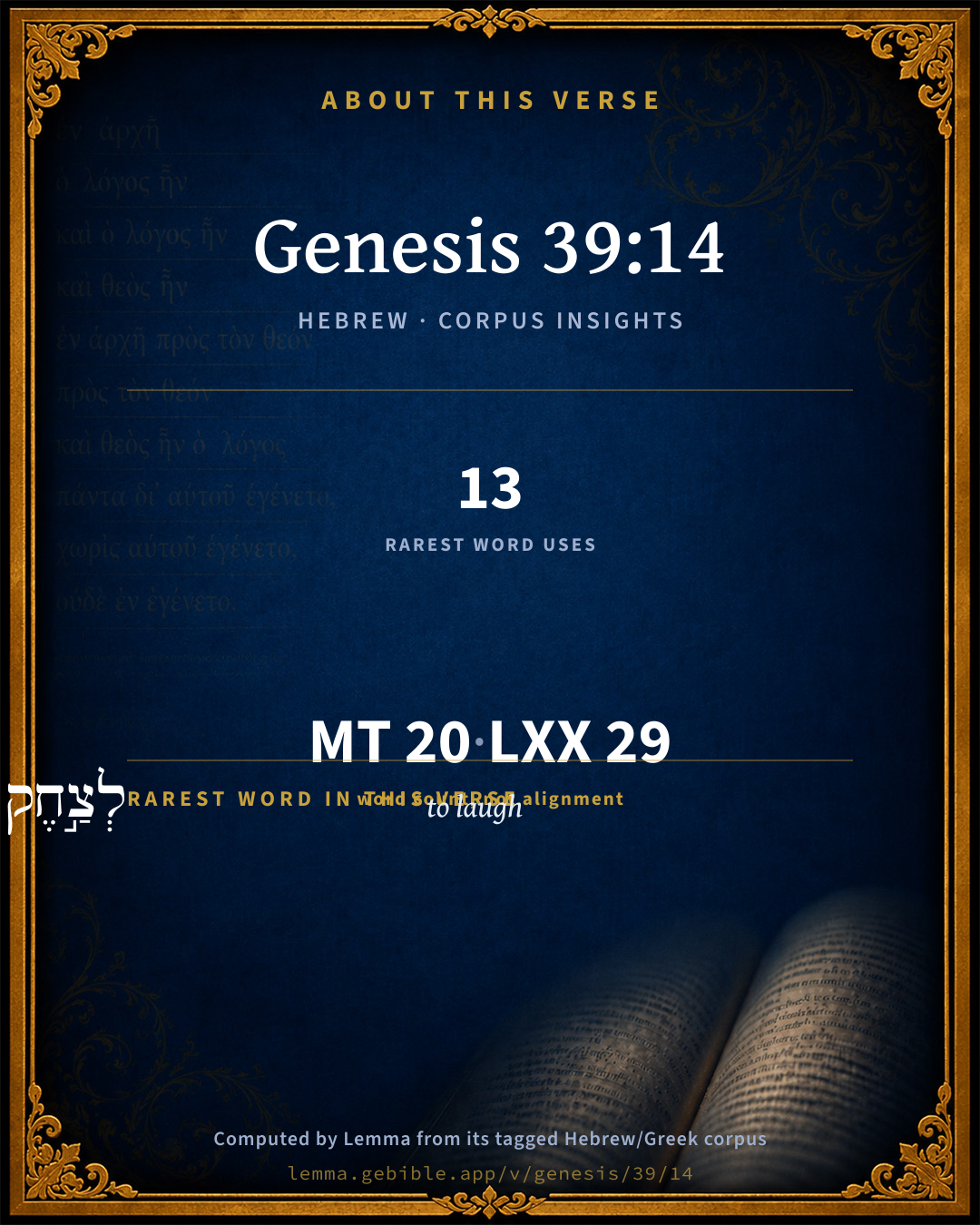
The rarest word here is לְצַ֣חֶק to laugh H6711 — appearing just 13 times in the whole Hebrew Bible.

Shared distinctive vocabulary

לְצַ֣חֶק to laugh H6711 occurs in 12 verses of the Hebrew Bible. Also found in:

Grammatical profile

  • 9 verbs
  • 5 nouns
  • 1 adjective
  • 5 prepositions

Verb forms

  • וַתִּקְרָ֞א Qal · Sequential Imperfect
  • וַתֹּ֤אמֶר Qal · Sequential Imperfect
  • לֵאמֹ֔ר Qal · Infinitive Construct
  • רְא֗וּ Qal · Imperative
  • הֵ֥בִיא Hiphil · Perfect
  • לְצַ֣חֶק Piel · Infinitive Construct
  • בָּ֤א Qal · Perfect
  • לִשְׁכַּ֣ב Qal · Infinitive Construct
  • וָאֶקְרָ֖א Qal · Sequential Imperfect

Repetition

Words recur within this verse — often emphatic in Hebrew:

  • וַתִּקְרָ֞א to call H7121 ×2
  • לְאַנְשֵׁ֣י man H376 ×2
  • וַתֹּ֤אמֶר to say H559 ×2
  • הֵ֥בִיא to enter H935 ×2

Hebrew & Septuagint length

In English translation the verse runs 42 words from the Hebrew and 42 from the Septuagint (LXX English) — the same length.

A rough comparison of the two English renderings, which tokenize alike — not a word-level alignment.

Word counts can differ between the Hebrew and the Greek without any difference in meaning — e.g. the Hebrew direct-object marker אֵת has no separate Greek word, and Greek often adds the article ὁ.

In the original languages it is 20 Hebrew tokens and 29 Greek tokens — but the two are counted differently (Hebrew bundles its prefixes and suffixes into one token; the Greek is in lemma form), so that isn’t a like-for-like length.

Cross-references

19

Topical passages linked to Genesis 39:14 in the Treasury of Scripture Knowledge — connected by theme and wording, ordered by reader-vote popularity; previews shown in the World English Bible.

  • Genesis 10:21 To Shem, the father of all the children of Eber, the elder brother of Japheth, to him also were children born.
  • Genesis 14:13 One who had escaped came and told Abram, the Hebrew. Now he lived by the oaks of Mamre, the Amorite, brother of Eshcol, and brother of Aner; and these were allies of Abram.
  • Genesis 39:7 It happened after these things, that his master's wife cast her eyes on Joseph; and she said, "Lie with me."
  • Genesis 39:17 She spoke to him according to these words, saying, "The Hebrew servant, whom you have brought to us, came in to me to mock me,
  • Genesis 40:15 For indeed, I was stolen away out of the land of the Hebrews, and here also have I done nothing that they should put me into the dungeon."
  • Psalms 35:11 Unrighteous witnesses rise up. They ask me about things that I don't know about.
  • Psalms 55:3 Because of the voice of the enemy, Because of the oppression of the wicked. For they bring suffering on me. In anger they hold a grudge against me.
  • Psalms 120:3 What will be given to you, and what will be done more to you, You deceitful tongue?
  • Proverbs 10:18 He who hides hatred has lying lips. He who utters a slander is a fool.
  • Isaiah 51:7 Listen to me, you who know righteousness, the people in whose heart is my law; don't you fear the reproach of men, neither be you dismayed at their insults.
  • Isaiah 54:17 No weapon that is formed against you shall prosper; and every tongue that shall rise against you in judgment you shall condemn. This is the heritage of the servants of Yahweh, and their righteousness which is of me, says Yahweh.
  • Matthew 5:11 "Blessed are you when people reproach you, persecute you, and say all kinds of evil against you falsely, for my sake.
  • Matthew 26:59 Now the chief priests, the elders, and the whole council sought false testimony against Jesus, that they might put him to death;
  • Luke 23:2 They began to accuse him, saying, "We found this man perverting the nation, forbidding paying taxes to Caesar, and saying that he himself is Christ, a king."
  • 1 Peter 2:20 For what glory is it if, when you sin, you patiently endure beating? But if, when you do well, you patiently endure suffering, this is commendable with God.
  • 1 Peter 3:14–18 But even if you should suffer for righteousness' sake, you are blessed. "Don't fear what they fear, neither be troubled."
  • 1 Peter 4:14–19 If you are insulted for the name of Christ, blessed are you; because the Spirit of glory and of God rests on you. On their part he is blasphemed, but on your part he is glorified.
  • Ezekiel 22:5 Those who are near, and those who are far from you, shall mock you, you infamous one [and] full of tumult.
  • 2 Corinthians 6:8 by glory and dishonor, by evil report and good report; as deceivers, and yet true;

Cross-references courtesy of OpenBible.info (CC BY 4.0).

Hebrew and Greek witnesses Masoretic Hebrew ↔ Greek Septuagint

The same verse in the two great witnesses to the Old Testament, shown verse-for-verse.

These are two independent witnesses, not word-aligned to each other, and the Septuagint is shown in lemma (dictionary) form.

Hebrew Genesis 39:14 Masoretic · Westminster Leningrad Codex

וַתִּקְרָ֞א לְאַנְשֵׁ֣י בֵיתָ֗הּ וַתֹּ֤אמֶר לָהֶם֙ לֵאמֹ֔ר רְא֗וּ הֵ֥בִיא לָ֛נוּ אִ֥ישׁ עִבְרִ֖י לְצַ֣חֶק בָּ֑נוּ בָּ֤א אֵלַי֙ לִשְׁכַּ֣ב עִמִּ֔י וָאֶקְרָ֖א בְּק֥וֹל גָּדֽוֹל

that she called to the men of her house, and spoke to them, saying, "Behold, he has brought in a Hebrew to us to mock us. He came in to me to lie with me, and I cried with a loud voice.

World English Bible · Public Domain

Greek LXX Genesis 39:14 Septuagint · lemma form

καί καλέω ὁ εἰμί ἐν ὁ οἰκία καί εἶπον αὐτός λέγω ὁράω εἰςἄγω ἐγώ παῖς εβραῖος ἐνπαίζω ἐγώ εἰςἔρχομαι πρός ἐγώ λέγω κοιμάω μετά ἐγώ καί βοάω φωνή μέγας

that she called those that were in the house, and spoke to them, saying, See, he has brought in to us a Hebrew servant to mock us—he came in to me, saying, Lie with me, and I cried with a loud voice.

LXX2012 (modern English Septuagint) · Public Domain

Hebrew: Westminster Leningrad Codex (CC BY 4.0). Greek: Septuagint (public domain); English from LXX2012 (modern English Septuagint) (Public Domain). How the Septuagint differs from the Hebrew →

Targum (Aramaic paraphrase)

2

The Targum is the ancient Jewish Aramaic paraphrase of the Hebrew Scriptures — an interpretive translation, not the Hebrew text itself. Onkelos (literal) and Pseudo-Jonathan (expansive) render the Torah, and Jonathan the Prophets. Coverage is partial: where no permissively-licensed English translation exists for a verse, only the Aramaic is shown. This is verse-level text, not a word-by-word alignment to the Hebrew.

  1. Targum Onkelos Torah (Genesis–Deuteronomy)
    וּקְרַת לַאֲנָשֵׁי בֵיתַהּ וַאֲמֶרֶת לְהוֹן לְמֵימָר חֲזוֹ אַיְתִי לָנָא גַּבְרָא עִבְרָאָה לְחַיָּכָא בָנָא עַל לְוָתִי לְמִשְׁכַּב עִמִּי וּקְרֵית בְּקָלָא רַבָּא

    (no public-domain English translation for this verse)

    Targum Onkelos — Aramaic: “Onkelos Genesis” (public domain); “Onkelos Exodus” (public domain); “Onkelos Leviticus” (public domain); “Onkelos Numbers” (public domain); “Onkelos Deuteronomy” (public domain). English: “Sefaria Community Translation” (CC0 1.0 (public-domain dedication)); “J.W. Etheridge. The Targums of Onkelos and Jonathan Ben Uzziel on the Pentateuch. London: Longmans, Green, 1862” (public domain). Text via Sefaria.

  2. Targum Pseudo-Jonathan Torah (Genesis–Deuteronomy)
    וְרָמַת חֶלְבּוֹנָא דְבֵיעָתָא בְּדַרְגְשָׁא וּקְרַת לְאַנְשֵׁי בֵיתָהּ וַאַמַרַת חָמוּן שִׁכְבַת זַרְעָא דְאַטִיל דֵין דְאַיְיתִי רִיבּוֹנְכוֹן לָנָא גְבַר עִבְרָאֵי לְמִגְחוֹךְ בָּנָא עַל לְוָתִי לְמִשְׁכּוֹב עִמִי וּקְרִית בְּקָלָא רָמָא

    that she called the men of the house and said, See this, ___ which the Hebrew man hath done whom your master hath brought to mock us. He came in to lie with me, and I cried with a high voice.

    Targum Pseudo-Jonathan — Aramaic: “Targum Jonathan on Genesis” (public domain); “Targum Jonathan on Exodus” (public domain); “Targum Jonathan on Leviticus” (public domain); “Targum Jonathan on Numbers” (public domain); “Targum Jonathan on Deuteronomy” (public domain). English: “The Targum of Jonathan ben Uzziel, trans. J. W. Etheridge, London, 1862” (public domain). Text via Sefaria.

Commentary

Notes on Genesis 39:14 from classic Christian and Jewish commentators (each source and its license shown beneath its notes). The classic Christian expositions comment on the surrounding passage and are grouped to its opening verse, so a note may address several verses; the Jewish commentaries on the Tanakh (Rashi and others) are per-verse, so they appear only where the commentator wrote on this verse.

Lemma curates 59 commentaries, every one of them public domain or Creative Commons licensed, each selected and text-cleaned for this edition rather than reprinted as found. About our sources →

Trapp's Complete Commentary

John Trapp

Gen 39:14 That she called unto the men of her house, and spake unto them, saying, See, he hath brought in an Hebrew unto us to mock us; he came in unto me to lie with me, and I cried with a loud voice:

Ver. 14. See, he hath brought in an Hebrew.] So she calls him, by way of contempt; as they called our Saviour Nazarene, and his followers Galileans. The Arians called the true Christians Ambrosians Athanasians, Homousians, &c. {a} And at this day, the most honourable name of Christian is in Italy and at Rome a name of reproach; and usually abused, to signify a fool, or a dolt. {b}

{a} Sir Humphrey Lynde.

{b} W. Fulke, Rhem. Test. on Acts xi., sec. iv.

John Trapp, A Commentary or Exposition upon All the Books of the Old and New Testament (1647–1656) — public domain. Text from a community e-Sword module.

Tyndale Open Study Notes

Tyndale Open Resources

39:14 Though Potiphar’s wife was addressing slaves, she appealed to them as fellow Egyptians (us) to enlist them as witnesses against the despised Hebrew (see 43:32) who had won Potiphar’s trust.

Tyndale Open Study Notes — © Tyndale Open Resources, licensed CC BY-SA 4.0. Text via the HelloAO Bible API.

Geneva Bible (1599)

Geneva Bible translators

Or, to do us villainy and shame.

This declareth that where incontinence is, thereunto is joined extreme impudency and craft.

Geneva Bible (1599) marginal notes — public domain. Text via Bolls.life.

Jamieson, Fausset & Brown

Robert Jamieson, A. R. Fausset & David Brown

Then she called unto the men of her house--Disappointed and affronted, she vowed revenge and accused Joseph, first to the servants of the house, and on his return to her lord.

See, he hath brought in an Hebrew . . . to mock us--an affected and blind aspersion of her husband for keeping in his house an Hebrew, the very abomination of Egyptians.

Jamieson, Fausset & Brown — Commentary Critical and Explanatory on the Whole Bible (1871) — public domain (CC PDM 1.0). Text via the HelloAO Bible API.

Adam Clarke's Commentary

Verse 14. He hath brought in a Hebrew unto us] Potiphar's wife affects to throw great blame on her husband, whom we may reasonably suppose she did not greatly love. He hath brought in - he hath raised this person to all his dignity and eminence, to give him the greater opportunity to mock us. לפחק letsachek, here translated to mock, is the same word used in Ge 26:8, relative to Isaac and Rebekah; and is certainly used by Potiphar's wife in Ge 39:17, to signify some kind of familiar intercourse not allowable but between man and wife.

Adam Clarke's Commentary on the Bible (1810–1826) — public domain. Text from a community e-Sword/MySword module.

The Cambridge Bible for Schools and Colleges

gen. ed. J. J. S. Perowne

14. an Hebrew] The designation used by foreigners for “an Israelite” (cf. Gen_41:12, Gen_43:32), and probably for any one who belonged to the group of peoples, Israelite, Moabite, Ammonite, Edomite, who invaded and settled down in Palestine and the adjacent territories. The word is an appeal to the racial prejudice against Asiatic strangers.

to mock] Cf. Pro_1:26. The idea is of wanton insult.

us] As if none of the women in the house would be secure from insult, when the master’s wife had been subjected to such an affront from this young upstart foreigner. She implies that her husband’s confidence in his Hebrew slave meant disregard for the family’s honour.

The Cambridge Bible for Schools and Colleges (gen. ed. J. J. S. Perowne; Cambridge University Press, 1878–1918) — public domain. Text from a community e-Sword module.

John Gill's Exposition

That she called unto the men of her house,.... Of that part of the house which belonged to her; her eunuchs that waited upon her, or that were in another part of the home, at some distance:

and spake unto them; when they came to her:

saying, see, he hath brought in an Hebrew unto us to mock us: she means her husband, whom through contempt, and in her passion, she names not, having lost all affection for him, as her addresses to Joseph showed; and so the Targum of Jonathan supplies it,"your master hath brought, &c.''and Joseph she calls an Hebrew by way of reproach, and with a view to set her servants against him; who before this might not have any great regard to him through envy at him, for the favours he enjoyed, and the authority he had; and because he prevented their doing wrong things to serve themselves, and hurt their master: and holding up his garment in her hand, which they knew full well, bid them look at it, and observe, that this was the issue of his Being brought into the house by their master; that though it was not with such an intention, which can hardly be thought to be her sense, yet this was the event of it; an attempt to abuse, vitiate, and corrupt her, and so bring contempt upon the whole family, and expose them to the scorn and mockery of men, for their mistress to be abused by a base foreigner: she explains herself more fully by saying:

he came in unto me to lie with me, and I cried with a loud voice; both of them lies; for it was she that solicited him to lie with her, and not he; nor did she cry out at all; and if she did, how came it she was not heard by them, as well as when she called unto them; thus her impure love was turned into hatred, which put her upon framing lies and calumnies; and which has been also done in cases similar to this (s), as Sthenobaea against Bellerophon.

(s) Vid. Juvenal Satyr. 10. Apollodorum de Deorum Origin. l. 2. p. 70.

John Gill's Exposition of the Whole Bible (1746–1763) — public domain (CC PDM 1.0). Text via the HelloAO Bible API.

Matthew Poole's English Annotations

Unto the men of her house; to such as were in other parts of the house, whom she called in as witnesses for her husband’s satisfaction.

He, i.e. my husband, whom she would not name, as it were out of disdain and high displeasure for being the occasion of this horrid affront. Thus the pronouns he and they are oft used by way of contempt, as Luk 4:24; 19:27; Joh 7:11; 8:10.

An Hebrew; so she calls him, to render him hateful and contemptible to the Egyptians.

To mock us; to abuse me; or to vitiate and defile me; for that word is oft used in an obscene sense. She insinuates, that this was not only an indignity to her, but an injury to all the family, which therefore they were obliged to revenge.

Matthew Poole's English Annotations on the Holy Bible (1683–1685) — public domain. Text from a community e-Sword/MySword module.

Whedon's Commentary on the Bible

Daniel D. Whedon

14. She called unto the men of her house — To other men-servants, who were under Joseph’s oversight. Like the evil woman of all times and nations, she was quick to ruin the man who would not follow her desires. She seeks first to make the men-servants witnesses in the case, and then waits until her husband’s return to repeat the same abominable falsehood to him. Gen_39:16-18. The story of Potiphar’s wife, whose traditionary name is Zuleekha, is told with much amplification by Josephus, (Ant., book ii, chap. iv,) and in Oriental romance. The Koran relates it in that chapter (12) to which Mohammed appealed as bearing the manifest signs of inspiration.

Daniel D. Whedon (gen. ed.), Commentary on the Old and New Testaments (1874–1909) — public domain. Text from a community e-Sword module.

Rashi

Rabbi Shlomo Yitzchaki (Rashi)

ראו הביא לנו SEE, HE HATH BROUGHT IN UNTO US — This is an elliptical phrase: “he hath brought in to us” without stating plainly who brought him in She was referring to her husband.

עברי A HEBREW — is one who came from the other side (עבר) of the river Euphrates, being at the same time of the sons of Eber (אדניו).

Rashi on the Tanakh — English translations: “The Judaica Press complete Tanach with Rashi, translated by A. J. Rosenberg” (CC BY 4.0); “Pentateuch with Rashi's commentary by M. Rosenbaum and A.M. Silbermann, 1929-1934” (public domain); “The Metsudah Tanach series, Lakewood, N.J” (CC BY 4.0); and “The Book of Joshua, Metsudah Publications, 1997” (CC BY 4.0). Text via Sefaria.

Ramban (Nachmanides)

Rabbi Moshe ben Nachman (Ramban / Nachmanides)

SEE, HE HATH BROUGHT IN A HEBREW UNTO US. The meaning thereof is that the Hebrews were hated by the Egyptians. They did not eat with them, this being a matter of abhorrence to them. They did not purchase them as servants except as vinedressers and plowmen, but they would not permit them to come into their homes. This is why she said: “Behold, the master has done us evil by bringing a Hebrew into our home, and he has further appointed him as overseer and ruler, and now he has fittingly seen to mock us.” [The point of her statement] is similar to that which is said in the verse, He that delicately bringeth up his servant from a child shall have him become a master at the last. This is the meaning of her saying, Whom thou hast brought unto us, as his being brought into their house was in itself embarassing to them.In the verse before us, the expression, He has brought us, refers to her husband. She does not mention him by name out of respect, or perhaps because such is the ethical way for women to speak, or perhaps because it is known who brought Joseph into the house. Similarly, in many places in the book of Job it speaks of Almighty G-d anonymously because the conversants know that they are speaking of Him. Similarly, in the verse, And he said to Abner, Why hast thou gone in unto my father’s concubine? the name of the speaker is not mentioned, and no reference is made to him at all in the above verse because it is known that he was Ish-bosheth.

Ramban (Nachmanides) on the Tanakh — English translation: “Commentary on the Torah by Ramban (Nachmanides). Translated and annotated by Charles B. Chavel. New York, Shilo Pub. House, 1971-1976” (CC BY 4.0). Text via Sefaria.

Radak

Rabbi David Kimhi (Radak)

ותקרא לאנשי ביתה, how is that possible seeing that none of them were in the house at the time?ואקרא בקול גדול.ותאמר..לאמר, to tell her husband.

הביא לנו, they said to him (accusingly) how he could have brought such a man.

בנו, a word denoting glory, i.e. how could he be “over us, in a superior position?”

Radak on the Tanakh — English translations: “Sefaria Community Translation” (CC0 1.0 (public-domain dedication)); “Eliyahu Munk, HaChut Hameshulash” (CC BY 4.0); “Rabbi Mike Feuer, Jerusalem Anthology” (CC BY 4.0); and “R. David Kimhi on the first book of Psalms, Translated by R.G. Finch, London, 1919” (public domain). Text via Sefaria.

Lesson kit

Teaching starters — assembled from the data on this page, not authored interpretation. Every prompt links to the verse data it draws on. Edit before teaching.

Genesis, in the Pentateuch, opens this verse with 20 words (13 distinct Hebrew lemmas). Its most distinctive word is tsâchaq (“to laugh”). A historical commentator’s framing appears above. Read the whole chapter for the surrounding context.

Discussion questions

  1. How does “to laugh” (tsâchaq) shape what this verse is saying?
  2. How does Genesis 17:17, which shares the word «to laugh», read alongside this verse?
  3. What does the repetition of “to call” (2× in this one verse) do in this verse?
  4. These translations render this verse differently; the difference is in the English rendering, not the original. What questions does that raise?
  5. «וַתִּקְרָ֞א» is a Qal Sequential Imperfect verb. How does that grammatical form shape the action described?
  6. Compare how Trapp's Complete Commentary and Tyndale Open Study Notes read this verse. Where do they agree or differ?

Things to notice

Reading settings

Reading text

Shown beneath each verse's original-language words.

Old Testament
Old Testament edition

Read the OT as the Masoretic Hebrew (MT) or the Greek Septuagint (LXX).

English shown for the Greek Septuagint (in the Hebrew ↔ Greek comparison).

Comparing translations? Open the Compare panel on any verse page to stack up to four side by side.