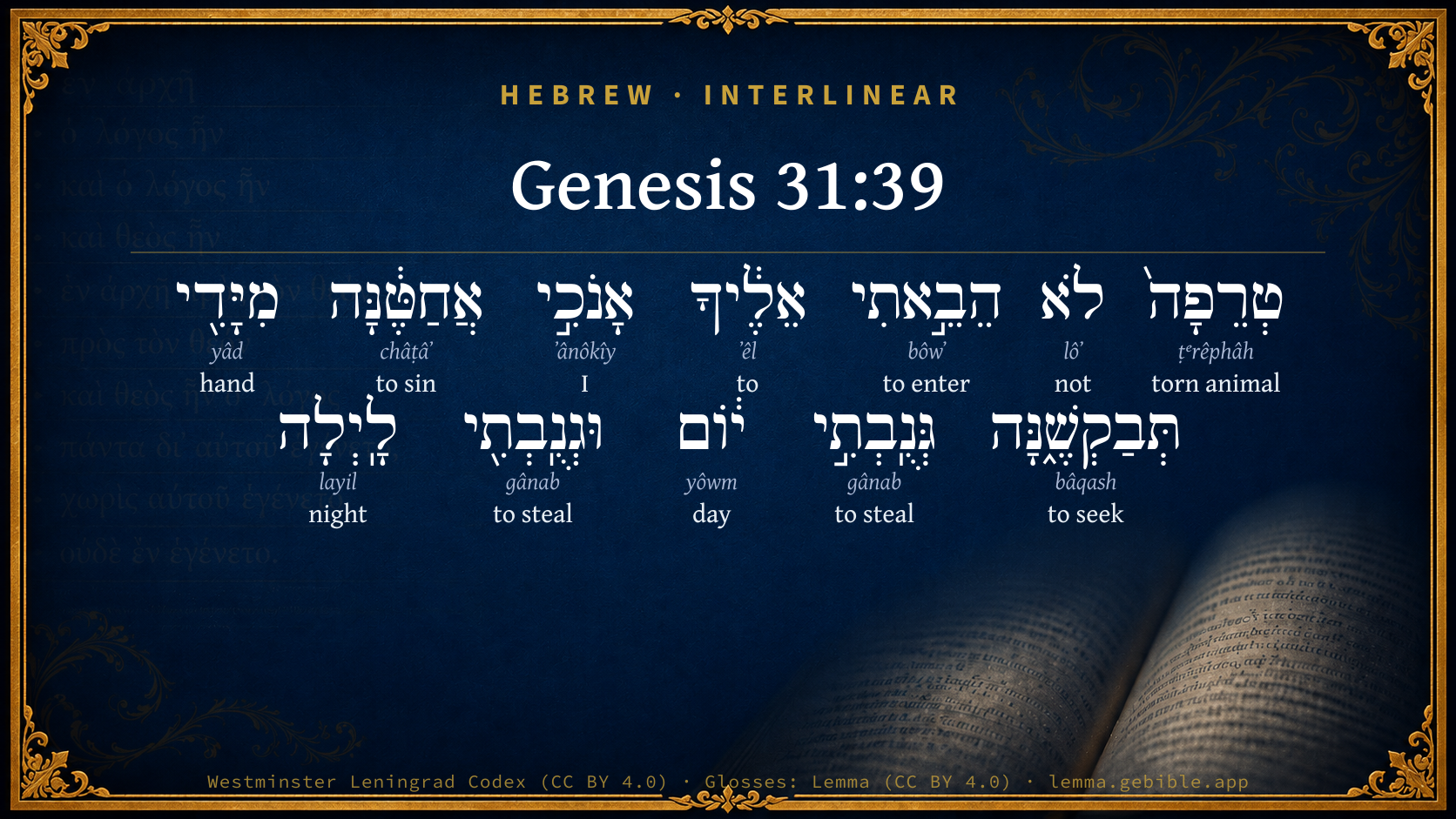
Genesis 31:39

Hebrew (Westminster Leningrad Codex) Genesis 31:39 appears in the Hebrew Old Testament. The text above is from the Westminster Leningrad Codex. Each word links to its Strong’s number, a concise gloss, and parsing drawn from the Open Scriptures Hebrew Bible morphology. Click any word for its full Brown-Driver-Briggs (BDB) entry.
Download image
Cite this verse

Genesis 31:39 (World English Bible). Public Domain. Lemma interlinear Bible study tool, https://lemma.gebible.app/v/genesis/31/39.

Show BibTeX & RIS
BibTeX
RIS
English Translation
That which was torn of animals, I didn't bring to you. I bore the loss of it. Of my hand you required it, whether stolen by day or stolen by night.
World English Bible · Public Domain
Highlights
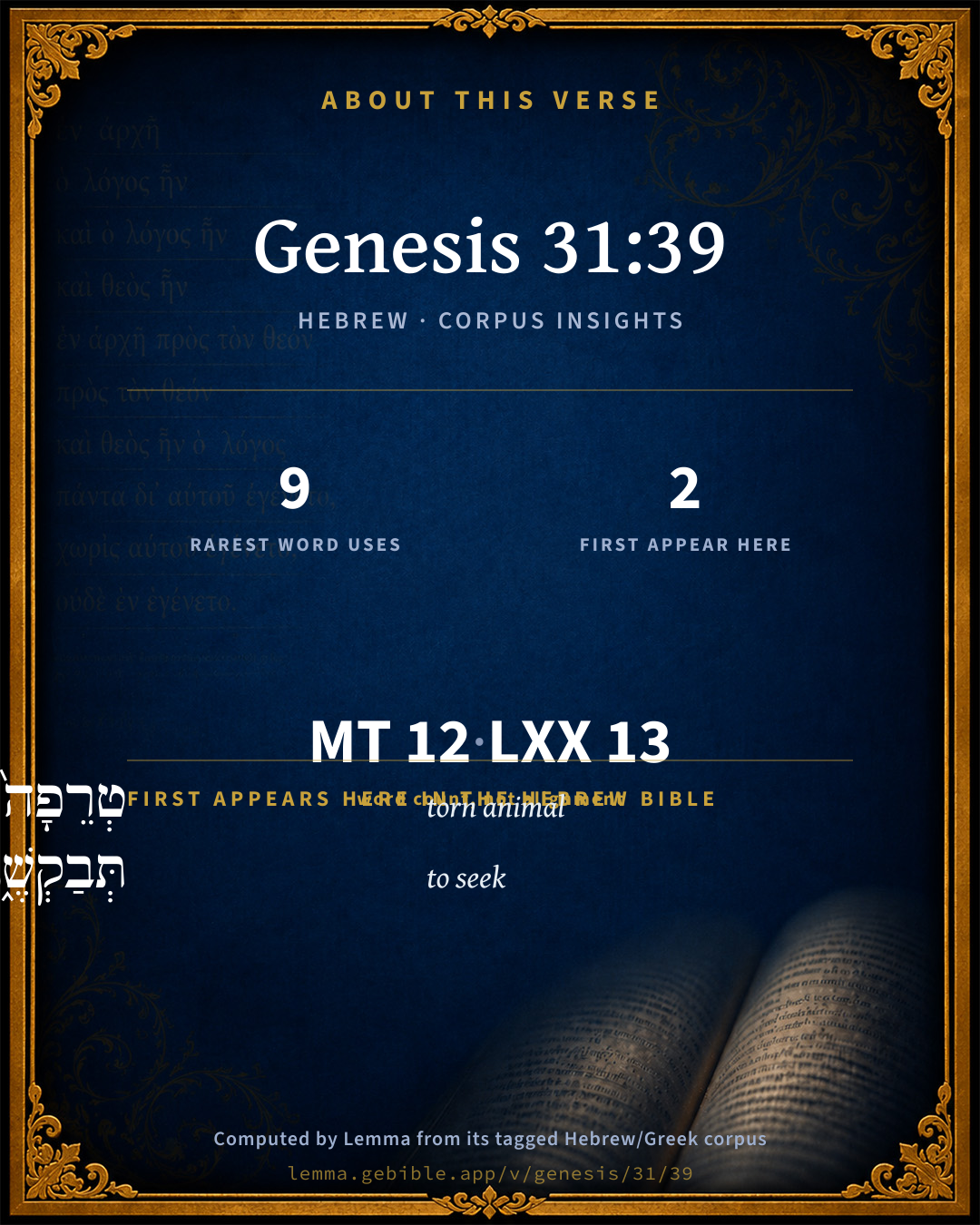
  • 2 first appearances in the Hebrew Bible
Full analysis ↓
Download a study sheet

One document with this verse’s original text, its word-by-word gloss line, the meaning frame, cross-references with their text, attributed commentary, and full source and license credits — printable, and it pastes into notes with its structure intact.

This verse Autodidact and up

Study sheet (.html) Plain text (.txt)

A passage Seminary Student

Up to 50 verses in one chapter. A passage sheet keeps up to 6 commentary sources and 12 cross-references per verse, in the order this page ranks them, and says so on the sheet whenever that leaves anything out. Ask for a single verse and you get the Autodidact verse sheet above.

Everything on this page stays free to read, with no account — the sheet is a download of what is already on screen, not access to it.

Want to remove ads? Support Godless Engineer
Compare translations 3

The same verse in 3 English versions, stacked beneath the original-language interlinear above. Click any original word for its lexicon entry.

Each is an independent rendering of the whole verse — the interlinear is not word-aligned to these translations.

Highlighted words mark where these versions differ — a whole-verse word diff, not a word-by-word alignment.

  • World English Bible Public Domain
    That which was torn of animals, I didn't bring to you. I bore the loss of it. Of my hand you required it, whether stolen by day or stolen by night.
  • King James Version Public Domain
    That which was torn of beasts I brought not unto thee; I bare the loss of it; of my hand didst thou require it, whether stolen by day, or stolen by night.
  • unfoldingWord Literal Text CC BY-SA 4.0
    I did not bring torn to you; I bore the loss of it myself. You required it from my hand, stolen by day and stolen by night.

unfoldingWord Literal Text — © unfoldingWord, licensed CC BY-SA 4.0. Word-aligned USFM3 via Door43 (git.door43.org/unfoldingWord/en_ult).

Versions to compare (up to 4)

3 of 4 selected

Show all 18 translations

Every available English version of this verse, each an independent rendering of the whole verse.

  • World English Bible Public Domain
    That which was torn of animals, I didn't bring to you. I bore the loss of it. Of my hand you required it, whether stolen by day or stolen by night.
  • Berean Standard Bible Public Domain
    I did not bring you anything torn by wild beasts; I bore the loss myself. And you demanded payment from me for what was stolen by day or night.
  • Majority Standard Bible Public Domain
    I did not bring you anything torn by wild beasts; I bore the loss myself. And you demanded payment from me for what was stolen by day or night.
  • King James Version Public Domain
    That which was torn of beasts I brought not unto thee; I bare the loss of it; of my hand didst thou require it, whether stolen by day, or stolen by night.
  • American Standard Version (1901) Public Domain
    That which was torn of beasts I brought not unto thee; I bare the loss of it; of my hand didst thou require it, whether stolen by day or stolen by night.
  • Revised Version (1885) Public Domain
    That which was torn of beasts I brought not unto thee; I bare the loss of it; of my hand didst thou require it, whether stolen by day or stolen by night.
  • Geneva Bible (1599) Public Domain
    Whatsoeuer was torne of beasts, I brought it not vnto thee, but made it good my selfe: of mine hand diddest thou require it, were it stollen by day or stollen by night.
  • Douay-Rheims (1899) Public Domain
    Neither did I show thee that which the beast had torn, I made good all the damage: whatsoever was lost by theft, thou didst exact it of me:
  • Young's Literal Translation Public Domain
    the torn I have not brought in unto thee -- I, I repay it -- from my hand thou dost seek it; I have been deceived by day, and I have been deceived by night;
  • Literal Standard Version CC BY-SA 4.0
    the torn I have not brought to you—I repay it—from my hand you seek it; I have been deceived by day, and I have been deceived by night;
  • Unlocked Literal Bible CC BY-SA 4.0
    What was torn by beasts I did not bring to you. Instead, I bore the loss of it. You always made me pay for every missing animal, whether stolen by day or stolen by night.
  • unfoldingWord Literal Text CC BY-SA 4.0
    I did not bring torn to you; I bore the loss of it myself. You required it from my hand, stolen by day and stolen by night.
  • Darby Bible Public Domain
    What was torn I have not brought to thee; I had to bear the loss of it: of my hand hast thou required it, [whether] stolen by day or stolen by night.
  • World Messianic Bible Public Domain
    That which was torn of animals, I didn’t bring to you. I bore its loss. Of my hand you required it, whether stolen by day or stolen by night.
  • Webster's Bible Public Domain
    That which was torn by beasts, I brought not to thee; I bore the loss of it; of my hand didst thou require it, whether stolen by day, or stolen by night.
  • Free Bible Version CC BY-SA 4.0
    If any of them were killed by wild animals, I never even brought you the carcass to prove the loss—I bore the loss myself. But you on the other hand always made me compensate you for any animals that were stolen, whether at night or in broad daylight.
  • Bible in Basic English Public Domain
    Anything which was wounded by beasts I did not take to you, but myself made up for the loss of it; you made me responsible for whatever was taken by thieves, by day or by night.
  • JPS Tanakh (1917) Public Domain
    That which was torn of beasts I brought not unto thee; I bore the loss of it; of my hand didst thou require it, whether stolen by day or stolen by night.

Literal Standard Version (2020), Covenant Press — licensed CC BY-SA 4.0. Text via the HelloAO Bible API (eBible.org). Unlocked Literal Bible (unfoldingWord) — licensed CC BY-SA 4.0. Text via the HelloAO Bible API (eBible.org). unfoldingWord Literal Text — © unfoldingWord, licensed CC BY-SA 4.0. Word-aligned USFM3 via Door43 (git.door43.org/unfoldingWord/en_ult). Free Bible Version, Dr. Jonathan Gallagher — licensed CC BY-SA 4.0. Text via the HelloAO Bible API (eBible.org).

Word by word

More ways to search: Search by grammar → Find every occurrence → Compare this word →

Practice this passage: Drill this verse → Learn its vocabulary →

טְרֵפָה֙
ṭᵉrêphâh
H2966
“torn animal”
Noun, Common, Feminine, Singular, Absolute
Part of Speech
Noun
Type
Common
Gender
Feminine
Number
Singular
State
Absolute
Full BDB Definition

Origin: from (collectively) H2964

TWOT: 827c

that which is torn, animal torn (by beasts)
  1. לֹא lôʼ H3808 “not” Particle, Negative
  2. הֵבֵ֣אתִי bôwʼ H935 “to enter” Verb, Hiphil, Perfect, 1st Person, Common, Singular
  3. אֵלֶ֔יךָ ʼêl H413 “to · you” Preposition + Suffix, Personal, 2nd Person, Masculine, Singular
  4. אָנֹכִ֣י ʼânôkîy H595 “I” Pronoun, Personal, 1st Person, Common, Singular
  5. אֲחַטֶּ֔נָּה châṭâʼ H2398 “to sin · her” Verb, Piel, Imperfect, 1st Person, Common, Singular + Suffix, Personal, 3rd Person, Feminine, Singular
  6. מִיָּדִ֖י yâd H3027 “from · hand · my” Preposition + Noun, Common, Both, Singular, Construct + Suffix, Personal, 1st Person, Common, Singular
  7. תְּבַקְשֶׁ֑נָּה bâqash H1245 “to seek · her” Verb, Piel, Imperfect, 2nd Person, Masculine, Singular + Suffix, Personal, 3rd Person, Feminine, Singular
  8. גְּנֻֽבְתִ֣י gânab H1589 “stolen” Verb, Qal, Participle Passive, Feminine, Singular, Construct
  9. י֔וֹם yôwm H3117 “day” Noun, Common, Masculine, Singular, Absolute
  10. וּגְנֻֽבְתִ֖י gânab H1589 “and · stolen” Conjunction + Verb, Qal, Participle Passive, Feminine, Singular, Construct
  11. לָֽיְלָה layil H3915 “night” Noun, Common, Masculine, Singular, Absolute

About this verse

These counts appear in no published source. They are computed here, from the morphology-tagged text and Lemma’s own curated glosses. What Lemma adds →

12
words
11
distinct lemmas
Pentateuch
section

Notable vocabulary

The rarest word here is טְרֵפָה֙ torn animal H2966 — appearing just 9 times in the whole Hebrew Bible.

First appearance in Scripture

These words make their first canonical appearance in the Hebrew Bible here:

  • טְרֵפָה֙ torn animal H2966
  • תְּבַקְשֶׁ֑נָּה to seek H1245

Shared distinctive vocabulary

טְרֵפָה֙ torn animal H2966 occurs in 9 verses of the Hebrew Bible. Also found in:

Grammatical profile

  • 5 verbs
  • 4 nouns
  • 1 pronoun
  • 1 preposition
  • 1 particle

Verb forms

  • הֵבֵ֣אתִי Hiphil · Perfect
  • אֲחַטֶּ֔נָּה Piel · Imperfect
  • תְּבַקְשֶׁ֑נָּה Piel · Imperfect
  • גְּנֻֽבְתִ֣י Qal · Participle Passive
  • וּגְנֻֽבְתִ֖י Qal · Participle Passive

Repetition

A word recurs within this verse — often emphatic in Hebrew:

  • גְּנֻֽבְתִ֣י to steal H1589 ×2

Hebrew & Septuagint length

In English translation the verse runs 31 words from the Hebrew and 27 from the Septuagint (LXX English) — closely comparable.

A rough comparison of the two English renderings, which tokenize alike — not a word-level alignment.

Word counts can differ between the Hebrew and the Greek without any difference in meaning — e.g. the Hebrew direct-object marker אֵת has no separate Greek word, and Greek often adds the article ὁ.

In the original languages it is 12 Hebrew tokens and 13 Greek tokens — but the two are counted differently (Hebrew bundles its prefixes and suffixes into one token; the Greek is in lemma form), so that isn’t a like-for-like length.

Cross-references

6

Topical passages linked to Genesis 31:39 in the Treasury of Scripture Knowledge — connected by theme and wording, ordered by reader-vote popularity; previews shown in the World English Bible.

  • Exodus 22:10–13 "If a man delivers to his neighbor a donkey, an ox, a sheep, or any animal to keep, and it dies or is injured, or driven away, no man seeing it;
  • Exodus 22:31 "You shall be holy men to me, therefore you shall not eat any flesh that is torn by animals in the field. You shall cast it to the dogs.
  • Leviticus 22:8 That which dies of itself, or is torn by animals, he shall not eat, defiling himself by it. I am Yahweh.
  • Luke 2:8 There were shepherds in the same country staying in the field, and keeping watch by night over their flock.
  • 1 Samuel 17:34–35 David said to Saul, Your servant was keeping his father's sheep; and when there came a lion, or a bear, and took a lamb out of the flock,
  • John 10:12–13 He who is a hired hand, and not a shepherd, who doesn't own the sheep, sees the wolf coming, leaves the sheep, and flees. The wolf snatches the sheep, and scatters them.

Cross-references courtesy of OpenBible.info (CC BY 4.0).

Hebrew and Greek witnesses Masoretic Hebrew ↔ Greek Septuagint

The same verse in the two great witnesses to the Old Testament, shown verse-for-verse.

These are two independent witnesses, not word-aligned to each other, and the Septuagint is shown in lemma (dictionary) form.

Hebrew Genesis 31:39 Masoretic · Westminster Leningrad Codex

טְרֵפָה֙ לֹא הֵבֵ֣אתִי אֵלֶ֔יךָ אָנֹכִ֣י אֲחַטֶּ֔נָּה מִיָּדִ֖י תְּבַקְשֶׁ֑נָּה גְּנֻֽבְתִ֣י י֔וֹם וּגְנֻֽבְתִ֖י לָֽיְלָה

That which was torn of animals, I didn't bring to you. I bore the loss of it. Of my hand you required it, whether stolen by day or stolen by night.

World English Bible · Public Domain

Greek LXX Genesis 31:39 Septuagint · lemma form

θηριάλωτος οὐ ἀναφέρω σύ ἐγώ ἀποτιννύω παρά ἐμαυτοῦ κλέμμα ἡμέρα καί κλέμμα νύξ

That which was taken of beasts I brought not to you; I made good of myself the thefts of the day, and the thefts of the night.

LXX2012 (modern English Septuagint) · Public Domain

Hebrew: Westminster Leningrad Codex (CC BY 4.0). Greek: Septuagint (public domain); English from LXX2012 (modern English Septuagint) (Public Domain). How the Septuagint differs from the Hebrew →

Targum (Aramaic paraphrase)

2

The Targum is the ancient Jewish Aramaic paraphrase of the Hebrew Scriptures — an interpretive translation, not the Hebrew text itself. Onkelos (literal) and Pseudo-Jonathan (expansive) render the Torah, and Jonathan the Prophets. Coverage is partial: where no permissively-licensed English translation exists for a verse, only the Aramaic is shown. This is verse-level text, not a word-by-word alignment to the Hebrew.

  1. Targum Onkelos Torah (Genesis–Deuteronomy)
    דִּתְבִירָא לָא אַיְתֵיתִי לְוָתָךְ דַּהֲוַת שָׁגְיָא מִמִּנְיָנָא מִנִּי אַתְּ בָּעֵי לַהּ נְטָרִית בִּימָמָא וּנְטָּרִית בְּלֵילְיָא

    (no public-domain English translation for this verse)

    Targum Onkelos — Aramaic: “Onkelos Genesis” (public domain); “Onkelos Exodus” (public domain); “Onkelos Leviticus” (public domain); “Onkelos Numbers” (public domain); “Onkelos Deuteronomy” (public domain). English: “Sefaria Community Translation” (CC0 1.0 (public-domain dedication)); “J.W. Etheridge. The Targums of Onkelos and Jonathan Ben Uzziel on the Pentateuch. London: Longmans, Green, 1862” (public domain). Text via Sefaria.

  2. Targum Pseudo-Jonathan Torah (Genesis–Deuteronomy)
    דִתְבִירָא מִן חֵיוַת בָּרָא לָא אַיְיתֵיתִי לְוָותָךְ דְאִין אֲנָא חָטִי בָּהּ מִן יְדִי הֲוֵית תָּבַע יָתָהּ מַה דְמִתְגְנִיב בִּימָמָא מִבְּנֵי נְשָׁא עָלַי הֲוָה לְאַשְׁלָמָא וּמַה דַהֲוָה מִתְגְנֵיב בְּלֵילְיָא מִן חֵיוַת בָּרָא עָלַי הֲוֵינָא לִמְשַׁלְמָא

    That torn by wild beasts I have not brought to thee; for had I sinned, from my hand thou wouldst have required it. What was stolen in the day by men, that have I made good; and what was stolen in the night by wild beasts was made good also.

    Targum Pseudo-Jonathan — Aramaic: “Targum Jonathan on Genesis” (public domain); “Targum Jonathan on Exodus” (public domain); “Targum Jonathan on Leviticus” (public domain); “Targum Jonathan on Numbers” (public domain); “Targum Jonathan on Deuteronomy” (public domain). English: “The Targum of Jonathan ben Uzziel, trans. J. W. Etheridge, London, 1862” (public domain). Text via Sefaria.

Commentary

Notes on Genesis 31:39 from classic Christian and Jewish commentators (each source and its license shown beneath its notes). The classic Christian expositions comment on the surrounding passage and are grouped to its opening verse, so a note may address several verses; the Jewish commentaries on the Tanakh (Rashi and others) are per-verse, so they appear only where the commentator wrote on this verse.

Lemma curates 59 commentaries, every one of them public domain or Creative Commons licensed, each selected and text-cleaned for this edition rather than reprinted as found. About our sources →

Trapp's Complete Commentary

John Trapp

Gen 31:39 That which was torn [of beasts] I brought not unto thee; I bare the loss of it; of my hand didst thou require it, [whether] stolen by day, or stolen by night.

Ver. 39. Of my hand didst thou require it.] Which was against all right and reason; {Exo 22:10; Exo 22:13} but that weighed little with this covetous cormorant. God "smites his fists" at such "dishonest gain," as Balak did at Balaam, in token of extreme indignation. {Eze 22:13} And lest Laban, or any like, should object, that these were but great words; - The Lord would not do it; They would deal well enough with the Lord for that matter; - he adds, in the next verse, "Can thine heart endure, or can thine hands be strong, in the days that I shall deal with thee? I the Lord have spoken it, and I will do it". {Gen 31:14}

John Trapp, A Commentary or Exposition upon All the Books of the Old and New Testament (1647–1656) — public domain. Text from a community e-Sword module.

Joseph Benson's Commentary

Gen 31:39-40. That which was torn I brought not unto thee — What Jacob here affirms, and for the truth of which he appeals to Laban, shows him to have been of a very industrious and faithful disposition, and that Laban’s temper was exceedingly selfish and sordid: for though Jacob was his relation, and his substance had increased so greatly under his hand, yet he was very rigid toward him, and required him to make good all the cattle that were lost, by whatever accident it happened. In the day the drought consumed me — “In Europe,” says Sir John Chardin, quoted by Harmer, vol. 1. p. 74, “the days and nights resemble each other, with respect to the qualities of heat and cold; but it is quite otherwise in the East. In the lower Asia, in particular, the day is always hot, and, as soon as the sun is fifteen degrees above the horizon, no cold is felt in the depth of winter itself. On the contrary, in the height of summer, the nights are as cold as at Paris in the month of March. It is for this reason that in Persia and Turkey they always make use of furred habits in the country, such only being sufficient to resist the cold of the nights.”

Joseph Benson's Commentary on the Old and New Testaments (1811–1818) — public domain. Text from a community e-Sword module.

Geneva Bible (1599)

Geneva Bible translators

Hebrew, the torn, or taken by prey.

Geneva Bible (1599) marginal notes — public domain. Text via Bolls.life.

Jamieson, Fausset & Brown

Robert Jamieson, A. R. Fausset & David Brown

That which was torn of beasts I brought not unto thee--The shepherds are strictly responsible for losses in the flock, unless they can prove these were occasioned by wild beasts.

Jamieson, Fausset & Brown — Commentary Critical and Explanatory on the Whole Bible (1871) — public domain (CC PDM 1.0). Text via the HelloAO Bible API.

Adam Clarke's Commentary

Verse 39. That which was torn - of my hand didst thou require it] This more particularly marks the covetous and rigorous disposition of Laban; for the law of God required that what had been torn by beasts the shepherd should not be obliged to make good, Ex 22:10; Ex 22:13. And it is very likely that this law was in force from the earliest times.

Adam Clarke's Commentary on the Bible (1810–1826) — public domain. Text from a community e-Sword/MySword module.

The Cambridge Bible for Schools and Colleges

gen. ed. J. J. S. Perowne

39. I brought not unto thee] Jacob allowed himself to be the loser by the animals that were killed by wild beasts. Instead of bringing the mangled remains so that their value might not be deducted, he cheerfully bore the full loss: see Exo_22:12-13; Amo_3:12. Jacob had exceeded the standard of fairness which was required by custom: “I bare the loss of it,” i.e. “I used to make myself responsible for the loss.”

The Cambridge Bible for Schools and Colleges (gen. ed. J. J. S. Perowne; Cambridge University Press, 1878–1918) — public domain. Text from a community e-Sword module.

John Gill's Exposition

Thus have I been twenty years in thy house,.... Attended with these difficulties, inconveniencies, and hardships:

I served thee fourteen years for thy two daughters; Rachel and Leah; first seven years for Rachel; and having Leah imposed upon him instead of her, was obliged to serve seven years more, which he did for her sake; whereas he ought to have given them, and a dowry with them, to one who was heir to the land of Canaan, and not have exacted servitude of him:

and six years for thy cattle, to have as many of them for his hire, as were produced from a flock of white sheep, that were speckled, spotted, or ringstraked, or brown:

and thou hast changed my wages ten times; See Gill on Gen 31:7;

John Gill's Exposition of the Whole Bible (1746–1763) — public domain (CC PDM 1.0). Text via the HelloAO Bible API.

Haydock's Catholic Bible Commentary

Exact it. Laban acted in opposition both to custom and to justice, (Calmet) while Jacob forebore to claim what he might have done, agreeably to both. (Haydock)

George Leo Haydock (1774–1849), Haydock's Catholic Family Bible and Commentary, 1859 edition — public domain. Excludes Psalms (Douay-Rheims chapter numbering differs from Protestant) and Deuterocanonical books (Catholic canon only).

Matthew Poole's English Annotations

Which was unjust and unreasonable, except where it fell out through the shepherd’s default. See Exo 22:13.

Quest. How could Jacob pay these losses, seeing he came empty from his father’s house, and got nothing by his service, for the first fourteen years, but his wives?

Answ. Either, 1. He had some supplies sent from his father, though it be not mentioned in this history. Or,

2. He might have some inconsiderable allowances or privileges from Laban, out of which he could easily defray these charges, which because of his great care and watchfulness did but seldom happen. Or,

3. These losses were put to his account, to be satisfied by him as soon as he should be able to do it.

Matthew Poole's English Annotations on the Holy Bible (1683–1685) — public domain. Text from a community e-Sword/MySword module.

Rashi

Rabbi Shlomo Yitzchaki (Rashi)

טרפה THAT WHICH WAS TORN by a lion or a wolf.

אנכי אחטנה I BARE THE LOSS OF IT — It has the same meaning as the verb in (Judges 20:16) “sling stones at a hair-breadth and not miss (יחטא)”, and (1 Kings 1:21) “that I and my son Solomon shall suffer the loss of it (חטאים)” i.e. shall be lacking in authority. The sense therefore is: “I” was short of it; if it was missing, it was missing to me because you required it of my hand.

אנכי אחטנה In the Targum it is translated by דהות שגיא ממנינא which means that which was missing and deficient from the number of the animals. The words (Numbers 31:49) “There is missing (נפקד) not one man of us”, is rendered in the Targum by ולא שגיא

גנבתי יום וגנבתי לילה WHETHER STOLEN BY DAY OR STOLEN BY NIGHT — everything I paid back.

גנבתי As regards the suffix י it is similar to the י in (Lamentations 1:1) “great (רבתי) among the nations, princess (שרתי) among the provinces”; (Isaiah 1:21) “that was full of (מלאתי) justice”; (Hosea 10:11) “that loveth (אהבתי) to thresh”.

Rashi on the Tanakh — English translations: “The Judaica Press complete Tanach with Rashi, translated by A. J. Rosenberg” (CC BY 4.0); “Pentateuch with Rashi's commentary by M. Rosenbaum and A.M. Silbermann, 1929-1934” (public domain); “The Metsudah Tanach series, Lakewood, N.J” (CC BY 4.0); and “The Book of Joshua, Metsudah Publications, 1997” (CC BY 4.0). Text via Sefaria.

Radak

Rabbi David Kimhi (Radak)

טרפה לא, even if an animal had been attacked by wild beasts in a manner which could not have been the fault of the shepherd, I did not bring you the evidence to prove my innocence in such an accident but replaced it out of my own pocket. I did not want you to claim that I could have protected the animal against its attacker. I knew that it would have been futile to claim that I was not to blame as you would have illegally debited me with its worth.

אנכי אחטנה, I would have been blamed even if I had not been at fault

גנבתי יום, if an animal had been stolen from the flock either by day or by night I was always blamed for it and held responsible. I paid you for it regardless of the circumstances.

גנבתי, the letter י at the end has been added for reasons which are not clear. It is similar to another superfluous י which is found in Isaiah 1,21. If the function of the letter י had been that of a pronoun, i.e. “mine,” the letter ב would have had to be written with the vowel kametz.

Radak on the Tanakh — English translations: “Sefaria Community Translation” (CC0 1.0 (public-domain dedication)); “Eliyahu Munk, HaChut Hameshulash” (CC BY 4.0); “Rabbi Mike Feuer, Jerusalem Anthology” (CC BY 4.0); and “R. David Kimhi on the first book of Psalms, Translated by R.G. Finch, London, 1919” (public domain). Text via Sefaria.

Lesson kit

Teaching starters — assembled from the data on this page, not authored interpretation. Every prompt links to the verse data it draws on. Edit before teaching.

Genesis, in the Pentateuch, opens this verse with 12 words (11 distinct Hebrew lemmas). Its most distinctive word is ṭᵉrêphâh (“torn animal”). A historical commentator’s framing appears above. Read the whole chapter for the surrounding context.

Discussion questions

  1. The word ṭᵉrêphâh carries the sense “torn animal.” How does it shape the verse?
  2. 2 words here appear for the first time in Scripture. What is being introduced at this debut?
  3. Exodus 22:13 shares the word «torn animal» with this verse. How do the two illuminate each other?
  4. “to steal” occurs 2× in this one verse. What is the effect of the repetition?
  5. The translations on this page render this verse differently — a whole-verse word diff, not a word-by-word alignment. What might account for the different wordings?
  6. The verb «הֵבֵ֣אתִי» is Hiphil Perfect. How does its form color the action?
  7. Reading how Trapp's Complete Commentary and Joseph Benson's Commentary read this verse, where do the two commentators agree and where do they part?

Things to notice

Reading settings

Reading text

Shown beneath each verse's original-language words.

Old Testament
Old Testament edition

Read the OT as the Masoretic Hebrew (MT) or the Greek Septuagint (LXX).

English shown for the Greek Septuagint (in the Hebrew ↔ Greek comparison).

Comparing translations? Open the Compare panel on any verse page to stack up to four side by side.