
Genesis 47:18

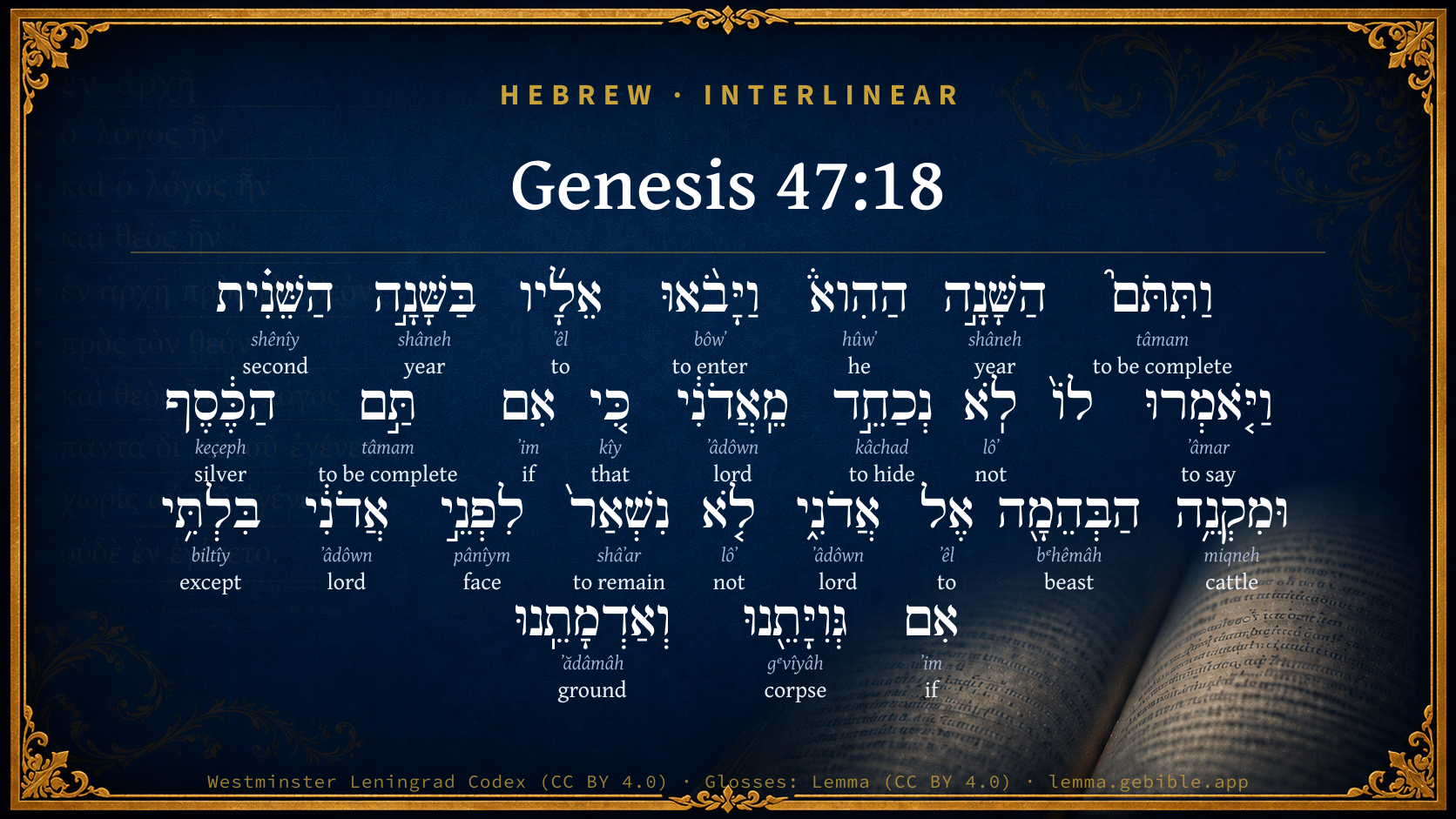
Hebrew (Westminster Leningrad Codex) Genesis 47:18 appears in the Hebrew Old Testament. The text above is from the Westminster Leningrad Codex. Each word links to its Strong’s number, a concise gloss, and parsing drawn from the Open Scriptures Hebrew Bible morphology. Click any word for its full Brown-Driver-Briggs (BDB) entry.
Download image
Cite this verse

Genesis 47:18 (World English Bible). Public Domain. Lemma interlinear Bible study tool, https://lemma.gebible.app/v/genesis/47/18.

Show BibTeX & RIS
BibTeX
RIS
English Translation
When that year was ended, they came to him the second year, and said to him, "We will not hide from my lord how our money is all spent, and the herds of cattle are my lord's. There is nothing left in the sight of my lord, but our bodies, and our lands.
World English Bible · Public Domain
Highlights
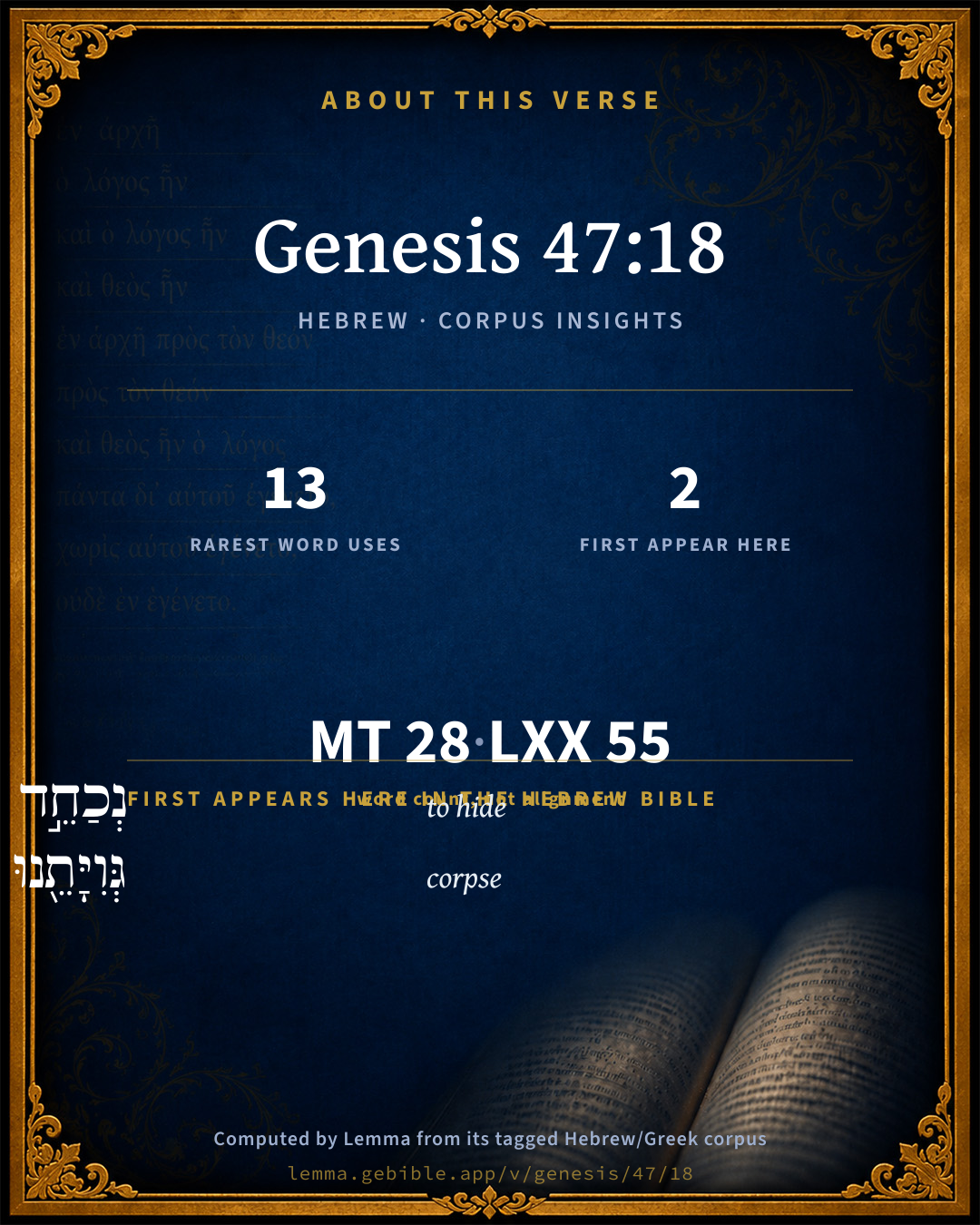
  • 2 first appearances in the Hebrew Bible
Full analysis ↓
Download a study sheet

One document with this verse’s original text, its word-by-word gloss line, the meaning frame, cross-references with their text, attributed commentary, and full source and license credits — printable, and it pastes into notes with its structure intact.

This verse Autodidact and up

Study sheet (.html) Plain text (.txt)

A passage Seminary Student

Up to 50 verses in one chapter. A passage sheet keeps up to 6 commentary sources and 12 cross-references per verse, in the order this page ranks them, and says so on the sheet whenever that leaves anything out. Ask for a single verse and you get the Autodidact verse sheet above.

Everything on this page stays free to read, with no account — the sheet is a download of what is already on screen, not access to it.

Want to remove ads? Support Godless Engineer
Compare translations 3

The same verse in 3 English versions, stacked beneath the original-language interlinear above. Click any original word for its lexicon entry.

Each is an independent rendering of the whole verse — the interlinear is not word-aligned to these translations.

Highlighted words mark where these versions differ — a whole-verse word diff, not a word-by-word alignment.

  • World English Bible Public Domain
    When that year was ended, they came to him the second year, and said to him, "We will not hide from my lord how our money is all spent, and the herds of cattle are my lord's. There is nothing left in the sight of my lord, but our bodies, and our lands.
  • King James Version Public Domain
    When that year was ended, they came unto him the second year, and said unto him, We will not hide it from my lord, how that our money is spent; my lord also hath our herds of cattle; there is not ought left in the sight of my lord, but our bodies, and our lands:
  • unfoldingWord Literal Text CC BY-SA 4.0
    And that year had ended, then they came to him in the second year and said to him, “We cannot hide from my lord that since the silver is consumed and the herd of livestock to my lord, there is nothing left before my lord except our bodies and our lands.

unfoldingWord Literal Text — © unfoldingWord, licensed CC BY-SA 4.0. Word-aligned USFM3 via Door43 (git.door43.org/unfoldingWord/en_ult).

Versions to compare (up to 4)

3 of 4 selected

Show all 18 translations

Every available English version of this verse, each an independent rendering of the whole verse.

  • World English Bible Public Domain
    When that year was ended, they came to him the second year, and said to him, "We will not hide from my lord how our money is all spent, and the herds of cattle are my lord's. There is nothing left in the sight of my lord, but our bodies, and our lands.
  • Berean Standard Bible Public Domain
    When that year was over, they came to him the second year and said, “We cannot hide from our lord that our money is gone and all our livestock belongs to you. There is nothing left for our lord except our bodies and our land.
  • Majority Standard Bible Public Domain
    When that year was over, they came to him the second year and said, “We cannot hide from our lord that our money is gone and all our livestock belongs to you. There is nothing left for our lord except our bodies and our land.
  • King James Version Public Domain
    When that year was ended, they came unto him the second year, and said unto him, We will not hide it from my lord, how that our money is spent; my lord also hath our herds of cattle; there is not ought left in the sight of my lord, but our bodies, and our lands:
  • American Standard Version (1901) Public Domain
    And when that year was ended, they came unto him the second year, and said unto him, We will not hide from my lord, how that our money is all spent; and the herds of cattle are my lord's; there is nought left in the sight of my lord, but our bodies, and our lands:
  • Revised Version (1885) Public Domain
    And when that year was ended, they came unto him the second year, and said unto him, We will not hide from my lord, how that our money is all spent; and the herds of cattle are my lord’s; there is nought left in the sight of my lord, but our bodies, and our lands:
  • Geneva Bible (1599) Public Domain
    But when the yeere was ended, they came vnto him the next yeere, and sayd vnto him, We will not hide from my lord, that since our money is spent, and my lord hath the heards of the cattel, there is nothing left in the sight of my lorde, but our bodies and our ground.
  • Douay-Rheims (1899) Public Domain
    And they came the second year, and said to him: We will not hide from our lord, how that our money is spent, and our cattle also are gone: neither art thou ignorant that we have nothing now left but our bodies and our lands.
  • Young's Literal Translation Public Domain
    And that year is finished, and they come in unto him on the second year, and say to him, `We do not hide from my lord, that since the money hath been finished, and possession of the cattle `is' unto my lord, there hath not been left before my lord save our bodies, and our ground;
  • Literal Standard Version CC BY-SA 4.0
    And that year is finished, and they come to him on the second year, and say to him, “We do not hide from my lord, that since the money has been finished, and possession of the livestock [is] to my lord, there has not been left before my lord except our bodies, and our ground;
  • Unlocked Literal Bible CC BY-SA 4.0
    When that year was ended, they came to him the next year and said to him, “We will not hide from my master that our money is all gone, and the herds of cattle are my master's. There is nothing left in the sight of my master, except our bodies and our land.
  • unfoldingWord Literal Text CC BY-SA 4.0
    And that year had ended, then they came to him in the second year and said to him, “We cannot hide from my lord that since the silver is consumed and the herd of livestock to my lord, there is nothing left before my lord except our bodies and our lands.
  • Darby Bible Public Domain
    And that year ended; and they came to him the second year, and said to him, We will not hide [it] from my lord that since [our] money is come to an end, and the herds of cattle are in the possession of my lord, nothing is left before my lord but our bodies and our land.
  • World Messianic Bible Public Domain
    When that year was ended, they came to him the second year, and said to him, “We will not hide from my lord how our money is all spent, and the herds of livestock are my lord’s. There is nothing left in the sight of my lord, but our bodies, and our lands.
  • Webster's Bible Public Domain
    When that year was ended, they came to him the second year, and said to him, We will not hide from my lord, how that our money is spent; my lord also hath our herds of cattle; there is not aught left in the sight of my lord, but our bodies and our lands:
  • Free Bible Version CC BY-SA 4.0
    But when that year was over, they came to him the next year and said, “My lord, we can't hide from you the fact that our money is gone and that you now own our livestock. All we have left to give you are our bodies and our land.
  • Bible in Basic English Public Domain
    And when that year was ended, they came to him in the second year, and said, We may not keep it from our lord's knowledge that all our money is gone, and all the herds of cattle are my lord's; there is nothing more to give my lord but our bodies and our land;
  • JPS Tanakh (1917) Public Domain
    And when that year was ended, they came unto him the second year, and said unto him: 'We will not hide from my lord, how that our money is all spent; and the herds of cattle are my lord's; there is nought left in the sight of my lord, but our bodies, and our lands.

Literal Standard Version (2020), Covenant Press — licensed CC BY-SA 4.0. Text via the HelloAO Bible API (eBible.org). Unlocked Literal Bible (unfoldingWord) — licensed CC BY-SA 4.0. Text via the HelloAO Bible API (eBible.org). unfoldingWord Literal Text — © unfoldingWord, licensed CC BY-SA 4.0. Word-aligned USFM3 via Door43 (git.door43.org/unfoldingWord/en_ult). Free Bible Version, Dr. Jonathan Gallagher — licensed CC BY-SA 4.0. Text via the HelloAO Bible API (eBible.org).

Word by word

More ways to search: Search by grammar → Find every occurrence → Compare this word →

Practice this passage: Drill this verse → Learn its vocabulary →

גְּוִיָּתֵ֖נוּ
gᵉvîyâh
H1472
“corpse · our”
Noun, Common, Feminine, Singular, Construct + Suffix, Personal, 1st Person, Common, Plural
Part of Speech
Noun
Type
Common
Gender
Feminine
Number
Singular
State
Construct
Full BDB Definition

Origin: prolonged for H1465

TWOT: 326d

a body (of living creatures) - a corpse, carcass, dead body
  1. וַתִּתֹּם֮ tâmam H8552 “and · to be complete” Conjunction + Verb, Qal, Sequential Imperfect, 3rd Person, Feminine, Singular
  2. הַשָּׁנָ֣ה shâneh H8141 “the · year” Particle, Definite Article + Noun, Common, Feminine, Singular, Absolute
  3. הַהִוא֒ hûwʼ H1931 “the · he” Particle, Definite Article + Pronoun, Personal, 3rd Person, Feminine, Singular
  4. וַיָּבֹ֨אוּ bôwʼ H935 “and · to enter” Conjunction + Verb, Qal, Sequential Imperfect, 3rd Person, Masculine, Plural
  5. אֵלָ֜יו ʼêl H413 “to · him” Preposition + Suffix, Personal, 3rd Person, Masculine, Singular
  6. בַּשָּׁנָ֣ה shâneh H8141 “in/at the · year” Preposition, Determined + Noun, Common, Feminine, Singular, Absolute
  7. הַשֵּׁנִ֗ית shênîy H8145 “the · second” Particle, Definite Article + Adjective, Ordinal number, Feminine, Singular, Absolute
  8. וַיֹּ֤אמְרוּ ʼâmar H559 “and · to say” Conjunction + Verb, Qal, Sequential Imperfect, 3rd Person, Masculine, Plural
  9. לֹֽא lôʼ H3808 “not” Particle, Negative
  10. נְכַחֵ֣ד kâchad H3582 “to hide” Verb, Piel, Imperfect, 1st Person, Common, Plural
  11. מֵֽאֲדֹנִ֔י ʼâdôwn H113 “from · lord · my” Preposition + Noun, Common, Masculine, Singular, Construct + Suffix, Personal, 1st Person, Common, Singular
  12. כִּ֚י kîy H3588 “that” Conjunction
  13. אִם ʼim H518 “if” Conjunction
  14. תַּ֣ם tâmam H8552 “to be complete” Verb, Qal, Perfect, 3rd Person, Masculine, Singular
  15. הַכֶּ֔סֶף keçeph H3701 “the · silver” Particle, Definite Article + Noun, Common, Masculine, Singular, Absolute
  16. וּמִקְנֵ֥ה miqneh H4735 “and · cattle of” Conjunction + Noun, Common, Masculine, Singular, Construct
  17. הַבְּהֵמָ֖ה bᵉhêmâh H929 “the · beast” Particle, Definite Article + Noun, Common, Feminine, Singular, Absolute
  18. אֶל ʼêl H413 “to” Preposition
  19. אֲדֹנִ֑י ʼâdôwn H113 “lord · my” Noun, Common, Masculine, Singular, Construct + Suffix, Personal, 1st Person, Common, Singular
  20. לֹ֤א lôʼ H3808 “not” Particle, Negative
  21. נִשְׁאַר֙ shâʼar H7604 “to remain” Verb, Niphal, Perfect, 3rd Person, Masculine, Singular
  22. לִפְנֵ֣י pânîym H6440 “to/for · face(s) of” Preposition + Noun, Common, Both, Plural, Construct
  23. אֲדֹנִ֔י ʼâdôwn H113 “lord · my” Noun, Common, Masculine, Singular, Construct + Suffix, Personal, 1st Person, Common, Singular
  24. בִּלְתִּ֥י biltîy H1115 “except” Conjunction
  25. אִם ʼim H518 “if” Conjunction
  26. וְאַדְמָתֵֽנוּ ʼădâmâh H127 “and · ground · our” Conjunction + Noun, Common, Feminine, Singular, Construct + Suffix, Personal, 1st Person, Common, Plural

About this verse

These counts appear in no published source. They are computed here, from the morphology-tagged text and Lemma’s own curated glosses. What Lemma adds →

28
words
20
distinct lemmas
Pentateuch
section

Notable vocabulary

The rarest word here is גְּוִיָּתֵ֖נוּ corpse H1472 — appearing just 13 times in the whole Hebrew Bible.

First appearance in Scripture

These words make their first canonical appearance in the Hebrew Bible here:

  • נְכַחֵ֣ד to hide H3582
  • גְּוִיָּתֵ֖נוּ corpse H1472

Shared distinctive vocabulary

גְּוִיָּתֵ֖נוּ corpse H1472 occurs in 11 verses of the Hebrew Bible. Also found in:

Grammatical profile

  • 6 verbs
  • 11 nouns
  • 1 adjective
  • 1 pronoun
  • 3 prepositions
  • 4 conjunctions
  • 2 particles

Verb forms

  • וַתִּתֹּם֮ Qal · Sequential Imperfect
  • וַיָּבֹ֨אוּ Qal · Sequential Imperfect
  • וַיֹּ֤אמְרוּ Qal · Sequential Imperfect
  • נְכַחֵ֣ד Piel · Imperfect
  • תַּ֣ם Qal · Perfect
  • נִשְׁאַר֙ Niphal · Perfect

Repetition

Words recur within this verse — often emphatic in Hebrew:

  • מֵֽאֲדֹנִ֔י lord H113 ×3
  • וַתִּתֹּם֮ to be complete H8552 ×2
  • הַשָּׁנָ֣ה year H8141 ×2
  • אֵלָ֜יו to H413 ×2
  • לֹֽא not H3808 ×2
  • אִם if H518 ×2

Hebrew & Septuagint length

In English translation the verse runs 53 words from the Hebrew and 66 from the Septuagint (LXX English) — closely comparable.

A rough comparison of the two English renderings, which tokenize alike — not a word-level alignment.

Word counts can differ between the Hebrew and the Greek without any difference in meaning — e.g. the Hebrew direct-object marker אֵת has no separate Greek word, and Greek often adds the article ὁ.

In the original languages it is 28 Hebrew tokens and 55 Greek tokens — but the two are counted differently (Hebrew bundles its prefixes and suffixes into one token; the Greek is in lemma form), so that isn’t a like-for-like length.

Cross-references

2

Topical passages linked to Genesis 47:18 in the Treasury of Scripture Knowledge — connected by theme and wording, ordered by reader-vote popularity; previews shown in the World English Bible.

  • 2 Kings 6:26 As the king of Israel was passing by on the wall, there cried a woman to him, saying, Help, my lord, O king.
  • Jeremiah 38:9 My lord the king, these men have done evil in all that they have done to Jeremiah the prophet, whom they have cast into the dungeon; and he is likely to die in the place where he is, because of the famine; for there is no more bread in the city.

Cross-references courtesy of OpenBible.info (CC BY 4.0).

Hebrew and Greek witnesses Masoretic Hebrew ↔ Greek Septuagint

The same verse in the two great witnesses to the Old Testament, shown verse-for-verse.

These are two independent witnesses, not word-aligned to each other, and the Septuagint is shown in lemma (dictionary) form.

Hebrew Genesis 47:18 Masoretic · Westminster Leningrad Codex

וַתִּתֹּם֮ הַשָּׁנָ֣ה הַהִוא֒ וַיָּבֹ֨אוּ אֵלָ֜יו בַּשָּׁנָ֣ה הַשֵּׁנִ֗ית וַיֹּ֤אמְרוּ לוֹ֙ לֹֽא נְכַחֵ֣ד מֵֽאֲדֹנִ֔י כִּ֚י אִם תַּ֣ם הַכֶּ֔סֶף וּמִקְנֵ֥ה הַבְּהֵמָ֖ה אֶל אֲדֹנִ֑י לֹ֤א נִשְׁאַר֙ לִפְנֵ֣י אֲדֹנִ֔י בִּלְתִּ֥י אִם גְּוִיָּתֵ֖נוּ וְאַדְמָתֵֽנוּ

When that year was ended, they came to him the second year, and said to him, "We will not hide from my lord how our money is all spent, and the herds of cattle are my lord's. There is nothing left in the sight of my lord, but our bodies, and our lands.

World English Bible · Public Domain

Greek LXX Genesis 47:18 Septuagint · lemma form

ἐκἔρχομαι δέ ὁ ἔτος ἐκεῖνος καί ἔρχομαι πρός αὐτός ἐν ὁ ἔτος ὁ δεύτερος καί εἶπον αὐτός μήποτε ἐκτρίβω ἀπό ὁ κύριος ἐγώ εἰ γάρ ἐκλείπω ὁ ἀργύριον καί ὁ ὑποἄρχω καί ὁ κτῆνος πρός σύ ὁ κύριος καί οὐ ὑπολείπω ἐγώ ἐναντίον ὁ κύριος ἐγώ ἀλλά ἤ ὁ ἴδιος σῶμα καί ὁ γῆ ἐγώ

And that year passed, and they came to him in the second year, and said to him, Must we then be consumed from before our lord? for if our money has failed, and our possessions, and our cattle, brought to you our lord, and there has not been left to us before our lord more than our own bodies and our land, we are indeed destitute.

LXX2012 (modern English Septuagint) · Public Domain

On this verse, The Cambridge Bible for Schools and Colleges discusses the Septuagint’s reading. Read the note in Commentary ↓

Hebrew: Westminster Leningrad Codex (CC BY 4.0). Greek: Septuagint (public domain); English from LXX2012 (modern English Septuagint) (Public Domain). How the Septuagint differs from the Hebrew →

Targum (Aramaic paraphrase)

2

The Targum is the ancient Jewish Aramaic paraphrase of the Hebrew Scriptures — an interpretive translation, not the Hebrew text itself. Onkelos (literal) and Pseudo-Jonathan (expansive) render the Torah, and Jonathan the Prophets. Coverage is partial: where no permissively-licensed English translation exists for a verse, only the Aramaic is shown. This is verse-level text, not a word-by-word alignment to the Hebrew.

  1. Targum Onkelos Torah (Genesis–Deuteronomy)
    וּשְׁלִימַת שַׁתָּא הַהִיא וַאֲתוֹ לְוָתֵהּ בְּשַׁתָּא תִנְיֵתָא וַאֲמָרוּ לֵהּ לָא נְכַסֵּי מִן רִבּוֹנִי אֶלָּהֵין שְׁלִים כַּסְפָּא וְגֵּיתֵי בְעִירָא לְוַת רִבּוֹנִי לָא אִשְׁתָּאַר קֳדָם רִבּוֹנִי אֶלָּהֵין גְּוִיָתָנָא וְאַרְעָנָא

    (no public-domain English translation for this verse)

    Targum Onkelos — Aramaic: “Onkelos Genesis” (public domain); “Onkelos Exodus” (public domain); “Onkelos Leviticus” (public domain); “Onkelos Numbers” (public domain); “Onkelos Deuteronomy” (public domain). English: “Sefaria Community Translation” (CC0 1.0 (public-domain dedication)); “J.W. Etheridge. The Targums of Onkelos and Jonathan Ben Uzziel on the Pentateuch. London: Longmans, Green, 1862” (public domain). Text via Sefaria.

  2. Targum Pseudo-Jonathan Torah (Genesis–Deuteronomy)
    וּשְׁלִימַת שַׁתָּא הַהוּא וְאָתוּ כָּל מִצְרָאֵי לְוָתֵיהּ בְּשַׁתָּא תִנְיֵיתָא וַאֲמָרוּ לֵיהּ לָא נְכַסֵי מִן רִבּוֹנִי אֲרוּם אִין שְׁלִים כַּסְפָּא וְגֵיתֵי בְּעִירָא לְרִבּוֹנִי לָא אִשְׁתַּיָיר לָנָא קֳדָם רִבּוֹנִי אֱלָהֵן גוּפְנִין וְאַרְעָן

    And that year being ended, all the Mizraee came to him, in the second year, and said to him, We will not hide it from my lord, that the money is finished and my lord hath the flocks of cattle: there is nothing left us before my lord except our bodies, and our land.

    Targum Pseudo-Jonathan — Aramaic: “Targum Jonathan on Genesis” (public domain); “Targum Jonathan on Exodus” (public domain); “Targum Jonathan on Leviticus” (public domain); “Targum Jonathan on Numbers” (public domain); “Targum Jonathan on Deuteronomy” (public domain). English: “The Targum of Jonathan ben Uzziel, trans. J. W. Etheridge, London, 1862” (public domain). Text via Sefaria.

Commentary

Notes on Genesis 47:18 from classic Christian and Jewish commentators (each source and its license shown beneath its notes). The classic Christian expositions comment on the surrounding passage and are grouped to its opening verse, so a note may address several verses; the Jewish commentaries on the Tanakh (Rashi and others) are per-verse, so they appear only where the commentator wrote on this verse.

Lemma curates 59 commentaries, every one of them public domain or Creative Commons licensed, each selected and text-cleaned for this edition rather than reprinted as found. About our sources →

Trapp's Complete Commentary

John Trapp

Gen 47:18 When that year was ended, they came unto him the second year, and said unto him, We will not hide [it] from my lord, how that our money is spent; my lord also hath our herds of cattle; there is not ought left in the sight of my lord, but our bodies, and our lands:

Ver. 18. We will not hide it from my lord.] Confess we our pitiful indigence also to God, and he will furnish us with food and seed. Say with learned Pomeran, Etiamsi non sum dignus, nihilo minus tamen sum indigens.

John Trapp, A Commentary or Exposition upon All the Books of the Old and New Testament (1647–1656) — public domain. Text from a community e-Sword module.

Adam Clarke's Commentary

Verse 18. When that year was ended] The sixth year of the famine, they came unto him the second year, which was the last or seventh year of the famine, in which it was necessary to sow the land that there might be a crop the succeeding year; for Joseph, on whose prediction they relied, had foretold that the famine should continue only seven years, and consequently they expected the eighth year to be a fruitful year provided the land was sowed, without which, though the inundation of the land by the Nile might amount to the sixteen requisite cubits, there could be no crop.

Adam Clarke's Commentary on the Bible (1810–1826) — public domain. Text from a community e-Sword/MySword module.

John Calvin's Commentaries

18. They came to him the second year. Moses does not reckon the second year from the date of the famine, but from the time when the money had failed. But since they knew, from the oracle, that the termination of the dearth was drawing near, they desired not only that corn should be given them for food, but also for seed. Whence it appears that they had become wise too late, and had neglected the useful admonition of God, at the time when they ought to have made provision for the future. Moreover, when they declare that their money and cattle had failed, they do it, not for the purpose of expostulating with Joseph, as if they had been unjustly deprived of these things by him; but for the purpose of showing that the only thing remaining for them was to purchase food and seed at the price of their lands, and that they could not otherwise be preserved, unless Joseph would enter into this compact. For it would have been the part of impudence to offer no price or compensation. They begin by saying, that they had nothing at hand, and that, therefore, their lives would be lost, unless Joseph were willing to buy their lands; and in order to excite his compassion, they ask again, why he would suffer them to die, and their very land to perish? For this is the death of the earth, when the cultivation of it is neglected, and when, being reduced to a desert, it can bring forth nothing more.

John Calvin's Commentaries (1540-1563) — public domain. Text from the Calvin Translation Society English edition (1840s-50s) via the Christian Classics Ethereal Library (ccel.org). Calvin's coverage is partial (roughly two-thirds of the Bible); uncommented books and verses are honest gaps, never fabricated. The 19th-century editor's footnotes and remarks are omitted so the notes are faithfully Calvin's own voice.

Ellicott's Commentary for English Readers

(18) The second year.—Not the second year of the famine, but the year following that in which they had given up their cattle.

A Bible Commentary for English Readers, edited by Charles John Ellicott (1878–1897) — public domain. Text from a community e-Sword module.

The Cambridge Bible for Schools and Colleges

gen. ed. J. J. S. Perowne

18. We will not hide] The LXX μή ποτε ἐκτριβῶμεν = “lest we be utterly ruined,” misunderstood the Hebrew.

our bodies, and our lands] The inhabitants propose that Pharaoh should become the feudal lord of all Egypt, with complete possession of the land and absolute control over the lives of the people. The proposal is represented as emanating from the people themselves. Joseph’s authority is unquestioned; his popularity never in doubt.

The Cambridge Bible for Schools and Colleges (gen. ed. J. J. S. Perowne; Cambridge University Press, 1878–1918) — public domain. Text from a community e-Sword module.

John Gill's Exposition

Wherefore shall we die before thine eyes, both we and our land?.... Beholding their miserable condition, and not helping them; die they must unless they had bread to eat, and their land die also if they had not seed to sow; that is, would become desolate, as the Septuagint version renders it; so Ben Melech observes, that land which is desolate is as if it was dead, because it produces neither grass nor fruit, whereas when it does it looks lively and cheerful:

buy us and our land for bread; they were willing to sell themselves and their land too for bread to support their lives, nothing being dearer to a man than life:

and we and our land will be servants unto Pharaoh; both should be his; they would hold their land of him, and be tenants to him:

and give us seed, that we may live, and not die, that the land may not be desolate; entirely so; some parts of it they could sow a little upon, as on the banks of the Nile, or perhaps that river might begin to overflow, or they had some hopes of it, especially from Joseph's prediction they knew this was the last year of famine, and therefore it was proper to sow the ground some time in this, that they might have a crop for the provision of the next year; and they had no seed to sow, and if they were not furnished with it, the famine must unavoidably continue, notwithstanding the flow of the Nile.

John Gill's Exposition of the Whole Bible (1746–1763) — public domain (CC PDM 1.0). Text via the HelloAO Bible API.

Haydock's Catholic Bible Commentary

Second; or the next year after they had sold their cattle; the fourth of the famine, or perhaps the last, since they ask for seed, ver. 19. In that year, Joseph gave back the cattle, &c., to the Egyptians, on condition that they should ever after pay the fifth part of the products of the land to the king, the sole proprietor, who had thus full authority to send them to till any part of his dominions. (Calmet)

George Leo Haydock (1774–1849), Haydock's Catholic Family Bible and Commentary, 1859 edition — public domain. Excludes Psalms (Douay-Rheims chapter numbering differs from Protestant) and Deuterocanonical books (Catholic canon only).

Matthew Poole's English Annotations

The second year; not the second from the beginning of the famine, but from their great extremity, the second year after that last mentioned, wherein they had sold their cattle; but this seems to have been the last year of the famine, because he now gives them corn for food and for seed too, Gen 47:23, whereas in the first six years there was no sowing nor reaping, Gen 45:6.

Matthew Poole's English Annotations on the Holy Bible (1683–1685) — public domain. Text from a community e-Sword/MySword module.

Whedon's Commentary on the Bible

Daniel D. Whedon

18. The second year — The second year after their money failed.

Daniel D. Whedon (gen. ed.), Commentary on the Old and New Testaments (1874–1909) — public domain. Text from a community e-Sword module.

The Pulpit Commentary

Vers. 18, 19. When that year was ended, they came unto him the second year (not the second from the commencement of the dearth, but the second from the consumption of their money), and said unto him, We will not hide it from my lord, how that literally, for if (so we should speak openly), hence equivalent to an intensified butour money (literally, the silver) is spent; my lord also hath our herds of cattle ; literally, our herds of cattle also (sc. have come) to my lord there is not ought left in the sight of my lord, but our bodies, and our lands: wherefore shall we die before thine eyes, both we and our land? buy us and our land for bread, and we and our land will be servants unto Pharaoh: and give us seed, that we may (literally, and we shall) live, and not die, that the land be not desolate (literally, and the land shall not be desolate).

The Pulpit Commentary (1880–1919), ed. H.D.M. Spence-Jones & Joseph S. Exell — public domain. Text from a community e-Sword module.

unfoldingWord translationNotes

Door43 World Missions Community

they came to him

"the people came to Joseph"

We will not hide from my master

The people refer to Joseph as "my master." This is a formal way of speaking to someone with greater authority. It can be stated in second person. AT: "We will not hide from you, our master" or "We will not hide from you" (See: First, Second, or Third Person)

There is nothing left in the sight of my master

Here "sight" stands for Joseph himself. AT: "We have nothing left to give you, our master" (See: Metonymy)

Why should we die before your eyes, both we and our land?

The word "eyes" refers to Joseph's sight. The people use a question to emphasize how desperate they are to buy food. This question can be translated as a statement. AT: "Please do not just watch as we die and our land is ruined!" (See: Metonymy and Rhetorical Question)

Why should we die ... both we and our land

The land becomes useless and ruined because there is no seed to plant; thus it is spoken of as if the land would die. (See: Metaphor)

translationWords

lord

flocks

servant

Pharaoh

desolate

unfoldingWord translationNotes — © Distant Shores Media and the Door43 World Missions Community, licensed CC BY-SA 4.0. Source: git.door43.org/Door43/en_tn.

Rashi

Rabbi Shlomo Yitzchaki (Rashi)

בשנה השנית IN THE SECOND YEAR — of the famine.

'כי אם תם הכסף וגו is the same as כי אשר תם הכסף and the meaning is: but (כי) it is a fact that (אשר) the money and the herds of cattle are exhausted, and everything has now come into my lord's hands.

בלתי אם גויתנו is the same as [NOTHING REMAINS] IF IT BE NOT OUR BODIES.

Rashi on the Tanakh — English translations: “The Judaica Press complete Tanach with Rashi, translated by A. J. Rosenberg” (CC BY 4.0); “Pentateuch with Rashi's commentary by M. Rosenbaum and A.M. Silbermann, 1929-1934” (public domain); “The Metsudah Tanach series, Lakewood, N.J” (CC BY 4.0); and “The Book of Joshua, Metsudah Publications, 1997” (CC BY 4.0). Text via Sefaria.

Ramban (Nachmanides)

Rabbi Moshe ben Nachman (Ramban / Nachmanides)

THEY CAME UNTO HIM IN THE SECOND YEAR. I.e., the second year of the years of the famine. Now although Joseph had said, And there are yet five years when there will be no plowing and sowing, as soon as Jacob came to Egypt a blessing came with his arrival, and they began to sow and the famine came to an end. And thus we read in the Tosephta of Tractate Sotah. means “addition.” This is a collection of Tannaitic teachings compiled by Rabbi Chiya and Rabbi Oshayah soon after the Mishnah was completed by Rabbi Yehudah Hanasi. Thus the language of Rashi. And it is similarly mentioned in Bereshith Rabbah: “Rabbi Yosei the son of Rabbi Chanina said that the famine lasted for two years, for when our father Jacob went down to Egypt the famine ceased. When did it return? In the days of Ezekiel, etc.” But if so, then Joseph’s words regarding his interpretation of [Pharaoh’s dream which predicted the seven years of famine] were not fulfilled, and would thus cause people to doubt his wisdom! Perhaps we shall say that the famine continued in the land of Canaan as Joseph had said, but in Egypt our father Jacob went down to the river in the presence of Pharaoh and all of Egypt, whereupon all his people saw that the waters in the Nile rose as he approached it, and thus they knew that G-d’s blessing was due to the prophet’s arrival. In that case, the verse stating, And Joseph sustained his father, and his brethren, and all his father’s household, with bread, according to the want of their little children, applies to the remainder of the seven years and for as long as his father lived, for even after his father’s death, Joseph said, I will sustain you and your little ones. Yet, with all this, I wonder: for if so, then Pharaoh’s dream was not true since it only revealed the decree to him but not what would ultimately become of those seven years! Now I have seen there in the Tosephta of Tractate Sotah: means “addition.” This is a collection of Tannaitic teachings compiled by Rabbi Chiya and Rabbi Oshayah soon after the Mishnah was completed by Rabbi Yehudah Hanasi. “Rabbi Yosei said that as soon as our father Jacob died, the famine reverted to its former condition, etc.” We have further been taught in the Sifre: “And Jacob blessed Pharaoh. How did he bless him? [His blessing was] that the years of famine should cease. Nevertheless they were completed after Jacob’s death, as it is said, Now therefore fear ye not; I will sustain you. Now just as ‘sustaining’ mentioned above. by Scripture refers to years of famine, so also ‘sustaining’ mentioned here refers to years of famine. Rabbi Shimon says, ‘It is not a sanctification of G-d’s Name for the words of the righteous to be effective as long as they live, and then to be removed after their death.’ Rabbi Eleazar the son of Rabbi Shimon said, ‘I accept the opinion of Rabbi Yosei rather than that of my father, for it is indeed a sanctification of G-d’s Name for there to be a blessing in the world for the period that the righteous are in the world, and for the blessing to remove from the world when they leave.’” Thus far the text of the Tosephta. Thus the remaining five years of the famine were completed.The opinion of Rabbi Abraham ibn Ezra is that these two years, [recounted in Verses 14-20, during which the Egyptians gave their money and cattle to Joseph in exchange for food], occurred after Jacob had come to Egypt, [and since there were two years of famine before he came to Egypt, this accounts for four of the seven years of famine]. And Ibn Ezra wrote as follows: “We find in homiletic texts of the Rabbis that the famine was removed by the merit of Jacob. It is also possible that there were three more years of famine, but that they were not as severe as the first four years which had passed.” But Ibn Ezra’s words are not at all correct. The account of the dream and its interpretation make all seven years alike, and, had it been as he said, Scripture would have mentioned the different nature of these three last years.In line with the plain meaning of Scripture, Joseph gathered up all the money that was found in the land of Egypt and in the land of Canaan during a period of five years, and he brought it to Pharaoh, for how is it possible for the money and cattle to be exhausted in one year? Rather, the money sufficed them for the entire five years, as is the usual way of the world. Now since nothing was initiated, and no change of any kind occurred during all these years, Scripture relates nothing about them except, And Joseph gathered up all the money, etc. When the money was exhausted, Scripture relates that they came to Joseph — this was in the sixth year of the famine — and he gave them bread in exchange for their cattle. He fed them with bread only to the extent of sustaining them, but not to satiety. And when that year was ended, in which he had vowed to them that he would feed them with bread in exchange for their cattle—which was the sixth year—they came unto him the second year, [i.e., the year following the sixth year of famine being discussed], and they told him that he should purchase them and their land for the bread which he will feed them during that seventh year, and since the land will then belong to Pharaoh, he should give them seed so that the land will not be desolate, for they knew that when the seven years of famine will be completed, they will have planting and reaping. The verse stating, And Joseph sustained his father…with bread, according to the want of their little ones, thus means that he furnished them with bread sufficient for their needs during the famine, as the expression, according to the want of their little ones, indicates.

Ramban (Nachmanides) on the Tanakh — English translation: “Commentary on the Torah by Ramban (Nachmanides). Translated and annotated by Charles B. Chavel. New York, Shilo Pub. House, 1971-1976” (CC BY 4.0). Text via Sefaria.

Lesson kit

Teaching starters — assembled from the data on this page, not authored interpretation. Every prompt links to the verse data it draws on. Edit before teaching.

Genesis, in the Pentateuch, opens this verse with 28 words (20 distinct Hebrew lemmas). Its most distinctive word is gᵉvîyâh (“corpse”). A historical commentator’s framing appears above. Read the whole chapter for the surrounding context.

Discussion questions

  1. How does “corpse” (gᵉvîyâh) shape what this verse is saying?
  2. 2 words here appear for the first time in Scripture. What is being introduced at this debut?
  3. Judges 14:8 shares the word «corpse» with this verse. How do the two illuminate each other?
  4. “lord” occurs 3× in this one verse. What is the effect of the repetition?
  5. The translations on this page render this verse differently — a whole-verse word diff, not a word-by-word alignment. What might account for the different wordings?
  6. The verb «וַתִּתֹּם֮» is Qal Sequential Imperfect. How does its form color the action?
  7. Reading how Trapp's Complete Commentary and Adam Clarke's Commentary read this verse, where do the two commentators agree and where do they part?

Things to notice

Reading settings

Reading text

Shown beneath each verse's original-language words.

Old Testament
Old Testament edition

Read the OT as the Masoretic Hebrew (MT) or the Greek Septuagint (LXX).

English shown for the Greek Septuagint (in the Hebrew ↔ Greek comparison).

Comparing translations? Open the Compare panel on any verse page to stack up to four side by side.