
Genesis 29:21

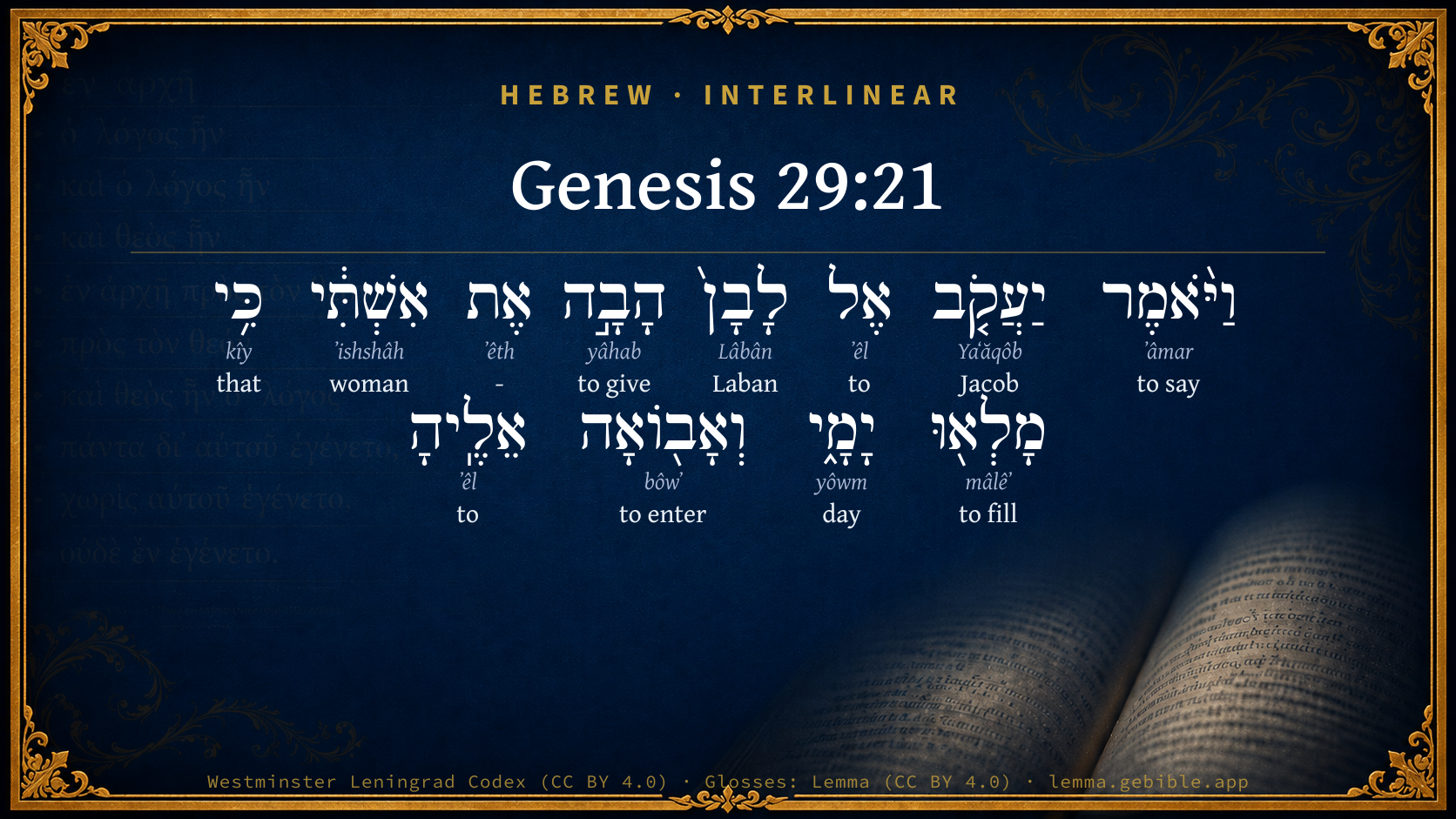
Hebrew (Westminster Leningrad Codex) Genesis 29:21 appears in the Hebrew Old Testament. The text above is from the Westminster Leningrad Codex. Each word links to its Strong’s number, a concise gloss, and parsing drawn from the Open Scriptures Hebrew Bible morphology. Click any word for its full Brown-Driver-Briggs (BDB) entry.
Download image
Cite this verse

Genesis 29:21 (World English Bible). Public Domain. Lemma interlinear Bible study tool, https://lemma.gebible.app/v/genesis/29/21.

Show BibTeX & RIS
BibTeX
RIS
English Translation
Jacob said to Laban, "Give me my wife, for my days are fulfilled, that I may go in to her."
World English Bible · Public Domain
Download a study sheet

One document with this verse’s original text, its word-by-word gloss line, the meaning frame, cross-references with their text, attributed commentary, and full source and license credits — printable, and it pastes into notes with its structure intact.

This verse Autodidact and up

Study sheet (.html) Plain text (.txt)

A passage Seminary Student

Up to 50 verses in one chapter. A passage sheet keeps up to 6 commentary sources and 12 cross-references per verse, in the order this page ranks them, and says so on the sheet whenever that leaves anything out. Ask for a single verse and you get the Autodidact verse sheet above.

Everything on this page stays free to read, with no account — the sheet is a download of what is already on screen, not access to it.

Want to remove ads? Support Godless Engineer
Compare translations 3

The same verse in 3 English versions, stacked beneath the original-language interlinear above. Click any original word for its lexicon entry.

Each is an independent rendering of the whole verse — the interlinear is not word-aligned to these translations.

Highlighted words mark where these versions differ — a whole-verse word diff, not a word-by-word alignment.

  • World English Bible Public Domain
    Jacob said to Laban, "Give me my wife, for my days are fulfilled, that I may go in to her."
  • King James Version Public Domain
    And Jacob said unto Laban, Give me my wife, for my days are fulfilled, that I may go in unto her.
  • unfoldingWord Literal Text CC BY-SA 4.0
    Then Jacob said to Laban, “Give my wife, because my days are completed, so that I may go to her.”

unfoldingWord Literal Text — © unfoldingWord, licensed CC BY-SA 4.0. Word-aligned USFM3 via Door43 (git.door43.org/unfoldingWord/en_ult).

Versions to compare (up to 4)

3 of 4 selected

Show all 18 translations

Every available English version of this verse, each an independent rendering of the whole verse.

  • World English Bible Public Domain
    Jacob said to Laban, "Give me my wife, for my days are fulfilled, that I may go in to her."
  • Berean Standard Bible Public Domain
    Finally Jacob said to Laban, “Grant me my wife, for my time is complete, and I want to sleep with her.”
  • Majority Standard Bible Public Domain
    Finally Jacob said to Laban, “Grant me my wife, for my time is complete, and I want to sleep with her.”
  • King James Version Public Domain
    And Jacob said unto Laban, Give me my wife, for my days are fulfilled, that I may go in unto her.
  • American Standard Version (1901) Public Domain
    And Jacob said unto Laban, Give me my wife, for my days are fulfilled, that I may go in unto her.
  • Revised Version (1885) Public Domain
    And Jacob said unto Laban, Give me my wife, for my days are fulfilled, that I may go in unto her.
  • Geneva Bible (1599) Public Domain
    Then Iaakob sayde to Laban, Giue me my wife, that I may goe in to her: for my terme is ended.
  • Douay-Rheims (1899) Public Domain
    And he said to Laban: Give me my wife; for now the time is fulfilled, that I may go in unto her.
  • Young's Literal Translation Public Domain
    And Jacob saith unto Laban, `Give up my wife, for my days have been fulfilled, and I go in unto her;'
  • Literal Standard Version CC BY-SA 4.0
    And Jacob says to Laban, “Give up my wife, for my days have been fulfilled, and I go in to her”;
  • Unlocked Literal Bible CC BY-SA 4.0
    Then Jacob said to Laban, “Give me my wife, for my days have been completed—so that I may marry her!”
  • unfoldingWord Literal Text CC BY-SA 4.0
    Then Jacob said to Laban, “Give my wife, because my days are completed, so that I may go to her.”
  • Darby Bible Public Domain
    And Jacob said to Laban, Give [me] my wife, for my days are fulfilled, that I may go in to her.
  • World Messianic Bible Public Domain
    Jacob said to Laban, “Give me my wife, for my days are fulfilled, that I may go in to her.”
  • Webster's Bible Public Domain
    And Jacob said to Laban, Give me my wife (for my days are fulfilled) that I may go in to her.
  • Free Bible Version CC BY-SA 4.0
    Then Jacob said to Laban, “I've completed the time we agreed. Now give me your daughter to be my wife.”
  • Bible in Basic English Public Domain
    Then Jacob said to Laban, Give me my wife so that I may have her, for the days are ended.
  • JPS Tanakh (1917) Public Domain
    And Jacob said unto Laban: 'Give me my wife, for my days are filled, that I may go in unto her.'

Literal Standard Version (2020), Covenant Press — licensed CC BY-SA 4.0. Text via the HelloAO Bible API (eBible.org). Unlocked Literal Bible (unfoldingWord) — licensed CC BY-SA 4.0. Text via the HelloAO Bible API (eBible.org). unfoldingWord Literal Text — © unfoldingWord, licensed CC BY-SA 4.0. Word-aligned USFM3 via Door43 (git.door43.org/unfoldingWord/en_ult). Free Bible Version, Dr. Jonathan Gallagher — licensed CC BY-SA 4.0. Text via the HelloAO Bible API (eBible.org).

Word by word

More ways to search: Search by grammar → Find every occurrence → Compare this word →

Practice this passage: Drill this verse → Learn its vocabulary →

הָבָ֣ה
yâhab
H3051
“give”
Verb, Qal, Imperative, 2nd Person, Masculine, Singular + Suffix, h
Part of Speech
Verb
Stem
Qal
Form
Imperative
Person
2nd Person
Gender
Masculine
Number
Singular
Full BDB Definition

Origin: a primitive root

TWOT: 849

to give, provide, ascribe, come - (Qal) - to give - to set, place - to provide (with reflexive) - to ascribe (glory) - to grant, permit, come now
  1. וַיֹּ֨אמֶר ʼâmar H559 “and · to say” Conjunction + Verb, Qal, Sequential Imperfect, 3rd Person, Masculine, Singular
  2. יַעֲקֹ֤ב Yaʻăqôb H3290 “Jacob” Noun, Proper
  3. אֶל ʼêl H413 “to” Preposition
  4. לָבָן֙ Lâbân H3837 “Laban” Noun, Proper
  5. אֶת ʼêth H853 “-” Particle, Direct Object
  6. אִשְׁתִּ֔י ʼishshâh H802 “woman · my” Noun, Common, Feminine, Singular, Construct + Suffix, Personal, 1st Person, Common, Singular
  7. כִּ֥י kîy H3588 “that” Conjunction
  8. מָלְא֖וּ mâlêʼ H4390 “to fill” Verb, Qal, Perfect, 3rd Person, Common, Plural
  9. יָמָ֑י yôwm H3117 “days · my” Noun, Common, Masculine, Plural, Construct + Suffix, Personal, 1st Person, Common, Singular
  10. וְאָב֖וֹאָה bôwʼ H935 “and · to enter” Conjunction + Verb, Qal, Cohortative, 1st Person, Common, Singular
  11. אֵלֶֽיהָ ʼêl H413 “to · her” Preposition + Suffix, Personal, 3rd Person, Feminine, Singular

About this verse

These counts appear in no published source. They are computed here, from the morphology-tagged text and Lemma’s own curated glosses. What Lemma adds →

12
words
11
distinct lemmas
Pentateuch
section

Shared distinctive vocabulary

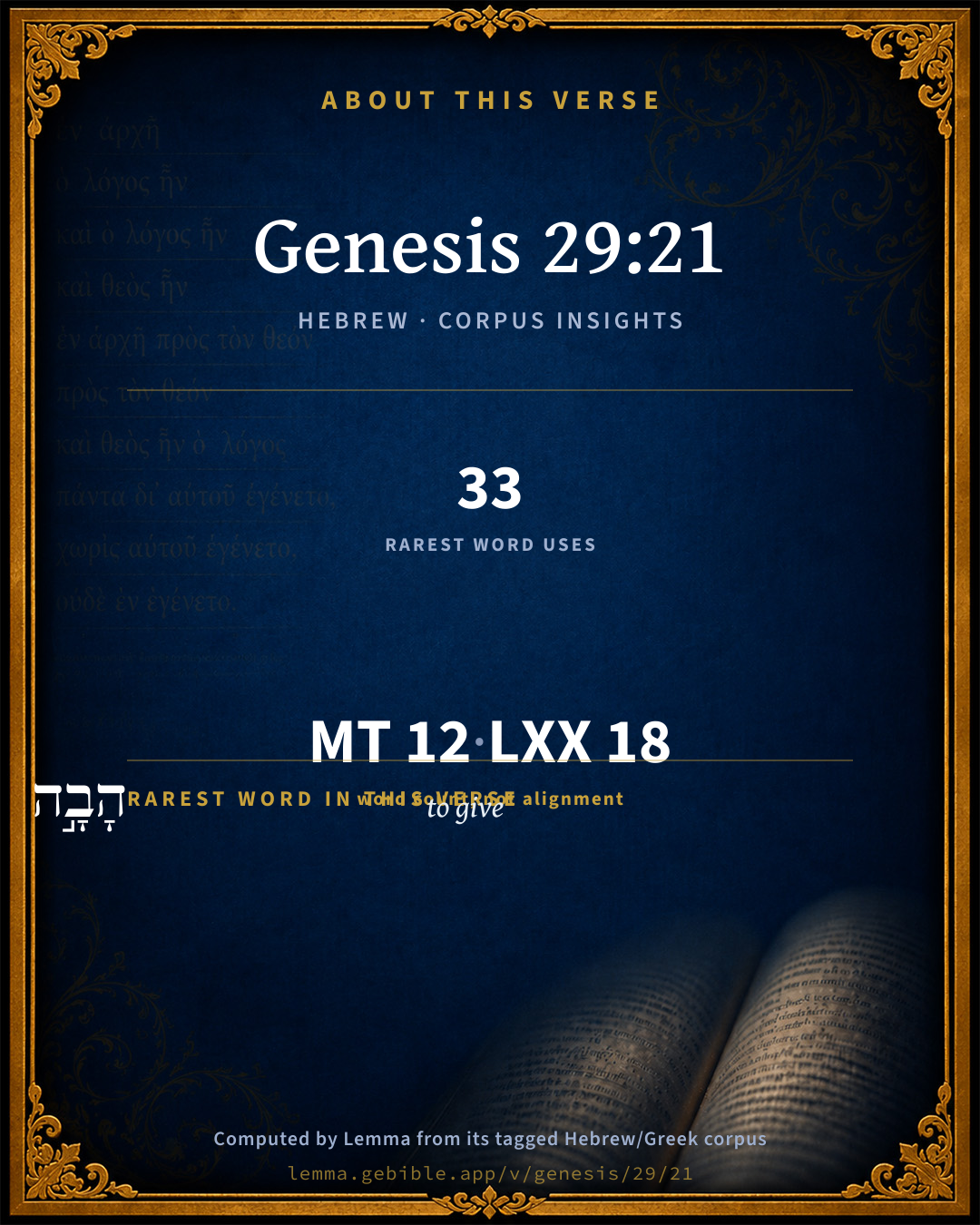
הָבָ֣ה to give H3051 occurs in 29 verses of the Hebrew Bible. Also found in:

Grammatical profile

  • 4 verbs
  • 4 nouns
  • 2 prepositions
  • 1 conjunction
  • 1 particle

Verb forms

  • וַיֹּ֨אמֶר Qal · Sequential Imperfect
  • הָבָ֣ה Qal · Imperative
  • מָלְא֖וּ Qal · Perfect
  • וְאָב֖וֹאָה Qal · Cohortative

Repetition

A word recurs within this verse — often emphatic in Hebrew:

  • אֶל to H413 ×2

Hebrew & Septuagint length

In English translation the verse runs 20 words from the Hebrew and 21 from the Septuagint (LXX English) — closely comparable.

A rough comparison of the two English renderings, which tokenize alike — not a word-level alignment.

Word counts can differ between the Hebrew and the Greek without any difference in meaning — e.g. the Hebrew direct-object marker אֵת has no separate Greek word, and Greek often adds the article ὁ.

In the original languages it is 12 Hebrew tokens and 18 Greek tokens — but the two are counted differently (Hebrew bundles its prefixes and suffixes into one token; the Greek is in lemma form), so that isn’t a like-for-like length.

Cross-references

7

Topical passages linked to Genesis 29:21 in the Treasury of Scripture Knowledge — connected by theme and wording, ordered by reader-vote popularity; previews shown in the World English Bible.

  • Judges 15:1 But it happened after a while, in the time of wheat harvest, that Samson visited his wife with a kid; and he said, I will go in to my wife into the chamber. But her father wouldn't allow him to go in.
  • Genesis 4:1 The man knew Eve his wife. She conceived, and gave birth to Cain, and said, "I have gotten a man with Yahweh's help."
  • Genesis 29:18 Jacob loved Rachel. He said, "I will serve you seven years for Rachel, your younger daughter."
  • Genesis 29:20 Jacob served seven years for Rachel. They seemed to him but a few days, for the love he had for her.
  • Genesis 31:41 These twenty years have I been in your house. I served you fourteen years for your two daughters, and six years for your flock, and you have changed my wages ten times.
  • Genesis 38:16 He turned to her by the way, and said, "Please come, let me come in to you:" for he didn't know that she was his daughter-in-law. She said, "What will you give me, that you may come in to me?"
  • Matthew 1:18 Now the birth of Jesus Christ was like this; for after his mother, Mary, was engaged to Joseph, before they came together, she was found pregnant by the Holy Spirit.

Cross-references courtesy of OpenBible.info (CC BY 4.0).

Hebrew and Greek witnesses Masoretic Hebrew ↔ Greek Septuagint

The same verse in the two great witnesses to the Old Testament, shown verse-for-verse.

These are two independent witnesses, not word-aligned to each other, and the Septuagint is shown in lemma (dictionary) form.

Hebrew Genesis 29:21 Masoretic · Westminster Leningrad Codex

וַיֹּ֨אמֶר יַעֲקֹ֤ב אֶל לָבָן֙ הָבָ֣ה אֶת אִשְׁתִּ֔י כִּ֥י מָלְא֖וּ יָמָ֑י וְאָב֖וֹאָה אֵלֶֽיהָ

Jacob said to Laban, "Give me my wife, for my days are fulfilled, that I may go in to her."

World English Bible · Public Domain

Greek LXX Genesis 29:21 Septuagint · lemma form

εἶπον δέ ἰακώβ πρός λαβαν ἀποδίδωμι ὁ γυνή ἐγώ πληρόω γάρ ὁ ἡμέρα ἐγώ ὅπως εἰςἔρχομαι πρός αὐτός

And Jacob said to Laban, Give me my wife, for my days are fulfilled, that I may go in to her.

LXX2012 (modern English Septuagint) · Public Domain

Hebrew: Westminster Leningrad Codex (CC BY 4.0). Greek: Septuagint (public domain); English from LXX2012 (modern English Septuagint) (Public Domain). How the Septuagint differs from the Hebrew →

Targum (Aramaic paraphrase)

2

The Targum is the ancient Jewish Aramaic paraphrase of the Hebrew Scriptures — an interpretive translation, not the Hebrew text itself. Onkelos (literal) and Pseudo-Jonathan (expansive) render the Torah, and Jonathan the Prophets. Coverage is partial: where no permissively-licensed English translation exists for a verse, only the Aramaic is shown. This is verse-level text, not a word-by-word alignment to the Hebrew.

  1. Targum Onkelos Torah (Genesis–Deuteronomy)
    וַאֲמַר יַעֲקֹב לְלָבָן הַב יָת אִתְּתִי אֲרֵי אַשְׁלֵמִית יוֹמֵי פָלְחָנִי וְאֵעוֹל לְוָתַהּ

    (no public-domain English translation for this verse)

    Targum Onkelos — Aramaic: “Onkelos Genesis” (public domain); “Onkelos Exodus” (public domain); “Onkelos Leviticus” (public domain); “Onkelos Numbers” (public domain); “Onkelos Deuteronomy” (public domain). English: “Sefaria Community Translation” (CC0 1.0 (public-domain dedication)); “J.W. Etheridge. The Targums of Onkelos and Jonathan Ben Uzziel on the Pentateuch. London: Longmans, Green, 1862” (public domain). Text via Sefaria.

  2. Targum Pseudo-Jonathan Torah (Genesis–Deuteronomy)
    וַאֲמַר יַעֲקב לְלָבָן הַב יַת אִנְתְּתִי אֲרוּם אַשְׁלִימוּ יוֹמֵי פּוּלְחָנִי וְאֵיעוֹל לְוָותָהּ

    And Jakob said to Laban, Give me my wife: for the days of my service are completed, and I will go in with her.

    Targum Pseudo-Jonathan — Aramaic: “Targum Jonathan on Genesis” (public domain); “Targum Jonathan on Exodus” (public domain); “Targum Jonathan on Leviticus” (public domain); “Targum Jonathan on Numbers” (public domain); “Targum Jonathan on Deuteronomy” (public domain). English: “The Targum of Jonathan ben Uzziel, trans. J. W. Etheridge, London, 1862” (public domain). Text via Sefaria.

Commentary

Notes on Genesis 29:21 from classic Christian and Jewish commentators (each source and its license shown beneath its notes). The classic Christian expositions comment on the surrounding passage and are grouped to its opening verse, so a note may address several verses; the Jewish commentaries on the Tanakh (Rashi and others) are per-verse, so they appear only where the commentator wrote on this verse.

Lemma curates 59 commentaries, every one of them public domain or Creative Commons licensed, each selected and text-cleaned for this edition rather than reprinted as found. About our sources →

Trapp's Complete Commentary

John Trapp

Gen 29:21 And Jacob said unto Laban, Give [me] my wife, for my days are fulfilled, that I may go in unto her.

Ver. 21. Give me my wife, for my days, &c.] Jacob had served out his time, and now demands his due. David also is said to have "served the will of God, for his own age"; {Act 13:36} and John Baptist to have "fulfilled his course". {Act 13:25} "Moses also was faithful in all God’s house, as a servant". {Heb 3:2} Yet these could not call for heaven as their wages, because they were (as the best are, at their best) but "unprofitable servants," {Luk 17:10} and did not, in any measure, what their duty was to do. We have not a bit of bread of our own earning; and are therefore taught to pray, "Give us this day our daily bread": we get our living by begging. Our best plea is, Domine, non sum dignus, nihi - lominus tamen sum indigens :Lord, I am not worthy, but I am needy, as Pomeran said. Then will God, of his free grace, supply all our necessities, and "afterwards receive us to glory." He will bring us into the bride chamber of heaven, and there will he give us his loves. He will let out himself into us, to our infinite delight. Of all natural delights, that of marriage is the greatest, because there is the greatest communication of one creature to another; and according to the degrees of communication are the degrees of delight. Think the same in the mystical marriage.

John Trapp, A Commentary or Exposition upon All the Books of the Old and New Testament (1647–1656) — public domain. Text from a community e-Sword module.

The Biblical Illustrator

Joseph S. Exell

Gen_29:21-28

He took Leah his daughter, and brought her to him

Labans fraud on Jacob

I.

THE CHARACTER OF THE FRAUD.

1. Deliberate.

2. Bold.

3. Selfish.

II. THE FRAUD CONSIDERED AS A RETRIBUTION. There are sins which in this world are often punished in kind. (T. H. Leale.)

Lessons

1. The day revealeth that evil usually which the night covereth, sin may hide itself a little while till the morning.

2. Seeming Rachel over night is found Leah in the morning. Fair offers to be deceits.

3. Honest souls, though drawn into error, are full of indignation against it, and the cursors of it when discovered.

4. Plain covenant work is sufficient to convince deceivers that forsake 2:5. Service for Rachel should have Rachel for its reward.

6. It is gross falsehood and deceit to deny covenant reward, and adulterate it with worse (Gen_2:25). (G. Hughes, B. D.)

Labans deceit

This discloses a baseness in Labans character, arousing contempt and aversion; but it ought not to blind us against the redeeming qualities of his heart. In the human mind, fragrant flowers often blossom surprisingly by the side of noxious weeds. The deceit of Laban was practicable, on account of the custom by which the bride is, on the day of marriage, conducted veiled to her future husband. (M. M. Kalisch, Ph. D.)

Evil result of Labans fraud

But the fraud of Laban was not only a moral offence in itself; it was the more deplorable, as it destroyed the principle of monogamy to which the patriarchs on the whole adhered. Jacob had intended to marry Rachel alone; and when he found himself, against his will, allied with Leah, his heart could not renounce her from whom he expected the best part of his happiness; he took her to wife besides Leah; nor was he permitted to dismiss the latter after the solemnization of the marriage. (M. M. Kalisch, Ph. D.)

The Biblical Illustrator, edited by Joseph S. Exell (c. 1880s–1900s) — public domain. Text from a community e-Sword module.

The Preacher's Complete Homiletical Commentary

Joseph S. Exell (gen. ed.)

CRITICAL NOTES.—

Gen_29:23. He took Leah, his daughter, and brought her to him.] “The fraud was rendered possible by the Eastern custom of the bride being veiled, aided by the darkness of the night.” (Alford.)—

Gen_29:27. Fulfil her week.] “Attach thyself to her during the accustomed days of the wedding-feast” (Jdg_14:12; Tob_11:18.) Alford.

MAIN HOMILETICS OF THE PARAGRAPH.—Gen_29:21-28

LABAN’S FRAUD ON JACOB

I. The character of the fraud. Jacob had served for his wife, and now demands her as his just right. When the time came for the bride to be conducted to the marriage chamber, Laban substitutes Leah for Rachel. It was not difficult to carry out this deception, as it was evening and the bride was conducted to the chamber of the husband closely veiled. In the morning Jacob discovered the fraud, and complained, “Did not I serve with thee for Rachel? Wherefore then hast thou beguiled me?” (Gen_29:25.) This fraud was,

1. Deliberate. It was not the result of sudden temptation by which a man is overtaken in a fault, but was quite in accordance with the settled habits and principles of Laban’s character. He was a covetous and scheming man, and had little scruple in demanding the services of a helpless relative under plausible professions of disinterestedness.

2. Bold. Laban attempts to justify his conduct by a reference to the custom of the country. (Gen_29:26.) But, why did he not mention this objection before, and why did he promise that which he considered he ought not to perform? He is bold and daring in the defence of his conduct as he was crafty in designing it.

3. Selfish. He proposes to give him Rachel when another week is fulfilled. (Gen_29:27.) Jacob’s labours were very valuable to him, and this was a shrewd device to bind Jacob for a longer term of service.

II. The fraud considered as a retribution. Jacob had deceived his own father, and now he is himself deceived. The measure which he meted is measured to him again. The sheep of God’s pasture may be found and restored, but they are often brought back wounded and lacerated, and smarting from the effects of their own folly and sin. Jacob who had deceived is now, in turn, overreached. Leah also deceived her husband, and as a natural consequence lost his affections. There are sins which in this world are often punished in kind. “Be sure your sin will find you out.” (Num_32:23).

SUGGESTIVE COMMENTS ON THE VERSES

Gen_29:21-22. Laban, like some in their gifts to God, is not wanting in ceremony. He “made a feast,” gave his daughter a hand-maid, and went through all the forms; but the gift was a deception.—(Fuller).

Gen_29:23. According to the custom of those eastern nations, the bride was conducted to the bed of her husband, with silence, in darkness, and covered from head to foot with a veil; circumstances all of them favourable to the wicked, selfish plan which Laban had formed to detain his son-in-law longer in his service. He who employed undue advantage to arrive at the right of the first-born has undue advantage taken of him in having the first-born put in place of the younger. He who could practise on a father’s blindness, though to obtain a laudable end, is, in his turn, practised upon by a father, employing the cover of the night to accomplish a very unwarrantable purpose.—(Hunter.)

God pays us often in our own coin, Herod mocked the wise men, and is mocked of them. (Mat_2:16.) And how oft do we see those that would beguile others, punished with illusion? God usually retaliates, and proportions jealousy to jealousy, provocation to provocation (Deu_32:21,) number to number (Isa_65:11-12,) choice to choice (Isa_66:3-4,) device to device (Mic_2:1; Mic_2:3,) frowardness to frowardness (Psa_18:26,) contrariety to contrariety (Lev_26:21.) Even the righteous shall be recompensed in the earth (Pro_11:31,) as was Jacob.—(Trapp.)

Gen_29:24. It is still customary in the East for a father, who can afford it, to transfer to his daughter, on her marriage, some female slave of the household, who becomes her confidential domestic and humble friend. This slave forms a link between the old and new households, which often proves irksome, but he has little, if any, control over the female slaves in his establishment.—(Bush.)

Gen_29:25-26. A foul disappointment, but so the world ever serves us. The Hebrews have taken up this passage for a proverb, when a man’s hopes are deceived in a wife, or anything else, wherein he looked for content or comfort.—(Trapp.)

But he received, notwithstanding his ignorance as to Leah, the wife designed for him by God, who was to become the mother of the Messiah, just as Isaac blessed him unwittingly as the rightful heir of the promise. Ah, in how many errors and follies of man, here and everywhere, do we find God’s inevitable grace and faithfulness intertwined.—(Ross.)

Gen_29:27-28. And now he must begin a new hope, where he made account of fruition. To raise up an expectation, once frustrate, is more difficult than to continue a long hope drawn on with likelihoods of performance; yet thus dear is Jacob content to pay for Rachel fourteen year’s servitude. Commonly, God’s children come not easily by their pleasures. What miseries will not love digest and overcome? And if Jacob were willingly consumed with heat in the day, and frost in the night, to become the son-in-law to Laban, what should we refuse to be the sons of God?—(Bishop Hall).

Jacob’s service for Rachel presents us a picture of bridal love equalled only in the same development and its poetic beauty in the Song of Solomon. It is particularly to be noticed that Jacob, however, was not indifferent to Rachel’s infirmities (Gen_30:2), and even treated Leah with patience and indulgence, through having suffered from her the most mortifying deception.—(Lange).

The Preacher's Complete Homiletical Commentary (gen. ed. Joseph S. Exell; Funk & Wagnalls, c. 1892) — public domain (pre-1929). A full-Bible homiletical/sermon-outline anthology covering 65 of 66 books (2 John is absent from the source module). Text from a community e-Sword module.

Geneva Bible (1599)

Geneva Bible translators

Hebrew, my days are full.

Geneva Bible (1599) marginal notes — public domain. Text via Bolls.life.

Jamieson, Fausset & Brown

Robert Jamieson, A. R. Fausset & David Brown

Jacob said, Give me my wife--At the expiry of the stipulated term the marriage festivities were held. But an infamous fraud was practised on Jacob, and on his showing a righteous indignation, the usage of the country was pleaded in excuse. No plea of kindred should ever be allowed to come in opposition to the claim of justice. But this is often overlooked by the selfish mind of man, and fashion or custom rules instead of the will of God. This was what Laban did, as he said, "It must not be so done in our country, to give the younger before the first-born." But, then, if that were the prevailing custom of society at Haran, he should have apprized his nephew of it at an early period in an honorable manner. This, however, is too much the way with the people of the East still. The duty of marrying an elder daughter before a younger, the tricks which parents take to get off an elder daughter that is plain or deformed and in which they are favored by the long bridal veil that entirely conceals her features all the wedding day, and the prolongation for a week of the marriage festivities among the greater sheiks, are accordant with the habits of the people in Arabia and Armenia in the present day.

Jamieson, Fausset & Brown — Commentary Critical and Explanatory on the Whole Bible (1871) — public domain (CC PDM 1.0). Text via the HelloAO Bible API.

Adam Clarke's Commentary

Verse 21. My days are fulfilled] My seven years are now completed, let me have my wife, for whom I have given this service as a dowry.

Adam Clarke's Commentary on the Bible (1810–1826) — public domain. Text from a community e-Sword/MySword module.

Ellicott's Commentary for English Readers

(21) My days are fulfilled.—That is, the appointed time of service is completed. It was undeniably at the end of the seven years that the marriage took place.

A Bible Commentary for English Readers, edited by Charles John Ellicott (1878–1897) — public domain. Text from a community e-Sword module.

John Gill's Exposition

And Jacob said unto Laban, give me my wife,.... Meaning Rachel, who was his wife by contract; the conditions of her being his wife were now fulfilled by him, and therefore he might challenge her as his wife:

for my days are now fulfilled; the seven years were up he agreed to serve him for his daughter; and therefore it was but just and right she should be given him:

that I may go in unto her; as his lawful wife, and it was high time Jacob had her; for he was now, as the Jewish writers generally say (n), and that very rightly, eighty four years of age; and from him were to spring twelve princes, the heads of twelve tribes, which should inhabit the land of Canaan.

(n) Bereshit Rabba, sect. 70. fol. 63. 1. Jarchi in loc. and others.

John Gill's Exposition of the Whole Bible (1746–1763) — public domain (CC PDM 1.0). Text via the HelloAO Bible API.

Haydock's Catholic Bible Commentary

Go in, &c. To consummate my marriage; (Menochius) as the time is expired. (Haydock)

George Leo Haydock (1774–1849), Haydock's Catholic Family Bible and Commentary, 1859 edition — public domain. Excludes Psalms (Douay-Rheims chapter numbering differs from Protestant) and Deuterocanonical books (Catholic canon only).

Matthew Poole's English Annotations

[1753]

Give me my wife; so she was by promise and contract; persons betrothed or espoused being oft called wives in Scripture, as Mt 1:18,20; Lu 2:5.

My days are fulfilled, the seven years of service agreed upon, Ge 29:18.

Matthew Poole's English Annotations on the Holy Bible (1683–1685) — public domain. Text from a community e-Sword/MySword module.

The Pulpit Commentary

And Jacob said unto Laban (who, though the term of servitude had expired, appeared to be in no haste to implement his part of the bargain), Give me my wife (i.e. my affianced wife, as in Deu_22:23, Deu_22:24; Mat_1:20) for my days are fulfilled (i.e. my term of service is completed), that I may go in unto herquo significant intactam adhuc esse virginem (Calvin); a proof that Jacob"s love was pure and true.

The Pulpit Commentary (1880–1919), ed. H.D.M. Spence-Jones & Joseph S. Exell — public domain. Text from a community e-Sword module.

Keil & Delitzsch

C. F. Keil & F. Delitzsch

But when Jacob asked for his reward at the expiration of this period, and according to the usual custom a great marriage feast had been prepared, instead of Rachel, Laban took his elder daughter Leah into the bride-chamber, and Jacob went in unto her, without discovering in the dark the deception that had been practised. Thus the overreacher of Esau was overreached himself, and sin was punished by sin.

Keil & Delitzsch — Biblical Commentary on the Old Testament (1861–1891) — public domain (CC PDM 1.0). Text via the HelloAO Bible API. (Old Testament only.)

Kretzmann's Popular Commentary

Paul E. Kretzmann

Jacob Marries Leah and Rachel

v. 21. And Jacob said unto Laban, at the end of the seven years, Give me my wife, for my days are fulfilled, that I may go in unto her. Note that he calls Rachel his wife, although only engaged to her, for a rightful betrothal is as binding as marriage in the sight of God.

v. 22. And Laban gathered together all the men of the place, and made a feast. He arranged the customary marriage-festival, making it as splendid as his wealth allowed.

v. 23. And it came to pass in the evening that he took Leah, his daughter, and brought her to him; and he went in unto her. This deception on Laban’s part could be carried out all the more easily, since custom required that the bride be heavily veiled when led to the bridegroom and to the bridal chamber.

v. 24. And Laban gave unto his daughter Leah Zilpah, his maid, for an handmaid. This fact is here expressly mentioned on account of later developments.

v. 25. And it came to pass that, in the morning, behold, it was Leah; and he said to Laban, What is this thou hast done unto me? Did not I serve with thee for Rachel? Wherefore, then, hast thou beguiled me? While the fraud which was practiced upon Jacob may, in a sense, be regarded as a just punishment, his reproof of Laban was nevertheless fully justified, and he might well, according to the contract, have dismissed Leah.

v. 26. And Laban said, It must not be so done in our country, to give the younger-afore the first-born. Granted that this was an established custom in the place, or district, where Laban was living, his excuse was still a flimsy pretext, for his business would have been to acquaint Jacob with that custom at the time the contract was made His selfish motives, especially his avarice, here came to the surface, even as it was in evidence more and more in the succeeding years.

v. 27. Fulfill her week, and we will give thee this also for the service which thou shalt serve with me yet seven other years. The nuptial feast lasting seven days, Jacob was to confirm marriage with Leah by accepting her as his wife during this time. In the second week he was then given Rachel as his wife, with the understanding that he would serve another seven years for her, thus really paying a greater price than he owed.

v. 28. And Jacob did so, and fulfilled her week; and he gave him Rachel, his daughter, to wife also. On either aide, sinful weaknesses had played a role and therefore Jacob’s married life in more than one instance became a school of afflictions.

v. 29. And Laban gave to Rachel, his daughter, Bilhah, his handmaid, to be her maid. This fact is also expressly stated on account of later developments.

v. 30. And he went in also unto Rachel, and he loved also Rachel more than Leah, and served with him yet seven other years. That bigamy, polygamy, is a perversion of God’s original order, since marriage is to be a monogamy, the union of one man and one woman, appears even here, for it was impossible for Jacob to distribute his affections with impartiality. In spite of the fact, therefore, that the blessing of God upon Abraham made use also of these means to make of the descendants of Abraham a great nation, it is clear, nevertheless, that much of the subsequent trouble was due to this unnatural arrangement.

Paul E. Kretzmann, Popular Commentary of the Bible (1921–1924) — public domain. Text from a community e-Sword module.

unfoldingWord translationNotes

Door43 World Missions Community

Give me my wife, for my days have been completed—so that I may marry her!

The phrase "have been completed" can be stated in active form. The statement is emphatic. AT: Give me my wife, so that I may marry her, for I have completed the length of time that I was to work for you!"Give me Rachel so that I may marry her, for I have worked seven years for you!" (See: Active or Passive)

made a feast

"prepared a wedding feast." Most likely Laban had others prepare the feast. AT: "had others prepare a wedding feast" (See: Metonymy)

translationWords

Laban

feast

unfoldingWord translationNotes — © Distant Shores Media and the Door43 World Missions Community, licensed CC BY-SA 4.0. Source: git.door43.org/Door43/en_tn.

Rashi

Rabbi Shlomo Yitzchaki (Rashi)

מלאו ימי MY DAYS ARE FULFILLED — which my mother told me to remain with you. And another explanation is: MY DAYS ARE FULFILLED for I am now eighty-four years old and when shall I beget twelve tribes? That is what he meant by adding “that I may go in unto her”; for surely even the commonest of people would not use such an expression. But he said this because his mind was intent upon having issue (to fulfil his mission of rearing children who would carry on the religious traditions of his fathers) (Genesis Rabbah 70:18).

Rashi on the Tanakh — English translations: “The Judaica Press complete Tanach with Rashi, translated by A. J. Rosenberg” (CC BY 4.0); “Pentateuch with Rashi's commentary by M. Rosenbaum and A.M. Silbermann, 1929-1934” (public domain); “The Metsudah Tanach series, Lakewood, N.J” (CC BY 4.0); and “The Book of Joshua, Metsudah Publications, 1997” (CC BY 4.0). Text via Sefaria.

Ramban (Nachmanides)

Rabbi Moshe ben Nachman (Ramban / Nachmanides)

FOR MY DAYS ARE FULFILLED. This means “the time which my mother told me to remain away from home.” Another explanation is: For my days are fulfilled — “I am now eighty-four years old and when shall I beget twelve tribes?” These are the words of Rashi.

Ramban (Nachmanides) on the Tanakh — English translation: “Commentary on the Torah by Ramban (Nachmanides). Translated and annotated by Charles B. Chavel. New York, Shilo Pub. House, 1971-1976” (CC BY 4.0). Text via Sefaria.

Lesson kit

Teaching starters — assembled from the data on this page, not authored interpretation. Every prompt links to the verse data it draws on. Edit before teaching.

Genesis, in the Pentateuch, opens this verse with 12 words (11 distinct Hebrew lemmas). Its most distinctive word is yâhab (“to give”). A historical commentator’s framing appears above. Read the whole chapter for the surrounding context.

Discussion questions

  1. How does “to give” (yâhab) shape what this verse is saying?
  2. Genesis 11:3 shares the word «to give» with this verse. How do the two illuminate each other?
  3. “to” occurs 2× in this one verse. What is the effect of the repetition?
  4. These translations render this verse differently. What is at stake in choosing one wording over another?
  5. The verb «וַיֹּ֨אמֶר» is Qal Sequential Imperfect. How does its form color the action?
  6. Reading how Trapp's Complete Commentary and The Biblical Illustrator read this verse, where do the two commentators agree and where do they part?

Things to notice

Reading settings

Reading text

Shown beneath each verse's original-language words.

Old Testament
Old Testament edition

Read the OT as the Masoretic Hebrew (MT) or the Greek Septuagint (LXX).

English shown for the Greek Septuagint (in the Hebrew ↔ Greek comparison).

Comparing translations? Open the Compare panel on any verse page to stack up to four side by side.