Genesis 45:19

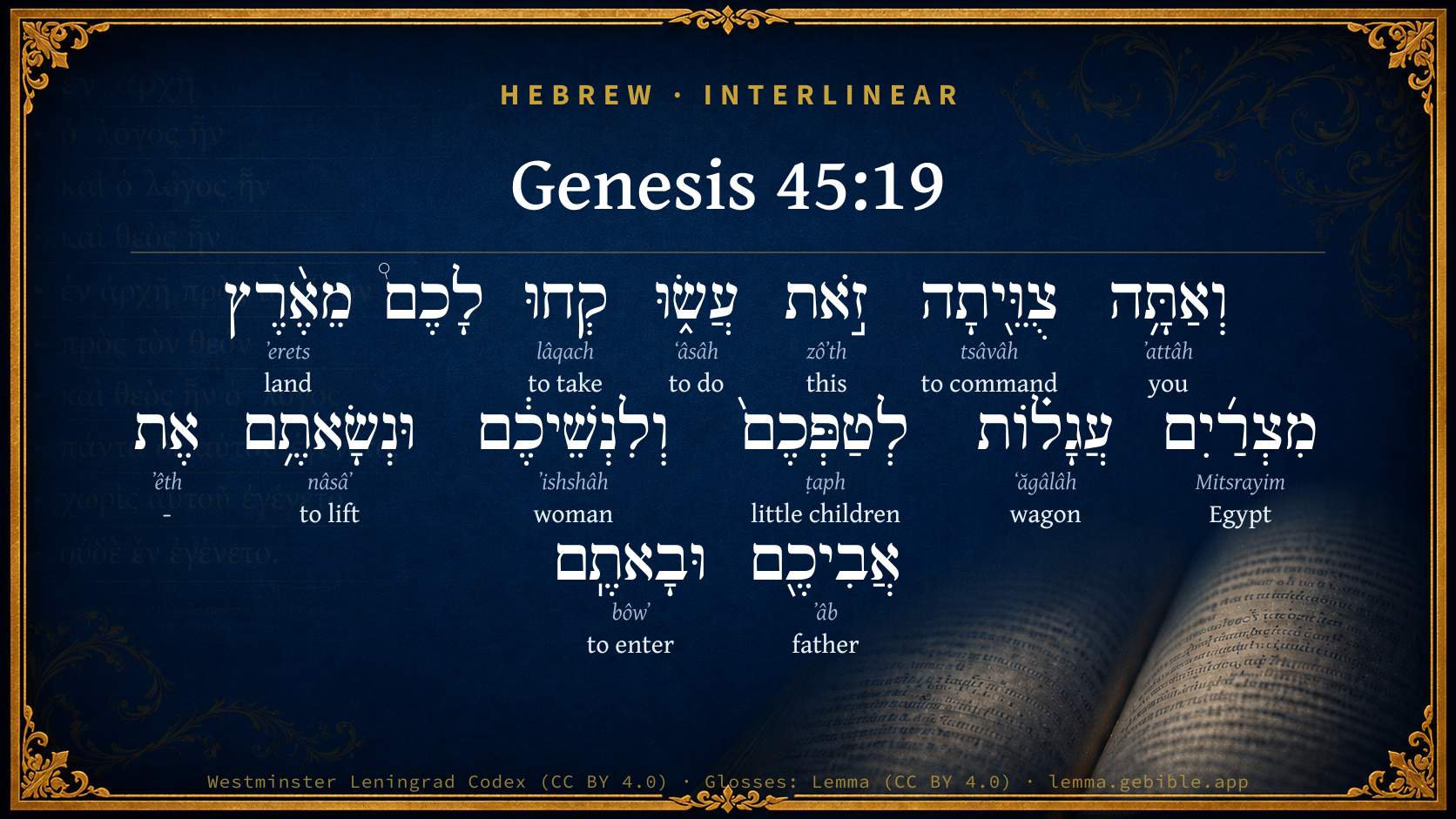
Hebrew (Westminster Leningrad Codex) Genesis 45:19 appears in the Hebrew Old Testament. The text above is from the Westminster Leningrad Codex. Each word links to its Strong’s number, a concise gloss, and parsing drawn from the Open Scriptures Hebrew Bible morphology. Click any word for its full Brown-Driver-Briggs (BDB) entry.
Download image
Cite this verse

Genesis 45:19 (World English Bible). Public Domain. Lemma interlinear Bible study tool, https://lemma.gebible.app/v/genesis/45/19.

Show BibTeX & RIS
BibTeX
RIS
English Translation
Now you are commanded: do this. Take wagons out of the land of Egypt for your little ones, and for your wives, and bring your father, and come.
World English Bible · Public Domain
Highlights
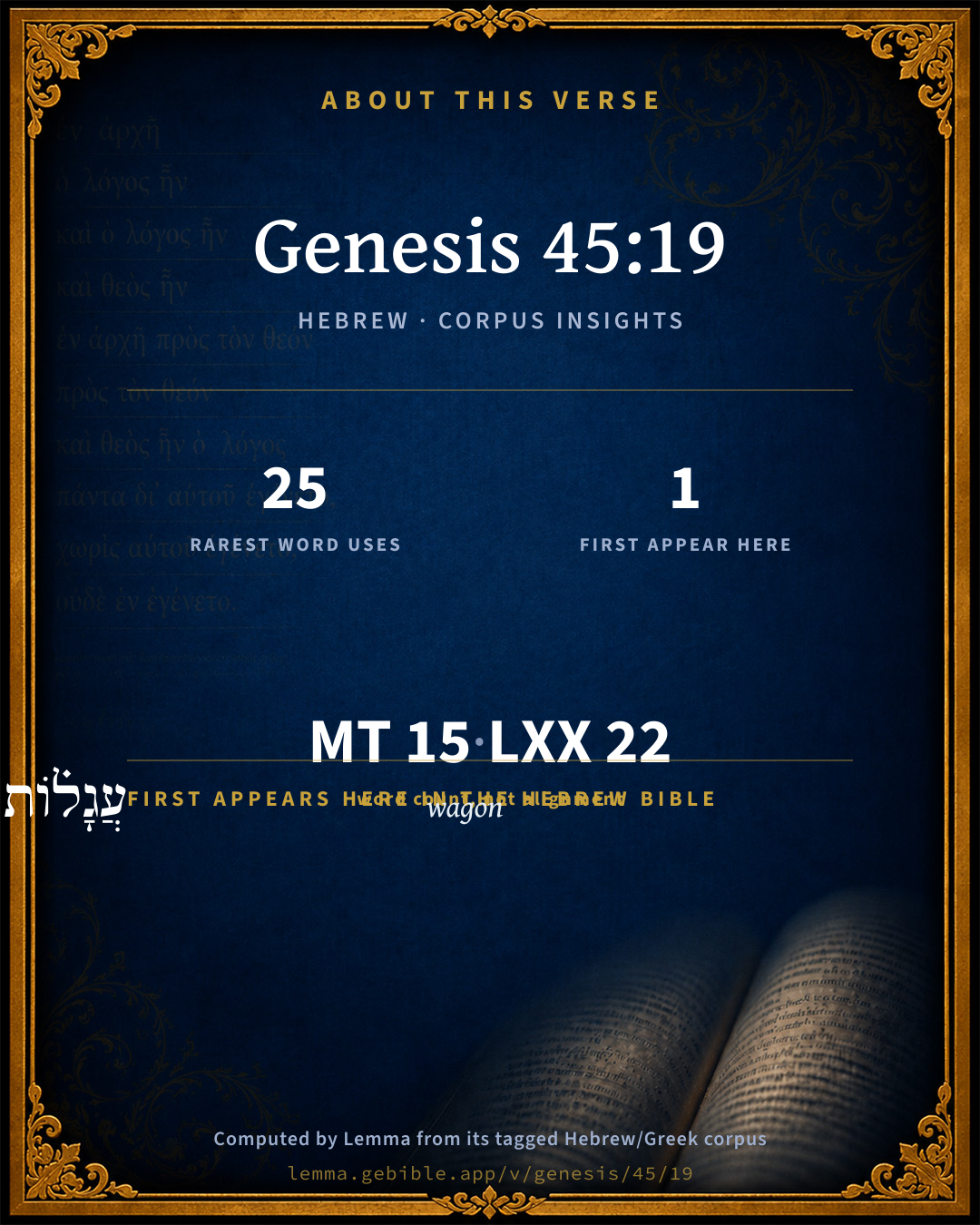
  • 1 first appearance in the Hebrew Bible
Full analysis ↓
Download a study sheet

One document with this verse’s original text, its word-by-word gloss line, the meaning frame, cross-references with their text, attributed commentary, and full source and license credits — printable, and it pastes into notes with its structure intact.

This verse Autodidact and up

Study sheet (.html) Plain text (.txt)

A passage Seminary Student

Up to 50 verses in one chapter. A passage sheet keeps up to 6 commentary sources and 12 cross-references per verse, in the order this page ranks them, and says so on the sheet whenever that leaves anything out. Ask for a single verse and you get the Autodidact verse sheet above.

Everything on this page stays free to read, with no account — the sheet is a download of what is already on screen, not access to it.

Want to remove ads? Support Godless Engineer
Compare translations 3

The same verse in 3 English versions, stacked beneath the original-language interlinear above. Click any original word for its lexicon entry.

Each is an independent rendering of the whole verse — the interlinear is not word-aligned to these translations.

Highlighted words mark where these versions differ — a whole-verse word diff, not a word-by-word alignment.

  • World English Bible Public Domain
    Now you are commanded: do this. Take wagons out of the land of Egypt for your little ones, and for your wives, and bring your father, and come.
  • King James Version Public Domain
    Now thou art commanded, this do ye; take you wagons out of the land of Egypt for your little ones, and for your wives, and bring your father, and come.
  • unfoldingWord Literal Text CC BY-SA 4.0
    And you are commanded, ‘Do this: Take carts with you from the land of Egypt for your little ones and for your wives, and get your father and come.

unfoldingWord Literal Text — © unfoldingWord, licensed CC BY-SA 4.0. Word-aligned USFM3 via Door43 (git.door43.org/unfoldingWord/en_ult).

Versions to compare (up to 4)

3 of 4 selected

Show all 18 translations

Every available English version of this verse, each an independent rendering of the whole verse.

  • World English Bible Public Domain
    Now you are commanded: do this. Take wagons out of the land of Egypt for your little ones, and for your wives, and bring your father, and come.
  • Berean Standard Bible Public Domain
    You are also directed to tell them: ‘Take wagons from the land of Egypt for your young children and your wives, and bring your father and come back.
  • Majority Standard Bible Public Domain
    You are also directed to tell them: ‘Take wagons from the land of Egypt for your young children and your wives, and bring your father and come back.
  • King James Version Public Domain
    Now thou art commanded, this do ye; take you wagons out of the land of Egypt for your little ones, and for your wives, and bring your father, and come.
  • American Standard Version (1901) Public Domain
    Now thou art commanded, this do ye: take you wagons out of the land of Egypt for your little ones, and for your wives, and bring your father, and come.
  • Revised Version (1885) Public Domain
    Now thou art commanded, this do ye; take you wagons out of the land of Egypt for your little ones, and for your wives, and bring your father, and come.
  • Geneva Bible (1599) Public Domain
    And I commaund thee, Thus doe ye, take you charets out of the lande of Egypt for your children, and for your wiues, and bring your father and come.
  • Douay-Rheims (1899) Public Domain
    Give orders also that they take wagons out of the land of Egypt, for/ the carriage of their children and their wives: and say: Take up your father, and make haste to come with all speed:
  • Young's Literal Translation Public Domain
    `Yea, thou -- thou hast been commanded: this do ye, take for yourselves out of the land of Egypt, waggons for your infants, and for your wives, and ye have brought your father, and come;
  • Literal Standard Version CC BY-SA 4.0
    Indeed, you have been commanded: this you do, take for yourselves out of the land of Egypt, wagons for your infants, and for your wives, and you have brought your father, and come;
  • Unlocked Literal Bible CC BY-SA 4.0
    Now you are commanded, 'Do this, take carts out of the land of Egypt for your children and for your wives. Get your father and come.
  • unfoldingWord Literal Text CC BY-SA 4.0
    And you are commanded, ‘Do this: Take carts with you from the land of Egypt for your little ones and for your wives, and get your father and come.
  • Darby Bible Public Domain
    And thou art commanded -- this do: take waggons out of the land of Egypt for your little ones and for your wives, and take up your father, and come.
  • World Messianic Bible Public Domain
    Now you are commanded to do this: Take wagons out of the land of Egypt for your little ones, and for your wives, and bring your father, and come.
  • Webster's Bible Public Domain
    Now thou art commanded, this do ye; take for yourselves wagons from the land of Egypt for your little ones, and for your wives, and bring your father, and come.
  • Free Bible Version CC BY-SA 4.0
    Tell them to do this as well: ‘Take some wagons from Egypt for your children and your wives. Bring them and your father here.
  • Bible in Basic English Public Domain
    And say to them, This you are to do: take carts from the land of Egypt for your little ones and for your wives, and get your father and come back.
  • JPS Tanakh (1917) Public Domain
    Now thou art commanded, this do ye: take you wagons out of the land of Egypt for your little ones, and for your wives, and bring your father, and come.

Literal Standard Version (2020), Covenant Press — licensed CC BY-SA 4.0. Text via the HelloAO Bible API (eBible.org). Unlocked Literal Bible (unfoldingWord) — licensed CC BY-SA 4.0. Text via the HelloAO Bible API (eBible.org). unfoldingWord Literal Text — © unfoldingWord, licensed CC BY-SA 4.0. Word-aligned USFM3 via Door43 (git.door43.org/unfoldingWord/en_ult). Free Bible Version, Dr. Jonathan Gallagher — licensed CC BY-SA 4.0. Text via the HelloAO Bible API (eBible.org).

Word by word

More ways to search: Search by grammar → Find every occurrence → Compare this word →

Practice this passage: Drill this verse → Learn its vocabulary →

עֲגָל֗וֹת
ʻăgâlâh
H5699
“wagons”
Noun, Common, Feminine, Plural, Absolute
Part of Speech
Noun
Type
Common
Gender
Feminine
Number
Plural
State
Absolute
Full BDB Definition

Origin: from the same as H5696

TWOT: 1560d

cart, wagon
  1. וְאַתָּ֥ה ʼattâh H859 “and · you” Conjunction + Pronoun, Personal, 2nd Person, Masculine, Singular
  2. צֻוֵּ֖יתָה tsâvâh H6680 “to command” Verb, Pual, Perfect, 2nd Person, Masculine, Singular
  3. זֹ֣את zôʼth H2063 “this” Pronoun, Demonstrative, Feminine, Singular
  4. עֲשׂ֑וּ ʻâsâh H6213 “do” Verb, Qal, Imperative, 2nd Person, Masculine, Plural
  5. קְחוּ lâqach H3947 “take” Verb, Qal, Imperative, 2nd Person, Masculine, Plural
  6. מֵאֶ֨רֶץ ʼerets H776 “from · land of” Preposition + Noun, Common, Both, Singular, Construct
  7. מִצְרַ֜יִם Mitsrayim H4714 “Egypt” Noun, Proper
  8. לְטַפְּכֶם֙ ṭaph H2945 “to/for · little children · your” Preposition + Noun, Common, Masculine, Singular, Construct + Suffix, Personal, 2nd Person, Masculine, Plural
  9. וְלִנְשֵׁיכֶ֔ם ʼishshâh H802 “and · to/for · women · your” Conjunction + Preposition + Noun, Common, Feminine, Plural, Construct + Suffix, Personal, 2nd Person, Masculine, Plural
  10. וּנְשָׂאתֶ֥ם nâsâʼ H5375 “and · to lift” Conjunction + Verb, Qal, Sequential Perfect, 2nd Person, Masculine, Plural
  11. אֶת ʼêth H853 “-” Particle, Direct Object
  12. אֲבִיכֶ֖ם ʼâb H1 “father · your” Noun, Common, Masculine, Singular, Construct + Suffix, Personal, 2nd Person, Masculine, Plural
  13. וּבָאתֶֽם bôwʼ H935 “and · to enter” Conjunction + Verb, Qal, Sequential Perfect, 2nd Person, Masculine, Plural

About this verse

These counts appear in no published source. They are computed here, from the morphology-tagged text and Lemma’s own curated glosses. What Lemma adds →

15
words
14
distinct lemmas
Pentateuch
section

Notable vocabulary

The rarest word here is עֲגָל֗וֹת wagon H5699 — appearing just 25 times in the whole Hebrew Bible.

First appearance in Scripture

This word makes its first canonical appearance in the Hebrew Bible here:

  • עֲגָל֗וֹת wagon H5699

Shared distinctive vocabulary

עֲגָל֗וֹת wagon H5699 occurs in 20 verses of the Hebrew Bible. Also found in:

Grammatical profile

  • 5 verbs
  • 6 nouns
  • 2 pronouns
  • 1 preposition
  • 1 particle

Verb forms

  • צֻוֵּ֖יתָה Pual · Perfect
  • עֲשׂ֑וּ Qal · Imperative
  • קְחוּ Qal · Imperative
  • וּנְשָׂאתֶ֥ם Qal · Sequential Perfect
  • וּבָאתֶֽם Qal · Sequential Perfect

Hebrew & Septuagint length

In English translation the verse runs 28 words from the Hebrew and 34 from the Septuagint (LXX English) — closely comparable.

A rough comparison of the two English renderings, which tokenize alike — not a word-level alignment.

Word counts can differ between the Hebrew and the Greek without any difference in meaning — e.g. the Hebrew direct-object marker אֵת has no separate Greek word, and Greek often adds the article ὁ.

In the original languages it is 15 Hebrew tokens and 22 Greek tokens — but the two are counted differently (Hebrew bundles its prefixes and suffixes into one token; the Greek is in lemma form), so that isn’t a like-for-like length.

Cross-references

5

Topical passages linked to Genesis 45:19 in the Treasury of Scripture Knowledge — connected by theme and wording, ordered by reader-vote popularity; previews shown in the World English Bible.

  • Genesis 46:5 Jacob rose up from Beersheba, and the sons of Israel carried Jacob, their father, their little ones, and their wives, in the wagons which Pharaoh had sent to carry him.
  • Genesis 45:27 They told him all the words of Joseph, which he had said to them. When he saw the wagons which Joseph had sent to carry him, the spirit of Jacob, their father, revived.
  • Genesis 31:17–18 Then Jacob rose up, and set his sons and his wives on the camels,
  • Isaiah 49:1 Listen, isles, to me; and listen, you peoples, from far: Yahweh has called me from the womb; from the bowels of my mother has he made mention of my name:
  • Isaiah 49:23 Kings shall be your nursing fathers, and their queens your nursing mothers: they shall bow down to you with their faces to the earth, and lick the dust of your feet; and you shall know that I am Yahweh; and those who wait for me shall not be disappointed.

Cross-references courtesy of OpenBible.info (CC BY 4.0).

Hebrew and Greek witnesses Masoretic Hebrew ↔ Greek Septuagint

The same verse in the two great witnesses to the Old Testament, shown verse-for-verse.

These are two independent witnesses, not word-aligned to each other, and the Septuagint is shown in lemma (dictionary) form.

Hebrew Genesis 45:19 Masoretic · Westminster Leningrad Codex

וְאַתָּ֥ה צֻוֵּ֖יתָה זֹ֣את עֲשׂ֑וּ קְחוּ לָכֶם֩ מֵאֶ֨רֶץ מִצְרַ֜יִם עֲגָל֗וֹת לְטַפְּכֶם֙ וְלִנְשֵׁיכֶ֔ם וּנְשָׂאתֶ֥ם אֶת אֲבִיכֶ֖ם וּבָאתֶֽם

Now you are commanded: do this. Take wagons out of the land of Egypt for your little ones, and for your wives, and bring your father, and come.

World English Bible · Public Domain

Greek LXX Genesis 45:19 Septuagint · lemma form

σύ δέ ἐντέλλομαι οὗτος λαμβάνω αὐτός ἅμαξα ἐκ γῆ αἴγυπτος ὁ παιδίον σύ καί ὁ γυνή καί ἀναλαμβάνω ὁ πατήρ σύ παραγίγνομαι

And do you charge them thus; that they should take for them wagons out of the land of Egypt, for your little ones, and for your wives; and take up your father, and come.

LXX2012 (modern English Septuagint) · Public Domain

On this verse, The Pulpit Commentary discusses the Septuagint’s reading. Read the note in Commentary ↓

Hebrew: Westminster Leningrad Codex (CC BY 4.0). Greek: Septuagint (public domain); English from LXX2012 (modern English Septuagint) (Public Domain). How the Septuagint differs from the Hebrew →

Targum (Aramaic paraphrase)

2

The Targum is the ancient Jewish Aramaic paraphrase of the Hebrew Scriptures — an interpretive translation, not the Hebrew text itself. Onkelos (literal) and Pseudo-Jonathan (expansive) render the Torah, and Jonathan the Prophets. Coverage is partial: where no permissively-licensed English translation exists for a verse, only the Aramaic is shown. This is verse-level text, not a word-by-word alignment to the Hebrew.

  1. Targum Onkelos Torah (Genesis–Deuteronomy)
    וְאַתְּ מְפַקָּדָא דָּא עִיבִידוּ סִיבוּ לְכוֹן מֵאַרְעָא דְמִצְרַיִם עֶגְלָן לְטַפְלֵּיכוֹן וְלִנְשֵׁיכוֹן וְתִטְּלוּן יָת אֲבוּכוֹן וְתֵיתוּן

    (no public-domain English translation for this verse)

    Targum Onkelos — Aramaic: “Onkelos Genesis” (public domain); “Onkelos Exodus” (public domain); “Onkelos Leviticus” (public domain); “Onkelos Numbers” (public domain); “Onkelos Deuteronomy” (public domain). English: “Sefaria Community Translation” (CC0 1.0 (public-domain dedication)); “J.W. Etheridge. The Targums of Onkelos and Jonathan Ben Uzziel on the Pentateuch. London: Longmans, Green, 1862” (public domain). Text via Sefaria.

  2. Targum Pseudo-Jonathan Torah (Genesis–Deuteronomy)
    וְאַנְתְּ יוֹסֵף מְפַקֵיד בְּאִיקַר אַבָּךְ בְּגִין כֵּן אֵימַר לְאָחָךְ דָא עִיבִידוּ סִיבוּ לְכוֹן מֵאַרְעָא דְמִצְרַיִם סְדָנֵי דְמִינַגְדָן בְּתוֹרְתֵּי לְסוֹבָרָא בְּהוֹן יַת טַפְלֵיכוֹן וְיַת נְשֵׁיכוֹן וְתִיטְלוּן יַת אֲבוּכוֹן וְתֵיתוּן

    And thou Joseph shalt appoint for the honour of thy father: therefore tell thy brethren, Do this. Take with you from the land of Mizraim waggons drawn by oxen, in which to carry your children and your wives, and bring your father, and come.

    Targum Pseudo-Jonathan — Aramaic: “Targum Jonathan on Genesis” (public domain); “Targum Jonathan on Exodus” (public domain); “Targum Jonathan on Leviticus” (public domain); “Targum Jonathan on Numbers” (public domain); “Targum Jonathan on Deuteronomy” (public domain). English: “The Targum of Jonathan ben Uzziel, trans. J. W. Etheridge, London, 1862” (public domain). Text via Sefaria.

Commentary

Notes on Genesis 45:19 from classic Christian and Jewish commentators (each source and its license shown beneath its notes). The classic Christian expositions comment on the surrounding passage and are grouped to its opening verse, so a note may address several verses; the Jewish commentaries on the Tanakh (Rashi and others) are per-verse, so they appear only where the commentator wrote on this verse.

Lemma curates 59 commentaries, every one of them public domain or Creative Commons licensed, each selected and text-cleaned for this edition rather than reprinted as found. About our sources →

Trapp's Complete Commentary

John Trapp

Gen 45:19 Now thou art commanded, this do ye; take you wagons out of the land of Egypt for your little ones, and for your wives, and bring your father, and come.

Ver. 19. Take you wagons out of the land of Egypt.] Christ also will send his wagons for us, his cherubims, and clouds to fetch us up to heaven, at the last day, {1Th 4:15} as they did Moses and Elias. {Mat 17:3} This David foresaw, and therefore envied not the pomp and state of those men of God’s hand, that are whirled here up and down in wagons and chariots, &c. {Psa 17:14-15}

John Trapp, A Commentary or Exposition upon All the Books of the Old and New Testament (1647–1656) — public domain. Text from a community e-Sword module.

Ellicott's Commentary for English Readers

(19) Wagons.—Egypt being a flat country and carefully cultivated was adapted for the use of vehicles, and consequently they were brought into use there at an early period. Those depicted on the monuments had two wheels, and were drawn by oxen. The chariots of Pharaoh and Joseph were probably drawn by horses, which had about this time been introduced into Egypt.

Your little ones.—Heb., your “taf.” (See Note on Gen_34:29.) The “taf” included the whole mass of dependants; and while “the household” (Gen_45:18) would have reference chiefly to the men, the “taf,” in opposition to it, would consist of the female slaves and the children.

A Bible Commentary for English Readers, edited by Charles John Ellicott (1878–1897) — public domain. Text from a community e-Sword module.

The Cambridge Bible for Schools and Colleges

gen. ed. J. J. S. Perowne

19. thou art commanded] The versions render “Command thou them”; and this rendering avoids the awkwardness of the sudden transition from sing. to plural, “Thou art commanded, this do ye.” As it stands, Pharaoh turns from Joseph to Joseph’s brethren; but they would hardly be present at such an interview.

wagons] Wheeled conveyances for carrying baggage: a different word from that which is rendered “chariots.” The wagon is for transport, the chariot for purposes of war or state. The Egyptian wagon ‘agolt’e is called by a Semitic name, possibly derived from the same form as the Hebrew ‘agâlah. See 1Sa_6:7 ff.; 2Sa_6:3.

The Cambridge Bible for Schools and Colleges (gen. ed. J. J. S. Perowne; Cambridge University Press, 1878–1918) — public domain. Text from a community e-Sword module.

John Gill's Exposition

Now thou art commanded, this do ye,.... Had his orders from Pharaoh; had full power and authority to do the above things, and what follows: the sense Joseph Kimchi gives of this clause is, that Joseph was ordered by Pharaoh not to let any wagons go out of Egypt with corn, lest the Egyptians should want; but now Pharaoh said to him, though thou wert thus ordered, yet bid thy brethren do as follows:

take you wagons out of the land of Egypt: and lade them with corn, as the same writer observes; the Targum of Jonathan adds, which were drawn by oxen:

for your little ones, and for your wives: the wagons were to carry the women and children in when they returned:

and bring your father, and come; in one of the carriages, or in what way was most agreeable to him in his old age.

John Gill's Exposition of the Whole Bible (1746–1763) — public domain (CC PDM 1.0). Text via the HelloAO Bible API.

Matthew Poole's English Annotations

Besides that absolute power which I have given thee to dispose of all things as thou pleasest, I do particularly and especially command thee to do this thing.

Matthew Poole's English Annotations on the Holy Bible (1683–1685) — public domain. Text from a community e-Sword/MySword module.

Whedon's Commentary on the Bible

Daniel D. Whedon

19. Now thou art commanded — “There is a beautiful kindness and courtesy here shown on the part of Pharaoh, in passing from the language of invitation to that of command, where Joseph’s personal interest is concerned.

Take you wagons — Of which there were probably none in Palestine; carts, two-wheeled vehicles which could easily pass through the roadless desert. The modern Egyptian cart has two solid wheels, but carts with spoked wheels are represented in the monuments.

Little ones — And in Gen_45:18, households, all their dependents, servants, amounting probably to several hundreds, are included in the invitation.” — Newhall.

Daniel D. Whedon (gen. ed.), Commentary on the Old and New Testaments (1874–1909) — public domain. Text from a community e-Sword module.

The Pulpit Commentary

Vers. 19, 20. Now thou art commanded, this do ye; an apostrophe to Joseph, Pharaoh manifestly regarding the cause of Joseph and his brethren as one (Rosenm Keil, Lange, and others)take you wagons out of the land of Egypt the carriages here referred to (twOlG; , from lG; to roll) were small two-wheeled vehicles suitable for a fiat country like Egypt, or for traversing roadless deserts. They were usually drawn by cattle, and employed for carrying agricultural produce. Herodotus mentions a four-wheeled car which was used for transporting the shrine and image of a deity (2:63; vide Rawlinson"s edition, and note by Sir G. Wilkinson) for your little ones, and for your wives, and bring your father, and come. Pharaoh meant them to understand that they had not only Joseph"s invitation, but his (Pharaoh"s) commandment, to encourage them to undertake so serious a project as the removal of their households to Egypt. Also regard not your stuff literally, and your eyes shall not (i.e. let them not) grieve for your utensils (i.e. articles of domestic furniture), although you should require to leave them behind (LXX, Rosenm Keil, Kalisch, Lange, et alii). The rendering of the Vulgate, nee dimittatis quicquid de supellectili vestra, conveys a meaning exactly the opposite of the true one, which is thus correctly expressed by Dathius: Nec aegre ferrent jacturam supellectilis suet. For the good of all the land of Egypt is yours literally, to you it (sc. shall belong).

The Pulpit Commentary (1880–1919), ed. H.D.M. Spence-Jones & Joseph S. Exell — public domain. Text from a community e-Sword module.

Keil & Delitzsch

C. F. Keil & F. Delitzsch

At the same time Pharaoh empowered Joseph ("thou art commanded") to give his brethren carriages to take with them, in which to convey their children and wives and their aged father, and recommended them to leave their goods behind them in Canaan, for the good of all Egypt was at their service. From time immemorial Egypt was rich in small, two-wheeled carriages, which could be used even where there were no roads (cf. Gen 50:9; Exo 14:6. with Isa 36:9). "Let not your eye look with mourning (תּחס) at your goods;" i.e., do not trouble about the house-furniture which you are obliged to leave behind. The good-will manifested in this invitation of Pharaoh towards Jacob's family was to be attributed to the feeling of gratitude to Joseph, and "is related circumstantially, because this free and honourable invitation involved the right of Israel to leave Egypt again without obstruction" (Delitzsch).

Keil & Delitzsch — Biblical Commentary on the Old Testament (1861–1891) — public domain (CC PDM 1.0). Text via the HelloAO Bible API. (Old Testament only.)

unfoldingWord translationNotes

Door43 World Missions Community

General Information:

Pharaoh continues to tell Joseph what to tell his brothers.

Now

This does not mean "at this moment," but is used to draw attention to the important point that follows.

you are commanded, 'Do this, take carts out of the land of Egypt for your children and for your wives. Get your father and come. Do not be concerned about your possessions, for the good of all the land of Egypt is yours.'

This is a quotation within a quotation. It can be stated as an indirect quotation. AT: "also tell them to take carts out of the land of Egypt for their children and wives, and to get their father and come here. They should not worry about bringing their possessions, for I will give them the best things we have in Egypt." (See: Quotes Within Quotes and Direct and Indirect Quotations)

you are commanded

This can be stated in active form. AT: "I also command you to tell them" or "also tell them" (See: Active or Passive)

take carts out

"Carts" are wagons with two or four wheels. Animals pull the carts.

translationWords

command

possess

unfoldingWord translationNotes — © Distant Shores Media and the Door43 World Missions Community, licensed CC BY-SA 4.0. Source: git.door43.org/Door43/en_tn.

Rashi

Rabbi Shlomo Yitzchaki (Rashi)

ואתה צויתה NOW THOU ART COMMANDED — supply the words by me (lit, by my mouth) to say unto them

זאת עשו THIS DO YE — Thus tell them: that it is done with my permission.

Rashi on the Tanakh — English translations: “The Judaica Press complete Tanach with Rashi, translated by A. J. Rosenberg” (CC BY 4.0); “Pentateuch with Rashi's commentary by M. Rosenbaum and A.M. Silbermann, 1929-1934” (public domain); “The Metsudah Tanach series, Lakewood, N.J” (CC BY 4.0); and “The Book of Joshua, Metsudah Publications, 1997” (CC BY 4.0). Text via Sefaria.

Ramban (Nachmanides)

Rabbi Moshe ben Nachman (Ramban / Nachmanides)

NOW THOU ART COMMANDED, THIS DO YE. Pharaoh stated the matter in the form of a directive to him because his knowledge of Joseph’s integrity assured him that he would not stretch forth a hand to take from the king’s fortune, and having him, he gave no concern to anything. Therefore Pharaoh thought that perhaps Joseph would not want to send his father anything. Hence he said to him, “I command you that you do this in any case.”

Ramban (Nachmanides) on the Tanakh — English translation: “Commentary on the Torah by Ramban (Nachmanides). Translated and annotated by Charles B. Chavel. New York, Shilo Pub. House, 1971-1976” (CC BY 4.0). Text via Sefaria.

Radak

Rabbi David Kimhi (Radak)

ואתה צויתה you have been commanded by me to tell them: זאת עשו, this is what you are to do, etc. My grandfather of blessed memory explained that Joseph commanded that that no carriages loaded with grain should depart from his house so as not to make Egypt short of food in the future. Upon hearing this, Pharaoh said that the standing orders prohibiting the export of grain in carriages notwithstanding, tell your brothers to commandeer carriages and load them with grain so that after arrival at your homes these same carriages can serve to carry their wives and children on their journey to Egypt.

Radak on the Tanakh — English translations: “Sefaria Community Translation” (CC0 1.0 (public-domain dedication)); “Eliyahu Munk, HaChut Hameshulash” (CC BY 4.0); “Rabbi Mike Feuer, Jerusalem Anthology” (CC BY 4.0); and “R. David Kimhi on the first book of Psalms, Translated by R.G. Finch, London, 1919” (public domain). Text via Sefaria.

Lesson kit

Teaching starters — assembled from the data on this page, not authored interpretation. Every prompt links to the verse data it draws on. Edit before teaching.

Genesis, in the Pentateuch, opens this verse with 15 words (14 distinct Hebrew lemmas). Its most distinctive word is ʻăgâlâh (“wagon”). A historical commentator’s framing appears above. Read the whole chapter for the surrounding context.

Discussion questions

  1. How does “wagon” (ʻăgâlâh) shape what this verse is saying?
  2. This is the first place “wagon” appears in Scripture (first appears here). What does its debut here establish?
  3. How does Genesis 45:21, which shares the word «wagon», read alongside this verse?
  4. The translations on this page render this verse differently — a whole-verse word diff, not a word-by-word alignment. What might account for the different wordings?
  5. «צֻוֵּ֖יתָה» is a Pual Perfect verb. How does that grammatical form shape the action described?
  6. Compare how Trapp's Complete Commentary and Ellicott's Commentary for English Readers read this verse. Where do they agree or differ?

Things to notice

Reading settings

Reading text

Shown beneath each verse's original-language words.

Old Testament
Old Testament edition

Read the OT as the Masoretic Hebrew (MT) or the Greek Septuagint (LXX).

English shown for the Greek Septuagint (in the Hebrew ↔ Greek comparison).

Comparing translations? Open the Compare panel on any verse page to stack up to four side by side.