Genesis 19:10

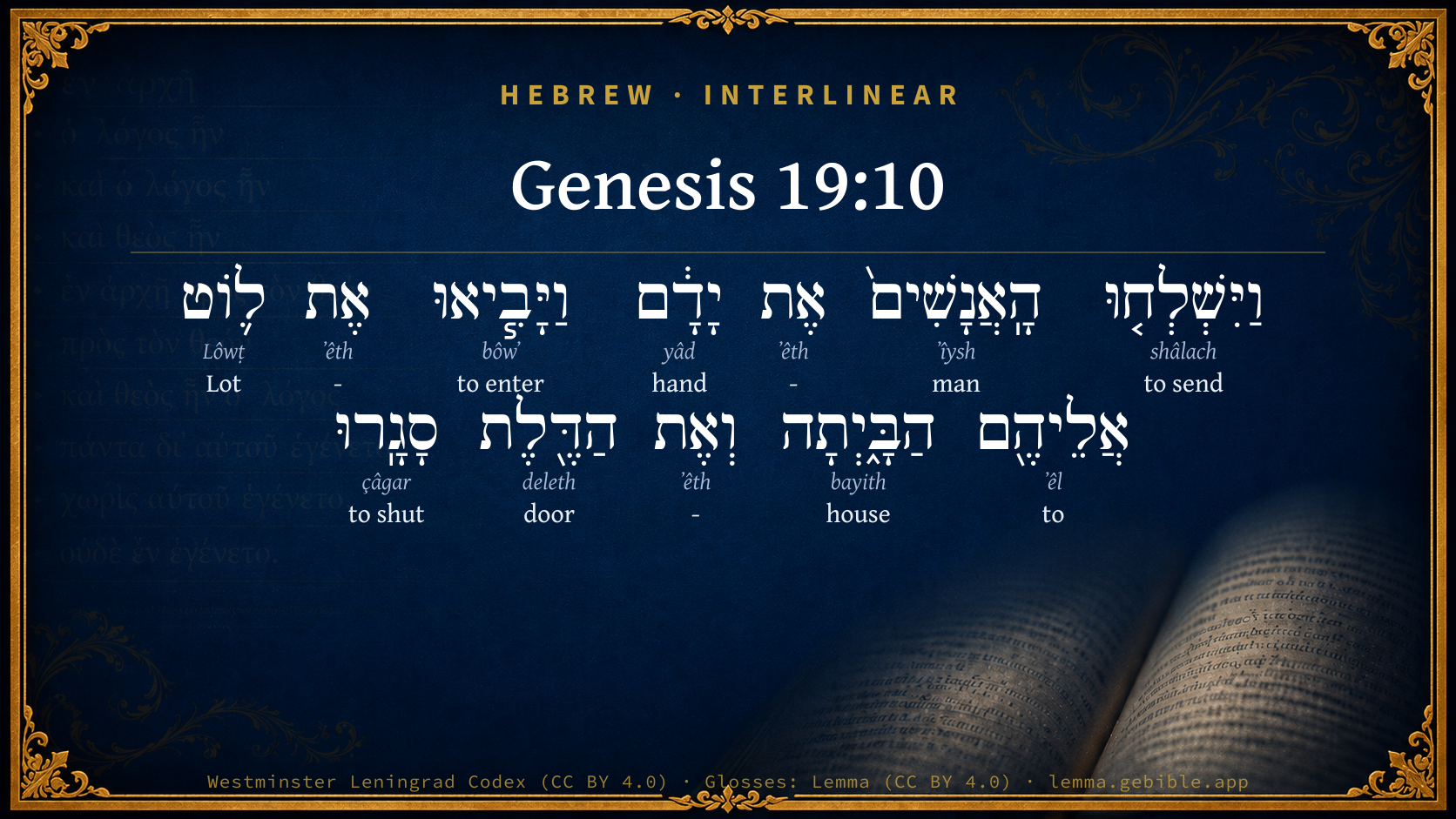
Hebrew (Westminster Leningrad Codex) Genesis 19:10 appears in the Hebrew Old Testament. The text above is from the Westminster Leningrad Codex. Each word links to its Strong’s number, a concise gloss, and parsing drawn from the Open Scriptures Hebrew Bible morphology. Click any word for its full Brown-Driver-Briggs (BDB) entry.
Download image
Cite this verse

Genesis 19:10 (World English Bible). Public Domain. Lemma interlinear Bible study tool, https://lemma.gebible.app/v/genesis/19/10.

Show BibTeX & RIS
BibTeX
RIS
English Translation
But the men put forth their hand, and brought Lot into the house to them, and shut the door.
World English Bible · Public Domain
Download a study sheet

One document with this verse’s original text, its word-by-word gloss line, the meaning frame, cross-references with their text, attributed commentary, and full source and license credits — printable, and it pastes into notes with its structure intact.

This verse Autodidact and up

Study sheet (.html) Plain text (.txt)

A passage Seminary Student

Up to 50 verses in one chapter. A passage sheet keeps up to 6 commentary sources and 12 cross-references per verse, in the order this page ranks them, and says so on the sheet whenever that leaves anything out. Ask for a single verse and you get the Autodidact verse sheet above.

Everything on this page stays free to read, with no account — the sheet is a download of what is already on screen, not access to it.

Want to remove ads? Support Godless Engineer
Compare translations 3

The same verse in 3 English versions, stacked beneath the original-language interlinear above. Click any original word for its lexicon entry.

Each is an independent rendering of the whole verse — the interlinear is not word-aligned to these translations.

Highlighted words mark where these versions differ — a whole-verse word diff, not a word-by-word alignment.

  • World English Bible Public Domain
    But the men put forth their hand, and brought Lot into the house to them, and shut the door.
  • King James Version Public Domain
    But the men put forth their hand, and pulled Lot into the house to them, and shut to the door.
  • unfoldingWord Literal Text CC BY-SA 4.0
    But the men reached out their hand and brought Lot into the house to them and shut the door.

unfoldingWord Literal Text — © unfoldingWord, licensed CC BY-SA 4.0. Word-aligned USFM3 via Door43 (git.door43.org/unfoldingWord/en_ult).

Versions to compare (up to 4)

3 of 4 selected

Show all 18 translations

Every available English version of this verse, each an independent rendering of the whole verse.

  • World English Bible Public Domain
    But the men put forth their hand, and brought Lot into the house to them, and shut the door.
  • Berean Standard Bible Public Domain
    But the men inside reached out, pulled Lot into the house with them, and shut the door.
  • Majority Standard Bible Public Domain
    But the men inside reached out, pulled Lot into the house with them, and shut the door.
  • King James Version Public Domain
    But the men put forth their hand, and pulled Lot into the house to them, and shut to the door.
  • American Standard Version (1901) Public Domain
    But the men put forth their hand, and brought Lot into the house to them, and shut to the door.
  • Revised Version (1885) Public Domain
    But the men put forth their hand, and brought Lot into the house to them, and shut to the door.
  • Geneva Bible (1599) Public Domain
    But the men put forth their hand and pulled Lot into the house to them and shut to ye doore.
  • Douay-Rheims (1899) Public Domain
    And behold the men put out their hand, and drew in Lot unto them, and shut the door:
  • Young's Literal Translation Public Domain
    And the men put forth their hand, and bring in Lot unto them, into the house, and have shut the door;
  • Literal Standard Version CC BY-SA 4.0
    And the men put forth their hand, and bring in Lot to them, into the house, and have shut the door;
  • Unlocked Literal Bible CC BY-SA 4.0
    But the men reached out their hands and brought Lot into the house with them and shut the door.
  • unfoldingWord Literal Text CC BY-SA 4.0
    But the men reached out their hand and brought Lot into the house to them and shut the door.
  • Darby Bible Public Domain
    And the men stretched out their hand, and brought Lot into the house to them, and shut the door.
  • World Messianic Bible Public Domain
    But the men reached out their hand, and brought Lot into the house to them, and shut the door.
  • Webster's Bible Public Domain
    But the men put forth their hand, and pulled Lot into the house to them, and shut the door.
  • Free Bible Version CC BY-SA 4.0
    But the men inside reached out and grabbed Lot, dragged him inside, and slammed the door shut.
  • Bible in Basic English Public Domain
    But the men put out their hands and took Lot into the house to them, shutting the door again.
  • JPS Tanakh (1917) Public Domain
    But the men put forth their hand, and brought Lot into the house to them, and the door they shut.

Literal Standard Version (2020), Covenant Press — licensed CC BY-SA 4.0. Text via the HelloAO Bible API (eBible.org). Unlocked Literal Bible (unfoldingWord) — licensed CC BY-SA 4.0. Text via the HelloAO Bible API (eBible.org). unfoldingWord Literal Text — © unfoldingWord, licensed CC BY-SA 4.0. Word-aligned USFM3 via Door43 (git.door43.org/unfoldingWord/en_ult). Free Bible Version, Dr. Jonathan Gallagher — licensed CC BY-SA 4.0. Text via the HelloAO Bible API (eBible.org).

Word by word

More ways to search: Search by grammar → Find every occurrence → Compare this word →

Practice this passage: Drill this verse → Learn its vocabulary →

ל֛וֹט
Lôwṭ
H3876
“Lot”
Noun, Proper
Part of Speech
Noun
Type
Proper
Full BDB Definition

Origin: the same as H3875

TWOT: None

Lot = "covering" - son of Haran and Abraham's nephew who settled in Sodom and was delivered from its destruction by God
  1. וַיִּשְׁלְח֤וּ shâlach H7971 “and · to send” Conjunction + Verb, Qal, Sequential Imperfect, 3rd Person, Masculine, Plural
  2. הָֽאֲנָשִׁים֙ ʼîysh H376 “the · men” Particle, Definite Article + Noun, Common, Masculine, Plural, Absolute
  3. אֶת ʼêth H853 “-” Particle, Direct Object
  4. יָדָ֔ם yâd H3027 “hand · their” Noun, Common, Both, Singular, Construct + Suffix, Personal, 3rd Person, Masculine, Plural
  5. וַיָּבִ֧יאוּ bôwʼ H935 “and · to enter” Conjunction + Verb, Hiphil, Sequential Imperfect, 3rd Person, Masculine, Plural
  6. אֶת ʼêth H853 “-” Particle, Direct Object
  7. אֲלֵיהֶ֖ם ʼêl H413 “to · them” Preposition + Suffix, Personal, 3rd Person, Masculine, Plural
  8. הַבָּ֑יְתָה bayith H1004 “the · house · toward” Particle, Definite Article + Noun, Common, Masculine, Singular, Absolute + Suffix, Demonstrative
  9. וְאֶת ʼêth H853 “and · -” Conjunction + Particle, Direct Object
  10. הַדֶּ֖לֶת deleth H1817 “the · door” Particle, Definite Article + Noun, Common, Feminine, Singular, Absolute
  11. סָגָֽרוּ çâgar H5462 “to shut” Verb, Qal, Perfect, 3rd Person, Common, Plural

About this verse

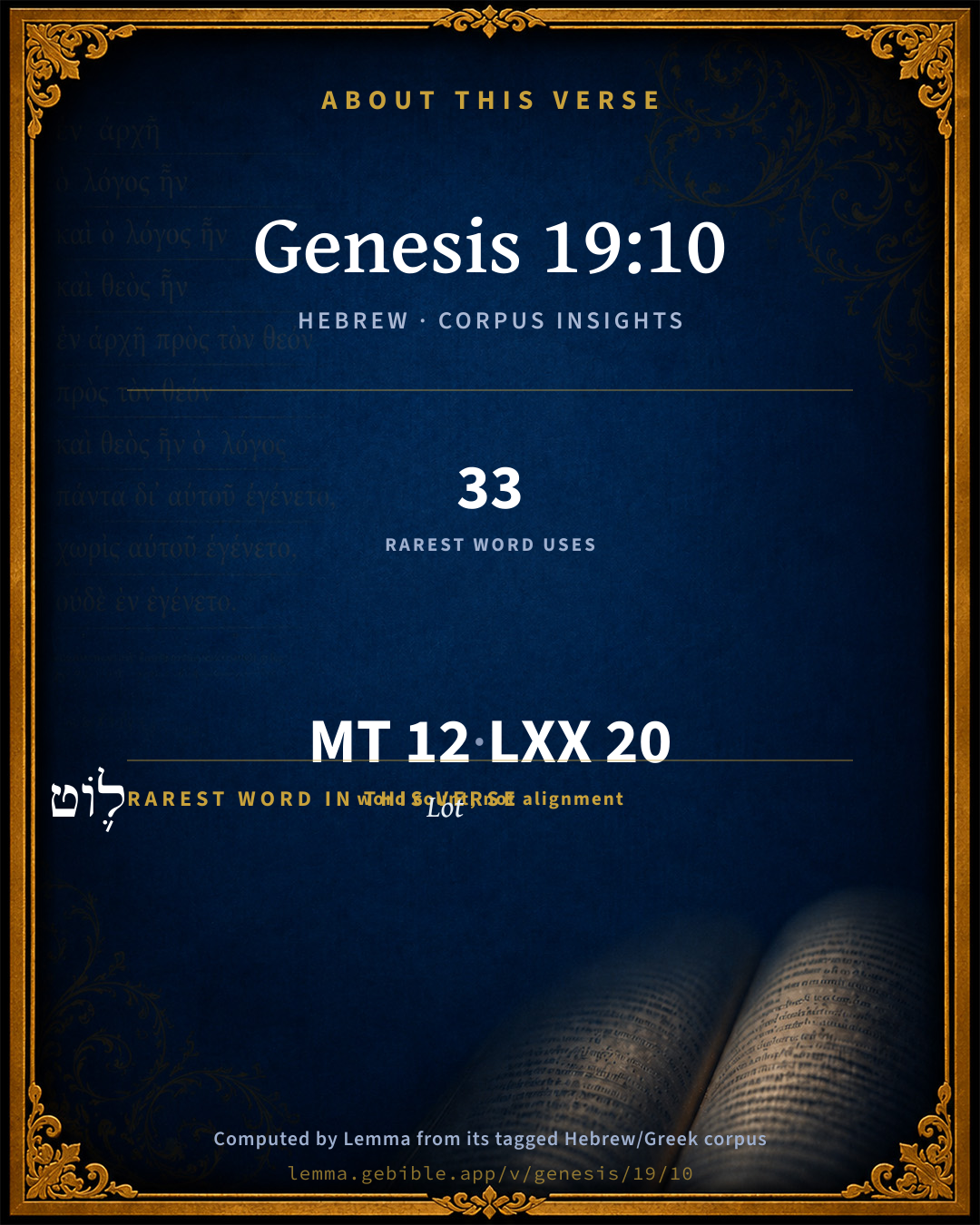
These counts appear in no published source. They are computed here, from the morphology-tagged text and Lemma’s own curated glosses. What Lemma adds →

12
words
10
distinct lemmas
Pentateuch
section

Shared distinctive vocabulary

ל֛וֹט Lot H3876 occurs in 30 verses of the Hebrew Bible. Also found in:

Grammatical profile

  • 3 verbs
  • 5 nouns
  • 1 preposition
  • 3 particles

Verb forms

  • וַיִּשְׁלְח֤וּ Qal · Sequential Imperfect
  • וַיָּבִ֧יאוּ Hiphil · Sequential Imperfect
  • סָגָֽרוּ Qal · Perfect

Hebrew & Septuagint length

In English translation the verse runs 19 words from the Hebrew and 23 from the Septuagint (LXX English) — closely comparable.

A rough comparison of the two English renderings, which tokenize alike — not a word-level alignment.

Word counts can differ between the Hebrew and the Greek without any difference in meaning — e.g. the Hebrew direct-object marker אֵת has no separate Greek word, and Greek often adds the article ὁ.

In the original languages it is 12 Hebrew tokens and 20 Greek tokens — but the two are counted differently (Hebrew bundles its prefixes and suffixes into one token; the Greek is in lemma form), so that isn’t a like-for-like length.

Hebrew and Greek witnesses Masoretic Hebrew ↔ Greek Septuagint

The same verse in the two great witnesses to the Old Testament, shown verse-for-verse.

These are two independent witnesses, not word-aligned to each other, and the Septuagint is shown in lemma (dictionary) form.

Hebrew Genesis 19:10 Masoretic · Westminster Leningrad Codex

וַיִּשְׁלְח֤וּ הָֽאֲנָשִׁים֙ אֶת יָדָ֔ם וַיָּבִ֧יאוּ אֶת ל֛וֹט אֲלֵיהֶ֖ם הַבָּ֑יְתָה וְאֶת הַדֶּ֖לֶת סָגָֽרוּ

But the men put forth their hand, and brought Lot into the house to them, and shut the door.

World English Bible · Public Domain

Greek LXX Genesis 19:10 Septuagint · lemma form

ἐκτείνω δέ ὁ ἀνήρ ὁ χείρ εἰςσπάω ὁ λωτ πρός ἑαυτοῦ εἰς ὁ οἶκος καί ὁ θύρα ὁ οἶκος ἀποκλείω

And the men stretched forth their hands and drew Lot in to them into the house, and shut the door of the house.

LXX2012 (modern English Septuagint) · Public Domain

Hebrew: Westminster Leningrad Codex (CC BY 4.0). Greek: Septuagint (public domain); English from LXX2012 (modern English Septuagint) (Public Domain). How the Septuagint differs from the Hebrew →

Targum (Aramaic paraphrase)

2

The Targum is the ancient Jewish Aramaic paraphrase of the Hebrew Scriptures — an interpretive translation, not the Hebrew text itself. Onkelos (literal) and Pseudo-Jonathan (expansive) render the Torah, and Jonathan the Prophets. Coverage is partial: where no permissively-licensed English translation exists for a verse, only the Aramaic is shown. This is verse-level text, not a word-by-word alignment to the Hebrew.

  1. Targum Onkelos Torah (Genesis–Deuteronomy)
    וְאוֹשִׁיטוּ גֻּבְרַיָּא יָת יְדֵיהוֹן וְאַיְתִיאוּ יָת לוֹט לְוָתְהוֹן לְבֵיתָא וְיָת דָּשָׁא אֲחָדוּ

    (no public-domain English translation for this verse)

    Targum Onkelos — Aramaic: “Onkelos Genesis” (public domain); “Onkelos Exodus” (public domain); “Onkelos Leviticus” (public domain); “Onkelos Numbers” (public domain); “Onkelos Deuteronomy” (public domain). English: “Sefaria Community Translation” (CC0 1.0 (public-domain dedication)); “J.W. Etheridge. The Targums of Onkelos and Jonathan Ben Uzziel on the Pentateuch. London: Longmans, Green, 1862” (public domain). Text via Sefaria.

  2. Targum Pseudo-Jonathan Torah (Genesis–Deuteronomy)
    וְאוֹשִׁיטוּ גוּבְרַיָא יַת יְדֵיהוֹן וְהַנְעִילוּ יַת לוֹט לְוַותְהוֹן לְבֵיתָא וְיַת דָשָׁא אָחָדוּ

    And the Men stretched forth their hands, and brought Lot unto them in the house, and shut the door.

    Targum Pseudo-Jonathan — Aramaic: “Targum Jonathan on Genesis” (public domain); “Targum Jonathan on Exodus” (public domain); “Targum Jonathan on Leviticus” (public domain); “Targum Jonathan on Numbers” (public domain); “Targum Jonathan on Deuteronomy” (public domain). English: “The Targum of Jonathan ben Uzziel, trans. J. W. Etheridge, London, 1862” (public domain). Text via Sefaria.

Commentary

Notes on Genesis 19:10 from classic Christian and Jewish commentators (each source and its license shown beneath its notes). The classic Christian expositions comment on the surrounding passage and are grouped to its opening verse, so a note may address several verses; the Jewish commentaries on the Tanakh (Rashi and others) are per-verse, so they appear only where the commentator wrote on this verse.

Lemma curates 59 commentaries, every one of them public domain or Creative Commons licensed, each selected and text-cleaned for this edition rather than reprinted as found. About our sources →

Trapp's Complete Commentary

John Trapp

Gen 19:10 But the men put forth their hand, and pulled Lot into the house to them, and shut to the door.

Ver. 10. But the men.] Thus Lot is rescued at a dead lift; that is God’s opportunity, who "knows how to deliver the godly". {2Pe 2:9}

John Trapp, A Commentary or Exposition upon All the Books of the Old and New Testament (1647–1656) — public domain. Text from a community e-Sword module.

John Calvin's Commentaries

10. But the men put forth their hand. Moses again gives the name of men to those who were not so, but who had appeared as such; for although they begin to exert their celestial force, they do not yet declare that they are angels divinely sent from heaven. But here Moses teaches, that the Lord, although he may for a time seem regardless, while the faithful are engaged in conflict, yet never deserts his own, but stretches out his hand, (so to speak,) at the critical moment. Thus, in preserving Lot, he defers his aid until the last extremity. Let us, therefore, with tranquil minds, wait on his providence; and let us intrepidly follow what belongs to our calling, and what he commands; for although he may suffer us to be exposed to dangers he will still show, that he has never been unmindful of us. For we see, that as Lot had shut the door of his house for the protection of his guests, so he is repaid, when the angels not only receive him again, through the opened door, but by opposing the barriers of divine power, prevent the impious men from approaching it. For, (as I have before intimated), they afford him not merely human help, but they come to bring him assistance, armed with divine power. Whereas, Moses says, that the men were smitten with blindness, we are not so to understand it, as if they had been deprived of eyesight; but that their vision was rendered so dull, that they could distinguish nothing. This miracle was more illustrious, than if their eyes had been thrust out, or entirely blinded; because with their eyes open, they feel about, just like blind men, and seeing, yet do not see. At the same time, Moses wishes to describe their iron obstinacy: they do not find Lot’s door; it follows then, that they had labored in seeking it; but, in this manner, they furiously wage war with God. This, however, has happened, not once only, and not with the men of Sodom alone; but is daily fulfilled in the reprobate, whom Satan fascinates with such madness, that when stricken by the mighty hand of God, they proceed with stupid obstinacy to advance against him. And we need not seek far, for an instance of such conduct; we see with what tremendous punishments God visits wandering lusts; and yet the world ceases not, with desperate audacity, to rush into the certain destruction which is set before their eyes.

John Calvin's Commentaries (1540-1563) — public domain. Text from the Calvin Translation Society English edition (1840s-50s) via the Christian Classics Ethereal Library (ccel.org). Calvin's coverage is partial (roughly two-thirds of the Bible); uncommented books and verses are honest gaps, never fabricated. The 19th-century editor's footnotes and remarks are omitted so the notes are faithfully Calvin's own voice.

John Gill's Exposition

But the men put forth their hand,.... They came to the door, and opened it, and put out their hands, one on one side the door, and the other on the other:

and pulled Lot into the house to them, and shut to the door; and thus they rescued Lot from the fury and rage of the men of Sodom, and prevented his daughters being exposed unto them, as he had offered. This action showed them to be more than men, that they should open the door, take in Lot, and shut it so suddenly, that the men of Sodom could take no advantage of it, could neither retain Lot, nor enter the door when opened, and especially what follows.

John Gill's Exposition of the Whole Bible (1746–1763) — public domain (CC PDM 1.0). Text via the HelloAO Bible API.

Haydock's Catholic Bible Commentary

Behold, &c. the angels not only secure Lot, but strike the whole people with blindness, so that they could neither find Lot’s door nor their own homes. Indeed, if they had been able to get back into their own houses, it would have been but a small consolation to them; since in a few minutes, the whole city was buried in sulphur and flame, Wisdom xix. 16.

George Leo Haydock (1774–1849), Haydock's Catholic Family Bible and Commentary, 1859 edition — public domain. Excludes Psalms (Douay-Rheims chapter numbering differs from Protestant) and Deuterocanonical books (Catholic canon only).

The Pulpit Commentary

But the men (i.e. the angels) put forth their hand, and pulled Lot into the house to them, and shut to the door deleth (vide Ver. 6).

The Pulpit Commentary (1880–1919), ed. H.D.M. Spence-Jones & Joseph S. Exell — public domain. Text from a community e-Sword module.

unfoldingWord translationNotes

Door43 World Missions Community

But the men

"But Lot's two guests" or "But the two angels"

the men reached out their hands and brought ... them and shut

Your language may need to add that the men opened the door first. AT: 'the men opened the door far enough so they could reach out their hands and pull ... them, and then they shut" (See: Assumed Knowledge and Implicit Information)

Lot's visitors struck with blindness the men

The phrase "struck with blindness" is a metaphor; the visitors did not physically hit the men. AT: "Lot's visitors blinded the men" or "they took away their sight" (See: Metaphor)

both young and old

"men of all ages." This merism emphasizes that the visitors blinded all the men. This could indicate social standing rather than age. AT: "both small and great" (See: Merism)

translationWords

Lot

unfoldingWord translationNotes — © Distant Shores Media and the Door43 World Missions Community, licensed CC BY-SA 4.0. Source: git.door43.org/Door43/en_tn.

Sforno

Rabbi Ovadia Sforno

They wearied themselves. They continued searching for the door even after they were stricken with blindness.

Sforno on the Tanakh — English translation: “Yalkut, Sifsei Chachomim Chumash, Metsudah Publications, 2009” (CC BY 4.0). Text via Sefaria.

Lesson kit

Teaching starters — assembled from the data on this page, not authored interpretation. Every prompt links to the verse data it draws on. Edit before teaching.

Genesis, in the Pentateuch, opens this verse with 12 words (10 distinct Hebrew lemmas). Its most distinctive word is Lôwṭ (“Lot”). A historical commentator’s framing appears above. Read the whole chapter for the surrounding context.

Discussion questions

  1. What does “Lot” (Lôwṭ) contribute to the verse as a whole?
  2. How does Genesis 11:27, which shares the word «Lot», read alongside this verse?
  3. The translations on this page render this verse differently — a whole-verse word diff, not a word-by-word alignment. What might account for the different wordings?
  4. «וַיִּשְׁלְח֤וּ» is a Qal Sequential Imperfect verb. How does that grammatical form shape the action described?
  5. Compare how Trapp's Complete Commentary and John Calvin's Commentaries read this verse. Where do they agree or differ?

Things to notice

Reading settings

Reading text

Shown beneath each verse's original-language words.

Old Testament
Old Testament edition

Read the OT as the Masoretic Hebrew (MT) or the Greek Septuagint (LXX).

English shown for the Greek Septuagint (in the Hebrew ↔ Greek comparison).

Comparing translations? Open the Compare panel on any verse page to stack up to four side by side.