
Deuteronomy 23:10

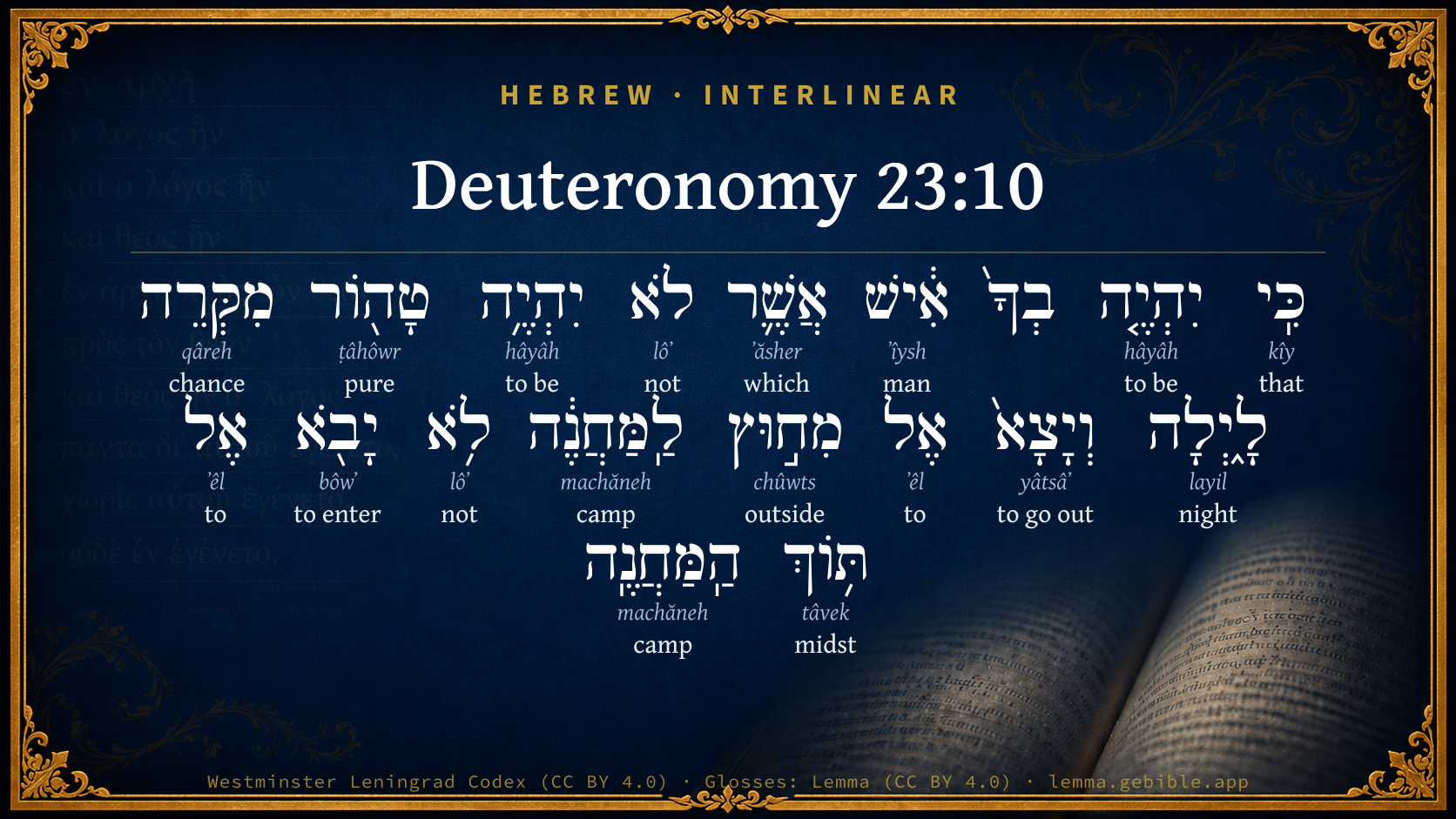
Hebrew (Westminster Leningrad Codex) Deuteronomy 23:10 appears in the Hebrew Old Testament. The text above is from the Westminster Leningrad Codex. Each word links to its Strong’s number, a concise gloss, and parsing drawn from the Open Scriptures Hebrew Bible morphology. Click any word for its full Brown-Driver-Briggs (BDB) entry.
Download image
Cite this verse

Deuteronomy 23:10 (World English Bible). Public Domain. Lemma interlinear Bible study tool, https://lemma.gebible.app/v/deuteronomy/23/10.

Show BibTeX & RIS
BibTeX
RIS
English Translation
If there be among you any man, who is not clean by reason of that which happens him by night, then shall he go abroad out of the camp, he shall not come within the camp:
World English Bible · Public Domain
Highlights
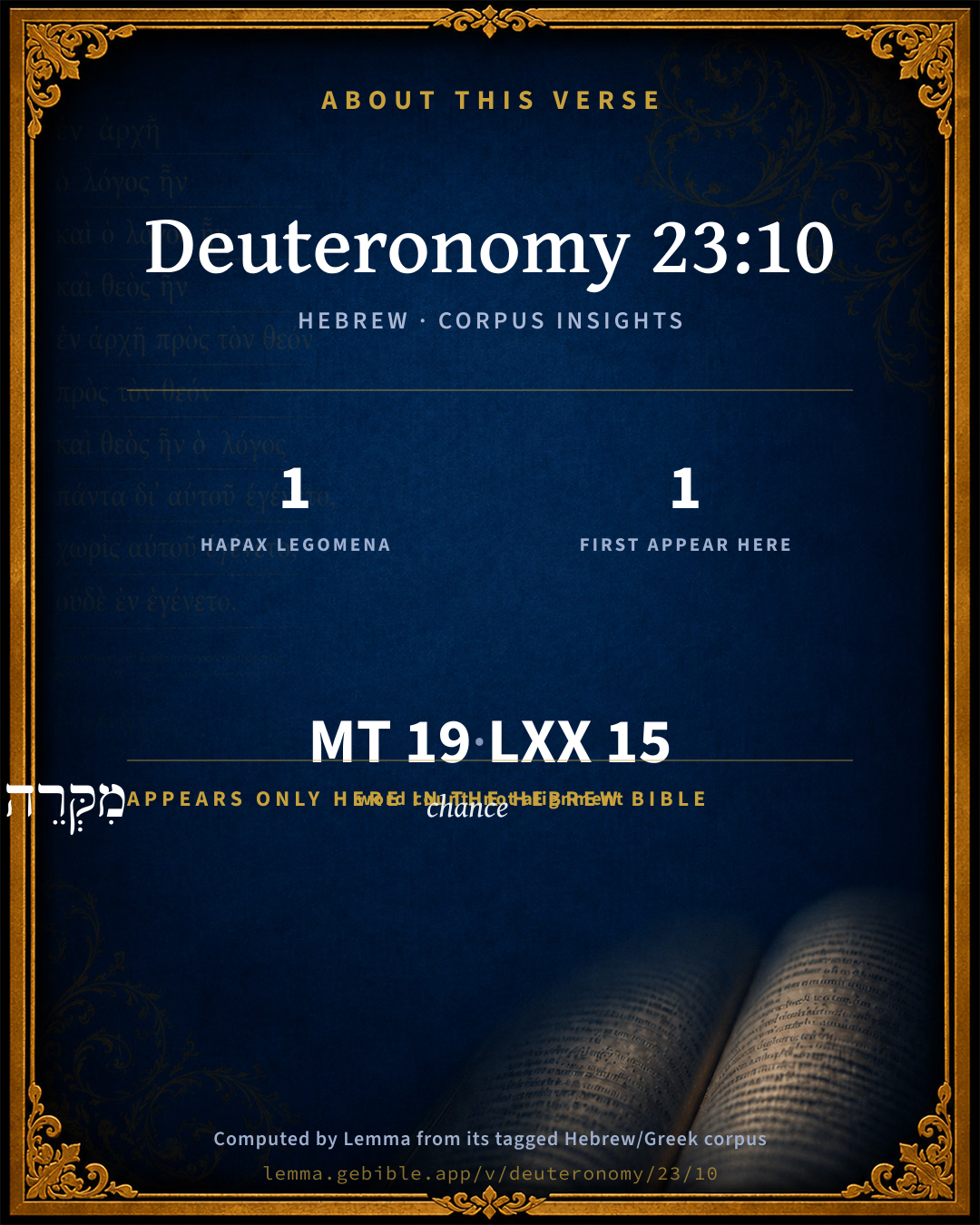
  • 1 hapax legomenon — only here in the Hebrew Bible
  • 1 first appearance in the Hebrew Bible
Full analysis ↓
Download a study sheet

One document with this verse’s original text, its word-by-word gloss line, the meaning frame, cross-references with their text, attributed commentary, and full source and license credits — printable, and it pastes into notes with its structure intact.

This verse Autodidact and up

Study sheet (.html) Plain text (.txt)

A passage Seminary Student

Up to 50 verses in one chapter. A passage sheet keeps up to 6 commentary sources and 12 cross-references per verse, in the order this page ranks them, and says so on the sheet whenever that leaves anything out. Ask for a single verse and you get the Autodidact verse sheet above.

Everything on this page stays free to read, with no account — the sheet is a download of what is already on screen, not access to it.

Want to remove ads? Support Godless Engineer
Compare translations 3

The same verse in 3 English versions, stacked beneath the original-language interlinear above. Click any original word for its lexicon entry.

Each is an independent rendering of the whole verse — the interlinear is not word-aligned to these translations.

Highlighted words mark where these versions differ — a whole-verse word diff, not a word-by-word alignment.

  • World English Bible Public Domain
    If there be among you any man, who is not clean by reason of that which happens him by night, then shall he go abroad out of the camp, he shall not come within the camp:
  • King James Version Public Domain
    If there be among you any man, that is not clean by reason of uncleanness that chanceth him by night, then shall he go abroad out of the camp, he shall not come within the camp:
  • unfoldingWord Literal Text CC BY-SA 4.0
    If there is among you a man who is not clean, happening night, then he shall go to the outside of the camp; he shall not come to the middle of the camp.

unfoldingWord Literal Text — © unfoldingWord, licensed CC BY-SA 4.0. Word-aligned USFM3 via Door43 (git.door43.org/unfoldingWord/en_ult).

Versions to compare (up to 4)

3 of 4 selected

Show all 18 translations

Every available English version of this verse, each an independent rendering of the whole verse.

  • World English Bible Public Domain
    If there be among you any man, who is not clean by reason of that which happens him by night, then shall he go abroad out of the camp, he shall not come within the camp:
  • Berean Standard Bible Public Domain
    If any man among you becomes unclean because of a nocturnal emission, he must leave the camp and stay outside.
  • Majority Standard Bible Public Domain
    If any man among you becomes unclean because of a nocturnal emission, he must leave the camp and stay outside.
  • King James Version Public Domain
    If there be among you any man, that is not clean by reason of uncleanness that chanceth him by night, then shall he go abroad out of the camp, he shall not come within the camp:
  • American Standard Version (1901) Public Domain
    If there be among you any man, that is not clean by reason of that which chanceth him by night, then shall he go abroad out of the camp, he shall not come within the camp:
  • Revised Version (1885) Public Domain
    If there be among you any man, that is not clean by reason of that which chanceth him by night, then shall he go abroad out of the camp, he shall not come within the camp:
  • Geneva Bible (1599) Public Domain
    If there be among you any that is vncleane by that which commeth to him by night, he shall goe out of the hoste, and shall not enter into the hoste,
  • Douay-Rheims (1899) Public Domain
    If there be among you any man, that is defiled in a dream by night, he shall go forth out of the camp.
  • Young's Literal Translation Public Domain
    `When there is in thee a man who is not clean, from an accident at night -- then he hath gone out unto the outside of the camp -- he doth not come in unto the midst of the camp --
  • Literal Standard Version CC BY-SA 4.0
    When there is a man who is not clean in you, from an accident at night, then he has gone out to the outside of the camp; he does not come into the midst of the camp;
  • Unlocked Literal Bible CC BY-SA 4.0
    If there is among you any man who is unclean because of what happened to him at night, then he must go out of the army's camp; he must not come back into the camp.
  • unfoldingWord Literal Text CC BY-SA 4.0
    If there is among you a man who is not clean, happening night, then he shall go to the outside of the camp; he shall not come to the middle of the camp.
  • Darby Bible Public Domain
    If there be with thee a man that is not clean from what hath happened in the night, then shall he go outside the camp; he shall not come inside the camp;
  • World Messianic Bible Public Domain
    If there is among you any man who is not clean by reason of that which happens to him by night, then shall he go outside of the camp. He shall not come within the camp;
  • Webster's Bible Public Domain
    If there shall be among you any man that is not clean by reason of uncleanness that chanceth to him by night, then shall he go abroad out of the camp, he shall not come within the camp:
  • Free Bible Version CC BY-SA 4.0
    Any man there who becomes unclean because of a release of semen must leave the camp and remain outside.
  • Bible in Basic English Public Domain
    If any man among you becomes unclean through anything which has taken place in the night, he is to go out from the tent-circle and keep outside it:
  • JPS Tanakh (1917) Public Domain
    (23-11) If there be among you any man, that is not clean by reason of that which chanceth him by night, then shall he go abroad out of the camp, he shall not come within the camp.

Literal Standard Version (2020), Covenant Press — licensed CC BY-SA 4.0. Text via the HelloAO Bible API (eBible.org). Unlocked Literal Bible (unfoldingWord) — licensed CC BY-SA 4.0. Text via the HelloAO Bible API (eBible.org). unfoldingWord Literal Text — © unfoldingWord, licensed CC BY-SA 4.0. Word-aligned USFM3 via Door43 (git.door43.org/unfoldingWord/en_ult). Free Bible Version, Dr. Jonathan Gallagher — licensed CC BY-SA 4.0. Text via the HelloAO Bible API (eBible.org).

Word by word

More ways to search: Search by grammar → Find every occurrence → Compare this word →

Practice this passage: Drill this verse → Learn its vocabulary →

מִקְּרֵה
qâreh
H7137
“from · chance of”
Preposition + Noun, Common, Masculine, Singular, Construct
Part of Speech
Preposition + Noun
Type
Common
Gender
Masculine
Number
Singular
State
Construct
Full BDB Definition

Origin: from H7136

TWOT: 2068a

chance, accident - of nocturnal pollution requiring temporary exodus from camp
  1. כִּֽי kîy H3588 “that” Conjunction
  2. יִהְיֶ֤ה hâyâh H1961 “to be” Verb, Qal, Imperfect, 3rd Person, Masculine, Singular
  3. אִ֔ישׁ ʼîysh H376 “man” Noun, Common, Masculine, Singular, Absolute
  4. אֲשֶׁ֛ר ʼăsher H834 “which” Particle, Relative
  5. לֹא lôʼ H3808 “not” Particle, Negative
  6. יִהְיֶ֥ה hâyâh H1961 “to be” Verb, Qal, Imperfect, 3rd Person, Masculine, Singular
  7. טָה֖וֹר ṭâhôwr H2889 “pure” Adjective, Adjective, Masculine, Singular, Absolute
  8. לָ֑יְלָה layil H3915 “night” Noun, Common, Masculine, Singular, Absolute
  9. וְיָצָא֙ yâtsâʼ H3318 “and · to go out” Conjunction + Verb, Qal, Sequential Perfect, 3rd Person, Masculine, Singular
  10. אֶל ʼêl H413 “to” Preposition
  11. מִח֣וּץ chûwts H2351 “from · outside” Preposition + Noun, Common, Masculine, Singular, Absolute
  12. לַֽמַּחֲנֶ֔ה machăneh H4264 “to/for the · camp” Preposition, Determined + Noun, Common, Both, Singular, Absolute
  13. לֹ֥א lôʼ H3808 “not” Particle, Negative
  14. יָבֹ֖א bôwʼ H935 “to enter” Verb, Qal, Imperfect, 3rd Person, Masculine, Singular
  15. אֶל ʼêl H413 “to” Preposition
  16. תּ֥וֹךְ tâvek H8432 “midst of” Noun, Common, Masculine, Singular, Construct
  17. הַֽמַּחֲנֶֽה machăneh H4264 “the · camp” Particle, Definite Article + Noun, Common, Both, Singular, Absolute

About this verse

These counts appear in no published source. They are computed here, from the morphology-tagged text and Lemma’s own curated glosses. What Lemma adds →

19
words
14
distinct lemmas
Pentateuch
section

Notable vocabulary

1 hapax legomenon — a word that appears only here in the entire Hebrew Bible:

  • מִקְּרֵה chance H7137

First appearance in Scripture

This word makes its first canonical appearance in the Hebrew Bible here:

  • מִקְּרֵה chance H7137

Grammatical profile

  • 4 verbs
  • 7 nouns
  • 1 adjective
  • 3 prepositions
  • 1 conjunction
  • 3 particles

Verb forms

  • יִהְיֶ֤ה Qal · Imperfect
  • יִהְיֶ֥ה Qal · Imperfect
  • וְיָצָא֙ Qal · Sequential Perfect
  • יָבֹ֖א Qal · Imperfect

Repetition

Words recur within this verse — often emphatic in Hebrew:

  • יִהְיֶ֤ה to be H1961 ×2
  • לַֽמַּחֲנֶ֔ה camp H4264 ×2
  • לֹא not H3808 ×2
  • אֶל to H413 ×2

Hebrew & Septuagint length

In English translation the verse runs 36 words from the Hebrew and 36 from the Septuagint (LXX English) — the same length.

A rough comparison of the two English renderings, which tokenize alike — not a word-level alignment.

Word counts can differ between the Hebrew and the Greek without any difference in meaning — e.g. the Hebrew direct-object marker אֵת has no separate Greek word, and Greek often adds the article ὁ.

In the original languages it is 19 Hebrew tokens and 15 Greek tokens — but the two are counted differently (Hebrew bundles its prefixes and suffixes into one token; the Greek is in lemma form), so that isn’t a like-for-like length.

Cross-references

3

Topical passages linked to Deuteronomy 23:10 in the Treasury of Scripture Knowledge — connected by theme and wording, ordered by reader-vote popularity; previews shown in the World English Bible.

  • Leviticus 15:16 "'If any man has an emission of semen, then he shall bathe all his flesh in water, and be unclean until the evening.
  • Numbers 5:2–3 "Command the children of Israel that they put out of the camp every leper, and everyone who has an issue, and whoever is unclean by the dead.
  • 1 Corinthians 5:11–13 But as it is, I wrote to you not to associate with anyone who is called a brother who is a sexual sinner, or covetous, or an idolater, or a slanderer, or a drunkard, or an extortioner. Don't even eat with such a person.

Cross-references courtesy of OpenBible.info (CC BY 4.0).

Hebrew and Greek witnesses Masoretic Hebrew ↔ Greek Septuagint

The same verse in the two great witnesses to the Old Testament, shown verse-for-verse.

These are two independent witnesses, not word-aligned to each other, and the Septuagint is shown in lemma (dictionary) form.

Hebrew Deuteronomy 23:10 Masoretic · Westminster Leningrad Codex

כִּֽי יִהְיֶ֤ה בְךָ֙ אִ֔ישׁ אֲשֶׁ֛ר לֹא יִהְיֶ֥ה טָה֖וֹר מִקְּרֵה לָ֑יְלָה וְיָצָא֙ אֶל מִח֣וּץ לַֽמַּחֲנֶ֔ה לֹ֥א יָבֹ֖א אֶל תּ֥וֹךְ הַֽמַּחֲנֶֽה

If there be among you any man, who is not clean by reason of that which happens him by night, then shall he go abroad out of the camp, he shall not come within the camp:

World English Bible · Public Domain

Greek LXX Deuteronomy 23:10 Septuagint · lemma form

ἐάν δέ ἐκἔρχομαι παρα ἐνβάλλω ἐπί ὁ ἐχθρός σύ καί φυλάσσω ἀπό πᾶς ῥῆμα πονηρός

If there should be in you a man who is not clean by reason of his issue by night, then he shall go forth out of the camp, and he shall not enter into the camp.

LXX2012 (modern English Septuagint) · Public Domain

On this verse, John Gill's Exposition discusses the Septuagint’s reading. Read the note in Commentary ↓

Hebrew: Westminster Leningrad Codex (CC BY 4.0). Greek: Septuagint (public domain); English from LXX2012 (modern English Septuagint) (Public Domain). How the Septuagint differs from the Hebrew →

Targum (Aramaic paraphrase)

2

The Targum is the ancient Jewish Aramaic paraphrase of the Hebrew Scriptures — an interpretive translation, not the Hebrew text itself. Onkelos (literal) and Pseudo-Jonathan (expansive) render the Torah, and Jonathan the Prophets. Coverage is partial: where no permissively-licensed English translation exists for a verse, only the Aramaic is shown. This is verse-level text, not a word-by-word alignment to the Hebrew.

  1. Targum Onkelos Torah (Genesis–Deuteronomy)
    אֲרֵי תִפּוֹק מַשְׁרִיתָא עַל בַּעֲלֵי דְבָבָךְ וְתִסְתַּמַר מִכֹּל מִדַעַם בִּישׁ

    (no public-domain English translation for this verse)

    Targum Onkelos — Aramaic: “Onkelos Genesis” (public domain); “Onkelos Exodus” (public domain); “Onkelos Leviticus” (public domain); “Onkelos Numbers” (public domain); “Onkelos Deuteronomy” (public domain). English: “Sefaria Community Translation” (CC0 1.0 (public-domain dedication)); “J.W. Etheridge. The Targums of Onkelos and Jonathan Ben Uzziel on the Pentateuch. London: Longmans, Green, 1862” (public domain). Text via Sefaria.

  2. Targum Pseudo-Jonathan Torah (Genesis–Deuteronomy)
    אֲרוּם תִּפְקוֹן מַשִׁירְוַיָן עַל בַּעֲלֵי דְבָבֵיכוֹן וְתִסְתַּמְּרוּן מִכָּל פִּתְגָם דְּבִישׁ מִפּוּלְחָנָא נוּכְרַיָא וְגִילוּי עֶרְיְיתָא וְשַׁדְיוּת אֲדַם זַכַּאי

    When you go forth in hosts against your enemies, beware of every evil thing, of strange worship, the, exposure of the shame, and the shedding of innocent blood.

    Targum Pseudo-Jonathan — Aramaic: “Targum Jonathan on Genesis” (public domain); “Targum Jonathan on Exodus” (public domain); “Targum Jonathan on Leviticus” (public domain); “Targum Jonathan on Numbers” (public domain); “Targum Jonathan on Deuteronomy” (public domain). English: “The Targum of Jonathan ben Uzziel, trans. J. W. Etheridge, London, 1862” (public domain). Text via Sefaria.

Commentary

Notes on Deuteronomy 23:10 from classic Christian and Jewish commentators (each source and its license shown beneath its notes). The classic Christian expositions comment on the surrounding passage and are grouped to its opening verse, so a note may address several verses; the Jewish commentaries on the Tanakh (Rashi and others) are per-verse, so they appear only where the commentator wrote on this verse.

Lemma curates 59 commentaries, every one of them public domain or Creative Commons licensed, each selected and text-cleaned for this edition rather than reprinted as found. About our sources →

Trapp's Complete Commentary

John Trapp

Deu 23:10 If there be among you any man, that is not clean by reason of uncleanness that chanceth him by night, then shall he go abroad out of the camp, he shall not come within the camp:

Ver. 10. Then shall he go abroad.] Go voluntarily, though he be not excluded, as lepers and the like were, Arcta nimis obedientia est, ad legem solummodo iustum esse, saith one: God likes a freewill offering.

John Trapp, A Commentary or Exposition upon All the Books of the Old and New Testament (1647–1656) — public domain. Text from a community e-Sword module.

Tyndale Open Study Notes

Tyndale Open Resources

23:10 nocturnal emission: Although they might have been unintentional or involuntary, these discharges rendered a man ceremonially unclean (see Lev 15:16-18).

Tyndale Open Study Notes — © Tyndale Open Resources, licensed CC BY-SA 4.0. Text via the HelloAO Bible API.

John Gill's Exposition

If there be among you any man that is not clean,.... Any unclean person in the army, that was even ceremonially unclean in any of the instances the law makes so, one of which put for the rest is mentioned:

by reason of uncleanness that chanceth him by night; through pollution by a nocturnal flux, as the Septuagint version, or a gonorrhoea, an involuntary one, occasioned by impure thoughts and imaginations in dreams; the same case as in Lev 15:16.

then shall he go abroad out of the camp; out of the army, lest others should be defiled by such; they not having houses to retire to, and chambers to keep themselves in separate from others, as when at home:

he shall not come within the camp; that is, not till he has done what is prescribed him in the next verse. Jarchi says, he might not come into the camp of the Levites, and much less into the camp of God.

John Gill's Exposition of the Whole Bible (1746–1763) — public domain (CC PDM 1.0). Text via the HelloAO Bible API.

Haydock's Catholic Bible Commentary

Camp of the Levites, according to the Rabbins. (Calmet) --- Bonfrere explains this of priests. (Menochius) --- But it rather refers to all who dwelt in the camp, where the ark seems to have been generally present, along with the armies, ver. 14., and Numbers xxxi. 6. (Calmet) --- It is not clear, however, that the law alludes to any other camp, but that in the midst of which the tabernacle was fixed; and Calmet elsewhere, denies that the ark commonly followed the army. (Haydock)

George Leo Haydock (1774–1849), Haydock's Catholic Family Bible and Commentary, 1859 edition — public domain. Excludes Psalms (Douay-Rheims chapter numbering differs from Protestant) and Deuterocanonical books (Catholic canon only).

Matthew Poole's English Annotations

Of which uncleanness see Lev 15:4,16,17; or by uncleanness of any like kind; one kind being here, as oft, put for all.

He shall go out of the camp.

Quest. Why doth this uncleanness oblige a man to go out of the camp, when it did not oblige him to such a removal, Le 15?

Answ. 1. It is not unreasonable if they were obliged to greater strictness and purity when they were undertaking so difficult and dangerous a work.

2. There is a manifest reason of the difference, because in their houses they had private chambers, where they could in such cases keep themselves from converse with others; whereas in the camp their conveniencies were so small, and their occasions of action so many, that it was very hard for his fellow soldiers that continued with him in the same tent, or part of the camp, to avoid the touching of him, which yet was infectious, Lev 15:7,22.

Matthew Poole's English Annotations on the Holy Bible (1683–1685) — public domain. Text from a community e-Sword/MySword module.

Rashi

Rabbi Shlomo Yitzchaki (Rashi)

כי תצא וגו׳ ונשמרת WHEN [THE HOST] GOETH FORTH [AGAINST THINE ENEMIES], THEN KEEP THEE [FROM EVERY EVIL THING] — because Satan accuses men in time of danger (Jerusalem Talmud Shabbat 2:6; Midrash Tanchuma, Vayigash 1 on Genesis 42:4; cf. Rashi on that verse and our Note thereon).

Rashi on the Tanakh — English translations: “The Judaica Press complete Tanach with Rashi, translated by A. J. Rosenberg” (CC BY 4.0); “Pentateuch with Rashi's commentary by M. Rosenbaum and A.M. Silbermann, 1929-1934” (public domain); “The Metsudah Tanach series, Lakewood, N.J” (CC BY 4.0); and “The Book of Joshua, Metsudah Publications, 1997” (CC BY 4.0). Text via Sefaria.

Ramban (Nachmanides)

Rabbi Moshe ben Nachman (Ramban / Nachmanides)

WHEN THOU GOEST FORTH IN CAMP AGAINST THINE ENEMIES, THEN THOU SHALT KEEP THEE FROM EVERY EVIL — “because Satan indicts [people] in the hour of danger.” This is Rashi’s language.The correct interpretation regarding this commandment appears to me that Scripture is warning of a time when sin is rampant. The well-known custom of forces going to war is that they eat all abominable things, rob and plunder, and are not ashamed even of lewdness and all vileness. The fairest of man by nature comes to be possessed of cruelty and fury when the army advances against the enemy. Therefore, Scripture warned, then thou shalt keep thee from every evil. And by way of the simple meaning of Scripture this is an admonition against doing anything forbidden. And in the Sifre it is stated: 254. “I might think that Scripture is speaking of the laws of defilements and purities and tithes. It therefore says ‘ervah’ [an unseemly thing, which refers to unchastity].. Whence do I know to include idolatry, lewdness, bloodshed, and blasphemy? Scripture therefore says, then thou shalt keep thee from every evil. Or perhaps the verse is speaking of defilements and purities, and tithes? It says ervah (an unseemly thing):. just as ervah uniquely represents a deed for which the Canaanites were driven from the Land and which removes the Divine Presence [from Israel], so all deeds for which the Canaanites were driven from the Land and which remove the Divine Presence [from Israel] are included in the admonition of this verse. When Scripture states davar [thing, but literally ‘word’ — then thou shalt keep thee from every evil ‘davar’] it includes also ‘evil talk.’” This also is included in the purport of the verse we have explained, that besides the [specific] admonitions which are stated concerning these stringent sins, he added yet a [special] prohibition to an army that we guard against any of these sins so that the Divine Presence withdraw not from the Israelites who are there, just as he said, For the Eternal thy G-d walketh in the midst of thy camp Thus he who commits any of the great sins while in the army, those about which it is written, they have set their detestable things in the house whereon My Name is called to defile it, [he causes the Divine Presence to withdraw from Israel]. Moreover, [we are to avoid these sins] in order that the enemy should not overpower us because of our committing the very deeds that cause them to be driven from before us, this being the sense of the expression, and to give up thine enemies before thee. The Sages [in the Sifre] added evil talk [as derived from this admonition] in order that contention should not increase among them and smite them with a very great plague, [even] more than the enemy [will inflict upon them].

Ramban (Nachmanides) on the Tanakh — English translation: “Commentary on the Torah by Ramban (Nachmanides). Translated and annotated by Charles B. Chavel. New York, Shilo Pub. House, 1971-1976” (CC BY 4.0). Text via Sefaria.

Lesson kit

Teaching starters — assembled from the data on this page, not authored interpretation. Every prompt links to the verse data it draws on. Edit before teaching.

Deuteronomy, in the Pentateuch, opens this verse with 19 words (14 distinct Hebrew lemmas). Its most distinctive word is qâreh (“chance”). A historical commentator’s framing appears above. Read the whole chapter for the surrounding context.

Discussion questions

  1. How does “chance” (qâreh) shape what this verse is saying?
  2. 1 word here appears nowhere else in the Hebrew Bible. Why might the author reach for such rare wording?
  3. This is the first place “chance” appears in Scripture (first appears here). What does its debut here establish?
  4. How does Leviticus 15:16, which shares this passage’s theme, read alongside this verse?
  5. What does the repetition of “to be” (2× in this one verse) do in this verse?
  6. The translations on this page render this verse differently — a whole-verse word diff, not a word-by-word alignment. What might account for the different wordings?
  7. «יִהְיֶ֤ה» is a Qal Imperfect verb. How does that grammatical form shape the action described?
  8. Compare how Trapp's Complete Commentary and Tyndale Open Study Notes read this verse. Where do they agree or differ?

Things to notice

  • 1 word in this verse appears nowhere else in the Hebrew Bible.
  • 1 word makes its first canonical appearance in Scripture here.
  • This verse counts 19 Hebrew ↔ 15 Greek words.
  • These translations choose different wording for 14 words in this verse.
  • “to be” occurs 2× in this single verse.

Reading settings

Reading text

Shown beneath each verse's original-language words.

Old Testament
Old Testament edition

Read the OT as the Masoretic Hebrew (MT) or the Greek Septuagint (LXX).

English shown for the Greek Septuagint (in the Hebrew ↔ Greek comparison).

Comparing translations? Open the Compare panel on any verse page to stack up to four side by side.