
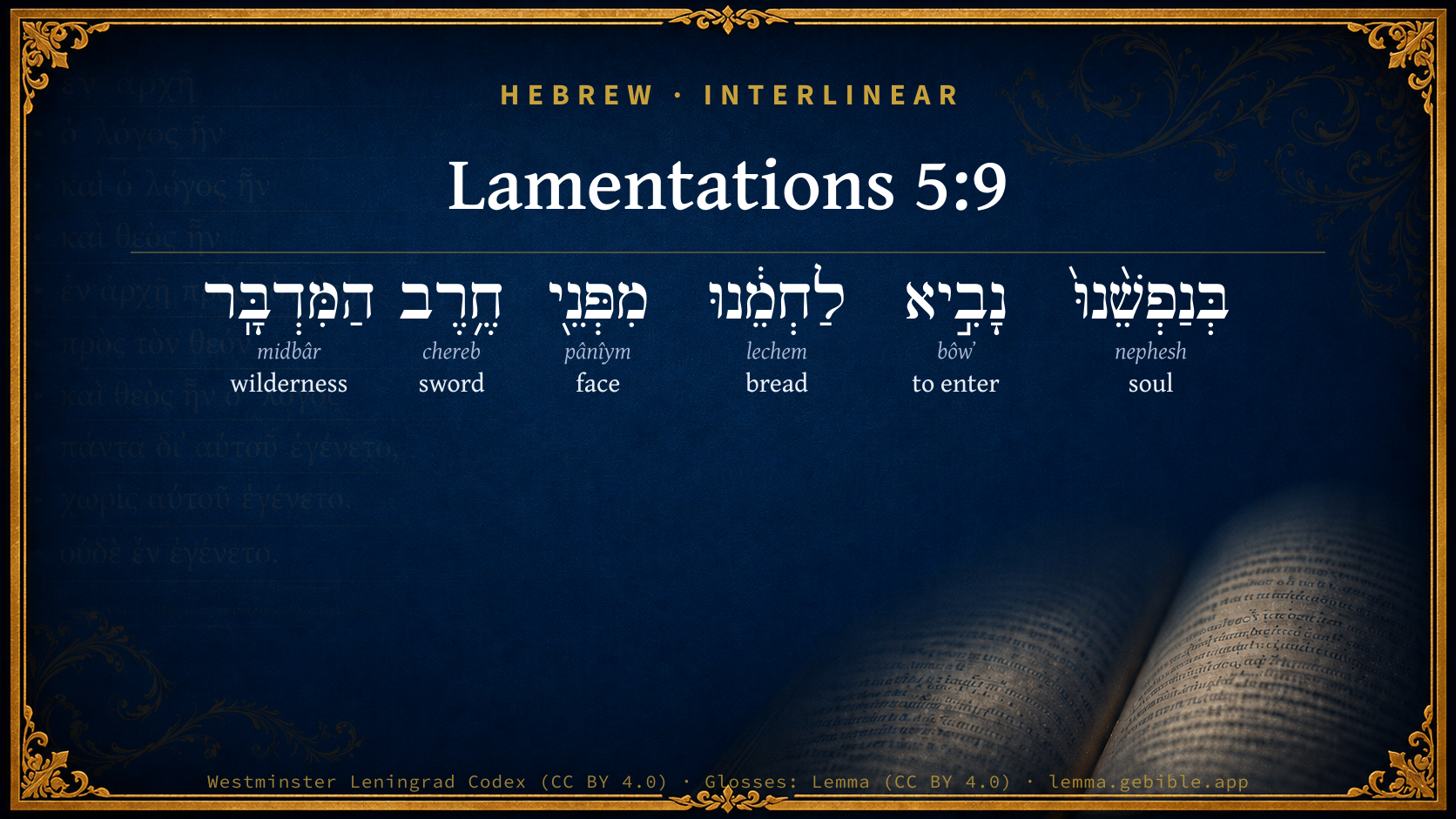
Lamentations 5:9

Hebrew (Westminster Leningrad Codex) Lamentations 5:9 appears in the Hebrew Old Testament. The text above is from the Westminster Leningrad Codex. Each word links to its Strong’s number, a concise gloss, and parsing drawn from the Open Scriptures Hebrew Bible morphology. Click any word for its full Brown-Driver-Briggs (BDB) entry.
Download image
Cite this verse

Lamentations 5:9 (World English Bible). Public Domain. Lemma interlinear Bible study tool, https://lemma.gebible.app/v/lamentations/5/9.

Show BibTeX & RIS
BibTeX
RIS
English Translation
We get our bread at the peril of our lives, Because of the sword of the wilderness.
World English Bible · Public Domain
Download a study sheet

One document with this verse’s original text, its word-by-word gloss line, the meaning frame, cross-references with their text, attributed commentary, and full source and license credits — printable, and it pastes into notes with its structure intact.

This verse Autodidact and up

Study sheet (.html) Plain text (.txt)

A passage Seminary Student

Up to 50 verses in one chapter. A passage sheet keeps up to 6 commentary sources and 12 cross-references per verse, in the order this page ranks them, and says so on the sheet whenever that leaves anything out. Ask for a single verse and you get the Autodidact verse sheet above.

Everything on this page stays free to read, with no account — the sheet is a download of what is already on screen, not access to it.

Want to remove ads? Support Godless Engineer
Compare translations 3

The same verse in 3 English versions, stacked beneath the original-language interlinear above. Click any original word for its lexicon entry.

Each is an independent rendering of the whole verse — the interlinear is not word-aligned to these translations.

Highlighted words mark where these versions differ — a whole-verse word diff, not a word-by-word alignment.

  • World English Bible Public Domain
    We get our bread at the peril of our lives, Because of the sword of the wilderness.
  • King James Version Public Domain
    We gat our bread with the peril of our lives because of the sword of the wilderness.
  • unfoldingWord Literal Text CC BY-SA 4.0
    At our lives we bring in our bread, from the face of the sword of the wilderness.

unfoldingWord Literal Text — © unfoldingWord, licensed CC BY-SA 4.0. Word-aligned USFM3 via Door43 (git.door43.org/unfoldingWord/en_ult).

Versions to compare (up to 4)

3 of 4 selected

Show all 18 translations

Every available English version of this verse, each an independent rendering of the whole verse.

  • World English Bible Public Domain
    We get our bread at the peril of our lives, Because of the sword of the wilderness.
  • Berean Standard Bible Public Domain
    We get our bread at the risk of our lives because of the sword in the wilderness.
  • Majority Standard Bible Public Domain
    We get our bread at the risk of our lives because of the sword in the wilderness.
  • King James Version Public Domain
    We gat our bread with the peril of our lives because of the sword of the wilderness.
  • American Standard Version (1901) Public Domain
    We get our bread at the peril of our lives, Because of the sword of the wilderness.
  • Revised Version (1885) Public Domain
    We get our bread with the peril of our lives because of the sword of the wilderness.
  • Geneva Bible (1599) Public Domain
    Wee gate our bread with the perill of our liues, because of the sword of the wildernesse.
  • Douay-Rheims (1899) Public Domain
    We fetched our bread at the peril of our lives, because of the sword in the desert.
  • Young's Literal Translation Public Domain
    With our lives we bring in our bread, Because of the sword of the wilderness.
  • Literal Standard Version CC BY-SA 4.0
    With our lives we bring in our bread, || Because of the sword of the wilderness.
  • Unlocked Literal Bible CC BY-SA 4.0
    We get our bread only by risking our lives, because of the sword in the wilderness.
  • unfoldingWord Literal Text CC BY-SA 4.0
    At our lives we bring in our bread, from the face of the sword of the wilderness.
  • Darby Bible Public Domain
    We have to get our bread at the risk of our lives, because of the sword of the wilderness.
  • World Messianic Bible Public Domain
    We get our bread at the peril of our lives, because of the sword in the wilderness.
  • Webster's Bible Public Domain
    We procured our bread with the peril of our lives, because of the sword of the wilderness.
  • Free Bible Version CC BY-SA 4.0
    We take our lives in our hands when we look for food, because of the armed raiders in the desert.
  • Bible in Basic English Public Domain
    We put our lives in danger to get our bread, because of the sword of the waste land.
  • JPS Tanakh (1917) Public Domain
    We get our bread with the peril of our lives because of the sword of the wilderness.

Literal Standard Version (2020), Covenant Press — licensed CC BY-SA 4.0. Text via the HelloAO Bible API (eBible.org). Unlocked Literal Bible (unfoldingWord) — licensed CC BY-SA 4.0. Text via the HelloAO Bible API (eBible.org). unfoldingWord Literal Text — © unfoldingWord, licensed CC BY-SA 4.0. Word-aligned USFM3 via Door43 (git.door43.org/unfoldingWord/en_ult). Free Bible Version, Dr. Jonathan Gallagher — licensed CC BY-SA 4.0. Text via the HelloAO Bible API (eBible.org).

Word by word

More ways to search: Search by grammar → Find every occurrence → Compare this word →

Practice this passage: Drill this verse → Learn its vocabulary →

About this verse

These counts appear in no published source. They are computed here, from the morphology-tagged text and Lemma’s own curated glosses. What Lemma adds →

6
words
6
distinct lemmas
Prophets
section

Grammatical profile

  • 1 verb
  • 5 nouns

Verb forms

  • נָבִ֣יא Hiphil · Imperfect

Hebrew & Septuagint length

In English translation the verse runs 17 words from the Hebrew and 18 from the Septuagint (LXX English) — closely comparable.

A rough comparison of the two English renderings, which tokenize alike — not a word-level alignment.

Word counts can differ between the Hebrew and the Greek without any difference in meaning — e.g. the Hebrew direct-object marker אֵת has no separate Greek word, and Greek often adds the article ὁ.

Cross-references

9

Topical passages linked to Lamentations 5:9 in the Treasury of Scripture Knowledge — connected by theme and wording, ordered by reader-vote popularity; previews shown in the World English Bible.

  • Ezekiel 4:16–17 Moreover he said to me, Son of man, behold, I will break the staff of bread in Jerusalem: and they shall eat bread by weight, and with fearfulness; and they shall drink water by measure, and in dismay:
  • Jeremiah 40:9–12 Gedaliah the son of Ahikam the son of Shaphan swore to them and to their men, saying, Don't be afraid to serve the Chaldeans: dwell in the land, and serve the king of Babylon, and it shall be well with you.
  • Ezekiel 12:18–19 Son of man, eat your bread with quaking, and drink your water with trembling and with fearfulness;
  • Judges 6:11 The angel of Yahweh came, and sat under the oak which was in Ophrah, that pertained to Joash the Abiezrite: and his son Gideon was beating out wheat in the winepress, to hide it from the Midianites.
  • 2 Samuel 23:17 He said, Be it far from me, Yahweh, that I should do this: [shall I drink] the blood of the men who went in jeopardy of their lives? therefore he would not drink it. These things did the three mighty men.
  • Jeremiah 41:1–10 Now it happened in the seventh month, that Ishmael the son of Nethaniah, the son of Elishama, of the seed royal and [one of] the chief officers of the king, and ten men with him, came to Gedaliah the son of Ahikam to Mizpah; and there they ate bread together in Mizpah.
  • Jeremiah 41:18 because of the Chaldeans; for they were afraid of them, because Ishmael the son of Nethaniah had killed Gedaliah the son of Ahikam, whom the king of Babylon made governor over the land.
  • Jeremiah 42:14 saying, No; but we will go into the land of Egypt, where we shall see no war, nor hear the sound of the trumpet, nor have hunger of bread; and there will we dwell:
  • Jeremiah 42:16 then it shall happen, that the sword, which you fear, shall overtake you there in the land of Egypt; and the famine, about which you are afraid, shall follow hard after you there in Egypt; and there you shall die.

Cross-references courtesy of OpenBible.info (CC BY 4.0).

Hebrew and Greek witnesses Masoretic Hebrew ↔ Greek Septuagint

The same verse in the two great witnesses to the Old Testament, shown verse-for-verse.

These are two independent witnesses, not word-aligned to each other, and the Septuagint is shown in lemma (dictionary) form.

Hebrew Lamentations 5:9 Masoretic · Westminster Leningrad Codex

בְּנַפְשֵׁ֨נוּ֙ נָבִ֣יא לַחְמֵ֔נוּ מִפְּנֵ֖י חֶ֥רֶב הַמִּדְבָּֽר

We get our bread at the peril of our lives, Because of the sword of the wilderness.

World English Bible · Public Domain

Greek LXX Lamentations 5:9 Septuagint · lemma form

ἐν ὁ ψυχή ἐγώ εἰςφέρω ἄρτος ἐγώ ἀπό πρόσωπον ῥομφαία ὁ ἐρῆμος

We shall bring in our bread with danger of our lives, because of the sword of the wilderness.

LXX2012 (modern English Septuagint) · Public Domain

Hebrew: Westminster Leningrad Codex (CC BY 4.0). Greek: Septuagint (public domain); English from LXX2012 (modern English Septuagint) (Public Domain). How the Septuagint differs from the Hebrew →

Commentary

Notes on Lamentations 5:9 from classic Christian and Jewish commentators (each source and its license shown beneath its notes). The classic Christian expositions comment on the surrounding passage and are grouped to its opening verse, so a note may address several verses; the Jewish commentaries on the Tanakh (Rashi and others) are per-verse, so they appear only where the commentator wrote on this verse.

Lemma curates 59 commentaries, every one of them public domain or Creative Commons licensed, each selected and text-cleaned for this edition rather than reprinted as found. About our sources →

Trapp's Complete Commentary

John Trapp

Lam 5:9 We gat our bread with [the peril of] our lives because of the sword of the wilderness.

Ver. 9. We gat our bread with the peril of our lives.] So did our good ancestors the bread of life, while their preachers also were glad to do as Jotham did, {Jdg 9:21} when they had delivered what they had to say, run away, and flee for their lives. See 2Sa 23:17.

Because of the sword of the wilderness.] Where rovers and robbers lay in wait for us; neither could we pass them without apparent peril.

John Trapp, A Commentary or Exposition upon All the Books of the Old and New Testament (1647–1656) — public domain. Text from a community e-Sword module.

Geneva Bible (1599)

Geneva Bible translators

Because of the enemy that came from the wilderness, and would not suffer us to go and seek our necessary food.

Geneva Bible (1599) marginal notes — public domain. Text via Bolls.life.

Jamieson, Fausset & Brown

Robert Jamieson, A. R. Fausset & David Brown

We gat our bread with . . . peril--that is, those of us left in the city after its capture by the Chaldeans.

because of . . . sword of . . . wilderness--because of the liability to attack by the robber Arabs of the wilderness, through which the Jews had to pass to get "bread" from Egypt (compare Lam 5:6).

Jamieson, Fausset & Brown — Commentary Critical and Explanatory on the Whole Bible (1871) — public domain (CC PDM 1.0). Text via the HelloAO Bible API.

Adam Clarke's Commentary

Verse 9. We gat our bread with the peril of our lives] They could not go into the wilderness to feed their cattle, or to get the necessaries of life, without being harassed and plundered by marauding parties, and by these were often exposed to the peril of their lives. This was predicted by Moses, De 28:31.

Adam Clarke's Commentary on the Bible (1810–1826) — public domain. Text from a community e-Sword/MySword module.

John Calvin's Commentaries

The word חרב, chereb, means drought as well as sword. As the Prophet is speaking of famine and the desert,, I have no doubt but that dryness or drought is sword the word means here; and I wonder that the word sword had occurred to any; they could not have regarded the context.

He then says that the people sought bread with the soul, that is, at the hazard of their own life. If danger be preferred, I do not object. But as he simply says, with the soul, he seems to express this, that for food they hazarded their own life. Food, indeed, is the support of life, for why is bread sought but for sustaining life? But the hungry so rush headlong to procure food, that they expose themselves to thousand dangers, and they also weary themselves with many labors; and this is to seek bread with their soul, that is, when men not only anxiously labor to procure food, but pour forth as it were their own blood, as when one undertakes a long journey to get some support, lie is almost lifeless when he reaches the distant hospital. As, then, the Jews nowhere found food, the Prophet says that they sought bread with their life, that is, at the hazard of life. This is the view I prefer.

He then adds, For the dryness of the wilderness. What has the sword to do with wilderness? We see that this is wholly unsuitable; there was then no reason why interpreters should pervert this word. But what he calls the dryness of the wilderness was the want by which the people were distressed, as though they were in the wilderness. This is said by way of comparison, — that on account of the dryness of the desert, that is, on account of sterility, they were under the necessity of exposing their life to death, only that they might anywhere find bread.

It may also be, that the Prophet meant, that they were fugitives, and thus went in hunger through woods and forest, when they dared not to go forth into the open country lest the enemy should meet them. But what I have said is most suitable, that is, that they were so famished as though they were in a vast desert, and far away from every hospital, so that bread could nowhere be found. We now, then, perceive the meaning of the Prophet. He adds, —

John Calvin's Commentaries (1540-1563) — public domain. Text from the Calvin Translation Society English edition (1840s-50s) via the Christian Classics Ethereal Library (ccel.org). Calvin's coverage is partial (roughly two-thirds of the Bible); uncommented books and verses are honest gaps, never fabricated. The 19th-century editor's footnotes and remarks are omitted so the notes are faithfully Calvin's own voice.

Ellicott's Commentary for English Readers

(9) The sword of the wilderness.—Another element of suffering is hinted at. Those who were left in the land were attacked, as they gathered in their scanty harvest, by the nomad tribes of the wilderness. Amalekites, Midianites, and others. (Comp. Jer_40:14.)

A Bible Commentary for English Readers, edited by Charles John Ellicott (1878–1897) — public domain. Text from a community e-Sword module.

The Cambridge Bible for Schools and Colleges

gen. ed. J. J. S. Perowne

9. We get our bread] The reference is to the bands of wild Arabs (Bedaween), who plundered them as they ventured from the shelter of the city to reap the harvest or to tend the cattle or sheep of their masters.

the sword of the wilderness] a unique expression in O.T. For the sense see last note. A suggestion, involving only changes of vocalisation and of one consonant (ûmiddeber instead of hammidbar), is to read for “of the wilderness” and because of pestilence. Cp. Jer_14:12; Jer_21:7; Jer_27:13; Jer_34:17 (Stade, ZATW, xv. p. 285). But pestilence has no proper place in this context. Enc. Bibl. (2700) suggests Arabian for “sword” (‘ãrâb for ḥereb).

The Cambridge Bible for Schools and Colleges (gen. ed. J. J. S. Perowne; Cambridge University Press, 1878–1918) — public domain. Text from a community e-Sword module.

John Gill's Exposition

We gat our bread with the peril of our lives,.... This seems to refer to the time of the siege when they privately went out of the city to get in some provision, but went in danger of their lives:

because of the sword of the wilderness: or, "of the plain" (t); because of the, word of the Chaldean army, which lay in the plain about Jerusalem into whose hand there was danger of falling, and of being cut to pieces.

(t) "propter gladium in deserto, sive plano", Gataker.

John Gill's Exposition of the Whole Bible (1746–1763) — public domain (CC PDM 1.0). Text via the HelloAO Bible API.

Albert Barnes' Notes on the Bible

We gat - Or, We get “our bread at the peril of our lives.” This verse apparently refers to those who were left in the land, and who in gathering in such fruits as remained, were exposed to incursions of the Bedouin, here called “the sword of the desert.”

Albert Barnes' Notes on the Bible (1834–1885) — public domain. Text from a community e-Sword/MySword module.

Haydock's Catholic Bible Commentary

Sword. Any one might kill us.

George Leo Haydock (1774–1849), Haydock's Catholic Family Bible and Commentary, 1859 edition — public domain. Excludes Psalms (Douay-Rheims chapter numbering differs from Protestant) and Deuterocanonical books (Catholic canon only).

Matthew Poole's English Annotations

The enemies lay encamped in all the plains, so as they could stir out no way but the sword of the Chaldeans was upon them, and what victuals they got they adventured their lives for, during the time of the siege.

Matthew Poole's English Annotations on the Holy Bible (1683–1685) — public domain. Text from a community e-Sword/MySword module.

Whedon's Commentary on the Bible

Daniel D. Whedon

9. Sword of the wilderness — This alludes to the predatory Bedouins, who sometimes strip a whole district of its herds and its harvests in a single day.

Daniel D. Whedon (gen. ed.), Commentary on the Old and New Testaments (1874–1909) — public domain. Text from a community e-Sword module.

The Pulpit Commentary

We gat our bread; rather, we get our bread. The allusion in the following words is perhaps to murderous attacks of Bedawins (as we should call the Ishmaelites) on the Jews who attempted to gather in the scanty harvest.

The Pulpit Commentary (1880–1919), ed. H.D.M. Spence-Jones & Joseph S. Exell — public domain. Text from a community e-Sword module.

John Wesley's Explanatory Notes

The sword - The enemies lay encamped in all the plains, so that they could stir out no way but the sword of the Chaldeans was upon them.

John Wesley, Explanatory Notes Upon the Whole Bible (1754–1765) — public domain. Text via the GEBible commentary corpus.

Rashi

Rabbi Shlomo Yitzchaki (Rashi)

With our lives we bring our bread with the peril of our soul. We were endangered when we would bring our food from the field because of the sword of the wilderness.

Rashi on the Tanakh — English translations: “The Judaica Press complete Tanach with Rashi, translated by A. J. Rosenberg” (CC BY 4.0); “Pentateuch with Rashi's commentary by M. Rosenbaum and A.M. Silbermann, 1929-1934” (public domain); “The Metsudah Tanach series, Lakewood, N.J” (CC BY 4.0); and “The Book of Joshua, Metsudah Publications, 1997” (CC BY 4.0). Text via Sefaria.

Lesson kit

Teaching starters — assembled from the data on this page, not authored interpretation. Every prompt links to the verse data it draws on. Edit before teaching.

Lamentations, in the Prophets, opens this verse with 6 words (6 distinct Hebrew lemmas). Its most distinctive word is midbâr (“wilderness”). A historical commentator’s framing appears above. Read the whole chapter for the surrounding context.

Discussion questions

  1. What does “wilderness” (midbâr) contribute to the verse as a whole?
  2. How does Ezekiel 4:16–17, which shares this passage’s theme, read alongside this verse?
  3. These translations render this verse differently; the difference is in the English rendering, not the original. What questions does that raise?
  4. «נָבִ֣יא» is a Hiphil Imperfect verb. How does that grammatical form shape the action described?
  5. Compare how Trapp's Complete Commentary and Geneva Bible (1599) read this verse. Where do they agree or differ?

Things to notice

Reading settings

Reading text

Shown beneath each verse's original-language words.

Old Testament
Old Testament edition

Read the OT as the Masoretic Hebrew (MT) or the Greek Septuagint (LXX).

English shown for the Greek Septuagint (in the Hebrew ↔ Greek comparison).

Comparing translations? Open the Compare panel on any verse page to stack up to four side by side.