
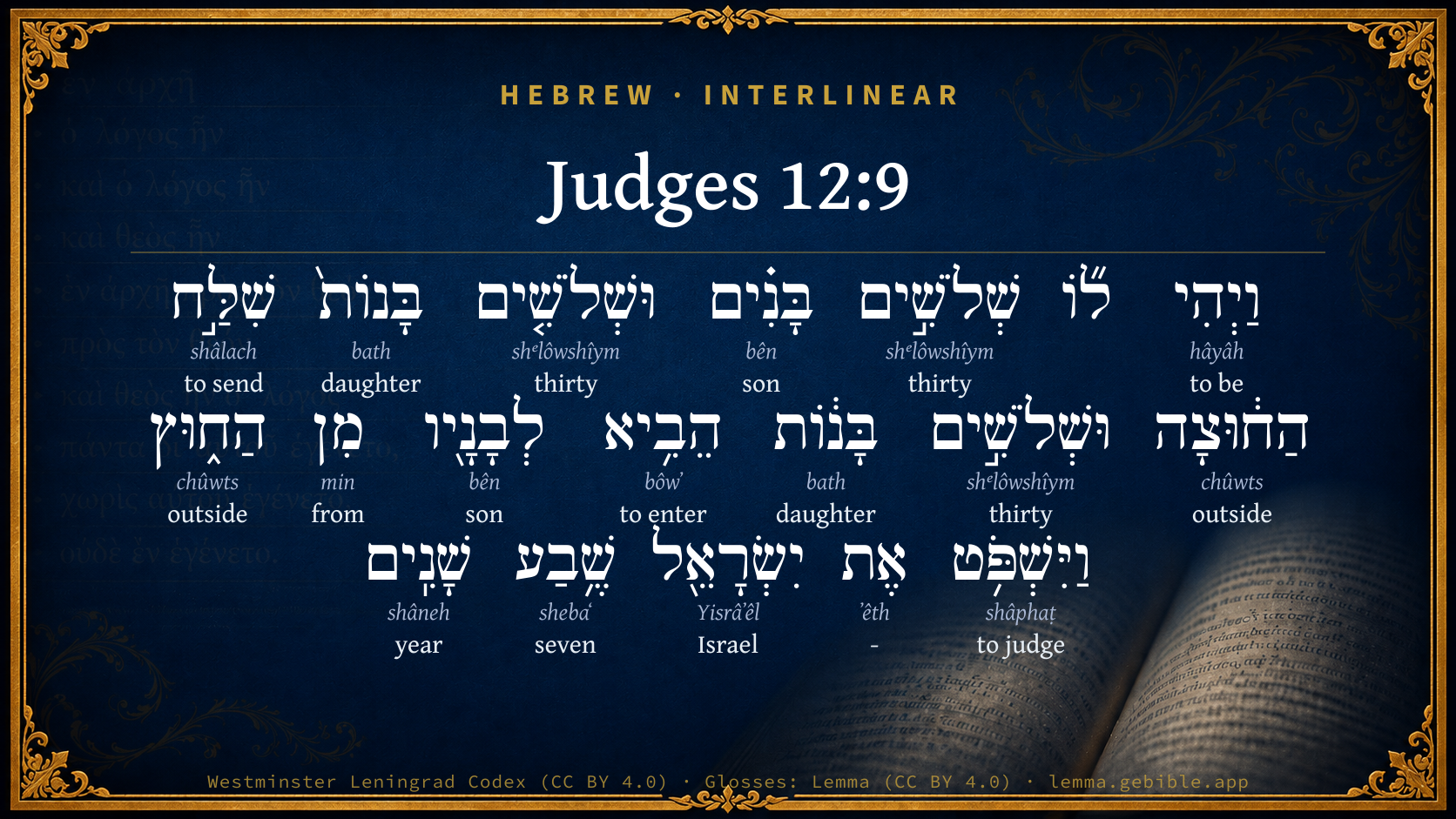
Judges 12:9

Hebrew (Westminster Leningrad Codex) Judges 12:9 appears in the Hebrew Old Testament. The text above is from the Westminster Leningrad Codex. Each word links to its Strong’s number, a concise gloss, and parsing drawn from the Open Scriptures Hebrew Bible morphology. Click any word for its full Brown-Driver-Briggs (BDB) entry.
Download image
Cite this verse

Judges 12:9 (World English Bible). Public Domain. Lemma interlinear Bible study tool, https://lemma.gebible.app/v/judges/12/9.

Show BibTeX & RIS
BibTeX
RIS
English Translation
He had thirty sons; and thirty daughters he sent abroad, and thirty daughters he brought in from abroad for his sons. He judged Israel seven years.
World English Bible · Public Domain
Download a study sheet

One document with this verse’s original text, its word-by-word gloss line, the meaning frame, cross-references with their text, attributed commentary, and full source and license credits — printable, and it pastes into notes with its structure intact.

This verse Autodidact and up

Study sheet (.html) Plain text (.txt)

A passage Seminary Student

Up to 50 verses in one chapter. A passage sheet keeps up to 6 commentary sources and 12 cross-references per verse, in the order this page ranks them, and says so on the sheet whenever that leaves anything out. Ask for a single verse and you get the Autodidact verse sheet above.

Everything on this page stays free to read, with no account — the sheet is a download of what is already on screen, not access to it.

Want to remove ads? Support Godless Engineer
Compare translations 3

The same verse in 3 English versions, stacked beneath the original-language interlinear above. Click any original word for its lexicon entry.

Each is an independent rendering of the whole verse — the interlinear is not word-aligned to these translations.

Highlighted words mark where these versions differ — a whole-verse word diff, not a word-by-word alignment.

  • World English Bible Public Domain
    He had thirty sons; and thirty daughters he sent abroad, and thirty daughters he brought in from abroad for his sons. He judged Israel seven years.
  • King James Version Public Domain
    And he had thirty sons, and thirty daughters, whom he sent abroad, and took in thirty daughters from abroad for his sons. And he judged Israel seven years.
  • unfoldingWord Literal Text CC BY-SA 4.0
    And 30 sons were to him. And 30 daughters he sent outside, and 30 daughters he brought in for his sons from outside. And he judged Israel seven years.

unfoldingWord Literal Text — © unfoldingWord, licensed CC BY-SA 4.0. Word-aligned USFM3 via Door43 (git.door43.org/unfoldingWord/en_ult).

Versions to compare (up to 4)

3 of 4 selected

Show all 18 translations

Every available English version of this verse, each an independent rendering of the whole verse.

  • World English Bible Public Domain
    He had thirty sons; and thirty daughters he sent abroad, and thirty daughters he brought in from abroad for his sons. He judged Israel seven years.
  • Berean Standard Bible Public Domain
    He had thirty sons, as well as thirty daughters whom he gave in marriage to men outside his clan; and for his sons he brought back thirty wives from elsewhere. Ibzan judged Israel seven years.
  • Majority Standard Bible Public Domain
    He had thirty sons, as well as thirty daughters whom he gave in marriage to men outside his clan; and for his sons he brought back thirty wives from elsewhere. Ibzan judged Israel seven years.
  • King James Version Public Domain
    And he had thirty sons, and thirty daughters, whom he sent abroad, and took in thirty daughters from abroad for his sons. And he judged Israel seven years.
  • American Standard Version (1901) Public Domain
    And he had thirty sons; and thirty daughters he sent abroad, and thirty daughters he brought in from abroad for his sons. And he judged Israel seven years.
  • Revised Version (1885) Public Domain
    And he had thirty sons, and thirty daughters he sent abroad, and thirty daughters he brought in from abroad for his sons. And he judged Israel seven years.
  • Geneva Bible (1599) Public Domain
    Who had thirtie sonnes and thirtie daughters, which he sent out, and tooke in thirtie daughters from abroade for his sonnes. and he iudged Israel seuen yeere.
  • Douay-Rheims (1899) Public Domain
    He had thirty sons, and as many daughters, whom he sent abroad, and gave to husbands, and took wives for his sons of the same number, bringing them into his house. And he judged Israel seven years:
  • Young's Literal Translation Public Domain
    and he hath thirty sons and thirty daughters, he hath sent without and thirty daughters hath brought in to his sons from without; and he judgeth Israel seven years.
  • Literal Standard Version CC BY-SA 4.0
    and he has thirty sons, and thirty daughters he gave away [in marriage], and thirty daughters he brought in from outside for his sons; and he judges Israel [for] seven years.
  • Unlocked Literal Bible CC BY-SA 4.0
    He had thirty sons. He gave away thirty daughters in marriage, and he brought in thirty daughters of other men for his sons, from the outside. He judged Israel for seven years.
  • unfoldingWord Literal Text CC BY-SA 4.0
    And 30 sons were to him. And 30 daughters he sent outside, and 30 daughters he brought in for his sons from outside. And he judged Israel seven years.
  • Darby Bible Public Domain
    He had thirty sons; and thirty daughters he gave in marriage outside his clan, and thirty daughters he brought in from outside for his sons. And he judged Israel seven years.
  • World Messianic Bible Public Domain
    He had thirty sons. He sent his thirty daughters outside his clan, and he brought in thirty daughters from outside his clan for his sons. He judged Israel seven years.
  • Webster's Bible Public Domain
    And he had thirty sons and thirty daughters whom he sent abroad, and took in thirty daughters from abroad for his sons: and he judged Israel seven years.
  • Free Bible Version CC BY-SA 4.0
    He had thirty sons and thirty daughters. He married off his daughters to men of other tribes, and he brought in thirty wives from other tribes to marry his sons. Ibzan led Israel as judge for seven years.
  • Bible in Basic English Public Domain
    He had thirty sons, and thirty daughters whom he sent to other places, and he got thirty wives from other places for his sons. And he was judge of Israel for seven years.
  • JPS Tanakh (1917) Public Domain
    And he had thirty sons, and thirty daughters he sent abroad, and thirty daughters he brought in from abroad for his sons. And he judged Israel seven years.

Literal Standard Version (2020), Covenant Press — licensed CC BY-SA 4.0. Text via the HelloAO Bible API (eBible.org). Unlocked Literal Bible (unfoldingWord) — licensed CC BY-SA 4.0. Text via the HelloAO Bible API (eBible.org). unfoldingWord Literal Text — © unfoldingWord, licensed CC BY-SA 4.0. Word-aligned USFM3 via Door43 (git.door43.org/unfoldingWord/en_ult). Free Bible Version, Dr. Jonathan Gallagher — licensed CC BY-SA 4.0. Text via the HelloAO Bible API (eBible.org).

Word by word

More ways to search: Search by grammar → Find every occurrence → Compare this word →

Practice this passage: Drill this verse → Learn its vocabulary →

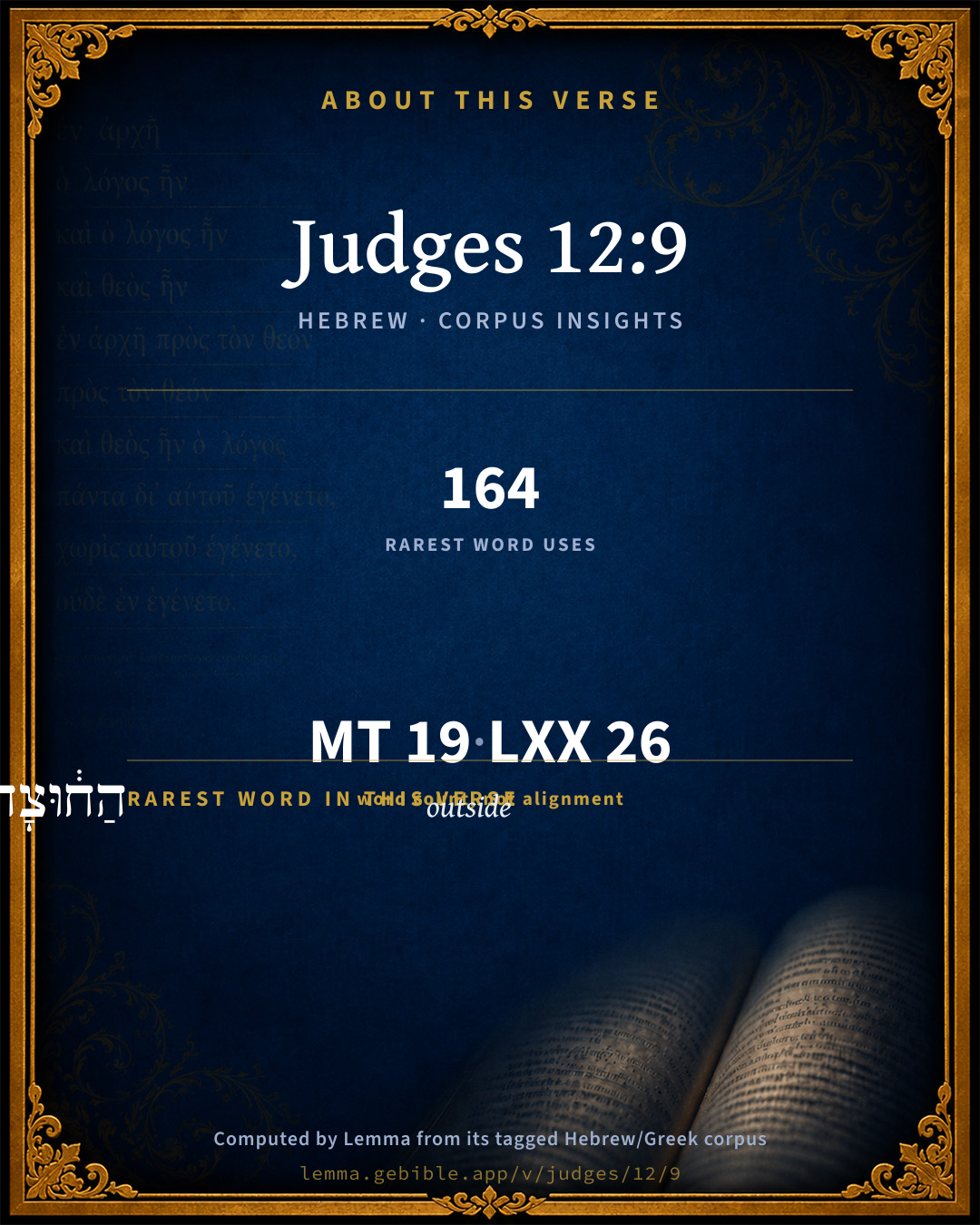
הַח֔וּצָה
chûwts
H2351
“the · outside · toward”
Particle, Definite Article + Noun, Common, Masculine, Singular, Absolute + Suffix, Demonstrative
Part of Speech
Particle + Noun
Type
Common
Gender
Masculine
Number
Singular
State
Absolute
Full BDB Definition

Origin: (both forms fem. in the pl.) from an unused root meaning to sever

TWOT: 627a

outside, outward, street, the outside
  1. וַיְהִי hâyâh H1961 “and · to be” Conjunction + Verb, Qal, Sequential Imperfect, 3rd Person, Masculine, Singular
  2. שְׁלֹשִׁ֣ים shᵉlôwshîym H7970 “thirty” Adjective, Cardinal number, Both, Plural, Absolute
  3. בָּנִ֗ים bên H1121 “sons” Noun, Common, Masculine, Plural, Absolute
  4. וּשְׁלֹשִׁ֤ים shᵉlôwshîym H7970 “and · thirty” Conjunction + Adjective, Cardinal number, Both, Plural, Absolute
  5. בָּנוֹת֙ bath H1323 “daughters” Noun, Common, Feminine, Plural, Absolute
  6. שִׁלַּ֣ח shâlach H7971 “to send” Verb, Piel, Perfect, 3rd Person, Masculine, Singular
  7. וּשְׁלֹשִׁ֣ים shᵉlôwshîym H7970 “and · thirty” Conjunction + Adjective, Cardinal number, Both, Plural, Absolute
  8. בָּנ֔וֹת bath H1323 “daughters” Noun, Common, Feminine, Plural, Absolute
  9. הֵבִ֥יא bôwʼ H935 “to enter” Verb, Hiphil, Perfect, 3rd Person, Masculine, Singular
  10. לְבָנָ֖יו bên H1121 “to/for · sons · his” Preposition + Noun, Common, Masculine, Plural, Construct + Suffix, Personal, 3rd Person, Masculine, Singular
  11. מִן min H4480 “from” Preposition
  12. הַח֑וּץ chûwts H2351 “the · outside” Particle, Definite Article + Noun, Common, Masculine, Singular, Absolute
  13. וַיִּשְׁפֹּ֥ט shâphaṭ H8199 “and · to judge” Conjunction + Verb, Qal, Sequential Imperfect, 3rd Person, Masculine, Singular
  14. אֶת ʼêth H853 “-” Particle, Direct Object
  15. יִשְׂרָאֵ֖ל Yisrâʼêl H3478 “Israel” Noun, Proper
  16. שֶׁ֥בַע shebaʻ H7651 “seven” Adjective, Cardinal number, Feminine, Singular, Absolute
  17. שָׁנִֽים shâneh H8141 “years” Noun, Common, Feminine, Plural, Absolute

About this verse

These counts appear in no published source. They are computed here, from the morphology-tagged text and Lemma’s own curated glosses. What Lemma adds →

19
words
13
distinct lemmas
Historical
section

Grammatical profile

  • 4 verbs
  • 8 nouns
  • 4 adjectives
  • 2 prepositions
  • 1 particle

Verb forms

  • וַיְהִי Qal · Sequential Imperfect
  • שִׁלַּ֣ח Piel · Perfect
  • הֵבִ֥יא Hiphil · Perfect
  • וַיִּשְׁפֹּ֥ט Qal · Sequential Imperfect

Repetition

Words recur within this verse — often emphatic in Hebrew:

  • שְׁלֹשִׁ֣ים thirty H7970 ×3
  • בָּנִ֗ים son H1121 ×2
  • בָּנוֹת֙ daughter H1323 ×2
  • הַח֔וּצָה outside H2351 ×2

Hebrew & Septuagint length

In English translation the verse runs 26 words from the Hebrew and 29 from the Septuagint (LXX English) — closely comparable.

A rough comparison of the two English renderings, which tokenize alike — not a word-level alignment.

Word counts can differ between the Hebrew and the Greek without any difference in meaning — e.g. the Hebrew direct-object marker אֵת has no separate Greek word, and Greek often adds the article ὁ.

In the original languages it is 19 Hebrew tokens and 26 Greek tokens — but the two are counted differently (Hebrew bundles its prefixes and suffixes into one token; the Greek is in lemma form), so that isn’t a like-for-like length.

Cross-references

2

Topical passages linked to Judges 12:9 in the Treasury of Scripture Knowledge — connected by theme and wording, ordered by reader-vote popularity; previews shown in the World English Bible.

  • Judges 10:4 He had thirty sons who rode on thirty donkey colts, and they had thirty cities, which are called Havvoth Jair to this day, which are in the land of Gilead.
  • Judges 12:14 He had forty sons and thirty sons' sons, who rode on seventy donkey colts: and he judged Israel eight years.

Cross-references courtesy of OpenBible.info (CC BY 4.0).

Hebrew and Greek witnesses Masoretic Hebrew ↔ Greek Septuagint

The same verse in the two great witnesses to the Old Testament, shown verse-for-verse.

These are two independent witnesses, not word-aligned to each other, and the Septuagint is shown in lemma (dictionary) form.

Hebrew Judges 12:9 Masoretic · Westminster Leningrad Codex

וַיְהִי ל֞וֹ שְׁלֹשִׁ֣ים בָּנִ֗ים וּשְׁלֹשִׁ֤ים בָּנוֹת֙ שִׁלַּ֣ח הַח֔וּצָה וּשְׁלֹשִׁ֣ים בָּנ֔וֹת הֵבִ֥יא לְבָנָ֖יו מִן הַח֑וּץ וַיִּשְׁפֹּ֥ט אֶת יִשְׂרָאֵ֖ל שֶׁ֥בַע שָׁנִֽים

He had thirty sons; and thirty daughters he sent abroad, and thirty daughters he brought in from abroad for his sons. He judged Israel seven years.

World English Bible · Public Domain

Greek LXX Judges 12:9 Septuagint · lemma form

καί εἰμί αὐτός τριάκοντα υἱός καί τριάκοντα θυγάτηρ ὅς ἐκ ἀποστέλλω ἔξω καί τριάκοντα θυγάτηρ εἰςφέρω ὁ υἱός αὐτός ἔξωθεν καί κρίνω ὁ ἰσραήλ ἑπτά ἔτος

And he had thirty sons, and thirty daughters, whom he sent forth; and he brought in thirty daughters for his sons from without; and he judged Israel seven years.

LXX2012 (modern English Septuagint) · Public Domain

Hebrew: Westminster Leningrad Codex (CC BY 4.0). Greek: Septuagint (public domain); English from LXX2012 (modern English Septuagint) (Public Domain). How the Septuagint differs from the Hebrew →

Targum (Aramaic paraphrase)

1

The Targum is the ancient Jewish Aramaic paraphrase of the Hebrew Scriptures — an interpretive translation, not the Hebrew text itself. Onkelos (literal) and Pseudo-Jonathan (expansive) render the Torah, and Jonathan the Prophets. Coverage is partial: where no permissively-licensed English translation exists for a verse, only the Aramaic is shown. This is verse-level text, not a word-by-word alignment to the Hebrew.

  1. Targum Jonathan Prophets (Joshua–Malachi)
    וַהֲוָה לֵיהּ תְּלָתִין בְּנִין וּתְלָתִין בְּנָן שִׁלַח לְבָרָא וּתְלָתִין בְּנָן כַּלָן אָעֵיל לִבְנוֹהִי מִן בְּרָא וְדָן יַת יִשְׂרָאֵל שְׁבַע שְׁנִין:

    (no public-domain English translation for this verse)

    Targum Jonathan — Aramaic: “Mikraot Gedolot” (public domain). English: “Sefaria Community Translation” (CC0 1.0 (public-domain dedication)); “London "Chaldee Paraphrase," 1871” (public domain). Text via Sefaria.

Commentary

Notes on Judges 12:9 from classic Christian and Jewish commentators (each source and its license shown beneath its notes). The classic Christian expositions comment on the surrounding passage and are grouped to its opening verse, so a note may address several verses; the Jewish commentaries on the Tanakh (Rashi and others) are per-verse, so they appear only where the commentator wrote on this verse.

Lemma curates 59 commentaries, every one of them public domain or Creative Commons licensed, each selected and text-cleaned for this edition rather than reprinted as found. About our sources →

Trapp's Complete Commentary

John Trapp

Jdg 12:9 And he had thirty sons, and thirty daughters, [whom] he sent abroad, and took in thirty daughters from abroad for his sons. And he judged Israel seven years.

Ver. 9. Thirty daughters, whom he sent abroad.] Providing fit matches for them in due time; which is the father’s duty, since there is in most people a propensity to the nuptial conjunction. The man misseth his rib, and the woman would be in her old place again, under the man’s arm or wing. "My daughter, shall I not seek rest for thee" - that is, a husband - "that it may be well with thee?" {Rth 3:1}

John Trapp, A Commentary or Exposition upon All the Books of the Old and New Testament (1647–1656) — public domain. Text from a community e-Sword module.

Joseph Benson's Commentary

Jdg 12:9. Took in thirty daughters — That is, took them home for wives to his sons. What a difference between his and his predecessor’s family! Ibzan had sixty children, and all married; Jephthah but one, and she dies unmarried. Some are increased, others diminished; all is the Lord’s doing.

Joseph Benson's Commentary on the Old and New Testaments (1811–1818) — public domain. Text from a community e-Sword module.

Ellicott's Commentary for English Readers

(9) Thirty sons, and thirty daughters.—Implying polygamy, wealth, and state (Jdg_8:30).

Whom he sent abroad—i.e., whom he gave in marriage “out of his house” (Vulg., quas emittens foras maritis dedit). The only reason for recording the marriage of his sons and daughters is to show that he was a great man, and sought additional influence by intermarriages with other families. It showed no little prosperity that he lived to see his sixty children married.

A Bible Commentary for English Readers, edited by Charles John Ellicott (1878–1897) — public domain. Text from a community e-Sword module.

John Gill's Exposition

And he had thirty sons and thirty daughters,.... Which was a very uncommon case for a man to have so many children, and those as to their sex to be equal. Between the former judge and him there was a great difference, in respect of this circumstance of children; he had but one daughter, an only child; and she, by reason of his vow, not suffered to marry. Such a difference does God, in his all wise Providence, make even among good men: nor is this any certain characteristic of a good man. Danaus had fifty daughters, and his brother Egyptus fifty sons, who were married to each other; and the husbands were all slain by their wives but one, on the wedding night, and so far from being happy in them: but it was otherwise with this judge:

whom he sent abroad, and took in thirty daughters from abroad for his sons; his daughters he sent abroad, or married them, to persons not of another nation, nor of another tribe, but of another family of the same tribe, and these he dismissed from him to live with their husbands; and he took in daughters of families in the same tribe to be wives to his sons, and who seem to have dwelt together; it being the custom then for sons, though married, to abide with their father, and their wives with them; as Abarbinel says is the custom at Zenobia unto this day:

and he judged Israel seven years; and in his days the wars of Troy are said (z) to begin; but they began in the times of Jephthah his predecessor, and ended in his (a).

(z) Juchasin, fol. 136. 1. (a) Gerard. Vossii Isagoge Chron. dissert. 1. p. 4.

John Gill's Exposition of the Whole Bible (1746–1763) — public domain (CC PDM 1.0). Text via the HelloAO Bible API.

Haydock's Catholic Bible Commentary

House, or family, though perhaps not under the same roof. (Menochius)

George Leo Haydock (1774–1849), Haydock's Catholic Family Bible and Commentary, 1859 edition — public domain. Excludes Psalms (Douay-Rheims chapter numbering differs from Protestant) and Deuterocanonical books (Catholic canon only).

Matthew Poole's English Annotations

Took in thirty daughters, i.e. took them home for wives to his sons. See Gen 24:67; 31:50; Deu 21:12; 2Sa 11:27.

Matthew Poole's English Annotations on the Holy Bible (1683–1685) — public domain. Text from a community e-Sword/MySword module.

Whedon's Commentary on the Bible

Daniel D. Whedon

9. Thirty sons, and thirty daughters — This fact alone would make him great in Israel, and might have been one reason of his being elected judge. Notice that the daughters were sent abroad to find homes in Israel, but the sons remained at home to inherit the paternal estate. Notice, also, how complete a contrast between Ibzan’s family fortunes and those of Jephthah.

Daniel D. Whedon (gen. ed.), Commentary on the Old and New Testaments (1874–1909) — public domain. Text from a community e-Sword module.

The Pulpit Commentary

He had thirty sons, etc. From no record of Ibzan"s judgeship being preserved, except this domestic incident, we may infer, as in the ease of Jair, that no important events took place in his time.

The Pulpit Commentary (1880–1919), ed. H.D.M. Spence-Jones & Joseph S. Exell — public domain. Text from a community e-Sword module.

John Wesley's Explanatory Notes

Took in - That is, took them home for wives to his sons. What a difference between his and his predecessor's family! Ibzan had sixty children, and all married: Jephthah but one, and she dies unmarried. Some are increased, others diminished: all is the Lord's doing.

John Wesley, Explanatory Notes Upon the Whole Bible (1754–1765) — public domain. Text via the GEBible commentary corpus.

Lesson kit

Teaching starters — assembled from the data on this page, not authored interpretation. Every prompt links to the verse data it draws on. Edit before teaching.

Judges, in the Historical, opens this verse with 19 words (13 distinct Hebrew lemmas). Its most distinctive word is chûwts (“outside”). A historical commentator’s framing appears above. Read the whole chapter for the surrounding context.

Discussion questions

  1. The word chûwts carries the sense “outside.” How does it shape the verse?
  2. Judges 10:4 shares this passage’s theme. How do the two illuminate each other?
  3. “thirty” occurs 3× in this one verse. What is the effect of the repetition?
  4. The translations on this page render this verse differently — a whole-verse word diff, not a word-by-word alignment. What might account for the different wordings?
  5. The verb «וַיְהִי» is Qal Sequential Imperfect. How does its form color the action?
  6. Reading how Trapp's Complete Commentary and Joseph Benson's Commentary read this verse, where do the two commentators agree and where do they part?

Things to notice

Reading settings

Reading text

Shown beneath each verse's original-language words.

Old Testament
Old Testament edition

Read the OT as the Masoretic Hebrew (MT) or the Greek Septuagint (LXX).

English shown for the Greek Septuagint (in the Hebrew ↔ Greek comparison).

Comparing translations? Open the Compare panel on any verse page to stack up to four side by side.