Genesis 19:31

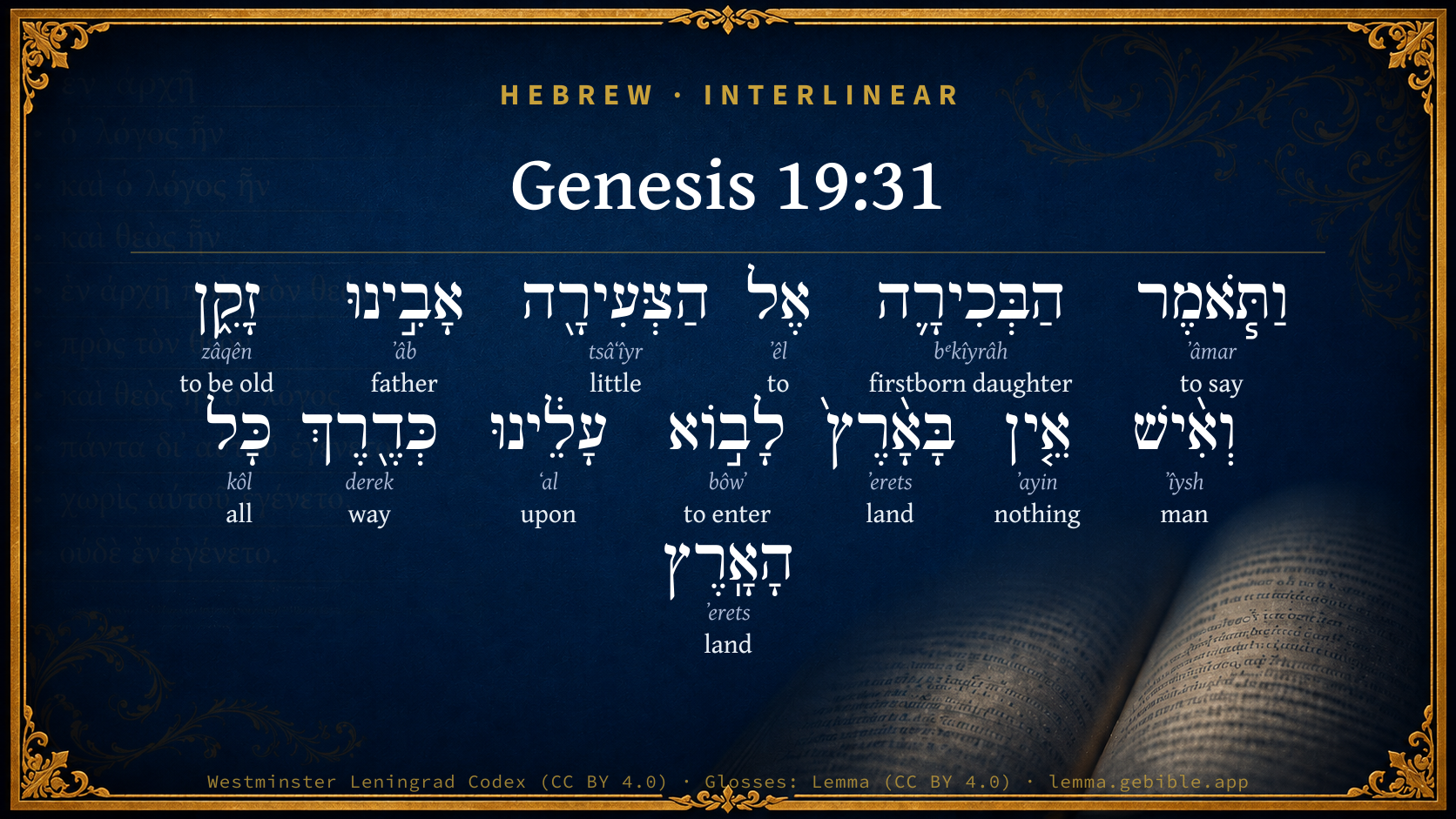
Hebrew (Westminster Leningrad Codex) Genesis 19:31 appears in the Hebrew Old Testament. The text above is from the Westminster Leningrad Codex. Each word links to its Strong’s number, a concise gloss, and parsing drawn from the Open Scriptures Hebrew Bible morphology. Click any word for its full Brown-Driver-Briggs (BDB) entry.
Download image
Cite this verse

Genesis 19:31 (World English Bible). Public Domain. Lemma interlinear Bible study tool, https://lemma.gebible.app/v/genesis/19/31.

Show BibTeX & RIS
BibTeX
RIS
English Translation
The firstborn said to the younger, "Our father is old, and there is not a man in the earth to come in to us after the manner of all the earth.
World English Bible · Public Domain
Highlights
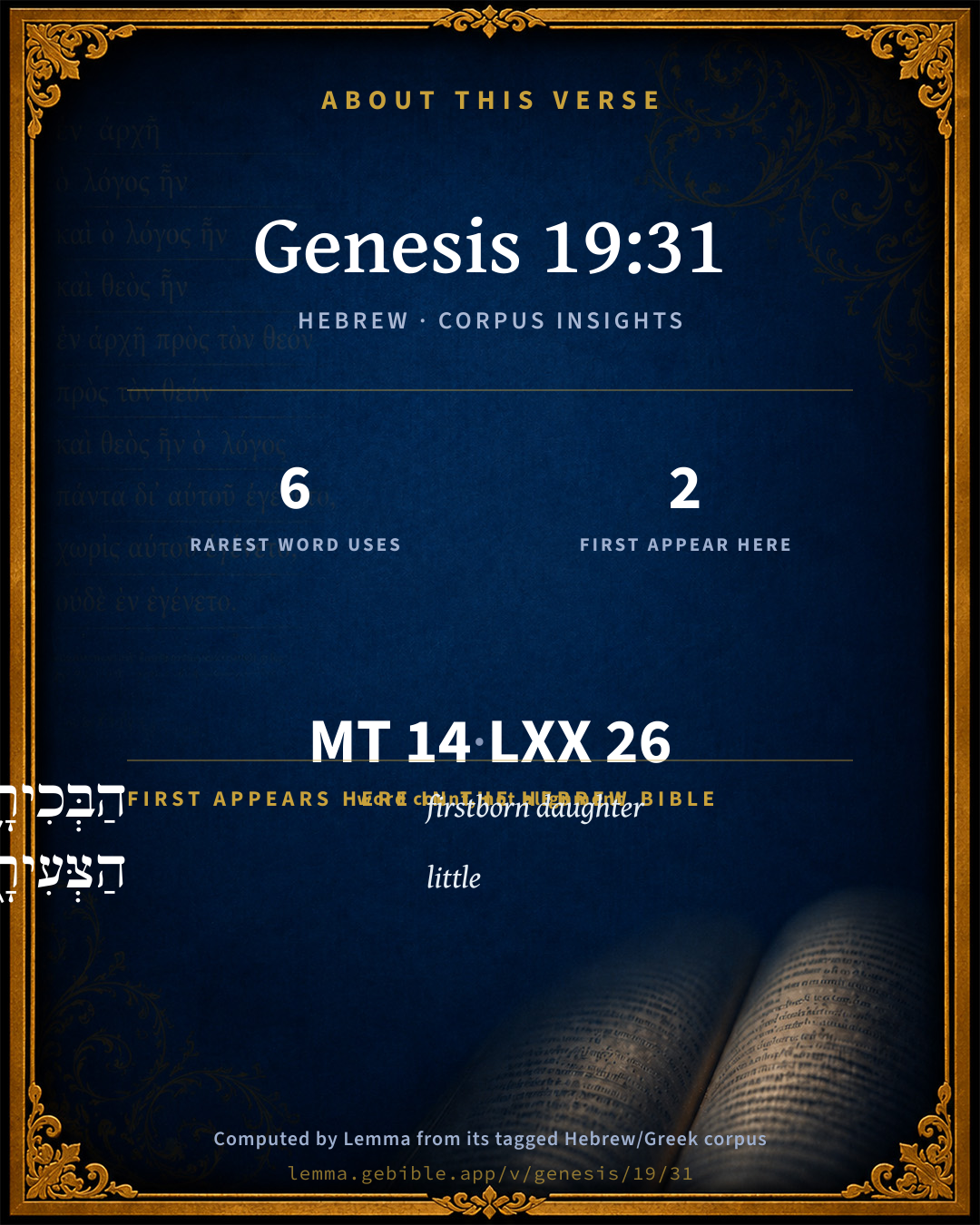
  • 2 first appearances in the Hebrew Bible
Full analysis ↓
Download a study sheet

One document with this verse’s original text, its word-by-word gloss line, the meaning frame, cross-references with their text, attributed commentary, and full source and license credits — printable, and it pastes into notes with its structure intact.

This verse Autodidact and up

Study sheet (.html) Plain text (.txt)

A passage Seminary Student

Up to 50 verses in one chapter. A passage sheet keeps up to 6 commentary sources and 12 cross-references per verse, in the order this page ranks them, and says so on the sheet whenever that leaves anything out. Ask for a single verse and you get the Autodidact verse sheet above.

Everything on this page stays free to read, with no account — the sheet is a download of what is already on screen, not access to it.

Want to remove ads? Support Godless Engineer
Compare translations 3

The same verse in 3 English versions, stacked beneath the original-language interlinear above. Click any original word for its lexicon entry.

Each is an independent rendering of the whole verse — the interlinear is not word-aligned to these translations.

Highlighted words mark where these versions differ — a whole-verse word diff, not a word-by-word alignment.

  • World English Bible Public Domain
    The firstborn said to the younger, "Our father is old, and there is not a man in the earth to come in to us after the manner of all the earth.
  • King James Version Public Domain
    And the firstborn said unto the younger, Our father is old, and there is not a man in the earth to come in unto us after the manner of all the earth:
  • unfoldingWord Literal Text CC BY-SA 4.0
    Then the firstborn said to the younger, “Our father is old, and there is not a man on the earth to come to us as the way of all the earth.

unfoldingWord Literal Text — © unfoldingWord, licensed CC BY-SA 4.0. Word-aligned USFM3 via Door43 (git.door43.org/unfoldingWord/en_ult).

Versions to compare (up to 4)

3 of 4 selected

Show all 18 translations

Every available English version of this verse, each an independent rendering of the whole verse.

  • World English Bible Public Domain
    The firstborn said to the younger, "Our father is old, and there is not a man in the earth to come in to us after the manner of all the earth.
  • Berean Standard Bible Public Domain
    One day the older daughter said to the younger, “Our father is old, and there is no man in the land to sleep with us, as is the custom over all the earth.
  • Majority Standard Bible Public Domain
    One day the older daughter said to the younger, “Our father is old, and there is no man in the land to sleep with us, as is the custom over all the earth.
  • King James Version Public Domain
    And the firstborn said unto the younger, Our father is old, and there is not a man in the earth to come in unto us after the manner of all the earth:
  • American Standard Version (1901) Public Domain
    And the first-born said unto the younger, Our father is old, and there is not a man in the earth to come in unto us after the manner of all the earth:
  • Revised Version (1885) Public Domain
    And the firstborn said unto the younger, Our father is old, and there is not a man in the earth to come in unto us after the manner of all the earth:
  • Geneva Bible (1599) Public Domain
    And the elder saide vnto the yonger, Our father is old, and there is not a man in the earth, to come in vnto vs after the maner of all ye earth.
  • Douay-Rheims (1899) Public Domain
    And the elder said to the younger Our father is old, and there is no man left on the earth, to come in unto us after the manner of the whole earth.
  • Young's Literal Translation Public Domain
    And the first-born saith unto the younger, `Our father `is' old, and a man there is not in the earth to come in unto us, as `is' the way of all the earth;
  • Literal Standard Version CC BY-SA 4.0
    And the firstborn says to the younger, “Our father [is] old, and there is not a man in the earth to come in to us, as [is] the way of all the earth;
  • Unlocked Literal Bible CC BY-SA 4.0
    The firstborn said to the younger, “Our father is old, and there is no man anywhere to sleep with us according to the way of all the world.
  • unfoldingWord Literal Text CC BY-SA 4.0
    Then the firstborn said to the younger, “Our father is old, and there is not a man on the earth to come to us as the way of all the earth.
  • Darby Bible Public Domain
    And the first-born said to the younger, Our father is old, and there is not a man in the land to come in to us after the manner of all the earth:
  • World Messianic Bible Public Domain
    The firstborn said to the younger, “Our father is old, and there is not a man in the earth to come in to us in the way of all the earth.
  • Webster's Bible Public Domain
    And the first-born said to the younger, Our father is old, and there is not a man on the earth to come in to us after the manner of all the earth:
  • Free Bible Version CC BY-SA 4.0
    Sometime later the older daughter said to the younger one, “Our father is growing old, and there's no men left to give us children like everyone does.
  • Bible in Basic English Public Domain
    And the older daughter said to her sister, Our father is old, and there is no man to be a husband to us in the natural way:
  • JPS Tanakh (1917) Public Domain
    And the first-born said unto the younger: 'Our father is old, and there is not a man in the earth to come in unto us after the manner of all the earth.

Literal Standard Version (2020), Covenant Press — licensed CC BY-SA 4.0. Text via the HelloAO Bible API (eBible.org). Unlocked Literal Bible (unfoldingWord) — licensed CC BY-SA 4.0. Text via the HelloAO Bible API (eBible.org). unfoldingWord Literal Text — © unfoldingWord, licensed CC BY-SA 4.0. Word-aligned USFM3 via Door43 (git.door43.org/unfoldingWord/en_ult). Free Bible Version, Dr. Jonathan Gallagher — licensed CC BY-SA 4.0. Text via the HelloAO Bible API (eBible.org).

Word by word

More ways to search: Search by grammar → Find every occurrence → Compare this word →

Practice this passage: Drill this verse → Learn its vocabulary →

הַבְּכִירָ֛ה
bᵉkîyrâh
H1067
“the · firstborn daughter”
Particle, Definite Article + Noun, Common, Feminine, Singular, Absolute
Part of Speech
Particle + Noun
Type
Common
Gender
Feminine
Number
Singular
State
Absolute
Full BDB Definition

Origin: from H1069

TWOT: 244d

firstborn daughter, firstborn (of women) - always used of women
  1. וַתֹּ֧אמֶר ʼâmar H559 “and · to say” Conjunction + Verb, Qal, Sequential Imperfect, 3rd Person, Feminine, Singular
  2. אֶל ʼêl H413 “to” Preposition
  3. הַצְּעִירָ֖ה tsâʻîyr H6810 “the · little” Particle, Definite Article + Adjective, Adjective, Feminine, Singular, Absolute
  4. אָבִ֣ינוּ ʼâb H1 “father · our” Noun, Common, Masculine, Singular, Construct + Suffix, Personal, 1st Person, Common, Plural
  5. זָקֵ֑ן zâqên H2204 “to be old” Verb, Qal, Perfect, 3rd Person, Masculine, Singular
  6. וְאִ֨ישׁ ʼîysh H376 “and · man” Conjunction + Noun, Common, Masculine, Singular, Absolute
  7. אֵ֤ין ʼayin H369 “nothing” Particle, Negative
  8. בָּאָ֨רֶץ֙ ʼerets H776 “in/at the · land” Preposition, Determined + Noun, Common, Both, Singular, Absolute
  9. לָב֣וֹא bôwʼ H935 “to enter” Preposition + Verb, Qal, Infinitive Construct
  10. עָלֵ֔ינוּ ʻal H5921 “upon · us” Preposition + Suffix, Personal, 1st Person, Common, Plural
  11. כְּדֶ֖רֶךְ derek H1870 “like/as · way of” Preposition + Noun, Common, Both, Singular, Construct
  12. כָּל kôl H3605 “all of” Noun, Common, Masculine, Singular, Construct
  13. הָאָֽרֶץ ʼerets H776 “the · land” Particle, Definite Article + Noun, Common, Both, Singular, Absolute

About this verse

These counts appear in no published source. They are computed here, from the morphology-tagged text and Lemma’s own curated glosses. What Lemma adds →

14
words
13
distinct lemmas
Pentateuch
section

Notable vocabulary

The rarest word here is הַבְּכִירָ֛ה firstborn daughter H1067 — appearing just 6 times in the whole Hebrew Bible.

First appearance in Scripture

These words make their first canonical appearance in the Hebrew Bible here:

  • הַבְּכִירָ֛ה firstborn daughter H1067
  • הַצְּעִירָ֖ה little H6810

Shared distinctive vocabulary

הַבְּכִירָ֛ה firstborn daughter H1067 occurs in 6 verses of the Hebrew Bible. Also found in:

Grammatical profile

  • 3 verbs
  • 7 nouns
  • 1 adjective
  • 2 prepositions
  • 1 particle

Verb forms

  • וַתֹּ֧אמֶר Qal · Sequential Imperfect
  • זָקֵ֑ן Qal · Perfect
  • לָב֣וֹא Qal · Infinitive Construct

Repetition

A word recurs within this verse — often emphatic in Hebrew:

  • בָּאָ֨רֶץ֙ land H776 ×2

Hebrew & Septuagint length

In English translation the verse runs 31 words from the Hebrew and 33 from the Septuagint (LXX English) — closely comparable.

A rough comparison of the two English renderings, which tokenize alike — not a word-level alignment.

Word counts can differ between the Hebrew and the Greek without any difference in meaning — e.g. the Hebrew direct-object marker אֵת has no separate Greek word, and Greek often adds the article ὁ.

In the original languages it is 14 Hebrew tokens and 26 Greek tokens — but the two are counted differently (Hebrew bundles its prefixes and suffixes into one token; the Greek is in lemma form), so that isn’t a like-for-like length.

Cross-references

10

Topical passages linked to Genesis 19:31 in the Treasury of Scripture Knowledge — connected by theme and wording, ordered by reader-vote popularity; previews shown in the World English Bible.

  • Deuteronomy 25:5 If brothers dwell together, and one of them die, and have no son, the wife of the dead shall not be married outside to a stranger: her husband's brother shall go in to her, and take her to him as wife, and perform the duty of a husband's brother to her.
  • Genesis 4:1 The man knew Eve his wife. She conceived, and gave birth to Cain, and said, "I have gotten a man with Yahweh's help."
  • Genesis 6:4 The Nephilim were in the earth in those days, and also after that, when God's sons came to men's daughters. They bore children to them: the same were the mighty men who were of old, men of renown.
  • Genesis 16:2 Sarai said to Abram," See now, Yahweh has restrained me from bearing. Please go in to my handmaid. It may be that I will obtain children by her." Abram listened to the voice of Sarai.
  • Genesis 16:4 He went in to Hagar, and she conceived. When she saw that she had conceived, her mistress was despised in her eyes.
  • Isaiah 4:1 Seven women shall take hold of one man in that day, saying, "We will eat our own bread, and wear our own clothing: only let us be called by your name. Take away our reproach."
  • Genesis 19:28 He looked toward Sodom and Gomorrah, and toward all the land of the plain, and looked, and saw that the smoke of the land went up as the smoke of a furnace.
  • Genesis 38:8–9 Judah said to Onan, "Go in to your brother's wife, and perform the duty of a husband's brother to her, and raise up seed to your brother."
  • Genesis 38:14–30 She took off of her the garments of her widowhood, and covered herself with her veil, and wrapped herself, and sat in the gate of Enaim, which is by the way to Timnah; for she saw that Shelah was grown up, and she wasn't given to him as a wife.
  • Mark 9:6 For he didn't know what to say, for they were very afraid.

Cross-references courtesy of OpenBible.info (CC BY 4.0).

Hebrew and Greek witnesses Masoretic Hebrew ↔ Greek Septuagint

The same verse in the two great witnesses to the Old Testament, shown verse-for-verse.

These are two independent witnesses, not word-aligned to each other, and the Septuagint is shown in lemma (dictionary) form.

Hebrew Genesis 19:31 Masoretic · Westminster Leningrad Codex

וַתֹּ֧אמֶר הַבְּכִירָ֛ה אֶל הַצְּעִירָ֖ה אָבִ֣ינוּ זָקֵ֑ן וְאִ֨ישׁ אֵ֤ין בָּאָ֨רֶץ֙ לָב֣וֹא עָלֵ֔ינוּ כְּדֶ֖רֶךְ כָּל הָאָֽרֶץ

The firstborn said to the younger, "Our father is old, and there is not a man in the earth to come in to us after the manner of all the earth.

World English Bible · Public Domain

Greek LXX Genesis 19:31 Septuagint · lemma form

εἶπον δέ ὁ πρεσβύτερος πρός ὁ νέος ὁ πατήρ ἐγώ πρεσβύτερος καί οὐδείς εἰμί ἐπί ὁ γῆ ὅς εἰςἔρχομαι πρός ἐγώ ὡς καταἥκω πᾶς ὁ γῆ

And the elder said to the younger, Our father is old, and there is no one on the earth who shall come in to us, as it is fit in all the earth.

LXX2012 (modern English Septuagint) · Public Domain

Hebrew: Westminster Leningrad Codex (CC BY 4.0). Greek: Septuagint (public domain); English from LXX2012 (modern English Septuagint) (Public Domain). How the Septuagint differs from the Hebrew →

Targum (Aramaic paraphrase)

2

The Targum is the ancient Jewish Aramaic paraphrase of the Hebrew Scriptures — an interpretive translation, not the Hebrew text itself. Onkelos (literal) and Pseudo-Jonathan (expansive) render the Torah, and Jonathan the Prophets. Coverage is partial: where no permissively-licensed English translation exists for a verse, only the Aramaic is shown. This is verse-level text, not a word-by-word alignment to the Hebrew.

  1. Targum Onkelos Torah (Genesis–Deuteronomy)
    וַאֲמֶרֶת רַבְּתָא לִזְעֶרְתָּא אֲבוּנָא סִיב וּגְבַר לֵית בְּאַרְעָא לְמֵיעַל עֲלָנָא כְּאוֹרַח כָּל אַרְעָא

    (no public-domain English translation for this verse)

    Targum Onkelos — Aramaic: “Onkelos Genesis” (public domain); “Onkelos Exodus” (public domain); “Onkelos Leviticus” (public domain); “Onkelos Numbers” (public domain); “Onkelos Deuteronomy” (public domain). English: “Sefaria Community Translation” (CC0 1.0 (public-domain dedication)); “J.W. Etheridge. The Targums of Onkelos and Jonathan Ben Uzziel on the Pentateuch. London: Longmans, Green, 1862” (public domain). Text via Sefaria.

  2. Targum Pseudo-Jonathan Torah (Genesis–Deuteronomy)
    וַאֲמָרַת רַבְּתָא לִזְעֵירְתָּא אָבוּנָא סִיב וּגְבַר לֵית בְּאַרְעָא לְמֵיעַל עֲלָנָא כְּאוֹרַח כָּל אַרְעָא

    And the elder said to the less, Our father is old, and there is no man in the land to come to us after the way of the whole earth:

    Targum Pseudo-Jonathan — Aramaic: “Targum Jonathan on Genesis” (public domain); “Targum Jonathan on Exodus” (public domain); “Targum Jonathan on Leviticus” (public domain); “Targum Jonathan on Numbers” (public domain); “Targum Jonathan on Deuteronomy” (public domain). English: “The Targum of Jonathan ben Uzziel, trans. J. W. Etheridge, London, 1862” (public domain). Text via Sefaria.

Commentary

Notes on Genesis 19:31 from classic Christian and Jewish commentators (each source and its license shown beneath its notes). The classic Christian expositions comment on the surrounding passage and are grouped to its opening verse, so a note may address several verses; the Jewish commentaries on the Tanakh (Rashi and others) are per-verse, so they appear only where the commentator wrote on this verse.

Lemma curates 59 commentaries, every one of them public domain or Creative Commons licensed, each selected and text-cleaned for this edition rather than reprinted as found. About our sources →

Trapp's Complete Commentary

John Trapp

Gen 19:31 And the firstborn said unto the younger, Our father [is] old, and [there is] not a man in the earth to come in unto us after the manner of all the earth:

Ver. 31. And the firstborn, &c.] It is dangerous to live in a wicked place: yea, for though thyself mayest escape infection, thy children may be tainted, as Lot’s were.

John Trapp, A Commentary or Exposition upon All the Books of the Old and New Testament (1647–1656) — public domain. Text from a community e-Sword module.

The Biblical Illustrator

Joseph S. Exell

Gen_19:31-38

And they made their father drink wine

The lessons of Lots dishonour

I.

THAT SAINTS WHO HAVE BEEN THE SUBJECTS OF EXTRAORDINARY MERCY MAY YET FALL INTO SIN.

II. THAT IT IS DIFFICULT, EVEN FOR THE BEST, TO ESCAPE THE EFFECT OF EVIL ASSOCIATIONS.

III. THE FOLLY OF A WORLDLY CHOICE.

IV. THE WISDOM OF AVOIDING THE OCCASIONS OF SIN.

V. THE AWFUL DEPTHS OF HUMAN DEPRAVITY.

VI. FLESHLY SINS COVER EVEN A FAIR NAME WITH DISHONOUR. VII. THE DANGER OF EXCITEMENT.

VIII. THE FAITHFULNESS OF THE SCRIPTURE RECORD. (T. H. Leale.)

Lots dishonour

The dishonourable end of this good man shows that we are never out of danger while we are upon earth. He whose righteous soul was grieved with the filthy conversation of the wicked, while in a city, is drawn into the same kind of evils himself, when dwelling in a cave! His whole history also, from the time of his leaving Abraham, furnishes an affecting lesson to the heads of families in the choice of habitations for themselves or their children. If worldly accommodations be preferred to religious advantages, we have nothing good, but everything evil to expect. We may, or we may not lose, our substance as he did; but, what is of far greater consequence, our families may be expected to become mere heathens, and our own minds contaminated with the examples which are continually before our eyes. Such was the harvest which Lot reaped from his well-watered plain; and such are the fruits very commonly seen in those who reflect his example! (A. Fuller.)

.

The Biblical Illustrator, edited by Joseph S. Exell (c. 1880s–1900s) — public domain. Text from a community e-Sword module.

The Preacher's Complete Homiletical Commentary

Joseph S. Exell (gen. ed.)

CRITICAL NOTES.—

Gen_19:37. Called his name Moab.] “From the father,” or “seed of the father.”

Gen_19:38. Ben-Ammi. “Son of my people.”

MAIN HOMILETICS OF THE PARAGRAPH.—Gen_19:31-38

THE LESSONS OF LOT’S DISHONOUR

This chapter closes with the sad picture of a good man betrayed into sin, and thus covering his name with dishonour. It is a painful history, but there are some lessons of instruction to be learned.

I. That saints who have been, the subjects of extraordinary mercy may yet fall into sin. The temporal deliverance of Lot was a special act of Divine mercy. His conviction of it depended upon no mere emotion. There was the outward fact in which he could distinctly trace the hand of God. Yet, after so distinct a favour of Providence, he falls by an easy temptation into the foulest sin. Thus God’s mercy is no guarantee for human gratitude. Those who have been saved, yet so as by fire, are often the very first to forget God their Saviour. The picture which the Bible gives of man is faithful to the facts of human nature. God merciful, but man ungrateful. God just, but man unrighteous. God true, but every man a liar.

II. That it is difficult, even for the best, to escape the effect of evil associations. The conduct of Lot’s daughters shows how much they were imbued with the spirit of evil around them, notwithstanding their pious parentage. It is difficult for goodness to stand upright in the land of wickedness. Lot’s spiritual character suffered less injury than that of his family from their sojourn in Sodom; yet his moral sense was blunted, his moral fibre relaxed. As there is said to be virtue and healing in the shadow of goodness falling upon us, so the shadow of evil spreads nought but what is baneful.

III. The folly of a worldly choice. Lot had chosen this place with a view of promoting his temporal prosperity, but at what a cost! He had nearly perished in the terrible judgments which fell upon its population. He is scarcely saved. Mercy had to snatch him out of the fire. By choosing this world, against his best spiritual interests, he had exposed himself to bodily danger; and, what is worse than this, to great impairment of his spiritual health and vigour. We run the greatest risk to our souls when worldly considerations are uppermost in our minds in choosing our path in life.

IV. The wisdom of avoiding the occasions of sin. Lot gave way to strong drink, and then committed the sin of incest. There is a special danger in all sins of the flesh, for, when once indulged in, they render easier sins of deeper dye. They dull the intellect and the conscience until all moral perceptions are weakened and confused. If we allow the animal man the mastery, the spiritual man is threatened. How much of the sin, degradation, and misery of mankind is to be traced to strong drink! “Intoxication deceived Lot, who was not deceived in Sodom; the flames of lust burn him whom flames of sulphur did not burn.” (Gregory 1.) “Lot, who in Sodom, the very school of unchastity, had lived chastely, in the cave was guilty of incest, suffering shipwreck in the harbour.” (Lange.) The occasions of sin—especially those of a fleshly nature—should be avoided, or else we venture upon a current which will, in the end, become too strong for us.

V. The awful depths of human depravity. All sin is evil, but there are sins which defile the whole body and reveal depths of human depravity, from the very thought of which pure minds shrink with pain. There are fleshly sins of so deep a stain that the common fault and corruption of human nature is almost pure by comparison with them. This view of specially degrading sins is confirmed by the usages of language, by which the term “sinner” is applied to a special class. Such sins tend to hurry a man along that path which leads to infamy and shame.

VI. Fleshly sins cover even a fair name with dishonour. Lot is never mentioned in the history after this circumstance. He disappears under a cloud. A blot lies on his memory for all generations. He is now both outwardly and inwardly separated from Abraham, and is of no further importance in the history of salvation. His sin may have been forgiven, and his person accepted, but the deeds themselves are recorded in the iron page, where they remain. They are things done, and cannot be altered. They are happier and more blest who have not greatly fallen, even though the mercy of God is not overtasked by the worst sins of mankind.

VII. The danger of excitement. Lot had witnessed alarming scenes. It was a time of wild excitement when he knew not where to look for rest, and fears were in the way—destruction all around him, his wife stricken down at his side by an awful judgment, he himself a wanderer, having no certain dwelling-place, and not strong in the inspiration of hope. It is a time of great spiritual danger when a man is recovering from the extreme tension of his mind, produced by the excitement of violent and conflicting feelings.

VIII. The faithfulness of the Scripture record. Sacred history records the faults of its good men with a wonderful faithfulness. Here are no impossible characters, no ideal personages created by human imagination, but never seen in actual flesh and blood. The facts of human nature are accepted, though the contemplation of them may be painful and sad. We have men as they are, and not written up to by the devices of literary art. No human story-teller would have forged such a narrative as this. It has all the marks of a truthful record. The gravest sins and faults of the righteous are not concealed.

SUGGESTIVE COMMENTS ON THE VERSES

Gen_19:32-36. The manners of Sodom here obtrude themselves upon our view. Lot’s daughters might seem to have been led to this unnatural project, first, because they thought the human race extinct with the exception of themselves, in which case their conduct may have seemed a work of justifiable necessity; and next, because the degrees of kindred within which it was unlawful to marry had not been determined by an express law. But they must have seen some of the inhabitants of Zoar after the destruction of the cities; and carnal intercourse between parent and offspring must have always been repugnant to nature.—(Murphy).

Kalisch well remarks, “No word is employed, no allusion made, in the whole of this tale to express disgust, aversion, or hatred: the laws concerning the allowed and forbidden degrees were not yet fixed: Abraham himself lived in a matrimony cursed as an abomination in the Mosaic code (Lev_18:9): the event is related with all the calmness of historical composition.” And it must also not be forgotten that in Deu_2:9-19, the possessions of the “children of Lot” in Ar and in the land of Ammon are recognised by God, and the Israelites are forbidden to distress or meddle with them. But at the same time the necessity which there was for bereaving Lot of his self-command, shows us beneath the surface that his “righteous soul,” even though it could brook much which nature now abhors (Gen_19:8), could not have been brought to consent to that into which he was unconsciously betrayed.—(Alford.)

It is a moral duty to take care of our physical nature and to preserve it in its integrity. Whatever confuses the understanding, or weakens the will, exposes to moral danger. Hence drunkenness leads men into crimes from which, in their sober senses, they would shrink in abhorrence. All that which rouses the beast within us tends to destroy our better nature.

Those carnal devices by which morality is strained to meet circumstances show a practical distrust in Providence.

Gen_19:37-38. Both these names justify the view that it was merely to preserve the family that the daughters of Lot had recourse to the expedient. Hence, as we do not find that they ever repeated the stratagem, so neither do they now appear to have been at all ashamed of it, both which would have been natural had their motives been more unworthy than they were. The offspring, however, of this incestuous connection, whatever may be said in behalf of the connection itself, was certainly a bad one. These Moabites soon fell from the faith of God, and became idolators, the worshippers of Chemosh and Baal-peor, and were enemies to the children of Abraham. The same is also true of the Ammonites. As both these make afterwards a considerable figure in the sacred history, the inspired writer takes care to introduce at this early period an account of their origin.—(Bush.)

In the worst races there is an element of hope. Ruth was a Moabitess, and was a member of that family through whom the Messiah came. The prophetic Scriptures give us a picture of the conversion of the Moabites to Christ. (Isa_11:14; Jer_48:47; Dan_11:41.) The golden age for mankind lies in the future, not in the past.

The Preacher's Complete Homiletical Commentary (gen. ed. Joseph S. Exell; Funk & Wagnalls, c. 1892) — public domain (pre-1929). A full-Bible homiletical/sermon-outline anthology covering 65 of 66 books (2 John is absent from the source module). Text from a community e-Sword module.

Geneva Bible (1599)

Geneva Bible translators

Meaning in the country, which the Lord had now destroyed.

Geneva Bible (1599) marginal notes — public domain. Text via Bolls.life.

Adam Clarke's Commentary

Verse 31. Our father is old]. And consequently not likely to re-marry; and there is not a man in the earth - none left, according to their opinion in all the land of Canaan, of their own family and kindred; and they might think it unlawful to match with others, such as the inhabitants of Zoar, who they knew had been devoted to destruction as well as those of Sodom and Gomorrah, and were only saved at the earnest request of their father; and probably while they lived among them they found them ripe enough for punishment, and therefore would have thought it both dangerous and criminal to have formed any matrimonial connections with them.

Adam Clarke's Commentary on the Bible (1810–1826) — public domain. Text from a community e-Sword/MySword module.

John Calvin's Commentaries

31. And the firstborn said Here Moses narrates a miracle, which rightly brings the readers to astonishment. For, how could that unchaste intercourse come into the mind of the daughters of Lot, while the terrible punishment of God of the Sodomites stood still before her eyes, and while they knew that the scandalous and sinful lusts were the chief causes thereof? True, they were not so much moved through sensual lusts, as through a foolish desire for the procreation of their family; nevertheless, this urge was too absurd, because it forces the nature to forget all chastity and sense of shame, and, like the beasts, to destroy all difference between scandalous and honorable. To understand the better the whole of the case, I will deal with the separate parts, in order.

In the first place, concerning the plan of Lot’s oldest daughter, whom the younger obeyed, concerning that I take for granted that none of both is urged trough fleshy lust, but that they both have only thought about the propagation of the family. For, what kind of passion would that have been, to desire for intercourse with an already old father?

That the oldest furtively comes in for but one night, and puts her sister in her stead, the next night, and that they, being pregnant, not think to return to the embrace of their father; from that we decide in the second place, that they have had no other goal but to become mother. But I do not approve of what some conjecture, who say that they were mislead by a great error, thinking that the whole world had perished together with Sodom. For, they had just dwelt in Zoar, also there were sweet regions before their eyes, which were surely not without inhabitants, and also they had learned from their father that a special punishment was inflicted upon the Sodomites and the other neighbors. They also were not ignorant of the family whence their father came, and what kind of uncle he had followed out of his fatherland. So, what must we think? That, because they were assured that families are maintained by children, it was hard for them and it was a continual cause of grief, that they were without children. Also the emptiness, when their father would be dead, could seem to be unbearable for them, because they saw that they then would be lonely, and without any help. So, hence their impudent desire, and that absurd urgency to seek this unchaste intercourse, as they were afraid of a lonely life, which was liable to many concerns. Also I doubt not, that Moses not narrates what they have used as a pretext, but what they have said in a sincere feeling of their hearts. So, they wanted to bring forth seed, like the custom of all the nations. They adduce the example of the entire world, because they would deem it unfair when their state would be worse then that of the others. Everywhere, they say, the young women are praised, who conceive children, and thus build their families; why must we then be condemned to be always childless? In the mean time, they well know that they commit a great sin. For, why make they their father drunken? Is it not, because they guess, that he cannot be made willing? When he has had an aversion to unchastity, the daughters must necessarily have had the same notion in their consciences. So, in no wise they are to be excused, that they lend themselves to a scandalous intercourse, which all the nation abhor by nature. While the people, with normal crimes, are forced to admit their crimes; how will they plead themselves free with important crimes, as if no fear for God’s judgement prickled them? Therefore, with suppression of the conscience, Lot’s daughters devote themselves to that crime. The reason to mislead their father was no other then this, that they knew the disgrace, which they themselves necessarily had to condemn, because they knew that it was against the order of the nature. From this appears, whereto the people come when they follow their own will; for nothing can be so absurd or bestial, that we not decay to that, when we give free rein to our flesh. Let this, therefore, be the beginning of al our desires, to examine what the Lord allows, in order that it comes not in our mind to ask something, what according His Word is free to us.

There is not a man in the earth. They mean not that all the nations are destroyed, as many explainers drivel, but because they are by fear driven in the cave, leading a lonely life, they complain, that they are cut off from any hope of marriage. And yes, being secluded from the rest of the nations, they lived as if they were sent away to some separated world. Might one object that they could ask husbands of their father, then I answer, that it absolutely not a miracle, that they, beaten down through fear, could not seek another medicine, than what was at hand. For, they thought that they on that solitary mountain, locked up in the den of a rock, had no more the least connection with the human race. It could be (as I have reminded before) that some slaves dwelt with them. This is even probable, for otherwise it was difficult to have wine in the cave, when this was not taken with them on a wagon with the other foods. Yet they say that there were no husbands for them, because they have an aversion to a marriage with slaves.

Further I mean, that the name earth in the first member, is put for region or area, as if they said: This region has no more men left, who could marry us after the custom of the entire world. For there is here a tacit contrast between the whole earth and a certain part thereof. But this is their first crime, that they, in a zeal to propagate the human race, violate the holy law of nature. Next, it is wrong and wicked, that they not flee to the Creator of the world Himself, to cure them from that desolation, about which they were worried. Thirdly, they show their negligence when they aim their hearts only on the earthly life, and not worry about the heavenly life. Though I dare not to give security concerning the time, which has elapsed between the destruction of Sodom, and the unchaste intercourse of Lot with his daughters, yet, it is probable that they, as soon as they had come in the cave, in aversion to the solitude, have made up this scandalous and execrable plan. It could not take a long time, that Lot lived in the cave, or there came lack of food and drink. And like a sudden fear had carried away their father, like a storm, likewise the daughters could not restrain themselves, even for some days. Without calling upon God, or asking their father for advice, they are carried away through a bestial instinct. Herein we see how soon the deliverance and the punishment of the Sodomites has left their memory, although both had always to be kept in their heart. Oh, that this vice also among us were not so great; but we show too clearly in both ways our ingratitude.

John Calvin's Commentaries (1540-1563) — public domain. Text from the Calvin Translation Society English edition (1840s-50s) via the Christian Classics Ethereal Library (ccel.org). Calvin's coverage is partial (roughly two-thirds of the Bible); uncommented books and verses are honest gaps, never fabricated. The 19th-century editor's footnotes and remarks are omitted so the notes are faithfully Calvin's own voice.

Ellicott's Commentary for English Readers

(31) The firstborn said unto the Younger.—Several modern commentators see in this recital a mark of Jewish hatred towards the Moabites and Ammonites, and an attempt to brand their origin with shame. Really we find in Deu_2:9-19, no trace of the existence of this hostility, but, on the contrary, the relationship of these two nations to Israel is used as a ground for kindly feelings; and in the story of Ruth the Moabitess, and the friendship which existed between the king of Moab and David, we have proof that such feelings existed.

A Bible Commentary for English Readers, edited by Charles John Ellicott (1878–1897) — public domain. Text from a community e-Sword module.

John Gill's Exposition

Come, let us make our father drink wine,.... Meaning to excess, so as to be inebriated with it, and not know what he did: this wine might be brought with them from Sodom, with other provisions for their refreshment and support; or it may be rather from Zoar, where they furnished themselves with a quantity for their support in the mountain they betook themselves unto:

and we will lie with him, that we may preserve the seed of our father; have children by him, and propagate and preserve the human species; this they might think lawful, such incestuous copulations being usual among their neighbours the Arabs, as appears from Strabo (s) and other writers, and especially when there seemed to them to be a necessity for it; and it may be this did not arise from a spirit of uncleanness, or a brutish lust prevailing in them, having been religiously educated, and having preserved their chastity among such an impure generation as the men of Sodom: wherefore this might rather arise, as Bishop Patrick and others have thought, from an eager desire after the Messiah, they might hope would spring from them; their father being a descendant of Shem, a son of Abraham's elder brother, and now remarkably saved from Sodom, which they might conclude was for this purpose; and they knew of no way in which it could be brought about but in this they proposed; and the rather this may be thought to be their view, as the above learned commentator observes, when we remark their former chaste life in Sodom; their joining together in this contrivance, which, had it been a lustful business, they would have been ashamed to have communicated their thoughts of it to one another; and their imposition of names on their children to perpetuate the memory of this fact, which they rather gloried in, than were ashamed of: to which may be added, that the ancient Jewish writers (t) interpret this of the Messiah; and they observe,"it is not said a son, but seed, that seed, which is he that comes from another place: and what is this? this is the King Messiah:''and Ruth, the Moabitess, who was of the race of the eldest daughter of Lot, stands in the genealogy of our Lord, Mat 1:5, however, let the intention be ever so good, it will, not justify an action so monstrously vile.

(s) Geograph. l. 16. p. 538. Vid. Pocock, Specim. Arab. Hist. p. 337, 338. (t) Bereshit Rabba, sect. 51. fol. 46. 1. Midrash Ruth, fol. 35. 4.

John Gill's Exposition of the Whole Bible (1746–1763) — public domain (CC PDM 1.0). Text via the HelloAO Bible API.

Haydock's Catholic Bible Commentary

No man. If this had been true, Lot might have had children by them, without any fault. But they ought to have consulted him. (Haydock)

George Leo Haydock (1774–1849), Haydock's Catholic Family Bible and Commentary, 1859 edition — public domain. Excludes Psalms (Douay-Rheims chapter numbering differs from Protestant) and Deuterocanonical books (Catholic canon only).

Matthew Poole's English Annotations

In the earth; either,

1. In the whole earth; for they thought the same deluge of fire which destroyed the four cities had by this time extended itself to Zoar, and all other places, knowing that the whole world did lie in wickedness, and having possibly heard from their father, that the world, as it was once destroyed by water, so it should afterwards be consumed by fire, which they might think was now executed, and that God had secured Abraham from it by taking him to himself. Or,

2. In that land, as the word may be rendered. And her meaning might not be this, that there was no man at all, but not a man with whom they might or durst marry; for though they knew they left many men in Zoar, yet the sad expericnce of the dreadful ruin wherein their brethren-in-law were involved, made them abhor the thoughts of any conjunction with them.

After the manner of all the earth, i.e. of all the inhabitants of the earth. Compare Gen 18:11.

Matthew Poole's English Annotations on the Holy Bible (1683–1685) — public domain. Text from a community e-Sword/MySword module.

Whedon's Commentary on the Bible

Daniel D. Whedon

31. The firstborn said unto the younger — The infamous measures which this elder daughter proposed, and in which she was readily followed by her younger sister, shows what demoralizing power the city life of Sodom had exerted over them. They became familiar with “the filthy conversation of the wicked,” (2Pe_2:7;) their sisters had married, and perhaps they themselves had been betrothed to men of Sodom, (see on Gen_19:14-15,) and possibly their mother was a woman of Sodom, (note on 13, 14;) what could be expected of daughters grown up amid such surroundings! Even though Lot held the faith of Abraham, and reproved his wicked neighbours, his worldly-mindedness was strong, and his parental discipline as feeble, perhaps, as Eli’s. 1Sa_2:22-25.

Not a man in the earth — That is, in the land, or country around them. We are not to understand by this, as some of the ancient interpreters, that Lot’s daughters believed the whole human race to have been destroyed, but that they had no hope of marriage with any of the men of the country to which they had fled.

Daniel D. Whedon (gen. ed.), Commentary on the Old and New Testaments (1874–1909) — public domain. Text from a community e-Sword module.

The Pulpit Commentary

And the firstborn said unto the younger, showing that she had not escaped the pollution, if she had the destruction, of Sodom. "It was time that Lot had left the cities of the plain. No wealth could compensate for the moral degradation into which his family had sunk" (Inglis)Our father is old, an indirect confirmation of the inference (Gen_11:26) that Abram was younger than Haran, since Lot, Haran"s son, now an old manand there is not a man in the earth not in the entire world (Origen, Irenaeus, Chrysostom, Kalisch), which is scarcely probable, since they knew that Zoar had been spared; but either in the district whither they had fled (Calvin, Willet), being under the impression that, living in so desolate a region, they could have no more intercourse with mankind; or in the land of Canaan (Ainsworth, Bush), meaning that there were no more godly men with whom they might marry; or perhaps they meant that no man would now care to unite himself with them, the remnant of a curse-stricken region (Knobel, Keil)to come in unto us after the manner of all the earth.

The Pulpit Commentary (1880–1919), ed. H.D.M. Spence-Jones & Joseph S. Exell — public domain. Text from a community e-Sword module.

unfoldingWord translationNotes

Door43 World Missions Community

The firstborn ... the younger

Here "firstborn" and "younger" are nominal adjectives that refer to Lot's two daughters according to their birth order. AT: "Lot's first daughter ... Lot's last daughter" or "The older daughter ... the younger daughter" (See: Nominal Adjectives)

according to the way of all the world

Here "the world" stands for the people. AT: "as people everywhere do" (See: Metonymy)

drink wine

It can be made explicit that their goal was to get him drunk. AT: "drink wine until he gets drunk" or "get drunk with wine" (See: Assumed Knowledge and Implicit Information)

so that we may extend our father's line

This speaks about giving Lot descendants as if his family were a line that they are making longer. AT: "so that we can bear children who will be our father's descendants" (See: Metaphor)

he did not know when she lay down, nor when she arose

"he did not know anything about it" or "he did not know that she had slept with him"

translationWords

wine

had relations with

unfoldingWord translationNotes — © Distant Shores Media and the Door43 World Missions Community, licensed CC BY-SA 4.0. Source: git.door43.org/Door43/en_tn.

Rashi

Rabbi Shlomo Yitzchaki (Rashi)

אבינו זקן OUR FATHER IS OLD — And if not now, when? He may die or may cease to beget children.

ואיש אין בארץ AND THERE IS NOT A MAN IN THE EARTH — They thought that the whole world had been destroyed as in the time of the generation of the Flood. (Genesis Rabbah 51:8).

Rashi on the Tanakh — English translations: “The Judaica Press complete Tanach with Rashi, translated by A. J. Rosenberg” (CC BY 4.0); “Pentateuch with Rashi's commentary by M. Rosenbaum and A.M. Silbermann, 1929-1934” (public domain); “The Metsudah Tanach series, Lakewood, N.J” (CC BY 4.0); and “The Book of Joshua, Metsudah Publications, 1997” (CC BY 4.0). Text via Sefaria.

Ramban (Nachmanides)

Rabbi Moshe ben Nachman (Ramban / Nachmanides)

AND THE FIRST-BORN SAID. Rabbi Abraham ibn Ezra said, “It is possible that Lot had another wife It must therefore be, concluded Ibn Ezra, that the ones mentioned above were from another wife who had died. Ramban, however, differs with this suggestion, as explained below in the text. who died before.”But there is no need for this; the first-born is just in contrast to the younger. In fraternal relations the one who is older is called “first-born,” and all those younger than he are called “the younger ones.”Thus the first fruits of the year are called bikurim; has as its root the word b’chor (the first born). Here also the first fruits are relative to this year’s crop. likewise, the first-born of the poor, meaning the most destitute, the poor of the poor. Likewise, With the loss of his first-born shall he lay the foundation thereof, and with the loss of his younger shall he set up the gates of it. Onkelos also here translated, rabtha. (the first-born).

Ramban (Nachmanides) on the Tanakh — English translation: “Commentary on the Torah by Ramban (Nachmanides). Translated and annotated by Charles B. Chavel. New York, Shilo Pub. House, 1971-1976” (CC BY 4.0). Text via Sefaria.

Radak

Rabbi David Kimhi (Radak)

ותאמר...אבינו זקן, there is no chance that he will marry again and have children from such a woman. If we will die without having children there will not be a memory of our father at all. If you were to say that we should take husbands and have children, where would we find such husbands?

איש אין בארץ לבא עלינו. Most interpreters assume that these daughters thought that that just as there was no survivor left from the cities of Sodom and Gomorrah, so there were none in the rest of the world. It is very difficult to accept such an interpretation, seeing that they had just left Tzoar which had not been destroyed, so that they had every reason to believe that other regions of the earth had also not been affected. Not only that, but their father had told them that the reason why Sodom and Gomorrah had been destroyed was due to their inhabitants’ wickedness. I therefore prefer an explanation which I have heard in the name of Rabbi Yoseph Karo (the elder) that the elder sister told her younger sister that none of the remaining men of the world would want to marry them, seeing they had lived in the wicked city of Sodom. People would not want to associate with anyone who had only narrowly escaped the fate of the Sodomites.

Radak on the Tanakh — English translations: “Sefaria Community Translation” (CC0 1.0 (public-domain dedication)); “Eliyahu Munk, HaChut Hameshulash” (CC BY 4.0); “Rabbi Mike Feuer, Jerusalem Anthology” (CC BY 4.0); and “R. David Kimhi on the first book of Psalms, Translated by R.G. Finch, London, 1919” (public domain). Text via Sefaria.

Lesson kit

Teaching starters — assembled from the data on this page, not authored interpretation. Every prompt links to the verse data it draws on. Edit before teaching.

Genesis, in the Pentateuch, opens this verse with 14 words (13 distinct Hebrew lemmas). Its most distinctive word is bᵉkîyrâh (“firstborn daughter”). A historical commentator’s framing appears above. Read the whole chapter for the surrounding context.

Discussion questions

  1. The word bᵉkîyrâh carries the sense “firstborn daughter.” How does it shape the verse?
  2. 2 words here appear for the first time in Scripture. What is being introduced at this debut?
  3. Genesis 19:33 shares the word «firstborn daughter» with this verse. How do the two illuminate each other?
  4. “land” occurs 2× in this one verse. What is the effect of the repetition?
  5. The translations on this page render this verse differently — a whole-verse word diff, not a word-by-word alignment. What might account for the different wordings?
  6. The verb «וַתֹּ֧אמֶר» is Qal Sequential Imperfect. How does its form color the action?
  7. Reading how Trapp's Complete Commentary and The Biblical Illustrator read this verse, where do the two commentators agree and where do they part?

Things to notice

Reading settings

Reading text

Shown beneath each verse's original-language words.

Old Testament
Old Testament edition

Read the OT as the Masoretic Hebrew (MT) or the Greek Septuagint (LXX).

English shown for the Greek Septuagint (in the Hebrew ↔ Greek comparison).

Comparing translations? Open the Compare panel on any verse page to stack up to four side by side.