
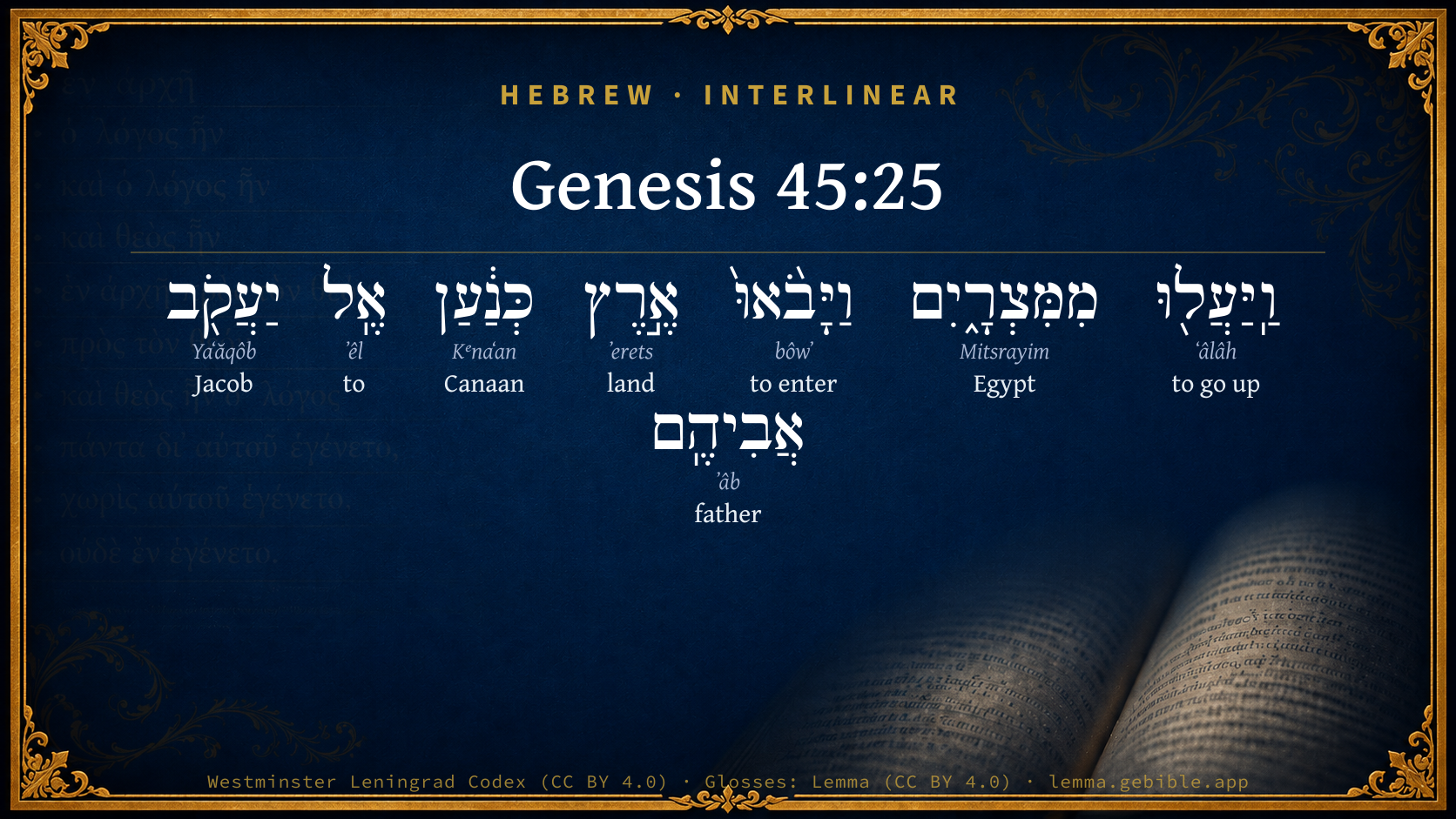
Genesis 45:25

Hebrew (Westminster Leningrad Codex) Genesis 45:25 appears in the Hebrew Old Testament. The text above is from the Westminster Leningrad Codex. Each word links to its Strong’s number, a concise gloss, and parsing drawn from the Open Scriptures Hebrew Bible morphology. Click any word for its full Brown-Driver-Briggs (BDB) entry.
Download image
Cite this verse

Genesis 45:25 (World English Bible). Public Domain. Lemma interlinear Bible study tool, https://lemma.gebible.app/v/genesis/45/25.

Show BibTeX & RIS
BibTeX
RIS
English Translation
They went up out of Egypt, and came into the land of Canaan, to Jacob their father.
World English Bible · Public Domain
Download a study sheet

One document with this verse’s original text, its word-by-word gloss line, the meaning frame, cross-references with their text, attributed commentary, and full source and license credits — printable, and it pastes into notes with its structure intact.

This verse Autodidact and up

Study sheet (.html) Plain text (.txt)

A passage Seminary Student

Up to 50 verses in one chapter. A passage sheet keeps up to 6 commentary sources and 12 cross-references per verse, in the order this page ranks them, and says so on the sheet whenever that leaves anything out. Ask for a single verse and you get the Autodidact verse sheet above.

Everything on this page stays free to read, with no account — the sheet is a download of what is already on screen, not access to it.

Want to remove ads? Support Godless Engineer
Compare translations 3

The same verse in 3 English versions, stacked beneath the original-language interlinear above. Click any original word for its lexicon entry.

Each is an independent rendering of the whole verse — the interlinear is not word-aligned to these translations.

Highlighted words mark where these versions differ — a whole-verse word diff, not a word-by-word alignment.

  • World English Bible Public Domain
    They went up out of Egypt, and came into the land of Canaan, to Jacob their father.
  • King James Version Public Domain
    And they went up out of Egypt, and came into the land of Canaan unto Jacob their father,
  • unfoldingWord Literal Text CC BY-SA 4.0
    Then they went up from Egypt and came the land of Canaan, to Jacob their father.

unfoldingWord Literal Text — © unfoldingWord, licensed CC BY-SA 4.0. Word-aligned USFM3 via Door43 (git.door43.org/unfoldingWord/en_ult).

Versions to compare (up to 4)

3 of 4 selected

Show all 18 translations

Every available English version of this verse, each an independent rendering of the whole verse.

  • World English Bible Public Domain
    They went up out of Egypt, and came into the land of Canaan, to Jacob their father.
  • Berean Standard Bible Public Domain
    So the brothers went up out of Egypt and came to their father Jacob in the land of Canaan.
  • Majority Standard Bible Public Domain
    So the brothers went up out of Egypt and came to their father Jacob in the land of Canaan.
  • King James Version Public Domain
    And they went up out of Egypt, and came into the land of Canaan unto Jacob their father,
  • American Standard Version (1901) Public Domain
    And they went up out of Egypt, and came into the land of Canaan unto Jacob their father.
  • Revised Version (1885) Public Domain
    And they went up out of Egypt, and came into the land of Canaan unto Jacob their father.
  • Geneva Bible (1599) Public Domain
    Then they went vp from Egypt, and came vnto the land of Canaan vnto Iaakob their father,
  • Douay-Rheims (1899) Public Domain
    And they went up out of Egypt, and came into the land of Chanaan to their father Jacob.
  • Young's Literal Translation Public Domain
    And they go up out of Egypt, and come in to the land of Canaan, unto Jacob their father,
  • Literal Standard Version CC BY-SA 4.0
    And they go up out of Egypt, and come to the land of Canaan, to their father Jacob,
  • Unlocked Literal Bible CC BY-SA 4.0
    They went up out of Egypt and came to the land of Canaan, to Jacob their father.
  • unfoldingWord Literal Text CC BY-SA 4.0
    Then they went up from Egypt and came the land of Canaan, to Jacob their father.
  • Darby Bible Public Domain
    And they went up out of Egypt, and came into the land of Canaan to Jacob their father.
  • World Messianic Bible Public Domain
    They went up out of Egypt, and came into the land of Canaan, to Jacob their father.
  • Webster's Bible Public Domain
    And they went up from Egypt, and came into the land of Canaan, to Jacob their father,
  • Free Bible Version CC BY-SA 4.0
    So they left Egypt and went back home to their father Jacob in the country of Canaan.
  • Bible in Basic English Public Domain
    So they went up from Egypt and came to the land of Canaan, to their father Jacob.
  • JPS Tanakh (1917) Public Domain
    And they went up out of Egypt, and came into the land of Canaan unto Jacob their father.

Literal Standard Version (2020), Covenant Press — licensed CC BY-SA 4.0. Text via the HelloAO Bible API (eBible.org). Unlocked Literal Bible (unfoldingWord) — licensed CC BY-SA 4.0. Text via the HelloAO Bible API (eBible.org). unfoldingWord Literal Text — © unfoldingWord, licensed CC BY-SA 4.0. Word-aligned USFM3 via Door43 (git.door43.org/unfoldingWord/en_ult). Free Bible Version, Dr. Jonathan Gallagher — licensed CC BY-SA 4.0. Text via the HelloAO Bible API (eBible.org).

Word by word

More ways to search: Search by grammar → Find every occurrence → Compare this word →

Practice this passage: Drill this verse → Learn its vocabulary →

About this verse

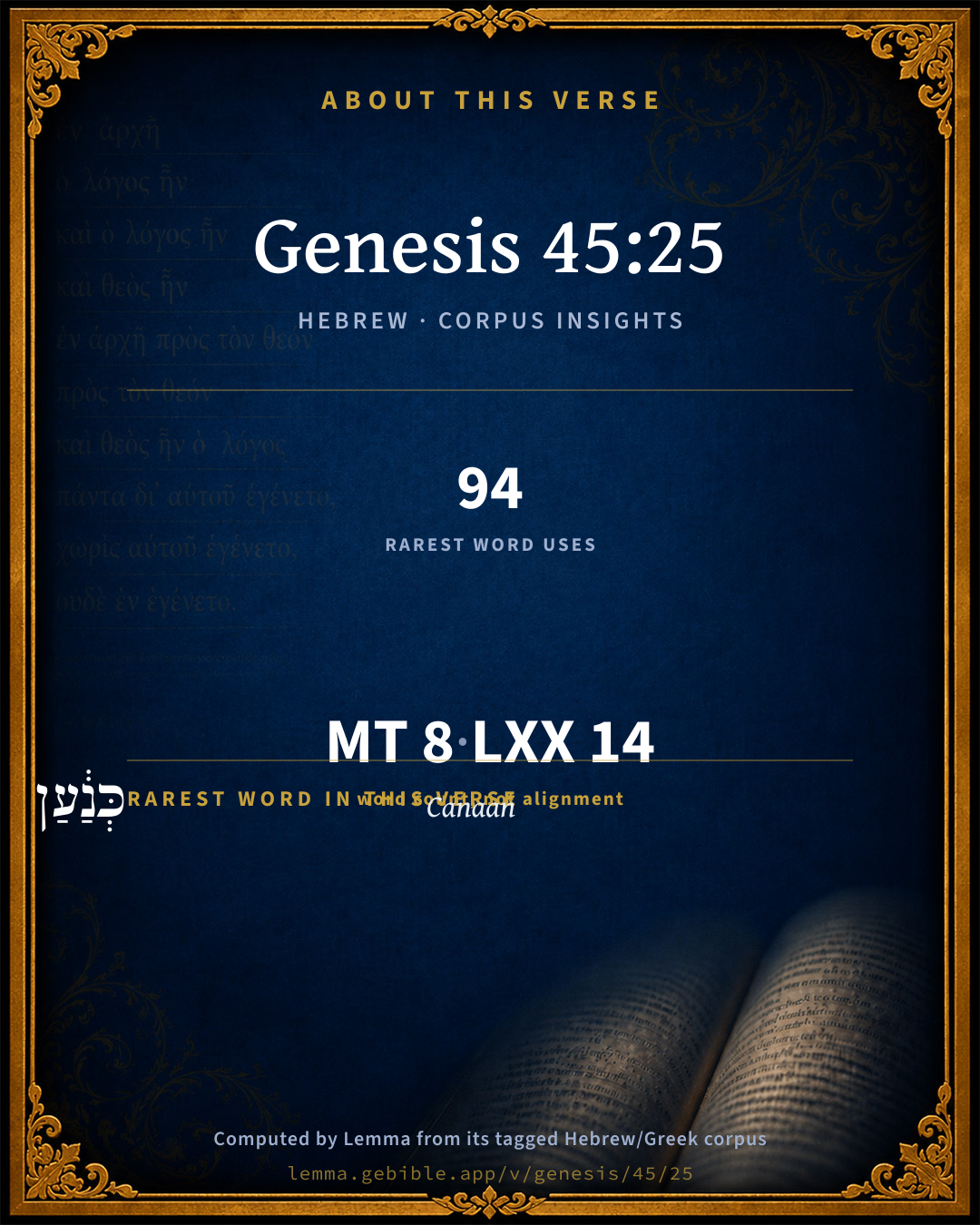
These counts appear in no published source. They are computed here, from the morphology-tagged text and Lemma’s own curated glosses. What Lemma adds →

8
words
8
distinct lemmas
Pentateuch
section

Grammatical profile

  • 2 verbs
  • 5 nouns
  • 1 preposition

Verb forms

  • וַֽיַּעֲל֖וּ Qal · Sequential Imperfect
  • וַיָּבֹ֨אוּ֙ Qal · Sequential Imperfect

Hebrew & Septuagint length

In English translation the verse runs 17 words from the Hebrew and 18 from the Septuagint (LXX English) — closely comparable.

A rough comparison of the two English renderings, which tokenize alike — not a word-level alignment.

Word counts can differ between the Hebrew and the Greek without any difference in meaning — e.g. the Hebrew direct-object marker אֵת has no separate Greek word, and Greek often adds the article ὁ.

In the original languages it is 8 Hebrew tokens and 14 Greek tokens — but the two are counted differently (Hebrew bundles its prefixes and suffixes into one token; the Greek is in lemma form), so that isn’t a like-for-like length.

Hebrew and Greek witnesses Masoretic Hebrew ↔ Greek Septuagint

The same verse in the two great witnesses to the Old Testament, shown verse-for-verse.

These are two independent witnesses, not word-aligned to each other, and the Septuagint is shown in lemma (dictionary) form.

Hebrew Genesis 45:25 Masoretic · Westminster Leningrad Codex

וַֽיַּעֲל֖וּ מִמִּצְרָ֑יִם וַיָּבֹ֨אוּ֙ אֶ֣רֶץ כְּנַ֔עַן אֶֽל יַעֲקֹ֖ב אֲבִיהֶֽם

They went up out of Egypt, and came into the land of Canaan, to Jacob their father.

World English Bible · Public Domain

Greek LXX Genesis 45:25 Septuagint · lemma form

καί ἀναβαίνω ἐκ αἴγυπτος καί ἔρχομαι εἰς γῆ χανααν πρός ἰακώβ ὁ πατήρ αὐτός

And they went up out of Egypt, and came into the land of Chanaan, to Jacob their father.

LXX2012 (modern English Septuagint) · Public Domain

Hebrew: Westminster Leningrad Codex (CC BY 4.0). Greek: Septuagint (public domain); English from LXX2012 (modern English Septuagint) (Public Domain). How the Septuagint differs from the Hebrew →

Targum (Aramaic paraphrase)

2

The Targum is the ancient Jewish Aramaic paraphrase of the Hebrew Scriptures — an interpretive translation, not the Hebrew text itself. Onkelos (literal) and Pseudo-Jonathan (expansive) render the Torah, and Jonathan the Prophets. Coverage is partial: where no permissively-licensed English translation exists for a verse, only the Aramaic is shown. This is verse-level text, not a word-by-word alignment to the Hebrew.

  1. Targum Onkelos Torah (Genesis–Deuteronomy)
    וּסְלִיקוּ מִמִּצְרָיִם וַאֲתוֹ לְאַרְעָא דִּכְנַעַן לְוַת יַעֲקֹב אֲבוּהוֹן

    (no public-domain English translation for this verse)

    Targum Onkelos — Aramaic: “Onkelos Genesis” (public domain); “Onkelos Exodus” (public domain); “Onkelos Leviticus” (public domain); “Onkelos Numbers” (public domain); “Onkelos Deuteronomy” (public domain). English: “Sefaria Community Translation” (CC0 1.0 (public-domain dedication)); “J.W. Etheridge. The Targums of Onkelos and Jonathan Ben Uzziel on the Pentateuch. London: Longmans, Green, 1862” (public domain). Text via Sefaria.

  2. Targum Pseudo-Jonathan Torah (Genesis–Deuteronomy)
    וּסְלִיקוּ מִמִצְרַיִם וְאָתוֹ לְאַרְעָא דִכְנָעַן לְוַת יַעֲקב אֲבוּהוֹן

    And they went up from Mizraim, and came to the land of Kenaan unto Jakob their father.

    Targum Pseudo-Jonathan — Aramaic: “Targum Jonathan on Genesis” (public domain); “Targum Jonathan on Exodus” (public domain); “Targum Jonathan on Leviticus” (public domain); “Targum Jonathan on Numbers” (public domain); “Targum Jonathan on Deuteronomy” (public domain). English: “The Targum of Jonathan ben Uzziel, trans. J. W. Etheridge, London, 1862” (public domain). Text via Sefaria.

Commentary

Notes on Genesis 45:25 from classic Christian and Jewish commentators (each source and its license shown beneath its notes). The classic Christian expositions comment on the surrounding passage and are grouped to its opening verse, so a note may address several verses; the Jewish commentaries on the Tanakh (Rashi and others) are per-verse, so they appear only where the commentator wrote on this verse.

Lemma curates 59 commentaries, every one of them public domain or Creative Commons licensed, each selected and text-cleaned for this edition rather than reprinted as found. About our sources →

Trapp's Complete Commentary

John Trapp

Gen 45:25 And they went up out of Egypt, and came into the land of Canaan unto Jacob their father,

Ver. 25. They came unto Jacob their father.] Who had looked many a long look for them: and now had far more joy of their return than before. {Gen 42:29}

John Trapp, A Commentary or Exposition upon All the Books of the Old and New Testament (1647–1656) — public domain. Text from a community e-Sword module.

The Preacher's Complete Homiletical Commentary

Joseph S. Exell (gen. ed.)

CRITICAL NOTES.—

Gen_45:26. And Jacob’s heart fainted.] “Fainted is perhaps literally, remained cold.” He had too much experience of deceit to believe easily a strange tale like this. (Alford.)

Gen_45:27. The spirit of Jacob their father revived.] “Warmth and life returned to his spirit.” (Alford.)

MAIN HOMILETICS OF THE PARAGRAPH.—Gen_45:25-28

THE JOYFUL NEWS TOLD TO JACOB

I. It is, at first, received with incredulity. He is told that Joseph lives, that he is governor of Egypt, and that he himself is summoned to go down thither. These were astonishing tidings. They were as a voice and an appearance from the grave. We do not wonder at their effect upon the physical frame of the aged man. There was a chill at his heart, the news overcame him, yet he received it with incredulity. The very thought of such prosperity, so vividly presented to his mind, would, of itself, powerfully affect his feelings. But he did not believe that all this could be true. There are two kinds of unbelief. One arises from moral perversity. A man refuses to believe because he hates the truth, and loves darkness rather than light. He refuses to see the truth, because he is content with his own lie and desires not goodness. He says, “Evil, be thou my good.” But another source of unbelief is, when the news seems too good to be true. There is a disposition to believe, and even a desire; but the greatness of that which is offered to faith is too much for it. This kind of unbelief does not denote a bad heart, though it may be an evidence of weakness. The Apostle, St. Thomas, could not believe, though he witnessed the joy of those who did. He required to see facts, such outward proofs and evidence which would be powerful enough to convince himself. The very greatness of the things to be believed by us is one of the difficulties of our faith.

II. It is afterwards accepted upon outward evidence. Jacob, at first, gave no credit to the tidings brought to him by his sons. But when he saw the waggons he believed. (Gen_45:27-28.) It is sad to think that he should believe the waggons more than the word of his sons. But this is true to human nature. A favourable fact comes to the aid of hesitating belief. We can steady our minds upon it. Hence it is that the outward evidences of Christianity are so valuable for the mass of mankind. They produce conviction when other modes of reasoning fail. They make a vivid impression upon the ordinary mind. It is a nobler kind of faith when we can trust God out of sight, when we can believe in Himself as He is made known to our souls, when we have that within us which admires and loves the truth upon our first beholding it, when we are captivated and conquered by its heavenly beauty.

III. It enabled Jacob to vindicate his old character. He was Israel,—a prince prevailing with both God and men. He had nobly won that character, and maintained it; but for many years past he had no opportunity to distinguish himself therein. Now his old character is revived. He appears, again, as Israel.

1. His faith triumphs. As it has done so oft before. He now believes. He is satisfied. “And Israel said, It is enough; Joseph my son is yet alive.” (Gen_45:28.)

2. His dark destiny is now about to be cleared up. The grief of twenty-two sad and sorrowful years is ended, and the meaning of his life is now, at length, to be rendered clear. The purpose of God is accomplished, and it is full of mercy and goodness to his servant. The soul is satisfied with the loving-kindness of the Lord, when faith is allowed to see and enjoy its victory.

3. He anticipates his peaceful end. “Joseph my son is yet alive: I will go and see him before I die.” (Gen_45:28.) He is satisfied now that he shall see his beloved son restored to him, and in great prosperity. He can now look forward to the happy end of his pilgrimage. He had now no more wishes left unsatisfied on this side of the grave. Let him see Joseph, and that is enough. Then, like Simeon, when his eyes have seen God’s salvation, he can depart in peace.

SUGGESTIVE COMMENTS ON THE VERSES

Gen_45:25-26. Jacob had doubtless been looking and longing for their return, and that with many fears and misgivings of mind. If the matter was announced as suddenly as it is here related, it is not surprising that “Jacob’s heart fainted, and he believed them not.” The suddenness of the transition would produce an effect like that of fire and water coming in contact. Perhaps, too, we may partly account for this incredulity from the aptness there is in a dejected mind to believe what is against him, rather than what is for him. When they brought him the bloody garment he readily believed, saying, Joseph no doubt is torn in pieces! But when good news is told him, it seems too good to be true.—(Fuller).

He believed them not. They had told him a tale before; and he that once hath cracked his credit is hardly, after, believed. Besides, he thought the news was too good to be true. The joy of heaven is so great that we must “enter into it;” it cannot enter into us. (Mat_25:21).—(Trapp).

Gen_45:27. When we see the history of redemption, the progress of Christianity, the means of grace, our confidence in God’s gracious intent is strengthened. When the Christian at last sees the provision made for his departure, the Intercessor gone before, the mansion prepared, the escort of angels, the welcome home, he receives dying grace, and often is most cheered and comforted in death.—(Jacobus).

Gen_45:28. Nothing is said of his reception of the gifts, nor is it intimated that he was particularly affected by the report of his son’s glory in Egypt; it was enough for him that he was alive. Though the sight of Benjamin, an hour before this time, would have appeared to him a sufficient happiness for this world, yet now he enjoys not only that, but cherishes the hope of seeing and embracing once more the son whose loss he had mourned year after year in bitterness of soul.—(Bush).

It is enough! The assurance of a living Lord and Saviour is soul-satisfying. We want to go and see Him. (Php_1:23).

The Preacher's Complete Homiletical Commentary (gen. ed. Joseph S. Exell; Funk & Wagnalls, c. 1892) — public domain (pre-1929). A full-Bible homiletical/sermon-outline anthology covering 65 of 66 books (2 John is absent from the source module). Text from a community e-Sword module.

Matthew Henry's Commentary

We have here the good news brought to Jacob. 1. The relation of it, at first, sunk his spirits. When, without any preamble, his sons came in, crying, Joseph is yet alive, each striving which should first proclaim it, perhaps he thought they bantered him, and the affront grieved him; or the very mention of Joseph's name revived his sorrow, so that his heart fainted, Gen 45:26. It was a good while before he came to himself. He was in such care and fear about the rest of them that at this time it would have been joy enough to him to hear that Simeon was released, and that Benjamin had come safely home (for he had been ready to despair concerning both these); but to hear that Joseph is alive is too good news to be true; he faints, for he believes it not. Note, We faint, because we do not believe; David himself had fainted if he had not believed, Psa 27:13. 2. The confirmation of it, by degrees, revived his spirit. Jacob had easily believed his sons formerly when they told him, Joseph is dead; but he can hardly believe them now that they tell him, Joseph is alive. Weak and tender spirits are influenced more by fear than hope, and are more apt to receive impressions that are discouraging than those that are encouraging. But at length Jacob is convinced of the truth of the story, especially when he sees the wagons which were sent to carry him (for seeing is believing), then his spirit revived. Death is as the wagons which are sent to fetch us to Christ: the very sight of it approaching should revive us. Now Jacob is called Israel (Gen 45:28), for he begins to recover his wonted vigour. (1.) It pleases him to think that Joseph is alive. He says nothing of Joseph's glory, of which they told him; it was enough to him that Joseph was alive. Note, Those that would be content with less degrees of comfort are best prepared for greater. (2.) It pleases him to think of going to see him. Though he was old, and the journey long, yet he would go to see Joseph, because Joseph's business would not permit him to come to see him. Observe, He says, "I will go and see him," not, "I will go and live with him;" Jacob was old, and did not expect to live long; "But I will go and see him before I die, and then let me depart in peace; let my eyes be refreshed with this sight before they are closed, and then it is enough, I need no more to make me happy in this world." Note, It is good for us all to make death familiar to us, and to speak of it as near, that we may think how little we have to do before we die, that we may do it with all our might, and may enjoy our comforts as those that must quickly die, and leave them.

Matthew Henry's Commentary on the Whole Bible (1708–1710) — public domain (CC PDM 1.0). Text via the HelloAO Bible API.

John Gill's Exposition

And they went up out of Egypt,.... That lying lower than the land of Canaan:

and came into the land of Canaan unto Jacob their father; they found him alive and well.

John Gill's Exposition of the Whole Bible (1746–1763) — public domain (CC PDM 1.0). Text via the HelloAO Bible API.

The Pulpit Commentary

Vers. 25-28. And they went up out of Egypt, and came into the land of Canaan unto Jacob their father, and told him, saying, Joseph is yet alive, and he (literally, and that he; an emphatic assurance which Keil, following Ewald, renders by" yea," and Kalisch by "indeed") is governor over all the land of Egypt. And Jacob"s (literally, his, i.e. Jacob"s) heart fainted (literally, A few chill, the primary idea of the root being that of rigidity through coldness; cf. phgnuw, to be rigid, and pigeo, rigeo, frigeo, to be chill. The sense is that Jacob s heart seemed to stop with amazement at the tidings which his sons brought), for he believed them not. This was scarcely an ease of believing not for joy (Bush), but rather of incredulity arising from suspicion, both of the messengers and their message, which was only removed by further explanation, and in particular by the sight of Joseph"s splendid presents and commodious carriages. And they told him all the words of Joseph, which he had said unto them:i.e. about Joseph"s invitation and promise (vers. 9-11) and when he saw the wagons probably royal vehicles (Wordsworth) which Joseph had sent to carry him, the spirit of Jacob their father revived (literally, lived; it having been previously numb and cold, as if dead): and Israel said, the change of name here is significant. The sublime theocratic designation, which had dropped into obscurity during the period of the old man"s sorrow for his lost son, revives with the resuscitation of his dead hope (cf. Gen_43:6) It is enough (one word, as if expressing his complacent satisfaction); Joseph my son is yet alive (this is the one thought that fills his aged heart): I will go down old man is young again in spirit; he is for going immediately; he could leap; yes, fly" (Lange) and see him (a sight of Joseph would be ample compensation for all the years of sorrow he had passed through) before I die. He would then be ready to be gathered to his fathers.

Vers. 25-28.

The believer led to his reward.

Jacob"s incredulity conquered. His spirit revived. His resolution taken.

I OUR ENJOYMENT OF WHAT GOD HAS PREPARED FOR US IS DEPENDENT UPON OUR CONFIDENT BELIEF AND EXPECTATION.

1. Separation from the old for the new life involves a struggle with self, with circumstances, with fellow-men.

2. The future must be laid hold of. We must believe that the better place is prepared for us, that the will of God is good.

II WE GAIN THE VICTORY OVER NATURAL FEARS, DOUBTS, AND DIFFICULTIES WHEN WE SIMPLY LOOK AT THE FACTS AS GOD HAS SET THEM BEFORE US, BOTH IN HIS WORD AND IN HIS PROVIDENCE. The men were deceivers. The facts, the wagons, the good things, the blessings plainly sent of God, earnest of the future, would not deceive.

III THE TRUE FAITH IS THAT WHICH GRATEFULLY ACCEPTS THE INVITATION OF DIVINE GRACE, ACTING UPON IT, BOTH BY THE DECISION OF THE WILL AND BY THE DEVOTION OF THE LIFE. It is enough, I will go.

IV THE REWARD WHICH IS PREPARED FOR THE TRUE OBEDIENCE IS MUCH GREATER THAN WE CAN ANTICIPATE. To see Joseph was the patriarch"s anticipation. The purpose of God was much larger for him. Joseph and Jacob met in the abundance of Egypt. The earthly pilgrimage leads to the true Goshen. It is enough. " We follow the voice of our God. It hath not entered into our heart to conceive what is before us. R.

The Pulpit Commentary (1880–1919), ed. H.D.M. Spence-Jones & Joseph S. Exell — public domain. Text from a community e-Sword module.

Keil & Delitzsch

C. F. Keil & F. Delitzsch

When they got back, and brought word to their father, "Joseph is still living, yea (וכי an emphatic assurance, Ewald, 3306) he is ruler in all the land of Egypt, his heart stopped, for he believed them not;" i.e., his heart did not beat at this joyful news, for he put no faith in what they said. It was not till they told him all that Joseph had said, and he saw the carriages that Joseph had sent, that "the spirit of their father Jacob revived; and Israel said: It is enough! Joseph my son is yet alive: I will go and see him before I die." Observe the significant interchange of Jacob and Israel. When once the crushed spirit of the old man was revived by the certainty that his son Joseph was still alive, Jacob was changed into Israel, the "conqueror overcoming his grief at the previous misconduct of his sons" (Fr. v. Meyer).

Keil & Delitzsch — Biblical Commentary on the Old Testament (1861–1891) — public domain (CC PDM 1.0). Text via the HelloAO Bible API. (Old Testament only.)

Lesson kit

Teaching starters — assembled from the data on this page, not authored interpretation. Every prompt links to the verse data it draws on. Edit before teaching.

Genesis, in the Pentateuch, opens this verse with 8 words (8 distinct Hebrew lemmas). Its most distinctive word is Kᵉnaʻan (“Canaan”). A historical commentator’s framing appears above. Read the whole chapter for the surrounding context.

Discussion questions

  1. How does “Canaan” (Kᵉnaʻan) shape what this verse is saying?
  2. These translations render this verse differently; the difference is in the English rendering, not the original. What questions does that raise?
  3. The verb «וַֽיַּעֲל֖וּ» is Qal Sequential Imperfect. How does its form color the action?
  4. Reading how Trapp's Complete Commentary and The Preacher's Complete Homiletical Commentary read this verse, where do the two commentators agree and where do they part?

Things to notice

Reading settings

Reading text

Shown beneath each verse's original-language words.

Old Testament
Old Testament edition

Read the OT as the Masoretic Hebrew (MT) or the Greek Septuagint (LXX).

English shown for the Greek Septuagint (in the Hebrew ↔ Greek comparison).

Comparing translations? Open the Compare panel on any verse page to stack up to four side by side.