1 Chronicles 4:38

Hebrew (Westminster Leningrad Codex) 1 Chronicles 4:38 appears in the Hebrew Old Testament. The text above is from the Westminster Leningrad Codex. Each word links to its Strong’s number, a concise gloss, and parsing drawn from the Open Scriptures Hebrew Bible morphology. Click any word for its full Brown-Driver-Briggs (BDB) entry.
Download image
Cite this verse

1 Chronicles 4:38 (World English Bible). Public Domain. Lemma interlinear Bible study tool, https://lemma.gebible.app/v/1-chronicles/4/38.

Show BibTeX & RIS
BibTeX
RIS
English Translation
these mentioned by name were princes in their families: and their fathers' houses increased greatly.
World English Bible · Public Domain
Download a study sheet

One document with this verse’s original text, its word-by-word gloss line, the meaning frame, cross-references with their text, attributed commentary, and full source and license credits — printable, and it pastes into notes with its structure intact.

This verse Autodidact and up

Study sheet (.html) Plain text (.txt)

A passage Seminary Student

Up to 50 verses in one chapter. A passage sheet keeps up to 6 commentary sources and 12 cross-references per verse, in the order this page ranks them, and says so on the sheet whenever that leaves anything out. Ask for a single verse and you get the Autodidact verse sheet above.

Everything on this page stays free to read, with no account — the sheet is a download of what is already on screen, not access to it.

Want to remove ads? Support Godless Engineer
Compare translations 3

The same verse in 3 English versions, stacked beneath the original-language interlinear above. Click any original word for its lexicon entry.

Each is an independent rendering of the whole verse — the interlinear is not word-aligned to these translations.

Highlighted words mark where these versions differ — a whole-verse word diff, not a word-by-word alignment.

  • World English Bible Public Domain
    these mentioned by name were princes in their families: and their fathers' houses increased greatly.
  • King James Version Public Domain
    These mentioned by their names were princes in their families: and the house of their fathers increased greatly.
  • unfoldingWord Literal Text CC BY-SA 4.0
    these, coming by names, leaders in their clans, for the house of their fathers broke through into a multitude.

unfoldingWord Literal Text — © unfoldingWord, licensed CC BY-SA 4.0. Word-aligned USFM3 via Door43 (git.door43.org/unfoldingWord/en_ult).

Versions to compare (up to 4)

3 of 4 selected

Show all 18 translations

Every available English version of this verse, each an independent rendering of the whole verse.

  • World English Bible Public Domain
    these mentioned by name were princes in their families: and their fathers' houses increased greatly.
  • Berean Standard Bible Public Domain
    These men listed by name were the leaders of their clans. Their families increased greatly,
  • Majority Standard Bible Public Domain
    These men listed by name were the leaders of their clans. Their families increased greatly,
  • King James Version Public Domain
    These mentioned by their names were princes in their families: and the house of their fathers increased greatly.
  • American Standard Version (1901) Public Domain
    these mentioned by name were princes in their families: and their fathers' houses increased greatly.
  • Revised Version (1885) Public Domain
    these mentioned by name were princes in their families: and their fathers’ houses increased greatly.
  • Geneva Bible (1599) Public Domain
    These were famous princes in their families, and increased greatly their fathers houses.
  • Douay-Rheims (1899) Public Domain
    These were named princes in their kindreds, and in the houses of their families were multiplied exceedingly.
  • Young's Literal Translation Public Domain
    These who are coming in by name `are' princes in their families, and the house of their fathers have broken forth into a multitude;
  • Literal Standard Version CC BY-SA 4.0
    These who are coming in by name [are] princes in their families, and the house of their fathers has broken forth into a multitude;
  • Unlocked Literal Bible CC BY-SA 4.0
    These mentioned by name were leaders in their clans, and their clans increased greatly.
  • unfoldingWord Literal Text CC BY-SA 4.0
    these, coming by names, leaders in their clans, for the house of their fathers broke through into a multitude.
  • Darby Bible Public Domain
    these mentioned by name were princes in their families; and their fathers' houses increased greatly.
  • World Messianic Bible Public Domain
    these mentioned by name were princes in their families. Their fathers’ houses increased greatly.
  • Webster's Bible Public Domain
    These mentioned by their names were princes in their families: and the house of their fathers increased greatly.
  • Free Bible Version CC BY-SA 4.0
    These were the names of the leaders of their families whose lineage increased significantly.
  • Bible in Basic English Public Domain
    These, whose names are given, were chiefs in their families, and their families became very great in number.
  • JPS Tanakh (1917) Public Domain
    these mentioned by name were princes in their families; and their fathers' houses increased greatly.

Literal Standard Version (2020), Covenant Press — licensed CC BY-SA 4.0. Text via the HelloAO Bible API (eBible.org). Unlocked Literal Bible (unfoldingWord) — licensed CC BY-SA 4.0. Text via the HelloAO Bible API (eBible.org). unfoldingWord Literal Text — © unfoldingWord, licensed CC BY-SA 4.0. Word-aligned USFM3 via Door43 (git.door43.org/unfoldingWord/en_ult). Free Bible Version, Dr. Jonathan Gallagher — licensed CC BY-SA 4.0. Text via the HelloAO Bible API (eBible.org).

Word by word

More ways to search: Search by grammar → Find every occurrence → Compare this word →

Practice this passage: Drill this verse → Learn its vocabulary →

פָּרְצ֖וּ
pârats
H6555
“to break through”
Verb, Qal, Perfect, 3rd Person, Common, Plural
Part of Speech
Verb
Stem
Qal
Form
Perfect
Person
3rd Person
Gender
Common
Number
Plural
Full BDB Definition

Origin: a primitive root

TWOT: 1826

to break through or down or over, burst, breach - (Qal) - to break or burst out (from womb or enclosure) - to break through or down, make a breach in - to break into - to break open - to break up, break in pieces - to break out (violently) upon - to break over (limits), increase - to use violence - to burst open - to spread, distribute - (Niphal) to be broken through - (Pual) to be broken down - (Hithpael) to break away
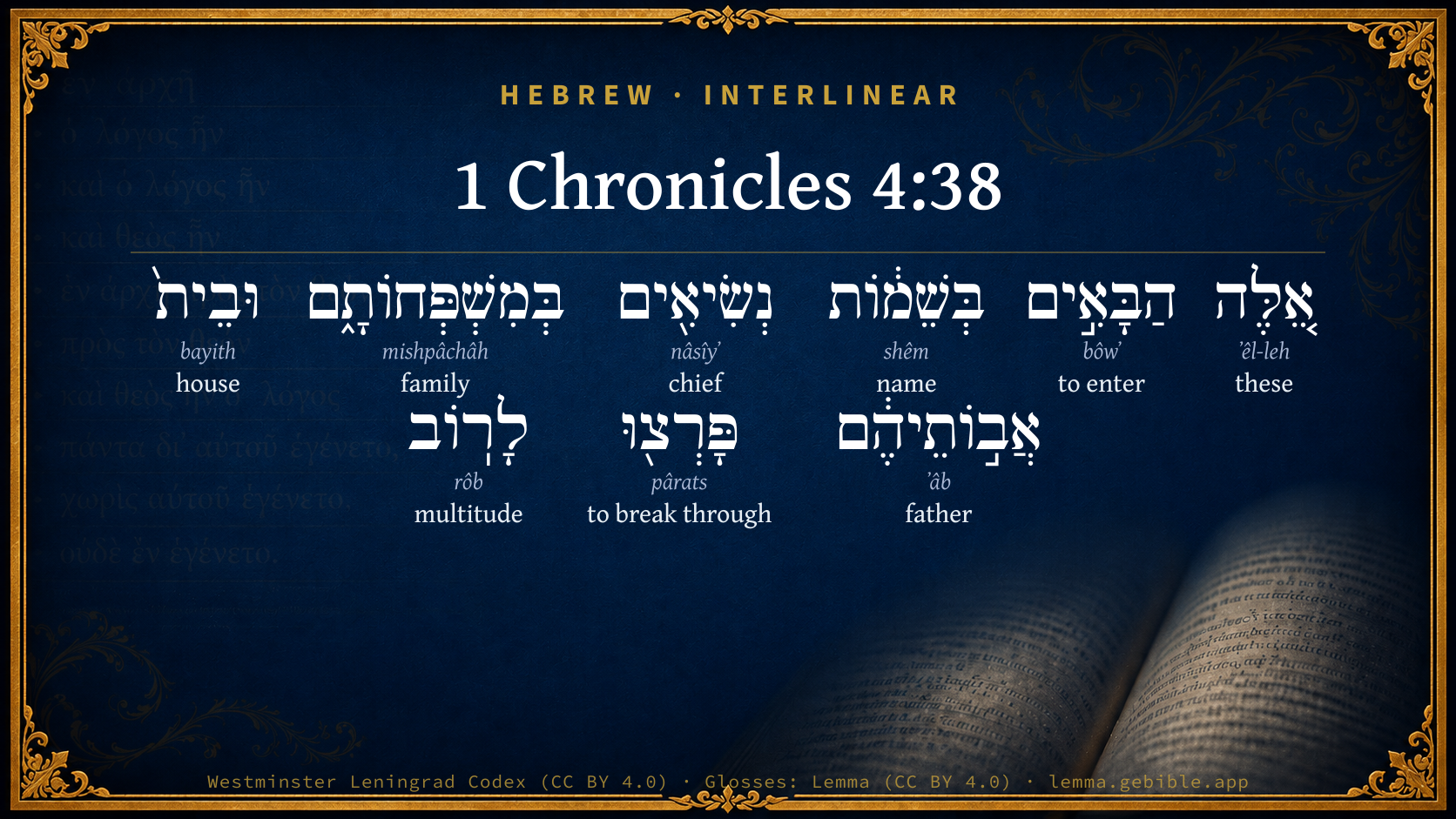
  1. אֵ֚לֶּה ʼêl-leh H428 “these” Pronoun, Demonstrative, Common, Plural
  2. הַבָּאִ֣ים bôwʼ H935 “the · entering” Particle, Definite Article + Verb, Qal, Participle Active, Masculine, Plural, Absolute
  3. בְּשֵׁמ֔וֹת shêm H8034 “in/at · names” Preposition + Noun, Common, Masculine, Plural, Absolute
  4. נְשִׂיאִ֖ים nâsîyʼ H5387 “chiefs” Noun, Common, Masculine, Plural, Absolute
  5. בְּמִשְׁפְּחוֹתָ֑ם mishpâchâh H4940 “in/at · families · their” Preposition + Noun, Common, Feminine, Plural, Construct + Suffix, Personal, 3rd Person, Masculine, Plural
  6. וּבֵית֙ bayith H1004 “and · house of” Conjunction + Noun, Common, Masculine, Singular, Construct
  7. אֲב֣וֹתֵיהֶ֔ם ʼâb H1 “fathers · their” Noun, Common, Masculine, Plural, Construct + Suffix, Personal, 3rd Person, Masculine, Plural
  8. לָרֽוֹב rôb H7230 “to/for · multitude” Preposition + Noun, Common, Both, Singular, Absolute

About this verse

These counts appear in no published source. They are computed here, from the morphology-tagged text and Lemma’s own curated glosses. What Lemma adds →

9
words
9
distinct lemmas
Historical
section

Shared distinctive vocabulary

פָּרְצ֖וּ to break through H6555 occurs in 48 verses of the Hebrew Bible. Also found in:

Grammatical profile

  • 2 verbs
  • 6 nouns
  • 1 pronoun

Verb forms

  • הַבָּאִ֣ים Qal · Participle Active
  • פָּרְצ֖וּ Qal · Perfect

Hebrew & Septuagint length

In English translation the verse runs 15 words from the Hebrew and 18 from the Septuagint (LXX English) — closely comparable.

A rough comparison of the two English renderings, which tokenize alike — not a word-level alignment.

Word counts can differ between the Hebrew and the Greek without any difference in meaning — e.g. the Hebrew direct-object marker אֵת has no separate Greek word, and Greek often adds the article ὁ.

Cross-references

2

Topical passages linked to 1 Chronicles 4:38 in the Treasury of Scripture Knowledge — connected by theme and wording, ordered by reader-vote popularity; previews shown in the World English Bible.

  • 1 Chronicles 5:24 These were the heads of their fathers' houses: even Epher, and Ishi, and Eliel, and Azriel, and Jeremiah, and Hodaviah, and Jahdiel, mighty men of valor, famous men, heads of their fathers' houses.
  • Genesis 6:4 The Nephilim were in the earth in those days, and also after that, when God's sons came to men's daughters. They bore children to them: the same were the mighty men who were of old, men of renown.

Cross-references courtesy of OpenBible.info (CC BY 4.0).

Hebrew and Greek witnesses Masoretic Hebrew ↔ Greek Septuagint

The same verse in the two great witnesses to the Old Testament, shown verse-for-verse.

These are two independent witnesses, not word-aligned to each other, and the Septuagint is shown in lemma (dictionary) form.

Hebrew 1 Chronicles 4:38 Masoretic · Westminster Leningrad Codex

אֵ֚לֶּה הַבָּאִ֣ים בְּשֵׁמ֔וֹת נְשִׂיאִ֖ים בְּמִשְׁפְּחוֹתָ֑ם וּבֵית֙ אֲב֣וֹתֵיהֶ֔ם פָּרְצ֖וּ לָרֽוֹב

these mentioned by name were princes in their families: and their fathers' houses increased greatly.

World English Bible · Public Domain

Greek LXX 1 Chronicles 4:38 Septuagint · lemma form

οὗτος ὁ διαἔρχομαι ἐν ὄνομα ἄρχων ἐν ὁ γένεσις αὐτός καί ἐν οἶκος πατριά αὐτός πληθύνω εἰς πλῆθος

These went by the names of princes in their families, and they increased abundantly in their fathers' households.

LXX2012 (modern English Septuagint) · Public Domain

On this verse, Ellicott's Commentary for English Readers discusses the Septuagint’s reading. Read the note in Commentary ↓

Hebrew: Westminster Leningrad Codex (CC BY 4.0). Greek: Septuagint (public domain); English from LXX2012 (modern English Septuagint) (Public Domain). How the Septuagint differs from the Hebrew →

Commentary

Notes on 1 Chronicles 4:38 from classic Christian and Jewish commentators (each source and its license shown beneath its notes). The classic Christian expositions comment on the surrounding passage and are grouped to its opening verse, so a note may address several verses; the Jewish commentaries on the Tanakh (Rashi and others) are per-verse, so they appear only where the commentator wrote on this verse.

Lemma curates 59 commentaries, every one of them public domain or Creative Commons licensed, each selected and text-cleaned for this edition rather than reprinted as found. About our sources →

Jamieson, Fausset & Brown

Robert Jamieson, A. R. Fausset & David Brown

increased greatly, and they went to the entrance of Gedor--Simeon having only a part of the land of Judah, they were forced to seek accommodation elsewhere; but their establishment in the new and fertile pastures of Gederah was soon broken up; for, being attacked by a band of nomad plunderers, they were driven from place to place till some of them effected by force a settlement on Mount Seir.

Next: 1 Chronicles Chapter 5

Jamieson, Fausset & Brown — Commentary Critical and Explanatory on the Whole Bible (1871) — public domain (CC PDM 1.0). Text via the HelloAO Bible API.

Ellicott's Commentary for English Readers

(38) These mentioned by their names.—Literally, these who have come (forward) with names, that is, have been adduced by name.

Were princes in their families.—Ameers or chieftains in their clans.

And the house of their fathers increased.—And their father-houses had spread greatly. Finding their territory too strait for them under these conditions, and probably also because of the encroachments of their powerful neighbours, the Judæans and Philistines, the Simeonite chieftains went forth at the head of their clans to seek new settlements.

And (so) they went to the entrance of Gedor, even unto the east side of the valley.—Gedor can hardly be the town of that name in the hill country of Judah (Jos_15:58). The LXX. read Gerar (Γεραρα).

Even unto the east side of the valley.—So far as to the east of the valley, that is, apparently, the valley of or near the unknown Gedor, or Gerar. The only considerable valley south-east of Judah is the Arabah, below the Dead Sea. That this locality is meant appears likely from the vicinity of Mount Seir and the Amalekites (1Ch_4:42).

To seek pasture for their flocks.—This statement is of interest as proving that even so late as the reign of Hezekiah, those Israelite clans which bordered on the desert were still nomades, like the Beidawis. (Comp. Gen_13:5-12).

A Bible Commentary for English Readers, edited by Charles John Ellicott (1878–1897) — public domain. Text from a community e-Sword module.

John Gill's Exposition

And they found fat pasture and good,.... In or near the valley of Gedor:

and the land was wide, and quiet, and peaceable; there was room enough for them and their flocks, and they had no enemies on either side to disturb them:

for they of Ham had dwelt there of old; either the Canaanites who descended from Canaan the son of Ham, and had never been expelled from thence; or the Philistines, who were a colony of the Egyptians, the posterity of Ham; and these inhabitants being of this cursed race, the Simeonites scrupled not to dispossess them.

John Gill's Exposition of the Whole Bible (1746–1763) — public domain (CC PDM 1.0). Text via the HelloAO Bible API.

Albert Barnes' Notes on the Bible

These mentioned by their names were princes - The registered chiefs of the cities in the first list 1Ch 4:28-31, in the time of Hezekiah 1Ch 4:41.

Albert Barnes' Notes on the Bible (1834–1885) — public domain. Text from a community e-Sword/MySword module.

Matthew Poole's English Annotations

These named 1Ch 4:34-37.

The house of their fathers increased greatly which forced them to seek for new and larger habitations.

Matthew Poole's English Annotations on the Holy Bible (1683–1685) — public domain. Text from a community e-Sword/MySword module.

The Pulpit Commentary

Princes in their families.

Words transferred from one language, and one state of society to another, are often misleading. By "princes" here we are to understand head-men of certain towns which were in possession of families among the Simeonites. They were persons of importance, of consideration, and influence in their localities. The record of them hears witness to a settled state of society, and to the establishment of civil order and subordination.

I HUMAN AUTHORITY IS OF DIVINE APPOINTMENT. That this is so in the family will be admitted by all who believe in a Creator, and in his interest in the human race. It is also admitted by thoughtful persons with regard to civil and national life. It does not follow that rulers are always righteous, or are even always to be tolerated and obeyed. It is an absurd inference to draw from the fact that sovereignty and submission in some form are of Divine appointment that kings have nothing to do but to command, and subjects nothing but to obey. The world has had enough of absolute monarchy, and theologians have too long inculcated "the right Divine of kings to govern wrong." Still, "the powers that be are ordained of God;" it was divinely intended that men should live in civil society, and that order should be maintained and authority upheld, and justice administered between man and man.

II As a consequence, SUBJECTION TO CIVIL AUTHORITY IS, WITHIN CERTAIN LIMITS, A HUMAN DUTY. In ordinary cases, where conscience does not enjoin the express contrary, men are bound to obey the laws of the land. Especially is this the case where, as in our own country, the government is constitutional, and the people have power to amend unjust and inexpedient laws, and to reform abuses in administration. The immoral character of lawful governors is no religious ground of resistance to their decrees.

III RULERS, SMALL AND GREAT, ARE THEMSELVES ACCOUNTABLE TO HIM WHO IS "THE BLESSED AND ONLY POTENTATE, KING OF KINGS, AND LORD OF LORDS." Let them remember this, and be wise and just. T.

The Pulpit Commentary (1880–1919), ed. H.D.M. Spence-Jones & Joseph S. Exell — public domain. Text from a community e-Sword module.

Keil & Delitzsch

C. F. Keil & F. Delitzsch

And they found fat pasture and good,.... In or near the valley of Gedor:

and the land was wide, and quiet, and peaceable; there was room enough for them and their flocks, and they had no enemies on either side to disturb them:

for they of Ham had dwelt there of old; either the Canaanites who descended from Canaan the son of Ham, and had never been expelled from thence; or the Philistines, who were a colony of the Egyptians, the posterity of Ham; and these inhabitants being of this cursed race, the Simeonites scrupled not to dispossess them.

Keil & Delitzsch — Biblical Commentary on the Old Testament (1861–1891) — public domain (CC PDM 1.0). Text via the HelloAO Bible API. (Old Testament only.)

Rashi

Rabbi Shlomo Yitzchaki (Rashi)

These mentioned by name were princes in their families, and their fathers’ house spread exceedingly and they had no place to dwell in.

Rashi on the Tanakh — English translations: “The Judaica Press complete Tanach with Rashi, translated by A. J. Rosenberg” (CC BY 4.0); “Pentateuch with Rashi's commentary by M. Rosenbaum and A.M. Silbermann, 1929-1934” (public domain); “The Metsudah Tanach series, Lakewood, N.J” (CC BY 4.0); and “The Book of Joshua, Metsudah Publications, 1997” (CC BY 4.0). Text via Sefaria.

Lesson kit

Teaching starters — assembled from the data on this page, not authored interpretation. Every prompt links to the verse data it draws on. Edit before teaching.

1 Chronicles, in the Historical, opens this verse with 9 words (9 distinct Hebrew lemmas). Its most distinctive word is pârats (“to break through”). A historical commentator’s framing appears above. Read the whole chapter for the surrounding context.

Discussion questions

  1. The word pârats carries the sense “to break through.” How does it shape the verse?
  2. Genesis 28:14 shares the word «to break through» with this verse. How do the two illuminate each other?
  3. These translations render this verse differently. What is at stake in choosing one wording over another?
  4. The verb «הַבָּאִ֣ים» is Qal Participle Active. How does its form color the action?
  5. Reading how Jamieson, Fausset & Brown and Ellicott's Commentary for English Readers read this verse, where do the two commentators agree and where do they part?

Things to notice

Reading settings

Reading text

Shown beneath each verse's original-language words.

Old Testament
Old Testament edition

Read the OT as the Masoretic Hebrew (MT) or the Greek Septuagint (LXX).

English shown for the Greek Septuagint (in the Hebrew ↔ Greek comparison).

Comparing translations? Open the Compare panel on any verse page to stack up to four side by side.