
1 Kings 11:18

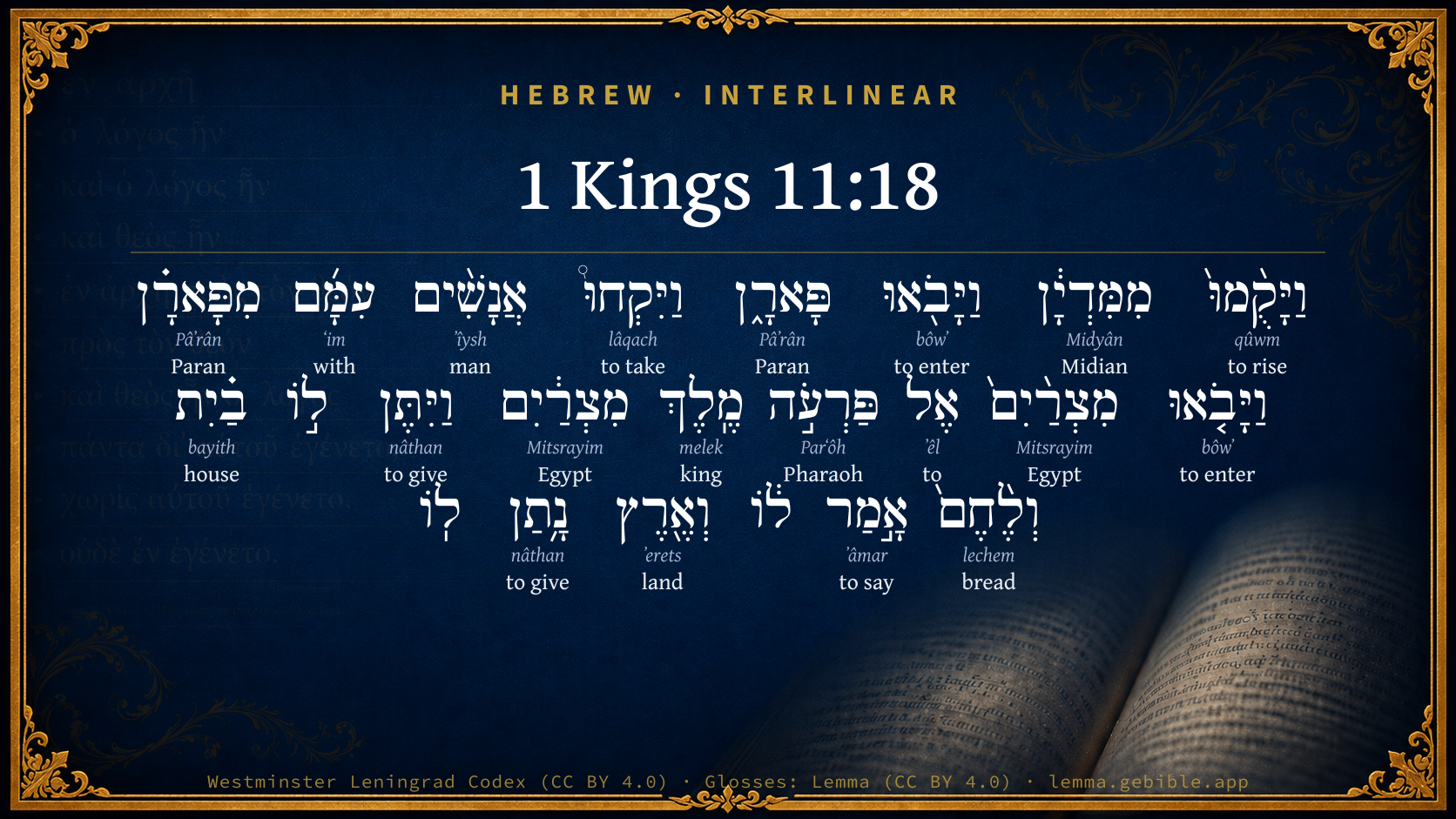
Hebrew (Westminster Leningrad Codex) 1 Kings 11:18 appears in the Hebrew Old Testament. The text above is from the Westminster Leningrad Codex. Each word links to its Strong’s number, a concise gloss, and parsing drawn from the Open Scriptures Hebrew Bible morphology. Click any word for its full Brown-Driver-Briggs (BDB) entry.
Download image
Cite this verse

1 Kings 11:18 (World English Bible). Public Domain. Lemma interlinear Bible study tool, https://lemma.gebible.app/v/1-kings/11/18.

Show BibTeX & RIS
BibTeX
RIS
English Translation
They arose out of Midian, and came to Paran; and they took men with them out of Paran, and they came to Egypt, to Pharaoh king of Egypt, who gave him a house, and appointed him food, and gave him land.
World English Bible · Public Domain
Download a study sheet

One document with this verse’s original text, its word-by-word gloss line, the meaning frame, cross-references with their text, attributed commentary, and full source and license credits — printable, and it pastes into notes with its structure intact.

This verse Autodidact and up

Study sheet (.html) Plain text (.txt)

A passage Seminary Student

Up to 50 verses in one chapter. A passage sheet keeps up to 6 commentary sources and 12 cross-references per verse, in the order this page ranks them, and says so on the sheet whenever that leaves anything out. Ask for a single verse and you get the Autodidact verse sheet above.

Everything on this page stays free to read, with no account — the sheet is a download of what is already on screen, not access to it.

Want to remove ads? Support Godless Engineer
Compare translations 3

The same verse in 3 English versions, stacked beneath the original-language interlinear above. Click any original word for its lexicon entry.

Each is an independent rendering of the whole verse — the interlinear is not word-aligned to these translations.

Highlighted words mark where these versions differ — a whole-verse word diff, not a word-by-word alignment.

  • World English Bible Public Domain
    They arose out of Midian, and came to Paran; and they took men with them out of Paran, and they came to Egypt, to Pharaoh king of Egypt, who gave him a house, and appointed him food, and gave him land.
  • King James Version Public Domain
    And they arose out of Midian, and came to Paran: and they took men with them out of Paran, and they came to Egypt, unto Pharaoh king of Egypt; which gave him an house, and appointed him victuals, and gave him land.
  • unfoldingWord Literal Text CC BY-SA 4.0
    And they arose from Midian and entered Paran. And they took men with them from Paran and came Egypt, to Pharaoh, the king of Egypt. And he gave a house to him, and he ordered bread for him, and he gave land to him.

unfoldingWord Literal Text — © unfoldingWord, licensed CC BY-SA 4.0. Word-aligned USFM3 via Door43 (git.door43.org/unfoldingWord/en_ult).

Versions to compare (up to 4)

3 of 4 selected

Show all 18 translations

Every available English version of this verse, each an independent rendering of the whole verse.

  • World English Bible Public Domain
    They arose out of Midian, and came to Paran; and they took men with them out of Paran, and they came to Egypt, to Pharaoh king of Egypt, who gave him a house, and appointed him food, and gave him land.
  • Berean Standard Bible Public Domain
    Hadad and his men set out from Midian and went to Paran. They took men from Paran with them and went to Egypt, to Pharaoh king of Egypt, who gave Hadad a house and land and provided him with food.
  • Majority Standard Bible Public Domain
    Hadad and his men set out from Midian and went to Paran. They took men from Paran with them and went to Egypt, to Pharaoh king of Egypt, who gave Hadad a house and land and provided him with food.
  • King James Version Public Domain
    And they arose out of Midian, and came to Paran: and they took men with them out of Paran, and they came to Egypt, unto Pharaoh king of Egypt; which gave him an house, and appointed him victuals, and gave him land.
  • American Standard Version (1901) Public Domain
    And they arose out of Midian, and came to Paran; and they took men with them out of Paran, and they came to Egypt, unto Pharaoh king of Egypt, who gave him a house, and appointed him victuals, and gave him land.
  • Revised Version (1885) Public Domain
    And they arose out of Midian, and came to Paran: and they took men with them out of Paran, and they came to Egypt unto Pharaoh king of Egypt; which gave him an house, and appointed him victuals, and gave him land.
  • Geneva Bible (1599) Public Domain
    And they arose out of Midian, and came to Paran, and tooke men with them out of Paran, and came to Egypt vnto Pharaoh King of Egypt, which gaue him an house, and appointed him vitailes, and gaue him lande.
  • Douay-Rheims (1899) Public Domain
    And they arose out of Madian, and came into Pharan, and they took men with them from Pharan, and went into Egypt to Pharao the king of Egypt: who gave him a house, and appointed him victuals, and assigned him land.
  • Young's Literal Translation Public Domain
    and they rise out of Midian, and come into Paran, and take men with them out of Paran, and come in to Egypt, unto Pharaoh king of Egypt, and he giveth to him a house, and bread hath commanded for him, and land hath given to him.
  • Literal Standard Version CC BY-SA 4.0
    and they rise out of Midian, and come into Paran, and take men with them out of Paran, and come into Egypt, to Pharaoh king of Egypt, and he gives a house to him, and has commanded bread for him, and has given land to him.
  • Unlocked Literal Bible CC BY-SA 4.0
    They left Midian and came to Paran, from where they took men with them to Egypt, to Pharaoh king of Egypt, who gave him a house and land and food.
  • unfoldingWord Literal Text CC BY-SA 4.0
    And they arose from Midian and entered Paran. And they took men with them from Paran and came Egypt, to Pharaoh, the king of Egypt. And he gave a house to him, and he ordered bread for him, and he gave land to him.
  • Darby Bible Public Domain
    And they arose out of Midian, and came to Paran, and took men with them out of Paran, and they came to Egypt, to Pharaoh king of Egypt; who gave him a house, and appointed him victuals, and gave him land.
  • World Messianic Bible Public Domain
    They arose out of Midian and came to Paran; and they took men with them out of Paran, and they came to Egypt, to Pharaoh king of Egypt, who gave him a house, and appointed him food, and gave him land.
  • Webster's Bible Public Domain
    And they arose out of Midian, and came to Paran: and they took men with them from Paran, and they came to Egypt, to Pharaoh king of Egypt; who gave him a house, and appointed him victuals, and gave him land.
  • Free Bible Version CC BY-SA 4.0
    They left Midian and went to Paran. Then, along with some people from Paran, they went to Egypt, to Pharaoh king of Egypt. He provided Hadad with a house and food, and also assigned him land as a gift.
  • Bible in Basic English Public Domain
    And they went on from Midian and came to Paran; and, taking men from Paran with them, they came to Egypt, to Pharaoh, king of Egypt, who gave him a house and gave orders for his food and gave him land.
  • JPS Tanakh (1917) Public Domain
    And they arose out of Midian, and came to Paran; and they took men with them out of Paran, and they came to Egypt, unto Pharaoh king of Egypt, who gave him a house, and appointed him victuals, and gave him land.

Literal Standard Version (2020), Covenant Press — licensed CC BY-SA 4.0. Text via the HelloAO Bible API (eBible.org). Unlocked Literal Bible (unfoldingWord) — licensed CC BY-SA 4.0. Text via the HelloAO Bible API (eBible.org). unfoldingWord Literal Text — © unfoldingWord, licensed CC BY-SA 4.0. Word-aligned USFM3 via Door43 (git.door43.org/unfoldingWord/en_ult). Free Bible Version, Dr. Jonathan Gallagher — licensed CC BY-SA 4.0. Text via the HelloAO Bible API (eBible.org).

Word by word

More ways to search: Search by grammar → Find every occurrence → Compare this word →

Practice this passage: Drill this verse → Learn its vocabulary →

פָּארָ֑ן
Pâʼrân
H6290
“Paran”
Noun, Proper
Part of Speech
Noun
Type
Proper
Full BDB Definition

Origin: from H6286

TWOT: 1728

Paran = "place of caverns" - wilderness area bounded on the north by Palestine, on the west by the wilderness of Etham, on the south by the desert of Sinai, and on the east by the valley of Arabah; the exodus was through this area and probably all 18 stops were in this area
  1. וַיָּקֻ֨מוּ֙ qûwm H6965 “and · to rise” Conjunction + Verb, Qal, Sequential Imperfect, 3rd Person, Masculine, Plural
  2. מִמִּדְיָ֔ן Midyân H4080 “from · Midian” Preposition + Noun, Proper
  3. וַיָּבֹ֖אוּ bôwʼ H935 “and · to enter” Conjunction + Verb, Qal, Sequential Imperfect, 3rd Person, Masculine, Plural
  4. וַיִּקְחוּ֩ lâqach H3947 “and · to take” Conjunction + Verb, Qal, Sequential Imperfect, 3rd Person, Masculine, Plural
  5. אֲנָשִׁ֨ים ʼîysh H376 “men” Noun, Common, Masculine, Plural, Absolute
  6. עִמָּ֜ם ʻim H5973 “with · them” Preposition + Suffix, Personal, 3rd Person, Masculine, Plural
  7. מִפָּארָ֗ן Pâʼrân H6290 “from · Paran” Preposition + Noun, Proper
  8. וַיָּבֹ֤אוּ bôwʼ H935 “and · to enter” Conjunction + Verb, Qal, Sequential Imperfect, 3rd Person, Masculine, Plural
  9. מִצְרַ֨יִם֙ Mitsrayim H4714 “Egypt” Noun, Proper
  10. אֶל ʼêl H413 “to” Preposition
  11. פַּרְעֹ֣ה Parʻôh H6547 “Pharaoh” Noun, Proper
  12. מֶֽלֶךְ melek H4428 “king of” Noun, Common, Masculine, Singular, Construct
  13. מִצְרַ֔יִם Mitsrayim H4714 “Egypt” Noun, Proper
  14. וַיִּתֶּן nâthan H5414 “and · to give” Conjunction + Verb, Qal, Sequential Imperfect, 3rd Person, Masculine, Singular
  15. בַ֗יִת bayith H1004 “house” Noun, Common, Masculine, Singular, Absolute
  16. וְלֶ֨חֶם֙ lechem H3899 “and · bread” Conjunction + Noun, Common, Both, Singular, Absolute
  17. אָ֣מַר ʼâmar H559 “to say” Verb, Qal, Perfect, 3rd Person, Masculine, Singular
  18. וְאֶ֖רֶץ ʼerets H776 “and · land” Conjunction + Noun, Common, Both, Singular, Absolute
  19. נָ֥תַן nâthan H5414 “to give” Verb, Qal, Perfect, 3rd Person, Masculine, Singular

About this verse

These counts appear in no published source. They are computed here, from the morphology-tagged text and Lemma’s own curated glosses. What Lemma adds →

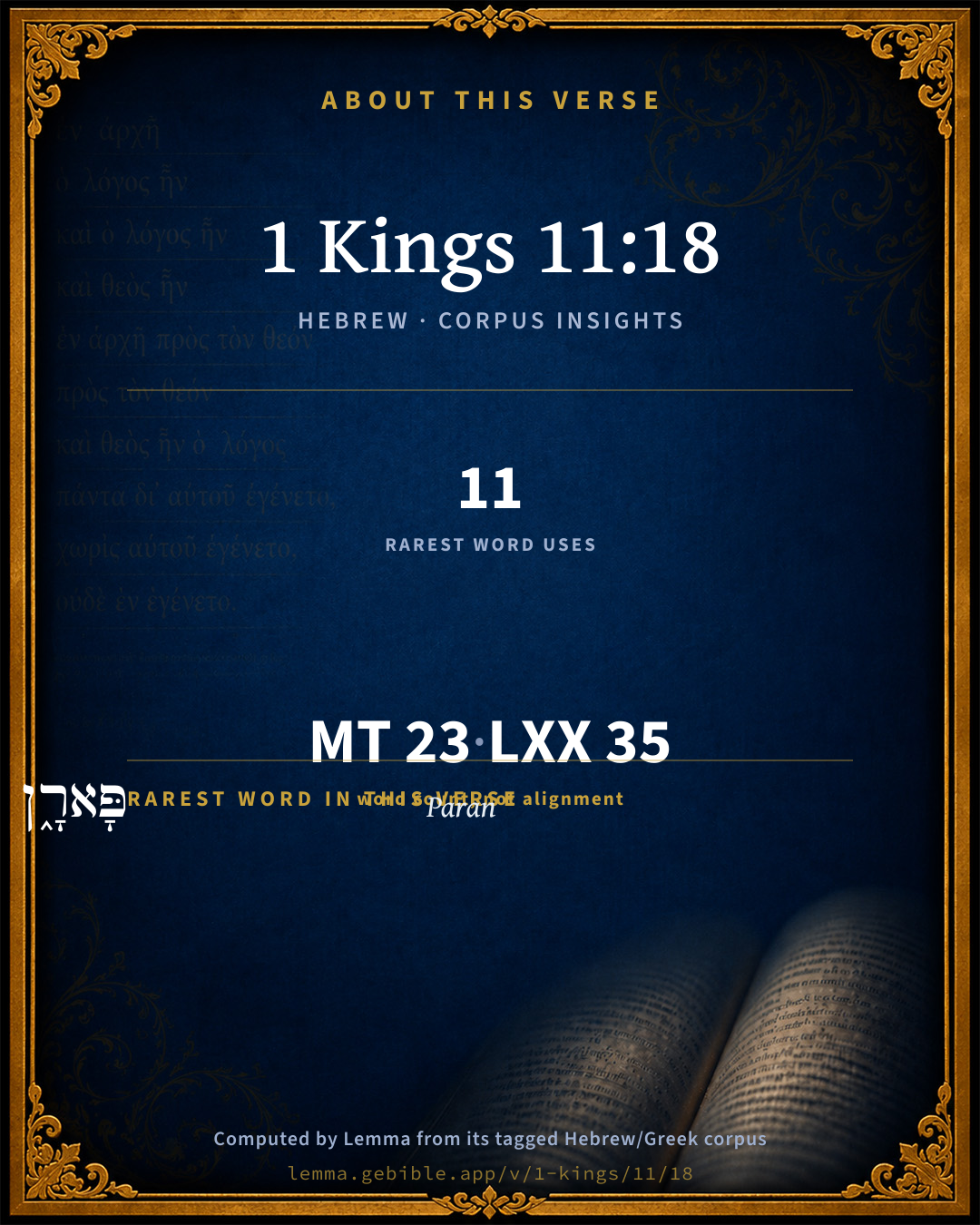
23
words
16
distinct lemmas
Historical
section

Notable vocabulary

The rarest word here is פָּארָ֑ן Paran H6290 — appearing just 11 times in the whole Hebrew Bible.

Shared distinctive vocabulary

פָּארָ֑ן Paran H6290 occurs in 10 verses of the Hebrew Bible. Also found in:

Grammatical profile

  • 7 verbs
  • 11 nouns
  • 5 prepositions

Verb forms

  • וַיָּקֻ֨מוּ֙ Qal · Sequential Imperfect
  • וַיָּבֹ֖אוּ Qal · Sequential Imperfect
  • וַיִּקְחוּ֩ Qal · Sequential Imperfect
  • וַיָּבֹ֤אוּ Qal · Sequential Imperfect
  • וַיִּתֶּן Qal · Sequential Imperfect
  • אָ֣מַר Qal · Perfect
  • נָ֥תַן Qal · Perfect

Repetition

Words recur within this verse — often emphatic in Hebrew:

  • וַיָּבֹ֖אוּ to enter H935 ×2
  • פָּארָ֑ן Paran H6290 ×2
  • מִצְרַ֨יִם֙ Egypt H4714 ×2
  • וַיִּתֶּן to give H5414 ×2

Hebrew & Septuagint length

In English translation the verse runs 41 words from the Hebrew and 44 from the Septuagint (LXX English) — closely comparable.

A rough comparison of the two English renderings, which tokenize alike — not a word-level alignment.

Word counts can differ between the Hebrew and the Greek without any difference in meaning — e.g. the Hebrew direct-object marker אֵת has no separate Greek word, and Greek often adds the article ὁ.

In the original languages it is 23 Hebrew tokens and 35 Greek tokens — but the two are counted differently (Hebrew bundles its prefixes and suffixes into one token; the Greek is in lemma form), so that isn’t a like-for-like length.

Cross-references

12

Topical passages linked to 1 Kings 11:18 in the Treasury of Scripture Knowledge — connected by theme and wording, ordered by reader-vote popularity; previews shown in the World English Bible.

  • Numbers 10:12 The children of Israel set forward according to their journeys out of the wilderness of Sinai; and the cloud abode in the wilderness of Paran.
  • Deuteronomy 1:1 These are the words which Moses spoke to all Israel beyond the Jordan in the wilderness, in the Arabah over against Suph, between Paran, and Tophel, and Laban, and Hazeroth, and Dizahab.
  • Deuteronomy 33:2 He said, Yahweh came from Sinai, Rose from Seir to them; He shined forth from Mount Paran, He came from the ten thousands of holy ones: At his right hand was a fiery law for them.
  • Genesis 14:6 and the Horites in their Mount Seir, to Elparan, which is by the wilderness.
  • Genesis 21:21 He lived in the wilderness of Paran. His mother took a wife for him out of the land of Egypt.
  • Genesis 25:2 She bore him Zimran, Jokshan, Medan, Midian, Ishbak, and Shuah.
  • Genesis 25:4 The sons of Midian: Ephah, Epher, Hanoch, Abida, and Eldaah. All these were the children of Keturah.
  • Numbers 22:4 Moab said to the elders of Midian, Now will this multitude lick up all that is round about us, as the ox licks up the grass of the field. Balak the son of Zippor was king of Moab at that time.
  • Numbers 25:6 Behold, one of the children of Israel came and brought to his brothers a Midianite woman in the sight of Moses, and in the sight of all the congregation of the children of Israel, while they were weeping at the door of the tent of meeting.
  • Numbers 25:14 Now the name of the man of Israel that was slain, who was slain with the Midianite woman, was Zimri, the son of Salu, a prince of a fathers' house among the Simeonites.
  • Numbers 25:18 for they vex you with their wiles, with which they have deceived you in the matter of Peor, and in the matter of Cozbi, the daughter of the prince of Midian, their sister, who was slain on the day of the plague in the matter of Peor.
  • Habakkuk 3:3 God came from Teman, The Holy One from Mount Paran. Selah. His glory covered the heavens, And his praise filled the earth.

Cross-references courtesy of OpenBible.info (CC BY 4.0).

Hebrew and Greek witnesses Masoretic Hebrew ↔ Greek Septuagint

The same verse in the two great witnesses to the Old Testament, shown verse-for-verse.

These are two independent witnesses, not word-aligned to each other, and the Septuagint is shown in lemma (dictionary) form.

Hebrew 1 Kings 11:18 Masoretic · Westminster Leningrad Codex

וַיָּקֻ֨מוּ֙ מִמִּדְיָ֔ן וַיָּבֹ֖אוּ פָּארָ֑ן וַיִּקְחוּ֩ אֲנָשִׁ֨ים עִמָּ֜ם מִפָּארָ֗ן וַיָּבֹ֤אוּ מִצְרַ֨יִם֙ אֶל פַּרְעֹ֣ה מֶֽלֶךְ מִצְרַ֔יִם וַיִּתֶּן ל֣וֹ בַ֗יִת וְלֶ֨חֶם֙ אָ֣מַר ל֔וֹ וְאֶ֖רֶץ נָ֥תַן לֽוֹ

They arose out of Midian, and came to Paran; and they took men with them out of Paran, and they came to Egypt, to Pharaoh king of Egypt, who gave him a house, and appointed him food, and gave him land.

World English Bible · Public Domain

Greek LXX 1 Kings 11:18 Septuagint · lemma form

καί ἀναἵστημι ἀνήρ ἐκ ὁ πόλις μαδιαμ καί ἔρχομαι εἰς φαραν καί λαμβάνω ἀνήρ μετά αὐτός καί ἔρχομαι πρός φαραώ βασιλεύς αἴγυπτος καί εἰςἔρχομαι αδερ πρός φαραώ καί δίδωμι αὐτός οἶκος καί ἄρτος διατάσσω αὐτός

And there rise up men out of the city of Madiam, and they come to Pharan, and take men with them, and come to Pharao king of Egypt: and Ader went in to Pharao, and he gave him a house, and appointed him provision.

LXX2012 (modern English Septuagint) · Public Domain

On this verse, Ellicott's Commentary for English Readers discusses the Septuagint’s reading. Read the note in Commentary ↓

Hebrew: Westminster Leningrad Codex (CC BY 4.0). Greek: Septuagint (public domain); English from LXX2012 (modern English Septuagint) (Public Domain). How the Septuagint differs from the Hebrew →

Targum (Aramaic paraphrase)

1

The Targum is the ancient Jewish Aramaic paraphrase of the Hebrew Scriptures — an interpretive translation, not the Hebrew text itself. Onkelos (literal) and Pseudo-Jonathan (expansive) render the Torah, and Jonathan the Prophets. Coverage is partial: where no permissively-licensed English translation exists for a verse, only the Aramaic is shown. This is verse-level text, not a word-by-word alignment to the Hebrew.

  1. Targum Jonathan Prophets (Joshua–Malachi)
    וְקָמוּ מִמִדְיָן וַאֲתוֹ לְפָארָן וּדְבַרוּ גַבְרִין עִמְהוֹן מִפָּארָן וַאֲתוֹ לְמִצְרַיִם לְוַת פַּרְעֹה מַלְכָּא דְמִצְרַיִם וִיהַב לֵיהּ בֵּיתָא וּמָזוֹן אֲמַר לְסַפְּקָא לֵיהּ וְאַרְעָא יְהַב לֵיהּ:

    (no public-domain English translation for this verse)

    Targum Jonathan — Aramaic: “Mikraot Gedolot” (public domain). English: “Sefaria Community Translation” (CC0 1.0 (public-domain dedication)); “London "Chaldee Paraphrase," 1871” (public domain). Text via Sefaria.

Commentary

Notes on 1 Kings 11:18 from classic Christian and Jewish commentators (each source and its license shown beneath its notes). The classic Christian expositions comment on the surrounding passage and are grouped to its opening verse, so a note may address several verses; the Jewish commentaries on the Tanakh (Rashi and others) are per-verse, so they appear only where the commentator wrote on this verse.

Lemma curates 59 commentaries, every one of them public domain or Creative Commons licensed, each selected and text-cleaned for this edition rather than reprinted as found. About our sources →

Trapp's Complete Commentary

John Trapp

1Ki 11:18 And they arose out of Midian, and came to Paran: and they took men with them out of Paran, and they came to Egypt, unto Pharaoh king of Egypt; which gave him an house, and appointed him victuals, and gave him land.

Ver. 18. Who gave him a house, &c.] As not knowing but that himself might one day have as much need to borrow mercy, as now he had to lend it.

John Trapp, A Commentary or Exposition upon All the Books of the Old and New Testament (1647–1656) — public domain. Text from a community e-Sword module.

Joseph Benson's Commentary

1Ki 11:18. They arose out of Midian — They first went into Midian and stayed there a while, probably that they might send from thence to know whether Pharaoh would give them entertainment and protection. And came to Paran — Another country in the road from Edom to Egypt, where he hired men to attend him, probably either as guides, or that, making his entrance into Egypt in some degree like a prince, he might find more favour from the king and people. Which gave him a house, &c. — According to the manner of generous princes, who pity noble persons that are in distress, Pharaoh not only assigned him a house, and kept a table for him, that he might want nothing, but also gave him land, that out of the revenues of it he might provide himself an equipage suitable to his quality.

Joseph Benson's Commentary on the Old and New Testaments (1811–1818) — public domain. Text from a community e-Sword module.

Adam Clarke's Commentary

Verse 18. These arose out of Midian] They at first retired to Midian, which lay to the southwest of the Dead Sea. Not supposing themselves in safety there, they went afterwards to Paran in the south of Idumea, and getting a number of persons to join them in Paran, they went straight to Egypt, where we find Hadad became a favourite with Pharaoh, who gave him his sister-in-law to wife; and incorporated him and his family with his own.

Adam Clarke's Commentary on the Bible (1810–1826) — public domain. Text from a community e-Sword/MySword module.

Ellicott's Commentary for English Readers

(18) They arose out of Midian.—The expression is a curious one; for we should have expected the starting-point of the flight to have been described in Edom itself. If the reading of the text is correct, the reference must be either to some branch of the Midianitish tribes settled between Edom and the desert of Paran, or to a city Midian, not far from the Gulf of Elath, of which some ancient authorities speak, and to which the LXX. expressly refers here.

Paran (see Gen_21:21; Num_10:12; Num_12:16; Num_13:3; Num_13:26 : 1Sa_25:1) is part of the Sinaitic region, adjacent to the wilderness of Zin, and north of the range now called the El-Tîh mountains. It lies to the west of the Edomite territory, and was then evidently inhabited by an independent race, from which the fugitive companions of Hadad enlisted support.

Pharaoh king of Egypt.—The dynasty then reigning in Lower Egypt is that called the twenty-first, or Tanite, dynasty. Chronological considerations, and perhaps internal probabilities, suggest that this Pharaoh was not the same as the king who became father-in-law to Solomon. But the same policy of alliance with the occupants of Palestine and the neighbourhood is equally exemplified in both cases, though by different methods; and accords well with the apparent decadence of Egyptian power at this time, of which very little record is preserved in the monuments. Jealousy of the growing power of Israel under David and Solomon might prompt this favourable reception of Hadad, as afterwards of Jeroboam. The marriage of Solomon with the daughter of Pharaoh, and the active co-operation of Pharaoh against Gezer (1Ki_9:16), indicate an intervening variation of policy, without, however, any change in the general design of securing Egypt by alliances on the north-east. In this case the intermarriage of Hadad with the royal house, and the inclusion of his son Genubath among the children of Pharaoh, argue an unusual distinction, which could only have been due to a high estimate of the importance of influence over the strong country of Edom, and of the future chances of Hadad’s recovery of the throne.

A Bible Commentary for English Readers, edited by Charles John Ellicott (1878–1897) — public domain. Text from a community e-Sword module.

The Cambridge Bible for Schools and Colleges

gen. ed. J. J. S. Perowne

18. And they arose out of Midian] It is not easy to decide what place or district is meant by Midian. The country so called in the time of Moses (Exo_2:15; Exo_3:1) could not have been far away from Mt. Sinai, and the fugitives from Edom would hardly have made their way to such a distance before setting out on their journey to Egypt. If the Midianites wandered about in the desert it may be that there was some more northern district nearer to the south-west of Edom which was called after them. Of this however we have no information.

The LXX. here reads ἐκ τῆς πόλεως Μαδιάμ, thus explaining the word as the name of a city. There is however a difference of reading in Jdg_10:12 which may help us. There we read ‘The Zidonians and Amalek and Maon did oppress you … and I delivered you out of their hand.’ Now instead of Maon the LXX. in that passage gives Madiam. The two words appear in Hebrew as מצון and מדין respectively, very closely resembling each other. But in the book of Judges ‘Maon’ is not mentioned among the enemies of Israel, but the Midianites play a conspicuous part. It seems likely therefore that the LXX. is correct and that in Jdg_10:12 ‘Midian’ should be read instead of ‘Maon’.

In the present verse it would almost seem as if the contrary change should be made. We read of Maon among the cities on the south of Judah, and not far from Paran, in the story of Nabal (1Sa_25:2). There we read that David could send men from the wilderness of Paran up to Maon, and when they came back rudely repulsed could set forth himself to chastise Nabal. If we suppose these fugitive Edomites to have taken refuge for a brief time in the mountainous district of south Judah, where Maon was, the rest of their proceedings becomes explicable. They came from Maon to the wilderness of Paran, found some men there, either fellow fugitives or others, whom they took as guides and a convoy and thus made their way to Egypt.

Paran] By this name seems to be meant that wilderness which beginning on the south of Judah and south-west of Edom is now known as El-Tih, and which was the scene of the wanderings of the Israelites.

unto Pharaoh king of Egypt] This king may have been the immediate predecessor of the monarch whose daughter Solomon married. There need not have been more than 30 years, if so much, between these events in David’s life, and the marriage of Solomon.

victuals] Heb. ‘bread,’ i.e. a regular sustenance for himself and those he had brought with him. In the same way ‘land’ implies a place in which they all might settle and live during their stay.

The Cambridge Bible for Schools and Colleges (gen. ed. J. J. S. Perowne; Cambridge University Press, 1878–1918) — public domain. Text from a community e-Sword module.

John Gill's Exposition

And Hadad found great favour in the sight of Pharaoh,.... Perhaps for his comely personage, princely qualities, and good behaviour, as he grew up:

so that he gave him to wife the sister of his own wife, the sister of Tahpenes the queen; it seems the kings of Egypt used to marry their favourites to great personages; see Gen 41:45.

John Gill's Exposition of the Whole Bible (1746–1763) — public domain (CC PDM 1.0). Text via the HelloAO Bible API.

Albert Barnes' Notes on the Bible

Midian - A town in the south of Judah. Paran is the desert tract immediately to the south of Judaea, the modern desert of et-Tih.

Pharaoh - King of the twenty-first (Tanite) dynasty; probably he was Psusennes I, Manetho’s second king. It appears to have been the policy of the Pharaohs about this time to make friends and contract alliances with their eastern neighbors.

Albert Barnes' Notes on the Bible (1834–1885) — public domain. Text from a community e-Sword/MySword module.

Haydock's Catholic Bible Commentary

Land, to maintain him (Josephus) out of the royal domains, (Calmet) of which the kings were possessed. (Didor. i. p. 46.) --- He appointed him governor of some part of the country. (Vatable)

George Leo Haydock (1774–1849), Haydock's Catholic Family Bible and Commentary, 1859 edition — public domain. Excludes Psalms (Douay-Rheims chapter numbering differs from Protestant) and Deuterocanonical books (Catholic canon only).

Matthew Poole's English Annotations

They arose out of Midian; he fled at first with an intent to go into Egypt, as is said, 1Ki 11:17, but took Midian, a neighbouring country, in his way, and staid there a while, possibly till he had by some of his servants tried Pharaoh’s mind, and prepared the way for his reception.

Paran; another country in the road from Edom to Egypt, where he hired men to attend him, that making his entrance there something like a prince, he might find more favour and respect from that king and people.

Appointed him victuals, and gave him land, to support himself and his train out of the profits of it.

Matthew Poole's English Annotations on the Holy Bible (1683–1685) — public domain. Text from a community e-Sword/MySword module.

Whedon's Commentary on the Bible

Daniel D. Whedon

18. They arose out of Midian, and came to Paran — They first fled from Edom to Midian, and then, probably supposing themselves still insecure, they arose and went toward Egypt as far as some settlement in the desert of Paran, where they seem to have stayed awhile before proceeding to Egypt. The Midian here referred to was probably the same as that to which Moses fled from Pharaoh, (Exo_2:15,) and lay in the Sinaitic peninsula south of Edom and around the mountains connected with Horeb. Paran was the vast wilderness north of Sinai and west of Edom, corresponding substantially with the modern desert et Tih. See on Gen_21:21, and Num_10:12.

Took men with them — Probably as guides through the wilderness.

Daniel D. Whedon (gen. ed.), Commentary on the Old and New Testaments (1874–1909) — public domain. Text from a community e-Sword module.

The Pulpit Commentary

And they arose out of Midian a name of wide and somewhat varied significance. Midian embraces the eastern portion of the peninsula of Sinai, (Exo_2:15, 21 3:1) and stretches along the eastern border of Palestine. The term has been compared with our "Arabia." And the indefiniteness arises in both instances from the same cause, viz., that the country was almost entirely desert. Midian would thus extend along the back or east of Edom. There is no need, consequently (with Thenius), to read wOm; i.e., their dwelling. It is noticeable, however, that the LXX reads ejk thv polewv Madmim, and some of the geographers do mention a city of that name on the eastern shore of the Elanitic gulf, and came to Paran Elsewhere Mount Paran, Habakkuk Deu_33:2; a desert and mountainous tract lying between Arabia Petraea, Palestine, and Idumaea (see Num_10:12 Num_13:3, Num_13:27; 1Sa_25:1; Deu_1:1) and comprehending the desert of Et Tih. It is difficult to identify it with greater precision, but it has been connected with the beautiful Wady Feiran, near Mount Serbal, in the Sinaitic range, which would agree fairly well with our narrative: and they took men with them out of Pavan as guides through the desert, and possibly as a protection also, and came to Egypt The direct route from Edom to Egypt would be across the desert of Et Tih practically the route of the caravan of pilgrims from Mecca. But this does not settle the position of Paran, as the text seems to hint that the fugitives did not proceed direct from Edom. They may have taken refuge in the first instance amongst the tribes of Midian; or they may have diverged from the straight course through fear, unto Pharaoh king of Egypt This cannot have been the Pharaoh who was Solomon"s father-in-law, for in the first place, the flight was in the time of David, and secondly, a prince who had aided and abetted these fugitives would hardly be likely to form an alliance with their great enemy. It may have been Psusennes II; which gave him a house, and appointed him victuals i.e., certain cities or officers were charged with his maintenance, though, as his relations with the royal family were so extremely intimate (vers. 19-22), he may have been fed from the royal table, and gave him land.

The Pulpit Commentary (1880–1919), ed. H.D.M. Spence-Jones & Joseph S. Exell — public domain. Text from a community e-Sword module.

John Wesley's Explanatory Notes

Midian - He fled at first with an intent to go into Egypt, but took Midian, a neighbouring country, in his way, and staid there a while, possibly 'till he had by some of his servants tried Pharaoh's mind, and prepared the way for his reception. Paran - Another country in the road from Edom to Egypt, where he hired men to attend him, that making his entrance there something like a prince, he might find more favour from that king and people. Land - To support himself and his followers out of the profits of it.

John Wesley, Explanatory Notes Upon the Whole Bible (1754–1765) — public domain. Text via the GEBible commentary corpus.

unfoldingWord translationNotes

Door43 World Missions Community

General Information:

This section continues the background information that began in 1 Kings 11:15.

They left Midian

Here the word "They" refers to Hadad and the other Edomites mentioned in 1 Kings 11:17.

Midian ... Paran ... Egypt

These are the names of places. (See: How to Translate Names)

Tahpenes

This is the name of a woman. (See: How to Translate Names)

translationWords

Midian

Paran

Pharaoh

favor

queen

unfoldingWord translationNotes — © Distant Shores Media and the Door43 World Missions Community, licensed CC BY-SA 4.0. Source: git.door43.org/Door43/en_tn.

Rashi

Rabbi Shlomo Yitzchaki (Rashi)

And ordered that he be provided with food. He said to his servants, “So much and so much bread should you give him daily.”

Rashi on the Tanakh — English translations: “The Judaica Press complete Tanach with Rashi, translated by A. J. Rosenberg” (CC BY 4.0); “Pentateuch with Rashi's commentary by M. Rosenbaum and A.M. Silbermann, 1929-1934” (public domain); “The Metsudah Tanach series, Lakewood, N.J” (CC BY 4.0); and “The Book of Joshua, Metsudah Publications, 1997” (CC BY 4.0). Text via Sefaria.

Lesson kit

Teaching starters — assembled from the data on this page, not authored interpretation. Every prompt links to the verse data it draws on. Edit before teaching.

1 Kings, in the Historical, opens this verse with 23 words (16 distinct Hebrew lemmas). Its most distinctive word is Pâʼrân (“Paran”). A historical commentator’s framing appears above. Read the whole chapter for the surrounding context.

Discussion questions

  1. What does “Paran” (Pâʼrân) contribute to the verse as a whole?
  2. Genesis 21:21 shares the word «Paran» with this verse. How do the two illuminate each other?
  3. “to enter” occurs 2× in this one verse. What is the effect of the repetition?
  4. The translations on this page render this verse differently — a whole-verse word diff, not a word-by-word alignment. What might account for the different wordings?
  5. The verb «וַיָּקֻ֨מוּ֙» is Qal Sequential Imperfect. How does its form color the action?
  6. Reading how Trapp's Complete Commentary and Joseph Benson's Commentary read this verse, where do the two commentators agree and where do they part?

Things to notice

Reading settings

Reading text

Shown beneath each verse's original-language words.

Old Testament
Old Testament edition

Read the OT as the Masoretic Hebrew (MT) or the Greek Septuagint (LXX).

English shown for the Greek Septuagint (in the Hebrew ↔ Greek comparison).

Comparing translations? Open the Compare panel on any verse page to stack up to four side by side.