
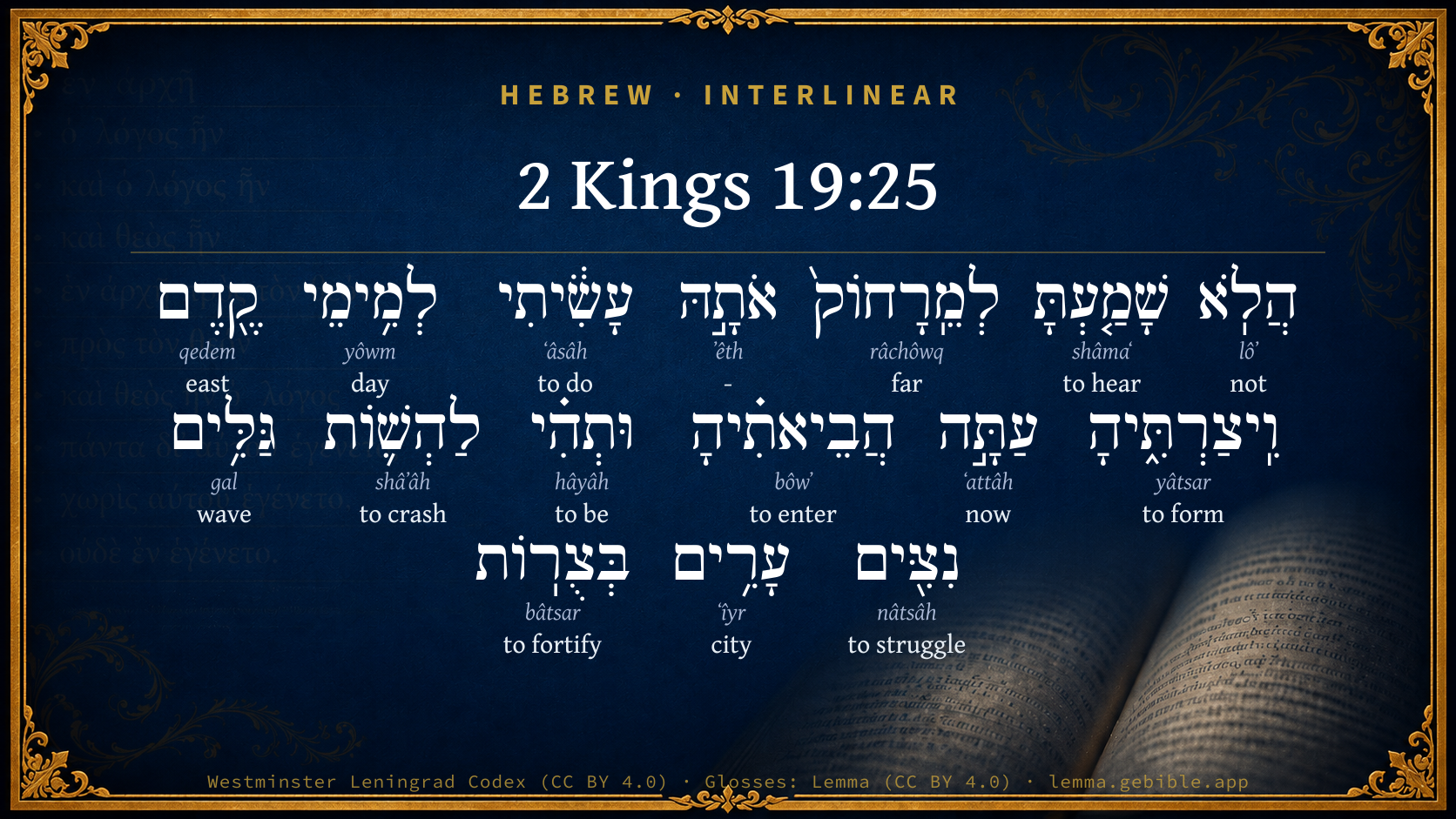
2 Kings 19:25

Hebrew (Westminster Leningrad Codex) 2 Kings 19:25 appears in the Hebrew Old Testament. The text above is from the Westminster Leningrad Codex. Each word links to its Strong’s number, a concise gloss, and parsing drawn from the Open Scriptures Hebrew Bible morphology. Click any word for its full Brown-Driver-Briggs (BDB) entry.
Download image
Cite this verse

2 Kings 19:25 (World English Bible). Public Domain. Lemma interlinear Bible study tool, https://lemma.gebible.app/v/2-kings/19/25.

Show BibTeX & RIS
BibTeX
RIS
English Translation
Haven't you heard how I have done it long ago, and formed it of ancient times? now have I brought it to pass, that it should be yours to lay waste fortified cities into ruinous heaps.
World English Bible · Public Domain
Highlights
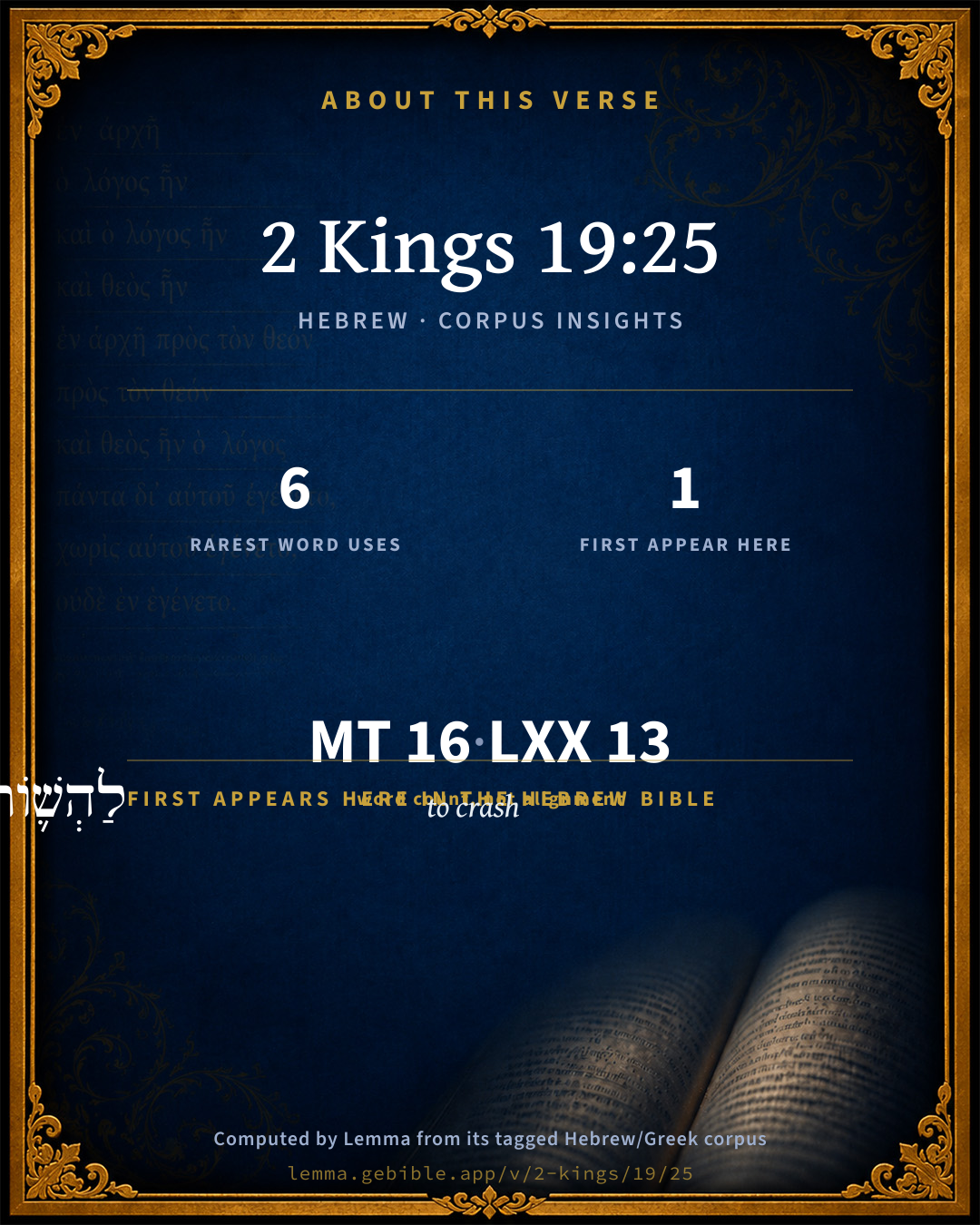
  • 1 first appearance in the Hebrew Bible
Full analysis ↓
Download a study sheet

One document with this verse’s original text, its word-by-word gloss line, the meaning frame, cross-references with their text, attributed commentary, and full source and license credits — printable, and it pastes into notes with its structure intact.

This verse Autodidact and up

Study sheet (.html) Plain text (.txt)

A passage Seminary Student

Up to 50 verses in one chapter. A passage sheet keeps up to 6 commentary sources and 12 cross-references per verse, in the order this page ranks them, and says so on the sheet whenever that leaves anything out. Ask for a single verse and you get the Autodidact verse sheet above.

Everything on this page stays free to read, with no account — the sheet is a download of what is already on screen, not access to it.

Want to remove ads? Support Godless Engineer
Compare translations 3

The same verse in 3 English versions, stacked beneath the original-language interlinear above. Click any original word for its lexicon entry.

Each is an independent rendering of the whole verse — the interlinear is not word-aligned to these translations.

Highlighted words mark where these versions differ — a whole-verse word diff, not a word-by-word alignment.

  • World English Bible Public Domain
    Haven't you heard how I have done it long ago, and formed it of ancient times? now have I brought it to pass, that it should be yours to lay waste fortified cities into ruinous heaps.
  • King James Version Public Domain
    Hast thou not heard long ago how I have done it, and of ancient times that I have formed it? now have I brought it to pass, that thou shouldest be to lay waste fenced cities into ruinous heaps.
  • unfoldingWord Literal Text CC BY-SA 4.0
    Have you not heard? From long ago, I did it; from days of antiquity, I formed it. Now I have brought it, that you should be for devastating fortified cities ruined heaps.

unfoldingWord Literal Text — © unfoldingWord, licensed CC BY-SA 4.0. Word-aligned USFM3 via Door43 (git.door43.org/unfoldingWord/en_ult).

Versions to compare (up to 4)

3 of 4 selected

Show all 18 translations

Every available English version of this verse, each an independent rendering of the whole verse.

  • World English Bible Public Domain
    Haven't you heard how I have done it long ago, and formed it of ancient times? now have I brought it to pass, that it should be yours to lay waste fortified cities into ruinous heaps.
  • Berean Standard Bible Public Domain
    Have you not heard? Long ago I ordained it; in days of old I planned it. Now I have brought it to pass, that you should crush fortified cities into piles of rubble.
  • Majority Standard Bible Public Domain
    Have you not heard? Long ago I ordained it; in days of old I planned it. Now I have brought it to pass, that you should crush fortified cities into piles of rubble.
  • King James Version Public Domain
    Hast thou not heard long ago how I have done it, and of ancient times that I have formed it? now have I brought it to pass, that thou shouldest be to lay waste fenced cities into ruinous heaps.
  • American Standard Version (1901) Public Domain
    Hast thou not heard how I have done it long ago, and formed it of ancient times? now have I brought it to pass, that it should be thine to lay waste fortified cities into ruinous heaps.
  • Revised Version (1885) Public Domain
    Hast thou not heard how I have done it long ago, and formed it of ancient times? now have I brought it to pass, that thou shouldest be to lay waste fenced cities into ruinous heaps.
  • Geneva Bible (1599) Public Domain
    Hast thou not heard, howe I haue of olde time made it, and haue formed it long ago? and should I nowe bring it, that it should be destroyed, and laid on ruinous heapes, as cities defensed?
  • Douay-Rheims (1899) Public Domain
    Hast thou not heard what I have done from the beginning? from the days of old I have formed it, and now I have brought it to effect: that fenced cities of fighting men should be turned to heaps of ruin:
  • Young's Literal Translation Public Domain
    Hast thou not heard from afar, it I made, From days of old that I formed it? Now I have brought it in, And it becometh a desolation, Ruinous heaps `are' fenced cities,
  • Literal Standard Version CC BY-SA 4.0
    Have you not heard from afar [that] I made it, || From days of old that I formed it? Now I have brought it in, || And it becomes a desolation, || Ruinous heaps [are] fortified cities,
  • Unlocked Literal Bible CC BY-SA 4.0
    Have you not heard how I determined it long ago, and worked it out in ancient times? Now I am bringing it to pass. You are here to reduce impregnable cities into heaps of ruins.
  • unfoldingWord Literal Text CC BY-SA 4.0
    Have you not heard? From long ago, I did it; from days of antiquity, I formed it. Now I have brought it, that you should be for devastating fortified cities ruined heaps.
  • Darby Bible Public Domain
    Hast thou not heard long ago that I have done it? And that from ancient days I formed it? Now have I brought it to pass, that thou shouldest lay waste fortified cities [into] ruinous heaps.
  • World Messianic Bible Public Domain
    Haven’t you heard how I have done it long ago, and formed it of ancient times? Now I have brought it to pass, that it should be yours to lay waste fortified cities into ruinous heaps.
  • Webster's Bible Public Domain
    Hast thou not heard long ago how I have done it, and of ancient times that I have formed it? now have I brought it to pass, that thou shouldst be to lay waste fortified cities in ruinous heaps.
  • Free Bible Version CC BY-SA 4.0
    The Lord replies, “Haven't you heard? I decided it long ago; I planned it in the olden days. Now I am making sure it happens—that you are to knock down fortified towns into piles of rubble.
  • Bible in Basic English Public Domain
    Has it not come to your ears how I did it long before, purposing it in times long past? Now I have given effect to my design, so that by you strong towns might be turned into masses of broken walls.
  • JPS Tanakh (1917) Public Domain
    Hast thou not heard? long ago I made it, in ancient times I fashioned it; now have I brought it to pass, yea, it is done; that fortified cities should be laid waste into ruinous heaps.

Literal Standard Version (2020), Covenant Press — licensed CC BY-SA 4.0. Text via the HelloAO Bible API (eBible.org). Unlocked Literal Bible (unfoldingWord) — licensed CC BY-SA 4.0. Text via the HelloAO Bible API (eBible.org). unfoldingWord Literal Text — © unfoldingWord, licensed CC BY-SA 4.0. Word-aligned USFM3 via Door43 (git.door43.org/unfoldingWord/en_ult). Free Bible Version, Dr. Jonathan Gallagher — licensed CC BY-SA 4.0. Text via the HelloAO Bible API (eBible.org).

Word by word

More ways to search: Search by grammar → Find every occurrence → Compare this word →

Practice this passage: Drill this verse → Learn its vocabulary →

לַהְשׁ֛וֹת
shâʼâh
H7582
“to crash”
Preposition + Verb, Hiphil, Infinitive Construct
Part of Speech
Preposition + Verb
Stem
Hiphil
Form
Infinitive Construct
Full BDB Definition

Origin: a primitive root

TWOT: 2301

crash, make a din or crash, crash into ruins, be in ruins, be desolated - (Qal) to crash into ruins - (Niphal) - to be ruined - to crash - to be left (a desolation) - (Hiphil) - to cause to crash - to cause to be desolated
  1. הֲלֹֽא lôʼ H3808 “not” Particle, Interrogative + Particle, Negative
  2. שָׁמַ֤עְתָּ shâmaʻ H8085 “to hear” Verb, Qal, Perfect, 2nd Person, Masculine, Singular
  3. לְמֵֽרָחוֹק֙ râchôwq H7350 “to/for · from · far” Preposition + Preposition + Adjective, Adjective, Masculine, Singular, Absolute
  4. אֹתָ֣הּ ʼêth H853 “- · her” Particle, Direct Object + Suffix, Personal, 3rd Person, Feminine, Singular
  5. עָשִׂ֔יתִי ʻâsâh H6213 “to do” Verb, Qal, Perfect, 1st Person, Common, Singular
  6. לְמִ֥ימֵי yôwm H3117 “to/for · from · days of” Preposition + Preposition + Noun, Common, Masculine, Plural, Construct
  7. קֶ֖דֶם qedem H6924 “east” Noun, Common, Masculine, Singular, Absolute
  8. וִֽיצַרְתִּ֑יהָ yâtsar H3335 “and · to form · her” Conjunction + Verb, Qal, Perfect, 1st Person, Common, Singular + Suffix, Personal, 3rd Person, Feminine, Singular
  9. עַתָּ֣ה ʻattâh H6258 “now” Adverb
  10. הֲבֵיאתִ֗יהָ bôwʼ H935 “to enter · her” Verb, Hiphil, Perfect, 1st Person, Common, Singular + Suffix, Personal, 3rd Person, Feminine, Singular
  11. וּתְהִ֗י hâyâh H1961 “and · to be” Conjunction + Verb, Qal, Imperfect, 2nd Person, Masculine, Singular
  12. גַּלִּ֥ים gal H1530 “waves” Noun, Common, Masculine, Plural, Absolute
  13. נִצִּ֖ים nâtsâh H5327 “struggling” Verb, Niphal, Participle Active, Masculine, Plural, Absolute
  14. עָרִ֥ים ʻîyr H5892 “cities” Noun, Common, Feminine, Plural, Absolute
  15. בְּצֻרֽוֹת bâtsar H1219 “fortified” Adjective, Adjective, Feminine, Plural, Absolute

About this verse

These counts appear in no published source. They are computed here, from the morphology-tagged text and Lemma’s own curated glosses. What Lemma adds →

16
words
16
distinct lemmas
Historical
section

Notable vocabulary

The rarest word here is לַהְשׁ֛וֹת to crash H7582 — appearing just 6 times in the whole Hebrew Bible.

First appearance in Scripture

This word makes its first canonical appearance in the Hebrew Bible here:

  • לַהְשׁ֛וֹת to crash H7582

Shared distinctive vocabulary

לַהְשׁ֛וֹת to crash H7582 occurs in 5 verses of the Hebrew Bible. Also found in:

Grammatical profile

  • 7 verbs
  • 4 nouns
  • 2 adjectives
  • 1 adverb
  • 2 particles

Verb forms

  • שָׁמַ֤עְתָּ Qal · Perfect
  • עָשִׂ֔יתִי Qal · Perfect
  • וִֽיצַרְתִּ֑יהָ Qal · Perfect
  • הֲבֵיאתִ֗יהָ Hiphil · Perfect
  • וּתְהִ֗י Qal · Imperfect
  • לַהְשׁ֛וֹת Hiphil · Infinitive Construct
  • נִצִּ֖ים Niphal · Participle Active

Hebrew & Septuagint length

In English translation the verse runs 36 words from the Hebrew and 30 from the Septuagint (LXX English) — closely comparable.

A rough comparison of the two English renderings, which tokenize alike — not a word-level alignment.

Word counts can differ between the Hebrew and the Greek without any difference in meaning — e.g. the Hebrew direct-object marker אֵת has no separate Greek word, and Greek often adds the article ὁ.

In the original languages it is 16 Hebrew tokens and 13 Greek tokens — but the two are counted differently (Hebrew bundles its prefixes and suffixes into one token; the Greek is in lemma form), so that isn’t a like-for-like length.

Cross-references

9

Topical passages linked to 2 Kings 19:25 in the Treasury of Scripture Knowledge — connected by theme and wording, ordered by reader-vote popularity; previews shown in the World English Bible.

  • Isaiah 45:7 I form the light, and create darkness; I make peace, and create evil. I am Yahweh, who does all these things.
  • Isaiah 10:5–6 Ho Assyrian, the rod of my anger, the staff in whose hand is my indignation!
  • Isaiah 37:26–27 Have you not heard how I have done it long ago, and formed it of ancient times? now have I brought it to pass, that it should be your to lay waste fortified cities into ruinous heaps.
  • Psalms 33:11 The counsel of Yahweh stands fast forever, The thoughts of his heart to all generations.
  • Psalms 76:10 Surely the wrath of man praises you. The survivors of your wrath are restrained.
  • Isaiah 10:15 Shall the axe boast itself against him who hews therewith? Shall the saw magnify itself against him who wields it? as if a rod should wield those who lift it up, [or] as if a staff should lift up [him who is] not wood.
  • Isaiah 46:10–11 declaring the end from the beginning, and from ancient times things that are not [yet] done; saying, My counsel shall stand, and I will do all my pleasure;
  • Isaiah 54:16 Behold, I have created the smith who blows the fire of coals, and brings forth a weapon for his work; and I have created the waster to destroy.
  • Acts 4:27–28 For truly, in this city against your holy servant, Jesus, whom you anointed, both Herod and Pontius Pilate, with the Gentiles and the people of Israel, were gathered together

Cross-references courtesy of OpenBible.info (CC BY 4.0).

Hebrew and Greek witnesses Masoretic Hebrew ↔ Greek Septuagint

The same verse in the two great witnesses to the Old Testament, shown verse-for-verse.

These are two independent witnesses, not word-aligned to each other, and the Septuagint is shown in lemma (dictionary) form.

Hebrew 2 Kings 19:25 Masoretic · Westminster Leningrad Codex

הֲלֹֽא שָׁמַ֤עְתָּ לְמֵֽרָחוֹק֙ אֹתָ֣הּ עָשִׂ֔יתִי לְמִ֥ימֵי קֶ֖דֶם וִֽיצַרְתִּ֑יהָ עַתָּ֣ה הֲבֵיאתִ֗יהָ וּתְהִ֗י לַהְשׁ֛וֹת גַּלִּ֥ים נִצִּ֖ים עָרִ֥ים בְּצֻרֽוֹת

Haven't you heard how I have done it long ago, and formed it of ancient times? now have I brought it to pass, that it should be yours to lay waste fortified cities into ruinous heaps.

World English Bible · Public Domain

Greek LXX 2 Kings 19:25 Septuagint · lemma form

πλάσσω αὐτός νῦν ἄγω αὐτός καί γίγνομαι εἰς ἔαρσις ἀποικεσία μάχιμος πόλις ὀχυρός

I have brought about the matter, I have brought it to a conclusion; and it is come to the destruction of the bands of warlike prisoners, even of strong cities.

LXX2012 (modern English Septuagint) · Public Domain

On this verse, The Cambridge Bible for Schools and Colleges discusses the Septuagint’s reading. Read the note in Commentary ↓

Hebrew: Westminster Leningrad Codex (CC BY 4.0). Greek: Septuagint (public domain); English from LXX2012 (modern English Septuagint) (Public Domain). How the Septuagint differs from the Hebrew →

Targum (Aramaic paraphrase)

1

The Targum is the ancient Jewish Aramaic paraphrase of the Hebrew Scriptures — an interpretive translation, not the Hebrew text itself. Onkelos (literal) and Pseudo-Jonathan (expansive) render the Torah, and Jonathan the Prophets. Coverage is partial: where no permissively-licensed English translation exists for a verse, only the Aramaic is shown. This is verse-level text, not a word-by-word alignment to the Hebrew.

  1. Targum Jonathan Prophets (Joshua–Malachi)
    הֲלֹא שְׁמַעְתָּא מִלְקַדְמִין מַה דַעֲבַדֵית לְפַרְעֹה מַלְכָּא דְמִצְרַיִם הֲלָא עַל דְשַׁלִיט בְּהוֹן וְאַף עֲלָךְ אִתְנַבִּיאוּ נְבִיֵי יִשְׂרָאֵל וְלָא תַבְתָּא וְדָא חַזְיָא קֳדָמַי מִיוֹמֵי קֶדֶם לְמֶעְבַּד לָךְ אַף אַתְקֵינְתָא כְּעַן אַיְתֵיתָהּ וְדָא הֲוַת לָךְ לְתַקָלָא עַל דַהֲוָאָה קֳדָמָךְ כְּאִתְרְגוּשַׁת גַלִין דְיִשְׁחוּ קִירְוִין כְּרִיכַן:

    (no public-domain English translation for this verse)

    Targum Jonathan — Aramaic: “Mikraot Gedolot” (public domain). English: “Sefaria Community Translation” (CC0 1.0 (public-domain dedication)); “London "Chaldee Paraphrase," 1871” (public domain). Text via Sefaria.

Commentary

Notes on 2 Kings 19:25 from classic Christian and Jewish commentators (each source and its license shown beneath its notes). The classic Christian expositions comment on the surrounding passage and are grouped to its opening verse, so a note may address several verses; the Jewish commentaries on the Tanakh (Rashi and others) are per-verse, so they appear only where the commentator wrote on this verse.

Lemma curates 59 commentaries, every one of them public domain or Creative Commons licensed, each selected and text-cleaned for this edition rather than reprinted as found. About our sources →

Trapp's Complete Commentary

John Trapp

2Ki 19:25 Hast thou not heard long ago [how] I have done it, [and] of ancient times that I have formed it? now have I brought it to pass, that thou shouldest be to lay waste fenced cities [into] ruinous heaps.

Ver. 25. Hast thou not heard?] Here God himself taketh Sennacherib in hand, and schooleth him concerning the divine providence and decree whereby he was now sent against a "hypocritical nation, a people of God’s wrath, to take the spoil," &c. "Howbeit he meant not so, neither did his heart think so; but it was in his heart to destroy and cut off nations not a few." {Isa 10:6-7}

That thou shouldest be to lay waste fenced cities.] This is all done by my determinate counsel, ordering the world’s disorders to mine own glory, and the good of my people. Tamerlane was wont to say, Ira De; ego sum, et orbis vastitas. Attilas called himself Metum mundi et flagellum Dei. Sennacherib was God’s scourge, and the sword in his hand. {Isa 10:5}

John Trapp, A Commentary or Exposition upon All the Books of the Old and New Testament (1647–1656) — public domain. Text from a community e-Sword module.

Joseph Benson's Commentary

2Ki 19:25. Hast thou not heard long ago, &c. — Hast thou not long since learned that which some of thy philosophers could have taught thee; that there is a supreme and powerful God, by whose decree and providence all these wars and calamities are sent and ordered; whose mere instrument thou art; so that thou hast no cause for these vain boastings? This work is mine, not thine. I have done it, &c. — I have so disposed of things by my providence, that thou shouldest be a great and victorious prince, and that thou shouldest be so successful as thou hast hitherto been, first against the kingdom of Israel, and now against Judah. Thus God answers the boastings of this proud prince, and shows him that all his counsel and power are nothing; since these events wholly depended on a superior cause; namely, on God’s sovereign decree and overruling providence, whereof he had made this Assyrian the instrument in his almighty hand.

Joseph Benson's Commentary on the Old and New Testaments (1811–1818) — public domain. Text from a community e-Sword module.

Tyndale Open Study Notes

Tyndale Open Resources

19:25-26 I am making it happen: All of Sennacherib’s great accomplishments were what God had planned for him.

Tyndale Open Study Notes — © Tyndale Open Resources, licensed CC BY-SA 4.0. Text via the HelloAO Bible API.

Geneva Bible (1599)

Geneva Bible translators

He declareth that forasmuch as he is the author and beginning of his Church, he will never suffer it utterly to be destroyed, as other cities and kingdoms.

Geneva Bible (1599) marginal notes — public domain. Text via Bolls.life.

Adam Clarke's Commentary

Verse 25. Hast thou not heard] Here Jehovah speaks, and shows this boasting king that what he had done was done by the Divine appointment, and that of his own counsel and might he could have done nothing. It was because God had appointed them to this civil destruction that he had overcome them; and it was not through his might; for God had made their inhabitants of small power, so that he only got the victory over men whom God had confounded, dismayed, and enervated, 2Kg 19:26.

Adam Clarke's Commentary on the Bible (1810–1826) — public domain. Text from a community e-Sword/MySword module.

Ellicott's Commentary for English Readers

(25) Hast thou not heard . . .?—Hast thou not heard? In the far past it I made; in the days of yore did I fashion it; now have I brought it to pass. The “it”—the thing long since foreordained by Jehovah—is defined by the words: “that thou shouldest be to lay waste,” &c. (Comp. Isa_22:11; Isa_46:10-11; Isa_10:5-15.)

A Bible Commentary for English Readers, edited by Charles John Ellicott (1878–1897) — public domain. Text from a community e-Sword module.

The Cambridge Bible for Schools and Colleges

gen. ed. J. J. S. Perowne

25. This verse and the three following contain Jehovah’s response to Sennacherib. The boaster is told that in all he has done he has been but God’s instrument, and that the events in which he has played that part had been ordained by the divine counsels long before.

Hast thou not heard long ago how I have done it] The R.V. puts ‘long ago’ at the end of this clause. The fame of God’s protection and leading of Israel might be expected to have penetrated to other nations. From their history the heathen might have learnt that the people of the world are under the rule of the Lord, and that their destinies are ordered by Him.

And of ancient times that I have formed it] R.V. and formed it of ancient times. The LXX. represents the two first clauses of this verse merely by ἔπλασα αὐτήν, συνήγαγον αὐτήν.

Now have I brought it to pass] It was ordained long ago, and now I have permitted it to become a fact. With the whole of these four verses may be compared the Lord’s address to the Assyrian (Isa_10:9-19). There that nation is described as the ‘rod of God’s anger’. It is God that sends him and gives him his charge to take spoil and prey. But hereafter the Lord will punish him also, and the glory of his high looks. For another rendering of this sentence see margin of A.V.

The Cambridge Bible for Schools and Colleges (gen. ed. J. J. S. Perowne; Cambridge University Press, 1878–1918) — public domain. Text from a community e-Sword module.

Albert Barnes' Notes on the Bible

Hast thou not heard long ago ... - Rather, “Hast thou not heard, that from long ago I did this, from ancient times I fashioned it? etc.” The former part of the verse refers to the secret divine decrees, whereby the affairs of this world are determined and ordered from the very beginning of things. Sennacherib’s boasting, however, proved that he did not know this, that he did not recognize himself simply as God’s instrument - “the rod of His anger” Isa 10:5 - but regarded his victories as gained by his own “strength and wisdom” Isa 10:13.

Albert Barnes' Notes on the Bible (1834–1885) — public domain. Text from a community e-Sword/MySword module.

Haydock's Catholic Bible Commentary

I have formed it, &c. All thy exploits, in which thou takest pride, are no more than what I have decreed; and are not to be ascribed to thy wisdom or strength, but to my will and ordinance: who have give to thee to take and destroy so many fenced cities, and to carry terror wherever thou comest. --- Ruins. Literally, "ruin of hills." (Challoner) --- Protestants, "Now have I brought it to pass, that thou shouldest be to lay waste fenced cities into ruinous heaps." (Haydock)

George Leo Haydock (1774–1849), Haydock's Catholic Family Bible and Commentary, 1859 edition — public domain. Excludes Psalms (Douay-Rheims chapter numbering differs from Protestant) and Deuterocanonical books (Catholic canon only).

Matthew Poole's English Annotations

Hast thou not long since learned that which some of thy philosophers could and did teach thee, that there is a supreme and powerful God, by whose decree and providence all these wars and calamities were sent and ordered, whose mere instrument thou art, so that thou hast no cause for these vain boastings? This work is mine, more than thine. Or, as it is in the margin of our Bibles, Hast thou not heard that (a particle oft understood) I have made (i.e. constituted, or purchased, or adorned, for all these ways is this Hebrew verb used) it (either Jerusalem, which he now threatened; or rather, the Jewish nation, which he endeavoured to root out; the relative pronoun being put without the antecedent, which is to be gathered out of the context; of which I have formerly given instances) long ago, and formed it

of ancient times? i.e. didst thou not hear what I did for this people many ages since, that I carried them out of Egypt in spite of Pharaoh and all his host; and through the Red Sea, where I overthrew the Egyptians; and through the vast howling wilderness; and then brought them into this land by a strong hand, by which I destroyed all their enemies, and planted them in their stead? By which thou mayest understand how dear this people are to me, and how easily I could destroy thee before them, if I saw it fit; and that the places which thou hast taken, and the conquest which thou hast made here, are not to be imputed to thy valour or numbers, but unto my providence, who for wise and just reasons have given them up into thy hands, as it here follows. This may seem to be the truest sense, because that barbarous prince and people were much more likely to hear the tidings of what God did for the Israelites in Egypt, and at the Red Sea, and in Canaan, the fame of which was spread in all those parts, than to hear of or be instructed in the doctrine of God’s particular providence in the government of several nations, and all their counsels and actions of state and war. For though the Assyrian was indeed the rod in God’s hand, &c., Isa 10:5, yet he did not so understand it, nor was God in all his thoughts; but he minded only the enlargement of his own empire by the destruction of other kingdoms, as it there follows, 2Ki 19:7,13-15.

Now have I brought it to pass, that thou shouldest be to lay waste fenced cities into ruinous heaps: this translation seems better to agree both with the foregoing branch of this verse, and with the following verse, than the other interrogative translation in the margin; and the plain sense seems to be this: Great things I have done for this people, which thou canst not be ignorant of; but now I have changed my course towards them, resolved to punish them severely for their sins; and therefore now I have brought it to pass, i.e. I have so disposed of things by my providence, that thou shouldst be a great and victorious prince, and that thou shouldst employ thy forces against them to do my work upon them, that thou shouldst be (to wit, a person raised up and fitted and strengthened for this very purpose) to lay waste fenced cities (and to turn them) into ruinous heaps, i.e. that thou shouldst be so successful as thou hast hitherto been, first against the kingdom of Israel, and now against Judah.

Matthew Poole's English Annotations on the Holy Bible (1683–1685) — public domain. Text from a community e-Sword/MySword module.

Whedon's Commentary on the Bible

Daniel D. Whedon

25. Hast thou not heard — The question expresses surprise that the king of Assyria should be ignorant of a matter so notorious as that Assyria was to be the instrument divinely chosen to scourge Israel and Judah.

Of ancient times that I have formed it — That is, Jehovah, long before, had appointed these triumphs of Assyria, ordained that Assyria should lay waste the land of Judah, and he had announced it by his holy prophets.

Compare Isa_7:17-20; Isa_8:7-8; Isa_10:5-11.

That thou shouldest be to lay waste — This is thy preordained destiny, namely, to lay waste fenced cities into ruinous heaps. So far was he from working his conquests by his own power, that he was unconsciously working out the preordained plans of Jehovah.

Daniel D. Whedon (gen. ed.), Commentary on the Old and New Testaments (1874–1909) — public domain. Text from a community e-Sword module.

The Pulpit Commentary

Hast thou not heard long ago how I have done it? The strain suddenly changes the person of the speaker is altered. It is no longer Sennacherib who reveals the thoughts of his own heart, but Jehovah who addresses the proud monarch. "Hast thou not heard, how from long ago I have acted thus? Hast thou never been taught that revolutions, conquests, the rise and fall of nations, are God"s doing, decreed by him long, long age ay, from the creation of the world? Art thou not aware that this is so, either from tradition, or by listening to the voice of reason within thine own heart?" It is implied that such knowledge ought to he in the possession of every man. And of ancient times that I have formed it? A rhetorical repetition of the previous question, needful for the balance of clauses, in which Hebrew poetry delights, but adding nothing to the sense. Now have I brought it to pass, that thou shouldest be to lay waste fenced cities into ruinous heaps. The idea was very familiar to Isaiah and his contemporaries. Years before, when Assyria first became threatening, Isaiah, speaking in the person of Jehovah, had exclaimed, "O Assyrian, the rod of mine anger, and the staff in their hand is mine indignation. I will send him against a hypocritical nation, and against the people of my wrath will I give him a charge, to take the spoil, and to take the prey, and to tread them down like the mire of the streets". (Isa_10:5, Isa_10:6) But the heathen kings whom God made his instruments to chasten sinful nations imagined that they conquered and destroyed and laid waste by their own strength. (see Isa_10:7-14)

The Pulpit Commentary (1880–1919), ed. H.D.M. Spence-Jones & Joseph S. Exell — public domain. Text from a community e-Sword module.

John Wesley's Explanatory Notes

Hast thou not, &c. - Hast thou not long since learned, that which some of thy philosophers could teach thee; that there is a supreme and powerful God, by whose decree and providence all these wars and calamities were sent, and ordered; whose mere instrument thou art, so that thou hast no cause for these vain boastings? This work is mine, not thine. I have, &c. - I have so disposed of things by my providence, that thou shouldest be a great and victorious prince, and that thou shouldest be so successful as thou hast hitherto been, first against the kingdom of Israel, and now against Judah.

John Wesley, Explanatory Notes Upon the Whole Bible (1754–1765) — public domain. Text via the GEBible commentary corpus.

unfoldingWord translationNotes

Door43 World Missions Community

General Information:

This continues the message from Yahweh, given by Isaiah, the prophet, for King Hezekiah concerning King Sennecherib. It uses parallelism throughout. (See: Parallelism)

Have you not heard how ... times?

To make the point strongly this question assumes the listener knows the answer. AT: "Surely you know how ... times." (See: Rhetorical Question)

impregnable cities

"cities that cannot be captured" or "cities surrounded by high walls"

plants in the field, green grass

This metaphor compares the weak victims of the Assyrian advance to fragile plants. AT: "as frail as plants and grass in the fields" or "as weak as shallow rooted plants" (See: Metaphor)

the grass on the roof or in the field, burned before it has grown up

This continues the metaphor comparing the weak victims of the Assyrian advance to fragile plants in difficult conditions for growing fully. AT: "like grass before it has matured" or "like grass before it has grown tall" (See: Metaphor)

translationWords

ruin

strength

shame

unfoldingWord translationNotes — © Distant Shores Media and the Door43 World Missions Community, licensed CC BY-SA 4.0. Source: git.door43.org/Door43/en_tn.

Rashi

Rabbi Shlomo Yitzchaki (Rashi)

Have you not heard from afar. Why do you glorify and aggrandize yourself with this? This is not yours, for you have heard from afar through the prophets, that I decreed upon the nations to bring you upon them, as the matter that is stated, ”Ho, Ashur, the staff of My wrath.”

In days of yore. Since the world was created, it entered My thought, as it is stated, ”For [Gehinnom] is arranged from days of yore; that too was prepared for the king.” This refers to Sancheiriv, who was burned in the fire of Gehinnom, as it is stated, ”The word of Adonoy, Who has fire in Tzion.”

Now I have brought it about. And this is the power that is in your hand.

And it shall be. The coming of My decree shall be to make desolate fortified cities into blossoming hills, into piles of earth upon which vegetables grow, for you destroy them because of My decree.

To make desolate. An expression of desolation, forsaken.

Rashi on the Tanakh — English translations: “The Judaica Press complete Tanach with Rashi, translated by A. J. Rosenberg” (CC BY 4.0); “Pentateuch with Rashi's commentary by M. Rosenbaum and A.M. Silbermann, 1929-1934” (public domain); “The Metsudah Tanach series, Lakewood, N.J” (CC BY 4.0); and “The Book of Joshua, Metsudah Publications, 1997” (CC BY 4.0). Text via Sefaria.

Lesson kit

Teaching starters — assembled from the data on this page, not authored interpretation. Every prompt links to the verse data it draws on. Edit before teaching.

2 Kings, in the Historical, opens this verse with 16 words (16 distinct Hebrew lemmas). Its most distinctive word is shâʼâh (“to crash”). A historical commentator’s framing appears above. Read the whole chapter for the surrounding context.

Discussion questions

  1. How does “to crash” (shâʼâh) shape what this verse is saying?
  2. This is the first place “to crash” appears in Scripture (first appears here). What does its debut here establish?
  3. How does Isaiah 6:11, which shares the word «to crash», read alongside this verse?
  4. These translations render this verse differently; the difference is in the English rendering, not the original. What questions does that raise?
  5. «שָׁמַ֤עְתָּ» is a Qal Perfect verb. How does that grammatical form shape the action described?
  6. Compare how Trapp's Complete Commentary and Joseph Benson's Commentary read this verse. Where do they agree or differ?

Things to notice

Reading settings

Reading text

Shown beneath each verse's original-language words.

Old Testament
Old Testament edition

Read the OT as the Masoretic Hebrew (MT) or the Greek Septuagint (LXX).

English shown for the Greek Septuagint (in the Hebrew ↔ Greek comparison).

Comparing translations? Open the Compare panel on any verse page to stack up to four side by side.