
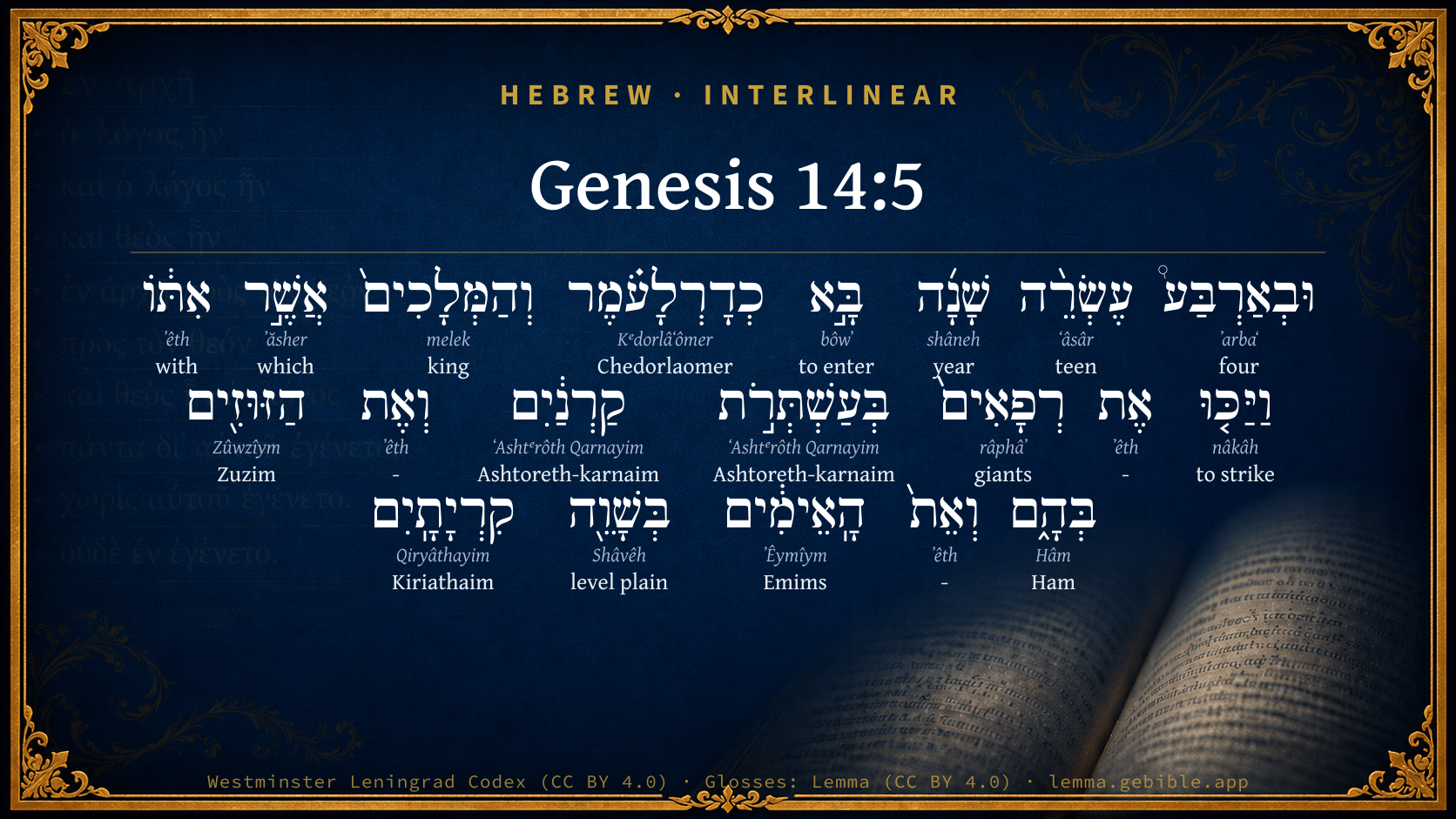
Genesis 14:5

Hebrew (Westminster Leningrad Codex) Genesis 14:5 appears in the Hebrew Old Testament. The text above is from the Westminster Leningrad Codex. Each word links to its Strong’s number, a concise gloss, and parsing drawn from the Open Scriptures Hebrew Bible morphology. Click any word for its full Brown-Driver-Briggs (BDB) entry.
Download image
Cite this verse

Genesis 14:5 (World English Bible). Public Domain. Lemma interlinear Bible study tool, https://lemma.gebible.app/v/genesis/14/5.

Show BibTeX & RIS
BibTeX
RIS
English Translation
In the fourteenth year Chedorlaomer came, and the kings who were with him, and struck the Rephaim in Ashteroth Karnaim, and the Zuzim in Ham, and the Emim in Shaveh-kiriathaim,
World English Bible · Public Domain
Highlights
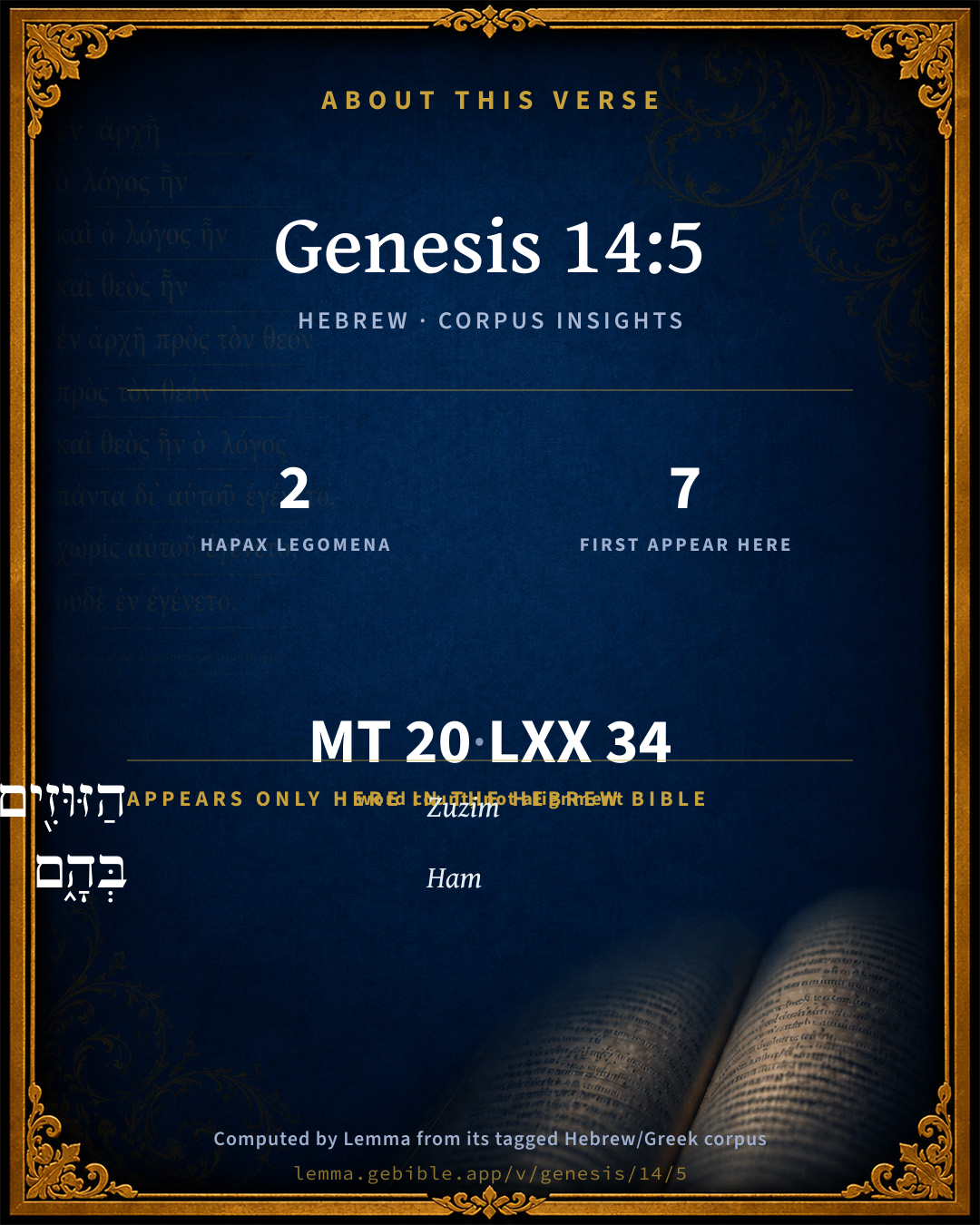
  • 2 hapax legomena — only here in the Hebrew Bible
  • 7 first appearances in the Hebrew Bible
Full analysis ↓
Download a study sheet

One document with this verse’s original text, its word-by-word gloss line, the meaning frame, cross-references with their text, attributed commentary, and full source and license credits — printable, and it pastes into notes with its structure intact.

This verse Autodidact and up

Study sheet (.html) Plain text (.txt)

A passage Seminary Student

Up to 50 verses in one chapter. A passage sheet keeps up to 6 commentary sources and 12 cross-references per verse, in the order this page ranks them, and says so on the sheet whenever that leaves anything out. Ask for a single verse and you get the Autodidact verse sheet above.

Everything on this page stays free to read, with no account — the sheet is a download of what is already on screen, not access to it.

Want to remove ads? Support Godless Engineer
Compare translations 3

The same verse in 3 English versions, stacked beneath the original-language interlinear above. Click any original word for its lexicon entry.

Each is an independent rendering of the whole verse — the interlinear is not word-aligned to these translations.

Highlighted words mark where these versions differ — a whole-verse word diff, not a word-by-word alignment.

  • World English Bible Public Domain
    In the fourteenth year Chedorlaomer came, and the kings who were with him, and struck the Rephaim in Ashteroth Karnaim, and the Zuzim in Ham, and the Emim in Shaveh-kiriathaim,
  • King James Version Public Domain
    And in the fourteenth year came Chedorlaomer, and the kings that were with him, and smote the Rephaim in Ashteroth Karnaim, and the Zuzims in Ham, and the Emins in Shaveh Kiriathaim,
  • unfoldingWord Literal Text CC BY-SA 4.0
    Then in the fourteenth year, Chedorlaomer and the kings who with him went and struck the Raphaites in Ashteroth-Karnaim and the Zuzites in Ham and the Emites in Shaveh-Kiriathaim

unfoldingWord Literal Text — © unfoldingWord, licensed CC BY-SA 4.0. Word-aligned USFM3 via Door43 (git.door43.org/unfoldingWord/en_ult).

Versions to compare (up to 4)

3 of 4 selected

Show all 18 translations

Every available English version of this verse, each an independent rendering of the whole verse.

  • World English Bible Public Domain
    In the fourteenth year Chedorlaomer came, and the kings who were with him, and struck the Rephaim in Ashteroth Karnaim, and the Zuzim in Ham, and the Emim in Shaveh-kiriathaim,
  • Berean Standard Bible Public Domain
    In the fourteenth year, Chedorlaomer and the kings allied with him went out and defeated the Rephaites in Ashteroth-karnaim, the Zuzites in Ham, the Emites in Shaveh-kiriathaim,
  • Majority Standard Bible Public Domain
    In the fourteenth year, Chedorlaomer and the kings allied with him went out and defeated the Rephaites in Ashteroth-karnaim, the Zuzites in Ham, the Emites in Shaveh-kiriathaim,
  • King James Version Public Domain
    And in the fourteenth year came Chedorlaomer, and the kings that were with him, and smote the Rephaim in Ashteroth Karnaim, and the Zuzims in Ham, and the Emins in Shaveh Kiriathaim,
  • American Standard Version (1901) Public Domain
    And in the fourteenth year came Chedorlaomer, and the kings that were with him, and smote the Rephaim in Ashteroth-karnaim, and the Zuzim in Ham, and the Emim in Shaveh-kiriathaim,
  • Revised Version (1885) Public Domain
    And in the fourteenth year came Chedorlaomer, and the kings that were with him, and smote the Rephaim in Ashteroth-karnaim, and the Zuzim in Ham, and the Emim in Shaveh-kiriathaim,
  • Geneva Bible (1599) Public Domain
    And in the fourteenth yeere came Chedor-laomer, and the Kings that were with him, and smote the Rephaims in Ashteroth Karnaim, and the Zuzims in Ham, and the Emims in Shaueh Kiriathaim,
  • Douay-Rheims (1899) Public Domain
    And in the fourteenth year came Chodorlahomor, and the kings that were with him: and they smote the Raphaim in Astarothcarnaim, and the Zuzim with them, and the Emim in Save of Cariathaim.
  • Young's Literal Translation Public Domain
    And in the fourteenth year came Chedorlaomer, and the kings who `are' with him, and they smite the Rephaim in Ashteroth Karnaim, and the Zuzim in Ham, and the Emim in Shaveh Kiriathaim,
  • Literal Standard Version CC BY-SA 4.0
    And in the fourteenth year came Chedorlaomer, and the kings who [are] with him, and they strike the Rephaim in Ashteroth Karnaim, and the Zuzim in Ham, and the Emim in Shaveh Kiriathaim,
  • Unlocked Literal Bible CC BY-SA 4.0
    Then in the fourteenth year, Kedorlaomer and the kings who were with him came and attacked the Rephaim in Ashteroth Karnaim, the Zuzites in Ham, the Emites in Shaveh Kiriathaim,
  • unfoldingWord Literal Text CC BY-SA 4.0
    Then in the fourteenth year, Chedorlaomer and the kings who with him went and struck the Raphaites in Ashteroth-Karnaim and the Zuzites in Ham and the Emites in Shaveh-Kiriathaim
  • Darby Bible Public Domain
    And in the fourteenth year came Chedorlaomer and the kings that were with him, and smote the Rephaim in Ashteroth-karnaim, and the Zuzim in Ham, and the Emim in Shaveh-Kirjathaim,
  • World Messianic Bible Public Domain
    In the fourteenth year Chedorlaomer and the kings who were with him came and struck the Rephaim in Ashteroth Karnaim, the Zuzim in Ham, the Emim in Shaveh Kiriathaim,
  • Webster's Bible Public Domain
    And in the fourteenth year came Chedorlaomer, and the kings that were with him, and smote the Rephaims in Ashteroth Karnaim, and the Zuzims in Ham, and the Emins in Shaveh Kiriathaim,
  • Free Bible Version CC BY-SA 4.0
    In the fourteenth year Chedorlaomer invaded, along with the kings in his alliance. They defeated the Rephaites in Ashteroth-karnaim, the Zuzites in Ham, the Emites in Shaveh-kiriathaim,
  • Bible in Basic English Public Domain
    And in the fourteenth year, Chedorlaomer and the kings who were on his side, overcame the Rephaim in Ashteroth-karnaim, and the Zuzim in Ham, and the Emim in Shaveh-kiriathaim,
  • JPS Tanakh (1917) Public Domain
    And in the fourteenth year came Chedorlaomer and the kings that were with him, and smote the Rephaim in Ashteroth-karnaim, and the Zuzim in Ham, and the Emim in Shaveh-kiriathaim,

Literal Standard Version (2020), Covenant Press — licensed CC BY-SA 4.0. Text via the HelloAO Bible API (eBible.org). Unlocked Literal Bible (unfoldingWord) — licensed CC BY-SA 4.0. Text via the HelloAO Bible API (eBible.org). unfoldingWord Literal Text — © unfoldingWord, licensed CC BY-SA 4.0. Word-aligned USFM3 via Door43 (git.door43.org/unfoldingWord/en_ult). Free Bible Version, Dr. Jonathan Gallagher — licensed CC BY-SA 4.0. Text via the HelloAO Bible API (eBible.org).

Word by word

More ways to search: Search by grammar → Find every occurrence → Compare this word →

Practice this passage: Drill this verse → Learn its vocabulary →

הַזּוּזִ֖ים
Zûwzîym
H2104
“the · Zuzim”
Particle, Definite Article + Noun, Gentilic, Masculine, Singular, Absolute
Part of Speech
Particle + Noun
Type
Gentilic
Gender
Masculine
Number
Singular
State
Absolute
Full BDB Definition

Origin: probably from the same as H2123

TWOT: None

Zuzim = "roving creatures" - an ancient people of uncertain origin, perhaps, inhabitants of ancient Ammon east of the Jordan
  1. וּבְאַרְבַּע֩ ʼarbaʻ H702 “and · in/at · four” Conjunction + Preposition + Adjective, Cardinal number, Feminine, Singular, Absolute
  2. עֶשְׂרֵ֨ה ʻâsâr H6240 “teen” Adjective, Cardinal number, Feminine, Singular, Absolute
  3. שָׁנָ֜ה shâneh H8141 “year” Noun, Common, Feminine, Singular, Absolute
  4. בָּ֣א bôwʼ H935 “to enter” Verb, Qal, Perfect, 3rd Person, Masculine, Singular
  5. כְדָרְלָעֹ֗מֶר Kᵉdorlâʻômer H3540 “Chedorlaomer” Noun, Proper
  6. וְהַמְּלָכִים֙ melek H4428 “and · the · kings” Conjunction + Particle, Definite Article + Noun, Common, Masculine, Plural, Absolute
  7. אֲשֶׁ֣ר ʼăsher H834 “which” Particle, Relative
  8. אִתּ֔וֹ ʼêth H854 “with · him” Preposition + Suffix, Personal, 3rd Person, Masculine, Singular
  9. וַיַּכּ֤וּ nâkâh H5221 “and · to strike” Conjunction + Verb, Hiphil, Sequential Imperfect, 3rd Person, Masculine, Plural
  10. אֶת ʼêth H853 “-” Particle, Direct Object
  11. רְפָאִים֙ râphâʼ H7497 “giants” Noun, Gentilic, Masculine, Singular, Absolute
  12. בְּעַשְׁתְּרֹ֣ת ʻAshtᵉrôth Qarnayim H6255 “in/at · Ashtoreth-karnaim” Preposition + Noun, Proper
  13. קַרְנַ֔יִם ʻAshtᵉrôth Qarnayim H6255 “Ashtoreth-karnaim” Noun, Gentilic, Masculine, Singular, Absolute
  14. וְאֶת ʼêth H853 “and · -” Conjunction + Particle, Direct Object
  15. בְּהָ֑ם Hâm H1990 “in/at · Ham” Preposition + Noun, Proper
  16. וְאֵת֙ ʼêth H853 “and · -” Conjunction + Particle, Direct Object
  17. הָֽאֵימִ֔ים ʼÊymîym H368 “the · Emims” Particle, Definite Article + Noun, Gentilic, Masculine, Singular, Absolute
  18. בְּשָׁוֵ֖ה Shâvêh H7740 “in/at · level plain” Preposition + Noun, Proper
  19. קִרְיָתָֽיִם Qiryâthayim H7156 “Kiriathaim” Noun, Proper

About this verse

These counts appear in no published source. They are computed here, from the morphology-tagged text and Lemma’s own curated glosses. What Lemma adds →

20
words
17
distinct lemmas
Pentateuch
section

Notable vocabulary

2 hapax legomena — words that appear only here in the entire Hebrew Bible:

  • הַזּוּזִ֖ים Zuzim H2104
  • בְּהָ֑ם Ham H1990

First appearance in Scripture

These words make their first canonical appearance in the Hebrew Bible here:

  • רְפָאִים֙ giants H7497
  • בְּעַשְׁתְּרֹ֣ת Ashtoreth-karnaim H6255
  • הַזּוּזִ֖ים Zuzim H2104
  • בְּהָ֑ם Ham H1990
  • הָֽאֵימִ֔ים Emims H368
  • בְּשָׁוֵ֖ה level plain H7740
  • קִרְיָתָֽיִם Kiriathaim H7156

Grammatical profile

  • 2 verbs
  • 11 nouns
  • 2 adjectives
  • 1 preposition
  • 4 particles

Verb forms

  • בָּ֣א Qal · Perfect
  • וַיַּכּ֤וּ Hiphil · Sequential Imperfect

Repetition

A word recurs within this verse — often emphatic in Hebrew:

  • בְּעַשְׁתְּרֹ֣ת Ashtoreth-karnaim H6255 ×2

Hebrew & Septuagint length

In English translation the verse runs 30 words from the Hebrew and 34 from the Septuagint (LXX English) — closely comparable.

A rough comparison of the two English renderings, which tokenize alike — not a word-level alignment.

Word counts can differ between the Hebrew and the Greek without any difference in meaning — e.g. the Hebrew direct-object marker אֵת has no separate Greek word, and Greek often adds the article ὁ.

In the original languages it is 20 Hebrew tokens and 34 Greek tokens — but the two are counted differently (Hebrew bundles its prefixes and suffixes into one token; the Greek is in lemma form), so that isn’t a like-for-like length.

Cross-references

24

Topical passages linked to Genesis 14:5 in the Treasury of Scripture Knowledge — connected by theme and wording, ordered by reader-vote popularity; previews shown in the World English Bible.

  • Genesis 15:20 the Hittites, the Perizzites, the Rephaim,
  • Deuteronomy 1:4 after he had struck Sihon the king of the Amorites, who lived in Heshbon, and Og the king of Bashan, who lived in Ashtaroth, at Edrei.
  • Deuteronomy 2:10–11 (The Emim lived therein before, a people great, and many, and tall, as the Anakim:
  • Deuteronomy 3:11 (For only Og king of Bashan remained of the remnant of the Rephaim; behold, his bedstead was a bedstead of iron; isn't it in Rabbah of the children of Ammon? nine cubits was the length of it, and four cubits the breadth of it, after the cubit of a man.)
  • Deuteronomy 3:22 You shall not fear them; for Yahweh your God, he it is who fights for you.
  • Deuteronomy 2:20–23 (That also is accounted a land of Rephaim: Rephaim lived therein before; but the Ammonites call them Zamzummim,
  • Deuteronomy 3:20 until Yahweh give rest to your brothers, as to you, and they also possess the land which Yahweh your God gives them beyond the Jordan: then shall you return every man to his possession, which I have given you.
  • Joshua 12:4 and the border of Og king of Bashan, of the remnant of the Rephaim, who lived at Ashtaroth and at Edrei,
  • Joshua 13:12 all the kingdom of Og in Bashan, who reigned in Ashtaroth and in Edrei (the same was left of the remnant of the Rephaim); for these did Moses strike, and drove them out.
  • Joshua 13:19 and Kiriathaim, and Sibmah, and Zereth-shahar in the mount of the valley,
  • Joshua 13:31 and half Gilead, and Ashtaroth, and Edrei, the cities of the kingdom of Og in Bashan, were for the children of Machir the son of Manasseh, even for the half of the children of Machir according to their families.
  • 2 Samuel 5:18 Now the Philistines had come and spread themselves in the valley of Rephaim.
  • 2 Samuel 5:22 The Philistines came up yet again, and spread themselves in the valley of Rephaim.
  • 2 Samuel 23:13 Three of the thirty chief men went down, and came to David in the harvest time to the cave of Adullam; and the troop of the Philistines was encamped in the valley of Rephaim.
  • 1 Chronicles 4:40 They found fat pasture and good, and the land was wide, and quiet, and peaceable; for those who lived there before were of Ham.
  • 1 Chronicles 11:15 Three of the thirty chief men went down to the rock to David, into the cave of Adullam; and the host of the Philistines were encamped in the valley of Rephaim.
  • 1 Chronicles 14:9 Now the Philistines had come and made a raid in the valley of Rephaim.
  • Psalms 78:51 And struck all the firstborn in Egypt, The chief of their strength in the tents of Ham.
  • Psalms 105:23 Israel also came into Egypt. Jacob sojourned in the land of Ham.
  • Psalms 105:27 They performed miracles among them, And wonders in the land of Ham.
  • Psalms 106:22 Wondrous works in the land of Ham, And awesome things by the Red Sea.
  • Isaiah 17:5 It shall be as when the harvester gathers the standing grain, and his arm reaps the ears; yes, it shall be as when one gleans ears in the valley of Rephaim.
  • Jeremiah 48:1 Of Moab. Thus says Yahweh of Hosts, the God of Israel: Woe to Nebo! for it is laid waste; Kiriathaim is disappointed, it is taken; Misgab is put to shame and broken down.
  • Jeremiah 48:23 and on Kiriathaim, and on Beth Gamul, and on Beth Meon,

Cross-references courtesy of OpenBible.info (CC BY 4.0).

Hebrew and Greek witnesses Masoretic Hebrew ↔ Greek Septuagint

The same verse in the two great witnesses to the Old Testament, shown verse-for-verse.

These are two independent witnesses, not word-aligned to each other, and the Septuagint is shown in lemma (dictionary) form.

Hebrew Genesis 14:5 Masoretic · Westminster Leningrad Codex

וּבְאַרְבַּע֩ עֶשְׂרֵ֨ה שָׁנָ֜ה בָּ֣א כְדָרְלָעֹ֗מֶר וְהַמְּלָכִים֙ אֲשֶׁ֣ר אִתּ֔וֹ וַיַּכּ֤וּ אֶת רְפָאִים֙ בְּעַשְׁתְּרֹ֣ת קַרְנַ֔יִם וְאֶת הַזּוּזִ֖ים בְּהָ֑ם וְאֵת֙ הָֽאֵימִ֔ים בְּשָׁוֵ֖ה קִרְיָתָֽיִם

In the fourteenth year Chedorlaomer came, and the kings who were with him, and struck the Rephaim in Ashteroth Karnaim, and the Zuzim in Ham, and the Emim in Shaveh-kiriathaim,

World English Bible · Public Domain

Greek LXX Genesis 14:5 Septuagint · lemma form

ἐν δέ ὁ οςτεσσαρεσκαιδεκάτ ἔτος ἔρχομαι χοδολλογομορ καί ὁ βασιλεύς ὁ μετά αὐτός καί κατακόπτω ὁ γίγας ὁ ἐν ασταρωθ καρναιν καί ἔθνος ἰσχυρός ἅμα αὐτός καί ὁ ομμαῖος ὁ ἐν σαυη ὁ πόλις

And in the fourteenth year came Chodollogomor, and the kings with him, and cut to pieces the giants in Astaroth, and Carnain, and strong nations with them, and the Ommaeans in the city Save.

LXX2012 (modern English Septuagint) · Public Domain

On this verse, John Gill's Exposition discusses the Septuagint’s reading. Read the note in Commentary ↓

Hebrew: Westminster Leningrad Codex (CC BY 4.0). Greek: Septuagint (public domain); English from LXX2012 (modern English Septuagint) (Public Domain). How the Septuagint differs from the Hebrew →

Targum (Aramaic paraphrase)

2

The Targum is the ancient Jewish Aramaic paraphrase of the Hebrew Scriptures — an interpretive translation, not the Hebrew text itself. Onkelos (literal) and Pseudo-Jonathan (expansive) render the Torah, and Jonathan the Prophets. Coverage is partial: where no permissively-licensed English translation exists for a verse, only the Aramaic is shown. This is verse-level text, not a word-by-word alignment to the Hebrew.

  1. Targum Onkelos Torah (Genesis–Deuteronomy)
    וּבְאַרְבַּע עֶשְׂרֵי שְׁנִין אֲתָא כְּדָרְלָעֹמֶר וּמַלְכַיָא דְעִמֵהּ וּמְחוֹ יָת גִבָּרַיָא דִי בְעַשְׁתְּרוֹת קַרְנַיִם וְיָת תַּקִיפַיָא דִבְהֶמְתָּא וְיָת אֵמְתָנֵי דִבְשָׁוֵה קִרְיָתָיִם

    And in the fourteenth year came Kedar‑laomer, and the kings who were with him, and smote the giants who were in Ashtaroth Karnaim, and the mighty who were in Chemta, and the terrible ones who were in Shaveh Kiryathaim,

    Targum Onkelos — Aramaic: “Onkelos Genesis” (public domain); “Onkelos Exodus” (public domain); “Onkelos Leviticus” (public domain); “Onkelos Numbers” (public domain); “Onkelos Deuteronomy” (public domain). English: “Sefaria Community Translation” (CC0 1.0 (public-domain dedication)); “J.W. Etheridge. The Targums of Onkelos and Jonathan Ben Uzziel on the Pentateuch. London: Longmans, Green, 1862” (public domain). Text via Sefaria.

  2. Targum Pseudo-Jonathan Torah (Genesis–Deuteronomy)
    וּבִירְבֵּיסְרֵי שְׁנִין אָתָא כְדָרְלָעוֹמֶר וּמַלְכַיָא דְעִימֵיהּ וּמְחוֹ יַת גִבָּרַיָא דִבְעַשְׁתְּרוֹת קַרְנָיִם וְיַת תַּקִיפַיָא דִבְהֶמְתָּא וְיַת אֵימְתָנֵי דִבְשָׁוֵהּ קִרְיָתָיִם

    And in the fourteenth year came Kedarlaomer and the kings who were with him, and smote the Giants (gibboraia) which were in Ashtaroth-Karniam, and the Strong who were in Hametha, and the Terrible who were in the plain of Kiriathaim,

    Targum Pseudo-Jonathan — Aramaic: “Targum Jonathan on Genesis” (public domain); “Targum Jonathan on Exodus” (public domain); “Targum Jonathan on Leviticus” (public domain); “Targum Jonathan on Numbers” (public domain); “Targum Jonathan on Deuteronomy” (public domain). English: “The Targum of Jonathan ben Uzziel, trans. J. W. Etheridge, London, 1862” (public domain). Text via Sefaria.

Commentary

Notes on Genesis 14:5 from classic Christian and Jewish commentators (each source and its license shown beneath its notes). The classic Christian expositions comment on the surrounding passage and are grouped to its opening verse, so a note may address several verses; the Jewish commentaries on the Tanakh (Rashi and others) are per-verse, so they appear only where the commentator wrote on this verse.

Lemma curates 59 commentaries, every one of them public domain or Creative Commons licensed, each selected and text-cleaned for this edition rather than reprinted as found. About our sources →

The Cambridge Bible for Schools and Colleges

gen. ed. J. J. S. Perowne

5. came Chedorlaomer] The king of Elam was strong enough to deal vigorously with the rebellion in his western dependencies. This and the two following verses describe the punitive expedition, with which Chedorlaomer and his vassal kings crushed the rebellion. Whether the kings led their forces in person, we are not able to say for certain. The description leaves it to be inferred. The Oriental style of chronicle identified successful generals with the name of the king who sent them on their campaign.

The march of the punitive expedition must have been across the Euphrates at Carchemish, and then southward past Damascus. It overthrew the Rephaim, Zuzim, Emim, and Horites who, apparently, were peoples on the east side of Jordan, involved in the rebellion. The southernmost point of the march was reached at the head of the Gulf of Akabah. As it commanded an important trade route, it may have formed the chief objective of the march. Returning from that point, the expedition struck at the Amalekites in the wilderness to the south of Palestine, and then attacked the joint forces of the five cities of the Plain and overthrew them in the valley of Siddim.

the Rephaim] or “sons of the Rapha.” The name given to the aborigines of Canaan, giant survivors of whom are mentioned in 2Sa_21:16-22. The name is specially applied, in Deu_3:11, to Og, the king of Bashan, whose territory corresponded with the country spoken of in this verse.

Ashteroth-karnaim] Generally identified with Tell-‘Ashtara, in the plateau of Bashan, about 20 miles east of the sea of Galilee. Karnaim means “the two horns”; and the full name will therefore probably mean “the two-horned Astarte,” who, as the Goddess of the Moon, was represented with two horns. “Astarte of horns was that immemorial fortress and sanctuary which lay out upon the great plateau of Bashan towards Damascus; so obvious and cardinal a site that it appears in the sacred history both in the earliest recorded campaign in Abraham’s time and in one of the latest under the Maccabees. Gen_14:5; 1Ma_5:26; 1Ma_5:43” (G. Adam Smith, The Twelve Prophets, vol. i. p. 176.)

the Zuzim] Possibly the same as “the Zamzummim,” mentioned in Deu_2:20 as the aborigines who were dispossessed by the Ammonites.

in Ham] Ham has been conjecturally identified with the old name of the Ammonite capital, mentioned in 2Sa_12:26, Rabbath Ammon.

the Emim] Mentioned in Deu_2:10 as the name of the aborigines, “a people great and many and tall, as the Anakim,” dispossessed by the Moabites. The name means probably “the terrible ones.”

in Shaveh-kiriathaim] or the plain of Kiriathaim. In Num_32:37 and Jos_13:19 Kiriathaim is a town in Reuben: in Jer_48:23 in Moab. It is generally identified with Kureyat, about 10 miles east of the Dead Sea and north of the river Arnon.

The Cambridge Bible for Schools and Colleges (gen. ed. J. J. S. Perowne; Cambridge University Press, 1878–1918) — public domain. Text from a community e-Sword module.

Trapp's Complete Commentary

John Trapp

Gen 14:5 And in the fourteenth year came Chedorlaomer, and the kings that [were] with him, and smote the Rephaims in Ashteroth Karnaim, and the Zuzims in Ham, and the Emims in Shaveh Kiriathaim,

Ver. 5. Chedorlaomer.] King of Persia; he was commander in chief; and upon his sword might have been written, as was upon Agamemnon’s, ουτος μεν φοβος εστιν ανθρωπων, this is the common terror. {a}

{a} Pausan.

John Trapp, A Commentary or Exposition upon All the Books of the Old and New Testament (1647–1656) — public domain. Text from a community e-Sword module.

Joseph Benson's Commentary

Gen 14:5. In the fourteenth year — After some pause and preparation, Chedorlaomer, in conjunction with his allies, set himself to reduce the revolters. The four kings laid the neighbouring countries waste, and enriched themselves with the spoil of them, Gen 14:5-7. Upon the alarm of which, the king of Sodom and his allies went out and were routed.

Joseph Benson's Commentary on the Old and New Testaments (1811–1818) — public domain. Text from a community e-Sword module.

Tyndale Open Study Notes

Tyndale Open Resources

14:5-8 The invaders came down the King’s Highway on the east side of the Jordan Valley to the Gulf of Aqaba, then circled back to the valley of the Dead Sea.

Tyndale Open Study Notes — © Tyndale Open Resources, licensed CC BY-SA 4.0. Text via the HelloAO Bible API.

Geneva Bible (1599)

Geneva Bible translators

Or, plain.

Or, giants.

Geneva Bible (1599) marginal notes — public domain. Text via Bolls.life.

Adam Clarke's Commentary

Verse 5. Rephaims] A people of Canaan: Ge 15:20.

Ashteroth] A city of Basan, where Og afterwards reigned; Jos 13:31.

Zuzims] Nowhere else spoken of, unless they were the same with the Zamzummims, De 2:20, as some imagine.

Emims] A people great and many in the days of Moses, and tall as the Anakim. They dwelt among the Moabites, by whom they were reputed giants; De 2:10-11.

Shaveh Kiriathaim] Rather, as the margin, the plain of Kiriathaim, which was a city afterwards belonging to Sihon king of Heshbon; Jos 13:19.

Adam Clarke's Commentary on the Bible (1810–1826) — public domain. Text from a community e-Sword/MySword module.

Ellicott's Commentary for English Readers

(5) The Rephaims.—Described as an Amorite tribe (Amo_2:9) of great stature, settled in Bashan, where Moses conquered them (Jos_13:12). We find them also on the other side of Jordan, in Mount Ephraim ( Jos_17:15), on the western side of Jerusalem (Jos_15:8; Jos_18:16; 2Sa_5:18; 2Sa_5:22), and even among the Philistines (2Sa_21:16; 2Sa_21:18). In many of these places the word is wrongly translated giants. From this wide dispersion of them we may safely conclude that they belonged to the earlier settlers in the land and that only their rulers, like Og (Jos_9:10), were Amorites.

Ashteroth Karnaim.—The two-horned Astarte, the Phœnician Venus, identified by the Rephaim with the moon. Her worship had, no doubt, been introduced by the Amorites. This city was the capital of Og (Deu_1:4), and is called Be-Eshtera, “the house of Astarte,” in Jos_21:27. Its remains have been found at Tell-Ashtereh, in the Hauran, about two leagues from the ancient Edrei.

The Zuzim.—Called in Deu_2:20 Zamzummim, where they are identified with the Rephaim, of which stock they were an inferior branch. Their capital, Ham, has been identified with Hameitât, about six miles to the east of the lower part of the Dead Sea (Tristram, Land of Moab, p. 117).

The Emims.—Of these also we read in Deu_2:10-11 : “The Emim . . . also were accounted Rephaim, as the Anakim.”

In Shaveh Kiriathaim.—More probably, in the plain of Kiriathaim. This city, given to the tribe of Reuben (Num_32:37), was, upon the decay of the Israelites upon the east of Jordan, re-occupied by the Moabites (Jer_48:1), who had taken it from the Emim.

A Bible Commentary for English Readers, edited by Charles John Ellicott (1878–1897) — public domain. Text from a community e-Sword module.

John Gill's Exposition

And in the fourteenth year came Chedorlaomer,.... Not in the fourteenth year of their rebellion against him, as Jarchi, but from their becoming vassals to him:

and the kings that were with him; those kings before mentioned:

and smote the Rephaims in Ashteroth Karnaim; which were in their way to Sodom, &c. and very probably were confederates with the five kings; the Targum, and so the Septuagint, render the word "giants", as it is in Deu 2:11; but they were one of the nations or tribes of the Canaanites, Gen 15:20; and had their name either from the Hebrew word which signifies to be healthful and robust, as those people might be, or from Rephas, the Remphan of Stephen, Act 7:43; called Chiun, Amo 5:26; and with Cronus or Ham the father of Canaan, as Bishop Cumberland (c) observes; and these dwelt in Ashteroth Karnaim, which was a place in Bashan, Deu 1:4; it is about six miles, as Eusebius (d) says, from Adraa or Edrei, and in the Apocrypha:"Then Maccabeus marched forth to Carnion, and to the temple of Atargatis, and there he slew five and twenty thousand persons.'' (2 Maccabees 12:26)mention is made of a place called Carnion, where was a temple of Atergates, a Phoenician deity, as Ashteroth or Astarte, was; and this city here had its first name from Astarte the wife of Cronus or Ham, and whose name may be preserved in Carnaim, as Bishop Cumberland thinks; though as Astarte is said by Sanchoniatho (e) to put on her head the mark of her sovereignty, a bull's head, that is, with its horns, this might be another of her names retained in this city; and it is certain that she was a Phoenician goddess, called the goddess of the Zidonians, Kg1 11:5; and Sanchoniatho relates (f), that the Phoenicians say, that Astarte is she, who among the Greeks is called Aphrodite or Venus; and Astarte is called by Lucian (g) the Phoenician Venus, and by Cicero (h) the Syrian Venus; and if she was the same with Diana or the moon, as some think, she might have the name of Carnaim from its two horns, as the word signifies: our English poet (i) seems to have this in his thoughts, when he speaks of Astoreth as the goddess of the Phoenicians: however the in habitants of this place who belonged to the Canaanites were first attacked by the four kings and routed, though not utterly destroyed, because we hear of them afterwards, as well as they that follow:

and the Zuzims in Ham; or Hemtha, as Onkelos and Jonathan render it, a place so called from Ham the father of Canaan, and was somewhere in the land of Canaan or near it, and near the former place; for it can hardly be thought the land of Egypt, sometimes called the land of Ham, is meant; these Zuzim are supposed by Jarchi to the same with the Zamzummim in Deu 2:20; the word is by Onkelos and Jonathan rendered strong and mighty ones, as also by the Septuagint, mighty nations:

and the Enims in Shaveh Kiriathaim: a people great, and many, and tall, as the Anakim, and were accounted giants as they, and who in later times were by the Moabites called Emim, Deu 2:10; and therefore Moses gives them the same name here, which they had from the dread and terror they injected into men, and so the word in all the three Targums is rendered terrible ones; and these dwelt in Kiriathaim, a city in the tribe of Reuben, taken from Sihon, king of the Amorites, and which seems to be situated in a plain, see Jos 13:19.

(c) Sanchoniatho's Phoenician History, p. 220, 221. (d) Apud Reland. Palest. illustrata, tom. 2. p. 5. 98. (e) Sanchoniatho's Phoenician History, p. 35. (f) Ibid. p. 36. (g) De Dea Syria. (h) De Natura Deorum, l. 3. (i) ------------with these in troop Came Astoreth, whom the Phoenicians call'd Astarte queen of heav'n, with crescent horns. --Milton's Paradise Lost, B. 1. l. 437, 438, 439.

John Gill's Exposition of the Whole Bible (1746–1763) — public domain (CC PDM 1.0). Text via the HelloAO Bible API.

Haydock's Catholic Bible Commentary

Raphaim, Zuzim, and Emim, were all of the gigantic race, robbers, like the Arabs. (Du Hamel) --- These dwelt in the land of Basan, or of giants, Deuteronomy iii. 13.

George Leo Haydock (1774–1849), Haydock's Catholic Family Bible and Commentary, 1859 edition — public domain. Excludes Psalms (Douay-Rheims chapter numbering differs from Protestant) and Deuterocanonical books (Catholic canon only).

Matthew Poole's English Annotations

The kings that were with him, i.e. confederate with him for the recovery of his right, expecting the same assistance from him upon the like occasion.

The Rephaims, a fierce and warlike people of Canaan. See Gen 15:20. Or the giants, as this word is taken Deu 2:11.

Ashteroth Karnaim, a place in Basan called Ashteroth, Deu 1:4; Jos 9:10; 13:31. It is surnamed Carnaim, q.d.

Two-horned, like a half moon, either from the situation and form of the place, or from the goddess Diana, or the moon, which usually was painted with two horns, whom they worshipped.

The Emims, a people in Canaan of giant-like stature, Deu 2:10-11.

Shaveh Kiriathaim; Kiriathaim is a noted city in Gilead, and Shaveh may be either the ancient name of that city, or the present name of the country adjoining and belonging to it.

Matthew Poole's English Annotations on the Holy Bible (1683–1685) — public domain. Text from a community e-Sword/MySword module.

Whedon's Commentary on the Bible

Daniel D. Whedon

5. Smote the Rephaim in Ashteroth Karnaim — The word Rephaim is in the Hebrew plural, and designates an ancient people of gigantic stature, of whom Og, king of Bashan, is spoken of as the last remnant.

Deu_3:11. Of their origin the Bible is silent. Their chief seat was at Ashteroth Karnaim, or Ashteroth of the two horns, so called, probably, from the worship of the two-horned Astarte, the Syrian Venus and moon-goddess. See note and cuts on Jdg_2:13. Some identify this place with the Ashtaroth near Edrei, where Og dwelt, (Deu_1:4,) which is generally identified with the modern Tel-Ashtereh, some 25 miles east of the Sea of Galilee. Others locate it at the modern Es-Sanamein, about half way between Tell-Ashtereh and Damascus. After this defeat these Rephaim seem to have settled in other parts of Canaan, and the “valley of Rephaim” south-west of Jerusalem probably derived its name from them. We find traces of them in the time of David. 2Sa_21:18; 2Sa_21:20; 2Sa_21:22. The Zuzim were probably the same as the Zamzummim of Deu_2:20, a people akin to the Rephaim, and described as “great, and many, and tall.” Ham, where they dwelt, is probably represented in the modern Amman, east of the Jordan, better known as Rabbath-Ammon, the capital city of the Ammonites. The Emim are represented in Deu_2:10-11, as the ancient occupants of the land of Moab, and also “a people great, and many, and tall, as the Anakim.” Shaveh Kiriathaim, or the “plain of the two cities,” is probably the same as Kirjathaim, allotted to the Reubenites. Num_32:37; Jos_13:19. The name still lingers in the extensive ruins of Kureiyat, east of the Dead Sea, and about three miles southeast of Mt. Attarus.

Daniel D. Whedon (gen. ed.), Commentary on the Old and New Testaments (1874–1909) — public domain. Text from a community e-Sword module.

The Pulpit Commentary

And in (or during) the fourteenth year came Chedorlaomer, and the kings that were with him, and smote (because of actual or probable rebellion) the Rephaims. Gigantav (LXX.), a tribe of gigantic stature (from an Arabic root, to be high), the iron bed of whose last king, Og, measured nine yards in length and four in breadth; (Deu_3:11) forming a portion of the aboriginal inhabitants of Palestine prior to the invasion of the Canaanites, though existing as a remnant as late as the conquest. (Gen_2:20 Gen_3:11, Gen_3:13) In Ashteroth Karnaim. Literally, Ashteroth of the Two Horns; so called either from its situation between two horn-shaped hills (Jewish interpreters), or because of the horned cattle with which it abounded (Hillery), or in honor of the goddess Ashtaroth, Astarte, or Venus, whose image was such as to suggest the idea of a horned figure (A Lapide, Gesenius, Kalisch); identified by some with the capital of Og (Keil), but by others distinguished from it (Wetstein); of uncertain site, though claimed to sin-rive in the ruins of Tell Ashtereh, near the ancient Edrei (Ritter); in those of Afineh, eight miles from Buzrah (Porter); in the modern village Mesarib (Burckhardt); or in El Kurnem or Ophein in Ledsha (Robinson). And the Zuzims. Probably the Zamzummims between the Arnon and the Jabbok. (Deu_2:20) In Ham. "Possibly the ancient name of Rabba of the Ammonites, (Deu_3:11) the remains being still preserved in the ruins of Amman" (Keil). And the Emims. Fearful and terrible men, the primitive inhabitants of Moab; (Deu_2:10, Deu_2:11) called also Rephaims, as being of colossal stature. In Shaveh Kiriathaim. Literally, the plain of Kiriatkaim, or the plain of the two cities, situated in the district afterwards assigned to Reuben; (Num_32:37) identified with Coraiatha, the modern Koerriath or Kereyat, ten miles west of Medebah (Eusebias, Jerome, Kalisch), which, however, rather corresponds with Kerioth, in Jer_48:24 (Keil).

The Pulpit Commentary (1880–1919), ed. H.D.M. Spence-Jones & Joseph S. Exell — public domain. Text from a community e-Sword module.

John Wesley's Explanatory Notes

In the fourteenth year - After some pause and preparation, Chedorlaomer, in conjunction with his allies, set himself to reduce the revolters. See note at "ver. 1" (For [1.], [2.]) [3.] The progress of the war. The four kings laid the neighbouring countries waste, and enriched themselves with the spoil of them, ver. 5, 6, 7. Upon the alarm of which, the king of Sodom and his allies went out and were routed.

John Wesley, Explanatory Notes Upon the Whole Bible (1754–1765) — public domain. Text via the GEBible commentary corpus.

Rashi

Rabbi Shlomo Yitzchaki (Rashi)

ובארבע עשרה שנה AND IN THE FOURTEENTH YEAR of their rebellion

בא כדרלעמר CHEDORLAOMER CAME — Because the matter concerned him mostly, “he bore the heavier side of the beam" (Genesis Rabbah 42:6).

והמלכים AND THE KINGS [THAT WERE WITH HIM] — These are the other three kings.

הזוזים These are the Zamzumim (see Deuteronomy 2:10 and Deuteronomy 2:20).

Rashi on the Tanakh — English translations: “The Judaica Press complete Tanach with Rashi, translated by A. J. Rosenberg” (CC BY 4.0); “Pentateuch with Rashi's commentary by M. Rosenbaum and A.M. Silbermann, 1929-1934” (public domain); “The Metsudah Tanach series, Lakewood, N.J” (CC BY 4.0); and “The Book of Joshua, Metsudah Publications, 1997” (CC BY 4.0). Text via Sefaria.

Radak

Rabbi David Kimhi (Radak)

ובארבעה עשר.. את רפאים בעשתרות קרנים, they defeated the giants who lived at that place. The place עשתרות קרנים was so named seeing it was situated between two mountains, so that the word קרנים, “horns,” describes the way in which these mountains protruded from the earth’s surface. Our sages in Sukkah 2 already mentioned that all the places mentioned in these verses are not far from Sodom and Gomorrah. Perhaps the inhabitants had supported the insubordination of Sodom and satellites and that is why they were attacked.

Radak on the Tanakh — English translations: “Sefaria Community Translation” (CC0 1.0 (public-domain dedication)); “Eliyahu Munk, HaChut Hameshulash” (CC BY 4.0); “Rabbi Mike Feuer, Jerusalem Anthology” (CC BY 4.0); and “R. David Kimhi on the first book of Psalms, Translated by R.G. Finch, London, 1919” (public domain). Text via Sefaria.

Lesson kit

Teaching starters — assembled from the data on this page, not authored interpretation. Every prompt links to the verse data it draws on. Edit before teaching.

Genesis, in the Pentateuch, opens this verse with 20 words (17 distinct Hebrew lemmas). Its most distinctive word is Zûwzîym (“Zuzim”). A historical commentator’s framing appears above. Read the whole chapter for the surrounding context.

Discussion questions

  1. The word Zûwzîym carries the sense “Zuzim.” How does it shape the verse?
  2. This verse holds 2 words here found nowhere else in the Hebrew Bible. What might the rare words draw attention to?
  3. 7 words here appear for the first time in Scripture. What is being introduced at this debut?
  4. Genesis 15:20 shares this passage’s theme. How do the two illuminate each other?
  5. “Ashtoreth-karnaim” occurs 2× in this one verse. What is the effect of the repetition?
  6. The translations on this page render this verse differently — a whole-verse word diff, not a word-by-word alignment. What might account for the different wordings?
  7. The verb «בָּ֣א» is Qal Perfect. How does its form color the action?
  8. Reading how The Cambridge Bible for Schools and Colleges and Trapp's Complete Commentary read this verse, where do the two commentators agree and where do they part?

Things to notice

  • 2 words in this verse appear nowhere else in the Hebrew Bible.
  • 7 words make their first canonical appearance in Scripture here.
  • This verse counts 20 Hebrew ↔ 34 Greek words.
  • These translations choose different wording for 19 words in this verse.
  • “Ashtoreth-karnaim” occurs 2× in this single verse.

Reading settings

Reading text

Shown beneath each verse's original-language words.

Old Testament
Old Testament edition

Read the OT as the Masoretic Hebrew (MT) or the Greek Septuagint (LXX).

English shown for the Greek Septuagint (in the Hebrew ↔ Greek comparison).

Comparing translations? Open the Compare panel on any verse page to stack up to four side by side.