
Genesis 30:38

Hebrew (Westminster Leningrad Codex) Genesis 30:38 appears in the Hebrew Old Testament. The text above is from the Westminster Leningrad Codex. Each word links to its Strong’s number, a concise gloss, and parsing drawn from the Open Scriptures Hebrew Bible morphology. Click any word for its full Brown-Driver-Briggs (BDB) entry.
Download image
Cite this verse

Genesis 30:38 (World English Bible). Public Domain. Lemma interlinear Bible study tool, https://lemma.gebible.app/v/genesis/30/38.

Show BibTeX & RIS
BibTeX
RIS
English Translation
He set the rods which he had peeled opposite the flocks in the gutters in the watering-troughs where the flocks came to drink. They conceived when they came to drink.
World English Bible · Public Domain
Highlights
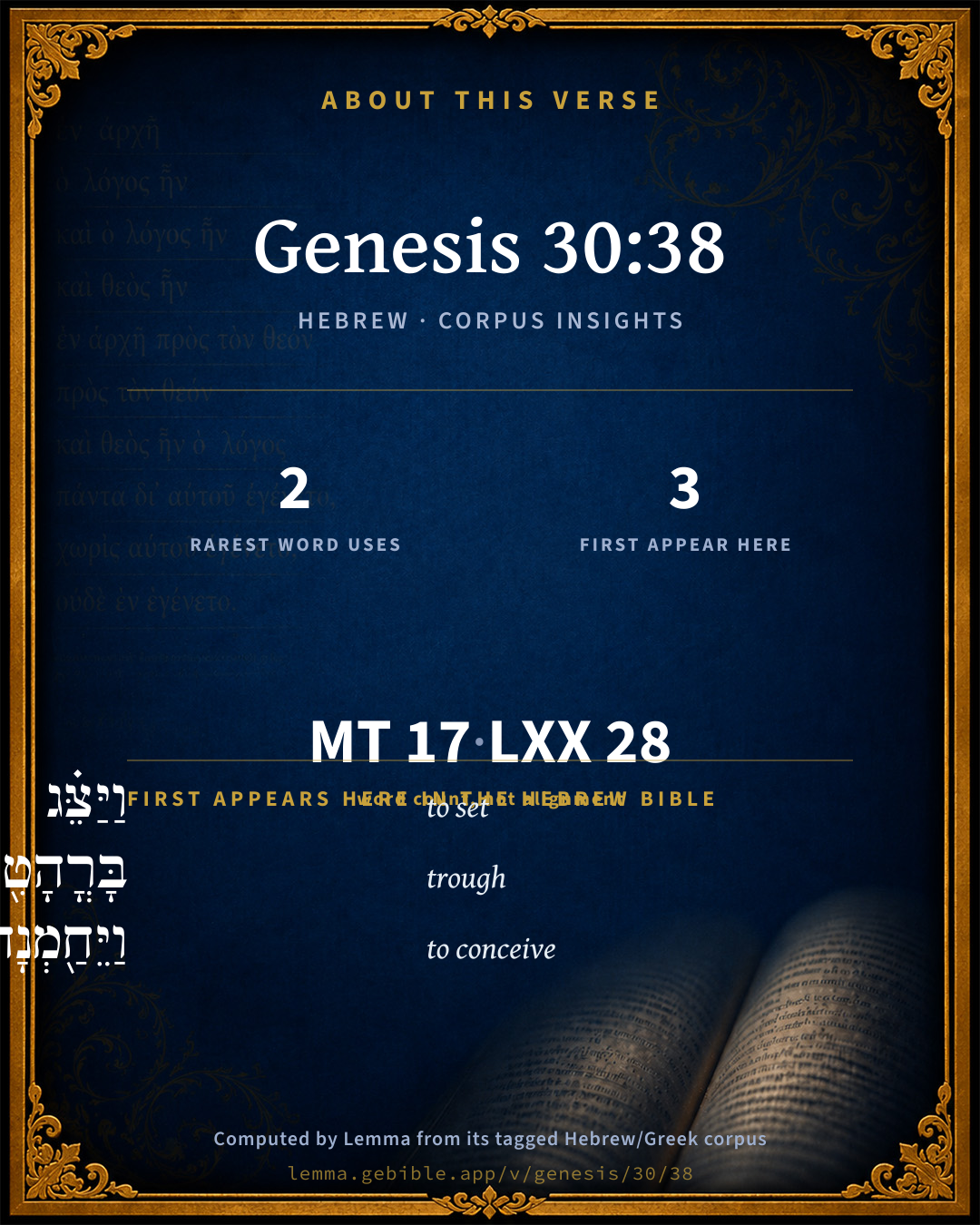
  • 3 first appearances in the Hebrew Bible
Full analysis ↓
Download a study sheet

One document with this verse’s original text, its word-by-word gloss line, the meaning frame, cross-references with their text, attributed commentary, and full source and license credits — printable, and it pastes into notes with its structure intact.

This verse Autodidact and up

Study sheet (.html) Plain text (.txt)

A passage Seminary Student

Up to 50 verses in one chapter. A passage sheet keeps up to 6 commentary sources and 12 cross-references per verse, in the order this page ranks them, and says so on the sheet whenever that leaves anything out. Ask for a single verse and you get the Autodidact verse sheet above.

Everything on this page stays free to read, with no account — the sheet is a download of what is already on screen, not access to it.

Want to remove ads? Support Godless Engineer
Compare translations 3

The same verse in 3 English versions, stacked beneath the original-language interlinear above. Click any original word for its lexicon entry.

Each is an independent rendering of the whole verse — the interlinear is not word-aligned to these translations.

Highlighted words mark where these versions differ — a whole-verse word diff, not a word-by-word alignment.

  • World English Bible Public Domain
    He set the rods which he had peeled opposite the flocks in the gutters in the watering-troughs where the flocks came to drink. They conceived when they came to drink.
  • King James Version Public Domain
    And he set the rods which he had pilled before the flocks in the gutters in the watering troughs when the flocks came to drink, that they should conceive when they came to drink.
  • unfoldingWord Literal Text CC BY-SA 4.0
    Then he put the branches that he had peeled in the troughs, in the water troughs where the flock came to drink, in front of the flock. And they were in heat when they came to drink,

unfoldingWord Literal Text — © unfoldingWord, licensed CC BY-SA 4.0. Word-aligned USFM3 via Door43 (git.door43.org/unfoldingWord/en_ult).

Versions to compare (up to 4)

3 of 4 selected

Show all 18 translations

Every available English version of this verse, each an independent rendering of the whole verse.

  • World English Bible Public Domain
    He set the rods which he had peeled opposite the flocks in the gutters in the watering-troughs where the flocks came to drink. They conceived when they came to drink.
  • Berean Standard Bible Public Domain
    Then he set the peeled branches in the watering troughs in front of the flocks coming in to drink. So when the flocks were in heat and came to drink,
  • Majority Standard Bible Public Domain
    Then he set the peeled branches in the watering troughs in front of the flocks coming in to drink. So when the flocks were in heat and came to drink,
  • King James Version Public Domain
    And he set the rods which he had pilled before the flocks in the gutters in the watering troughs when the flocks came to drink, that they should conceive when they came to drink.
  • American Standard Version (1901) Public Domain
    And he set the rods which he had peeled over against the flocks in the gutters in the watering-troughs where the flocks came to drink; and they conceived when they came to drink.
  • Revised Version (1885) Public Domain
    And he set the rods which he had peeled over against the flocks in the gutters in the watering troughs where the flocks came to drink; and they conceived when they came to drink.
  • Geneva Bible (1599) Public Domain
    Then he put the rods, which he had pilled, in the gutters and watering troughes, when the sheepe came to drink, before the sheepe. (for they were in heate, when they came to drinke)
  • Douay-Rheims (1899) Public Domain
    And he put them in the troughs, where the water was poured out: that when the flocks should come to drink, they might have the rods before their eyes, and in the sight of them might conceive.
  • Young's Literal Translation Public Domain
    and setteth up the rods which he hath peeled in the gutters in the watering troughs (when the flock cometh in to drink), over-against the flock, that they may conceive in their coming in to drink;
  • Literal Standard Version CC BY-SA 4.0
    and sets up the rods which he has peeled in the gutters in the watering troughs (where the flock comes to drink), in front of the flock, that they may conceive in their coming to drink;
  • Unlocked Literal Bible CC BY-SA 4.0
    Then he set the sticks that he had peeled in front of the flocks, in front of the watering troughs where they came to drink. They conceived when they came to drink.
  • unfoldingWord Literal Text CC BY-SA 4.0
    Then he put the branches that he had peeled in the troughs, in the water troughs where the flock came to drink, in front of the flock. And they were in heat when they came to drink,
  • Darby Bible Public Domain
    And he set the rods which he had peeled before the flock, in the troughs at the watering-places where the flock came to drink, and they were ardent when they came to drink.
  • World Messianic Bible Public Domain
    He set the rods which he had peeled opposite the flocks in the watering troughs where the flocks came to drink. They conceived when they came to drink.
  • Webster's Bible Public Domain
    And he set the rods, which he had peeled, before the flocks in the gutters in the watering-troughs, when the flocks came to drink, that they should conceive when they came to drink.
  • Free Bible Version CC BY-SA 4.0
    He put the sticks he'd peeled in the water troughs where the flocks came to drink because that's where they mated.
  • Bible in Basic English Public Domain
    And he put the banded sticks in the drinking-places where the flock came to get water; and they became with young when they came to the water.
  • JPS Tanakh (1917) Public Domain
    And he set the rods which he had peeled over against the flocks in the gutters in the watering-troughs where the flocks came to drink; and they conceived when they came to drink.

Literal Standard Version (2020), Covenant Press — licensed CC BY-SA 4.0. Text via the HelloAO Bible API (eBible.org). Unlocked Literal Bible (unfoldingWord) — licensed CC BY-SA 4.0. Text via the HelloAO Bible API (eBible.org). unfoldingWord Literal Text — © unfoldingWord, licensed CC BY-SA 4.0. Word-aligned USFM3 via Door43 (git.door43.org/unfoldingWord/en_ult). Free Bible Version, Dr. Jonathan Gallagher — licensed CC BY-SA 4.0. Text via the HelloAO Bible API (eBible.org).

Word by word

More ways to search: Search by grammar → Find every occurrence → Compare this word →

Practice this passage: Drill this verse → Learn its vocabulary →

פִּצֵּ֔ל
pâtsal
H6478
“to peel”
Verb, Piel, Perfect, 3rd Person, Masculine, Singular
Part of Speech
Verb
Stem
Piel
Form
Perfect
Person
3rd Person
Gender
Masculine
Number
Singular
Full BDB Definition

Origin: a primitive root

TWOT: 1797

(Piel) to peel
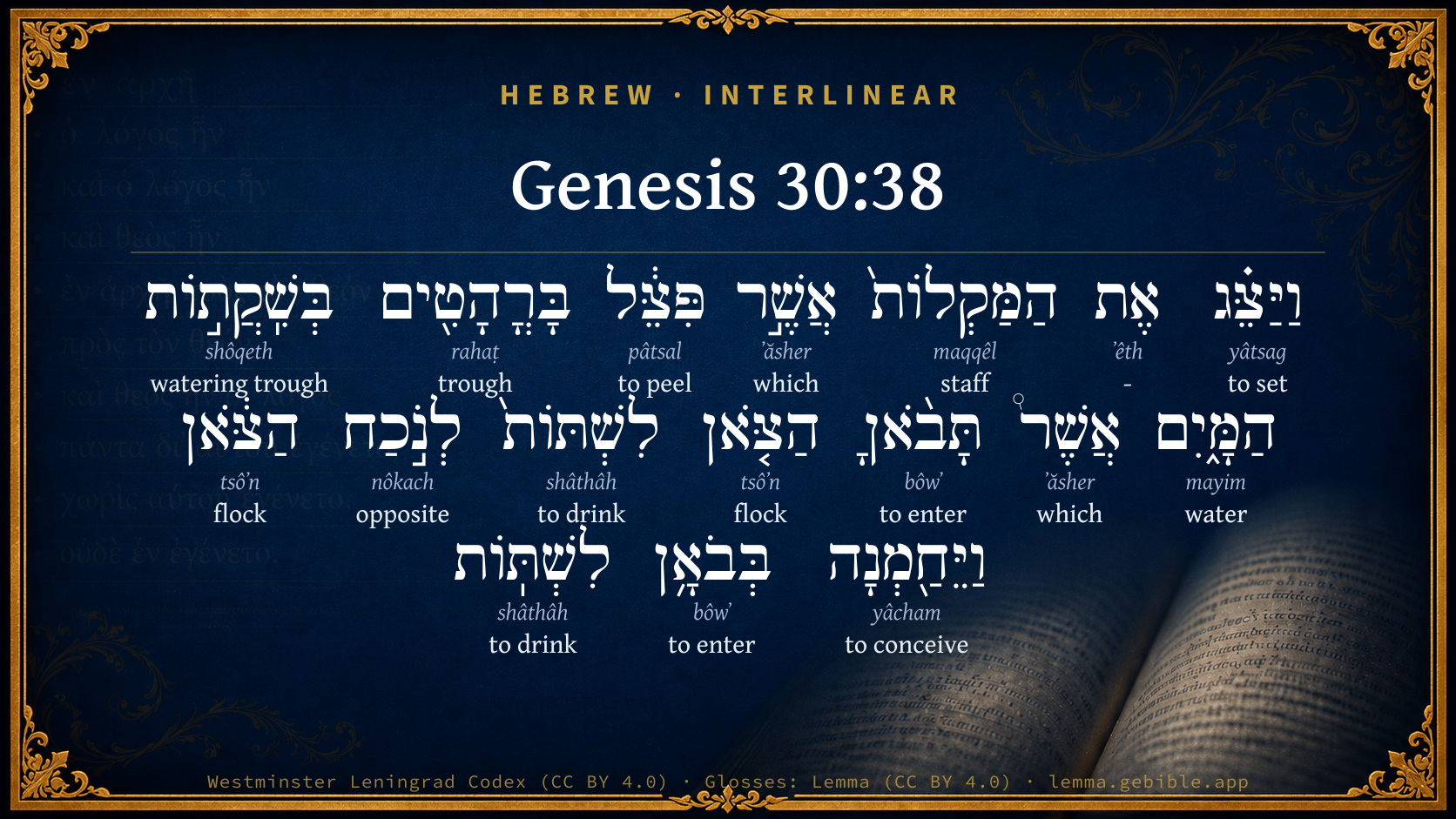
  1. וַיַּצֵּ֗ג yâtsag H3322 “and · to set” Conjunction + Verb, Hiphil, Sequential Imperfect, 3rd Person, Masculine, Singular
  2. אֶת ʼêth H853 “-” Particle, Direct Object
  3. הַמַּקְלוֹת֙ maqqêl H4731 “the · staves” Particle, Definite Article + Noun, Common, Masculine, Plural, Absolute
  4. אֲשֶׁ֣ר ʼăsher H834 “which” Particle, Relative
  5. בָּרֳהָטִ֖ים rahaṭ H7298 “in/at the · troughs” Preposition, Determined + Noun, Common, Masculine, Plural, Absolute
  6. בְּשִֽׁקֲת֣וֹת shôqeth H8268 “in/at · watering troughs of” Preposition + Noun, Common, Feminine, Plural, Construct
  7. הַמָּ֑יִם mayim H4325 “the · water(s)” Particle, Definite Article + Noun, Common, Masculine, Plural, Absolute
  8. אֲשֶׁר֩ ʼăsher H834 “which” Particle, Relative
  9. תָּבֹ֨אןָ bôwʼ H935 “to enter” Verb, Qal, Imperfect, 3rd Person, Feminine, Plural
  10. הַצֹּ֤אן tsôʼn H6629 “the · flock” Particle, Definite Article + Noun, Common, Both, Singular, Absolute
  11. לִשְׁתּוֹת֙ shâthâh H8354 “to drink” Preposition + Verb, Qal, Infinitive Construct
  12. לְנֹ֣כַח nôkach H5227 “to/for · opposite” Preposition + Preposition
  13. הַצֹּ֔אן tsôʼn H6629 “the · flock” Particle, Definite Article + Noun, Common, Both, Singular, Absolute
  14. וַיֵּחַ֖מְנָה yâcham H3179 “and · to conceive” Conjunction + Verb, Qal, Sequential Imperfect, 3rd Person, Feminine, Plural
  15. בְּבֹאָ֥ן bôwʼ H935 “in/at · to enter · them” Preposition + Verb, Qal, Infinitive Construct + Suffix, Personal, 3rd Person, Feminine, Plural
  16. לִשְׁתּֽוֹת shâthâh H8354 “to drink” Preposition + Verb, Qal, Infinitive Construct

About this verse

These counts appear in no published source. They are computed here, from the morphology-tagged text and Lemma’s own curated glosses. What Lemma adds →

17
words
13
distinct lemmas
Pentateuch
section

Notable vocabulary

The rarest word here is פִּצֵּ֔ל to peel H6478 — appearing just 2 times in the whole Hebrew Bible.

First appearance in Scripture

These words make their first canonical appearance in the Hebrew Bible here:

  • וַיַּצֵּ֗ג to set H3322
  • בָּרֳהָטִ֖ים trough H7298
  • וַיֵּחַ֖מְנָה to conceive H3179

Shared distinctive vocabulary

פִּצֵּ֔ל to peel H6478 occurs in 2 verses of the Hebrew Bible. Also found in:

Grammatical profile

  • 7 verbs
  • 6 nouns
  • 1 preposition
  • 3 particles

Verb forms

  • וַיַּצֵּ֗ג Hiphil · Sequential Imperfect
  • פִּצֵּ֔ל Piel · Perfect
  • תָּבֹ֨אןָ Qal · Imperfect
  • לִשְׁתּוֹת֙ Qal · Infinitive Construct
  • וַיֵּחַ֖מְנָה Qal · Sequential Imperfect
  • בְּבֹאָ֥ן Qal · Infinitive Construct
  • לִשְׁתּֽוֹת Qal · Infinitive Construct

Repetition

Words recur within this verse — often emphatic in Hebrew:

  • תָּבֹ֨אןָ to enter H935 ×2
  • הַצֹּ֤אן flock H6629 ×2
  • לִשְׁתּוֹת֙ to drink H8354 ×2
  • אֲשֶׁ֣ר which H834 ×2

Hebrew & Septuagint length

In English translation the verse runs 30 words from the Hebrew and 40 from the Septuagint (LXX English) — closely comparable.

A rough comparison of the two English renderings, which tokenize alike — not a word-level alignment.

Word counts can differ between the Hebrew and the Greek without any difference in meaning — e.g. the Hebrew direct-object marker אֵת has no separate Greek word, and Greek often adds the article ὁ.

In the original languages it is 17 Hebrew tokens and 28 Greek tokens — but the two are counted differently (Hebrew bundles its prefixes and suffixes into one token; the Greek is in lemma form), so that isn’t a like-for-like length.

Hebrew and Greek witnesses Masoretic Hebrew ↔ Greek Septuagint

The same verse in the two great witnesses to the Old Testament, shown verse-for-verse.

These are two independent witnesses, not word-aligned to each other, and the Septuagint is shown in lemma (dictionary) form.

Hebrew Genesis 30:38 Masoretic · Westminster Leningrad Codex

וַיַּצֵּ֗ג אֶת הַמַּקְלוֹת֙ אֲשֶׁ֣ר פִּצֵּ֔ל בָּרֳהָטִ֖ים בְּשִֽׁקֲת֣וֹת הַמָּ֑יִם אֲשֶׁר֩ תָּבֹ֨אןָ הַצֹּ֤אן לִשְׁתּוֹת֙ לְנֹ֣כַח הַצֹּ֔אן וַיֵּחַ֖מְנָה בְּבֹאָ֥ן לִשְׁתּֽוֹת

He set the rods which he had peeled opposite the flocks in the gutters in the watering-troughs where the flocks came to drink. They conceived when they came to drink.

World English Bible · Public Domain

Greek LXX Genesis 30:38 Septuagint · lemma form

καί παρατίθημι ὁ ῥάβδος ὅς λεπίζω ἐν ὁ ληνός ὁ ποτιστήριον ὁ ὕδωρ ἵνα ὡς ἄν ἔρχομαι ὁ πρόβατον πίνω ἐνώπιον ὁ ῥάβδος ἔρχομαι αὐτός εἰς ὁ πίνω

And he laid the rods which he had peeled, in the hollows of the watering-troughs, that whenever the cattle should come to drink, as they should have come to drink before the rods, the cattle might conceive at the rods.

LXX2012 (modern English Septuagint) · Public Domain

Hebrew: Westminster Leningrad Codex (CC BY 4.0). Greek: Septuagint (public domain); English from LXX2012 (modern English Septuagint) (Public Domain). How the Septuagint differs from the Hebrew →

Targum (Aramaic paraphrase)

2

The Targum is the ancient Jewish Aramaic paraphrase of the Hebrew Scriptures — an interpretive translation, not the Hebrew text itself. Onkelos (literal) and Pseudo-Jonathan (expansive) render the Torah, and Jonathan the Prophets. Coverage is partial: where no permissively-licensed English translation exists for a verse, only the Aramaic is shown. This is verse-level text, not a word-by-word alignment to the Hebrew.

  1. Targum Onkelos Torah (Genesis–Deuteronomy)
    וְדָעִיץ יָת חוּטְרַיָּא דִּי קַלִּיף בִּרְהָטַיָּא אֲתַר בֵּית שַׁקְיָא דְמַיָּא אֲתַר דְּאָתָן (נ''י דְּאָתְיָן) עָנָא לְמִשְׁתֵּי לְקִבְלֵיהוֹן דְּעָנָא וּמִתְיַחֲמָן בְּמֵיתֵיהוֹן לְמִשְׁתֵּי

    (no public-domain English translation for this verse)

    Targum Onkelos — Aramaic: “Onkelos Genesis” (public domain); “Onkelos Exodus” (public domain); “Onkelos Leviticus” (public domain); “Onkelos Numbers” (public domain); “Onkelos Deuteronomy” (public domain). English: “Sefaria Community Translation” (CC0 1.0 (public-domain dedication)); “J.W. Etheridge. The Targums of Onkelos and Jonathan Ben Uzziel on the Pentateuch. London: Longmans, Green, 1862” (public domain). Text via Sefaria.

  2. Targum Pseudo-Jonathan Torah (Genesis–Deuteronomy)
    וְנָעַץ יַת חוּטְרַיָא דִיקָלִיף בְּמוּרִכְיָיתָא בְּשַׁקְיָיתָא דְמַיָא אֲתַר דְאַתְיָין עָנָא לְמִשְׁתֵּי תַּמָן שַׁוִוינוּן לְקִבְלֵהֶן דַעֲנָא וַהֲווֹן מִתְיַחְמָן בְּמֵיתֵיהוֹן לְמִשְׁתֵּי

    And the rods which he had peeled, he fixed in the canals, in the troughs of water; at the place to which they brought the flocks to water, there placed he them over against the flock that they might conceive when they came to drink.

    Targum Pseudo-Jonathan — Aramaic: “Targum Jonathan on Genesis” (public domain); “Targum Jonathan on Exodus” (public domain); “Targum Jonathan on Leviticus” (public domain); “Targum Jonathan on Numbers” (public domain); “Targum Jonathan on Deuteronomy” (public domain). English: “The Targum of Jonathan ben Uzziel, trans. J. W. Etheridge, London, 1862” (public domain). Text via Sefaria.

Commentary

Notes on Genesis 30:38 from classic Christian and Jewish commentators (each source and its license shown beneath its notes). The classic Christian expositions comment on the surrounding passage and are grouped to its opening verse, so a note may address several verses; the Jewish commentaries on the Tanakh (Rashi and others) are per-verse, so they appear only where the commentator wrote on this verse.

Lemma curates 59 commentaries, every one of them public domain or Creative Commons licensed, each selected and text-cleaned for this edition rather than reprinted as found. About our sources →

Trapp's Complete Commentary

John Trapp

Gen 30:38 And he set the rods which he had pilled before the flocks in the gutters in the watering troughs when the flocks came to drink, that they should conceive when they came to drink.

Ver. 38. And he set the rods which he had pilled.] This was done, partly by the force of the fantasy, which is much affected with objects of the sight; or some other cogitation in the time of conception: partly and chiefly by the blessing of God: for, he that shall now try the same conclusion, shall find himself frustrated.

John Trapp, A Commentary or Exposition upon All the Books of the Old and New Testament (1647–1656) — public domain. Text from a community e-Sword module.

Jamieson, Fausset & Brown

Robert Jamieson, A. R. Fausset & David Brown

watering troughs--usually a long stone block hollowed out, from which several sheep could drink at once, but sometimes so small as to admit of only one drinking at a time.

Next: Genesis Chapter 31

Jamieson, Fausset & Brown — Commentary Critical and Explanatory on the Whole Bible (1871) — public domain (CC PDM 1.0). Text via the HelloAO Bible API.

Adam Clarke's Commentary

Verse 38. And he set the rods which he had pilled before the flocks] It has long been an opinion that whatever makes a strong impression on the mind of a female in the time of conception and gestation, will have a corresponding influence on the mind or body of the fetus. This opinion is not yet rationally accounted for. It is not necessary to look for a miracle here; for though the fact has not been accounted for, it is nevertheless sufficiently plain that the effect does not exceed the powers of nature; and I have no doubt that the same modes of trial used by Jacob would produce the same results in similar cases. The finger of God works in nature myriads of ways unknown to us; we see effects without end, of which no rational cause can be assigned; it has pleased God to work thus and thus, and this is all that we know; and God mercifully hides the operations of his power from man in a variety of eases, that he may hide pride from him. Even with the little we know, how apt are we to be puffed up! We must adore God in a reverential silence on such subjects as these, confess our ignorance, and acknowledge that nature is the instrument by which he chooses to work, and that he performs all things according to the counsel of his own will, which is always infinitely wise and infinitely good.

Adam Clarke's Commentary on the Bible (1810–1826) — public domain. Text from a community e-Sword/MySword module.

Ellicott's Commentary for English Readers

(38) In the gutters . . . —Heb., in the troughs at the watering-places. So virtually all the versions; and see Exo_2:16, where the word rendered here “gutters” is rightly translated troughs. The idea that there were gutters through which to pour the water into the troughs is utterly modern, but all travellers describe the fixed troughs put for the convenience of the cattle round the wells.

A Bible Commentary for English Readers, edited by Charles John Ellicott (1878–1897) — public domain. Text from a community e-Sword module.

The Cambridge Bible for Schools and Colleges

gen. ed. J. J. S. Perowne

38. over against] Jacob places the white peeled rods in front of the flocks, when they come to drink at the breeding season. It was the popular belief that such objects, being presented to the eye at such a season, would be likely to affect the colouring of the progeny.

gutters] This word is explained by the phrase following, “watering troughs”; cf. Exo_2:16.

The Cambridge Bible for Schools and Colleges (gen. ed. J. J. S. Perowne; Cambridge University Press, 1878–1918) — public domain. Text from a community e-Sword module.

John Gill's Exposition

And when the cattle were feeble, he put them not in,.... Or "when covered", as Menachem, that is, with wool, and so not so desirous of copulation with the males, nor so fit and strong for generation; and therefore he put not in the rods into the gutters, partly that he might have none feeble in his flock, and partly that he might not spoil Laban of his whole flock, strong and weak:

so the feebler were Laban's, and the stronger Jacob's; not only his flocks became more numerous than Laban's, but were a better quality.

John Gill's Exposition of the Whole Bible (1746–1763) — public domain (CC PDM 1.0). Text via the HelloAO Bible API.

Matthew Poole's English Annotations

When by their refreshment and meeting together, they were most likely to generate and conceive.

Matthew Poole's English Annotations on the Holy Bible (1683–1685) — public domain. Text from a community e-Sword/MySword module.

The Pulpit Commentary

And he set the rods which he had pilled before the flecks in the gutters ( literally, the canals or channels through which the water ran, from a root signifying to run) in the watering troughs (twOtq) i.e. the troughs which contained the water, to which the animals approached) when the flocks came to drink, that they should conceive (literally, and they became warm, in the sense expressed in the A.V) when they cams to drink this was Jacob"s first artifice to overreach Laban.

The Pulpit Commentary (1880–1919), ed. H.D.M. Spence-Jones & Joseph S. Exell — public domain. Text from a community e-Sword module.

Rashi

Rabbi Shlomo Yitzchaki (Rashi)

ויצג AND HE SET — In the Targum it is rendered by ודעיץ which signifies in the Aramaic language sticking in and inserting. It occurs many times in the Talmud: (Shabbat 50b) “if he stuck it in (דצה) and pulled it out”; (Chullin 93b) “he stuck (דץ) something into it”, where דצה is the same as דעצה, being really a contracted form of it.

ברהטים IN THE GUTTERS — in the currents (מרוצות) of water running in the trenches made in the ground to water the sheep there (רהט is the Aramaic of רוץ).

אשר תבאנה WHERE THE FLOCKS COME TO DRINK etc. — In the currents whither the sheep come to drink, there did he set the rods in front of the sheep.

ויחמנה AND THEY CONCEIVED — The female animal saw the rods, it was startled at the sight of them and recoiled; its mate then pairing with it, it afterwards gave birth to young marked similar to the rods (Genesis Rabbah 73:10).

Rashi on the Tanakh — English translations: “The Judaica Press complete Tanach with Rashi, translated by A. J. Rosenberg” (CC BY 4.0); “Pentateuch with Rashi's commentary by M. Rosenbaum and A.M. Silbermann, 1929-1934” (public domain); “The Metsudah Tanach series, Lakewood, N.J” (CC BY 4.0); and “The Book of Joshua, Metsudah Publications, 1997” (CC BY 4.0). Text via Sefaria.

Radak

Rabbi David Kimhi (Radak)

ויצג את המקלות, he positioned them at the water troughs. This is the meaning of the words

אשר תבאן, meaning: “as they would come there.” In Exodus 14,13 the word אשר in the line אשר ראיתם את מצרים היום also means “when, as,” i.e. “as you have seen Egypt to day.” The word אשר in the line תאכל מצות אשר צויתיך in Exodus 34,18 also means “as,” i.e. “you shall eat unleavened bread as I commanded you.”

לנכח הצאן, he had made them face the sheep.

ויחמנה, it is in the nature of the sheep to become heated, excited, and to mount the females when they are about to drink from the troughs.

ברהטים, Onkelos translates the word ותרץ in 29,12 as “she ran.” The word here means that this was a place where the water ran into pools which had been dug in the ground in order to facilitate the watering of the sheep. The word ויחמנה contains both masculine and feminine components, perhaps to hint at the mating of the two sexes. A similar construction occurs in Samuel I 6,12.

Radak on the Tanakh — English translations: “Sefaria Community Translation” (CC0 1.0 (public-domain dedication)); “Eliyahu Munk, HaChut Hameshulash” (CC BY 4.0); “Rabbi Mike Feuer, Jerusalem Anthology” (CC BY 4.0); and “R. David Kimhi on the first book of Psalms, Translated by R.G. Finch, London, 1919” (public domain). Text via Sefaria.

Lesson kit

Teaching starters — assembled from the data on this page, not authored interpretation. Every prompt links to the verse data it draws on. Edit before teaching.

Genesis, in the Pentateuch, opens this verse with 17 words (13 distinct Hebrew lemmas). Its most distinctive word is pâtsal (“to peel”). A historical commentator’s framing appears above. Read the whole chapter for the surrounding context.

Discussion questions

  1. The word pâtsal carries the sense “to peel.” How does it shape the verse?
  2. 3 words here appear for the first time in Scripture. What is being introduced at this debut?
  3. Genesis 30:37 shares the word «to peel» with this verse. How do the two illuminate each other?
  4. “to enter” occurs 2× in this one verse. What is the effect of the repetition?
  5. These translations render this verse differently; the difference is in the English rendering, not the original. What questions does that raise?
  6. The verb «וַיַּצֵּ֗ג» is Hiphil Sequential Imperfect. How does its form color the action?
  7. Reading how Trapp's Complete Commentary and Jamieson, Fausset & Brown read this verse, where do the two commentators agree and where do they part?

Things to notice

Reading settings

Reading text

Shown beneath each verse's original-language words.

Old Testament
Old Testament edition

Read the OT as the Masoretic Hebrew (MT) or the Greek Septuagint (LXX).

English shown for the Greek Septuagint (in the Hebrew ↔ Greek comparison).

Comparing translations? Open the Compare panel on any verse page to stack up to four side by side.