Psalms 78:71

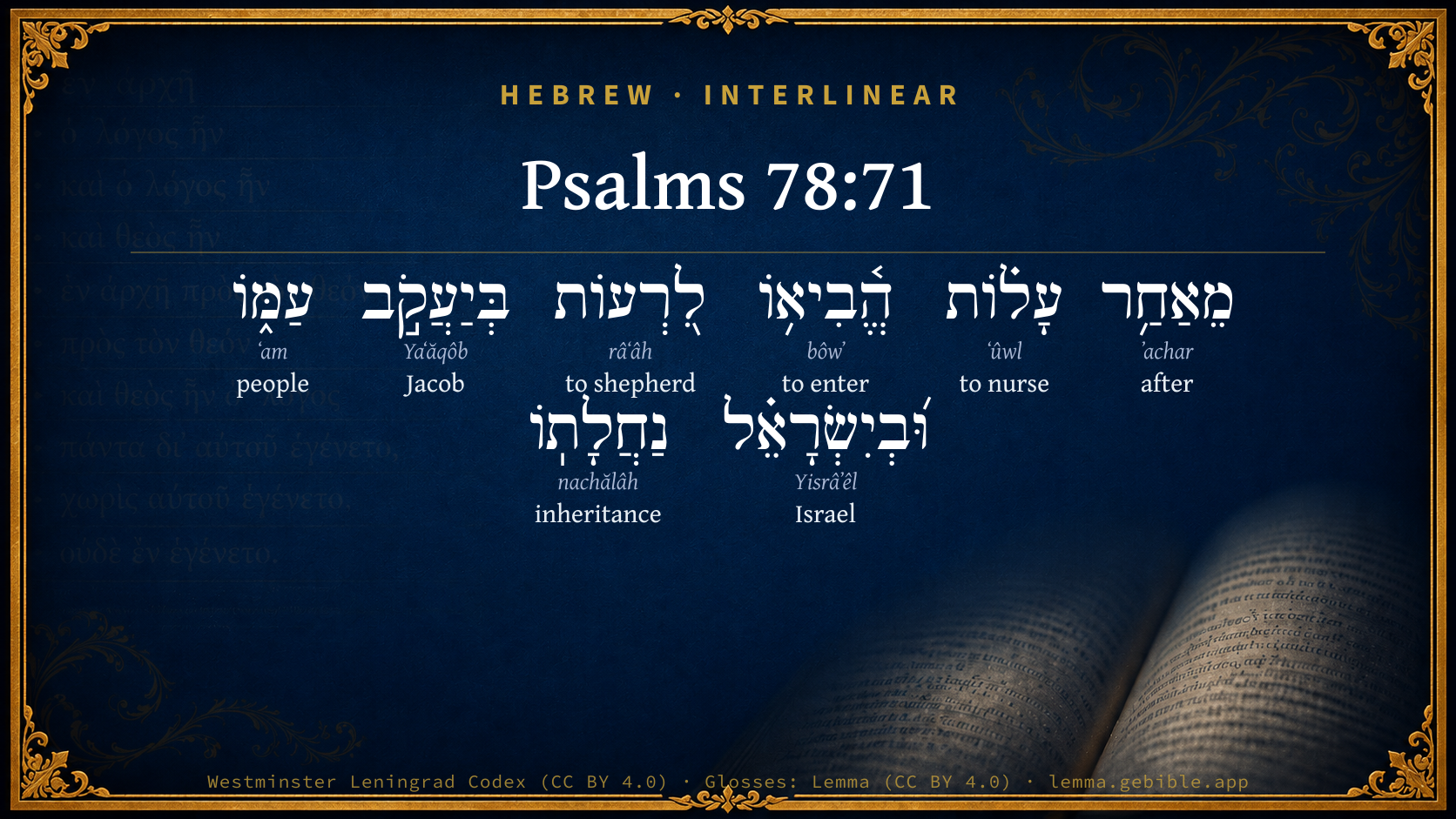
Hebrew (Westminster Leningrad Codex) Psalms 78:71 appears in the Hebrew Old Testament. The text above is from the Westminster Leningrad Codex. Each word links to its Strong’s number, a concise gloss, and parsing drawn from the Open Scriptures Hebrew Bible morphology. Click any word for its full Brown-Driver-Briggs (BDB) entry.
Download image
Cite this verse

Psalms 78:71 (World English Bible). Public Domain. Lemma interlinear Bible study tool, https://lemma.gebible.app/v/psalms/78/71.

Show BibTeX & RIS
BibTeX
RIS
English Translation
From following the ewes that have their young, He brought him to be the shepherd of Jacob, his people, And Israel, his inheritance.
World English Bible · Public Domain
Download a study sheet

One document with this verse’s original text, its word-by-word gloss line, the meaning frame, cross-references with their text, attributed commentary, and full source and license credits — printable, and it pastes into notes with its structure intact.

This verse Autodidact and up

Study sheet (.html) Plain text (.txt)

A passage Seminary Student

Up to 50 verses in one chapter. A passage sheet keeps up to 6 commentary sources and 12 cross-references per verse, in the order this page ranks them, and says so on the sheet whenever that leaves anything out. Ask for a single verse and you get the Autodidact verse sheet above.

Everything on this page stays free to read, with no account — the sheet is a download of what is already on screen, not access to it.

Want to remove ads? Support Godless Engineer
Compare translations 3

The same verse in 3 English versions, stacked beneath the original-language interlinear above. Click any original word for its lexicon entry.

Each is an independent rendering of the whole verse — the interlinear is not word-aligned to these translations.

Highlighted words mark where these versions differ — a whole-verse word diff, not a word-by-word alignment.

  • World English Bible Public Domain
    From following the ewes that have their young, He brought him to be the shepherd of Jacob, his people, And Israel, his inheritance.
  • King James Version Public Domain
    From following the ewes great with young he brought him to feed Jacob his people, and Israel his inheritance.
  • unfoldingWord Literal Text CC BY-SA 4.0
    From behind the nursing ewes he brought him, to shepherd Jacob his people and Israel his inheritance.

unfoldingWord Literal Text — © unfoldingWord, licensed CC BY-SA 4.0. Word-aligned USFM3 via Door43 (git.door43.org/unfoldingWord/en_ult).

Versions to compare (up to 4)

3 of 4 selected

Show all 18 translations

Every available English version of this verse, each an independent rendering of the whole verse.

  • World English Bible Public Domain
    From following the ewes that have their young, He brought him to be the shepherd of Jacob, his people, And Israel, his inheritance.
  • Berean Standard Bible Public Domain
    from tending the ewes He brought him to be shepherd of His people Jacob, of Israel His inheritance.
  • Majority Standard Bible Public Domain
    from tending the ewes He brought him to be shepherd of His people Jacob, of Israel His inheritance.
  • King James Version Public Domain
    From following the ewes great with young he brought him to feed Jacob his people, and Israel his inheritance.
  • American Standard Version (1901) Public Domain
    From following the ewes that have their young he brought him, To be the shepherd of Jacob his people, and Israel his inheritance.
  • Revised Version (1885) Public Domain
    From following the ewes that give suck he brought him, to feed Jacob his people, and Israel his inheritance.
  • Geneva Bible (1599) Public Domain
    Euen from behinde the ewes with yong brought he him to feede his people in Iaakob, and his inheritance in Israel.
  • Douay-Rheims (1899) Public Domain
    To feed Jacob his servant, and Israel his inheritance.
  • Young's Literal Translation Public Domain
    From behind suckling ones He hath brought him in, To rule over Jacob His people, And over Israel His inheritance.
  • Literal Standard Version CC BY-SA 4.0
    He has brought him in from behind suckling ones, || To rule over Jacob His people, || And over Israel His inheritance.
  • Unlocked Literal Bible CC BY-SA 4.0
    He took him from following the ewes with their young, and he brought him to be shepherd of Jacob, his people, and of Israel, his heritage.
  • unfoldingWord Literal Text CC BY-SA 4.0
    From behind the nursing ewes he brought him, to shepherd Jacob his people and Israel his inheritance.
  • Darby Bible Public Domain
    From following the suckling-ewes, he brought him to feed Jacob his people, and Israel his inheritance.
  • World Messianic Bible Public Domain
    from following the ewes that have their young, he brought him to be the shepherd of Jacob, his people, and Israel, his inheritance.
  • Webster's Bible Public Domain
    From following the ewes great with young he brought him to feed Jacob his people, and Israel his inheritance.
  • Free Bible Version CC BY-SA 4.0
    taking him from caring for the sheep and lambs to be a shepherd to the descendants of Jacob—God's special people, Israel.
  • Bible in Basic English Public Domain
    From looking after the sheep which were giving milk, he took him to give food to Jacob his people, and to Israel his heritage.
  • JPS Tanakh (1917) Public Domain
    From following the ewes that give suck He brought him, to be shepherd over Jacob His people, and Israel His inheritance.

Literal Standard Version (2020), Covenant Press — licensed CC BY-SA 4.0. Text via the HelloAO Bible API (eBible.org). Unlocked Literal Bible (unfoldingWord) — licensed CC BY-SA 4.0. Text via the HelloAO Bible API (eBible.org). unfoldingWord Literal Text — © unfoldingWord, licensed CC BY-SA 4.0. Word-aligned USFM3 via Door43 (git.door43.org/unfoldingWord/en_ult). Free Bible Version, Dr. Jonathan Gallagher — licensed CC BY-SA 4.0. Text via the HelloAO Bible API (eBible.org).

Word by word

More ways to search: Search by grammar → Find every occurrence → Compare this word →

Practice this passage: Drill this verse → Learn its vocabulary →

About this verse

These counts appear in no published source. They are computed here, from the morphology-tagged text and Lemma’s own curated glosses. What Lemma adds →

8
words
8
distinct lemmas
Wisdom
section

Notable vocabulary

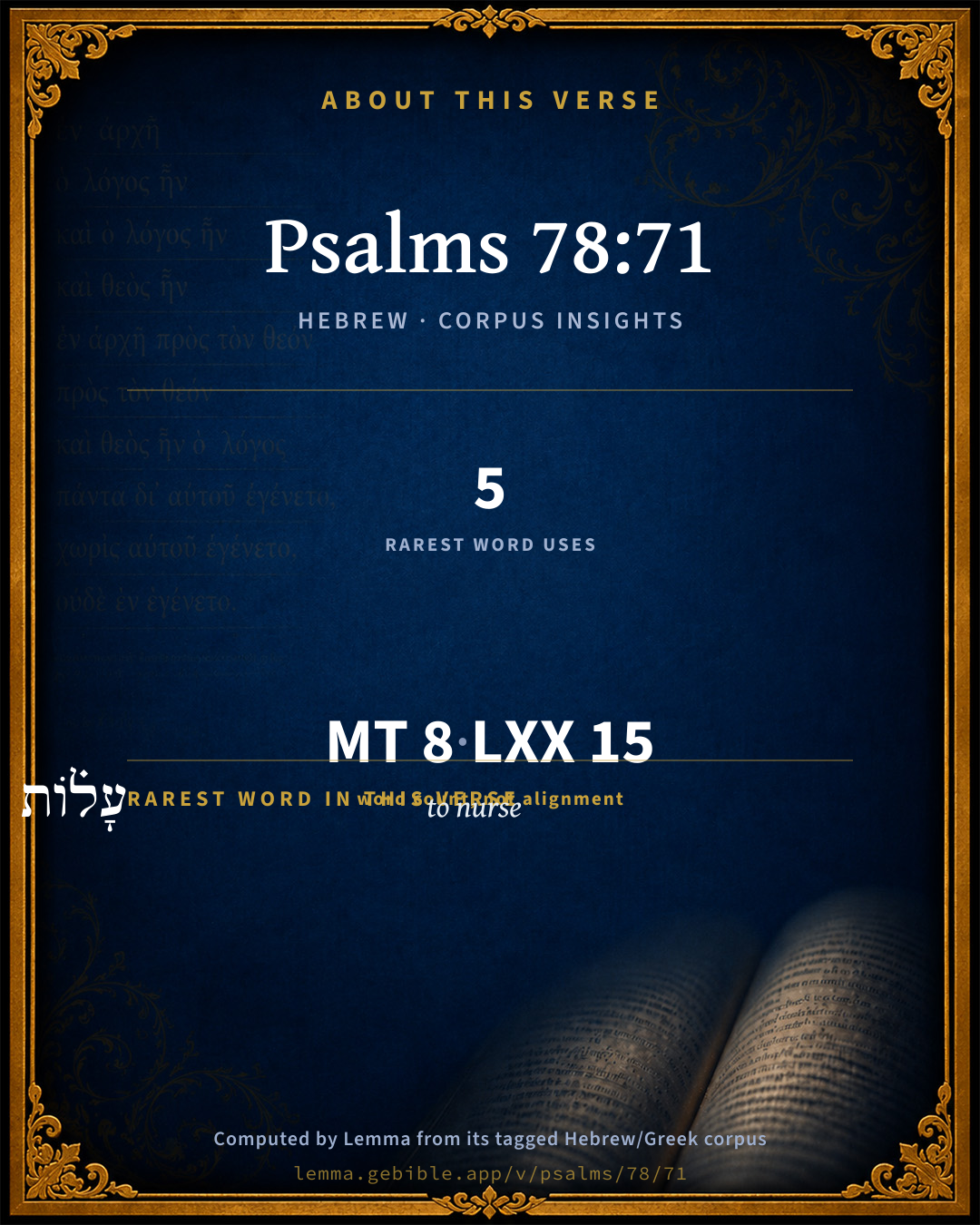
The rarest word here is עָל֗וֹת to nurse H5763 — appearing just 5 times in the whole Hebrew Bible.

Shared distinctive vocabulary

עָל֗וֹת to nurse H5763 occurs in 5 verses of the Hebrew Bible. Also found in:

Grammatical profile

  • 3 verbs
  • 4 nouns
  • 1 preposition

Verb forms

  • עָל֗וֹת Qal · Participle Active
  • הֱ֫בִיא֥וֹ Hiphil · Perfect
  • לִ֭רְעוֹת Qal · Infinitive Construct

Hebrew & Septuagint length

In English translation the verse runs 23 words from the Hebrew and 22 from the Septuagint (LXX English) — closely comparable.

A rough comparison of the two English renderings, which tokenize alike — not a word-level alignment.

Word counts can differ between the Hebrew and the Greek without any difference in meaning — e.g. the Hebrew direct-object marker אֵת has no separate Greek word, and Greek often adds the article ὁ.

In the original languages it is 8 Hebrew tokens and 15 Greek tokens — but the two are counted differently (Hebrew bundles its prefixes and suffixes into one token; the Greek is in lemma form), so that isn’t a like-for-like length.

Cross-references

17

Topical passages linked to Psalms 78:71 in the Treasury of Scripture Knowledge — connected by theme and wording, ordered by reader-vote popularity; previews shown in the World English Bible.

  • 2 Samuel 5:2 In times past, when Saul was king over us, it was you who led out and brought in Israel: and Yahweh said to you, You shall be shepherd of my people Israel, and you shall be prince over Israel.
  • 1 Chronicles 11:2 In times past, even when Saul was king, it was you who led out and brought in Israel: and Yahweh your God said to you, You shall be shepherd of my people Israel, and you shall be prince over my people Israel.
  • Genesis 33:13 Jacob said to him, "My lord knows that the children are tender, and that the flocks and herds with me have their young, and if they overdrive them one day, all the flocks will die.
  • 1 Samuel 2:7–8 Yahweh makes poor, and makes rich: He brings low, he also lifts up.
  • Psalms 28:9 Save your people, And bless your inheritance. Be their shepherd also, And bear them up forever.
  • Psalms 75:6–7 For neither from the east, nor from the west, Nor yet from the south, comes exaltation.
  • Isaiah 40:11 He will feed his flock like a shepherd, he will gather the lambs in his arm, and carry them in his bosom, [and] will gently lead those who have their young.
  • Ezekiel 34:23–24 I will set up one shepherd over them, and he shall feed them, even my servant David; he shall feed them, and he shall be their shepherd.
  • 1 Peter 5:2 Shepherd the flock of God which is among you, exercising the oversight, not under compulsion, but voluntarily, not for dishonest gain, but willingly;
  • 1 Samuel 10:1 Then Samuel took the vial of oil, and poured it on his head, and kissed him, and said, Isn't it that Yahweh has anointed you to be prince over his inheritance?
  • 2 Samuel 7:8 Now therefore thus shall you tell my servant David, Thus says Yahweh of Hosts, I took you from the sheep pen, from following the sheep, that you should be prince over my people, over Israel;
  • Psalms 113:7–8 He raises up the poor out of the dust. Lifts up the needy from the ash heap;
  • Jeremiah 27:5–6 I have made the earth, the men and the animals that are on the surface of the earth, by my great power and by my outstretched arm; and I give it to whom it seems right to me.
  • Micah 5:2–4 But you, Bethlehem Ephrathah, Being small among the clans of Judah, Out of you one will come forth to me that is to be ruler in Israel; Whose goings forth are from of old, from everlasting.
  • Zechariah 11:4–17 Thus says Yahweh my God: "Feed the flock of slaughter.
  • John 21:15–17 So when they had eaten their breakfast, Jesus said to Simon Peter, "Simon, son of Jonah, do you love me more than these?" He said to him, "Yes, Lord; you know that I have affection for you." He said to him, "Feed my lambs."
  • Matthew 2:6 'You Bethlehem, land of Judah, Are in no way least among the princes of Judah: For out of you shall come forth a governor, Who shall shepherd my people, Israel.'"

Cross-references courtesy of OpenBible.info (CC BY 4.0).

Hebrew and Greek witnesses Masoretic Hebrew ↔ Greek Septuagint

The same verse in the two great witnesses to the Old Testament, shown verse-for-verse.

You’re reading Greek Psalm 77 (Hebrew Psalm 78). The Septuagint counts the superscription, so verse numbers can differ from the Hebrew — chapter-level alignment, not verse-by-verse. Numbering follows Rahlfs.

These are two independent witnesses, not word-aligned to each other, and the Septuagint is shown in lemma (dictionary) form.

Hebrew Psalms 78:71 Masoretic · Westminster Leningrad Codex

מֵאַחַ֥ר עָל֗וֹת הֱ֫בִיא֥וֹ לִ֭רְעוֹת בְּיַעֲקֹ֣ב עַמּ֑וֹ וּ֝בְיִשְׂרָאֵ֗ל נַחֲלָתֽוֹ

From following the ewes that have their young, He brought him to be the shepherd of Jacob, his people, And Israel, his inheritance.

World English Bible · Public Domain

Greek LXX Greek Psalm 77:71 Septuagint · lemma form

ἐξόπισθεν ὁ λοχεύω λαμβάνω αὐτός ποιμαίνω ἰακώβ ὁ λαός αὐτός καί ἰσραήλ ὁ κληρονομία αὐτός

He took him from following the ewes great with young, to be the shepherd of Jacob his servant, and Israel his inheritance.

LXX2012 (modern English Septuagint) · Public Domain

On this verse, Albert Barnes' Notes on the Bible discusses the Septuagint’s reading. Read the note in Commentary ↓

Hebrew: Westminster Leningrad Codex (CC BY 4.0). Greek: Septuagint (public domain); English from LXX2012 (modern English Septuagint) (Public Domain). How the Septuagint differs from the Hebrew →

Commentary

Notes on Psalms 78:71 from classic Christian and Jewish commentators (each source and its license shown beneath its notes). The classic Christian expositions comment on the surrounding passage and are grouped to its opening verse, so a note may address several verses; the Jewish commentaries on the Tanakh (Rashi and others) are per-verse, so they appear only where the commentator wrote on this verse.

Lemma curates 59 commentaries, every one of them public domain or Creative Commons licensed, each selected and text-cleaned for this edition rather than reprinted as found. About our sources →

Trapp's Complete Commentary

John Trapp

Psa 78:71 From following the ewes great with young he brought him to feed Jacob his people, and Israel his inheritance.

Ver. 71. From following the ewes] So Saul from seeking asses, Agathocles from making pots, Valentinian, ropes, &c. Placilla called upon her husband Theodosius, the emperor, to remember from what mean estate God had called him to the highest honours, εξ οιων, εις οια.~

John Trapp, A Commentary or Exposition upon All the Books of the Old and New Testament (1647–1656) — public domain. Text from a community e-Sword module.

J. A. Alexander on Psalms

Joseph Addison Alexander

71. (Psa 78:71) From behind the suckling (ewes) he brought him, to feed Jacob his people and Israel his heritage. From behind them, i.e. from following and watching them with tender care, one of the chief duties of a shepherd. The next word in Hebrew is a participle, and means nursing, giving suck. The sense is incorrectly given in the common version of this place, and ambiguously in that of Isa 40:11. To feed expresses only one part of the meaning of the Hebrew verb, which signifies to do the work or exercise the office of a shepherd. See above, on Psa 49:13. The contrast presented is, that he who had spent his youth in tending sheep was now to be the shepherd of a nation, nay, of the chosen people, of the church, the heritage of God himself. To this passage, and those portions of the history on which it is founded (2Sa 7:8, 1Ch 11:2), may be traced the constant use of pastoral images, in the later Scriptures, to express the relation which subsists between the Church and Christ, as its Chief Shepherd, and his faithful ministers as his representatives and deputies.

Joseph Addison Alexander, The Psalms Translated and Explained (1850) — public domain. Text from a community e-Sword module.

Adam Clarke's Commentary

Verse 71. From following the ewes] Instances of this kind are not unfrequent in the ancient Greek and Roman history. Croesus said that Gyges, who was the first of his race, was a slave, and rose to sovereignty, succeeding his predecessor, of whose sheep he had been the pastor.

Adam Clarke's Commentary on the Bible (1810–1826) — public domain. Text from a community e-Sword/MySword module.

John Calvin's Commentaries

71. He took him from following the suckling ewes, etc. The grace of God is farther commended from the circumstance, that David, who was a keeper of sheep, was made the shepherd of the chosen people and heritage of God. There is an allusion to David’s original condition; but the Spirit of God, at the same time, shows us the difference between good and lawful kings, and tyrants, robbers, and insatiable extortioners, by telling us that whoever would aspire to the character of the former must be like shepherds.

It is afterwards added, (verse 72,) that David had faithfully performed the duties of the trust committed to him. By this the prophet indirectly rebukes the ingratitude and perverseness of the people, who not only overturned the holy and inviolable order which God had established, but who had also, in shaking off his salutary yoke, thrown themselves into a state of miserable dispersion. What follows concerning the prudence of David’s hands seems to be an improper form of expression. But it is intended forcibly to express, that he not only was successful in what he had undertaken, but that he was governed by the Spirit of God, which prevented him from putting his hand at random to any work which might come in his way, and led him prudently and skilfully to do that to which faith and duty called him; and thus, in the success of his undertakings, his wisdom appears more conspicuous than his good fortune.

John Calvin's Commentaries (1540-1563) — public domain. Text from the Calvin Translation Society English edition (1840s-50s) via the Christian Classics Ethereal Library (ccel.org). Calvin's coverage is partial (roughly two-thirds of the Bible); uncommented books and verses are honest gaps, never fabricated. The 19th-century editor's footnotes and remarks are omitted so the notes are faithfully Calvin's own voice.

Ellicott's Commentary for English Readers

(71) Ewes great with young—So also in Isa_40:11; but properly, ewes with lambs. Literally, giving suck.

A Bible Commentary for English Readers, edited by Charles John Ellicott (1878–1897) — public domain. Text from a community e-Sword module.

The Cambridge Bible for Schools and Colleges

gen. ed. J. J. S. Perowne

71. From following the ewes with their young ones he brought him,

To be shepherd of Jacob his people &c.

This natural metaphor for the ruler’s care of his people was especially appropriate in the case of David, who was taken from being the shepherd of Jesse’s flock to be the shepherd of Jehovah’s flock. Cp. 2Sa_5:2.

The Cambridge Bible for Schools and Colleges (gen. ed. J. J. S. Perowne; Cambridge University Press, 1878–1918) — public domain. Text from a community e-Sword module.

John Gill's Exposition

So he fed them according to the integrity of his heart,.... Or, "reigned over them", as the Targum; that is, over the people of Israel, and which he did in such manner as showed uprightness of heart, and that he was, as his character is, a man after God's own heart: it appeared, by his administration of government, that he sought not his own honour and interest, and the aggrandizing of his family, but the good of his people, and the glory of God; and this character, in the fullest extent, and highest sense of it, best agrees with Christ, the righteous branch raised unto David, Jer 23:5,

and guided them by the skilfulness of his hands; or "by the prudencies" of his hands, as the Targum; or, by the prudencies (c), as in the original text; with the most consummate wisdom and skill: hands are made mention of, partly in allusion to the shepherd, as David had been, who carries a staff in his hand, and guides his flock with it; and partly with respect to the acts and administration of government, which were wisely performed by him: he made wise laws for his people and soldiers, and put them in execution; he behaved wisely in the court and in the camp; but was greatly and infinitely exceeded by his antitype, the servant of the Lord, that should deal prudently, Isa 52:13, and who is abundantly qualified for it, as being not only the Wisdom of God, and the all wise God, but even, as Mediator, has the spirit of wisdom on him, and the treasures of wisdom in him.

(c) "prudentiis", Vatablus; "intelligentiis", Pagninus, Montanus, Gejerus, Michaelis; "discretions", Ainsworth.

Next: Psalms Chapter 79

John Gill's Exposition of the Whole Bible (1746–1763) — public domain (CC PDM 1.0). Text via the HelloAO Bible API.

Albert Barnes' Notes on the Bible

From following the ewes great with younq - Margin, as in Hebrew, From after. The meaning is, that he followed after them; that is, he attended them, or watched over them as a shepherd. The single word rendered “the ewes great with young” - עול ‛ûl - is a participle from עלוה ‛âlâhô, to ascend, to go up; and then, to bring up, to nourish. The exact idea here is doubtless that of bringing up, or of sucking them, and the word should have been so translated here. It is so rendered by Luther. The idea in our translation has been derived from the Septuagint and the Latin Vulgate. The meaning is, that he brought him from being a shepherd to be the ruler of his people - expressed still in the language of a shepherd life.

To feed Jacob his people - Rather, to be a shepherd to them; to perform toward them the office of a shepherd, including the ideas of governing them, providing for them, and defending them. See the notes at Psa 23:1-2.

Albert Barnes' Notes on the Bible (1834–1885) — public domain. Text from a community e-Sword/MySword module.

Matthew Poole's English Annotations

Following the ewes great with young; by which employment he was inured to that care, and diligence, and self-denial which is necessary in a king or governor; and instructed to rule his people with all gentleness and tenderness.

Matthew Poole's English Annotations on the Holy Bible (1683–1685) — public domain. Text from a community e-Sword/MySword module.

The Treasury of David

Charles H. Spurgeon

Ver. 71. From following the ewes great with young he brought him to feed Jacob his people, and Israel his inheritance. Exercising the care and art of those who watch for the young lambs, David followed the ewes in their wanderings; the tenderness and patience thus acquired would tend to the development of characteristics most becoming in a king. To the man thus prepared, the office and dignity which God had appointed for him, came in due season, and he was enabled worthily to wear them. It is wonderful how often divine wisdom so arranges the early and obscure portion of a choice life, so as to make it a preparatory school for a more active and noble future.

Ver. 71. From following the ewes great with young. A good and steady lamber is of great value to a grazier, but I would advise all graziers to attend to this operation themselves, as few servants will be found to pay that attention which is necessary, or which a master himself would do, and the slightest neglect, is, in many cases, followed with the greatest disadvantage. I have attended to the practice of lambing for several years, therefore, trust I am not a novice in it, or incompetent to give a description of it. Many lambs may be lost without its being possible to charge the lamber with neglect or ignorance, though greater attention on his part might have saved many that otherwise perish...The practice of lambing is at times very intricate, and is apt to exhaust the patience of a lamber. Sheep are obstinate, and lambing presents a scene of confusion, disorder, and trouble, which it is the lamber's business to rectify, and for which he ought always to be prepared: some of the ewes perhaps leave their lambs, or the lambs get intermixed, and the ewes which have lost their lambs run about bleating, while others want assistance. These are only a few of the various occurrences which call for the immediate attention of the lamber. Daniel Price, in "A System of Sheep grazing and Management." 1809.

Ver. 71. From following the ewes great with young. It hath been reported that a learned doctor of Oxford hung up his leathern breeches in his study for a memorial to visitors of his mean original; the truth I avouch not, but history tells us of Agathocles who arose from a potter to be king of Sicily, and would be served in no other plate at his table but earthenware, to mind him of his former drudgery. It were well if some would remember whose shoes they have cleaned, whose coals they have carried, and whose money they have borrowed, and deal gratefully with their creditors, as the good Lord Cromwell did by the Florentine merchant in the time of Henry the Eighth, when Wolsey (Foxe's Martyrology) like a butcher forgot the king his master. It was otherwise with holy David, who being in kingly dignity, graciously calls to mind his following the ewes great with young, when now feeding the sheep of Israel. His golden sceptre points at his wooden hook, and he plays the old lessons of his oaten pipe upon his Algum harp, and spreads his Bethlehem tent within his marble palace on Mount Zion. Samuel Lee.

Ver. 71. To feed Jacob his people. (This is a curious specimen of medieval spiritualising, and is here inserted as such. It is amusing to note that a Tractarian expositor quotes the passage with evidently intense admiration. C. H. S.) Observe, a good shepherd must be humble and faithful, he ought to have bread in a wallet, a dog by a string, a staff with a rod, and a tuneful horn. The bread is the word of God, the wallet is the memory of the word; the dog is zeal, wherewith the shepherd glows for the house of God, casts out the wolves with pious barking, following preaching and unwearied prayer: the string by which the dog is held is the moderation of zeal, and discretion, whereby the zeal of the shepherd is tempered by the spirit of piety and knowledge. The staff is the consolation of pious exhortation by which the too timid are sustained and refreshed, lest they fail in the time of tribulation; but the rod is the authority and power by which the turbulent are restrained. The tuneful horn, which sounds so sweetly, signifies the sweetness of eternal blessedness, which the faithful shepherd gently and often instils into the ears of his flock. Johannes Paulus Palanterius. 1600.

Charles H. Spurgeon's The Treasury of David (1869–1885) — public domain. Psalms only. Text from a community e-Sword/MySword module.

The Pulpit Commentary

From following the ewes great with young he brought him. (comp. Isa_40:11) The Hebrew word translated "ewes great with young" really means "ewes that are giving suck." This is the portion of the flock which needs the tenderest care. To feed Jacob his people, and Israel his inheritance. (see 1Ch_11:2) As Peter, James, and John were called from their occupation of fishers to be "fishers of men", (Mat_4:19) so David was called from feeding sheep to feed God"s people.

The Pulpit Commentary (1880–1919), ed. H.D.M. Spence-Jones & Joseph S. Exell — public domain. Text from a community e-Sword module.

Rashi

Rabbi Shlomo Yitzchaki (Rashi)

From behind the nursing ewes He brought him For he would shepherd the nursing ewes for his father, because he was merciful and would bring the kids first and feed them the upper tips of the grasses, which are tender. Then after them he would bring out the he-goats, who would eat the middle of the grasses, and afterwards, he would bring out the older ones, who would eat the roots. Said the Holy One, blessed be He, “This one is fit to shepherd My people.”

Rashi on the Tanakh — English translations: “The Judaica Press complete Tanach with Rashi, translated by A. J. Rosenberg” (CC BY 4.0); “Pentateuch with Rashi's commentary by M. Rosenbaum and A.M. Silbermann, 1929-1934” (public domain); “The Metsudah Tanach series, Lakewood, N.J” (CC BY 4.0); and “The Book of Joshua, Metsudah Publications, 1997” (CC BY 4.0). Text via Sefaria.

Lesson kit

Teaching starters — assembled from the data on this page, not authored interpretation. Every prompt links to the verse data it draws on. Edit before teaching.

Psalms, in the Wisdom, opens this verse with 8 words (8 distinct Hebrew lemmas). Its most distinctive word is ʻûwl (“to nurse”). A historical commentator’s framing appears above. Read the whole chapter for the surrounding context.

Discussion questions

  1. How does “to nurse” (ʻûwl) shape what this verse is saying?
  2. How does Genesis 33:13, which shares the word «to nurse», read alongside this verse?
  3. These translations render this verse differently. What is at stake in choosing one wording over another?
  4. «עָל֗וֹת» is a Qal Participle Active verb. How does that grammatical form shape the action described?
  5. Compare how Trapp's Complete Commentary and J. A. Alexander on Psalms read this verse. Where do they agree or differ?

Things to notice

Reading settings

Reading text

Shown beneath each verse's original-language words.

Old Testament
Old Testament edition

Read the OT as the Masoretic Hebrew (MT) or the Greek Septuagint (LXX).

English shown for the Greek Septuagint (in the Hebrew ↔ Greek comparison).

Comparing translations? Open the Compare panel on any verse page to stack up to four side by side.