
Ezekiel 44:9

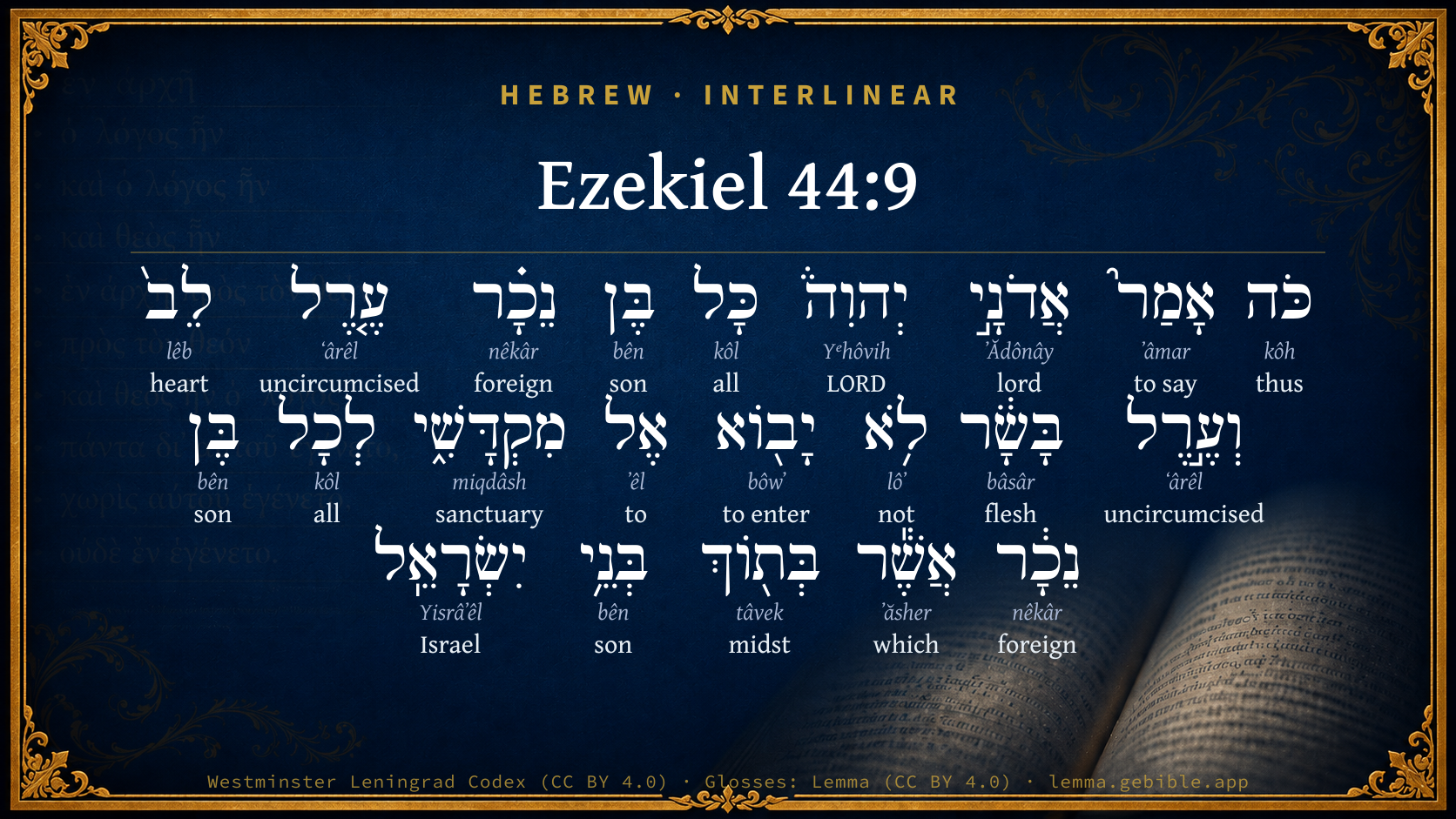
Hebrew (Westminster Leningrad Codex) Ezekiel 44:9 appears in the Hebrew Old Testament. The text above is from the Westminster Leningrad Codex. Each word links to its Strong’s number, a concise gloss, and parsing drawn from the Open Scriptures Hebrew Bible morphology. Click any word for its full Brown-Driver-Briggs (BDB) entry.
Download image
Cite this verse

Ezekiel 44:9 (World English Bible). Public Domain. Lemma interlinear Bible study tool, https://lemma.gebible.app/v/ezekiel/44/9.

Show BibTeX & RIS
BibTeX
RIS
English Translation
Thus says the Lord Yahweh, No foreigner, uncircumcised in heart and uncircumcised in flesh, shall enter into my sanctuary, of any foreigners who are among the children of Israel.
World English Bible · Public Domain
Download a study sheet

One document with this verse’s original text, its word-by-word gloss line, the meaning frame, cross-references with their text, attributed commentary, and full source and license credits — printable, and it pastes into notes with its structure intact.

This verse Autodidact and up

Study sheet (.html) Plain text (.txt)

A passage Seminary Student

Up to 50 verses in one chapter. A passage sheet keeps up to 6 commentary sources and 12 cross-references per verse, in the order this page ranks them, and says so on the sheet whenever that leaves anything out. Ask for a single verse and you get the Autodidact verse sheet above.

Everything on this page stays free to read, with no account — the sheet is a download of what is already on screen, not access to it.

Want to remove ads? Support Godless Engineer
Compare translations 3

The same verse in 3 English versions, stacked beneath the original-language interlinear above. Click any original word for its lexicon entry.

Each is an independent rendering of the whole verse — the interlinear is not word-aligned to these translations.

Highlighted words mark where these versions differ — a whole-verse word diff, not a word-by-word alignment.

  • World English Bible Public Domain
    Thus says the Lord Yahweh, No foreigner, uncircumcised in heart and uncircumcised in flesh, shall enter into my sanctuary, of any foreigners who are among the children of Israel.
  • King James Version Public Domain
    Thus saith the Lord GOD; No stranger, uncircumcised in heart, nor uncircumcised in flesh, shall enter into my sanctuary, of any stranger that is among the children of Israel.
  • unfoldingWord Literal Text CC BY-SA 4.0
    The Lord Yahweh says this: No foreigner, uncircumcised in heart and flesh, from any of those who live among the people of Israel, may enter my holy place.

unfoldingWord Literal Text — © unfoldingWord, licensed CC BY-SA 4.0. Word-aligned USFM3 via Door43 (git.door43.org/unfoldingWord/en_ult).

Versions to compare (up to 4)

3 of 4 selected

Show all 18 translations

Every available English version of this verse, each an independent rendering of the whole verse.

  • World English Bible Public Domain
    Thus says the Lord Yahweh, No foreigner, uncircumcised in heart and uncircumcised in flesh, shall enter into my sanctuary, of any foreigners who are among the children of Israel.
  • Berean Standard Bible Public Domain
    This is what the Lord GOD says: No foreigner uncircumcised in heart and flesh may enter My sanctuary—not even a foreigner who lives among the Israelites.
  • Majority Standard Bible Public Domain
    This is what the Lord GOD says: No foreigner uncircumcised in heart and flesh may enter My sanctuary—not even a foreigner who lives among the Israelites.
  • King James Version Public Domain
    Thus saith the Lord GOD; No stranger, uncircumcised in heart, nor uncircumcised in flesh, shall enter into my sanctuary, of any stranger that is among the children of Israel.
  • American Standard Version (1901) Public Domain
    Thus saith the Lord Jehovah, No foreigner, uncircumcised in heart and uncircumcised in flesh, shall enter into my sanctuary, of any foreigners that are among the children of Israel.
  • Revised Version (1885) Public Domain
    Thus saith the Lord GOD, No alien, uncircumcised in heart and uncircumcised in flesh, shall enter into my sanctuary, of any alien that is among the children of Israel.
  • Geneva Bible (1599) Public Domain
    Thus saieth the Lord God, No stranger vncircumcised in heart, nor vncircumcised in flesh, shall enter into my Sanctuarie, of any stranger that is among the children of Israel,
  • Douay-Rheims (1899) Public Domain
    Thus saith the Lord God: No stranger uncircumcised in heart, and uncircumcised in flesh, shall enter into my sanctuary, no stranger that is in the midst of the children of Israel.
  • Young's Literal Translation Public Domain
    `Thus said the Lord Jehovah: No son of a stranger, uncircumcised of heart, and uncircumcised of flesh, cometh in unto My sanctuary, even any son of a stranger, who `is' in the midst of the sons of Israel,
  • Literal Standard Version CC BY-SA 4.0
    Thus said Lord YHWH: No son of a stranger, uncircumcised of heart, and uncircumcised of flesh, comes into My sanctuary, even any son of a stranger, who [is] in the midst of the sons of Israel.
  • Unlocked Literal Bible CC BY-SA 4.0
    The Lord Yahweh says this: No foreigner, uncircumcised in heart and flesh, from any of those who live among the people of Israel, may enter my holy place.
  • unfoldingWord Literal Text CC BY-SA 4.0
    The Lord Yahweh says this: No foreigner, uncircumcised in heart and flesh, from any of those who live among the people of Israel, may enter my holy place.
  • Darby Bible Public Domain
    Thus saith the Lord Jehovah: No stranger, uncircumcised in heart and uncircumcised in flesh, shall enter into my sanctuary, of any stranger that is among the children of Israel.
  • World Messianic Bible Public Domain
    The Lord GOD says, “No foreigner, uncircumcised in heart and uncircumcised in flesh, shall enter into my sanctuary, of any foreigners who are among the children of Israel.
  • Webster's Bible Public Domain
    Thus saith the Lord GOD; No stranger, uncircumcised in heart, nor uncircumcised in flesh, shall enter into my sanctuary, of any stranger that is among the children of Israel.
  • Free Bible Version CC BY-SA 4.0
    This is what the Lord God says: No unconverted, pagan foreigners are allowed to enter my sanctuary—not even a foreigner who lives with the Israelites.
  • Bible in Basic English Public Domain
    For this cause the Lord has said, No man from a strange land, without circumcision of heart and flesh, of all those who are living among the children of Israel, is to come into my holy place.
  • JPS Tanakh (1917) Public Domain
    Thus saith the Lord GOD: No alien, uncircumcised in heart and uncircumcised in flesh, shall enter into My sanctuary, even any alien that is among the children of Israel.

Literal Standard Version (2020), Covenant Press — licensed CC BY-SA 4.0. Text via the HelloAO Bible API (eBible.org). Unlocked Literal Bible (unfoldingWord) — licensed CC BY-SA 4.0. Text via the HelloAO Bible API (eBible.org). unfoldingWord Literal Text — © unfoldingWord, licensed CC BY-SA 4.0. Word-aligned USFM3 via Door43 (git.door43.org/unfoldingWord/en_ult). Free Bible Version, Dr. Jonathan Gallagher — licensed CC BY-SA 4.0. Text via the HelloAO Bible API (eBible.org).

Word by word

More ways to search: Search by grammar → Find every occurrence → Compare this word →

Practice this passage: Drill this verse → Learn its vocabulary →

עֶ֤רֶל
ʻârêl
H6189
“uncircumcised of”
Adjective, Adjective, Masculine, Singular, Construct
Part of Speech
Adjective
Type
Adjective
Gender
Masculine
Number
Singular
State
Construct
Full BDB Definition

Origin: from H6188

TWOT: 1695b

uncircumcised, having foreskin
  1. כֹּה kôh H3541 “thus” Adverb
  2. אָמַר֮ ʼâmar H559 “to say” Verb, Qal, Perfect, 3rd Person, Masculine, Singular
  3. אֲדֹנָ֣י ʼĂdônây H136 “Lord · my” Noun, Common, Masculine, Plural, Construct + Suffix, Personal, 1st Person, Common, Singular
  4. יְהוִה֒ Yᵉhôvih H3069 “LORD” Noun, Proper
  5. כָּל kôl H3605 “all of” Noun, Common, Masculine, Singular, Construct
  6. בֶּן bên H1121 “son of” Noun, Common, Masculine, Singular, Construct
  7. נֵכָ֗ר nêkâr H5236 “foreign” Noun, Common, Masculine, Singular, Absolute
  8. לֵב֙ lêb H3820 “heart” Noun, Common, Masculine, Singular, Absolute
  9. וְעֶ֣רֶל ʻârêl H6189 “and · uncircumcised of” Conjunction + Adjective, Adjective, Masculine, Singular, Construct
  10. בָּשָׂ֔ר bâsâr H1320 “flesh” Noun, Common, Masculine, Singular, Absolute
  11. לֹ֥א lôʼ H3808 “not” Particle, Negative
  12. יָב֖וֹא bôwʼ H935 “to enter” Verb, Qal, Imperfect, 3rd Person, Masculine, Singular
  13. אֶל ʼêl H413 “to” Preposition
  14. מִקְדָּשִׁ֑י miqdâsh H4720 “sanctuary · my” Noun, Common, Masculine, Singular, Construct + Suffix, Personal, 1st Person, Common, Singular
  15. לְכָל kôl H3605 “to/for · all of” Preposition + Noun, Common, Masculine, Singular, Construct
  16. בֶּן bên H1121 “son of” Noun, Common, Masculine, Singular, Construct
  17. נֵכָ֔ר nêkâr H5236 “foreign” Noun, Common, Masculine, Singular, Absolute
  18. אֲשֶׁ֕ר ʼăsher H834 “which” Particle, Relative
  19. בְּת֖וֹךְ tâvek H8432 “in/at · midst of” Preposition + Noun, Common, Masculine, Singular, Construct
  20. בְּנֵ֥י bên H1121 “sons of” Noun, Common, Masculine, Plural, Construct
  21. יִשְׂרָאֵֽל Yisrâʼêl H3478 “Israel” Noun, Proper

About this verse

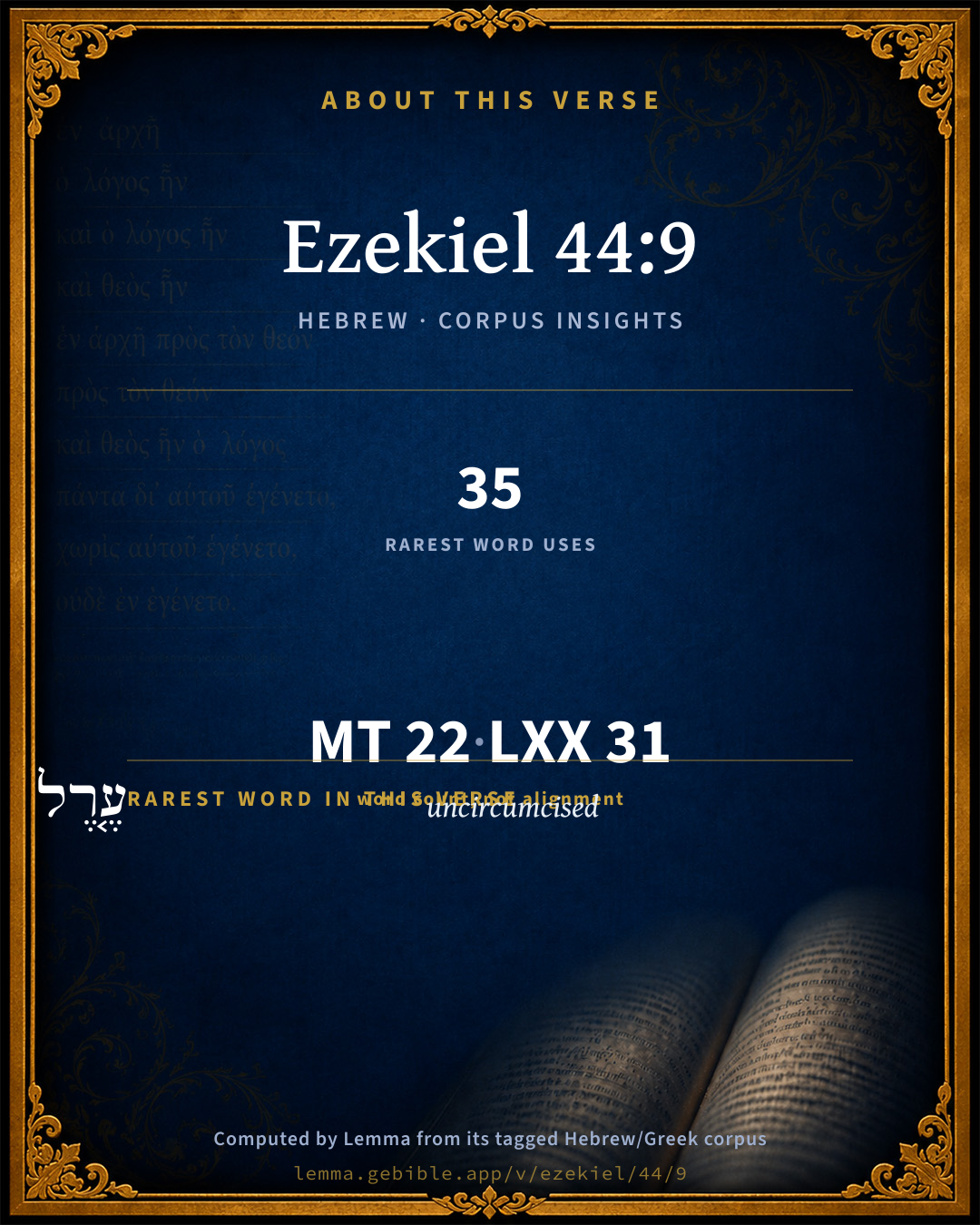
These counts appear in no published source. They are computed here, from the morphology-tagged text and Lemma’s own curated glosses. What Lemma adds →

22
words
17
distinct lemmas
Prophets
section

Shared distinctive vocabulary

עֶ֤רֶל uncircumcised H6189 occurs in 32 verses of the Hebrew Bible. Also found in:

Grammatical profile

  • 2 verbs
  • 14 nouns
  • 2 adjectives
  • 1 preposition
  • 1 adverb
  • 2 particles

Verb forms

  • אָמַר֮ Qal · Perfect
  • יָב֖וֹא Qal · Imperfect

Repetition

Words recur within this verse — often emphatic in Hebrew:

  • בֶּן son H1121 ×3
  • כָּל all H3605 ×2
  • נֵכָ֗ר foreign H5236 ×2
  • עֶ֤רֶל uncircumcised H6189 ×2

Hebrew & Septuagint length

In English translation the verse runs 29 words from the Hebrew and 36 from the Septuagint (LXX English) — closely comparable.

A rough comparison of the two English renderings, which tokenize alike — not a word-level alignment.

Word counts can differ between the Hebrew and the Greek without any difference in meaning — e.g. the Hebrew direct-object marker אֵת has no separate Greek word, and Greek often adds the article ὁ.

In the original languages it is 22 Hebrew tokens and 31 Greek tokens — but the two are counted differently (Hebrew bundles its prefixes and suffixes into one token; the Greek is in lemma form), so that isn’t a like-for-like length.

Cross-references

8

Topical passages linked to Ezekiel 44:9 in the Treasury of Scripture Knowledge — connected by theme and wording, ordered by reader-vote popularity; previews shown in the World English Bible.

  • Joel 3:17 "So you will know that I am Yahweh, your God, Dwelling in Zion, my holy mountain. Then Jerusalem will be holy, And no strangers will pass through her any more.
  • Zechariah 14:21 Yes, every pot in Jerusalem and in Judah will be holy to Yahweh of Hosts; and all those who sacrifice will come and take of them, and cook in them. In that day there will no longer be a Canaanite in the house of Yahweh of Hosts.
  • Ezekiel 44:7 in that you have brought in foreigners, uncircumcised in heart and uncircumcised in flesh, to be in my sanctuary, to profane it, even my house, when you offer my bread, the fat and the blood, and they have broken my covenant, [to add] to all your abominations.
  • Mark 16:16 He who believes and is baptized will be saved; but he who disbelieves will be condemned.
  • John 3:3–5 Jesus answered him, "Most assuredly, I tell you, unless one is born anew, he can't see the Kingdom of God."
  • Psalms 50:16 But to the wicked God says, "What right do you have to declare my statutes, That you have taken my covenant on your lips,
  • Psalms 93:5 Your statutes stand firm. Holiness adorns your house, Yahweh, forevermore.
  • Titus 1:5–9 I left you in Crete for this reason, that you would set in order the things that were lacking, and appoint elders in every city, as I directed you;

Cross-references courtesy of OpenBible.info (CC BY 4.0).

Hebrew and Greek witnesses Masoretic Hebrew ↔ Greek Septuagint

The same verse in the two great witnesses to the Old Testament, shown verse-for-verse.

These are two independent witnesses, not word-aligned to each other, and the Septuagint is shown in lemma (dictionary) form.

Hebrew Ezekiel 44:9 Masoretic · Westminster Leningrad Codex

כֹּה אָמַר֮ אֲדֹנָ֣י יְהוִה֒ כָּל בֶּן נֵכָ֗ר עֶ֤רֶל לֵב֙ וְעֶ֣רֶל בָּשָׂ֔ר לֹ֥א יָב֖וֹא אֶל מִקְדָּשִׁ֑י לְכָל בֶּן נֵכָ֔ר אֲשֶׁ֕ר בְּת֖וֹךְ בְּנֵ֥י יִשְׂרָאֵֽל

Thus says the Lord Yahweh, No foreigner, uncircumcised in heart and uncircumcised in flesh, shall enter into my sanctuary, of any foreigners who are among the children of Israel.

World English Bible · Public Domain

Greek LXX Ezekiel 44:9 Septuagint · lemma form

διά οὗτος ὅδε λέγω κύριος ὁ θεός πᾶς υἱός ἀλλογενής ἀπερίτμητος καρδία καί ἀπερίτμητος σάρξ οὐ εἰςἔρχομαι εἰς ὁ ἅγιος ἐγώ ἐν πᾶς υἱός ἀλλογενής ὁ εἰμί ἐν μέσος οἶκος ἰσραήλ

Therefore thus says the Lord God; No alien, uncircumcised in heart or uncircumcised in flesh, shall enter into my sanctuary, of all the children of strangers that are in the midst of the house of Israel.

LXX2012 (modern English Septuagint) · Public Domain

Hebrew: Westminster Leningrad Codex (CC BY 4.0). Greek: Septuagint (public domain); English from LXX2012 (modern English Septuagint) (Public Domain). How the Septuagint differs from the Hebrew →

Targum (Aramaic paraphrase)

1

The Targum is the ancient Jewish Aramaic paraphrase of the Hebrew Scriptures — an interpretive translation, not the Hebrew text itself. Onkelos (literal) and Pseudo-Jonathan (expansive) render the Torah, and Jonathan the Prophets. Coverage is partial: where no permissively-licensed English translation exists for a verse, only the Aramaic is shown. This is verse-level text, not a word-by-word alignment to the Hebrew.

  1. Targum Jonathan Prophets (Joshua–Malachi)
    כִּדְנַן אֲמַר יְיָ אֱלֹהִים כָּל בַּר עַמְמִין רַשִׁיעֵי לִבָּא וְעַרְלֵי בִסְרָא לָא יַעֲלוּן לְמַקְדְשִׁי לְכָל בְּנֵי עַמְמַיָא דִי בְּגוֹ בְּנֵי יִשְׂרָאֵל:

    (no public-domain English translation for this verse)

    Targum Jonathan — Aramaic: “Mikraot Gedolot” (public domain). English: “Sefaria Community Translation” (CC0 1.0 (public-domain dedication)); “London "Chaldee Paraphrase," 1871” (public domain). Text via Sefaria.

Commentary

Notes on Ezekiel 44:9 from classic Christian and Jewish commentators (each source and its license shown beneath its notes). The classic Christian expositions comment on the surrounding passage and are grouped to its opening verse, so a note may address several verses; the Jewish commentaries on the Tanakh (Rashi and others) are per-verse, so they appear only where the commentator wrote on this verse.

Lemma curates 59 commentaries, every one of them public domain or Creative Commons licensed, each selected and text-cleaned for this edition rather than reprinted as found. About our sources →

Trapp's Complete Commentary

John Trapp

Eze 44:9 Thus saith the Lord GOD; No stranger, uncircumcised in heart, nor uncircumcised in flesh, shall enter into my sanctuary, of any stranger that [is] among the children of Israel.

Ver. 9. Shall enter into my sanctuary.] See a like prohibition in 1Ti 3:3; 1Ti 3:8 Tit 1:7. Such as were the scribes and Pharisees, the Arian bishops, the Popish priests, the cleri (ut vocant) - dehonestamenta among us, till cast out.

John Trapp, A Commentary or Exposition upon All the Books of the Old and New Testament (1647–1656) — public domain. Text from a community e-Sword module.

The Biblical Illustrator

Joseph S. Exell

Eze_44:9-16

No stranger, uncircumcised in heart, nor uncircumcised in flesh, shall enter into My sanctuary.

Gods care of His altar

Is not this rather severe upon the stranger? The injunction does not rest upon the fact of the strangeness of the stranger, because in Eze_47:22-23 there is a distinct provision for the stranger in Israel. God will therefore have the stranger in Israel have his inheritance, his lot; but when it becomes a question of the altar, God naturally looks round for the Levite. In this case the Levite was not present; the Levite had gone away. How had the Levites disqualified themselves? The facts are given in the context and in the text itself. First, in Eze_47:10, they are gone away. The man who has exchanged vows with God should always be found in his place. When he goes away it is like high treason in the army; when such a man goes away it is as if a troop had been cut down with the edge of the sword. Gone away far. Observe that next word. It was not a little lapse, one step aside; but gone away far from Me. You cannot stop one inch away from God; one inch means two, and two inches mean a foot, and the foot soon grows into furlongs and miles. To what had they gone? They went astray from Me after their idols. Here is the prostitution of reason. Here is no theological mystery, but a mystery of daily life,--that a man shall know the true God, and turn away from Him; a man shall know that there is a coming eternity, and yet shall tabernacle himself in the huts of minutes and hours and all the other little details of perishing time. To know the right, and yet the wrong pursue, is the miracle of manhood. But were the Levites without excuse? They had their reasons. There was a general decadence in Israel. In Eze_47:10 we have these awful words--when Israel went astray. It was not the movement of a man or two here and there, or of a Levite or a priest, or an eminent legislator or leader; but all Israel in one great mass, as it were, went away, and the Levites went with them. Were not the Levites justified? May we not follow the times? The Lord will not have it so. It is the part of the Levite to stem the torrent of the crowd. It is the part of great statesmen and great writers and great characters to stop others from doing evil, not to go along with them. The Levites should have stood firm, whatever others did. Yet we must not make a perverted use even of this explanation. There God expects every man to be firm, and we only increase in responsibility as we increase in capacity, in opportunity, in faculty, and in profession. Whilst, therefore, it is quite right to expect that certain men should keep the faith and walk in the right way, our expectancy concerning them is no excuse why we ourselves should go wrong. The Lord will not deal with us in crowds, but in individual relationship to Himself, His throne, and His law. What was the result? Were the Levites wholly discharged? No; the word yet with which the eleventh verse opens point to an exercise of the Divine clemency that is really wonderful, and it is worth while to indicate this in words, because it continues unto this day. The Lord will never give up a man until the man literally wrenches himself out of the Divine grasp. What became of the errant Levites? First, they were deposed, put down to lower work; degraded, we may say, to the second place; taken down one step, three steps, a dozen steps, but still not wholly banished and excommunicated from the service of the sanctuary. Now this may happen with all of us. What some men might have been! They might have led us; instead of that they are put down to menial service. Search into the reason, and you will find there has been a moral lapse, or an intellectual infirmity, or some proof of disqualification. They are not cast into the bottomless pit, they are not put beyond the reach of light and hope and mercy; but it is of necessity that they should be deposed or degraded. What is true of men individually is true of men ecclesiastically. Churches are put into the second place; churches are put back into the third place. The Church that ought to lead the world because of its wealth, its learning, its historical opportunities and advantages, may so act that men who have no name, no status, no background of history, shall come forward by the voice and appointment of God, and lead the world into redemption and liberty and prospect of heaven. Was the Lord then left wholly without faithful men? You find the contrast in Eze_47:15. There is always a contrast in history. We thought in the preceding verses that all Israel had gone astray, we find in the 15th verse that the sons of Zadok kept the charge of My sanctuary when the children of Israel went astray from Me. There has always been a faithful party in the state. There has always been an element of constancy in all the mutation of men and times and institutions. God keeps watch over that permanent quantity; it is as His own ark in the wilderness of time. Sometimes the case of the ark has been brought very low; now and then in history it would seem as if the kingdom of God had been within a very short distance of extinction: but what is a short distance in the estimation of God? A hairs breadth is a universe; if there is one moment between a nation and destruction, in that one moment God can work all the miracles of deliverance. Mans extremity is Gods opportunity. This lies within our province and within our hope, may it lie also within our sense of duty, that it is possible for us though few to be faithful; it is possible when all others have proved faithless for us to be faithful found. (J. Parker, D. D.)

Faithful to our charge

A beautiful story was told by Dr. Cooke, of Belfast, about a gunner at Waterloo. Just as the recruits came up, who were the means of turning, under Wellington, the great battle of modern days, the smoke and noise was so great that he could not see five yards in front of him. But he felt the swaying tides of the battle going this way and that, and did not know at one time whether he was among English or French, friends or foes; and Dr. Cooke asked him afterwards, Well, my friend, and what did you do? I stood by my gun, replied the man. And that is what we have to do.

The Biblical Illustrator, edited by Joseph S. Exell (c. 1880s–1900s) — public domain. Text from a community e-Sword module.

Joseph Benson's Commentary

Eze 44:9-14. No stranger shall enter into my sanctuary — To offer any sacrifice or oblation there, (see Eze 44:7,) nor be suffered to go beyond the precincts appointed for proselytes. The Levites that are gone far from me, &c. — Many of the Levites departed from God’s service, and fell into idolatry; first in the general apostacy of the ten tribes, and afterward under Ahaz, and other wicked kings of Judah: see 2Ki 23:9. These, God here says, should bear the punishment due to their iniquity, and be degraded from attending upon the higher offices belonging to the priesthood, and thrust down to lower services: see Eze 44:13. Many of the priests and Levites, who had been employed in the service of the first temple, lived to see the second, as appears from Ezr 3:12. But the descendants of former idolatrous priests and Levites may be here meant; or, the ordinances here prescribed were intended to be standing rules, which were to be always observed whenever such a case as that here specified should happen. Yet they shall be ministers, &c., having charge at the gates — Performing the office of porters, or other inferior offices belonging to the Levites. They shall slay the burnt-offering, &c. — Shall kill and flay the beasts appointed for the sacrifices. And they shall stand before them, &c. — They shall be servants to the people, in performing the most servile offices belonging to the temple. Because they ministered unto them before their idols, &c. — They led the people into idolatry, by giving them a bad example. Therefore have I lifted up my hand against them — I have solemnly sworn that I will punish them for this their sin. They shall not come near me, &c. — They shall not offer any sacrifice at my altar, or come into the temple to perform any part of the priestly office there. So Josiah discharged the priests that had been guilty of idolatry from attending upon the service of the altar, 2Ki 23:9.

Joseph Benson's Commentary on the Old and New Testaments (1811–1818) — public domain. Text from a community e-Sword module.

Tyndale Open Study Notes

Tyndale Open Resources

44:9 No foreigners: This was not a blanket prohibition against non-Israelite access to the sanctuary. It only affected those who had not been circumcised and have not surrendered themselves to the Lord. Genuine converts could be part of the new Israel (see 47:22-23).

Tyndale Open Study Notes — © Tyndale Open Resources, licensed CC BY-SA 4.0. Text via the HelloAO Bible API.

Ellicott's Commentary for English Readers

(9) Shall enter into my sanctuary.—To guard against the evils of the past, the command is now given that none of the strangers described shall even enter the sanctuary; but our version gives a wrong impression of this prohibition by rendering, “nor uncircumcised in flesh.” It should be, as in Eze_44:7, and. The command is not that no uncircumcised person should be allowed to enter the sanctuary, for the residence of strangers among the Israelites is expressly provided for in Eze_47:22-23; but the emphasis here, as before, is upon the “uncircumcised in heart.” No godless heathen should be allowed to enter in to profane the Divine worship.

A Bible Commentary for English Readers, edited by Charles John Ellicott (1878–1897) — public domain. Text from a community e-Sword module.

The Cambridge Bible for Schools and Colleges

gen. ed. J. J. S. Perowne

9–14. Such services shall not be performed by foreigners any more, but by the Levites who formerly ministered at the high-places. Because of their sin in leading the house of Israel astray they shall bear their iniquity and be excluded from the priesthood.

The Cambridge Bible for Schools and Colleges (gen. ed. J. J. S. Perowne; Cambridge University Press, 1878–1918) — public domain. Text from a community e-Sword module.

John Gill's Exposition

Thus saith the Lord God,.... This that follows is the law and rule to be observed, and which will be observed by the churches in the latter day, though so little regarded now:

no stranger uncircumcised in heart, nor uncircumcised in flesh, shall enter into my sanctuary; of these See Gill on Eze 44:7 unregenerate men may not be admitted members of a Gospel church; for that is holy, and holiness becomes it; but they are unholy, and as unfit to be received as swine into a king's palace; saints and they cannot talk together, their language being different, they are barbarians to one another; nor can they walk together, being not agreed in sentiment and practice; besides, such persons disquiet the churches of Christ by their quarrelsome behaviour in it, and immoral conversation out of it; and are dangerous and infectious persons, whether heterodox in principle, or immoral in life: and much less should such be admitted to public service, to preach the word, and administer ordinances; since they should be holy that bear the vessels of the Lord, his name, and Gospel; they are blind and ignorant, and so not apt and fit to teach others; they are dumb, and cannot speak to cases they are strangers to, as those of wounded consciences, tempted and deserted, or backslidden ones; they will bring in strange doctrines, foreign to the Scriptures, and the experience of saints; and it is no wonder they are unsuccessful in their ministry, and churches do not thrive under them; to which, among other things, we must impute the great decline of religion, even among Protestant dissenters, who, it is to be feared, have too many of this character among them: but there should not be here

of any stranger that is among the children of Israel; though they are among them, nay, though they are the children of them, and have had a religious education; yet being strangers to the grace of God, should not be admitted members, and much less ministers, of the churches of Christ.

John Gill's Exposition of the Whole Bible (1746–1763) — public domain (CC PDM 1.0). Text via the HelloAO Bible API.

Matthew Poole's English Annotations

Now God renews his former law against the permitting of the wicked and heathens to enter his sanctuary. None, of what quality soever, what interest soever they make, though princes, nobles, learned, travellers, that come to view nations and the rarities of them; none of these, or such like, shall on any colour of pretence be brought into my sanctuary. Perhaps Solomon showed Sheba’s queen too much, we are sure Hezekiah showed the ambassadors too much, yet we read not that either of them showed the sanctuary.

Matthew Poole's English Annotations on the Holy Bible (1683–1685) — public domain. Text from a community e-Sword/MySword module.

Whedon's Commentary on the Bible

Daniel D. Whedon

9-16. It is not necessary to suppose, with Wellhausen, that these alien religionists (Eze_44:7-8) had ever been the assistants of the higher order of priests in the inner court. It is far more probable that they had been assistants of the Levites. It is by no means proved that all the Levites up to this time had been accustomed to perform the highest duties of the priesthood, and that the whole tribe was now degraded by Ezekiel to the position which these foreigners had formerly occupied. This is an unproved hypothesis and is opposed to the explicit statements of Scripture. The Levites, as a whole, were themselves the assistants of the higher priestly order (Num_8:19; Num_18:6), and had charge of the vessels, etc., connected with the temple in general, while Aaron and his sons had exclusive charge of the altar sacrifices and vessels of the sanctuary, or inner temple (Num_18:2-6; Num_18:23). Ezekiel does call the Levites priests, but this by no means proves that up to this time all priests (kohanem) had exercised the same functions. As we have shown in the Introduction, “Ezekiel and the Levitical Law,” the surrounding nations in their temple ritual recognized several orders of the priesthood, each having different functions, and this same distinction between the kohanem who were priests in the higher sense and “keepers of the altar” and the kohanem who were priestly Levites and assistants and “keepers of the house,” is made not only in many places in other books, such as 1 and 2 Chronicles, Ezra, and Deuteronomy (Eze_18:1-6), but even in Ezekiel itself (Eze_40:45-46). Such Levites as had, previous to this exercised the higher priestly functions — either by right or by sufferance — seem from Ezekiel’s words to have been leaders in the great apostasy toward idol worship, of which the prophetic and historical books are full, being willing to minister in “high places” and on heathen altars, which Ezekiel himself declares had even been brought into the temple of Jehovah. (See chap. 8; Eze_20:27-30, etc.; compare Jdg_17:12; 2Ki_23:8-9.) For this reason they are from this time to be degraded from this higher office, which is henceforth to be filled only by one branch of the Aaronic family, the Zadokites, which had proved most faithful (1Ki_2:27; 1Ki_2:35). The term kohen (priest), which probably had been taking on gradually a more narrow technical meaning — as in the history of other rituals — now becomes exclusively reserved for the higher order of clergy. (See Introduction.)

Daniel D. Whedon (gen. ed.), Commentary on the Old and New Testaments (1874–1909) — public domain. Text from a community e-Sword module.

The Pulpit Commentary

Vers. 9-16 Accordingly, that no such abuses might creep in to desecrate the temple of the future, a new Torah was promulgated concerning the persons who should have a right to participate in its services. If the "prince" is omitted, the reason probably was that a special section is subsequently devoted to him. (Eze_46:1-8)

The ordinance for the people. No stranger (or, alien), uncircumcised in heart, nor uncircumcised in flesh, shall enter into my sanctuary. The publication of this edict marked a clear advance upon preceding legislation. The old Torah conceded right of access to a foreigner, though uncircumcised, on certain conditions (ver. 7); this new Torah would accord such right of access to a foreigner on no conditions. Even should he be circumcised in the flesh, unless he possessed also that which the bodily mark symbolized, viz. circumcision of heart, he must remain without. Does not this look as if Ezekiel were posterior to the priest-code, rather than vice versa, as Wellhausen contends?

The exclusion of the stranger.

There was a strict exclusiveness about the Hebrew religion. Only the circumcised were to share in its privileges. In regard to outward ordinances and national distinctions, this exclusiveness is destroyed by Christ, and his gospel is free to Gentile as well as Jew, to the uncircumcised as well as the circumcised. (Gal_5:6) Nevertheless, in spite of the new breadth of Christianity, the ideas suggested by the old, narrow exclusiveness still obtain, though now only in spiritual relations.

I THE STRANGER TO GOD IS EXCLUDED FROM THE PRIVILEGES OF RELIGION. It matters not what nation he belongs to; now we have to do with spiritual, not national distinctions. Thus it is possible that the Jew or the Christian may be a stranger to God, while the Gentile and one of a heathen nation may really know and love God. But where the distinction is it does involve serious consequences. It is a mistake to treat a Christian nation as though all its citizens enjoyed the favor of Heaven; and it is a mistake to address a Christian congregation as though all its members were devout men and women. Now, so long as a man is alienated from God, he is excluded from all the highest blessings of the gospel. The door of heaven is shut against the hard, the worldly, the impenitent. Surely some Church discipline should be exercised in regard to those whose alienation from God is undisguised. To keep up the name of Church-fellowship with people in this unhappy condition is to delude them with false hopes.

II THE UNCIRCUMCISED IN HEART ARE STRANGERS TO GOD. Even in the directions that concern the old Jewish ritual this class is named as well as that of the uncircumcised in flesh. The one great question is as to the state of a man"s heart. The uncircumcised heart is given up to sinful naturalism. Pure human nature should be fit for the presence of God, but sinful human nature is not. Unclean and degraded, it needs a spiritual circumcision before it can be accepted by God. In the state of sin man is thus far from God, and so excluded from the privileges of enjoying heavenly Blessings. But the estrangement that results from this sinful condition involves a state of ignorance. Alienated from God, sinful man does not know his loss. He is out in the darkness, a heathen, though bearing the Christian name.

III THE STRANGERS WHO ARE AS YET UNCIRCUMCISED IN HEART MAY BECOME TRUE PEOPLE OF GOD AND ENJOY THE PRIVILEGE OF ACCESS TO GOD. The hindrance must first be removed.

1. There must be a change of heart. The mischief is in the heart; thither the cure must be brought. Thus the first thing is for a man to pray that God would create in him a clean heart. (Psa_51:10)

2. This can only be brought about by a Divine renewal, which may be called the circumcision of the heart. God, and he only, can create, and we need to be new creatures in Christ Jesus.

3. This may be realized through the gospel of Christ. He has come to call in the strangers. By his great all-embracing love he reconciles "them that are afar off" as well as "them that are near." There are now no barriers which the grace of Christ cannot break through. It only remains for the strangers and uncircumcised in heart to avail themselves of that grace by penitent confession of sin and active trust in Christ.

The true circumcision and the true worshipper.

Provisions such as this were no doubt of an educational character, and were intended to teach the Israelites the necessity and the duty of holiness. The consecrated nation was called to present to Jehovah a pure offering. The alien was denied the privileges appointed for the Israelite; being uncircumcised, and not a child of the covenant, he was forbidden access to the holy place.

I THE SANCTUARY WAS A SYMBOL OF THE DIVINE PRESENCE, FELLOWSHIP, AND FAVOR. The Lord"s holy temple was the scene of the especial manifestation vouchsafed by Jehovah to Israel. The Divine presence, naturally ubiquitous, was for a purpose localized. Here was, so to speak, the point of contact between the God of Israel and his chosen people; the media of communication being the sacrifices and services ministered by the consecrated priesthood. Here the acceptance and good will of Jehovah were sealed. They who conformed to Divine appointments were ceremonially justified and cleansed; and they who drew near with hearts prepared to receive a spiritual blessing were abundantly rewarded.

II THE SELECTION OF THE CIRCUMCISED AND CONSECRATED, AND THE EXCLUSION OF THE UNCIRCUMCISED AND THE ALIEN, WERE SYMBOLICAL OF THE SPIRITUAL CONDITIONS OF ACCEPTABLE WORSHIP. No one can suppose that there was "favoritism" in the treatment of worshippers by the just, impartial God; we know that in every nation those who wrought righteousness were accepted. But so far as the temple at Jerusalem was concerned, there were regulations intended to draw attention to the character of true worship, and to the qualifications of acceptable worshippers. No doubt impure Israelites were admitted, and just and benevolent aliens were excluded. But all were taught the indispensable necessity of compliance with Divine regulations, and of the possession of prescribed qualifications. This provision was a preparation for the introduction amongst men of a higher and purer conception of true holiness, that which is not ceremonial, but real.

III IN CHRISTIANITY WE HAVE THE FULFILMENT OF THE TYPE AND PROMISE OF THIS PREPARATORY DISPENSATION. The religion of Christ lays stress upon the new nature, the new heart, the new birth, the new life. It requires a cleansing, a putting off of the old nature, the circumcision of the spirit. It requires a naturalization in the new and Divine kingdom, a citizenship such as no physical birth and no external legislation can impart. A man must be born anew and from above in order to enter into the kingdom of God, of heaven. The conditions of acceptable worship at Jerusalem have to be translated into the language of spiritual reality in order to be applicable to the new dispensation.

IV THE CONDITIONS OF ENTRANCE INTO THE HEBREW SANCTUARY WERE AN ANTICIPATION OF THE TERMS OF HEAVENLY CITIZENSHIP. In this, as in so many passages; the prophecies of Ezekiel point on to the language of the Apocalypse, and the reader of the New Testament interprets these ancient declarations, prescriptions, and promises in the light of the closing book of the canon. The ceremonial preparation required of the Hebrew worshipper prefigured the qualifications laid down as a condition of admission into the celestial temple. Into the abodes of immortal purity there enters nothing that worketh abomination or maketh a lie. The citizens of the heavenly Jerusalem are renewed and purified and thus fitted for the privileges and occupations of the city whose Builder and Maker is God.

Vers. 9-14Divine discrimination.

The prophet is necessarily expressing himself in the terms of the old dispensation; and he declares, in God"s name, that no man who has not received a right spirit ("uncircumcised in heart"), and that no man who has not been admitted to the citizenship of the kingdom of God ("uncircumcised in flesh"), can "enter the sanctuary can come into closest contact with, and render holiest service unto, the Lord (see ver. 9). And he further declares that those of his people who had grievously sinned against him by their guilty apostasy should be excluded from the more sacred offices of the priesthood; yet that they should be admitted to the humbler posts of guarding the doors, of slaying "the sacrificial animals, and of ministering to those priests who were worthier than themselves (vers. 11, 14). The general lesson we learn is that God deals with us graciously and generously, but discriminately. He gives to all his children, but he does not give the same kind, nor does he give the same measure, to all; he is merciful to the penitent, but he does not let his mercy obscure or reduce his righteousness. Those who have done serious wrong "bear their iniquity" (ver. 10), they "bear their shame" (ver. 13); and yet they have their place and do their work in the day of restoration (see vers. 11, 14). In that kingdom of God wherein we now stand we see illustrations of this Divine discrimination in

I THE DISPENSING OF THE DIVINE BOUNTY. God gives much to all his creatures, to all his children; but he gives much more to some than he does to others. Herein is no favoritism or injustice. It is simply the presence of a most desirable variety; the conferring upon every one more than he deserves or can claim, and upon some a very large inheritance of good. Not any one of us is entitled to our being, or our comforts, or our powers; but God, in the fullness of his bounty, gives us these. Shall we complain because there are those to whom he has been even more bountifully than he has to us? Shall we not rather rejoice and be grateful that he has not limited his love as he might well have done? In fact, although very much inequality here is due to our own unwisdom, much is due to the variety in the Divine distribution. To some he gives more vigorous health, a clearer or more active mind, a stronger will, a fuller or longer life. Surely gratitude and not complaint is the note of the wise and the good.

II THE DIVERSITY OF THE DIVINE BESTOWAL OF "GIFTS." While there is no one who may not and who should not bring his contribution to the cause of Christ and of man, it is clear that some may do a much higher and a much greater work than others can. To some it is given to guard the door only; to others to present the sacrifice unto the Lord. Some with a feeble intelligence and a scanty knowledge may be quite equal to a humble post; others with versatile and vigorous powers and a well-stored mind may render most important and vital service. And there are many degrees between the humblest and the highest office in the Christian ranks. Let every man feel that to be or to do anything for Christ is a joy and an honor; let those who are invited to the "chief seats" remind themselves that they "have nothing which they have not received," and let them do everything "as with the ability which God giveth.

III THE EXERCISE OF DIVINE MERCY. The "Levites that went astray after their idols" were to receive the Divine mercy; they were to be restored to their place in the commonwealth of Israel; they were to be admitted to service at and indeed in the sanctuary (see vers. 11, 14); but they could not wholly regain what they had lost; some of their iniquity (or shame, ver. 13) they would have to bear; at a certain point their privileges stopped. Now, in the kingdom of Christ, we have the same kind of Divine discrimination.

1. There is mercy for those who have gone furthest astray. Into whatever alienation of heart, rejection by the mind, guiltiness of behavior, they have wandered, there is forgiveness to be had in Jesus Christ.

2. The mercy of God means much. It means the absolute pardon of all past sin; the restoration of the soul to the favor and the friendship of God; access, full and free, to his praise, his throne, his table; liberty to serve him in the broad field of sacred usefulness.

3. But there is some serious and necessary qualification. They who have gone very far into wrong-doing, or have spent many years in sinful estrangement, must "bear their iniquity" in one sense they must suffer the injury which their sin has wrought in the formation of evil habits (mental or physical) which cannot be immediately cast forth; in the loss of reputation which cannot be at once regained; in the enfeeblement of the soul (or, at any rate, the loss of strength and influence that might have been acquired) which has to be endured. Sin means some considerable measure of absolutely irreparable loss. C.

The Pulpit Commentary (1880–1919), ed. H.D.M. Spence-Jones & Joseph S. Exell — public domain. Text from a community e-Sword module.

Lesson kit

Teaching starters — assembled from the data on this page, not authored interpretation. Every prompt links to the verse data it draws on. Edit before teaching.

Ezekiel, in the Prophets, opens this verse with 22 words (17 distinct Hebrew lemmas). Its most distinctive word is ʻârêl (“uncircumcised”). A historical commentator’s framing appears above. Read the whole chapter for the surrounding context.

Discussion questions

  1. The word ʻârêl carries the sense “uncircumcised.” How does it shape the verse?
  2. Genesis 17:14 shares the word «uncircumcised» with this verse. How do the two illuminate each other?
  3. “son” occurs 3× in this one verse. What is the effect of the repetition?
  4. The translations on this page render this verse differently — a whole-verse word diff, not a word-by-word alignment. What might account for the different wordings?
  5. The verb «אָמַר֮» is Qal Perfect. How does its form color the action?
  6. Reading how Trapp's Complete Commentary and The Biblical Illustrator read this verse, where do the two commentators agree and where do they part?

Things to notice

Reading settings

Reading text

Shown beneath each verse's original-language words.

Old Testament
Old Testament edition

Read the OT as the Masoretic Hebrew (MT) or the Greek Septuagint (LXX).

English shown for the Greek Septuagint (in the Hebrew ↔ Greek comparison).

Comparing translations? Open the Compare panel on any verse page to stack up to four side by side.