Genesis 13:18

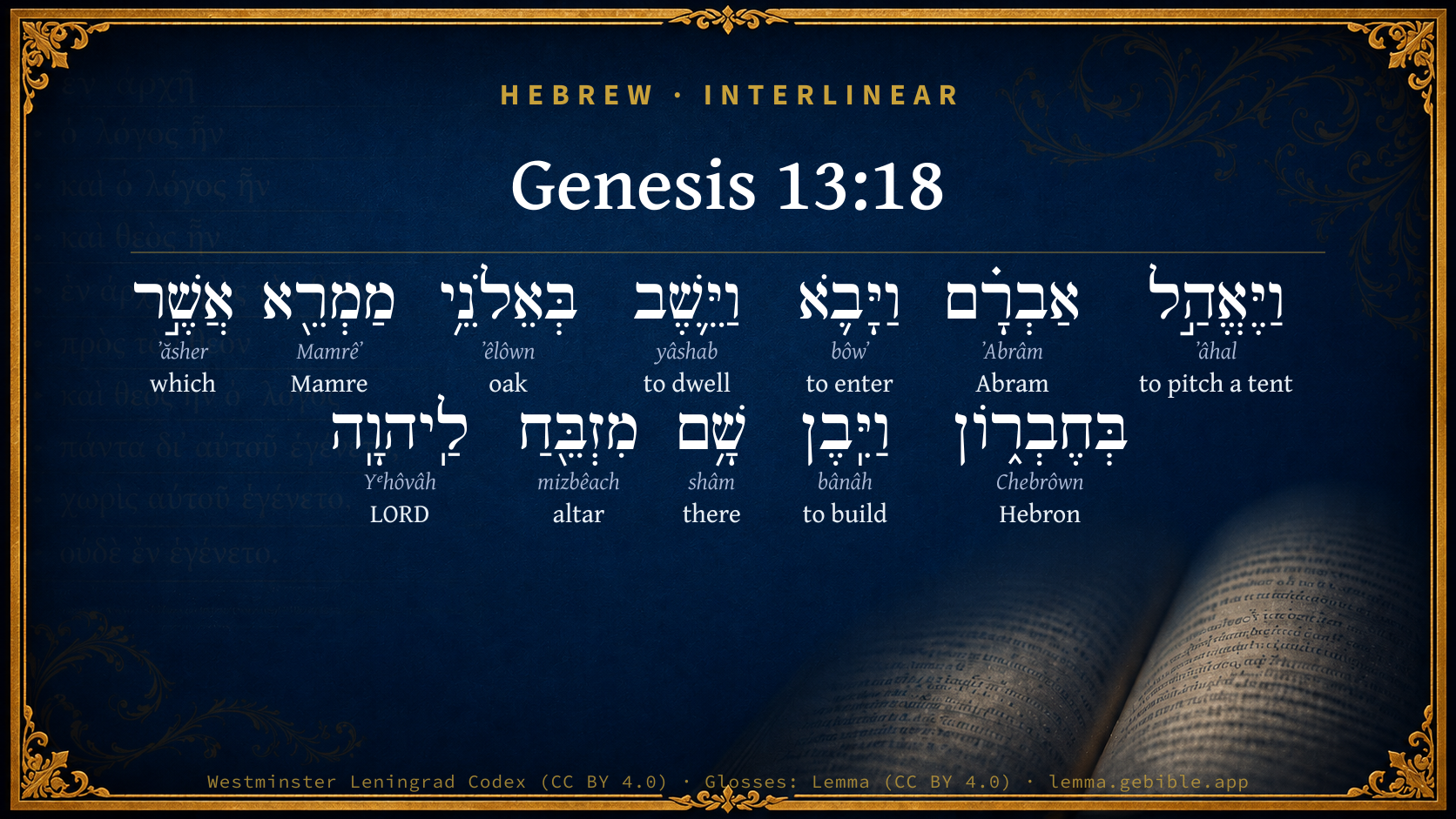
Hebrew (Westminster Leningrad Codex) Genesis 13:18 appears in the Hebrew Old Testament. The text above is from the Westminster Leningrad Codex. Each word links to its Strong’s number, a concise gloss, and parsing drawn from the Open Scriptures Hebrew Bible morphology. Click any word for its full Brown-Driver-Briggs (BDB) entry.
Download image
Cite this verse

Genesis 13:18 (World English Bible). Public Domain. Lemma interlinear Bible study tool, https://lemma.gebible.app/v/genesis/13/18.

Show BibTeX & RIS
BibTeX
RIS
English Translation
Abram moved his tent, and came and lived by the oaks of Mamre, which are in Hebron, and built an altar there to Yahweh.
World English Bible · Public Domain
Highlights
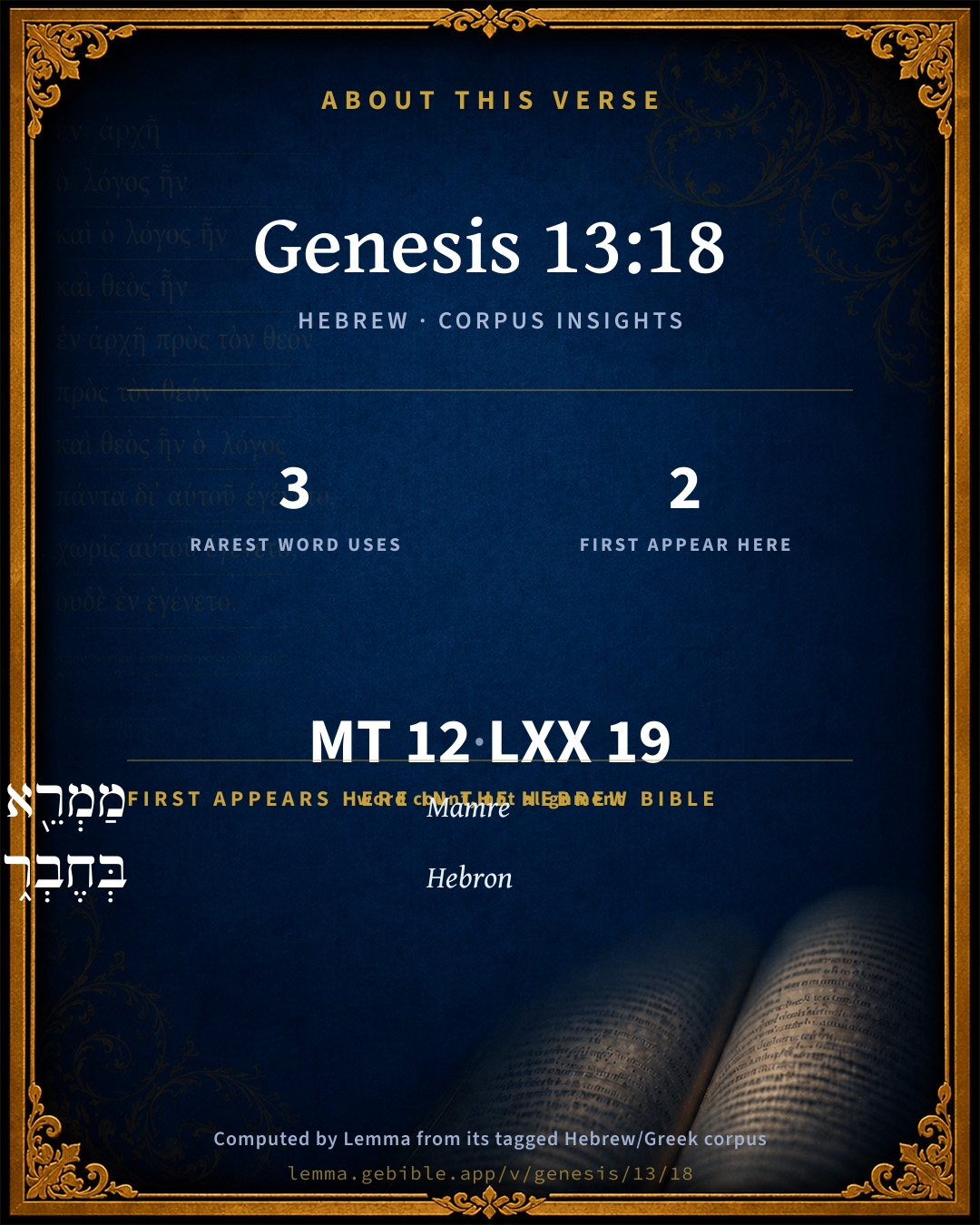
  • 2 first appearances in the Hebrew Bible
Full analysis ↓
Download a study sheet

One document with this verse’s original text, its word-by-word gloss line, the meaning frame, cross-references with their text, attributed commentary, and full source and license credits — printable, and it pastes into notes with its structure intact.

This verse Autodidact and up

Study sheet (.html) Plain text (.txt)

A passage Seminary Student

Up to 50 verses in one chapter. A passage sheet keeps up to 6 commentary sources and 12 cross-references per verse, in the order this page ranks them, and says so on the sheet whenever that leaves anything out. Ask for a single verse and you get the Autodidact verse sheet above.

Everything on this page stays free to read, with no account — the sheet is a download of what is already on screen, not access to it.

Want to remove ads? Support Godless Engineer
Compare translations 3

The same verse in 3 English versions, stacked beneath the original-language interlinear above. Click any original word for its lexicon entry.

Each is an independent rendering of the whole verse — the interlinear is not word-aligned to these translations.

Highlighted words mark where these versions differ — a whole-verse word diff, not a word-by-word alignment.

  • World English Bible Public Domain
    Abram moved his tent, and came and lived by the oaks of Mamre, which are in Hebron, and built an altar there to Yahweh.
  • King James Version Public Domain
    Then Abram removed his tent, and came and dwelt in the plain of Mamre, which is in Hebron, and built there an altar unto the LORD.
  • unfoldingWord Literal Text CC BY-SA 4.0
    So Abram moved his tents and went and settled by the terebinth trees of Mamre that near Hebron, and there he built an altar to Yahweh.

unfoldingWord Literal Text — © unfoldingWord, licensed CC BY-SA 4.0. Word-aligned USFM3 via Door43 (git.door43.org/unfoldingWord/en_ult).

Versions to compare (up to 4)

3 of 4 selected

Show all 18 translations

Every available English version of this verse, each an independent rendering of the whole verse.

  • World English Bible Public Domain
    Abram moved his tent, and came and lived by the oaks of Mamre, which are in Hebron, and built an altar there to Yahweh.
  • Berean Standard Bible Public Domain
    So Abram moved his tent and went to live near the Oaks of Mamre at Hebron, where he built an altar to the LORD.
  • Majority Standard Bible Public Domain
    So Abram moved his tent and went to live near the Oaks of Mamre at Hebron, where he built an altar to the LORD.
  • King James Version Public Domain
    Then Abram removed his tent, and came and dwelt in the plain of Mamre, which is in Hebron, and built there an altar unto the LORD.
  • American Standard Version (1901) Public Domain
    And Abram moved his tent, and came and dwelt by the oaks of Mamre, which are in Hebron, and built there an altar unto Jehovah.
  • Revised Version (1885) Public Domain
    And Abram moved his tent, and came and dwelt by the oaks of Mamre, which are in Hebron, and built there an altar unto the LORD.
  • Geneva Bible (1599) Public Domain
    Then Abram remoued his tent, and came and dwelled in the plaine of Mamre, which is in Hebron, and builded there an altar vnto ye Lord.
  • Douay-Rheims (1899) Public Domain
    So Abram removing his tent came and dwelt by the vale of Mambre, which is in Hebron: and he built there an altar to the Lord.
  • Young's Literal Translation Public Domain
    And Abram tenteth, and cometh, and dwelleth among the oaks of Mamre, which `are' in Hebron, and buildeth there an altar to Jehovah.
  • Literal Standard Version CC BY-SA 4.0
    And Abram moves [his] tent, and comes, and dwells among the oaks of Mamre, which [are] in Hebron, and builds there an altar to YHWH.
  • Unlocked Literal Bible CC BY-SA 4.0
    So Abram picked up his tent, and came and lived by the oaks of Mamre, which are in Hebron, and there built an altar to Yahweh.
  • unfoldingWord Literal Text CC BY-SA 4.0
    So Abram moved his tents and went and settled by the terebinth trees of Mamre that near Hebron, and there he built an altar to Yahweh.
  • Darby Bible Public Domain
    Then Abram moved [his] tents, and came and dwelt by the oaks of Mamre, which are in Hebron. And he built there an altar to Jehovah.
  • World Messianic Bible Public Domain
    Abram moved his tent, and came and lived by the oaks of Mamre, which are in Hebron, and built an altar there to the LORD.
  • Webster's Bible Public Domain
    Then Abram removed his tent, and came and dwelt in the plain of Mamre, which is in Hebron, and built there an altar to the LORD.
  • Free Bible Version CC BY-SA 4.0
    So Abram went to live at Hebron, setting up his tents among the oaks at Mamre, where he built an altar to the Lord.
  • Bible in Basic English Public Domain
    And Abram, moving his tent, came and made his living-place by the holy tree of Mamre, which is in Hebron, and made an altar there to the Lord.
  • JPS Tanakh (1917) Public Domain
    And Abram moved his tent, and came and dwelt by the terebinths of Mamre, which are in Hebron, and built there an altar unto the LORD.

Literal Standard Version (2020), Covenant Press — licensed CC BY-SA 4.0. Text via the HelloAO Bible API (eBible.org). Unlocked Literal Bible (unfoldingWord) — licensed CC BY-SA 4.0. Text via the HelloAO Bible API (eBible.org). unfoldingWord Literal Text — © unfoldingWord, licensed CC BY-SA 4.0. Word-aligned USFM3 via Door43 (git.door43.org/unfoldingWord/en_ult). Free Bible Version, Dr. Jonathan Gallagher — licensed CC BY-SA 4.0. Text via the HelloAO Bible API (eBible.org).

Word by word

More ways to search: Search by grammar → Find every occurrence → Compare this word →

Practice this passage: Drill this verse → Learn its vocabulary →

וַיֶּאֱהַ֣ל
ʼâhal
H167
“and · to pitch a tent”
Conjunction + Verb, Qal, Sequential Imperfect, 3rd Person, Masculine, Singular
Part of Speech
Conjunction + Verb
Stem
Qal
Form
Sequential Imperfect
Person
3rd Person
Gender
Masculine
Number
Singular
Full BDB Definition

Origin: a denominative from H168

TWOT: 32

to pitch a tent, to move a tent - (Qal) pitch or remove a tent - (Piel) to pitch one's tent
  1. אַבְרָ֗ם ʼAbrâm H87 “Abram” Noun, Proper
  2. וַיָּבֹ֛א bôwʼ H935 “and · to enter” Conjunction + Verb, Qal, Sequential Imperfect, 3rd Person, Masculine, Singular
  3. וַיֵּ֛שֶׁב yâshab H3427 “and · to dwell” Conjunction + Verb, Qal, Sequential Imperfect, 3rd Person, Masculine, Singular
  4. בְּאֵלֹנֵ֥י ʼêlôwn H436 “in/at · oaks of” Preposition + Noun, Common, Masculine, Plural, Construct
  5. מַמְרֵ֖א Mamrêʼ H4471 “Mamre” Noun, Proper
  6. אֲשֶׁ֣ר ʼăsher H834 “which” Particle, Relative
  7. בְּחֶבְר֑וֹן Chebrôwn H2275 “in/at · Hebron” Preposition + Noun, Proper
  8. וַיִּֽבֶן bânâh H1129 “and · to build” Conjunction + Verb, Qal, Sequential Imperfect, 3rd Person, Masculine, Singular
  9. שָׁ֥ם shâm H8033 “there” Adverb
  10. מִזְבֵּ֖חַ mizbêach H4196 “altar” Noun, Common, Masculine, Singular, Absolute
  11. לַֽיהוָֽה Yᵉhôvâh H3068 “to/for · LORD” Preposition + Noun, Proper

About this verse

These counts appear in no published source. They are computed here, from the morphology-tagged text and Lemma’s own curated glosses. What Lemma adds →

12
words
12
distinct lemmas
Pentateuch
section

Notable vocabulary

The rarest word here is וַיֶּאֱהַ֣ל to pitch a tent H167 — appearing just 3 times in the whole Hebrew Bible.

First appearance in Scripture

These words make their first canonical appearance in the Hebrew Bible here:

  • מַמְרֵ֖א Mamre H4471
  • בְּחֶבְר֑וֹן Hebron H2275

Shared distinctive vocabulary

וַיֶּאֱהַ֣ל to pitch a tent H167 occurs in 3 verses of the Hebrew Bible. Also found in:

Grammatical profile

  • 4 verbs
  • 6 nouns
  • 1 adverb
  • 1 particle

Verb forms

  • וַיֶּאֱהַ֣ל Qal · Sequential Imperfect
  • וַיָּבֹ֛א Qal · Sequential Imperfect
  • וַיֵּ֛שֶׁב Qal · Sequential Imperfect
  • וַיִּֽבֶן Qal · Sequential Imperfect

Hebrew & Septuagint length

In English translation the verse runs 24 words from the Hebrew and 27 from the Septuagint (LXX English) — closely comparable.

A rough comparison of the two English renderings, which tokenize alike — not a word-level alignment.

Word counts can differ between the Hebrew and the Greek without any difference in meaning — e.g. the Hebrew direct-object marker אֵת has no separate Greek word, and Greek often adds the article ὁ.

In the original languages it is 12 Hebrew tokens and 19 Greek tokens — but the two are counted differently (Hebrew bundles its prefixes and suffixes into one token; the Greek is in lemma form), so that isn’t a like-for-like length.

Cross-references

12

Topical passages linked to Genesis 13:18 in the Treasury of Scripture Knowledge — connected by theme and wording, ordered by reader-vote popularity; previews shown in the World English Bible.

  • Genesis 8:20 Noah built an altar to Yahweh, and took of every clean animal, and of every clean bird, and offered burnt offerings on the altar.
  • Genesis 14:13 One who had escaped came and told Abram, the Hebrew. Now he lived by the oaks of Mamre, the Amorite, brother of Eshcol, and brother of Aner; and these were allies of Abram.
  • Genesis 18:1 Yahweh appeared to him by the oaks of Mamre, as he sat in the tent door in the heat of the day.
  • Genesis 35:27 Jacob came to Isaac his father, to Mamre, to Kiriath Arba (the same is Hebron), where Abraham and Isaac lived as foreigners.
  • Genesis 12:7–8 Yahweh appeared to Abram, and said, "I will give this land to your seed." He built an altar there to Yahweh, who appeared to him.
  • Psalms 16:8 I have set Yahweh always before me. Because he is at my right hand, I shall not be moved.
  • Genesis 13:4 to the place of the altar, which he had made there at the first. There Abram called on the name of Yahweh.
  • Genesis 37:14 He said to him, "Go now, see whether it is well with your brothers, and well with the flock; and bring me word again." So he sent him out of the valley of Hebron, and he came to Shechem.
  • Numbers 13:22 They went up by the South, and came to Hebron; and Ahiman, Sheshai, and Talmai, the children of Anak, were there. (Now Hebron was built seven years before Zoan in Egypt.)
  • 1 Timothy 2:8 I desire therefore that the men in every place pray, lifting up holy hands without wrath and doubting.
  • Joshua 14:13 Joshua blessed him; and he gave Hebron to Caleb the son of Jephunneh for an inheritance.
  • Genesis 23:2 Sarah died in Kiriath Arba (the same is Hebron), in the land of Canaan. Abraham came to mourn for Sarah, and to weep for her.

Cross-references courtesy of OpenBible.info (CC BY 4.0).

Hebrew and Greek witnesses Masoretic Hebrew ↔ Greek Septuagint

The same verse in the two great witnesses to the Old Testament, shown verse-for-verse.

These are two independent witnesses, not word-aligned to each other, and the Septuagint is shown in lemma (dictionary) form.

Hebrew Genesis 13:18 Masoretic · Westminster Leningrad Codex

וַיֶּאֱהַ֣ל אַבְרָ֗ם וַיָּבֹ֛א וַיֵּ֛שֶׁב בְּאֵלֹנֵ֥י מַמְרֵ֖א אֲשֶׁ֣ר בְּחֶבְר֑וֹן וַיִּֽבֶן שָׁ֥ם מִזְבֵּ֖חַ לַֽיהוָֽה

Abram moved his tent, and came and lived by the oaks of Mamre, which are in Hebron, and built an altar there to Yahweh.

World English Bible · Public Domain

Greek LXX Genesis 13:18 Septuagint · lemma form

καί ἀποσκηνόω αβραμ ἔρχομαι καταοἰκέω παρά ὁ δρῦς ὁ μαμβρη ὅς εἰμί ἐν χεβρων καί οἰκοδομέω ἐκεῖ θυσιαστήριον κύριος

And Abram having removed his tent, came and lived by the oak of Mambre, which was in Chebrom, and he there built an altar to the Lord.

LXX2012 (modern English Septuagint) · Public Domain

Hebrew: Westminster Leningrad Codex (CC BY 4.0). Greek: Septuagint (public domain); English from LXX2012 (modern English Septuagint) (Public Domain). How the Septuagint differs from the Hebrew →

Targum (Aramaic paraphrase)

2

The Targum is the ancient Jewish Aramaic paraphrase of the Hebrew Scriptures — an interpretive translation, not the Hebrew text itself. Onkelos (literal) and Pseudo-Jonathan (expansive) render the Torah, and Jonathan the Prophets. Coverage is partial: where no permissively-licensed English translation exists for a verse, only the Aramaic is shown. This is verse-level text, not a word-by-word alignment to the Hebrew.

  1. Targum Onkelos Torah (Genesis–Deuteronomy)
    וּפְרַס אַבְרָם וַאֲתָא וִיתֵב בְּמֵישְׁרֵי מַמְרֵא דִי בְחֶבְרוֹן וּבְנָא תַמָן מַדְבְּחָא קֳדָם יְיָ

    And Abram spread (his tent), and came and dwelt in the plain of Mamre which is near Hebron, and builded there an altar before the Lord.

    Targum Onkelos — Aramaic: “Onkelos Genesis” (public domain); “Onkelos Exodus” (public domain); “Onkelos Leviticus” (public domain); “Onkelos Numbers” (public domain); “Onkelos Deuteronomy” (public domain). English: “Sefaria Community Translation” (CC0 1.0 (public-domain dedication)); “J.W. Etheridge. The Targums of Onkelos and Jonathan Ben Uzziel on the Pentateuch. London: Longmans, Green, 1862” (public domain). Text via Sefaria.

  2. Targum Pseudo-Jonathan Torah (Genesis–Deuteronomy)
    וּפְרַס אַבְרָם לְמַשְׁכְּנֵיהּ תַיְירִין אִימוֹר (ס"א משׁכוני לתירי ואמרי) וְאָתָא וְיָתִיב בְּחֵיזוֹ מַמְרֵא דִי בְּחֶבְרוֹן וּבְנָא תַמָן מַדְבְּחָא קֳדָם יְיָ

    And Abram stretched his tent (and made folds) for oxen and sheep, and came and dwelt in the vale of Mamre which is in Hebron, and builded there an altar before the Lord.

    Targum Pseudo-Jonathan — Aramaic: “Targum Jonathan on Genesis” (public domain); “Targum Jonathan on Exodus” (public domain); “Targum Jonathan on Leviticus” (public domain); “Targum Jonathan on Numbers” (public domain); “Targum Jonathan on Deuteronomy” (public domain). English: “The Targum of Jonathan ben Uzziel, trans. J. W. Etheridge, London, 1862” (public domain). Text via Sefaria.

Commentary

Notes on Genesis 13:18 from classic Christian and Jewish commentators (each source and its license shown beneath its notes). The classic Christian expositions comment on the surrounding passage and are grouped to its opening verse, so a note may address several verses; the Jewish commentaries on the Tanakh (Rashi and others) are per-verse, so they appear only where the commentator wrote on this verse.

Lemma curates 59 commentaries, every one of them public domain or Creative Commons licensed, each selected and text-cleaned for this edition rather than reprinted as found. About our sources →

Trapp's Complete Commentary

John Trapp

Gen 13:18 Then Abram removed [his] tent, and came and dwelt in the plain of Mamre, which [is] in Hebron, and built there an altar unto the LORD.

Ver. 18. Built an altar.] {See Trapp on "Gen 12:8"}

John Trapp, A Commentary or Exposition upon All the Books of the Old and New Testament (1647–1656) — public domain. Text from a community e-Sword module.

The Biblical Illustrator

Joseph S. Exell

Gen_13:18

Abram removed his tent, and came and dwelt in the plain of Mature, which is in Hebron, and built there an altar unto the Lord.

Mamre

Mamre is the first village that comes before us distinctly in any authentic history. If Ararat was the cradle of the races of our world, Mamre was the cradle of the Church.

I. MAMRE WAS A CHURCH AMONG THE TREES.

II. IT WAS A REFUGE FOR FAITH. Abraham and the patriarchs were emigrants; they left for the honour of God. The East is full of traditions concerning Abraham and his hatred to idolatry, and how he forsook the worship of the fire and the sun. He had come from the neighbourhood where the Babel society was founded--faith, not in God, but in bricks--it had all ended in confusion, but the sacred memories of Mamre, where Abraham reared an altar to the Lord, these linger and send out their influence still. A high faithfulness ruled the life of Mature, the life of domestic piety--the first story given us of the life of faith, where Abraham raised an altar and called upon the name of the Lord.

III. The village of Mamre was THE VILLAGE OF SACRED PROMISE. What night was that, when among its moorlands the Lord appeared unto Abraham in a vision and consecrated those heights by the glowing promises which we still recognize as true? In that little mountain hamlet was given the promise of the Messiahs reign.

IV. Mamre: WHAT GUESTS CAME THITHER? Here was that great entertainment made, where, says quaint Thomas Fuller, the covert of the tree was the dining room, probably the ground the board, Abraham the caterer, and Sarah the cook; a welcome their cheer; angels, and Christ in the notion of an angel, their guests.

V. At Mamre are THE OLDEST AUTHENTIC GRAVES OF THIS EARTH--among them the grave of Abraham, the friend of God. (E. Paxton Hood.)

Abrams altar

Abrams altar was intended--

1. As a public profession of religion in the midst of enemies.

2. As a constant memorial of Gods presence.

3. As a tribute of gratitude for His mercies.

4. As expressing a sense of obligation to His love, and a desire to enjoy His presence.

5. As a sign of his determination to be fully dedicated to God. (T. H.Leale.)

Lessons

1. Faith gives immediate obedience unto Gods advice.

2. Grace will untent souls anywhere, to go where God will have them.

3. God sometimes scatters brethren in the Church to carry saving knowledge to strangers; so here with Abrams motions.

4. God sometimes makes the places of His Churchs habitation memorable.

5. The faithful cannot sit down quietly in any place without God.

6. Gods promise draweth out the saints worship of, and sacrifice to, Him.

7. Saints worship is such as is instituted by God only, a single altar.

8. Gods faithful ones desire to instruct others in the worship of

God, so Abram to Mamre.

9. Jehovah terminates all his saints worship and obedience. It is all to Jehovah (Gen_13:18). (G. Hughes, B. D.)

Hebron

From Bethel, Abraham travelled southward till he pitched his tents in the oak grove of Mamre, at Hebron, situated in a cool and elevated region, and commanding a fertile region; about twenty-two Roman miles south of Jerusalem, and belonging to the later territory of Judah. Hebron was one of the oldest towns of Palestine; it was built seven years before Tanis in Egypt; and was early the residence of a heathen king. However, it was, by Joshua, appointed as one of the cities of refuge, and assigned to the Levites; it thus assumed the character of a holy town where vows were taken and performed; and David chose it as his abode when he was king of Judah, during seven years and a half. These circumstances suffice to explain the interest evinced for Hebron in the history of the patriarchs; Abraham resided here when the angels made him the happy announcement of the birth of a son; here he acquired the first territorial property in Canaan; and here was the burial place of himself, of Isaac, and of Jacob, of Sarah, Rebekah, and Leah. The town was, therefore, appropriately distinguished by the erection of an altar (verse 18). Later, it was fortified by Rehoboam among many other cities; it is still mentioned after the exile; it then belonged to the Idumeans, who were, however, expelled from it by Judas Maccabaeus; in the Roman war, it was captured and burnt by the enemies, without, however, being destroyed. In the period of the Crusades, after having, for a time, suffered from heavy attacks, it was made the seat of the bishopric of St. Abraham (in 1167), but returned already in 1187 into the possession of the Moslems, who have ever since retained it, though it was several times assailed and plundered by rebellious pachas or lawless chiefs. In the fifteenth century, it was distinguished by a magnificent hospital and general charity for the distribution of bread and other necessaries to strangers. The present Hebron is a large village rather than a town; it counts among its inhabitants about a hundred Jewish families, living together in a separate quarter; as, in fact, Jews, though often ill-treated, oppressed, and insulted, seem always to have lived in the town, with few interruptions; but it is not unimportant in its commerce, though it is chiefly celebrated for its glass works, which form the principal articles of export. It is surrounded by elevations, containing the highest peaks in the range of the mountains of Judah. Its blooming vicinity, with its vineyards and orchards, its wells, its rich pastures and numerous flocks and herds, is one of the proofs that the care of the agriculturist may still convert Palestines desolation into smiling prosperity. The tombs of the patriarchs and of their wives, situated at the eastern end of Hebron on the slope of a ravine, attracted continually the visits of travellers; over the cave of Machpelah, called Al Magr by the Arabians, and surrounded by a high and strong wall, a mosque was erected which the Moslems regard as one of the four holiest sanctuaries of the world, from which Christians are excluded, and which stratagem only has enabled a few Europeans to enter. The town itself was, from that structure, called the Castle of Abraham, and received, therefore, from the Mohammedans the name of Bet El-Khalil, that is, the house of the Friend of God, which is the honorary title given to Abram by the Arabians. (M. M. Kalisch, Ph. D.)

.

The Biblical Illustrator, edited by Joseph S. Exell (c. 1880s–1900s) — public domain. Text from a community e-Sword module.

Tyndale Open Study Notes

Tyndale Open Resources

13:18 Hebron was an Anakite city (Num 13:22) originally called Kiriath-arba (“city of Arba”), located in forested highlands just north of the Negev (Gen 12:9; Josh 17:15). Abraham, Isaac, and Jacob all settled there (Gen 18:1; 35:27; 37:14), and Sarah, Abraham, Isaac, Rebekah, Jacob, and Leah were buried there (23:19; 35:27-29; 49:29-32; 50:13). • Mamre was an Amorite (14:13; 15:16).

Tyndale Open Study Notes — © Tyndale Open Resources, licensed CC BY-SA 4.0. Text via the HelloAO Bible API.

Jamieson, Fausset & Brown

Robert Jamieson, A. R. Fausset & David Brown

the plain of Mamre . . . built . . . an altar--the renewal of the promise was acknowledged by Abram by a fresh tribute of devout gratitude.

Next: Genesis Chapter 14

Jamieson, Fausset & Brown — Commentary Critical and Explanatory on the Whole Bible (1871) — public domain (CC PDM 1.0). Text via the HelloAO Bible API.

Adam Clarke's Commentary

Verse 18. Abram removed his tent] Continued to travel and pitch in different places, till at last he fixed his tent in the plain, or by the oak, of Mamre, see Ge 12:6, which is in Hebron; i.e., the district in which Mamre was situated was called Hebron. Mamre was an Amorite then living, with whom Abram made a league, Ge 14:13; and the oak probably went by his name, because he was the possessor of the ground. Hebron is called Kirjath-arba, Ge 23:2; but it is very likely that Hebron was its primitive name, and that it had the above appellation from being the residence of four gigantic or powerful Anakim, for Kirjath-arba literally signifies the city of the four; See Clarke on Ge 23:2.

Built there an altar unto the Lord.] On which he offered sacrifice, as the word מזבח mizbach, from זבח zabach, to slay, imports.

THE increase of riches in the family of Abram must, in the opinion of many, be a source of felicity to them. If earthly possessions could produce happiness, it must be granted that they had now a considerable share of it in their power. But happiness must have its seat in the mind, and, like that, be of a spiritual nature; consequently earthly goods cannot give it; so far are they from either producing or procuring it, that they always engender care and anxiety, and often strifes and contentions. The peace of this amiable family had nearly been destroyed by the largeness of their possessions. To prevent the most serious misunderstandings, Abram and his nephew were obliged to separate. He who has much in general wishes to have more, for the eye is not satisfied with seeing. Lot, for the better accommodation of his flocks and family, chooses the most fertile district in that country, and even sacrifices reverence and filial affection at the shrine of worldly advantage; but the issue proved that a pleasant worldly prospect may not be the most advantageous, even to our secular affairs. Abram prospered greatly in the comparatively barren part of the land, while Lot lost all his possessions, and nearly the lives of himself and family, in that land which appeared to him like the garden of the Lord, like a second paradise. Rich and fertile countries have generally luxurious, effeminate, and profligate inhabitants; so it was in this case. The inhabitants of Sodom were sinners, and exceedingly wicked, and their profligacy was of that kind which luxury produces; they fed themselves without fear, and they acted without shame. Lot however was, through the mercy of God, preserved from this contagion: he retained his religion; and this supported his soul and saved his life, when his goods and his wife perished. Let us learn from this to be jealous over our own wills and wishes; to distrust flattering prospects, and seek and secure a heavenly inheritance. "Man wants but little; nor that little long." A man's life - the comfort and happiness of it - does not consist in the multitude of the things he possesses. "One house, one day's food, and one suit of raiment," says the Arabic proverb, "are sufficient for thee; and if thou die before noon, thou hast one half too much." The example of Abram, in constantly erecting an altar wherever he settled, is worthy of serious regard; he knew the path of duty was the way of safety, and that, if he acknowledged God in all his ways, he might expect him to direct all his steps: he felt his dependence on God, he invoked him through a Mediator, and offered sacrifices in faith of the coming Saviour; he found blessedness in this work - it was not an empty service; he rejoiced to see the day of Christ - he saw it and was glad. See Clarke on Ge 12:8. Reader, has God an altar in thy house? Dost thou sacrifice to him? Dost thou offer up daily by faith, in behalf of thy soul and the souls of thy family, the Lamb of God who taketh away the sin of the world? No man cometh unto the Father but by me, said Christ: this was true, not only from the incarnation, but from the foundation of the world. And to this another truth, not less comfortable, may be added: Whosoever cometh unto me I will in no-wise cast out.

Adam Clarke's Commentary on the Bible (1810–1826) — public domain. Text from a community e-Sword/MySword module.

John Calvin's Commentaries

18. And Abram removed his tent Here Moses relates that the holy man, animated by the renewed promise of Gods traversed the land with great courage as if by a look alone he could subdue it to himself. Thus we see how greatly the oracle had profited him: not that he had heard anything from the mouth of God to which he had been unaccustomed, but because he had obtained a medicine so seasonable and suitable to his present grief, that he rose with collected energy towards heaven. At length Moses records that the holy man, having, performed his circuit, returned to the oak, or valley of Mare, to dwell there. But, again, he commends his piety in raising an altar, and calling upon God. I have already frequently explained what this means: for he himself bore an altar in his heart; but seeing that the land was full of profane altars on which the Canaanites and other nations polluted the worship of God, Abram publicly professed that he worshipped the true God; and that not at random, but according to the method revealed to him by the word. Hence we infer, that the altar of which mention is made was not built rashly by his hand, but that it was consecrated by the same word of God.

John Calvin's Commentaries (1540-1563) — public domain. Text from the Calvin Translation Society English edition (1840s-50s) via the Christian Classics Ethereal Library (ccel.org). Calvin's coverage is partial (roughly two-thirds of the Bible); uncommented books and verses are honest gaps, never fabricated. The 19th-century editor's footnotes and remarks are omitted so the notes are faithfully Calvin's own voice.

Ellicott's Commentary for English Readers

(18) The plain of Mamre.—(Heb., oaks of Mamre. See on Gen_12:6). Mamre was an Amorite, then living, and as he was confederate with Abram, it was apparently with the consent of the Amorites, and by virtue of the treaty entered into with them, that Abram made this oak-grove one of his permanent stations.

Hebron.—That is, alliance. Hebron was perhaps so called from the confederacy formed between Abram and the Amorites, and was apparently the name not only of a city, but of a district, as the oaks of Mamre are described as being “in Hebron.” For its other name, Kirjath-arba, see note on Gen_23:2.

A Bible Commentary for English Readers, edited by Charles John Ellicott (1878–1897) — public domain. Text from a community e-Sword module.

The Cambridge Bible for Schools and Colleges

gen. ed. J. J. S. Perowne

18. the oaks of Mamre] Better, as R.V. marg., terebinths. Cf. Gen_14:13, Gen_18:1. Probably the sacred trees of the Canaanite sanctuary at Hebron. Josephus (Ant. i. x. § 4 and B.J. iv. ix. § 7) mentions the oak tree (δρύς) of Hebron. The so-called oak of Abraham, 3 miles N.W. of Hebron, was shattered by a storm in the winter of 1888–9. The tree was said to be six or seven hundred years old. In Gen_14:24 Mamre is the name of a local chieftain allied with Abram. Here, and in Gen_23:17; Gen_23:19, Gen_25:9, Gen_49:30, Gen_50:13, it is the name of a place near Hebron.

in Hebron] The famous city of Judah; cf. Gen_23:2. From its connexion with Abram it derives its modern name El Ḥalil, “the friend,” an abbreviation of Ḥalil er-raḥman, “the friend of the Merciful One, i.e. God,” the designation of Abram. Cf. Isa_41:8; Jas_2:23. It stands 3000 ft. above the sea, at the junction of the main roads, from Gaza in the W., from Egypt in the S.W., from the Red Sea on the S.E., and from Jerusalem, 19 miles away, on the N.

The Cambridge Bible for Schools and Colleges (gen. ed. J. J. S. Perowne; Cambridge University Press, 1878–1918) — public domain. Text from a community e-Sword module.

John Gill's Exposition

Then Abram removed his tent,.... From the mountain between Bethel and Hai, Gen 13:3,

and came and dwelt in the plain of Mamre, or "in the oaks of Mamre" (e); in a grove of oaks there, as being shady and pleasant to dwell among or under, and not through any superstitious regard to such trees and places where they grew; which has obtained since among the Heathens, and particularly among the Druids, who have their name from thence. Indeed such superstitions might take their rise from hence, being improved and abused to such purposes; and both Jerom (f) and Sozomen (g) speak of the oak of Abram being there in the times of Constantine, and greatly resorted to, and had in great veneration; and they and others make mention of a turpentine tree, which it is pretended sprung from a walking stick of one of the angels that appeared to Abram at this place, greatly regarded in a superstitious way by all sorts of persons: this plain or grove of oaks, here spoken of, was called after a man whose name was Mamre, an Amorite, a friend and confederate of Abram:

which is in Hebron; or near it, an ancient city built seven years before Zoan or Tanis in Egypt, Num 13:22; it was first called Kirjath Arbab, but, in the times of Moses, Hebron, Gen 23:2. The place they call the Turpentine, from the tree that grows there, according to Sozomen (h), was fifteen furlongs distant from Hebron to the south; but Josephus (i) says it was but six furlongs, or three quarters of a mile; who speaking of Hebron says,"the inhabitants of it say, that it is not only more ancient than the cities of that country, but than Memphis in Egypt, and is reckoned to be of 2300 years standing: they report, that it was the habitation of Abram, the ancestor of the Jews, after he came out of Mesopotamia, and that from hence his children descended into Egypt, whose monuments are now shown in this little city, made of beautiful marble, and elegantly wrought; and there is shown, six furlongs from it, a large turpentine tree, which they say remained from the creation to that time.''A certain traveller (j) tells us, that the valley of Mamre was about half a mile from old Hebron; from Bethel, whence Abram removed to Mamre, according to Sir Walter Raleigh (k), was about twenty four miles; but Bunting (l) makes it thirty two:

and built there an altar unto the Lord; and gave thanks for the prevention of strife between Lot and him, and for the renewal of the grant of the land of Canaan to him and his seed; and performed all acts of religious worship, which the building of an altar is expressive of.

(e) "juxta quercetum Mamre", Tigurine version, Pagninus, Montanus; so Ainsworth. (f) De loc. Heb. fol. 87. E. tom. 3. (g) Eccles. Hist. l. 2. c. 4. p. 447. (h) lbid. (i) De Bello Jud. l. 5. c. 9. sect. 7. (j) Baumgarten. Peregrinatio, l. 2. c. 4. p. 79. (k) History of the World, par. 1. B. 2. sect. 3. p. 132. (l) Travels, p. 57.

Next: Genesis Chapter 14

John Gill's Exposition of the Whole Bible (1746–1763) — public domain (CC PDM 1.0). Text via the HelloAO Bible API.

Haydock's Catholic Bible Commentary

Vale, or grove of oaks, where there was a famous one which was called the oak of Mambre, either from the neighbouring city, or from a man of that name, chap. xiv. 13. (Menochius) --- Hebron was on the hill above. (Calmet)

George Leo Haydock (1774–1849), Haydock's Catholic Family Bible and Commentary, 1859 edition — public domain. Excludes Psalms (Douay-Rheims chapter numbering differs from Protestant) and Deuterocanonical books (Catholic canon only).

Matthew Poole's English Annotations

Mamre was an Amorite of great note, from whom the city Hebron was called Mamre, Gen 23:19, a friend and confederate of Abram, Gen 14:13, by whom it is thought he was brought to the knowledge and worship of the true God.

In Hebron; or, near Hebron; for so the Hebrew Beth is sometimes taken.

Matthew Poole's English Annotations on the Holy Bible (1683–1685) — public domain. Text from a community e-Sword/MySword module.

Whedon's Commentary on the Bible

Daniel D. Whedon

18. Plain of Mamre — Rather, oaks of Mamre. Abram now pitches his tent among the oaks (or in the oak-grove) of Mamre, as formerly at the oak of Moreh. Gen_12:6, note. About a mile from Hebron is one of the largest oaks of Palestine, and bears the name of “Abram’s Oak.” Mamre is not to be identified with Hebron, but seems to have been the name of the oak-grove or plain in Hebron, that is, at or near Hebron; perhaps so called from Mamre the Amorite, the friend and confederate of Abram.

Gen_14:18. Hebron is celebrated as the most ancient city of Canaan, “built seven years before Zoan in Egypt.” Num_13:22. Its more ancient name was Kirjath-arba. Gen_23:2; Jos_14:15. Abraham, Isaac, and Jacob spent much of their lives in the vicinity of this city, and here was Machpelah, the tomb of these patriarchs. Chap. 23. Hebron is now called El-khalil, “the friend.”

Built there an altar — The third altar he had built in Canaan, (comp. Gen_12:7-8,) and thus is he careful to “keep the way of the Lord.” Gen_18:19. “This remarkable narrative,” says Bunsen, “bears upon its face every evidence of historic truth, and is most fitly assigned to a time soon after 2900 years before Christ.” Notable concession from such a source.

Daniel D. Whedon (gen. ed.), Commentary on the Old and New Testaments (1874–1909) — public domain. Text from a community e-Sword module.

The Pulpit Commentary

Then literally, and, acting immediately as the heavenly voice directedAbram removed or rather pitched (cf. ver. 12) his tent, and dwelt settled down, made the central point of his subsequent abode in Canaan (Wordsworth)in the plane ynOelaeB = oaks (Gesenius) or terebinths Celsins); (vide Gen_12:6) of Mamre an Amorite chieftain who afterwards became the friend and ally of Abram, (Gen_14:13, Gen_14:24) and to whom probably the grove belongedwhich is in Hebron twenty-two miles south of Jerusalem on the way to Beersheba, a town of great antiquity, having been built seven years before Zoan, in Egypt. (Num_13:22) As it is elsewhere styled Kirjatharba, or the city of Arba, (Gen_23:2 Gen_35:27) and appears to have been so called until the conquest, (Jos_14:15) the occurrence of the name Hebron is regarded as a trace of post-Mosaic authorship (Clericus, et alii); but it is more probable that Hebron was the original name of the city, and that it received the appellation Kirjath-arba on the arrival in the country of Arba the Anakite, perhaps during the sojourn of Jacob"s descendants in Egypt (Rosenm Bantugarten, Hengstenberg, Keil, Kurtz). The place is called by modern Arabs El Khalil, the friend of God. And built there an altar unto the Lord.

The Pulpit Commentary (1880–1919), ed. H.D.M. Spence-Jones & Joseph S. Exell — public domain. Text from a community e-Sword module.

John Wesley's Explanatory Notes

Then Abram removed his tent - God bid him walk through the land, that is, Do not think of fixing in it, but expect to be always unsettled, and walking through it to a better Canaan; in compliance with God's will herein, he removed his tent, conforming himself to the condition of a pilgrim. And he built there an altar - in token of his thankfulness to God for the kind visit he had made him.

John Wesley, Explanatory Notes Upon the Whole Bible (1754–1765) — public domain. Text via the GEBible commentary corpus.

Rashi

Rabbi Shlomo Yitzchaki (Rashi)

ממרא MAMRE — the name of a man.

Rashi on the Tanakh — English translations: “The Judaica Press complete Tanach with Rashi, translated by A. J. Rosenberg” (CC BY 4.0); “Pentateuch with Rashi's commentary by M. Rosenbaum and A.M. Silbermann, 1929-1934” (public domain); “The Metsudah Tanach series, Lakewood, N.J” (CC BY 4.0); and “The Book of Joshua, Metsudah Publications, 1997” (CC BY 4.0). Text via Sefaria.

Radak

Rabbi David Kimhi (Radak)

ויאהל אברם, he moved his tent from there and pitched it from one place to another until he arrived at Eloney Mamre. This is not the same אלון מורה mentioned in 12,6. The previous place was located in the plain, and the owner of that site was called Moreh. Here we speak of at least two plains belonging to a person called Mamre, the brother of Eshkol and the brother of Aner.

אשר בחברון, within the general area of Chevron.

ויבן שם מזבח, in order to call people to worship the Lord G’d at the altar he had built there. Wherever Avram made a permanent halt, stayed for a period, he used to build an altar and preach in the name of the Lord.

Radak on the Tanakh — English translations: “Sefaria Community Translation” (CC0 1.0 (public-domain dedication)); “Eliyahu Munk, HaChut Hameshulash” (CC BY 4.0); “Rabbi Mike Feuer, Jerusalem Anthology” (CC BY 4.0); and “R. David Kimhi on the first book of Psalms, Translated by R.G. Finch, London, 1919” (public domain). Text via Sefaria.

Lesson kit

Teaching starters — assembled from the data on this page, not authored interpretation. Every prompt links to the verse data it draws on. Edit before teaching.

Genesis, in the Pentateuch, opens this verse with 12 words (12 distinct Hebrew lemmas). Its most distinctive word is ʼâhal (“to pitch a tent”). A historical commentator’s framing appears above. Read the whole chapter for the surrounding context.

Discussion questions

  1. What does “to pitch a tent” (ʼâhal) contribute to the verse as a whole?
  2. 2 words make their first appearance in Scripture here. What does this debut establish?
  3. How does Genesis 13:12, which shares the word «to pitch a tent», read alongside this verse?
  4. The translations on this page render this verse differently — a whole-verse word diff, not a word-by-word alignment. What might account for the different wordings?
  5. «וַיֶּאֱהַ֣ל» is a Qal Sequential Imperfect verb. How does that grammatical form shape the action described?
  6. Compare how Trapp's Complete Commentary and The Biblical Illustrator read this verse. Where do they agree or differ?

Things to notice

Reading settings

Reading text

Shown beneath each verse's original-language words.

Old Testament
Old Testament edition

Read the OT as the Masoretic Hebrew (MT) or the Greek Septuagint (LXX).

English shown for the Greek Septuagint (in the Hebrew ↔ Greek comparison).

Comparing translations? Open the Compare panel on any verse page to stack up to four side by side.