
Deuteronomy 9:28

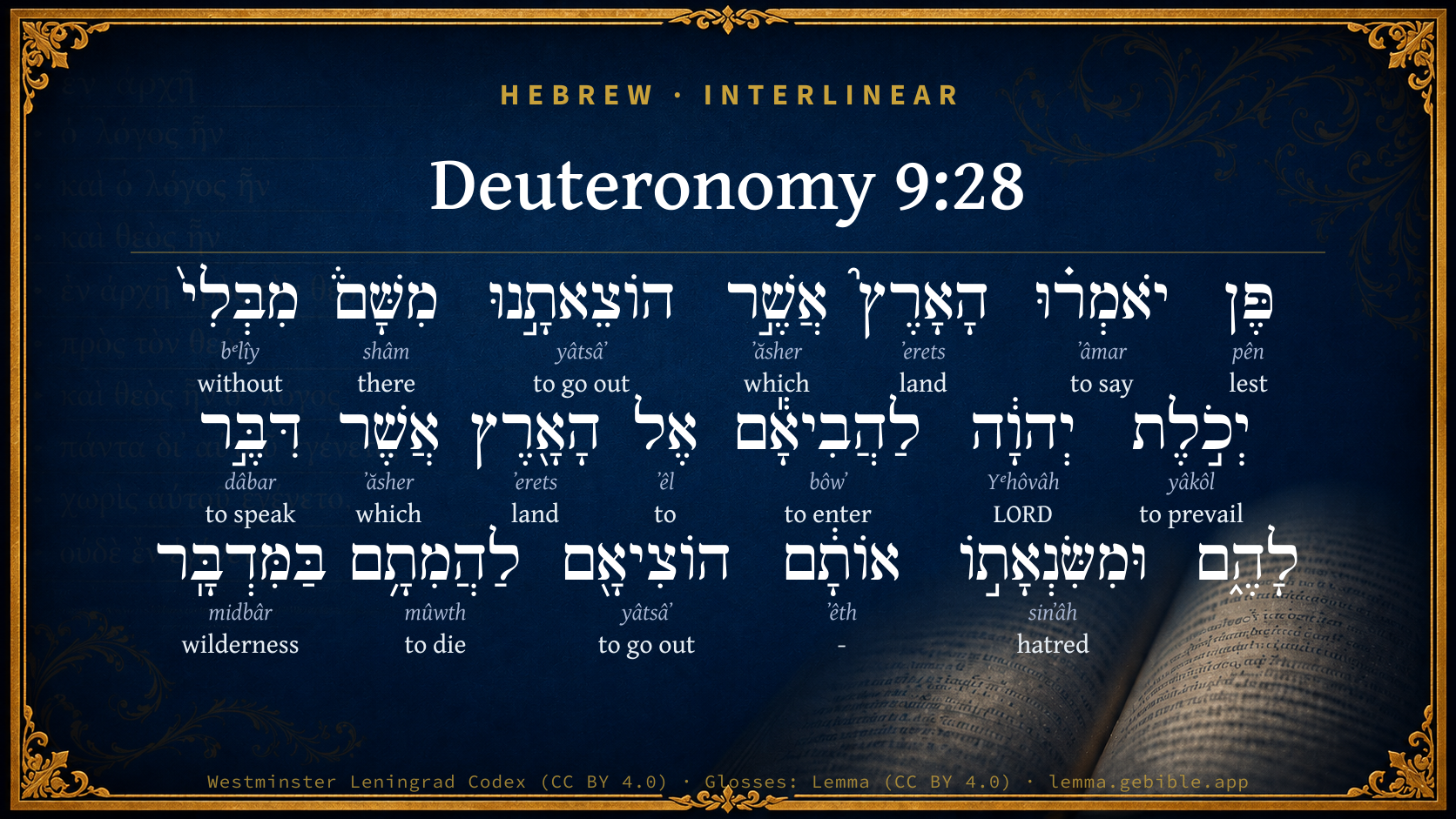
Hebrew (Westminster Leningrad Codex) Deuteronomy 9:28 appears in the Hebrew Old Testament. The text above is from the Westminster Leningrad Codex. Each word links to its Strong’s number, a concise gloss, and parsing drawn from the Open Scriptures Hebrew Bible morphology. Click any word for its full Brown-Driver-Briggs (BDB) entry.
Download image
Cite this verse

Deuteronomy 9:28 (World English Bible). Public Domain. Lemma interlinear Bible study tool, https://lemma.gebible.app/v/deuteronomy/9/28.

Show BibTeX & RIS
BibTeX
RIS
English Translation
lest the land whence you brought us out say, Because Yahweh was not able to bring them into the land which he promised to them, and because he hated them, he has brought them out to kill them in the wilderness.
World English Bible · Public Domain
Download a study sheet

One document with this verse’s original text, its word-by-word gloss line, the meaning frame, cross-references with their text, attributed commentary, and full source and license credits — printable, and it pastes into notes with its structure intact.

This verse Autodidact and up

Study sheet (.html) Plain text (.txt)

A passage Seminary Student

Up to 50 verses in one chapter. A passage sheet keeps up to 6 commentary sources and 12 cross-references per verse, in the order this page ranks them, and says so on the sheet whenever that leaves anything out. Ask for a single verse and you get the Autodidact verse sheet above.

Everything on this page stays free to read, with no account — the sheet is a download of what is already on screen, not access to it.

Want to remove ads? Support Godless Engineer
Compare translations 3

The same verse in 3 English versions, stacked beneath the original-language interlinear above. Click any original word for its lexicon entry.

Each is an independent rendering of the whole verse — the interlinear is not word-aligned to these translations.

Highlighted words mark where these versions differ — a whole-verse word diff, not a word-by-word alignment.

  • World English Bible Public Domain
    lest the land whence you brought us out say, Because Yahweh was not able to bring them into the land which he promised to them, and because he hated them, he has brought them out to kill them in the wilderness.
  • King James Version Public Domain
    Lest the land whence thou broughtest us out say, Because the LORD was not able to bring them into the land which he promised them, and because he hated them, he hath brought them out to slay them in the wilderness.
  • unfoldingWord Literal Text CC BY-SA 4.0
    lest the land where you brought us out from should say, “From Yahweh not being able to bring them into the land that he spoke to them, or from his hatred of them he has brought them out to kill them in the wilderness.”

unfoldingWord Literal Text — © unfoldingWord, licensed CC BY-SA 4.0. Word-aligned USFM3 via Door43 (git.door43.org/unfoldingWord/en_ult).

Versions to compare (up to 4)

3 of 4 selected

Show all 18 translations

Every available English version of this verse, each an independent rendering of the whole verse.

  • World English Bible Public Domain
    lest the land whence you brought us out say, Because Yahweh was not able to bring them into the land which he promised to them, and because he hated them, he has brought them out to kill them in the wilderness.
  • Berean Standard Bible Public Domain
    Otherwise, those in the land from which You brought us out will say, ‘Because the LORD was not able to bring them into the land He had promised them, and because He hated them, He has brought them out to kill them in the wilderness.’
  • Majority Standard Bible Public Domain
    Otherwise, those in the land from which You brought us out will say, ‘Because the LORD was not able to bring them into the land He had promised them, and because He hated them, He has brought them out to kill them in the wilderness.’
  • King James Version Public Domain
    Lest the land whence thou broughtest us out say, Because the LORD was not able to bring them into the land which he promised them, and because he hated them, he hath brought them out to slay them in the wilderness.
  • American Standard Version (1901) Public Domain
    lest the land whence thou broughtest us out say, Because Jehovah was not able to bring them into the land which he promised unto them, and because he hated them, he hath brought them out to slay them in the wilderness.
  • Revised Version (1885) Public Domain
    lest the land whence thou broughtest us out say, Because the LORD was not able to bring them into the land which he promised unto them, and because he hated them, he hath brought them out to slay them in the wilderness.
  • Geneva Bible (1599) Public Domain
    Lest the countrey, whence thou broughtest them, say, Because ye Lord was not able to bring them into the land which he promised them, or because he hated them, he caried them out, to slay them in the wildernesse.
  • Douay-Rheims (1899) Public Domain
    Lest perhaps the inhabitants of the land, out of which thou hast brought us, say: The Lord could not bring them into the land that he promised them, and he hated them: therefore he brought them out, that he might kill them in the wilderness,
  • Young's Literal Translation Public Domain
    lest the land say from which Thou hast brought us out, Because of Jehovah's want of ability to bring them in unto the land of which He hath spoken to them, and because of His hating them, He brought them out to put them to death in the wilderness;
  • Literal Standard Version CC BY-SA 4.0
    lest the land from which You have brought us out says, Because of YHWH’s want of ability to bring them into the land of which He has spoken to them, and because of His hating them, He brought them out to put them to death in the wilderness.
  • Unlocked Literal Bible CC BY-SA 4.0
    so that the land from where you brought us should say, “Because Yahweh was not able to bring them into the land that he promised to them, and because he hated them, he has brought them out to kill them in the wilderness.”
  • unfoldingWord Literal Text CC BY-SA 4.0
    lest the land where you brought us out from should say, “From Yahweh not being able to bring them into the land that he spoke to them, or from his hatred of them he has brought them out to kill them in the wilderness.”
  • Darby Bible Public Domain
    lest the land whence thou broughtest us out say, Because Jehovah was not able to bring them into the land which he had promised them, and because he hated them, he hath brought them out to kill them in the wilderness.
  • World Messianic Bible Public Domain
    lest the land you brought us out from say, ‘Because the LORD was not able to bring them into the land which he promised to them, and because he hated them, he has brought them out to kill them in the wilderness.’
  • Webster's Bible Public Domain
    Lest the land from which thou hast brought us should say, Because the LORD was not able to bring them into the land which he promised them, and because he hated them, he hath brought them out to slay them in the wilderness.
  • Free Bible Version CC BY-SA 4.0
    If you don't, those people back in Egypt will say, ‘The Lord brought them out to kill them in the desert because he couldn't take them to the land he'd promised them, and because he hated them.’
  • Bible in Basic English Public Domain
    Or it may be said in the land from which you have taken them, Because the Lord was not able to take them into the land which he said he would give them, and because of his hate for them, he has taken them out to put them to death in the waste land.
  • JPS Tanakh (1917) Public Domain
    lest the land whence Thou broughtest us out say: Because the LORD was not able to bring them into the land which He promised unto them, and because He hated them, He hath brought them out to slay them in the wilderness.

Literal Standard Version (2020), Covenant Press — licensed CC BY-SA 4.0. Text via the HelloAO Bible API (eBible.org). Unlocked Literal Bible (unfoldingWord) — licensed CC BY-SA 4.0. Text via the HelloAO Bible API (eBible.org). unfoldingWord Literal Text — © unfoldingWord, licensed CC BY-SA 4.0. Word-aligned USFM3 via Door43 (git.door43.org/unfoldingWord/en_ult). Free Bible Version, Dr. Jonathan Gallagher — licensed CC BY-SA 4.0. Text via the HelloAO Bible API (eBible.org).

Word by word

More ways to search: Search by grammar → Find every occurrence → Compare this word →

Practice this passage: Drill this verse → Learn its vocabulary →

וּמִשִּׂנְאָת֣וֹ
sinʼâh
H8135
“and · from · hatred · his”
Conjunction + Preposition + Noun, Common, Feminine, Singular, Construct + Suffix, Personal, 3rd Person, Masculine, Singular
Part of Speech
Conjunction + Preposition + Noun
Type
Common
Gender
Feminine
Number
Singular
State
Construct
Full BDB Definition

Origin: from H8130

TWOT: 2272b

hating, hatred, hate - hatred - of man, God
  1. פֶּן pên H6435 “lest” Conjunction
  2. יֹאמְר֗וּ ʼâmar H559 “to say” Verb, Qal, Imperfect, 3rd Person, Masculine, Plural
  3. הָאָרֶץ֮ ʼerets H776 “the · land” Particle, Definite Article + Noun, Common, Both, Singular, Absolute
  4. אֲשֶׁ֣ר ʼăsher H834 “which” Particle, Relative
  5. הוֹצֵאתָ֣נוּ yâtsâʼ H3318 “to go out · us” Verb, Hiphil, Perfect, 2nd Person, Masculine, Singular + Suffix, Personal, 1st Person, Common, Plural
  6. מִשָּׁם֒ shâm H8033 “from · there” Preposition + Adverb
  7. מִבְּלִי֙ bᵉlîy H1097 “from · without of” Preposition + Noun, Common, Masculine, Singular, Construct
  8. יְכֹ֣לֶת yâkôl H3201 “to prevail” Verb, Qal, Infinitive Construct
  9. יְהוָ֔ה Yᵉhôvâh H3068 “LORD” Noun, Proper
  10. לַהֲבִיאָ֕ם bôwʼ H935 “to enter · them” Preposition + Verb, Hiphil, Infinitive Construct + Suffix, Personal, 3rd Person, Masculine, Plural
  11. אֶל ʼêl H413 “to” Preposition
  12. הָאָ֖רֶץ ʼerets H776 “the · land” Particle, Definite Article + Noun, Common, Both, Singular, Absolute
  13. אֲשֶׁר ʼăsher H834 “which” Particle, Relative
  14. דִּבֶּ֣ר dâbar H1696 “to speak” Verb, Piel, Perfect, 3rd Person, Masculine, Singular
  15. אוֹתָ֔ם ʼêth H853 “- · them” Particle, Direct Object + Suffix, Personal, 3rd Person, Masculine, Plural
  16. הוֹצִיאָ֖ם yâtsâʼ H3318 “to go out · them” Verb, Hiphil, Perfect, 3rd Person, Masculine, Singular + Suffix, Personal, 3rd Person, Masculine, Plural
  17. לַהֲמִתָ֥ם mûwth H4191 “to die · them” Preposition + Verb, Hiphil, Infinitive Construct + Suffix, Personal, 3rd Person, Masculine, Plural
  18. בַּמִּדְבָּֽר midbâr H4057 “in/at the · wilderness” Preposition, Determined + Noun, Common, Masculine, Singular, Absolute

About this verse

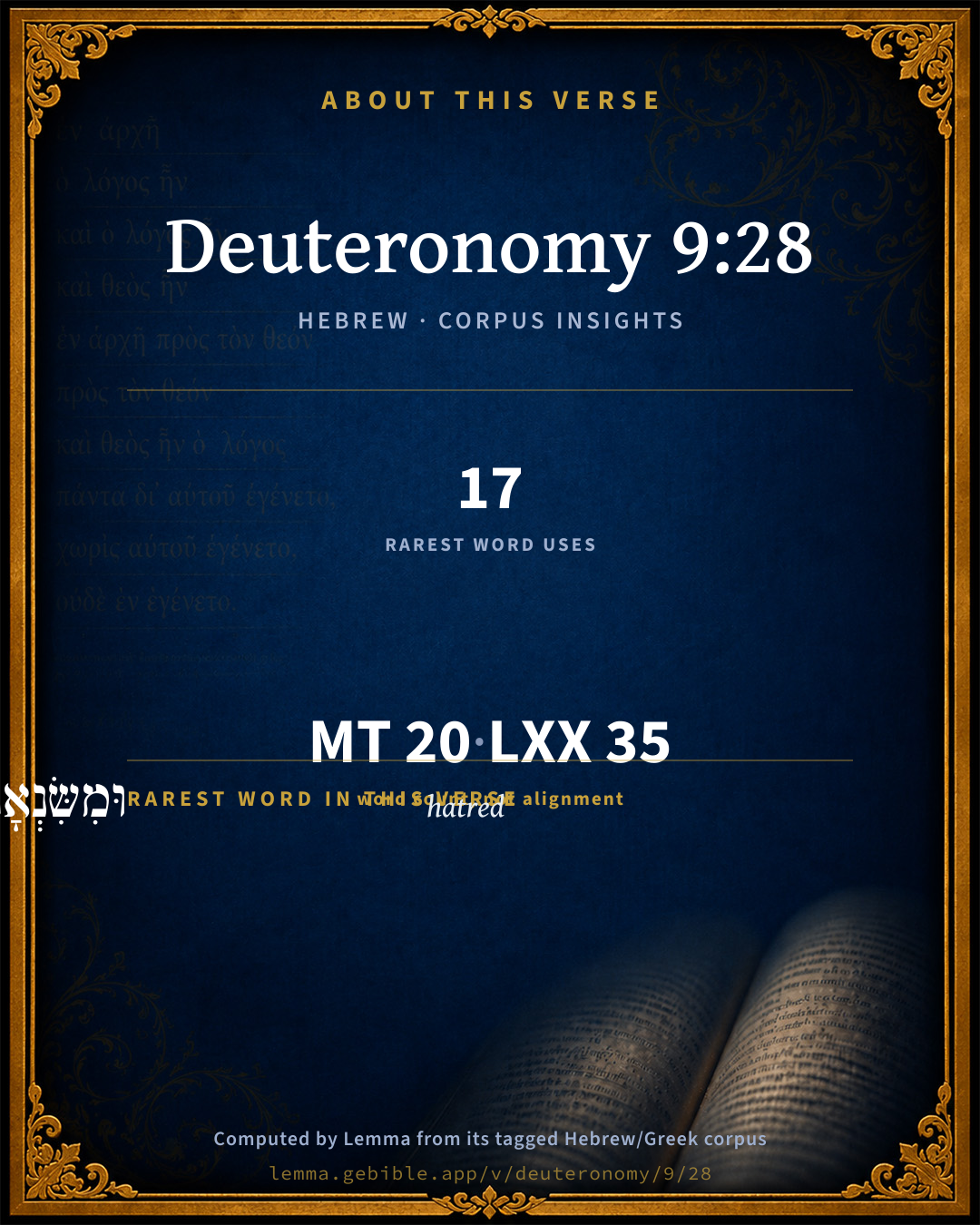
These counts appear in no published source. They are computed here, from the morphology-tagged text and Lemma’s own curated glosses. What Lemma adds →

20
words
16
distinct lemmas
Pentateuch
section

Notable vocabulary

The rarest word here is וּמִשִּׂנְאָת֣וֹ hatred H8135 — appearing just 17 times in the whole Hebrew Bible.

Shared distinctive vocabulary

וּמִשִּׂנְאָת֣וֹ hatred H8135 occurs in 16 verses of the Hebrew Bible. Also found in:

Grammatical profile

  • 7 verbs
  • 6 nouns
  • 2 prepositions
  • 1 conjunction
  • 1 adverb
  • 3 particles

Verb forms

  • יֹאמְר֗וּ Qal · Imperfect
  • הוֹצֵאתָ֣נוּ Hiphil · Perfect
  • יְכֹ֣לֶת Qal · Infinitive Construct
  • לַהֲבִיאָ֕ם Hiphil · Infinitive Construct
  • דִּבֶּ֣ר Piel · Perfect
  • הוֹצִיאָ֖ם Hiphil · Perfect
  • לַהֲמִתָ֥ם Hiphil · Infinitive Construct

Repetition

Words recur within this verse — often emphatic in Hebrew:

  • הָאָרֶץ֮ land H776 ×2
  • הוֹצֵאתָ֣נוּ to go out H3318 ×2
  • אֲשֶׁ֣ר which H834 ×2

Hebrew & Septuagint length

In English translation the verse runs 41 words from the Hebrew and 45 from the Septuagint (LXX English) — closely comparable.

A rough comparison of the two English renderings, which tokenize alike — not a word-level alignment.

Word counts can differ between the Hebrew and the Greek without any difference in meaning — e.g. the Hebrew direct-object marker אֵת has no separate Greek word, and Greek often adds the article ὁ.

In the original languages it is 20 Hebrew tokens and 35 Greek tokens — but the two are counted differently (Hebrew bundles its prefixes and suffixes into one token; the Greek is in lemma form), so that isn’t a like-for-like length.

Cross-references

2

Topical passages linked to Deuteronomy 9:28 in the Treasury of Scripture Knowledge — connected by theme and wording, ordered by reader-vote popularity; previews shown in the World English Bible.

  • Numbers 14:16 Because Yahweh was not able to bring this people into the land which he swore to them, therefore he has slain them in the wilderness.
  • Exodus 32:12 Why should the Egyptians speak, saying, 'He brought them forth for evil, to kill them in the mountains, and to consume them from the surface of the earth?' Turn from your fierce wrath, and repent of this evil against your people.

Cross-references courtesy of OpenBible.info (CC BY 4.0).

Hebrew and Greek witnesses Masoretic Hebrew ↔ Greek Septuagint

The same verse in the two great witnesses to the Old Testament, shown verse-for-verse.

These are two independent witnesses, not word-aligned to each other, and the Septuagint is shown in lemma (dictionary) form.

Hebrew Deuteronomy 9:28 Masoretic · Westminster Leningrad Codex

פֶּן יֹאמְר֗וּ הָאָרֶץ֮ אֲשֶׁ֣ר הוֹצֵאתָ֣נוּ מִשָּׁם֒ מִבְּלִי֙ יְכֹ֣לֶת יְהוָ֔ה לַהֲבִיאָ֕ם אֶל הָאָ֖רֶץ אֲשֶׁר דִּבֶּ֣ר לָהֶ֑ם וּמִשִּׂנְאָת֣וֹ אוֹתָ֔ם הוֹצִיאָ֖ם לַהֲמִתָ֥ם בַּמִּדְבָּֽר

lest the land whence you brought us out say, Because Yahweh was not able to bring them into the land which he promised to them, and because he hated them, he has brought them out to kill them in the wilderness.

World English Bible · Public Domain

Greek LXX Deuteronomy 9:28 Septuagint · lemma form

μή εἶπον ὁ καταοἰκέω ὁ γῆ ὅθεν ἐκἄγω ἐγώ ἐκεῖθεν λέγω παρά ὁ μή δύναμαι κύριος εἰςἄγω αὐτός εἰς ὁ γῆ ὅς εἶπον αὐτός καί παρά ὁ μισέω αὐτός ἐκἄγω αὐτός ἀποκτείνω ἐν ὁ ἔρημος

Lest the inhabitants of the land whence you brought us out speak, saying, Because the Lord could not bring them into the land of which he spoke to them, and because he hated them, has he brought them forth to kill them in the wilderness.

LXX2012 (modern English Septuagint) · Public Domain

Hebrew: Westminster Leningrad Codex (CC BY 4.0). Greek: Septuagint (public domain); English from LXX2012 (modern English Septuagint) (Public Domain). How the Septuagint differs from the Hebrew →

Targum (Aramaic paraphrase)

2

The Targum is the ancient Jewish Aramaic paraphrase of the Hebrew Scriptures — an interpretive translation, not the Hebrew text itself. Onkelos (literal) and Pseudo-Jonathan (expansive) render the Torah, and Jonathan the Prophets. Coverage is partial: where no permissively-licensed English translation exists for a verse, only the Aramaic is shown. This is verse-level text, not a word-by-word alignment to the Hebrew.

  1. Targum Onkelos Torah (Genesis–Deuteronomy)
    דִילְמָא יֵימְרוּן דָיְרֵי אַרְעָא דִי אַפֶּקְתָּנָא מִתַּמָן מִדְלֵית יוּכְלָא דַיְיָ לְאָעָלוּתְהוֹן לְאַרְעָא דִי מַלִיל לְהוֹן וּמִדְסָנֵי יָתְהוֹן אַפֵּקִנוּן לְקַטָלוּתְהוֹן בְּמַדְבְּרָא

    (no public-domain English translation for this verse)

    Targum Onkelos — Aramaic: “Onkelos Genesis” (public domain); “Onkelos Exodus” (public domain); “Onkelos Leviticus” (public domain); “Onkelos Numbers” (public domain); “Onkelos Deuteronomy” (public domain). English: “Sefaria Community Translation” (CC0 1.0 (public-domain dedication)); “J.W. Etheridge. The Targums of Onkelos and Jonathan Ben Uzziel on the Pentateuch. London: Longmans, Green, 1862” (public domain). Text via Sefaria.

  2. Targum Pseudo-Jonathan Torah (Genesis–Deuteronomy)
    דִּילְמָא יֵימְרוּן דַּיְירֵי אַרְעָא דְאַפֵּקְתָּנָא מִתַּמָּן מִדְאִיתְתִישׁ חֵילָא מִן קֳדָם יְיָ לְאַעֲלוּתְהוֹן לְאַרְעָא דְמַלֵּיל לְהוֹן וּמִדְסָנֵי יַתְהוֹן אַפֵּיקִינוּן לְקַטְלוּתְהוֹן בְּמַדְבְּרָא

    lest the inhabitants of the land from whence Thou hast led us say, that power failed before the Lord to bring them into the land of which Thou hast told them, and that because Thou didst hate them, therefore didst Thou lead them out to kill them in the wilderness.

    Targum Pseudo-Jonathan — Aramaic: “Targum Jonathan on Genesis” (public domain); “Targum Jonathan on Exodus” (public domain); “Targum Jonathan on Leviticus” (public domain); “Targum Jonathan on Numbers” (public domain); “Targum Jonathan on Deuteronomy” (public domain). English: “The Targum of Jonathan ben Uzziel, trans. J. W. Etheridge, London, 1862” (public domain). Text via Sefaria.

Commentary

Notes on Deuteronomy 9:28 from classic Christian and Jewish commentators (each source and its license shown beneath its notes). The classic Christian expositions comment on the surrounding passage and are grouped to its opening verse, so a note may address several verses; the Jewish commentaries on the Tanakh (Rashi and others) are per-verse, so they appear only where the commentator wrote on this verse.

Lemma curates 59 commentaries, every one of them public domain or Creative Commons licensed, each selected and text-cleaned for this edition rather than reprinted as found. About our sources →

The Pulpit Commentary

The land, that is, the people of the land, as in Gen_41:36 the Egyptians; the verb, accordingly, is in the plural. Were theIsraelites to perish in the wilderness, the Egyptians might say that God had destroyed them, either because he was unable to obtain for them the land he had promised them, or because he had ceased to regard them with favor, and had become their enemy. Neither of these could be, for were they not the people of his inheritance, and had he not showed his power already in delivering them out of Egypt?

Moses in this chapter recalls to the remembrance of Israel this and that place, time, and occasion of their sinning, so should each one often seriously reflect on his past life. This conduces to humility, to watchfulness, and to effort at improvement" (Herxheimer).

The Pulpit Commentary (1880–1919), ed. H.D.M. Spence-Jones & Joseph S. Exell — public domain. Text from a community e-Sword module.

Ramban (Nachmanides)

Rabbi Moshe ben Nachman (Ramban / Nachmanides)

BECAUSE THE ETERNAL WAS NOT ABLE TO BRING THEM INTO THE LAND WHICH HE PROMISED THEM. During the affair of the spies, Moses said, [that the nations will say] Because the Eternal was not able to bring this people into the Land which He swore unto them, therefore He hath slain them in the wilderness, meaning, they [the nations] will say that as they [the Israelites] approached and were near to the Land, and He saw that He was not able to be victorious over those nations He slew them [the Israelites] in the wilderness. But here [with reference to the calf] he [Moses] said [that the Egyptians would claim], and because He hated them, He hath brought them out to slay them in the wilderness, since this hatred already existed in Egypt before He took them out from there. The purport of this was that, since at the time when the calf was made, they were still close to Egypt and far from the land of Canaan, the Egyptians would claim that even when they were still in Egypt, He realized that He lacked the power to bring them into the Land of which He spoke to them within hearing of the Egyptians. Therefore He hated them that it [His Name] should not be profaned in the sight of the nations in whose sight He made Himself known to them [the Israelites]. He brought them forth out of the land of Egypt to slay them in the wilderness in a place where their fate would not become known. This is the intent of the verse, [Why should the Egyptians speak, saying:] for evil did He bring them forth, to slay them in the mountains? meaning, that He planned this evil design against them before He brought them out from among the people of Egypt to slay them between the mountains, a place that no man passed through, and where no man dwelt. The point of these arguments was that the nations would speak of the Eternal, the G-d of Israel, [in a manner as they speak of other gods], speaking against Him [saying:] ‘As the gods of the nations of the lands,’ similar to what is stated, and now I will return to fight with the prince of Persia. I have already mentioned something of this subject.

Ramban (Nachmanides) on the Tanakh — English translation: “Commentary on the Torah by Ramban (Nachmanides). Translated and annotated by Charles B. Chavel. New York, Shilo Pub. House, 1971-1976” (CC BY 4.0). Text via Sefaria.

Lesson kit

Teaching starters — assembled from the data on this page, not authored interpretation. Every prompt links to the verse data it draws on. Edit before teaching.

Deuteronomy, in the Pentateuch, opens this verse with 20 words (16 distinct Hebrew lemmas). Its most distinctive word is sinʼâh (“hatred”). A historical commentator’s framing appears above. Read the whole chapter for the surrounding context.

Discussion questions

  1. How does “hatred” (sinʼâh) shape what this verse is saying?
  2. Numbers 35:20 shares the word «hatred» with this verse. How do the two illuminate each other?
  3. “land” occurs 2× in this one verse. What is the effect of the repetition?
  4. These translations render this verse differently. What is at stake in choosing one wording over another?
  5. The verb «יֹאמְר֗וּ» is Qal Imperfect. How does its form color the action?
  6. Reading how The Pulpit Commentary and Ramban (Nachmanides) read this verse, where do the two commentators agree and where do they part?

Things to notice

Reading settings

Reading text

Shown beneath each verse's original-language words.

Old Testament
Old Testament edition

Read the OT as the Masoretic Hebrew (MT) or the Greek Septuagint (LXX).

English shown for the Greek Septuagint (in the Hebrew ↔ Greek comparison).

Comparing translations? Open the Compare panel on any verse page to stack up to four side by side.