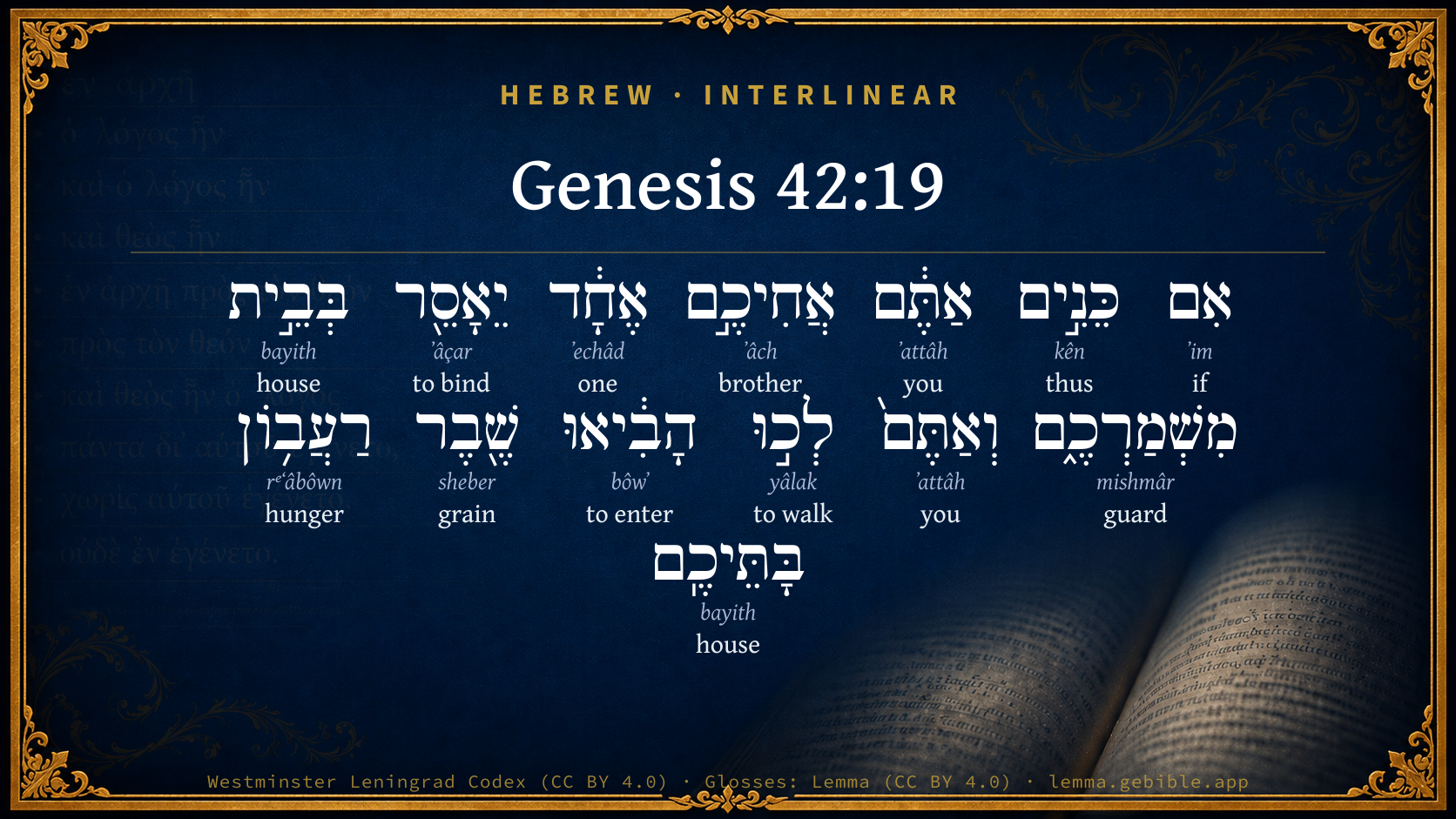
Genesis 42:19

Hebrew (Westminster Leningrad Codex) Genesis 42:19 appears in the Hebrew Old Testament. The text above is from the Westminster Leningrad Codex. Each word links to its Strong’s number, a concise gloss, and parsing drawn from the Open Scriptures Hebrew Bible morphology. Click any word for its full Brown-Driver-Briggs (BDB) entry.
Download image
Cite this verse

Genesis 42:19 (World English Bible). Public Domain. Lemma interlinear Bible study tool, https://lemma.gebible.app/v/genesis/42/19.

Show BibTeX & RIS
BibTeX
RIS
English Translation
If you are honest men, then let one of your brothers be bound in your prison-house; but you go, carry grain for the famine of your houses.
World English Bible · Public Domain
Highlights
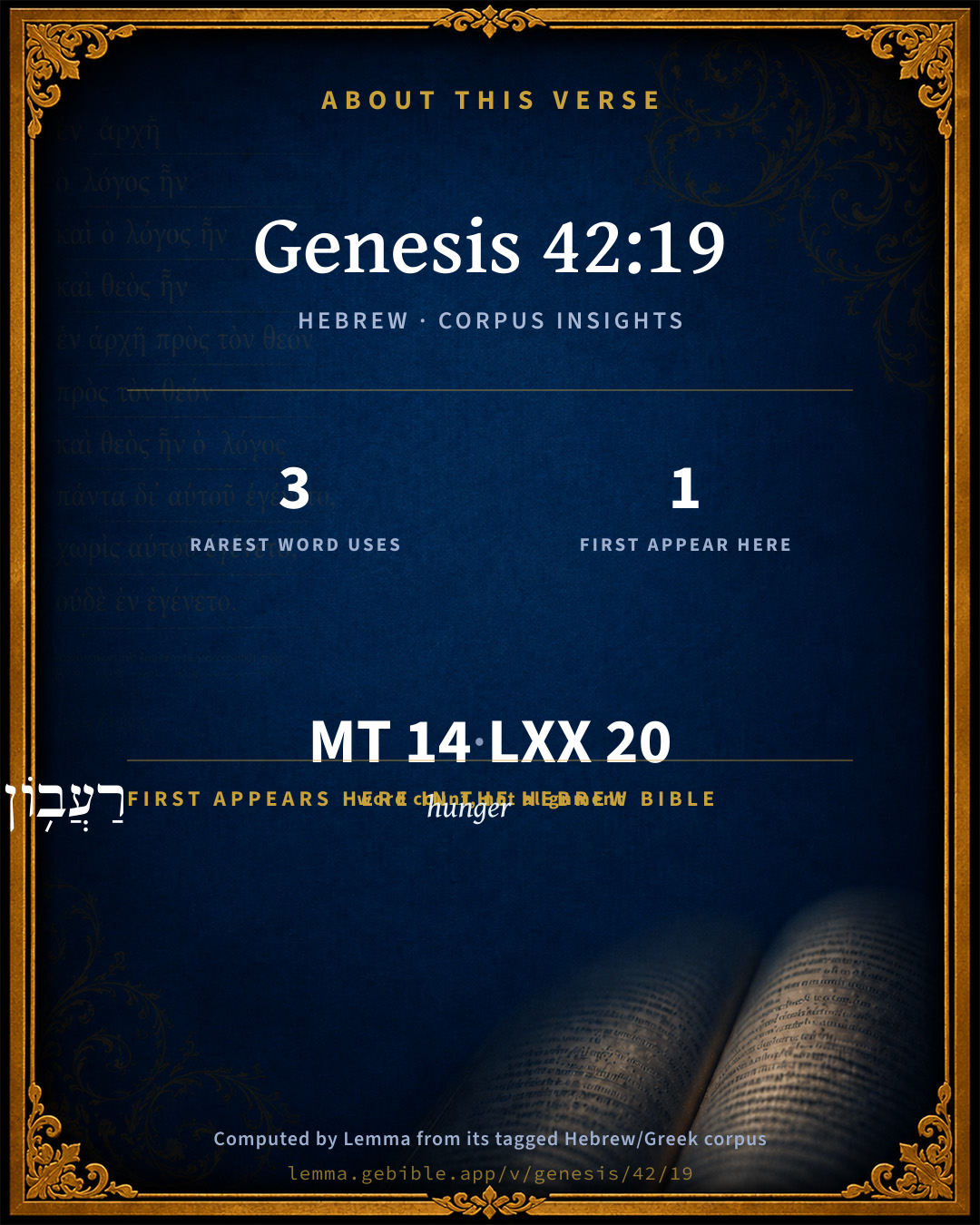
  • 1 first appearance in the Hebrew Bible
Full analysis ↓
Download a study sheet

One document with this verse’s original text, its word-by-word gloss line, the meaning frame, cross-references with their text, attributed commentary, and full source and license credits — printable, and it pastes into notes with its structure intact.

This verse Autodidact and up

Study sheet (.html) Plain text (.txt)

A passage Seminary Student

Up to 50 verses in one chapter. A passage sheet keeps up to 6 commentary sources and 12 cross-references per verse, in the order this page ranks them, and says so on the sheet whenever that leaves anything out. Ask for a single verse and you get the Autodidact verse sheet above.

Everything on this page stays free to read, with no account — the sheet is a download of what is already on screen, not access to it.

Want to remove ads? Support Godless Engineer
Compare translations 3

The same verse in 3 English versions, stacked beneath the original-language interlinear above. Click any original word for its lexicon entry.

Each is an independent rendering of the whole verse — the interlinear is not word-aligned to these translations.

Highlighted words mark where these versions differ — a whole-verse word diff, not a word-by-word alignment.

  • World English Bible Public Domain
    If you are honest men, then let one of your brothers be bound in your prison-house; but you go, carry grain for the famine of your houses.
  • King James Version Public Domain
    If ye be true men, let one of your brethren be bound in the house of your prison: go ye, carry corn for the famine of your houses:
  • unfoldingWord Literal Text CC BY-SA 4.0
    If you honest, let one of your brothers be bound in your prison house, and you go take grain back the famine of your households.

unfoldingWord Literal Text — © unfoldingWord, licensed CC BY-SA 4.0. Word-aligned USFM3 via Door43 (git.door43.org/unfoldingWord/en_ult).

Versions to compare (up to 4)

3 of 4 selected

Show all 18 translations

Every available English version of this verse, each an independent rendering of the whole verse.

  • World English Bible Public Domain
    If you are honest men, then let one of your brothers be bound in your prison-house; but you go, carry grain for the famine of your houses.
  • Berean Standard Bible Public Domain
    If you are honest, leave one of your brothers in custody while the rest of you go and take back grain to relieve the hunger of your households.
  • Majority Standard Bible Public Domain
    If you are honest, leave one of your brothers in custody while the rest of you go and take back grain to relieve the hunger of your households.
  • King James Version Public Domain
    If ye be true men, let one of your brethren be bound in the house of your prison: go ye, carry corn for the famine of your houses:
  • American Standard Version (1901) Public Domain
    if ye be true men, let one of your brethren be bound in your prison-house; but go ye, carry grain for the famine of your houses:
  • Revised Version (1885) Public Domain
    if ye be true men, let one of your brethren be bound in your prison house; but go ye, carry corn for the famine of your houses:
  • Geneva Bible (1599) Public Domain
    If ye be true men, let one of your brethren be bounde in your prison house, and goe ye, carie foode for the famine of your houses:
  • Douay-Rheims (1899) Public Domain
    If you be peaceable men, let one of your brethren be bound in prison: and go ye your ways and carry the corn that you have bought, unto your houses.
  • Young's Literal Translation Public Domain
    if ye `are' right men, let one of your brethren be bound in the house of your ward, and ye, go, carry in corn `for' the famine of your houses,
  • Literal Standard Version CC BY-SA 4.0
    If you [are] right men, let one of your brothers be bound in the house of your confinement, and you, go, carry in grain [for] the famine of your houses,
  • Unlocked Literal Bible CC BY-SA 4.0
    If you are honest men, let one of your brothers be confined in this prison, but you go, carry grain for the famine of your houses.
  • unfoldingWord Literal Text CC BY-SA 4.0
    If you honest, let one of your brothers be bound in your prison house, and you go take grain back the famine of your households.
  • Darby Bible Public Domain
    If ye are honest, let one of your brethren remain bound in the house of your prison, but go ye, carry grain for the hunger of your households;
  • World Messianic Bible Public Domain
    If you are honest men, then let one of your brothers be bound in your prison; but you go, carry grain for the famine of your houses.
  • Webster's Bible Public Domain
    If ye are true men, let one of your brethren be bound in the house of your prison: go ye, carry corn for the famine of your houses:
  • Free Bible Version CC BY-SA 4.0
    If you're truly honest, choose one of your brothers to stay here in prison. The rest of you can go back home with grain for your hungry families.
  • Bible in Basic English Public Domain
    If you are true men, let one of you be kept in prison, while you go and take grain for the needs of your families;
  • JPS Tanakh (1917) Public Domain
    if ye be upright men, let one of your brethren be bound in your prison-house; but go ye, carry corn for the famine of your houses;

Literal Standard Version (2020), Covenant Press — licensed CC BY-SA 4.0. Text via the HelloAO Bible API (eBible.org). Unlocked Literal Bible (unfoldingWord) — licensed CC BY-SA 4.0. Text via the HelloAO Bible API (eBible.org). unfoldingWord Literal Text — © unfoldingWord, licensed CC BY-SA 4.0. Word-aligned USFM3 via Door43 (git.door43.org/unfoldingWord/en_ult). Free Bible Version, Dr. Jonathan Gallagher — licensed CC BY-SA 4.0. Text via the HelloAO Bible API (eBible.org).

Word by word

More ways to search: Search by grammar → Find every occurrence → Compare this word →

Practice this passage: Drill this verse → Learn its vocabulary →

רַעֲב֥וֹן
rᵉʻâbôwn
H7459
“hunger of”
Noun, Common, Masculine, Singular, Construct
Part of Speech
Noun
Type
Common
Gender
Masculine
Number
Singular
State
Construct
Full BDB Definition

Origin: from H7456

TWOT: 2183c

hunger, lack of food, famine
  1. אִם ʼim H518 “if” Conjunction
  2. כֵּנִ֣ים kên H3651 “thus” Adjective, Adjective, Masculine, Plural, Absolute
  3. אַתֶּ֔ם ʼattâh H859 “you” Pronoun, Personal, 2nd Person, Masculine, Plural
  4. אֲחִיכֶ֣ם ʼâch H251 “brother · your” Noun, Common, Masculine, Singular, Construct + Suffix, Personal, 2nd Person, Masculine, Plural
  5. אֶחָ֔ד ʼechâd H259 “one” Adjective, Cardinal number, Masculine, Singular, Absolute
  6. יֵאָסֵ֖ר ʼâçar H631 “to bind” Verb, Niphal, Imperfect, 3rd Person, Masculine, Singular
  7. בְּבֵ֣ית bayith H1004 “in/at · house of” Preposition + Noun, Common, Masculine, Singular, Construct
  8. מִשְׁמַרְכֶ֑ם mishmâr H4929 “guard · your” Noun, Common, Masculine, Singular, Construct + Suffix, Personal, 2nd Person, Masculine, Plural
  9. וְאַתֶּם֙ ʼattâh H859 “and · you” Conjunction + Pronoun, Personal, 2nd Person, Masculine, Plural
  10. לְכ֣וּ yâlak H3212 “walk” Verb, Qal, Imperative, 2nd Person, Masculine, Plural
  11. הָבִ֔יאוּ bôwʼ H935 “enter” Verb, Hiphil, Imperative, 2nd Person, Masculine, Plural
  12. שֶׁ֖בֶר sheber H7668 “grain of” Noun, Common, Masculine, Singular, Construct
  13. בָּתֵּיכֶֽם bayith H1004 “houses · your” Noun, Common, Masculine, Plural, Construct + Suffix, Personal, 2nd Person, Masculine, Plural

About this verse

These counts appear in no published source. They are computed here, from the morphology-tagged text and Lemma’s own curated glosses. What Lemma adds →

14
words
12
distinct lemmas
Pentateuch
section

Notable vocabulary

The rarest word here is רַעֲב֥וֹן hunger H7459 — appearing just 3 times in the whole Hebrew Bible.

First appearance in Scripture

This word makes its first canonical appearance in the Hebrew Bible here:

  • רַעֲב֥וֹן hunger H7459

Shared distinctive vocabulary

רַעֲב֥וֹן hunger H7459 occurs in 3 verses of the Hebrew Bible. Also found in:

Grammatical profile

  • 3 verbs
  • 6 nouns
  • 2 adjectives
  • 2 pronouns
  • 1 conjunction

Verb forms

  • יֵאָסֵ֖ר Niphal · Imperfect
  • לְכ֣וּ Qal · Imperative
  • הָבִ֔יאוּ Hiphil · Imperative

Repetition

Words recur within this verse — often emphatic in Hebrew:

  • בְּבֵ֣ית house H1004 ×2
  • אַתֶּ֔ם you H859 ×2

Hebrew & Septuagint length

In English translation the verse runs 27 words from the Hebrew and 24 from the Septuagint (LXX English) — closely comparable.

A rough comparison of the two English renderings, which tokenize alike — not a word-level alignment.

Word counts can differ between the Hebrew and the Greek without any difference in meaning — e.g. the Hebrew direct-object marker אֵת has no separate Greek word, and Greek often adds the article ὁ.

In the original languages it is 14 Hebrew tokens and 20 Greek tokens — but the two are counted differently (Hebrew bundles its prefixes and suffixes into one token; the Greek is in lemma form), so that isn’t a like-for-like length.

Cross-references

9

Topical passages linked to Genesis 42:19 in the Treasury of Scripture Knowledge — connected by theme and wording, ordered by reader-vote popularity; previews shown in the World English Bible.

  • Genesis 40:3 He put them in custody in the house of the captain of the guard, into the prison, the place where Joseph was bound.
  • Genesis 41:56 The famine was over all the surface of the earth. Joseph opened all the store-houses, and sold to the Egyptians. The famine was severe in the land of Egypt.
  • Genesis 42:1–2 Now Jacob saw that there was grain in Egypt, and Jacob said to his sons, "Why do you look at one another?"
  • Genesis 42:26 They loaded their donkeys with their grain, and departed from there.
  • Genesis 43:1–2 The famine was severe in the land.
  • Genesis 45:23 To his father, he sent after this manner: ten donkeys loaded with the good things of Egypt, and ten female donkeys loaded with grain and bread and provision for his father by the way.
  • Isaiah 42:7 to open the blind eyes, to bring out the prisoners from the dungeon, and those who sit in darkness out of the prison-house.
  • Isaiah 42:22 But this is a people robbed and plundered; they are all of them snared in holes, and they are hid in prison-houses: they are for a prey, and none delivers; for a spoil, and none says, Restore.
  • Jeremiah 37:15 The princes were angry with Jeremiah, and struck him, and put him in prison in the house of Jonathan the scribe; for they had made that the prison.

Cross-references courtesy of OpenBible.info (CC BY 4.0).

Hebrew and Greek witnesses Masoretic Hebrew ↔ Greek Septuagint

The same verse in the two great witnesses to the Old Testament, shown verse-for-verse.

These are two independent witnesses, not word-aligned to each other, and the Septuagint is shown in lemma (dictionary) form.

Hebrew Genesis 42:19 Masoretic · Westminster Leningrad Codex

אִם כֵּנִ֣ים אַתֶּ֔ם אֲחִיכֶ֣ם אֶחָ֔ד יֵאָסֵ֖ר בְּבֵ֣ית מִשְׁמַרְכֶ֑ם וְאַתֶּם֙ לְכ֣וּ הָבִ֔יאוּ שֶׁ֖בֶר רַעֲב֥וֹן בָּתֵּיכֶֽם

If you are honest men, then let one of your brothers be bound in your prison-house; but you go, carry grain for the famine of your houses.

World English Bible · Public Domain

Greek LXX Genesis 42:19 Septuagint · lemma form

εἰ εἰρηνικός εἰμί ἀδελφός σύ εἷς καταἔχω ἐν ὁ φυλακή αὐτός δέ βαδίζω καί ἀποἄγω ὁ ἀγορασμός ὁ σιτοδοσία σύ

If you⌃ be peaceful, let one of your brethren be detained in prison; but go you⌃, and carry back the corn you⌃ have purchased.

LXX2012 (modern English Septuagint) · Public Domain

Hebrew: Westminster Leningrad Codex (CC BY 4.0). Greek: Septuagint (public domain); English from LXX2012 (modern English Septuagint) (Public Domain). How the Septuagint differs from the Hebrew →

Targum (Aramaic paraphrase)

2

The Targum is the ancient Jewish Aramaic paraphrase of the Hebrew Scriptures — an interpretive translation, not the Hebrew text itself. Onkelos (literal) and Pseudo-Jonathan (expansive) render the Torah, and Jonathan the Prophets. Coverage is partial: where no permissively-licensed English translation exists for a verse, only the Aramaic is shown. This is verse-level text, not a word-by-word alignment to the Hebrew.

  1. Targum Onkelos Torah (Genesis–Deuteronomy)
    אִם כֵּיוָנֵי אַתּוּן אֲחוּכוֹן חַד יִתְאַסַּר בְּבֵית מַטַּרְתְּכוֹן וְאַתּוּן אִיזִילוּ אוֹבִילוּ עִיבוּרָא דְּחַסִּיר בְּבָתֵּיכוֹן

    (no public-domain English translation for this verse)

    Targum Onkelos — Aramaic: “Onkelos Genesis” (public domain); “Onkelos Exodus” (public domain); “Onkelos Leviticus” (public domain); “Onkelos Numbers” (public domain); “Onkelos Deuteronomy” (public domain). English: “Sefaria Community Translation” (CC0 1.0 (public-domain dedication)); “J.W. Etheridge. The Targums of Onkelos and Jonathan Ben Uzziel on the Pentateuch. London: Longmans, Green, 1862” (public domain). Text via Sefaria.

  2. Targum Pseudo-Jonathan Torah (Genesis–Deuteronomy)
    אִם מְהֵמְנִין אַתּוּן אֲחוּכוֹן חַד יִתְאַסַר בְּבֵית מַטְרַתְכוֹן וְאַתּוּן אִיזִילוּ אוֹבִילוּ עִיבּוּרָא דִזְבַּנְתּוּן לִכְפֵינֵי בָתֵּיכוֹן

    If you are true, let one of your brothers be bound in the house of your confinement and go you, carry the corn, that you may buy for the hunger of your house,

    Targum Pseudo-Jonathan — Aramaic: “Targum Jonathan on Genesis” (public domain); “Targum Jonathan on Exodus” (public domain); “Targum Jonathan on Leviticus” (public domain); “Targum Jonathan on Numbers” (public domain); “Targum Jonathan on Deuteronomy” (public domain). English: “The Targum of Jonathan ben Uzziel, trans. J. W. Etheridge, London, 1862” (public domain). Text via Sefaria.

Commentary

Notes on Genesis 42:19 from classic Christian and Jewish commentators (each source and its license shown beneath its notes). The classic Christian expositions comment on the surrounding passage and are grouped to its opening verse, so a note may address several verses; the Jewish commentaries on the Tanakh (Rashi and others) are per-verse, so they appear only where the commentator wrote on this verse.

Lemma curates 59 commentaries, every one of them public domain or Creative Commons licensed, each selected and text-cleaned for this edition rather than reprinted as found. About our sources →

Trapp's Complete Commentary

John Trapp

Gen 42:19 If ye [be] true [men], let one of your brethren be bound in the house of your prison: go ye, carry corn for the famine of your houses:

Ver. 19. Let one of your brethren be bound.] By binding Simeon, he brought down Benjamin to himself. So doth God, by chastening our bodies, save our souls.

John Trapp, A Commentary or Exposition upon All the Books of the Old and New Testament (1647–1656) — public domain. Text from a community e-Sword module.

The Biblical Illustrator

Joseph S. Exell

Gen_42:19-20

Let one of your brethren be bound

Lessons

1.

To prove truth among national parties, it is not unequal to give hostages.

2. Hostages being taken it is but equal that parties have liberty to manifest truth.

3. Nature will not, much less grace, dispatch hungry men without food.

4. Bread-corn is the break-neck of hunger (Gen_42:19).

5. Reasonable testimonies of truth may be peremptorily demanded of suspected persons.

6. Justification and security are to be afforded to men of truth.

7. It is reasonable for men under trials to yield to just terms for deliverance (Gen_42:20). (G. Hughes, B. D.)

The Biblical Illustrator, edited by Joseph S. Exell (c. 1880s–1900s) — public domain. Text from a community e-Sword module.

The Cambridge Bible for Schools and Colleges

gen. ed. J. J. S. Perowne

19. let one of your brethren] Joseph’s previous sentence in Gen_42:16, by which one brother should be sent back, while the remainder should be kept in prison, is here reversed. The three days’ interval had moderated Joseph’s threat and his first appearance of indignation. The change to a more generous treatment is part of his whole policy: see note on Gen_42:6.

The Cambridge Bible for Schools and Colleges (gen. ed. J. J. S. Perowne; Cambridge University Press, 1878–1918) — public domain. Text from a community e-Sword module.

John Gill's Exposition

And they knew not that Joseph understood them,.... For what is above related they spoke in his presence and hearing; but speaking to one another in the Hebrew language, and he being an Egyptian, as they took him to be, they did not imagine that he could understand them, and therefore were not at all upon their guard in what they said: and what confirmed them in this was:

for he spake unto them by an interpreter; which he the rather chose to do, that they might have no suspicion of him; and which shows, that though there was a likeness between the Hebrew language and the Egyptian in many things, yet in some they differed, and the difference was such that there was need of an interpreter, where the parties did not understand both languages: this interpreter between Joseph and his brethren, according to the Targums of Jonathan and Jerusalem, was Manasseh, the eldest son of Joseph, and so Jarchi; which is very improbable, he being but a child at this time, if not an infant; see Gen 41:50.

John Gill's Exposition of the Whole Bible (1746–1763) — public domain (CC PDM 1.0). Text via the HelloAO Bible API.

Matthew Poole's English Annotations

Your prison, in which you are now imprisoned, and are still like to be so, if you accept not this condition.

Matthew Poole's English Annotations on the Holy Bible (1683–1685) — public domain. Text from a community e-Sword/MySword module.

Rashi

Rabbi Shlomo Yitzchaki (Rashi)

בבית משמרכם (literally, in the house of your ward) — the house in which you are at present imprisoned.

ואתם לכו הביאו BUT YE, GO, CARRY to your father’s house.

שבר רעבון בתיכם CORN FOR THE FAMINE OF YOUR HOUSES — what you have purchased for the hunger of the people in your houses.

Rashi on the Tanakh — English translations: “The Judaica Press complete Tanach with Rashi, translated by A. J. Rosenberg” (CC BY 4.0); “Pentateuch with Rashi's commentary by M. Rosenbaum and A.M. Silbermann, 1929-1934” (public domain); “The Metsudah Tanach series, Lakewood, N.J” (CC BY 4.0); and “The Book of Joshua, Metsudah Publications, 1997” (CC BY 4.0). Text via Sefaria.

Radak

Rabbi David Kimhi (Radak)

שבר רעבון בתיכם, what will break the hunger, i.e. the harvest; this is why the harvest, תבואה is also called שבר, as we have already explained on 41,56.

Radak on the Tanakh — English translations: “Sefaria Community Translation” (CC0 1.0 (public-domain dedication)); “Eliyahu Munk, HaChut Hameshulash” (CC BY 4.0); “Rabbi Mike Feuer, Jerusalem Anthology” (CC BY 4.0); and “R. David Kimhi on the first book of Psalms, Translated by R.G. Finch, London, 1919” (public domain). Text via Sefaria.

Lesson kit

Teaching starters — assembled from the data on this page, not authored interpretation. Every prompt links to the verse data it draws on. Edit before teaching.

Genesis, in the Pentateuch, opens this verse with 14 words (12 distinct Hebrew lemmas). Its most distinctive word is rᵉʻâbôwn (“hunger”). A historical commentator’s framing appears above. Read the whole chapter for the surrounding context.

Discussion questions

  1. The word rᵉʻâbôwn carries the sense “hunger.” How does it shape the verse?
  2. The word “hunger” first appears here in Scripture. What is being introduced at this debut?
  3. Genesis 42:33 shares the word «hunger» with this verse. How do the two illuminate each other?
  4. “house” occurs 2× in this one verse. What is the effect of the repetition?
  5. These translations render this verse differently. What is at stake in choosing one wording over another?
  6. The verb «יֵאָסֵ֖ר» is Niphal Imperfect. How does its form color the action?
  7. Reading how Trapp's Complete Commentary and The Biblical Illustrator read this verse, where do the two commentators agree and where do they part?

Things to notice

Reading settings

Reading text

Shown beneath each verse's original-language words.

Old Testament
Old Testament edition

Read the OT as the Masoretic Hebrew (MT) or the Greek Septuagint (LXX).

English shown for the Greek Septuagint (in the Hebrew ↔ Greek comparison).

Comparing translations? Open the Compare panel on any verse page to stack up to four side by side.