Genesis 24:31

Hebrew (Westminster Leningrad Codex) Genesis 24:31 appears in the Hebrew Old Testament. The text above is from the Westminster Leningrad Codex. Each word links to its Strong’s number, a concise gloss, and parsing drawn from the Open Scriptures Hebrew Bible morphology. Click any word for its full Brown-Driver-Briggs (BDB) entry.
Download image
Cite this verse

Genesis 24:31 (World English Bible). Public Domain. Lemma interlinear Bible study tool, https://lemma.gebible.app/v/genesis/24/31.

Show BibTeX & RIS
BibTeX
RIS
English Translation
He said, "Come in, you blessed of Yahweh. Why do you stand outside? For I have prepared the house, and room for the camels."
World English Bible · Public Domain
Download a study sheet

One document with this verse’s original text, its word-by-word gloss line, the meaning frame, cross-references with their text, attributed commentary, and full source and license credits — printable, and it pastes into notes with its structure intact.

This verse Autodidact and up

Study sheet (.html) Plain text (.txt)

A passage Seminary Student

Up to 50 verses in one chapter. A passage sheet keeps up to 6 commentary sources and 12 cross-references per verse, in the order this page ranks them, and says so on the sheet whenever that leaves anything out. Ask for a single verse and you get the Autodidact verse sheet above.

Everything on this page stays free to read, with no account — the sheet is a download of what is already on screen, not access to it.

Want to remove ads? Support Godless Engineer
Compare translations 3

The same verse in 3 English versions, stacked beneath the original-language interlinear above. Click any original word for its lexicon entry.

Each is an independent rendering of the whole verse — the interlinear is not word-aligned to these translations.

Highlighted words mark where these versions differ — a whole-verse word diff, not a word-by-word alignment.

  • World English Bible Public Domain
    He said, "Come in, you blessed of Yahweh. Why do you stand outside? For I have prepared the house, and room for the camels."
  • King James Version Public Domain
    And he said, Come in, thou blessed of the LORD; wherefore standest thou without? for I have prepared the house, and room for the camels.
  • unfoldingWord Literal Text CC BY-SA 4.0
    Then he said, “Come, blessed of Yahweh. Why are you standing out here? For I have prepared the house and a place for the camels.”

unfoldingWord Literal Text — © unfoldingWord, licensed CC BY-SA 4.0. Word-aligned USFM3 via Door43 (git.door43.org/unfoldingWord/en_ult).

Versions to compare (up to 4)

3 of 4 selected

Show all 18 translations

Every available English version of this verse, each an independent rendering of the whole verse.

  • World English Bible Public Domain
    He said, "Come in, you blessed of Yahweh. Why do you stand outside? For I have prepared the house, and room for the camels."
  • Berean Standard Bible Public Domain
    “Come, you who are blessed by the LORD,” said Laban. “Why are you standing out here? I have prepared the house and a place for the camels.”
  • Majority Standard Bible Public Domain
    “Come, you who are blessed by the LORD,” said Laban. “Why are you standing out here? I have prepared the house and a place for the camels.”
  • King James Version Public Domain
    And he said, Come in, thou blessed of the LORD; wherefore standest thou without? for I have prepared the house, and room for the camels.
  • American Standard Version (1901) Public Domain
    And he said, Come in, thou blessed of Jehovah. Wherefore standest thou without? For I have prepared the house, and room for the camels.
  • Revised Version (1885) Public Domain
    And he said, Come in, thou blessed of the LORD; wherefore standest thou without? for I have prepared the house, and room for the camels.
  • Geneva Bible (1599) Public Domain
    And he saide, Come in thou blessed of the Lord: wherefore standest thou without, seeing I haue prepared the house, and roume for ye camels?
  • Douay-Rheims (1899) Public Domain
    And said to him: Come in, thou blessed of the Lord: why standest thou without? I have prepared the house, and a place for the camels.
  • Young's Literal Translation Public Domain
    And he saith, `Come in, O blessed one of Jehovah, why standest thou without, and I -- I have prepared the house and place for the camels!'
  • Literal Standard Version CC BY-SA 4.0
    And he says, “Come in, O blessed one of YHWH! Why do you stand outside—and I have prepared the house and place for the camels?”
  • Unlocked Literal Bible CC BY-SA 4.0
    Then Laban said, “Come, you blessed of Yahweh. Why are you standing outside? I have prepared the house, and a place for the camels.”
  • unfoldingWord Literal Text CC BY-SA 4.0
    Then he said, “Come, blessed of Yahweh. Why are you standing out here? For I have prepared the house and a place for the camels.”
  • Darby Bible Public Domain
    And he said, Come in, blessed of Jehovah! why standest thou outside? for I have prepared the house, and room for the camels.
  • World Messianic Bible Public Domain
    He said, “Come in, you blessed of the LORD. Why do you stand outside? For I have prepared the house, and room for the camels.”
  • Webster's Bible Public Domain
    And he said, Come in, thou blessed of the LORD; why standest thou without? for I have prepared the house, and room for the camels.
  • Free Bible Version CC BY-SA 4.0
    “Please come home with me, you who are blessed by the Lord,” said Laban. “What are you standing out here for? I've got a room at home ready for you, and a place for the camels to stay.”
  • Bible in Basic English Public Domain
    And he said to him, Come in, you on whom is the blessing of the Lord; why are you waiting outside? for I have made the house ready for you, and a place for the camels.
  • JPS Tanakh (1917) Public Domain
    And he said: 'Come in, thou blessed of the LORD; wherefore standest thou without? for I have cleared the house, and made room for the camels.'

Literal Standard Version (2020), Covenant Press — licensed CC BY-SA 4.0. Text via the HelloAO Bible API (eBible.org). Unlocked Literal Bible (unfoldingWord) — licensed CC BY-SA 4.0. Text via the HelloAO Bible API (eBible.org). unfoldingWord Literal Text — © unfoldingWord, licensed CC BY-SA 4.0. Word-aligned USFM3 via Door43 (git.door43.org/unfoldingWord/en_ult). Free Bible Version, Dr. Jonathan Gallagher — licensed CC BY-SA 4.0. Text via the HelloAO Bible API (eBible.org).

Word by word

More ways to search: Search by grammar → Find every occurrence → Compare this word →

Practice this passage: Drill this verse → Learn its vocabulary →

לַגְּמַלִּֽים
gâmâl
H1581
“to/for the · camels”
Preposition, Determined + Noun, Common, Masculine, Plural, Absolute
Part of Speech
Preposition + Noun
Type
Common
Gender
Masculine
Number
Plural
State
Absolute
Full BDB Definition

Origin: apparently from H1580

TWOT: 360d

camel - as property, as beast of burden, for riding, forbidden for food
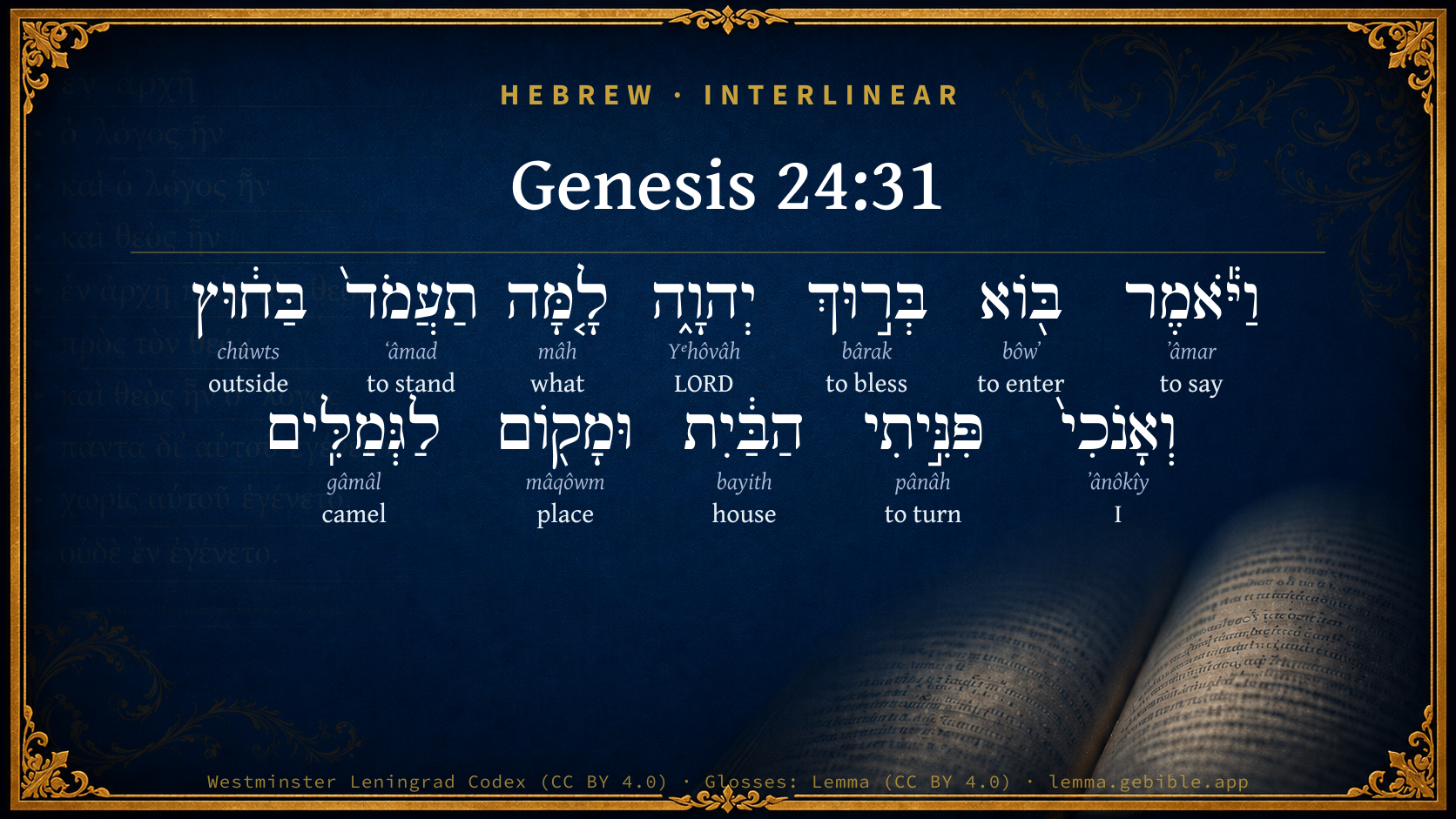
  1. וַיֹּ֕אמֶר ʼâmar H559 “and · to say” Conjunction + Verb, Qal, Sequential Imperfect, 3rd Person, Masculine, Singular
  2. בּ֖וֹא bôwʼ H935 “enter” Verb, Qal, Imperative, 2nd Person, Masculine, Singular
  3. בְּר֣וּךְ bârak H1288 “blessed” Verb, Qal, Participle Passive, Masculine, Singular, Construct
  4. יְהוָ֑ה Yᵉhôvâh H3068 “LORD” Noun, Proper
  5. לָ֤מָּה mâh H4100 “to/for · what” Preposition + Particle, Interrogative
  6. תַעֲמֹד֙ ʻâmad H5975 “to stand” Verb, Qal, Imperfect, 2nd Person, Masculine, Singular
  7. בַּח֔וּץ chûwts H2351 “in/at the · outside” Preposition, Determined + Noun, Common, Masculine, Singular, Absolute
  8. וְאָנֹכִי֙ ʼânôkîy H595 “and · I” Conjunction + Pronoun, Personal, 1st Person, Common, Singular
  9. פִּנִּ֣יתִי pânâh H6437 “to turn” Verb, Piel, Perfect, 1st Person, Common, Singular
  10. הַבַּ֔יִת bayith H1004 “the · house” Particle, Definite Article + Noun, Common, Masculine, Singular, Absolute
  11. וּמָק֖וֹם mâqôwm H4725 “and · place” Conjunction + Noun, Common, Masculine, Singular, Absolute

About this verse

These counts appear in no published source. They are computed here, from the morphology-tagged text and Lemma’s own curated glosses. What Lemma adds →

12
words
12
distinct lemmas
Pentateuch
section

Shared distinctive vocabulary

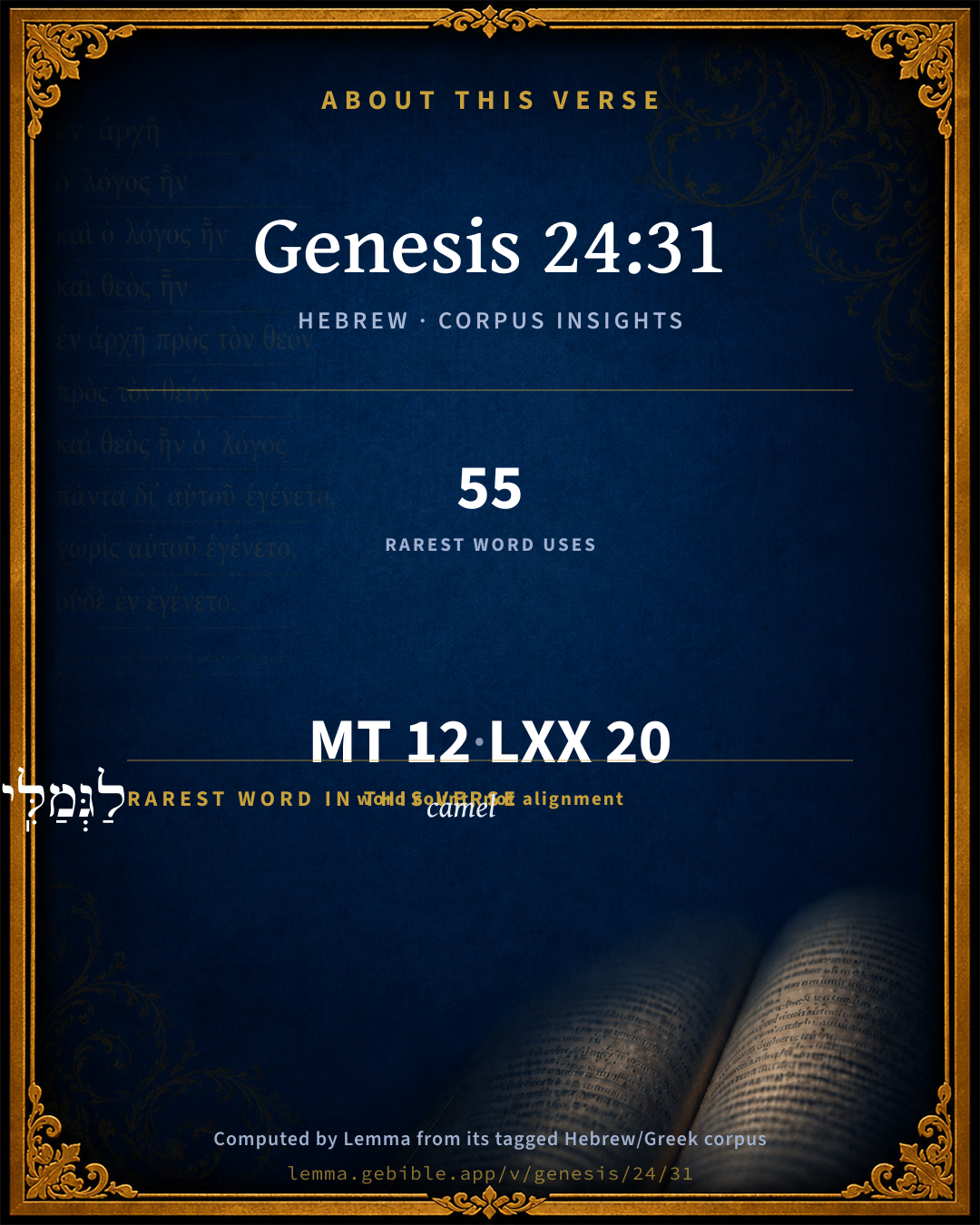
לַגְּמַלִּֽים camel H1581 occurs in 52 verses of the Hebrew Bible. Also found in:

Grammatical profile

  • 5 verbs
  • 5 nouns
  • 1 pronoun
  • 1 particle

Verb forms

  • וַיֹּ֕אמֶר Qal · Sequential Imperfect
  • בּ֖וֹא Qal · Imperative
  • בְּר֣וּךְ Qal · Participle Passive
  • תַעֲמֹד֙ Qal · Imperfect
  • פִּנִּ֣יתִי Piel · Perfect

Hebrew & Septuagint length

In English translation the verse runs 24 words from the Hebrew and 29 from the Septuagint (LXX English) — closely comparable.

A rough comparison of the two English renderings, which tokenize alike — not a word-level alignment.

Word counts can differ between the Hebrew and the Greek without any difference in meaning — e.g. the Hebrew direct-object marker אֵת has no separate Greek word, and Greek often adds the article ὁ.

In the original languages it is 12 Hebrew tokens and 20 Greek tokens — but the two are counted differently (Hebrew bundles its prefixes and suffixes into one token; the Greek is in lemma form), so that isn’t a like-for-like length.

Cross-references

6

Topical passages linked to Genesis 24:31 in the Treasury of Scripture Knowledge — connected by theme and wording, ordered by reader-vote popularity; previews shown in the World English Bible.

  • Genesis 26:29 that you will do us no harm, as we have not touched you, and as we have done to you nothing but good, and have sent you away in peace.' You are now the blessed of Yahweh."
  • Ruth 3:10 He said, Blessed are you by Yahweh, my daughter: you have shown more kindness in the latter end than at the beginning, inasmuch as you didn't follow young men, whether poor or rich.
  • Psalms 115:15 Blessed are you by Yahweh, Who made heaven and earth.
  • Judges 17:2 He said to his mother, The eleven hundred [pieces] of silver that were taken from you, about which you did utter a curse, and did also speak it in my ears, behold, the silver is with me; I took it. His mother said, Blessed be my son of Yahweh.
  • Proverbs 18:16 A man's gift makes room for him, And brings him before great men.
  • Proverbs 17:8 A bribe is a precious stone in the eyes of him who gives it; Wherever he turns, he prospers.

Cross-references courtesy of OpenBible.info (CC BY 4.0).

Hebrew and Greek witnesses Masoretic Hebrew ↔ Greek Septuagint

The same verse in the two great witnesses to the Old Testament, shown verse-for-verse.

These are two independent witnesses, not word-aligned to each other, and the Septuagint is shown in lemma (dictionary) form.

Hebrew Genesis 24:31 Masoretic · Westminster Leningrad Codex

וַיֹּ֕אמֶר בּ֖וֹא בְּר֣וּךְ יְהוָ֑ה לָ֤מָּה תַעֲמֹד֙ בַּח֔וּץ וְאָנֹכִי֙ פִּנִּ֣יתִי הַבַּ֔יִת וּמָק֖וֹם לַגְּמַלִּֽים

He said, "Come in, you blessed of Yahweh. Why do you stand outside? For I have prepared the house, and room for the camels."

World English Bible · Public Domain

Greek LXX Genesis 24:31 Septuagint · lemma form

καί εἶπον αὐτός δεῦρο εἰςἔρχομαι εὐλογητός κύριος ἵνα τίς ἵστημι ἔξω ἐγώ δέ ἑτοιμάζω ὁ οἰκία καί τόπος ὁ κάμηλος

And he said to him, Come in hither, you blessed of the Lord, why stand you without, whereas I have prepared the house and a place for the camels?

LXX2012 (modern English Septuagint) · Public Domain

Hebrew: Westminster Leningrad Codex (CC BY 4.0). Greek: Septuagint (public domain); English from LXX2012 (modern English Septuagint) (Public Domain). How the Septuagint differs from the Hebrew →

Targum (Aramaic paraphrase)

2

The Targum is the ancient Jewish Aramaic paraphrase of the Hebrew Scriptures — an interpretive translation, not the Hebrew text itself. Onkelos (literal) and Pseudo-Jonathan (expansive) render the Torah, and Jonathan the Prophets. Coverage is partial: where no permissively-licensed English translation exists for a verse, only the Aramaic is shown. This is verse-level text, not a word-by-word alignment to the Hebrew.

  1. Targum Onkelos Torah (Genesis–Deuteronomy)
    וַאֲמַר עוּל בְּרִיכָא דַּיְיָ לְמָא אַתְּ קָאֵם בְּבָרָא וַאֲנָא פַּנֵּיתִי בֵיתָא וַאֲתַר כָּשַׁר לְגַמְלַיָּא

    (no public-domain English translation for this verse)

    Targum Onkelos — Aramaic: “Onkelos Genesis” (public domain); “Onkelos Exodus” (public domain); “Onkelos Leviticus” (public domain); “Onkelos Numbers” (public domain); “Onkelos Deuteronomy” (public domain). English: “Sefaria Community Translation” (CC0 1.0 (public-domain dedication)); “J.W. Etheridge. The Targums of Onkelos and Jonathan Ben Uzziel on the Pentateuch. London: Longmans, Green, 1862” (public domain). Text via Sefaria.

  2. Targum Pseudo-Jonathan Torah (Genesis–Deuteronomy)
    וְחָשִׁיב לָבָן דְהוּא אַבְרָהָם וְאָמַר עוּל בְּרִיכָא דַיְיָ לְמָא אַנְתְּ קָאֵי בְּבָרָא וַאֲנָא פַּנְיַת בֵּיתָא מִפּוּלְחָנָא נוּכְרָאָה וַאֲתַר אַתְקִינַת לְגַמְלַיָא

    And Laban thought that this was Abraham, and said, Come in, thou blessed of the Lord: wherefore standest thou without, when I have purified the house from strange worship, and have prepared a place for the camels?

    Targum Pseudo-Jonathan — Aramaic: “Targum Jonathan on Genesis” (public domain); “Targum Jonathan on Exodus” (public domain); “Targum Jonathan on Leviticus” (public domain); “Targum Jonathan on Numbers” (public domain); “Targum Jonathan on Deuteronomy” (public domain). English: “The Targum of Jonathan ben Uzziel, trans. J. W. Etheridge, London, 1862” (public domain). Text via Sefaria.

Commentary

Notes on Genesis 24:31 from classic Christian and Jewish commentators (each source and its license shown beneath its notes). The classic Christian expositions comment on the surrounding passage and are grouped to its opening verse, so a note may address several verses; the Jewish commentaries on the Tanakh (Rashi and others) are per-verse, so they appear only where the commentator wrote on this verse.

Lemma curates 59 commentaries, every one of them public domain or Creative Commons licensed, each selected and text-cleaned for this edition rather than reprinted as found. About our sources →

Trapp's Complete Commentary

John Trapp

Gen 24:31 And he said, Come in, thou blessed of the LORD; wherefore standest thou without? for I have prepared the house, and room for the camels.

Ver. 31, 32. And he ungirded his camels.] Laban did. Si spes lucri affulserit, &c. Sing but a song of "Utile," and many will dance after it, yea, stoop to any drudgery almost.

John Trapp, A Commentary or Exposition upon All the Books of the Old and New Testament (1647–1656) — public domain. Text from a community e-Sword module.

The Biblical Illustrator

Joseph S. Exell

Gen_24:31

Come in, thou blessed of the Lord

Confession of Christ; or, persuasives to church fellowship

As Laban said I have prepared the house, so Christ has ordained the Church and provided it with all things necessary for the refreshment, repose, and invigoration of His people.

As Abrahams servant was invited to enter, so the ministers and stewards of Gods word, and all the members of His Church, should bless those whom the Lord has blessed, and affectionately invite them to participate in all the privileges of the Lords house.

I. WHO ARE THE BLESSED OF THE LORD? The Lord Jesus answered our question in the very first sentences of His great sermon on the mount. He opened His mouth and taught them, saying, Blessed are the poor in spirit. The Lord also said, Blessed are they that mourn. The Lord also said, Blessed are they which do hunger and thirst after righteousness. These are blessed of the Lord.

II. Let us inquire WHY THOSE WHO ARE BLESSED OF THE LORD SHOULD ACCEPT THE INVITATION of the Church to come in, by personal confession of Christ.

1. The Lord commands it (Mat_10:32-33; Mar_8:38).

2. The Church solicits it. A Christian who never confesses Christ and who holds aloof from fellowship with the Church, might as well not exist, so far as the interests of the Church are concerned.

3. The world needs it. The stronger the Church the more potent is the influence at work for the worlds good.

4. Your own spiritual welfare requires it. The value of association is recognized in other things. And thus church fellowship is useful in strengthening the convictions of those who share in a common faith and love towards Christ. An additional safeguard is thus furnished in seasons of temptation.

III. Let us now examine SOME OF THE EXCUSES adduced by those who, though blessed of the Lord, yet stand without. Some are ashamed of Christ, and shrink from the ridicule or enmity which confession might bring upon them. But these are not blessed of the Lord, for He says to them: He that is ashamed of Me, of him shall the Son of Man be ashamed. Some keep outside that they may be free from the restraints of membership, and have more liberty for sin, or at least for folly. Others keep outside because they resolve to postpone repentance. But why do any who really trust in Jesus and who desire to love and obey Him stand without? They are hindered by unscriptural obstacles, erroneous opinions, or misapplied humility. (Newman Hall, LL. B.)

The blessed of the Lord

I. WHAT IT IS THAT CONSTITUTES REAL HAPPINESS IN THE SIGHT OF GOD. It is being blessed of the Lord.

II. WHO ARE THEY THAT MAY BE SAID TO RE EMPHATICALLY BLESSED?

1. They who are justified in the sight of God.

2. Those who are sanctified by the Holy Spirit.

III. IN WHAT RESPECT AWE THEY BLESSED?

1. In their souls.

2. In their trials and sorrows.

3. In their mercies and prosperity.

4. In their labours.

5. In their relationship.

6. Throughout all eternity.

IV. And those, in the next place, who are thus blessed of the Lord, may TEST THE REALITY of their having that benediction by what they do for, or distribute amongst others, to whom the knowledge of that blessing has long been strange. He who is most blessed of God is always the greatest blessing to those that are about him. The greatest receiver of spiritual things is always the greatest giver; and the more he gives the more he gets, till he learns, by blessed and practical experience, it is more blessed to give than to receive. (J. Cumming, D. D.)

The Biblical Illustrator, edited by Joseph S. Exell (c. 1880s–1900s) — public domain. Text from a community e-Sword module.

Joseph Benson's Commentary

Gen 24:31. Come in, thou blessed of the Lord — Such was the beautiful language of those ancient times, whereby a sense of God was constantly kept up in their minds. How little is this language used in our day! Perhaps, because they heard from Rebekah of the gracious words which proceeded out of his mouth, they concluded that he was a good man, and therefore blessed of the Lord.

Joseph Benson's Commentary on the Old and New Testaments (1811–1818) — public domain. Text from a community e-Sword module.

Adam Clarke's Commentary

Verse 31. Thou blessed of the Lord] Probably a usual mode of wishing prosperity, as he that is blessed of the Lord is worthy of all respect; for, enjoying the Divine favour, he is in possession of the sum of happiness.

Adam Clarke's Commentary on the Bible (1810–1826) — public domain. Text from a community e-Sword/MySword module.

Ellicott's Commentary for English Readers

(31) Come in, thou blessed of the Lord.—This hospitality was in the East almost a matter of course, though Laban’s earnestness may have been increased by the sight of his sister’s golden ornaments. More remarkable is it that Laban addresses the servant as “blessed of Jehovah;” for we learn in Jos_24:2 that the monotheism of Nahor and his family was by no means pure. Still, neither were they idolaters, and the “other gods” whom they served were probably teraphim, as certainly were the gods of Laban mentioned in Gen_31:30. Even to the last these household gods seem to have retained a hold upon the affections of the nation (Hos_3:4); and probably most uneducated minds, even when their religion is in the main. true, have nevertheless a tendency to add on to it some superstitions, especially in the way of fashioning for themselves some lower mediator.

A Bible Commentary for English Readers, edited by Charles John Ellicott (1878–1897) — public domain. Text from a community e-Sword module.

The Cambridge Bible for Schools and Colleges

gen. ed. J. J. S. Perowne

31. thou blessed of the Lord] Cf. Gen_26:29. Laban’s reference to Jehovah probably implies that he too, as a member of Abraham’s kindred, was a worshipper of Jehovah the God of Abraham.

The Cambridge Bible for Schools and Colleges (gen. ed. J. J. S. Perowne; Cambridge University Press, 1878–1918) — public domain. Text from a community e-Sword module.

John Gill's Exposition

And he said, come in, thou blessed of the Lord,.... Both with temporal and spiritual blessings; he concluded he was blessed with the former by the presents he had made to his sister, and by the men that attended him, and the number of camels that were with him; and with the latter by his devotion, his worshipping of God, and thankfulness to him, which Rebekah had observed and related: some Jewish writers say (h), he thought he was Abraham, and therefore gave him this title and this invitation to come into the house:

wherefore standest thou without? this he said either as reproving him that he did not follow his sister upon her invitation, or rather as pressing him to make no more delay:

for I have prepared the house: swept it clean, or ordered it to be so, as the word (i) signifies; had fitted and furnished it with everything convenient for him and those with him: Jonathan and Jarchi interpret it of purging the house from idols and strange worship, which he knew would be offensive to Abraham, or any that belonged to him; but the former sense is best:

and room for the camels; he had ordered the stable to be cleansed also, and everything provided there fit for the camels; so that some time elapsed between Rebekah's return home and Laban's coming to the well, though no doubt everything was done with as much dispatch as possible.

(h) Bereshit Rabba, sect. 60. fol. 52. 4. Targ. Jon. in loc. (i) "repurgavi", Drusius; "verri", Schmidt.

John Gill's Exposition of the Whole Bible (1746–1763) — public domain (CC PDM 1.0). Text via the HelloAO Bible API.

Matthew Poole's English Annotations

Come in, thou blessed of the Lord, i.e. whom God hath so eminently favoured and blessed.

Matthew Poole's English Annotations on the Holy Bible (1683–1685) — public domain. Text from a community e-Sword/MySword module.

The Pulpit Commentary

And he said, Come in, thou blessed of the Lord. hwO; hy (cf. Gen_26:29; Num_24:9) the usual form being hwOhyl (vide Gen_14:19; Rth_2:20; 1Sa_15:13) Though Laban was an idolater, (Gen_31:30) it seems more satisfactory to regard him as belonging to a family in which the worship of Jehovah had originated, and by which it was still retained (Murphy, Wordsworth), than to suppose that he first learnt the name Jehovah from the servant"s address (Keil, Lange, Hengstenberg). Wherefore standest thou without? (as if his not accepting Rebekah"s invitation were almost a reflection on, the hospitality of the house of Abraham"s kinsmen) for (literally, arid, in expectation of thine arrival) I have prepared the house, or, put the house in order, by clearing it from things in confusion (cf. Lev_14:36) and room ( i.e. place) for the camels.

Laban, the solicitous host.

standest thou without?" The character of Laban has been well explained by Blunt in his "Coincidences." It is one of consistent greed. He was sincere in inviting Eliezer because he saw the bracelets on his sister"s hand, and expected still further favors from a guest who can so lavishly bestow gifts. Christ asks us to enter his kingdom, but he expects nothing from us in return but love. We may adapt this inquiry of Laban to souls as yet outside the Church.

I THE POSITION OCCUPIED. "Without." Probably they have no realized pardon, no enjoyment in religion, no future prospects of joy. Life is a dread mystery to them. They are saying, "Who will show us any good?" They may be just awakened spiritually, like the Philippian jailor. They may be under the condemnings of law and conscience, and in dread of the consequences of sin. Those within the true Church know in whom they have believed, and rejoice in forgiveness and the prospect of heaven. They are no longer outside the gates of mercy. We may be in a visible Church without being of Christ"s fold. It is penitence, faith, and character that determine our position, and not birth, rank, or ceremonial observances.

II THE REASONS WHEREFORE MANY RETAIN A POSITION OUTSIDE THE CHURCH.

1. Accustomed to the state, and unwilling to change. They are like the prisoner who, after many years" imprisonment in the Bastile, was liberated, and went forth only to find all his friends gone and himself a mere burden

2. to society. He went back and entreated to be allowed to retain his cell until he should pass out of the world.

3. Many, because they are ignorant of the fullness of Divine mercy.

1. Others, because they think there is so much to be done ere they can be fitted to be received within, and are looking to their own efforts to prepare themselves.

2. Many, because they fear their opportunity of admittance is past.

3. Others, because undecided as to whether they shall give up the pleasures of the world for the privileges of Christian fellowship.

4. Others, because they lack faith in their faith and its power to justify.

5. Many stand outside because they think themselves as secure outside as within. They forget that Christ demands open confession, and that to be united openly, to his Church is one way of confessing his name before men. Let there be a personal and searching inquiry, "Wherefore standest thou without?" The invited guest passed within, and found his highest expectations more than realized, because God had prospered his journey. H.

The Pulpit Commentary (1880–1919), ed. H.D.M. Spence-Jones & Joseph S. Exell — public domain. Text from a community e-Sword module.

John Wesley's Explanatory Notes

Come in thou blessed of the Lord - Perhaps, because they heard from Rebekah, of the gracious words which proceeded out of his mouth, they concluded him a good man, and therefore blessed of the Lord.

John Wesley, Explanatory Notes Upon the Whole Bible (1754–1765) — public domain. Text via the GEBible commentary corpus.

unfoldingWord translationNotes

Door43 World Missions Community

Come, you

"Come in, you" or "Enter, you"

you blessed of Yahweh

"you whom Yahweh has blessed"

you

Here the word "you" refers to Abraham's servant. (See: Forms of You)

Why are you standing outside?

Laban used this question to invite Abraham's servant into his house. This question can be translated as a statement. AT: "You do not need to stay outside." (See: Rhetorical Question)

So the man came to the house

The word "came" can be translated as "went." (See: Go and Come)

he unloaded the camels

It is not clear who did this work. This may be stated in active form. AT: "Laban's servants unloaded the camels" or "the camels were unloaded" (See: Active or Passive)

The camels were given straw and feed, and water was provided

This does not say who did the work. If you state this in active form use "Laban's servants" as the subject. AT: "Laban's servants gave straw and feed to the camels, and they provided water" (See: Active or Passive)

to wash his feet ... him

"for Abraham's servant and the men who were with him to wash their feet"

translationWords

Laban

bless

Yahweh

unfoldingWord translationNotes — © Distant Shores Media and the Door43 World Missions Community, licensed CC BY-SA 4.0. Source: git.door43.org/Door43/en_tn.

Rashi

Rabbi Shlomo Yitzchaki (Rashi)

פניתי הבית I HAVE CLEARED THE HOUSE of idols (Genesis Rabbah 60:7).

Rashi on the Tanakh — English translations: “The Judaica Press complete Tanach with Rashi, translated by A. J. Rosenberg” (CC BY 4.0); “Pentateuch with Rashi's commentary by M. Rosenbaum and A.M. Silbermann, 1929-1934” (public domain); “The Metsudah Tanach series, Lakewood, N.J” (CC BY 4.0); and “The Book of Joshua, Metsudah Publications, 1997” (CC BY 4.0). Text via Sefaria.

Radak

Rabbi David Kimhi (Radak)

'ויאמר בא ברוך ה, he meant that he could see that G’d had blessed Eliezer with wealth and therefore

פניתי הבית, for you and your men, מקום לגמלים, and I have also cleared space to accommodate the camels.

Radak on the Tanakh — English translations: “Sefaria Community Translation” (CC0 1.0 (public-domain dedication)); “Eliyahu Munk, HaChut Hameshulash” (CC BY 4.0); “Rabbi Mike Feuer, Jerusalem Anthology” (CC BY 4.0); and “R. David Kimhi on the first book of Psalms, Translated by R.G. Finch, London, 1919” (public domain). Text via Sefaria.

Lesson kit

Teaching starters — assembled from the data on this page, not authored interpretation. Every prompt links to the verse data it draws on. Edit before teaching.

Genesis, in the Pentateuch, opens this verse with 12 words (12 distinct Hebrew lemmas). Its most distinctive word is gâmâl (“camel”). A historical commentator’s framing appears above. Read the whole chapter for the surrounding context.

Discussion questions

  1. What does “camel” (gâmâl) contribute to the verse as a whole?
  2. Genesis 12:16 shares the word «camel» with this verse. How do the two illuminate each other?
  3. These translations render this verse differently; the difference is in the English rendering, not the original. What questions does that raise?
  4. The verb «וַיֹּ֕אמֶר» is Qal Sequential Imperfect. How does its form color the action?
  5. Reading how Trapp's Complete Commentary and The Biblical Illustrator read this verse, where do the two commentators agree and where do they part?

Things to notice

Reading settings

Reading text

Shown beneath each verse's original-language words.

Old Testament
Old Testament edition

Read the OT as the Masoretic Hebrew (MT) or the Greek Septuagint (LXX).

English shown for the Greek Septuagint (in the Hebrew ↔ Greek comparison).

Comparing translations? Open the Compare panel on any verse page to stack up to four side by side.