
Genesis 20:13

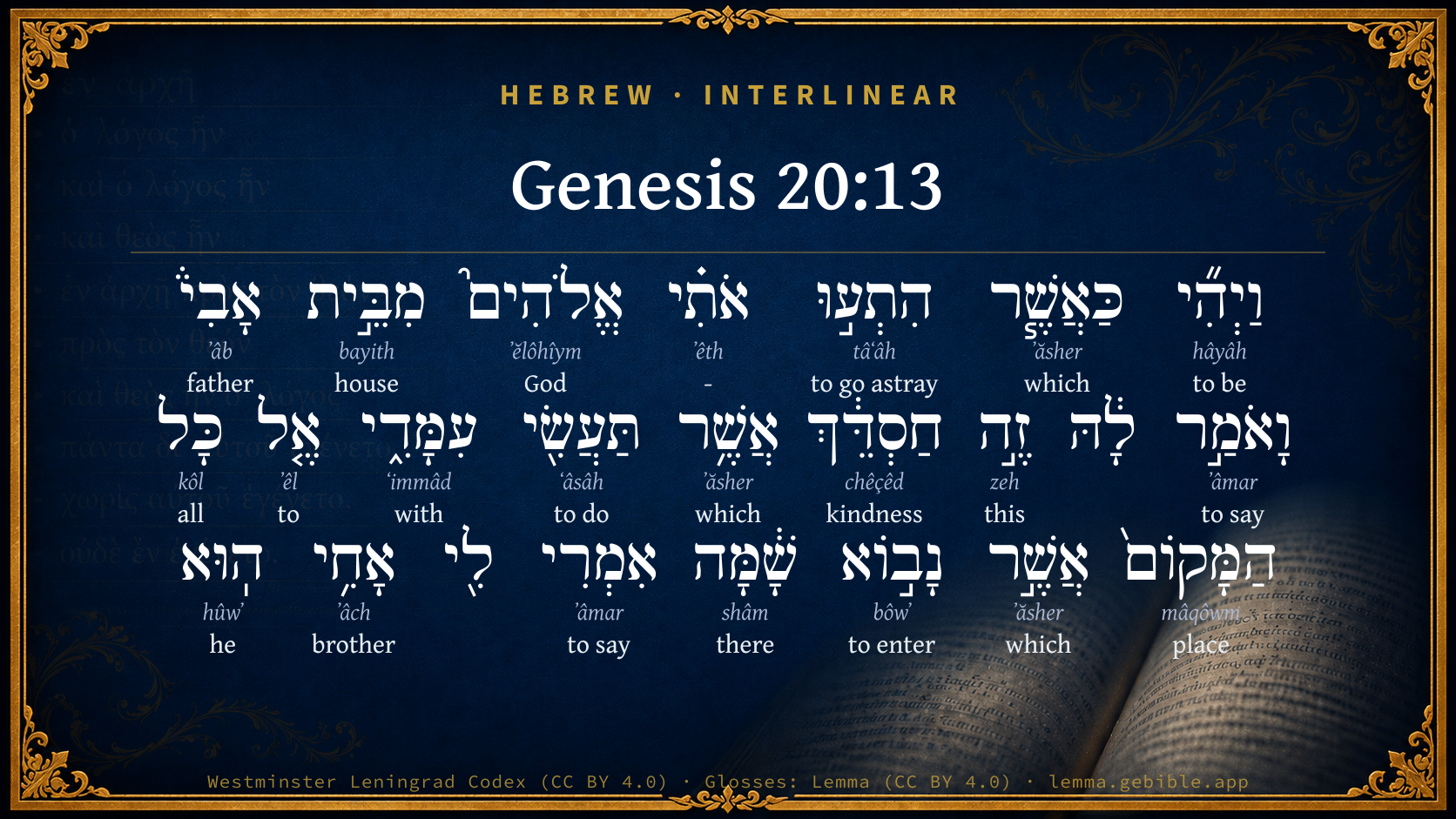
Hebrew (Westminster Leningrad Codex) Genesis 20:13 appears in the Hebrew Old Testament. The text above is from the Westminster Leningrad Codex. Each word links to its Strong’s number, a concise gloss, and parsing drawn from the Open Scriptures Hebrew Bible morphology. Click any word for its full Brown-Driver-Briggs (BDB) entry.
Download image
Cite this verse

Genesis 20:13 (World English Bible). Public Domain. Lemma interlinear Bible study tool, https://lemma.gebible.app/v/genesis/20/13.

Show BibTeX & RIS
BibTeX
RIS
English Translation
It happened, when God caused me to wander from my father's house, that I said to her, 'This is your kindness which you shall show to me. Everywhere that we go, say of me, "He is my brother."'"
World English Bible · Public Domain
Highlights
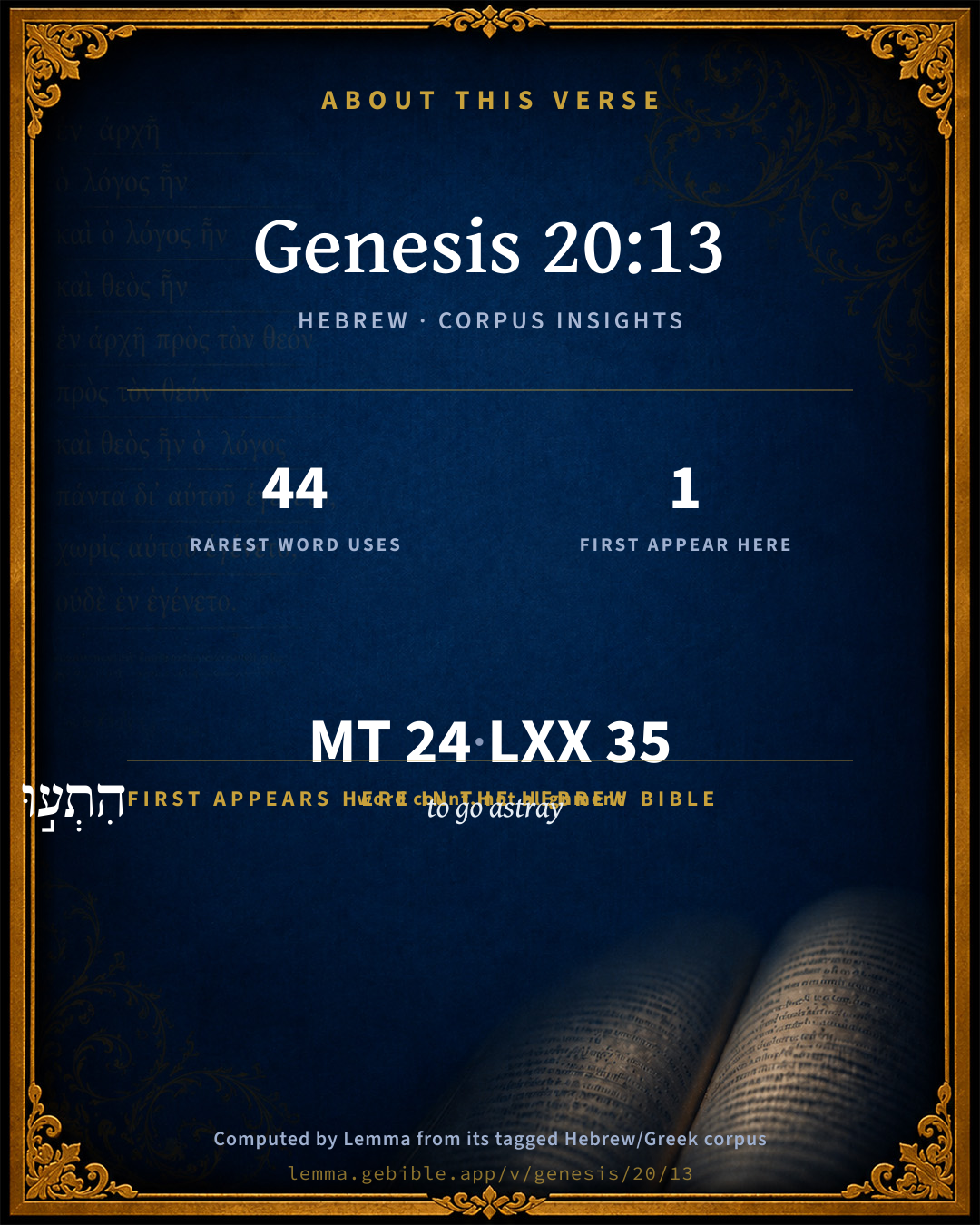
  • 1 first appearance in the Hebrew Bible
Full analysis ↓
Download a study sheet

One document with this verse’s original text, its word-by-word gloss line, the meaning frame, cross-references with their text, attributed commentary, and full source and license credits — printable, and it pastes into notes with its structure intact.

This verse Autodidact and up

Study sheet (.html) Plain text (.txt)

A passage Seminary Student

Up to 50 verses in one chapter. A passage sheet keeps up to 6 commentary sources and 12 cross-references per verse, in the order this page ranks them, and says so on the sheet whenever that leaves anything out. Ask for a single verse and you get the Autodidact verse sheet above.

Everything on this page stays free to read, with no account — the sheet is a download of what is already on screen, not access to it.

Want to remove ads? Support Godless Engineer
Compare translations 3

The same verse in 3 English versions, stacked beneath the original-language interlinear above. Click any original word for its lexicon entry.

Each is an independent rendering of the whole verse — the interlinear is not word-aligned to these translations.

Highlighted words mark where these versions differ — a whole-verse word diff, not a word-by-word alignment.

  • World English Bible Public Domain
    It happened, when God caused me to wander from my father's house, that I said to her, 'This is your kindness which you shall show to me. Everywhere that we go, say of me, "He is my brother."'"
  • King James Version Public Domain
    And it came to pass, when God caused me to wander from my father's house, that I said unto her, This is thy kindness which thou shalt show unto me; at every place whither we shall come, say of me, He is my brother.
  • unfoldingWord Literal Text CC BY-SA 4.0
    And it happened when God caused me to wander from the house of my father, then I said to her, ‘This your kindness that you can do for me: At every place where we go, say about me, “He my brother.”’”

unfoldingWord Literal Text — © unfoldingWord, licensed CC BY-SA 4.0. Word-aligned USFM3 via Door43 (git.door43.org/unfoldingWord/en_ult).

Versions to compare (up to 4)

3 of 4 selected

Show all 18 translations

Every available English version of this verse, each an independent rendering of the whole verse.

  • World English Bible Public Domain
    It happened, when God caused me to wander from my father's house, that I said to her, 'This is your kindness which you shall show to me. Everywhere that we go, say of me, "He is my brother."'"
  • Berean Standard Bible Public Domain
    So when God had me journey from my father’s house, I said to Sarah, ‘This is how you can show your loyalty to me: Wherever we go, say of me, “He is my brother.”’”
  • Majority Standard Bible Public Domain
    So when God had me journey from my father’s house, I said to Sarah, ‘This is how you can show your loyalty to me: Wherever we go, say of me, “He is my brother.”’”
  • King James Version Public Domain
    And it came to pass, when God caused me to wander from my father's house, that I said unto her, This is thy kindness which thou shalt show unto me; at every place whither we shall come, say of me, He is my brother.
  • American Standard Version (1901) Public Domain
    and it came to pass, when God caused me to wander from my father's house, that I said unto her, This is thy kindness which thou shalt show unto me. At every place whither we shall come, say of me, He is my brother.
  • Revised Version (1885) Public Domain
    and it came to pass, when God caused me to wander from my father’s house, that I said unto her, This is thy kindness which thou shalt shew unto me; at every place whither we shall come, say of me, He is my brother.
  • Geneva Bible (1599) Public Domain
    Nowe when God caused me to wander out of my fathers house, I said then to her, This is thy kindnes that thou shalt shewe vnto me in all places where we come, Say thou of me, He is my brother.
  • Douay-Rheims (1899) Public Domain
    And after God brought me out of my father's house, I said to her: I Thou shalt do me this kindness: In every place, to which we shall come, thou shalt say that I am thy brother.
  • Young's Literal Translation Public Domain
    and it cometh to pass, when God hath caused me to wander from my father's house, that I say to her, This `is' thy kindness which thou dost with me: at every place whither we come, say of me, He `is' my brother.'
  • Literal Standard Version CC BY-SA 4.0
    and it comes to pass, when God has caused me to wander from my father’s house, that I say to her, This [is] your kindness which you do with me: at every place to where we come, say of me, He [is] my brother.”
  • Unlocked Literal Bible CC BY-SA 4.0
    When God caused me to leave my father's house and travel from place to place, I said to her, 'You must show me this faithfulness as my wife: At every place where we go, say about me, “He is my brother.”'”
  • unfoldingWord Literal Text CC BY-SA 4.0
    And it happened when God caused me to wander from the house of my father, then I said to her, ‘This your kindness that you can do for me: At every place where we go, say about me, “He my brother.”’”
  • Darby Bible Public Domain
    And it came to pass when God caused me to wander from my father's house, that I said to her, Let this be thy kindness which thou shalt shew to me: at every place whither we shall come, say of me, He is my brother.
  • World Messianic Bible Public Domain
    When God caused me to wander from my father’s house, I said to her, ‘This is your kindness which you shall show to me. Everywhere that we go, say of me, “He is my brother.”’”
  • Webster's Bible Public Domain
    And it came to pass, when God caused me to wander from my father's house, that I said to her, This is thy kindness which thou shalt show to me; At every place whither we shall come, say of me, He is my brother.
  • Free Bible Version CC BY-SA 4.0
    Since my God made me move far away from my family home, I told her, ‘If you really love me, then wherever you go with me you must tell people: He's my brother.’”
  • Bible in Basic English Public Domain
    And when God sent me wandering from my father's house, I said to her, Let this be the sign of your love for me; wherever we go, say of me, He is my brother.
  • JPS Tanakh (1917) Public Domain
    And it came to pass, when God caused me to wander from my father's house, that I said unto her: This is thy kindness which thou shalt show unto me; at every place whither we shall come, say of me: He is my brother.'

Literal Standard Version (2020), Covenant Press — licensed CC BY-SA 4.0. Text via the HelloAO Bible API (eBible.org). Unlocked Literal Bible (unfoldingWord) — licensed CC BY-SA 4.0. Text via the HelloAO Bible API (eBible.org). unfoldingWord Literal Text — © unfoldingWord, licensed CC BY-SA 4.0. Word-aligned USFM3 via Door43 (git.door43.org/unfoldingWord/en_ult). Free Bible Version, Dr. Jonathan Gallagher — licensed CC BY-SA 4.0. Text via the HelloAO Bible API (eBible.org).

Word by word

More ways to search: Search by grammar → Find every occurrence → Compare this word →

Practice this passage: Drill this verse → Learn its vocabulary →

עִמָּדִ֑י
ʻimmâd
H5978
“with · me”
Preposition + Suffix, Personal, 1st Person, Common, Singular
Part of Speech
Preposition
Full BDB Definition

Origin: prol for H5973

TWOT: 1640b

with
  1. וַיְהִ֞י hâyâh H1961 “and · to be” Conjunction + Verb, Qal, Sequential Imperfect, 3rd Person, Masculine, Singular
  2. כַּאֲשֶׁ֧ר ʼăsher H834 “like/as · which” Preposition + Particle, Relative
  3. הִתְע֣וּ tâʻâh H8582 “to go astray” Verb, Hiphil, Perfect, 3rd Person, Common, Plural
  4. אֹתִ֗י ʼêth H853 “- · me” Particle, Direct Object + Suffix, Personal, 1st Person, Common, Singular
  5. אֱלֹהִים֮ ʼĕlôhîym H430 “God(s)” Noun, Common, Masculine, Plural, Absolute
  6. מִבֵּ֣ית bayith H1004 “from · house of” Preposition + Noun, Common, Masculine, Singular, Construct
  7. אָבִי֒ ʼâb H1 “father · my” Noun, Common, Masculine, Singular, Construct + Suffix, Personal, 1st Person, Common, Singular
  8. וָאֹמַ֣ר ʼâmar H559 “and · to say” Conjunction + Verb, Qal, Sequential Imperfect, 1st Person, Common, Singular
  9. זֶ֣ה zeh H2088 “this” Pronoun, Demonstrative, Masculine, Singular
  10. חַסְדֵּ֔ךְ chêçêd H2617 “kindness · your” Noun, Common, Masculine, Singular, Construct + Suffix, Personal, 2nd Person, Feminine, Singular
  11. אֲשֶׁ֥ר ʼăsher H834 “which” Particle, Relative
  12. תַּעֲשִׂ֖י ʻâsâh H6213 “to do” Verb, Qal, Imperfect, 2nd Person, Feminine, Singular
  13. אֶ֤ל ʼêl H413 “to” Preposition
  14. כָּל kôl H3605 “all of” Noun, Common, Masculine, Singular, Construct
  15. הַמָּקוֹם֙ mâqôwm H4725 “the · place” Particle, Definite Article + Noun, Common, Masculine, Singular, Absolute
  16. אֲשֶׁ֣ר ʼăsher H834 “which” Particle, Relative
  17. נָב֣וֹא bôwʼ H935 “to enter” Verb, Qal, Imperfect, 1st Person, Common, Plural
  18. שָׁ֔מָּה shâm H8033 “there · toward” Adverb + Suffix, Demonstrative
  19. אִמְרִי ʼâmar H559 “say” Verb, Qal, Imperative, 2nd Person, Feminine, Singular
  20. אָחִ֥י ʼâch H251 “brother · my” Noun, Common, Masculine, Singular, Construct + Suffix, Personal, 1st Person, Common, Singular
  21. הֽוּא hûwʼ H1931 “he” Pronoun, Personal, 3rd Person, Masculine, Singular

About this verse

These counts appear in no published source. They are computed here, from the morphology-tagged text and Lemma’s own curated glosses. What Lemma adds →

24
words
19
distinct lemmas
Pentateuch
section

First appearance in Scripture

This word makes its first canonical appearance in the Hebrew Bible here:

  • הִתְע֣וּ to go astray H8582

Shared distinctive vocabulary

עִמָּדִ֑י with H5978 occurs in 44 verses of the Hebrew Bible. Also found in:

Grammatical profile

  • 6 verbs
  • 7 nouns
  • 2 pronouns
  • 4 prepositions
  • 1 adverb
  • 4 particles

Verb forms

  • וַיְהִ֞י Qal · Sequential Imperfect
  • הִתְע֣וּ Hiphil · Perfect
  • וָאֹמַ֣ר Qal · Sequential Imperfect
  • תַּעֲשִׂ֖י Qal · Imperfect
  • נָב֣וֹא Qal · Imperfect
  • אִמְרִי Qal · Imperative

Repetition

Words recur within this verse — often emphatic in Hebrew:

  • וָאֹמַ֣ר to say H559 ×2
  • כַּאֲשֶׁ֧ר which H834 ×3

Hebrew & Septuagint length

In English translation the verse runs 38 words from the Hebrew and 44 from the Septuagint (LXX English) — closely comparable.

A rough comparison of the two English renderings, which tokenize alike — not a word-level alignment.

Word counts can differ between the Hebrew and the Greek without any difference in meaning — e.g. the Hebrew direct-object marker אֵת has no separate Greek word, and Greek often adds the article ὁ.

In the original languages it is 24 Hebrew tokens and 35 Greek tokens — but the two are counted differently (Hebrew bundles its prefixes and suffixes into one token; the Greek is in lemma form), so that isn’t a like-for-like length.

Cross-references

8

Topical passages linked to Genesis 20:13 in the Treasury of Scripture Knowledge — connected by theme and wording, ordered by reader-vote popularity; previews shown in the World English Bible.

  • Genesis 12:1 Now Yahweh said to Abram, "Get out of your country, and from your relatives, and from your father's house, to the land that I will show you.
  • Genesis 12:9 Abram traveled, going on still toward the South.
  • Genesis 12:11–20 It happened, when he was come near to enter into Egypt, that he said to Sarai his wife, "See now, I know that you are a beautiful woman to look on.
  • 1 Samuel 23:21 Saul said, Blessed be you of Yahweh; for you have had compassion on me.
  • Psalms 64:5 They encourage themselves in evil plans. They talk about laying snares secretly. They say, "Who will see them?"
  • Acts 5:9 But Peter asked her, "How is it that you have agreed together to tempt the Spirit of the Lord? Behold, the feet of those who have buried your husband are at the door, and they will carry you out."
  • Acts 7:3–5 and said to him, 'Get out of your land, and from your relatives, and come into a land which I will show you.'
  • Hebrews 11:8 By faith, Abraham, when he was called, obeyed to go out to the place which he was to receive for an inheritance. He went out, not knowing where he went.

Cross-references courtesy of OpenBible.info (CC BY 4.0).

Hebrew and Greek witnesses Masoretic Hebrew ↔ Greek Septuagint

The same verse in the two great witnesses to the Old Testament, shown verse-for-verse.

These are two independent witnesses, not word-aligned to each other, and the Septuagint is shown in lemma (dictionary) form.

Hebrew Genesis 20:13 Masoretic · Westminster Leningrad Codex

וַיְהִ֞י כַּאֲשֶׁ֧ר הִתְע֣וּ אֹתִ֗י אֱלֹהִים֮ מִבֵּ֣ית אָבִי֒ וָאֹמַ֣ר לָ֔הּ זֶ֣ה חַסְדֵּ֔ךְ אֲשֶׁ֥ר תַּעֲשִׂ֖י עִמָּדִ֑י אֶ֤ל כָּל הַמָּקוֹם֙ אֲשֶׁ֣ר נָב֣וֹא שָׁ֔מָּה אִמְרִי לִ֖י אָחִ֥י הֽוּא

It happened, when God caused me to wander from my father's house, that I said to her, 'This is your kindness which you shall show to me. Everywhere that we go, say of me, "He is my brother."'"

World English Bible · Public Domain

Greek LXX Genesis 20:13 Septuagint · lemma form

γίγνομαι δέ ἡνίκα ἐκἄγω ἐγώ ὁ θεός ἐκ ὁ οἶκος ὁ πατήρ ἐγώ καί εἶπον αὐτός οὗτος ὁ δικαιοσύνη ποιέω ἐπί ἐγώ εἰς πᾶς τόπος οὗ ἐάν εἰςἔρχομαι ἐκεῖ εἶπον ἐγώ ὅτι ἀδελφός ἐγώ εἰμί

And it came to pass when God brought me forth out of the house of my father, that I said to her, This righteousness you shall perform to me, in every place into which we may enter, say of me, He is my brother.

LXX2012 (modern English Septuagint) · Public Domain

Hebrew: Westminster Leningrad Codex (CC BY 4.0). Greek: Septuagint (public domain); English from LXX2012 (modern English Septuagint) (Public Domain). How the Septuagint differs from the Hebrew →

Targum (Aramaic paraphrase)

2

The Targum is the ancient Jewish Aramaic paraphrase of the Hebrew Scriptures — an interpretive translation, not the Hebrew text itself. Onkelos (literal) and Pseudo-Jonathan (expansive) render the Torah, and Jonathan the Prophets. Coverage is partial: where no permissively-licensed English translation exists for a verse, only the Aramaic is shown. This is verse-level text, not a word-by-word alignment to the Hebrew.

  1. Targum Onkelos Torah (Genesis–Deuteronomy)
    וַהֲוָה כַּד טָעוּ עַמְמַיָּא בָּתַר עוֹבָדֵי יְדֵיהוֹן יָתִי קָרִיב יְיָ לְדַחַלְתֵּהּ מִבֵּית אַבָּא וַאֲמָרִית לַהּ דֵּין (נ''י דָּא) טֵיבוּתִיךְ דִּי תַעְבְּדִי עִמִּי לְכָל אַתְרָא דִּי נְהַךְ לְתַמָּן אֱמָרִי עֲלַי אָחִי הוּא

    (no public-domain English translation for this verse)

    Targum Onkelos — Aramaic: “Onkelos Genesis” (public domain); “Onkelos Exodus” (public domain); “Onkelos Leviticus” (public domain); “Onkelos Numbers” (public domain); “Onkelos Deuteronomy” (public domain). English: “Sefaria Community Translation” (CC0 1.0 (public-domain dedication)); “J.W. Etheridge. The Targums of Onkelos and Jonathan Ben Uzziel on the Pentateuch. London: Longmans, Green, 1862” (public domain). Text via Sefaria.

  2. Targum Pseudo-Jonathan Torah (Genesis–Deuteronomy)
    וַהֲוָה כַּד בָּעוּ לְאַטְעָאָה יָתִי פִּלְחֵי טַעֲוָותָא וּנְפָקֵית מִבֵּית אַבָּא וַאֲמָרִית לָהּ דֵין טִיבוּתִיךְ דְתַעַבְדִין עִמִי לְכָל אַתְרָא דִנְהַךְ לְתַמָן אִמְרִי עָלַי דְאָחִי הוּא

    And it was when they sought to turn me aside to the wor-ship of idols, and I went forth from my father's house, that I said to her, This is the kindness thou shalt do me: in every place to which we come, say concerning me, He is my brother.

    Targum Pseudo-Jonathan — Aramaic: “Targum Jonathan on Genesis” (public domain); “Targum Jonathan on Exodus” (public domain); “Targum Jonathan on Leviticus” (public domain); “Targum Jonathan on Numbers” (public domain); “Targum Jonathan on Deuteronomy” (public domain). English: “The Targum of Jonathan ben Uzziel, trans. J. W. Etheridge, London, 1862” (public domain). Text via Sefaria.

Commentary

Notes on Genesis 20:13 from classic Christian and Jewish commentators (each source and its license shown beneath its notes). The classic Christian expositions comment on the surrounding passage and are grouped to its opening verse, so a note may address several verses; the Jewish commentaries on the Tanakh (Rashi and others) are per-verse, so they appear only where the commentator wrote on this verse.

Lemma curates 59 commentaries, every one of them public domain or Creative Commons licensed, each selected and text-cleaned for this edition rather than reprinted as found. About our sources →

Trapp's Complete Commentary

John Trapp

Gen 20:13 And it came to pass, when God caused me to wander from my father’s house, that I said unto her, This [is] thy kindness which thou shalt shew unto me; at every place whither we shall come, say of me, He [is] my brother.

Ver. 13. When God caused me to wander.] Cum facerent Dii , when they, even God, caused me. The mystery of the Trinity, {a} though Calvin interpret it of the angels; as Cartwright likewise doth that of Solomon, which Junius conceiveth to be spoken of the blessed Trinity, "There be higher than they," {Ecc 5:8} sc., that Three in One, and One in Three.

{a} Mysterium Triados . - Jun.

John Trapp, A Commentary or Exposition upon All the Books of the Old and New Testament (1647–1656) — public domain. Text from a community e-Sword module.

Joseph Benson's Commentary

Gen 20:13. When God caused me to wander from my father’s house — Then we settled this matter. It may be, that God denied Abraham and Sarah the blessing of children so long, to punish them for this sinful compact they had made to deny one another: if they will not own their marriage, why should God own it? But we may suppose that, after this reproof, they agreed never to do so again, and then presently we read, (Gen 21:1-2.) that Sarah conceived.

Joseph Benson's Commentary on the Old and New Testaments (1811–1818) — public domain. Text from a community e-Sword module.

Adam Clarke's Commentary

Verse 13. When God caused me to wander] Here the word אלהים Elohim is used with a plural verb, (התעו hithu, caused me to wander), which is not very usual in the Hebrew language, as this plural noun is generally joined with verbs in the singular number. Because there is a departure from the general mode in this instance, some have contended that the word Elohim signifies princes in this place, and suppose it to refer to those in Chaldea, who expelled Abraham because he would not worship the fire; but the best critics, and with them the Jews, allow that Elohim here signifies the true God. Abraham probably refers to his first call.

Adam Clarke's Commentary on the Bible (1810–1826) — public domain. Text from a community e-Sword/MySword module.

John Calvin's Commentaries

13. When God caused me to wander Because the verb is here put in the plural number, I freely expound the passage as referring to the angels, who led Abraham through his various wanderings. Some, with too much subtlety, infer from it a Trinity of Persons: as if it had been written: The gods caused me to wander. I grant, indeed, that the noun אלהים (Elohim,) is frequently taken for God in the Scripture: but then the verb with which it is connected is always singular. Wherever a plural verb is added then it signifies angels or princes. There are those who think that Abraham, because he was speaking with one who was not rightly instructed, spoke thus in conformity with the common custom of the heathen; but, in my opinion, most erroneously. For to what purpose did he, by erecting altars, make it manifest that he was devoted to the service of the only true God, if it were lawful for him afterwards to deny, in words, the very God whom he had worshipped? On which subject we have before spoken, as the case required. Abraham, however, does not complain respecting, the angels, that he had been led astray by their fallacious guidance: but he points out what his own condition formerly was; namely, that having left his own country, he had not only migrated into a distant land, but had been constantly compelled to change his abode. Wherefore there is no wonder, that necessity drove him into new designs. Should any one inquire, why he makes angels the guides of his pilgrimage? the answer is ready; Although Abraham knew that he was wandering by the will and providence of God alone, he yet refers to angels, who, as he elsewhere acknowledges, were given him to be the guides of his journey. The sum of the address is of this tendency; to teach Abimelech, that Abraham was alike free from malicious cunning, and from falsehood: and then, that because he was passing a wandering and unquiet life; Sarah, by agreement, had always said the same thing which she had done in Gerar. This wretched anxiety of the holy man might so move Abimelech to compassion as to cause his anger to cease.

John Calvin's Commentaries (1540-1563) — public domain. Text from the Calvin Translation Society English edition (1840s-50s) via the Christian Classics Ethereal Library (ccel.org). Calvin's coverage is partial (roughly two-thirds of the Bible); uncommented books and verses are honest gaps, never fabricated. The 19th-century editor's footnotes and remarks are omitted so the notes are faithfully Calvin's own voice.

Ellicott's Commentary for English Readers

(13) When God caused me to wander.—According to rule, Elohim is construed with a verb singular for the true God, but with a verb plural for false gods. Here the verb is plural, and the same construction occurs in Gen_35:7; Exo_22:9; 2Sa_7:22 (but singular in 1Ch_17:20); and Psa_58:11 : moreover, in Jos_24:19, Elohim is joined with an adjective (holy) in the plural. These exceptions may either be relics of a less strict use of the name Elohim, or they may be errors of copyists, misled by the ordinary rules of grammar. This latter view is confirmed by the fact that the Samaritan Pentateuch, both here and in Gen_35:7, has the singular.

At every place.—The fact of this compact between Abraham and Sarah having been made so long before, would convince Abimelech that their conduct was not occasioned by anything which they had seen at Gerar (comp. Gen_20:10).

A Bible Commentary for English Readers, edited by Charles John Ellicott (1878–1897) — public domain. Text from a community e-Sword module.

The Cambridge Bible for Schools and Colleges

gen. ed. J. J. S. Perowne

13. God caused me to wander] Referring to Gen_12:1. The Hebrew student will notice that the verb “caused me to wander” is in the plural, although, as a rule in the O.T., the word “God” (Elohim) is treated as sing. But it is sometimes the case that the plural is used, as here and in Gen_31:53, Jos_24:19, when an Israelite speaks to heathen, or else heathen are speaking of God, e.g. 1Sa_4:8; 1Ki_19:2; 1Ki_20:10. For an exception, see Gen_35:7. Here the Massoretic note adds “holy,” in order to call attention to the unusual construction.

The Cambridge Bible for Schools and Colleges (gen. ed. J. J. S. Perowne; Cambridge University Press, 1878–1918) — public domain. Text from a community e-Sword module.

John Gill's Exposition

And it came to pass, when God caused me to wander from my father's house,.... In Ur of the Chaldees, from whence God called him to go forth; which laid him under an obligation to depart from thence, and move from place to place, and go he knew not where, as in Heb 11:8; or "the Gods", as it is in the plural number, and so the verb in construction with it; not the idol gods, the gods of the Gentiles, as the Targum of Jonathan, who interprets the words thus,"and it was when the worshippers of idols sought to cause men to err, and I went from my father's house;''but the true God, as Jarchi, Aben Ezra, and Ben Melech acknowledge, and is by many Christian interpreters understood of the three Persons in the Godhead:

that I said unto her, this is thy kindness which thou shalt show unto me; this I shall take as a favour done me, as an instance of tender affection unto me:

at every place whither we shall come, say of me; or for the sake of me, as Aben Ezra and Kimchi, in order to save me from the hands of wicked men, whom he feared would slay him for her sake:

he is my brother; and so he hoped, instead of being ill used, he should meet with favour and friendship on her account, being thus nearly related to her: this he observes to Abimelech, to show that this was an old agreement, near thirty years ago, when they first set out on their travels, and was no new device and scheme which they pursued on account of him and his people in particular; but what they had formerly agreed upon should be said in all places wherever they came, and therefore there was no intention to affront Abimelech; only it supposed they might come into places where wicked men dwelt.

John Gill's Exposition of the Whole Bible (1746–1763) — public domain (CC PDM 1.0). Text via the HelloAO Bible API.

Matthew Poole's English Annotations

To wander. This word he useth because God did not direct him to any certain place, but sent him out he knew not whither, Heb 11:8. And being to travel and sojourn amongst persons of divers tempers and manners, and all pagans, he thought this equivocal expression convenient for his security.

Matthew Poole's English Annotations on the Holy Bible (1683–1685) — public domain. Text from a community e-Sword/MySword module.

The Pulpit Commentary

And it came to pass, when God caused me to wander (or to go on pilgrimages) from my father"s house, Elohim, usually construed with a singular verb, is here joined with a verb in the plural, as an accommodation to the polytheistic stand-point of Abimelech (Keil), as a proof that Elohim is to be viewed as a Pluralis Majes-taticus (Kalisch), as referring to the plurality of Divine manifestations which Abraham had received (Lange), as showing that Elohim here signifies angels (Calvin), or, most likely, as an instance of the literal meaning of the term as the supernatural powers (Murphy. Cf. Gen_35:7; Exo_22:8; 2Sa_7:23; Psa_58:1-2) that I said unto her, This is thy kindness which thou shalt show unto me. The third plea which the patriarch presented for his conduct; it had no special reference to Abimelech, but was the result of an old compact formed between himself and Sarah. At every place whither he shall come, say of me, He is my brother (cf. Gen_12:13)

The Pulpit Commentary (1880–1919), ed. H.D.M. Spence-Jones & Joseph S. Exell — public domain. Text from a community e-Sword module.

John Wesley's Explanatory Notes

When God caused me to wander from my father's house - Then we settled this matter. It may be, that God denied Abraham and Sarah the blessing of children so long to punish them for this sinful compact they had made to deny one another: if they will not own their marriage, why should God own it? But we may suppose, that alter this reproof they agreed never to do so again, and then presently we read, chap. xxi, 1, 2, that Sarah conceived.

John Wesley, Explanatory Notes Upon the Whole Bible (1754–1765) — public domain. Text via the GEBible commentary corpus.

unfoldingWord translationNotes

Door43 World Missions Community

General Information:

Verse 13 is a continuation of Abraham's answer to Abimelech.

my father's house

Here "house" stands for Abraham's family. AT: "my father and the rest of my family" or "my father's household" (See: Metonymy)

I said to her, 'You must show me this faithfulness as my wife: At every place where we go, say about me, "He is my brother."'

This has quotations within quotations. They can be stated as indirect quotations. AT: "I said to Sarah that I wanted her to be faithful to me by telling people everywhere we go that I am her brother" (See: Quotes Within Quotes and Direct and Indirect Quotations)

Abimelech took

"Abimelech brought some"

translationWords

God

faithful

Abimelech

ewe

cow

servant

Abraham

Sarah

unfoldingWord translationNotes — © Distant Shores Media and the Door43 World Missions Community, licensed CC BY-SA 4.0. Source: git.door43.org/Door43/en_tn.

Rashi

Rabbi Shlomo Yitzchaki (Rashi)

'ויהי כאשר התעו אותי וגו AND IT CAME TO PASS WHEN GOD CAUSED ME TO WANDER etc. — Onkelos translates it in his own way, but it can be explained in another manner that is also appropriate: When the Holy One, blessed be He, brought me forth from my father’s house to be a nomad, wandering from place to place, I knew that I would traverse places where there are wicked people ואמר לה זה חסדך AND so I SAID UNTO HER THIS IS THY LOVINGKINDNESS [WHICH THOU SHALT SHOW UNTO ME].

כאשר התעו WHEN GOD (CAUSED ME TO WANDER — The verb is in the plural. Do not be surprised at this for in many passages words denoting Godship or denoting Authority are grammatically treated as plural, e. g., (2 Samuel 7:23) “Whom God went (הלכו plural) to redeem”; (Deuteronomy 5:23) “the living (חיים adjective, plural) God”; (Joshua 24:19) “a Holy (קדושים adjective, plural) God”. So, too, the idea of Authority is expressed by the plural form, as (39:20) “And the master of (אדני construct plural) Joseph took him” and as (Deuteronomy 10:17) “Lord of (אדני) lords (האדנים)”, and (42:30) “the lord of (אדני) the land”; as well as (Exodus 22:14) “if its owner (בעליו) be with it”, and (Exodus 21:29) “and warning has been given to its master (בעליו)”. If you ask why does it here use the term התעו, I reply, anyone who is exiled from his home and has no settled abode may be styled תועה a wanderer (or “one moving about aimlessly”), as (21:14) “And she, Hagar, went and strayed about (ותתע) in the wilderness”; (Psalms 119:176) “I have gone astray (תעיתי) like a lost sheep”, and (Job 38:41) “they wander (יתעו) through lack of food”, i.e. they go out and wander about to seek their food.

אמרי לי means say regarding me (the ל of לי signifies על); similar are: (26:7) “And the men of the place asked לאשתו” where לאשתו is the same as על אשתו regarding his wife; (Exodus 14:3) “And Pharaoh will say לבני ישראל” where לבני is the same as על בני ישראל; (Judges 9:54) “That men say not (לי) regarding me, a woman slew him”.

Rashi on the Tanakh — English translations: “The Judaica Press complete Tanach with Rashi, translated by A. J. Rosenberg” (CC BY 4.0); “Pentateuch with Rashi's commentary by M. Rosenbaum and A.M. Silbermann, 1929-1934” (public domain); “The Metsudah Tanach series, Lakewood, N.J” (CC BY 4.0); and “The Book of Joshua, Metsudah Publications, 1997” (CC BY 4.0). Text via Sefaria.

Radak

Rabbi David Kimhi (Radak)

התעו אותי אלוקים, the meaning of the word התעו is similar to הגלו, “exiled.” When someone is exiled from a place with which he is familiar, he will tend to lose his way in areas with which he is unfamiliar.

אלוקים, this word here is sacred. The reason why the word is used in the plural is because the listeners refer to their gods in the plural, so the Torah uses a syntax familiar to ordinary people. In spite of this the word is treated as a sacred name of G’d, one that must not be erased, such as when Job speaks of אלו-ה עושי, literally: the “G’d Who have made me.” (not: has made me). (Job 35,10). We find a similar construction where אלוקים is sacred and at the same time treated as if totally in the plural mode in Psalms 149,2 ישמח ישראל בעושיו instead of בעושו. (as opposed to בראשית ברא אלוקים where the verb is in the singular) A somewhat less perplexing construction is found in Joshua 24,19 אלוקים קדושין הוא. [even though the adjective is in the plural, at least the pronoun הוא is in the singular. Ed.]

מבית אבי, from the house of my brothers and family, as when G’d instructed him in 12,1 מארצך ומבית אביך וגו'.

ואומר לה, seeing that we were coming to countries about which we knew nothing or very little, I said to her, out of my fear of the local inhabitants,

אל כל המקום, actually, we find that this stratagem was employed by Avraham only twice. We must therefore assume that Avraham meant that he had told Sarah that in any location which appeared to warrant such a white lie, he told her to use it. As soon as we hear from others that the people in the place which we are approaching are evil people, we need to avail ourselves of this strategy in order to enhance my chances of survival. This applied to locations in which Avraham would only be a transient. Wherever he settled down, people knew who he was and respected him, and would not dream of molesting either him or Sarah. We know that Avner, Eshkol and Mamre were actually allies of Avraham. Even the people of Kiryat Arba referred to him as a “prince in our midst.” (23,6)

אמרי לי, on my account, concerning me; Actually, many people asked Avraham concerning Sarah’s marital status.

Radak on the Tanakh — English translations: “Sefaria Community Translation” (CC0 1.0 (public-domain dedication)); “Eliyahu Munk, HaChut Hameshulash” (CC BY 4.0); “Rabbi Mike Feuer, Jerusalem Anthology” (CC BY 4.0); and “R. David Kimhi on the first book of Psalms, Translated by R.G. Finch, London, 1919” (public domain). Text via Sefaria.

Lesson kit

Teaching starters — assembled from the data on this page, not authored interpretation. Every prompt links to the verse data it draws on. Edit before teaching.

Genesis, in the Pentateuch, opens this verse with 24 words (19 distinct Hebrew lemmas). Its most distinctive word is ʻimmâd (“with”). A historical commentator’s framing appears above. Read the whole chapter for the surrounding context.

Discussion questions

  1. The word ʻimmâd carries the sense “with.” How does it shape the verse?
  2. The word “to go astray” first appears here in Scripture. What is being introduced at this debut?
  3. Genesis 3:12 shares the word «with» with this verse. How do the two illuminate each other?
  4. “to say” occurs 2× in this one verse. What is the effect of the repetition?
  5. These translations render this verse differently; the difference is in the English rendering, not the original. What questions does that raise?
  6. The verb «וַיְהִ֞י» is Qal Sequential Imperfect. How does its form color the action?
  7. Reading how Trapp's Complete Commentary and Joseph Benson's Commentary read this verse, where do the two commentators agree and where do they part?

Things to notice

Reading settings

Reading text

Shown beneath each verse's original-language words.

Old Testament
Old Testament edition

Read the OT as the Masoretic Hebrew (MT) or the Greek Septuagint (LXX).

English shown for the Greek Septuagint (in the Hebrew ↔ Greek comparison).

Comparing translations? Open the Compare panel on any verse page to stack up to four side by side.