
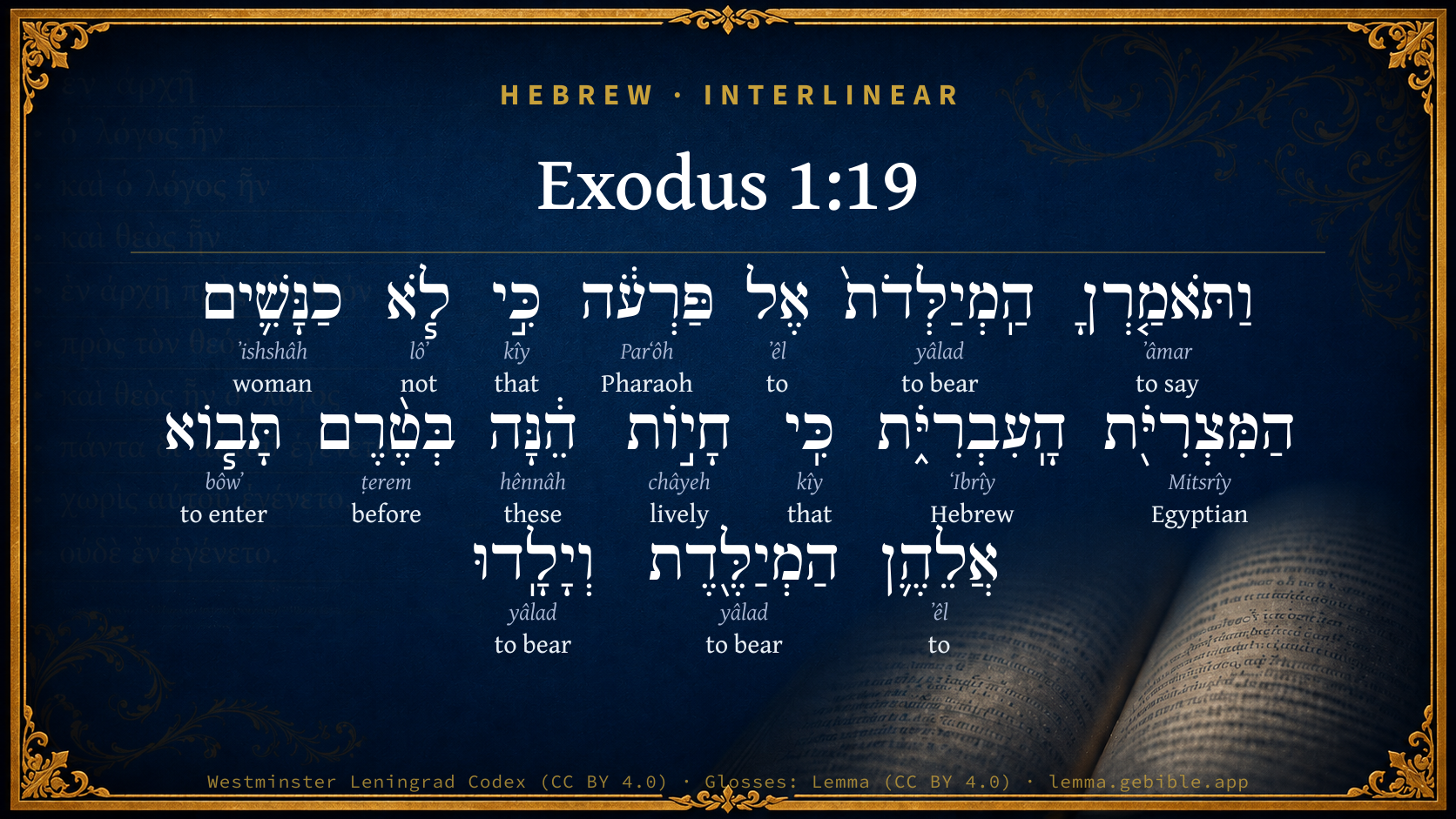
Exodus 1:19

Hebrew (Westminster Leningrad Codex) Exodus 1:19 appears in the Hebrew Old Testament. The text above is from the Westminster Leningrad Codex. Each word links to its Strong’s number, a concise gloss, and parsing drawn from the Open Scriptures Hebrew Bible morphology. Click any word for its full Brown-Driver-Briggs (BDB) entry.
Download image
Cite this verse

Exodus 1:19 (World English Bible). Public Domain. Lemma interlinear Bible study tool, https://lemma.gebible.app/v/exodus/1/19.

Show BibTeX & RIS
BibTeX
RIS
English Translation
The midwives said to Pharaoh, "Because the Hebrew women aren't like the Egyptian women; for they are vigorous, and give birth before the midwife comes to them."
World English Bible · Public Domain
Highlights
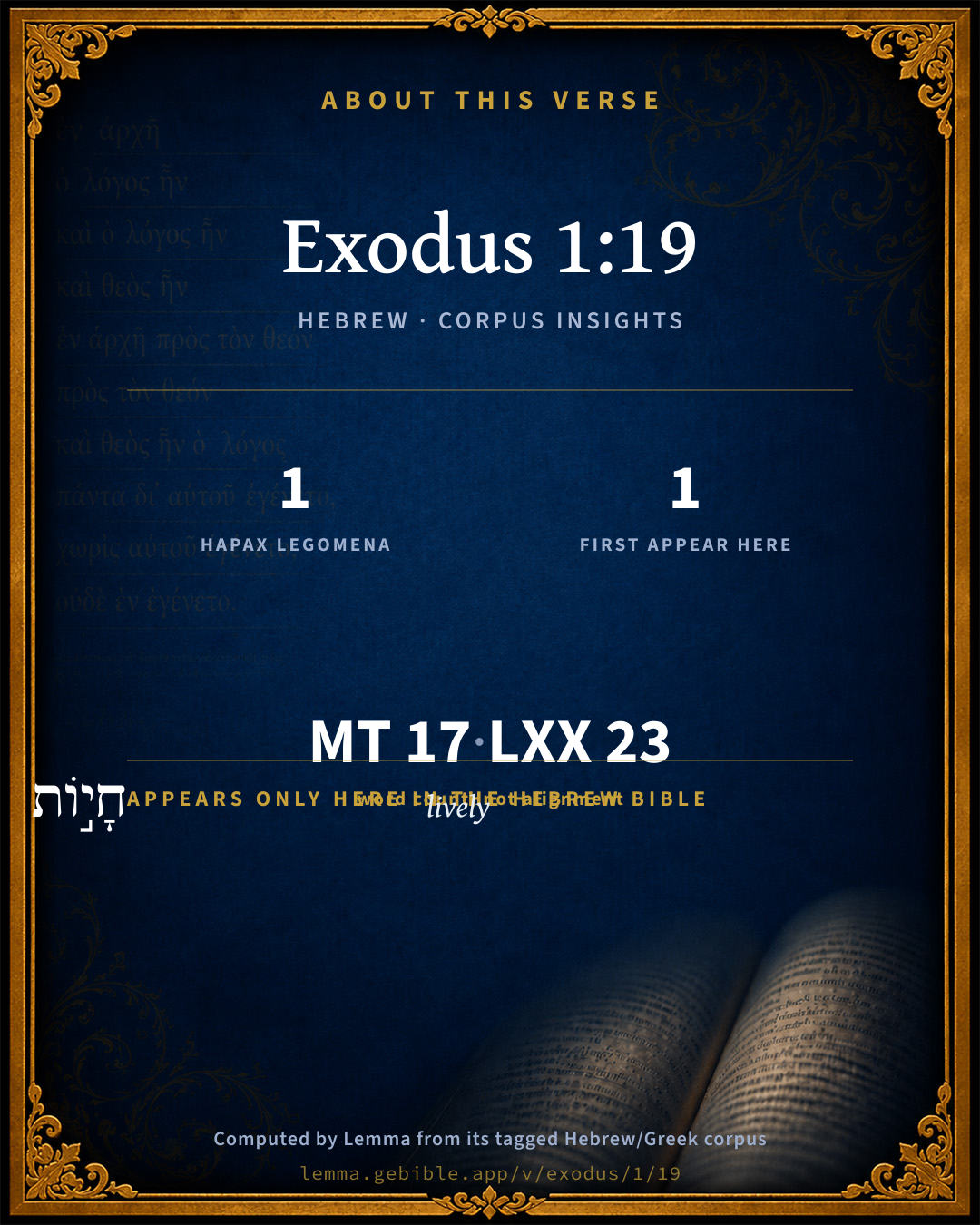
  • 1 hapax legomenon — only here in the Hebrew Bible
  • 1 first appearance in the Hebrew Bible
Full analysis ↓
Download a study sheet

One document with this verse’s original text, its word-by-word gloss line, the meaning frame, cross-references with their text, attributed commentary, and full source and license credits — printable, and it pastes into notes with its structure intact.

This verse Autodidact and up

Study sheet (.html) Plain text (.txt)

A passage Seminary Student

Up to 50 verses in one chapter. A passage sheet keeps up to 6 commentary sources and 12 cross-references per verse, in the order this page ranks them, and says so on the sheet whenever that leaves anything out. Ask for a single verse and you get the Autodidact verse sheet above.

Everything on this page stays free to read, with no account — the sheet is a download of what is already on screen, not access to it.

Want to remove ads? Support Godless Engineer
Compare translations 3

The same verse in 3 English versions, stacked beneath the original-language interlinear above. Click any original word for its lexicon entry.

Each is an independent rendering of the whole verse — the interlinear is not word-aligned to these translations.

Highlighted words mark where these versions differ — a whole-verse word diff, not a word-by-word alignment.

  • World English Bible Public Domain
    The midwives said to Pharaoh, "Because the Hebrew women aren't like the Egyptian women; for they are vigorous, and give birth before the midwife comes to them."
  • King James Version Public Domain
    And the midwives said unto Pharaoh, Because the Hebrew women are not as the Egyptian women; for they are lively, and are delivered ere the midwives come in unto them.
  • unfoldingWord Literal Text CC BY-SA 4.0
    And the midwives said to Pharaoh, “Because the Hebrew women are not like the Egyptian women: for they are lively, and, before the midwife comes to them, they have given birth.”

unfoldingWord Literal Text — © unfoldingWord, licensed CC BY-SA 4.0. Word-aligned USFM3 via Door43 (git.door43.org/unfoldingWord/en_ult).

Versions to compare (up to 4)

3 of 4 selected

Show all 18 translations

Every available English version of this verse, each an independent rendering of the whole verse.

  • World English Bible Public Domain
    The midwives said to Pharaoh, "Because the Hebrew women aren't like the Egyptian women; for they are vigorous, and give birth before the midwife comes to them."
  • Berean Standard Bible Public Domain
    The midwives answered Pharaoh, “The Hebrew women are not like the Egyptian women, for they are vigorous and give birth before a midwife arrives.”
  • Majority Standard Bible Public Domain
    The midwives answered Pharaoh, “The Hebrew women are not like the Egyptian women, for they are vigorous and give birth before a midwife arrives.”
  • King James Version Public Domain
    And the midwives said unto Pharaoh, Because the Hebrew women are not as the Egyptian women; for they are lively, and are delivered ere the midwives come in unto them.
  • American Standard Version (1901) Public Domain
    And the midwives said unto Pharaoh, Because the Hebrew women are not as the Egyptian women; for they are lively, and are delivered ere the midwife come unto them.
  • Revised Version (1885) Public Domain
    And the midwives said unto Pharaoh, Because the Hebrew women are not as the Egyptian women; for they are lively, and are delivered ere the midwife come unto them.
  • Geneva Bible (1599) Public Domain
    And the midwiues answered Pharaoh, Because the Ebrewe women are not as the women of Egypt: for they are liuely, and are deliuered yer the midwife come at them.
  • Douay-Rheims (1899) Public Domain
    They answered: The Hebrew women are not as the Egyptian women: for they themselves are skillful in the office of a midwife; and they are delivered before we come to them.
  • Young's Literal Translation Public Domain
    And the midwives say unto Pharaoh, `Because the Hebrew women `are' not as the Egyptian women, for they `are' lively; before the midwife cometh in unto them -- they have borne!'
  • Literal Standard Version CC BY-SA 4.0
    And the midwives say to Pharaoh, “Because the Hebrew women [are] not as the Egyptian women, for they [are] lively; before the midwife comes to them—they have borne!”
  • Unlocked Literal Bible CC BY-SA 4.0
    The midwives answered Pharaoh, “The Hebrew women are not like the Egyptian women. They are vigorous and have finished giving birth before a midwife comes to them.”
  • unfoldingWord Literal Text CC BY-SA 4.0
    And the midwives said to Pharaoh, “Because the Hebrew women are not like the Egyptian women: for they are lively, and, before the midwife comes to them, they have given birth.”
  • Darby Bible Public Domain
    And the midwives said to Pharaoh, Because the Hebrew women are not as the Egyptian; for they are strong, and they have borne before the midwife comes to them.
  • World Messianic Bible Public Domain
    The midwives said to Pharaoh, “Because the Hebrew women aren’t like the Egyptian women; for they are vigorous and give birth before the midwife comes to them.”
  • Webster's Bible Public Domain
    And the midwives said to Pharaoh, Because the Hebrew women are not as the Egyptian women: for they are lively, and are delivered ere the midwives come in to them.
  • Free Bible Version CC BY-SA 4.0
    “Hebrew women aren't like Egyptian women,” the midwives told Pharaoh. “They give birth more easily—they have them before we midwives arrive.”
  • Bible in Basic English Public Domain
    And they said to Pharaoh, Because the Hebrew women are not like the Egyptian women, for they are strong, and the birth takes place before we come to them.
  • JPS Tanakh (1917) Public Domain
    And the midwives said unto Pharaoh: 'Because the Hebrew women are not as the Egyptian women; for they are lively, and are delivered ere the midwife come unto them.'

Literal Standard Version (2020), Covenant Press — licensed CC BY-SA 4.0. Text via the HelloAO Bible API (eBible.org). Unlocked Literal Bible (unfoldingWord) — licensed CC BY-SA 4.0. Text via the HelloAO Bible API (eBible.org). unfoldingWord Literal Text — © unfoldingWord, licensed CC BY-SA 4.0. Word-aligned USFM3 via Door43 (git.door43.org/unfoldingWord/en_ult). Free Bible Version, Dr. Jonathan Gallagher — licensed CC BY-SA 4.0. Text via the HelloAO Bible API (eBible.org).

Word by word

More ways to search: Search by grammar → Find every occurrence → Compare this word →

Practice this passage: Drill this verse → Learn its vocabulary →

חָי֣וֹת
châyeh
H2422
“lively”
Adjective, Adjective, Feminine, Plural, Absolute
Part of Speech
Adjective
Type
Adjective
Gender
Feminine
Number
Plural
State
Absolute
Full BDB Definition

Origin: from H2421

TWOT: 644e

vigorous, lively, having the vigour of life
  1. וַתֹּאמַ֤רְןָ ʼâmar H559 “and · to say” Conjunction + Verb, Qal, Sequential Imperfect, 3rd Person, Feminine, Plural
  2. הַֽמְיַלְּדֹת֙ yâlad H3205 “the · bearing” Particle, Definite Article + Verb, Piel, Participle Active, Feminine, Plural, Absolute
  3. אֶל ʼêl H413 “to” Preposition
  4. פַּרְעֹ֔ה Parʻôh H6547 “Pharaoh” Noun, Proper
  5. כִּ֣י kîy H3588 “that” Conjunction
  6. לֹ֧א lôʼ H3808 “not” Particle, Negative
  7. כַנָּשִׁ֛ים ʼishshâh H802 “like/as the · women” Preposition, Determined + Noun, Common, Feminine, Plural, Absolute
  8. הַמִּצְרִיֹּ֖ת Mitsrîy H4713 “the · Egyptians” Particle, Definite Article + Noun, Gentilic, Feminine, Plural, Absolute
  9. הָֽעִבְרִיֹּ֑ת ʻIbrîy H5680 “the · Hebrews” Particle, Definite Article + Noun, Gentilic, Feminine, Plural, Absolute
  10. כִּֽי kîy H3588 “that” Conjunction
  11. הֵ֔נָּה hênnâh H2007 “these” Pronoun, Personal, 3rd Person, Feminine, Plural
  12. בְּטֶ֨רֶם ṭerem H2962 “in/at · before” Preposition + Adverb
  13. תָּב֧וֹא bôwʼ H935 “to enter” Verb, Qal, Imperfect, 3rd Person, Feminine, Singular
  14. אֲלֵהֶ֛ן ʼêl H413 “to · them” Preposition + Suffix, Personal, 3rd Person, Feminine, Plural
  15. הַמְיַלֶּ֖דֶת yâlad H3205 “the · bearing” Particle, Definite Article + Verb, Piel, Participle Active, Feminine, Singular, Absolute
  16. וְיָלָֽדוּ yâlad H3205 “and · to bear” Conjunction + Verb, Qal, Perfect, 3rd Person, Common, Plural

About this verse

These counts appear in no published source. They are computed here, from the morphology-tagged text and Lemma’s own curated glosses. What Lemma adds →

17
words
13
distinct lemmas
Pentateuch
section

Notable vocabulary

1 hapax legomenon — a word that appears only here in the entire Hebrew Bible:

  • חָי֣וֹת lively H2422

First appearance in Scripture

This word makes its first canonical appearance in the Hebrew Bible here:

  • חָי֣וֹת lively H2422

Shared distinctive vocabulary

הָֽעִבְרִיֹּ֑ת Hebrew H5680 occurs in 32 verses of the Hebrew Bible. Also found in:

Grammatical profile

  • 5 verbs
  • 4 nouns
  • 1 adjective
  • 1 pronoun
  • 2 prepositions
  • 2 conjunctions
  • 1 adverb
  • 1 particle

Verb forms

  • וַתֹּאמַ֤רְןָ Qal · Sequential Imperfect
  • הַֽמְיַלְּדֹת֙ Piel · Participle Active
  • תָּב֧וֹא Qal · Imperfect
  • הַמְיַלֶּ֖דֶת Piel · Participle Active
  • וְיָלָֽדוּ Qal · Perfect

Repetition

Words recur within this verse — often emphatic in Hebrew:

  • הַֽמְיַלְּדֹת֙ to bear H3205 ×3
  • אֶל to H413 ×2
  • כִּ֣י that H3588 ×2

Hebrew & Septuagint length

In English translation the verse runs 27 words from the Hebrew and 31 from the Septuagint (LXX English) — closely comparable.

A rough comparison of the two English renderings, which tokenize alike — not a word-level alignment.

Word counts can differ between the Hebrew and the Greek without any difference in meaning — e.g. the Hebrew direct-object marker אֵת has no separate Greek word, and Greek often adds the article ὁ.

In the original languages it is 17 Hebrew tokens and 23 Greek tokens — but the two are counted differently (Hebrew bundles its prefixes and suffixes into one token; the Greek is in lemma form), so that isn’t a like-for-like length.

Cross-references

3

Topical passages linked to Exodus 1:19 in the Treasury of Scripture Knowledge — connected by theme and wording, ordered by reader-vote popularity; previews shown in the World English Bible.

  • Joshua 2:4–24 The woman took the two men, and hid them; and she said, Yes, the men came to me, but I didn't know whence they were:
  • 2 Samuel 17:19–20 The woman took and spread the covering over the well's mouth, and strewed bruised grain thereon; and nothing was known.
  • 1 Samuel 21:2 David said to Ahimelech the priest, The king has commanded me a business, and has said to me, Let no man know anything of the business about which I send you, and what I have commanded you: and I have appointed the young men to such and such a place.

Cross-references courtesy of OpenBible.info (CC BY 4.0).

Hebrew and Greek witnesses Masoretic Hebrew ↔ Greek Septuagint

The same verse in the two great witnesses to the Old Testament, shown verse-for-verse.

These are two independent witnesses, not word-aligned to each other, and the Septuagint is shown in lemma (dictionary) form.

Hebrew Exodus 1:19 Masoretic · Westminster Leningrad Codex

וַתֹּאמַ֤רְןָ הַֽמְיַלְּדֹת֙ אֶל פַּרְעֹ֔ה כִּ֣י לֹ֧א כַנָּשִׁ֛ים הַמִּצְרִיֹּ֖ת הָֽעִבְרִיֹּ֑ת כִּֽי חָי֣וֹת הֵ֔נָּה בְּטֶ֨רֶם תָּב֧וֹא אֲלֵהֶ֛ן הַמְיַלֶּ֖דֶת וְיָלָֽדוּ

The midwives said to Pharaoh, "Because the Hebrew women aren't like the Egyptian women; for they are vigorous, and give birth before the midwife comes to them."

World English Bible · Public Domain

Greek LXX Exodus 1:19 Septuagint · lemma form

εἶπον δέ ὁ μαῖα ὁ φαραώ οὐ ὡς γυνή αἴγυπτος ὁ εβραῖα τίκτω γάρ πρίν ἤ εἰςἔρχομαι πρός αὐτός ὁ μαῖα καί τίκτω

And the midwives said to Pharao, The Hebrew women are not as the women of Egypt, for they are delivered before the midwives go in to them. So they bore children.

LXX2012 (modern English Septuagint) · Public Domain

Hebrew: Westminster Leningrad Codex (CC BY 4.0). Greek: Septuagint (public domain); English from LXX2012 (modern English Septuagint) (Public Domain). How the Septuagint differs from the Hebrew →

Targum (Aramaic paraphrase)

2

The Targum is the ancient Jewish Aramaic paraphrase of the Hebrew Scriptures — an interpretive translation, not the Hebrew text itself. Onkelos (literal) and Pseudo-Jonathan (expansive) render the Torah, and Jonathan the Prophets. Coverage is partial: where no permissively-licensed English translation exists for a verse, only the Aramaic is shown. This is verse-level text, not a word-by-word alignment to the Hebrew.

  1. Targum Onkelos Torah (Genesis–Deuteronomy)
    וַאֲמָרָא חַיָתָא לְפַרְעֹה אֲרֵי לָא כִנְשַׁיָא מִצְרְיָתָא יְהוּדַיָתָא אֲרֵי חֲכִּימָן אִנוּן עַד לָא עַלַת לְוָתְהֶּן חַיָתָא וִילִידָן:

    (no public-domain English translation for this verse)

    Targum Onkelos — Aramaic: “Onkelos Genesis” (public domain); “Onkelos Exodus” (public domain); “Onkelos Leviticus” (public domain); “Onkelos Numbers” (public domain); “Onkelos Deuteronomy” (public domain). English: “Sefaria Community Translation” (CC0 1.0 (public-domain dedication)); “J.W. Etheridge. The Targums of Onkelos and Jonathan Ben Uzziel on the Pentateuch. London: Longmans, Green, 1862” (public domain). Text via Sefaria.

  2. Targum Pseudo-Jonathan Torah (Genesis–Deuteronomy)
    וַאֲמָרַן חַיְיתָא לְפַרְעה אֲרוּם לָא כִנְשַׁיָא מִצְרַיְתָא יְהוּדַיְיתָא אֲרוּם זְרִיזִין וְחַכִּימִין בְּדַעֲתֵּיהֶן הִינוּן קֳדָם עַד לָא תֵיתֵי לְוַותְהוֹן חַיְיתָא הִינִין תַּלְיַין עֵינֵיהֶן בִּצְלוֹי מַצְלָן וּבַעֲיָין רַחֲמִין מִן קֳדָם אֲבוּהֶן דְבִשְׁמַיָא וְהוּא שָמַע בְּקַל צְלוֹתְהוֹן מִן יַד הִינִין מִתְעַנְיַין וִילִידַן וּפָרְקַן בִּשְׁלָם

    And the mid-wives said to Pharoh, The Jehudith women are not as the Mizraite, for they are sturdy (or, courageous) and wise-minded: before the midwife cometh to them they lift up their eyes in prayer, supplicating mercy before their Father who is in heaven, who heareth the voice of their prayer, and at once they are heard, and bring forth, and are delivered in peace.

    Targum Pseudo-Jonathan — Aramaic: “Targum Jonathan on Genesis” (public domain); “Targum Jonathan on Exodus” (public domain); “Targum Jonathan on Leviticus” (public domain); “Targum Jonathan on Numbers” (public domain); “Targum Jonathan on Deuteronomy” (public domain). English: “The Targum of Jonathan ben Uzziel, trans. J. W. Etheridge, London, 1862” (public domain). Text via Sefaria.

Commentary

Notes on Exodus 1:19 from classic Christian and Jewish commentators (each source and its license shown beneath its notes). The classic Christian expositions comment on the surrounding passage and are grouped to its opening verse, so a note may address several verses; the Jewish commentaries on the Tanakh (Rashi and others) are per-verse, so they appear only where the commentator wrote on this verse.

Lemma curates 59 commentaries, every one of them public domain or Creative Commons licensed, each selected and text-cleaned for this edition rather than reprinted as found. About our sources →

Trapp's Complete Commentary

John Trapp

Exo 1:19 And the midwives said unto Pharaoh, Because the Hebrew women [are] not as the Egyptian women; for they [are] lively, and are delivered ere the midwives come in unto them.

Ver. 19. For they are lively.] By that "voice of the Lord which maketh the hinds to calve." {Psa 29:9} Lady Faith was their midwife: and she hath delivered the graves of their dead; {Heb 11:35} how much more wombs of their quick children! But we need the less wonder at the matter here reported, if that were true which Varro writeth of the Illyrian women; who, being at harvest work in the field, when they were near their time, would but step aside, and return again, bringing a child with them, as if they had found it behind the hedge. {a}

{a} Var., De Agric., lib. ii. cap. 10.

John Trapp, A Commentary or Exposition upon All the Books of the Old and New Testament (1647–1656) — public domain. Text from a community e-Sword module.

Tyndale Open Study Notes

Tyndale Open Resources

1:19 It might trouble us that the midwives were not candid in giving their main reason for keeping the boy babies alive. Comprehensive honesty is less important to God than absolute faithfulness to him and to his believing community.

Tyndale Open Study Notes — © Tyndale Open Resources, licensed CC BY-SA 4.0. Text via the HelloAO Bible API.

Geneva Bible (1599)

Geneva Bible translators

Their disobedience herein was lawful, but their dissembling evil.

Geneva Bible (1599) marginal notes — public domain. Text via Bolls.life.

Adam Clarke's Commentary

Verse 19. The Hebrew women are not as the Egyptian women] This is a simple statement of what general experience shows to be a fact, viz., that women, who during the whole of their pregnancy are accustomed to hard labour, especially in the open air, have comparatively little pain in parturition. At this time the whole Hebrew nation, men and women, were in a state of slavery, and were obliged to work in mortar and brick, and all manner of service IN THE FIELD, Ex 1:14, and this at once accounts for the ease and speediness of their travail. With the strictest truth the midwives might say, The Hebrew women are not as the Egyptian women: the latter fare delicately, are not inured to labour, and are kept shut up at home, therefore they have hard, difficult, and dangerous labours; but the Hebrew women are lively, חיות chayoth, are strong, hale, and vigorous, and therefore are delivered ere the midwives come in unto them. In such cases we may naturally conclude that the midwives were very seldom even sent for. And this is probably the reason why we find but two mentioned; as in such a state of society there could be but very little employment for persons of that profession, as a mother, an aunt, or any female acquaintance or neighbour, could readily afford all the assistance necessary in such cases. Commentators, pressed with imaginary difficulties, have sought for examples of easy parturition in AEthiopia, Persia, and India, as parallels to the case before us; but they might have spared themselves the trouble, because the case is common in all parts of the globe where the women labour hard, and especially in the open air. I have known several instances of the kind myself among the labouring poor. I shall mention one: I saw a poor woman in the open field at hard labour; she stayed away in the afternoon, but she returned the next morning to her work with her infant child, having in the interim been safely delivered! She continued at her daily work, having apparently suffered no inconvenience!

I have entered more particularly into this subject because, through want of proper information, (perhaps from a worse motive,) certain persons have spoken very unguardedly against this inspired record: "The Hebrew midwives told palpable lies, and God commends them for it; thus we may do evil that good may come of it, and sanctify the means by the end." Now I contend that there was neither lie direct nor even prevarication in the case. The midwives boldly state to Pharaoh a fact, (had it not been so, he had a thousand means of ascertaining the truth,) and they state it in such a way as to bring conviction to his mind on the subject of his oppressive cruelty on the one hand, and the mercy of Jehovah on the other. As if they had said, "The very oppression under which, through thy cruelty, the Israelites groan, their God has turned to their advantage; they are not only fruitful, but they bring forth with comparatively no trouble; we have scarcely any employment among them." Here then is a fact, boldly announced in the face of danger; and we see that God was pleased with this frankness of the midwives, and he blessed them for it.

Adam Clarke's Commentary on the Bible (1810–1826) — public domain. Text from a community e-Sword/MySword module.

Ellicott's Commentary for English Readers

(19) The Hebrew women are not as the Egyptian women.—This was probably true; but it was not the whole truth. Though the midwives had the courage to disobey the king, they had not “the courage of their convictions,” and were afraid to confess their real motive. So they took refuge in a half truth, and pretended that what really occurred in some cases only was a general occurrence. It is a fact, that in the East parturition is often so short a process that the attendance of a midwife is dispensed with.

A Bible Commentary for English Readers, edited by Charles John Ellicott (1878–1897) — public domain. Text from a community e-Sword module.

The Cambridge Bible for Schools and Colleges

gen. ed. J. J. S. Perowne

19. Too much cannot be inferred from the midwives’ excuse with regard to the facts in question; but it is at least true that Arabian women are delivered very quickly (Knob., with references to travellers). As to whether the Egyptian women were delivered more slowly, there appears to be no independent evidence.

The Cambridge Bible for Schools and Colleges (gen. ed. J. J. S. Perowne; Cambridge University Press, 1878–1918) — public domain. Text from a community e-Sword module.

John Gill's Exposition

And the midwives said unto Pharaoh, because the Hebrew women are not as the Egyptian women,.... Not so tender, weak, and feeble, nor so ignorant of midwifery, and needed not the assistance of midwives, as the Egyptian women:

for they are lively; or midwives themselves, as Kimchi (k) says the word signifies; and so (l) Symmachus translates the words, "for they are midwives"; or are skilful in the art of midwifery, as Jarchi interprets it; and so the, Vulgate Latin version is, "for they have knowledge of midwifery"; and so could help themselves; or, "for they are as beasts" (m), as animals which need not, nor have the assistance of any in bringing forth their young; and so Jarchi observes, that their Rabbins (n) explain it, they are like to the beasts of the field, who have no need of a midwife; or they were so lively, hale, and strong, as our version, and others, and their infants also, through a more than common blessing of God upon them at this time, that they brought forth children as soon as they were in travail, with scarce any pain or trouble, without the help of others: nor need this seem strange, if what is reported is true, of women in Illyria, Ireland, Italy (o), and other places (p), where it is said women will go aside from their work, or from the table, and bring forth their offspring, and return to their business or meal again; and especially in the eastern and hotter countries, women generally bring forth without much difficulty, and without the use of a midwife (q):

and are delivered ere the midwives come in unto them; which doubtless was true in some cases, though not in all, because it is before said, they saved the men children alive; and had it been so at all times, there would have been no proof and evidence of their fearing God, and obeying his commands, rather than the king's; and in some cases not only the strength and liveliness of the Hebrew women, and their fears also, occasioned by the orders of the king, might hasten their births before the midwives could get to them; and they might not choose to send for them, but use their own judgment, and the help of their neighbours, and do without them, knowing what the midwives were charged to do.

(k) Sepher Shorash. "sie alii", "quia obstetrices ipsae", Pagninus, Montanus; so the Syriac version. (l) , Symmachus apud Drusium. (m) In T. Bab. Sotah, fol. 11. 1. Chronicon Mosis, fol. 2. 1. (n) Vid Wagenseil. Sotah, p. 249. & Varro & Gataker in ib. (o) Posidonius apud Strabo. Geograph. l. 3. p. 114. (p) See Harte's History of the Life of Gustavus Adelphus, vol. 1. p. 233. (q) Ludolph. Ethiopic. l. 1. c. 14.

John Gill's Exposition of the Whole Bible (1746–1763) — public domain (CC PDM 1.0). Text via the HelloAO Bible API.

Haydock's Catholic Bible Commentary

Skilful, &c. Hebrew Caioth means midwives: or they are full of vigour, or bring forth alive, like brutes. By this allusion they not only excuse themselves, but seem also to enter into the king’s sentiments of hatred and scorn for the Hebrews. (Menochius) --- Women in Egypt, and in the eastern regions, are easily delivered, and hardly stand in need of any assistance. (Ludolf.) (1 Kings iv. 19.) Perhaps, therefore, the midwives spoke truth, with regard to the generality of the Hebrew women. But they gave way to a lie of excuse, with regard to some, (ver. 17,) which St. Augustine would not allow, even to save all the Hebrew children. (contra Mend. 15.) It was not so easy to discover this delusion, as women in that country seldom appear in public; and hence Jochabed was enabled to hide Moses so long. (Calmet)

George Leo Haydock (1774–1849), Haydock's Catholic Family Bible and Commentary, 1859 edition — public domain. Excludes Psalms (Douay-Rheims chapter numbering differs from Protestant) and Deuterocanonical books (Catholic canon only).

Matthew Poole's English Annotations

They are lively, or, vigorous and active in promoting the birth of their own children; or, like the beasts, which without any help of others bring forth their young. So the Hebrew word signifies; and so there is only a refe of the particle of similitude, which is frequent, as I have noted before.

This might be no lie, as many suppose, but a truth concerning many of them, and they do not affirm it to be so with all. And so it might be, either because their daily and excessive labours joined with the fears of the execution of the king’s command, whereof they seem to have gotten notice, did hasten their birth, as the same causes do commonly in other women; or because they, understanding their danger, would not send for the midwives, but committed themselves to God’s providence, and the care of some of their neighbours present with them. So here was nothing but truth, though they did not speak the whole truth, which they were not obliged to do.

Matthew Poole's English Annotations on the Holy Bible (1683–1685) — public domain. Text from a community e-Sword/MySword module.

The Pulpit Commentary

They are vigorous. Literally, "they are lively." In the East at the present day a large proportion of the women deliver themselves; and the services of professional accoucheurs are very rarely called in. The excuse of the midwives had thus a basis of fact to rest upon, and was only untrue because it was not the whole truth.

The Pulpit Commentary (1880–1919), ed. H.D.M. Spence-Jones & Joseph S. Exell — public domain. Text from a community e-Sword module.

John Wesley's Explanatory Notes

I see no reason we have to doubt the truth of this; it is plain they were now under an extraordinary blessing of increase, which may well be supposed to have this effect, that the women had quick and easy labour, and the mothers and children being both lively, they seldon needed the help of midwives; this these midwives took notice of, and concluding it to be the finger of God, were thereby emboldened to disobey the king, and with this justify themselves before Pharaoh, when he called them to an account for it.

John Wesley, Explanatory Notes Upon the Whole Bible (1754–1765) — public domain. Text via the GEBible commentary corpus.

Rashi

Rabbi Shlomo Yitzchaki (Rashi)

כי חיות הנה signifies they are just as skilful as midwives. The Aramaic for מילדות, midwives, is חיתא (hence the term חיות in this verse). Our Rabbis, however, (taking this word in the sense of animals) gave the following explanation (Sotah 11b): they have been compared to the beasts of the field which do not require the help of midwives. And where are they compared to animals? (Genesis 49:9) “Judah is a young lion”; (Genesis 27) “Benjamin is a wolf that leareth”; (Deuteronomy 33:17) “Joseph is the firstling of his ox”; (Genesis 49:21) “Naphtali is a hind sent forth”. As for the ancestors of those tribes about whom such a comparison is not expressly written Scripture implicitly includes them in the several blessings bestowed upon their brothers, (and thus they also are compared, as their brothers, to animals), for Scripture states, (Genesis 49:28) “And he blessed them etc.” (cf. Rashi on these words). Then, again, it is written, (Ezekiel 19:2) “How was thy mother a lioness!” (The prophet is addressing the princes of Israel as the representatives of the people, and by the term “thy mother” means the progenitors of the nation; the chapter proceeds to speak of the mother’s offspring as “whelps”).

Rashi on the Tanakh — English translations: “The Judaica Press complete Tanach with Rashi, translated by A. J. Rosenberg” (CC BY 4.0); “Pentateuch with Rashi's commentary by M. Rosenbaum and A.M. Silbermann, 1929-1934” (public domain); “The Metsudah Tanach series, Lakewood, N.J” (CC BY 4.0); and “The Book of Joshua, Metsudah Publications, 1997” (CC BY 4.0). Text via Sefaria.

Lesson kit

Teaching starters — assembled from the data on this page, not authored interpretation. Every prompt links to the verse data it draws on. Edit before teaching.

Exodus, in the Pentateuch, opens this verse with 17 words (13 distinct Hebrew lemmas). Its most distinctive word is châyeh (“lively”). A historical commentator’s framing appears above. Read the whole chapter for the surrounding context.

Discussion questions

  1. What does “lively” (châyeh) contribute to the verse as a whole?
  2. 1 word here appears nowhere else in the Hebrew Bible. Why might the author reach for such rare wording?
  3. This is the first place “lively” appears in Scripture (first appears here). What does its debut here establish?
  4. How does Genesis 14:13, which shares the word «Hebrew», read alongside this verse?
  5. What does the repetition of “to bear” (3× in this one verse) do in this verse?
  6. The translations on this page render this verse differently — a whole-verse word diff, not a word-by-word alignment. What might account for the different wordings?
  7. «וַתֹּאמַ֤רְןָ» is a Qal Sequential Imperfect verb. How does that grammatical form shape the action described?
  8. Compare how Trapp's Complete Commentary and Tyndale Open Study Notes read this verse. Where do they agree or differ?

Things to notice

  • 1 word in this verse appears nowhere else in the Hebrew Bible.
  • 1 word makes its first canonical appearance in Scripture here.
  • This verse counts 17 Hebrew ↔ 23 Greek words.
  • These translations choose different wording for 14 words in this verse.
  • “to bear” occurs 3× in this single verse.

Reading settings

Reading text

Shown beneath each verse's original-language words.

Old Testament
Old Testament edition

Read the OT as the Masoretic Hebrew (MT) or the Greek Septuagint (LXX).

English shown for the Greek Septuagint (in the Hebrew ↔ Greek comparison).

Comparing translations? Open the Compare panel on any verse page to stack up to four side by side.