
Genesis 28:11

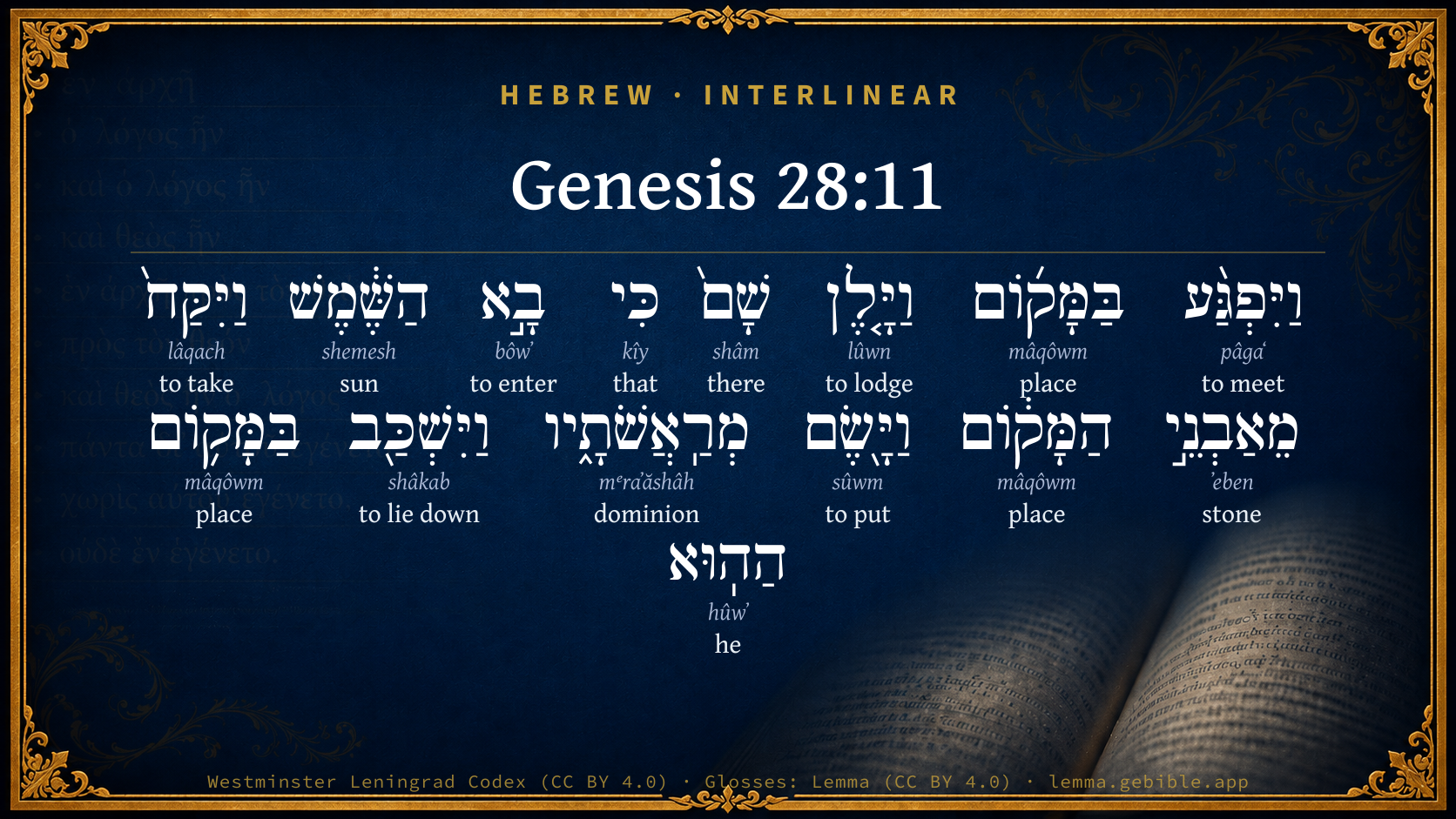
Hebrew (Westminster Leningrad Codex) Genesis 28:11 appears in the Hebrew Old Testament. The text above is from the Westminster Leningrad Codex. Each word links to its Strong’s number, a concise gloss, and parsing drawn from the Open Scriptures Hebrew Bible morphology. Click any word for its full Brown-Driver-Briggs (BDB) entry.
Download image
Cite this verse

Genesis 28:11 (World English Bible). Public Domain. Lemma interlinear Bible study tool, https://lemma.gebible.app/v/genesis/28/11.

Show BibTeX & RIS
BibTeX
RIS
English Translation
He came to a certain place, and stayed there all night, because the sun had set. He took one of the stones of the place, and put it under his head, and lay down in that place to sleep.
World English Bible · Public Domain
Highlights
  • 1 first appearance in the Hebrew Bible
Full analysis ↓
Download a study sheet

One document with this verse’s original text, its word-by-word gloss line, the meaning frame, cross-references with their text, attributed commentary, and full source and license credits — printable, and it pastes into notes with its structure intact.

This verse Autodidact and up

Study sheet (.html) Plain text (.txt)

A passage Seminary Student

Up to 50 verses in one chapter. A passage sheet keeps up to 6 commentary sources and 12 cross-references per verse, in the order this page ranks them, and says so on the sheet whenever that leaves anything out. Ask for a single verse and you get the Autodidact verse sheet above.

Everything on this page stays free to read, with no account — the sheet is a download of what is already on screen, not access to it.

Want to remove ads? Support Godless Engineer
Compare translations 3

The same verse in 3 English versions, stacked beneath the original-language interlinear above. Click any original word for its lexicon entry.

Each is an independent rendering of the whole verse — the interlinear is not word-aligned to these translations.

Highlighted words mark where these versions differ — a whole-verse word diff, not a word-by-word alignment.

  • World English Bible Public Domain
    He came to a certain place, and stayed there all night, because the sun had set. He took one of the stones of the place, and put it under his head, and lay down in that place to sleep.
  • King James Version Public Domain
    And he lighted upon a certain place, and tarried there all night, because the sun was set; and he took of the stones of that place, and put them for his pillows, and lay down in that place to sleep.
  • unfoldingWord Literal Text CC BY-SA 4.0
    Then he reached a place, and he stopped there because the sun had gone. And he took of the stones of the place and put it under his head, and he lay down in that place.

unfoldingWord Literal Text — © unfoldingWord, licensed CC BY-SA 4.0. Word-aligned USFM3 via Door43 (git.door43.org/unfoldingWord/en_ult).

Versions to compare (up to 4)

3 of 4 selected

Show all 18 translations

Every available English version of this verse, each an independent rendering of the whole verse.

  • World English Bible Public Domain
    He came to a certain place, and stayed there all night, because the sun had set. He took one of the stones of the place, and put it under his head, and lay down in that place to sleep.
  • Berean Standard Bible Public Domain
    On reaching a certain place, he spent the night there because the sun had set. And taking one of the stones from that place, he put it under his head and lay down to sleep.
  • Majority Standard Bible Public Domain
    On reaching a certain place, he spent the night there because the sun had set. And taking one of the stones from that place, he put it under his head and lay down to sleep.
  • King James Version Public Domain
    And he lighted upon a certain place, and tarried there all night, because the sun was set; and he took of the stones of that place, and put them for his pillows, and lay down in that place to sleep.
  • American Standard Version (1901) Public Domain
    And he lighted upon a certain place, and tarried there all night, because the sun was set. And he took one of the stones of the place, and put it under his head, and lay down in that place to sleep.
  • Revised Version (1885) Public Domain
    And he lighted upon a certain place, and tarried there all night, because the sun was set; and he took one of the stones of the place, and put it under his head, and lay down in that place to sleep.
  • Geneva Bible (1599) Public Domain
    And he came vnto a certaine place, and taried there al night, because the sunne was downe, and tooke of the stones of the place, and layde vnder his head and slept in the same place.
  • Douay-Rheims (1899) Public Domain
    And when he was come to a certain place, and would rest in it after sunset, he took of the stones that lay there, and putting under his head, slept in the same place.
  • Young's Literal Translation Public Domain
    and he toucheth at a `certain' place, and lodgeth there, for the sun hath gone in, and he taketh of the stones of the place, and maketh `them' his pillows, and lieth down in that place.
  • Literal Standard Version CC BY-SA 4.0
    and he touches at a [certain] place, and lodges there, for the sun has gone in, and he takes of the stones of the place, and makes [them] his pillows, and lies down in that place.
  • Unlocked Literal Bible CC BY-SA 4.0
    He came to a certain place and stayed there all night, because the sun had set. He took one of the stones in that place, put it under his head, and lay down in that place to sleep.
  • unfoldingWord Literal Text CC BY-SA 4.0
    Then he reached a place, and he stopped there because the sun had gone. And he took of the stones of the place and put it under his head, and he lay down in that place.
  • Darby Bible Public Domain
    And he lighted on a certain place, and lodged there, because the sun had set. And he took [one] of the stones of the place, and made [it] his pillow, and lay down in that place.
  • World Messianic Bible Public Domain
    He came to a certain place, and stayed there all night, because the sun had set. He took one of the stones of the place, and put it under his head, and lay down in that place to sleep.
  • Webster's Bible Public Domain
    And he lighted upon a certain place, and tarried there all night, because the sun was set: and he took of the stones of that place, and put them for his pillows, and lay down in that place to sleep.
  • Free Bible Version CC BY-SA 4.0
    He arrived after sunset at a particular place and stopped there for the night. He picked up a stone, put it under his head, lay down and went to sleep.
  • Bible in Basic English Public Domain
    And coming to a certain place, he made it his resting-place for the night, for the sun had gone down; and he took one of the stones which were there, and putting it under his head he went to sleep in that place.
  • JPS Tanakh (1917) Public Domain
    And he lighted upon the place, and tarried there all night, because the sun was set; and he took one of the stones of the place, and put it under his head, and lay down in that place to sleep.

Literal Standard Version (2020), Covenant Press — licensed CC BY-SA 4.0. Text via the HelloAO Bible API (eBible.org). Unlocked Literal Bible (unfoldingWord) — licensed CC BY-SA 4.0. Text via the HelloAO Bible API (eBible.org). unfoldingWord Literal Text — © unfoldingWord, licensed CC BY-SA 4.0. Word-aligned USFM3 via Door43 (git.door43.org/unfoldingWord/en_ult). Free Bible Version, Dr. Jonathan Gallagher — licensed CC BY-SA 4.0. Text via the HelloAO Bible API (eBible.org).

Word by word

More ways to search: Search by grammar → Find every occurrence → Compare this word →

Practice this passage: Drill this verse → Learn its vocabulary →

מְרַֽאֲשֹׁתָ֑יו
mᵉraʼăshâh
H4763
“head place · his”
Noun, Common, Feminine, Plural, Construct + Suffix, Personal, 3rd Person, Masculine, Singular
Part of Speech
Noun
Type
Common
Gender
Feminine
Number
Plural
State
Construct
Full BDB Definition

Origin: formed like H4761

TWOT: 2097f

place at the head, dominion, head place (noun feminine) - at head place (adverb)
  1. וַיִּפְגַּ֨ע pâgaʻ H6293 “and · to meet” Conjunction + Verb, Qal, Sequential Imperfect, 3rd Person, Masculine, Singular
  2. בַּמָּק֜וֹם mâqôwm H4725 “in/at the · place” Preposition, Determined + Noun, Common, Masculine, Singular, Absolute
  3. וַיָּ֤לֶן lûwn H3885 “and · to lodge” Conjunction + Verb, Qal, Sequential Imperfect, 3rd Person, Masculine, Singular
  4. שָׁם֙ shâm H8033 “there” Adverb
  5. כִּי kîy H3588 “that” Conjunction
  6. בָ֣א bôwʼ H935 “to enter” Verb, Qal, Perfect, 3rd Person, Masculine, Singular
  7. הַשֶּׁ֔מֶשׁ shemesh H8121 “the · sun” Particle, Definite Article + Noun, Common, Both, Singular, Absolute
  8. וַיִּקַּח֙ lâqach H3947 “and · to take” Conjunction + Verb, Qal, Sequential Imperfect, 3rd Person, Masculine, Singular
  9. מֵאַבְנֵ֣י ʼeben H68 “from · stones of” Preposition + Noun, Common, Feminine, Plural, Construct
  10. הַמָּק֔וֹם mâqôwm H4725 “the · place” Particle, Definite Article + Noun, Common, Masculine, Singular, Absolute
  11. וַיָּ֖שֶׂם sûwm H7760 “and · to put” Conjunction + Verb, Qal, Sequential Imperfect, 3rd Person, Masculine, Singular
  12. וַיִּשְׁכַּ֖ב shâkab H7901 “and · to lie down” Conjunction + Verb, Qal, Sequential Imperfect, 3rd Person, Masculine, Singular
  13. בַּמָּק֥וֹם mâqôwm H4725 “in/at the · place” Preposition, Determined + Noun, Common, Masculine, Singular, Absolute
  14. הַהֽוּא hûwʼ H1931 “the · he” Particle, Definite Article + Pronoun, Personal, 3rd Person, Masculine, Singular

About this verse

These counts appear in no published source. They are computed here, from the morphology-tagged text and Lemma’s own curated glosses. What Lemma adds →

15
words
13
distinct lemmas
Pentateuch
section

Notable vocabulary

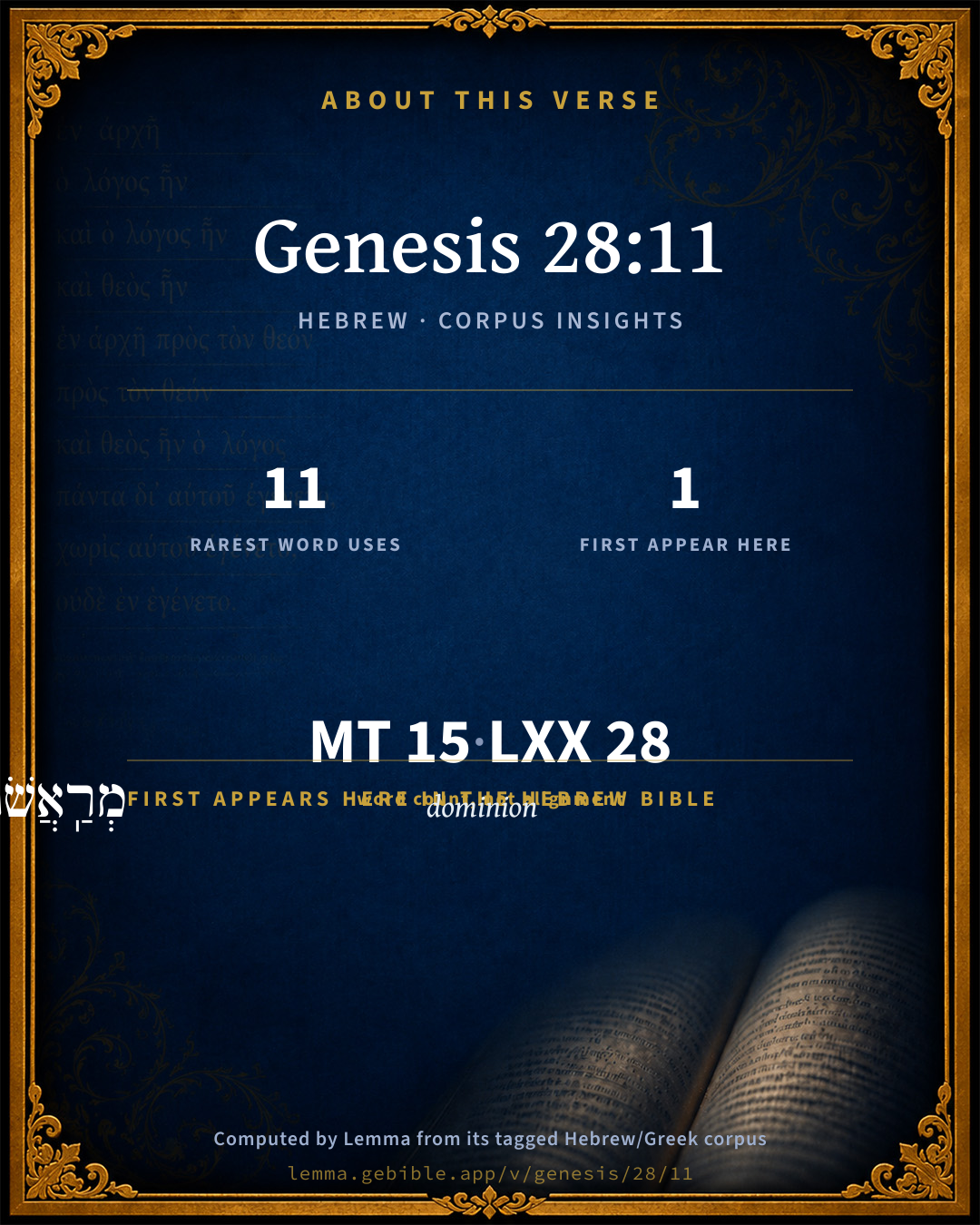
The rarest word here is מְרַֽאֲשֹׁתָ֑יו dominion H4763 — appearing just 11 times in the whole Hebrew Bible.

First appearance in Scripture

This word makes its first canonical appearance in the Hebrew Bible here:

  • מְרַֽאֲשֹׁתָ֑יו dominion H4763

Shared distinctive vocabulary

מְרַֽאֲשֹׁתָ֑יו dominion H4763 occurs in 8 verses of the Hebrew Bible. Also found in:

Grammatical profile

  • 6 verbs
  • 6 nouns
  • 1 pronoun
  • 1 conjunction
  • 1 adverb

Verb forms

  • וַיִּפְגַּ֨ע Qal · Sequential Imperfect
  • וַיָּ֤לֶן Qal · Sequential Imperfect
  • בָ֣א Qal · Perfect
  • וַיִּקַּח֙ Qal · Sequential Imperfect
  • וַיָּ֖שֶׂם Qal · Sequential Imperfect
  • וַיִּשְׁכַּ֖ב Qal · Sequential Imperfect

Repetition

A word recurs within this verse — often emphatic in Hebrew:

  • בַּמָּק֜וֹם place H4725 ×3

Hebrew & Septuagint length

In English translation the verse runs 39 words from the Hebrew and 39 from the Septuagint (LXX English) — the same length.

A rough comparison of the two English renderings, which tokenize alike — not a word-level alignment.

Word counts can differ between the Hebrew and the Greek without any difference in meaning — e.g. the Hebrew direct-object marker אֵת has no separate Greek word, and Greek often adds the article ὁ.

In the original languages it is 15 Hebrew tokens and 28 Greek tokens — but the two are counted differently (Hebrew bundles its prefixes and suffixes into one token; the Greek is in lemma form), so that isn’t a like-for-like length.

Cross-references

4

Topical passages linked to Genesis 28:11 in the Treasury of Scripture Knowledge — connected by theme and wording, ordered by reader-vote popularity; previews shown in the World English Bible.

  • Genesis 28:18 Jacob rose up early in the morning, and took the stone that he had put under his head, and set it up for a pillar, and poured oil on the top of it.
  • Matthew 8:20 Jesus said to him, "The foxes have holes, and the birds of the sky have nests, but the Son of Man has nowhere to lay his head."
  • Genesis 31:46 Jacob said to his relatives, "Gather stones." They took stones, and made a heap. They ate there by the heap.
  • 2 Corinthians 1:5 For as the sufferings of Christ abound to us, even so our comfort also abounds through Christ.

Cross-references courtesy of OpenBible.info (CC BY 4.0).

Hebrew and Greek witnesses Masoretic Hebrew ↔ Greek Septuagint

The same verse in the two great witnesses to the Old Testament, shown verse-for-verse.

These are two independent witnesses, not word-aligned to each other, and the Septuagint is shown in lemma (dictionary) form.

Hebrew Genesis 28:11 Masoretic · Westminster Leningrad Codex

וַיִּפְגַּ֨ע בַּמָּק֜וֹם וַיָּ֤לֶן שָׁם֙ כִּי בָ֣א הַשֶּׁ֔מֶשׁ וַיִּקַּח֙ מֵאַבְנֵ֣י הַמָּק֔וֹם וַיָּ֖שֶׂם מְרַֽאֲשֹׁתָ֑יו וַיִּשְׁכַּ֖ב בַּמָּק֥וֹם הַהֽוּא

He came to a certain place, and stayed there all night, because the sun had set. He took one of the stones of the place, and put it under his head, and lay down in that place to sleep.

World English Bible · Public Domain

Greek LXX Genesis 28:11 Septuagint · lemma form

καί ἀποἀντάω τόπος καί κοιμάω ἐκεῖ δύω γάρ ὁ ἥλιος καί λαμβάνω ἀπό ὁ λίθος ὁ τόπος καί τίθημι πρός κεφαλή αὐτός καί κοιμάω ἐν ὁ τόπος ἐκεῖνος

And came to a certain place and slept there, for the sun had gone down; and he took one of the stones of the place, and put it at his head, and lay down to sleep in that place,

LXX2012 (modern English Septuagint) · Public Domain

Hebrew: Westminster Leningrad Codex (CC BY 4.0). Greek: Septuagint (public domain); English from LXX2012 (modern English Septuagint) (Public Domain). How the Septuagint differs from the Hebrew →

Targum (Aramaic paraphrase)

2

The Targum is the ancient Jewish Aramaic paraphrase of the Hebrew Scriptures — an interpretive translation, not the Hebrew text itself. Onkelos (literal) and Pseudo-Jonathan (expansive) render the Torah, and Jonathan the Prophets. Coverage is partial: where no permissively-licensed English translation exists for a verse, only the Aramaic is shown. This is verse-level text, not a word-by-word alignment to the Hebrew.

  1. Targum Onkelos Torah (Genesis–Deuteronomy)
    וַעֲרַע בְּאַתְרָא וּבָת תַּמָּן אֲרֵי עָל שִׁמְשָׁא וּנְסִיב מֵאַבְנֵי אַתְרָא וְשַׁוִּי אִסָדוֹהִי וּשְׁכִיב בְּאַתְרָא הַהוּא

    (no public-domain English translation for this verse)

    Targum Onkelos — Aramaic: “Onkelos Genesis” (public domain); “Onkelos Exodus” (public domain); “Onkelos Leviticus” (public domain); “Onkelos Numbers” (public domain); “Onkelos Deuteronomy” (public domain). English: “Sefaria Community Translation” (CC0 1.0 (public-domain dedication)); “J.W. Etheridge. The Targums of Onkelos and Jonathan Ben Uzziel on the Pentateuch. London: Longmans, Green, 1862” (public domain). Text via Sefaria.

  2. Targum Pseudo-Jonathan Torah (Genesis–Deuteronomy)
    וְצַלִי בַּאֲתַר בֵּי מוּקְדָשָׁא וּבַת תַּמָן אֲרוּם טְמַע שִׁמְשָׁא וּנְסֵיב אַרְבְּעָה מֵאַבְנֵי אַתְרָא קַדִישׁ וְשַׁוִי אִיסָדוֹי וּשְׁכִיב בְּאַתְרָא הַהוּא

    And he prayed in the place of the house of the sanctuary, and lodged there, because the sun had gone down. And he took four stones of the holy place, and set his pillow, and slept in that place.

    Targum Pseudo-Jonathan — Aramaic: “Targum Jonathan on Genesis” (public domain); “Targum Jonathan on Exodus” (public domain); “Targum Jonathan on Leviticus” (public domain); “Targum Jonathan on Numbers” (public domain); “Targum Jonathan on Deuteronomy” (public domain). English: “The Targum of Jonathan ben Uzziel, trans. J. W. Etheridge, London, 1862” (public domain). Text via Sefaria.

Commentary

Notes on Genesis 28:11 from classic Christian and Jewish commentators (each source and its license shown beneath its notes). The classic Christian expositions comment on the surrounding passage and are grouped to its opening verse, so a note may address several verses; the Jewish commentaries on the Tanakh (Rashi and others) are per-verse, so they appear only where the commentator wrote on this verse.

Lemma curates 59 commentaries, every one of them public domain or Creative Commons licensed, each selected and text-cleaned for this edition rather than reprinted as found. About our sources →

Trapp's Complete Commentary

John Trapp

Gen 28:11 And he lighted upon a certain place, and tarried there all night, because the sun was set; and he took of the stones of that place, and put [them for] his pillows, and lay down in that place to sleep.

Ver. 11. And he lighted upon a certain place.] Little thinking to have found heaven there. Let this comfort travellers, and friends that part with them. Jacob never lay better than when he lay outdoors; nor yet slept sweeter than when he laid his head upon a stone. {a} He was a rich man’s son, and yet inured to take harsh situation.

{a} Male cubans suaviter dormit, et foeliciter somniat.

John Trapp, A Commentary or Exposition upon All the Books of the Old and New Testament (1647–1656) — public domain. Text from a community e-Sword module.

Joseph Benson's Commentary

Gen 28:11. The stones for his pillows, and the heavens for his canopy! Yet his comfort in the divine blessing, and his confidence in the divine protection, made him easy, even when he lay thus exposed: being sure that his God made him to dwell in safety, he could lie down and sleep upon a stone!

Joseph Benson's Commentary on the Old and New Testaments (1811–1818) — public domain. Text from a community e-Sword module.

Tyndale Open Study Notes

Tyndale Open Resources

28:11 The good place where Jacob set up camp was apparently a protected area at the foot of a hill. The stone to rest his head against was probably large, more for protection than for a pillow.

Tyndale Open Study Notes — © Tyndale Open Resources, licensed CC BY-SA 4.0. Text via the HelloAO Bible API.

Jamieson, Fausset & Brown

Robert Jamieson, A. R. Fausset & David Brown

he lighted upon a certain place--By a forced march he had reached Beth-el, about forty-eight miles from Beer-sheba, and had to spend the night in the open field.

he took of the stones, etc.--"The nature of the soil is an existing comment on the record of the stony territory where Jacob lay" [CLARKE'S Travels].

Jamieson, Fausset & Brown — Commentary Critical and Explanatory on the Whole Bible (1871) — public domain (CC PDM 1.0). Text via the HelloAO Bible API.

Adam Clarke's Commentary

Verse 11. A certain place, and tarried there] From Ge 28:19, we find this certain place was Luz, or some part of its vicinity. Jacob had probably intended to reach Luz; but the sun being set, and night coming on, he either could not reach the city, or he might suspect the inhabitants, and rather prefer the open field, as he must have heard of the character and conduct of the men of Sodom and Gomorrah. Or the gates might be shut by the time he reached it, which would prevent his admission; for it frequently happens, to the present day, that travellers not reaching a city in the eastern countries previously to the shutting of the gates, are obliged to lodge under the walls all night, as when once shut they refuse to open them till the next day. This was probably Jacob's case.

He took of the stones] He took one of the stones that were in that place: from Ge 28:18 we find it was one stone only which he had for his pillow. Luz was about forty-eight miles distant from Beer-sheba; too great a journey for one day, through what we may conceive very unready roads.

Adam Clarke's Commentary on the Bible (1810–1826) — public domain. Text from a community e-Sword/MySword module.

Ellicott's Commentary for English Readers

(11) He lighted upon a certain place.—Heb., he lighted upon the place. The article probably signifies that it was the place appointed for the revelation, though lighted upon by Jacob by chance. As it lay twelve miles north of Jerusalem, in the mountains of Ephraim, Jacob had already been at least four days on the route (see Note on Gen_22:4); and though we are not to suppose that Isaac would send away the son who was heir of the blessing without a few trusty servants (nor does the expression in Gen_32:10 require it), yet Jacob would none the less feel the solemnity of the journey, and the difficulties which surrounded him. Well may he have asked whether El Shaddai would confirm him in the possession of that which he had defiled by fraud and cunning. And thus, meditating much and praying much, he had in those four days drawn near to God, and is at last accepted. The interest in Jacob’s life lies in the gradual improvement and progress of his character. Religion was always a reality with him; but at first it was of a low type, and marred by duplicity and earthly scheming. His schemes succeed, but bring with them sorrow and trial; and trial purifies him, and gradually he advances into a region of unselfish and holy piety. Though to the last he was a man sagacious, and full of expedients, yet the nobler part of his character finally had the supremacy.

He took of the stones. . . . —Heb., he took one of the stones of the place, and put it as his bolster. Jewish commentators identify the place with Mount Moriah, and say that the stone which Jacob placed under his head was one of those which had formed the altar upon which Isaac had been bound for sacrifice. The name Beth-el signified, they add, the temple, and as makôm—place—is thrice used in this verse, it mysteriously foreshadowed the three temples—Solomon’s, Ze-rubbabel’s, and Herod’s—which successively occupied the site. More probably Beth-el was really the town of that name, and these explanations are allegorical rather than expository.

A Bible Commentary for English Readers, edited by Charles John Ellicott (1878–1897) — public domain. Text from a community e-Sword module.

The Cambridge Bible for Schools and Colleges

gen. ed. J. J. S. Perowne

11. And he lighted] i.e. he by chance reached, like our colloquial “hit upon.” The Divine purpose of the revelation made to Jacob is contrasted in this word with the fortuitousness of Jacob’s action.

a certain place] Heb. the place. For the special significance of “place,” with the possible meaning of “sacred spot,” see note on Gen_12:6. The scene of this story is afterwards (Gen_28:19) identified as Bethel: and it is natural to assume that the famous story of the Theophany to Jacob was preserved and honoured at the shrine of Bethel.

put it under his head] Jacob makes a pillow of the stone: his action in so doing, though it may sound strange to English readers, can be illustrated by the ordinary experience of those who are acquainted with Arab life and Oriental travel.

The Cambridge Bible for Schools and Colleges (gen. ed. J. J. S. Perowne; Cambridge University Press, 1878–1918) — public domain. Text from a community e-Sword module.

John Gill's Exposition

And he lighted upon a certain place,.... Without any design to take up there, but as it were casually to him, though very providentially, after he had travelled forty eight miles; for so far it seems it was from Beersheba to Luz or Bethel (k), as this place was called:

and tarried there all night, because the sun was set; which hindered his pursuing his journey any further that day, and therefore took a night's lodging here: and he took of the stones of that place; one of the stones that lay there, as Aben Ezra and Ben Melech rightly interpret it, as appears from Gen 28:13; though the Targums of Jonathan and Jerusalem will have it, that these were four stones that he took, and that by a miracle they became one, and is one of the five miracles they say were done for Jacob on that day:

and put them for his pillows, and lay down in that place and slept; being weary with his journey though he had no other bed than the earth, and for his pillow a stone, and for his canopy or curtain the open heaven; a different lodging this from what he had been used to in his father's house, and under the indulgence of his mother; and one would wonder how he could sleep in such circumstances, and that he did not take cold, after such a journey: but it must be considered that it was in a warm climate, and in an age when they did not use themselves to such soft beds as now, and especially that he was under the particular care of divine Providence.

(k) Bunting's Travels, p. 72.

John Gill's Exposition of the Whole Bible (1746–1763) — public domain (CC PDM 1.0). Text via the HelloAO Bible API.

Haydock's Catholic Bible Commentary

Head for a pillow. Behold the austerity of the heir of all that country! (Haydock) --- He departs from home in haste, with his staff only, that Esau might not know. (Worthington)

George Leo Haydock (1774–1849), Haydock's Catholic Family Bible and Commentary, 1859 edition — public domain. Excludes Psalms (Douay-Rheims chapter numbering differs from Protestant) and Deuterocanonical books (Catholic canon only).

Whedon's Commentary on the Bible

Daniel D. Whedon

11. Upon a certain place — Hebrews, struck in the place. His striking on that particular place was to him accidental, but the place was one already hallowed by one of Abraham’s altars. Gen_12:8; Gen_13:4.

Tarried there all night — Tarried, as it appears, in the open field, not seeking the hospitality of the neighbouring Luz. Gen_28:19. Many anxious thoughts, doubtless, filled his soul; and when night overtook him there, he preferred to lie down alone rather than mix with any Canaanites.

The stones of that place — The ridges and valleys about Beitin, the representative of the ancient Bethel, are covered with stones. Hard pillows were these, but there came refreshing visions.

Lay down… to sleep — Before darkness covered him he, doubtless, like Abram long before in this place, (Gen_13:14,) looked “northward, and southward, and eastward, and westward,” and saw afar the hills and mountains towering up like a stairway to heaven — a kind of preparation for his dream.

Daniel D. Whedon (gen. ed.), Commentary on the Old and New Testaments (1874–1909) — public domain. Text from a community e-Sword module.

The Pulpit Commentary

And he lighted upon a certain place, literally, he struck upon the place; i.e. either the place best suited for him to rest in (Inglis), or the place appointed for him by God (Ainsworth, Bush), or more probably the well-known place afterwards mentioned (Keil, Wordsworth, "Speaker"s Commentary"). Situated in the mountains of Ephraim, about three hours north of Jerusalem, it was not reached after one, but after several days" journey (cf. Gen_22:4) and tarried there all night, because the sun was set; being either remote from the city Luz when overtaken by darkness, or unwilling to enter the town; not because he hated the inhabitants (Josephus), but because he was a strangerand he took of the stones of that place, i.e. one of the stones (vide ver. 18). "The track (of pilgrims) winds through an uneven valley, covered, as with gravestones, by large sheets of bare rock; some few here and there standing up like the cromlechs of Druidical monuments" (Stanley"s "Sinai and Palestine," p. 219; cf. "Lectures on Jewish Church," p. 59)and put them for his pillows, literally, and put for his head-bolster, the word signifying that which is at the head of any one (cf. 1Sa_19:13 1Sa_26:7, 1Sa_26:11, 1Sa_26:16; 1Ki_19:6) and lay down in that place to sleep (Gen_19:4; 1Sa_3:5, 1Sa_3:6, 1Sa_3:9)

The Pulpit Commentary (1880–1919), ed. H.D.M. Spence-Jones & Joseph S. Exell — public domain. Text from a community e-Sword module.

John Wesley's Explanatory Notes

The stones for his pillow, and the heavens for his canopy! Yet his comfort in the divine blessing, and his confidence in the divine protection, made him easy, even when he lay thus exposed: being sure that his God made him to dwell in safety, he could lie down and sleep upon a stone.

John Wesley, Explanatory Notes Upon the Whole Bible (1754–1765) — public domain. Text via the GEBible commentary corpus.

Rashi

Rabbi Shlomo Yitzchaki (Rashi)

ויפגע במקום AND HE LIGHTED UPON THE PLACE — Scripture does not mention which place, but by writing בַּמָקוֹם the place it refers to the place mentioned already in another passage, viz., Mount Moriah of which it is stated (Genesis 22:4) “And he saw the place (המקום) afar off”.

ויפגע AND HE LIGHTED — similar are (Joshua 16:7) “and it reached (ופגע) unto Jericho”, and (Joshua 19:11) “and reached (ופגע) to Dabesheth”. Our Rabbis explained it in the sense of “praying”, just as (Jeremiah 7:16) “Neither make intercession (תפגע) to me”. Thus we may learn that Jacob originated the custom of Evening Prayer. Scripture purposely changed the usual word for “praying”, not writing יתפלל, “And he prayed” (which would have been the more appropriate word, but ויפגע which means to hit upon a place unexpectedly), to teach you also that the ground shrunk before him (the journey was miraculously shortened) as it is explained in the Chapter גיד הנשה (Chullin 91b).

כי בא השמש BECAUSE THE SUN WAS SET — It should have written, “The sun set and he tarried there all night”, but the words “he tarried there all night because the sun set”, imply that the sun set unexpectedly — not at its proper time — just in order that he should tarry there over night).

וישם מראשתיו AND PUT THEM FOR A RESTING PLACE FOR HIS HEAD — He arranged them in the form of a drain-pipe around his head for he was afraid of wild beasts (Genesis Rabbah 68:11). They (the stones) began quarrelling with one another. One said, “Upon me let this righteous man rest his head”, and another said “Upon me let him rest it”. Whereupon the Holy One, blessed be He, straightway made them into one stone! This explains what is written (Genesis 28:18), “And he took the stone that he had put under his head” (Chullin 91b).

וישכב במקום ההוא AND [HE] LAY DOWN IN THAT PLACE —The word ההוא, that, has a limitative force: in that place he lay down to sleep, but during the previous fourteen years when he sat under his teachers in the School of Eber he never slept at night for he was incessantly engaged in the study of the Torah (Genesis Rabbah 68:11).

Rashi on the Tanakh — English translations: “The Judaica Press complete Tanach with Rashi, translated by A. J. Rosenberg” (CC BY 4.0); “Pentateuch with Rashi's commentary by M. Rosenbaum and A.M. Silbermann, 1929-1934” (public domain); “The Metsudah Tanach series, Lakewood, N.J” (CC BY 4.0); and “The Book of Joshua, Metsudah Publications, 1997” (CC BY 4.0). Text via Sefaria.

Radak

Rabbi David Kimhi (Radak)

יפגע במקום, while on his way Yaakov encountered one evening a site less than a day’s walk from Beer Sheva. Since it was already evening, the sun having set, he decided to spend the night there as he was too tired to walk any further. The reason why the letter ב in במקום is spelled with the vowel kametz, suggesting that the place was known, is that the location was known as a site where travelers from Beer Sheva would often spend the night.

ויקח מאבני המקום, one of the stones of the place, for he had not entered the town to spend the night there but preferred to spend the night in the open field.. To that end he placed the stone under his head to serve him as a pillow and lay down there.

Radak on the Tanakh — English translations: “Sefaria Community Translation” (CC0 1.0 (public-domain dedication)); “Eliyahu Munk, HaChut Hameshulash” (CC BY 4.0); “Rabbi Mike Feuer, Jerusalem Anthology” (CC BY 4.0); and “R. David Kimhi on the first book of Psalms, Translated by R.G. Finch, London, 1919” (public domain). Text via Sefaria.

Lesson kit

Teaching starters — assembled from the data on this page, not authored interpretation. Every prompt links to the verse data it draws on. Edit before teaching.

Genesis, in the Pentateuch, opens this verse with 15 words (13 distinct Hebrew lemmas). Its most distinctive word is mᵉraʼăshâh (“dominion”). A historical commentator’s framing appears above. Read the whole chapter for the surrounding context.

Discussion questions

  1. How does “dominion” (mᵉraʼăshâh) shape what this verse is saying?
  2. The word “dominion” first appears here in Scripture. What is being introduced at this debut?
  3. Genesis 28:18 shares the word «dominion» with this verse. How do the two illuminate each other?
  4. “place” occurs 3× in this one verse. What is the effect of the repetition?
  5. These translations render this verse differently; the difference is in the English rendering, not the original. What questions does that raise?
  6. The verb «וַיִּפְגַּ֨ע» is Qal Sequential Imperfect. How does its form color the action?
  7. Reading how Trapp's Complete Commentary and Joseph Benson's Commentary read this verse, where do the two commentators agree and where do they part?

Things to notice

Reading settings

Reading text

Shown beneath each verse's original-language words.

Old Testament
Old Testament edition

Read the OT as the Masoretic Hebrew (MT) or the Greek Septuagint (LXX).

English shown for the Greek Septuagint (in the Hebrew ↔ Greek comparison).

Comparing translations? Open the Compare panel on any verse page to stack up to four side by side.