Genesis 46:6

Hebrew (Westminster Leningrad Codex) Genesis 46:6 appears in the Hebrew Old Testament. The text above is from the Westminster Leningrad Codex. Each word links to its Strong’s number, a concise gloss, and parsing drawn from the Open Scriptures Hebrew Bible morphology. Click any word for its full Brown-Driver-Briggs (BDB) entry.
Download image
Cite this verse

Genesis 46:6 (World English Bible). Public Domain. Lemma interlinear Bible study tool, https://lemma.gebible.app/v/genesis/46/6.

Show BibTeX & RIS
BibTeX
RIS
English Translation
They took their cattle, and their goods, which they had gotten in the land of Canaan, and came into Egypt-- Jacob, and all his seed with him,
World English Bible · Public Domain
Download a study sheet

One document with this verse’s original text, its word-by-word gloss line, the meaning frame, cross-references with their text, attributed commentary, and full source and license credits — printable, and it pastes into notes with its structure intact.

This verse Autodidact and up

Study sheet (.html) Plain text (.txt)

A passage Seminary Student

Up to 50 verses in one chapter. A passage sheet keeps up to 6 commentary sources and 12 cross-references per verse, in the order this page ranks them, and says so on the sheet whenever that leaves anything out. Ask for a single verse and you get the Autodidact verse sheet above.

Everything on this page stays free to read, with no account — the sheet is a download of what is already on screen, not access to it.

Want to remove ads? Support Godless Engineer
Compare translations 3

The same verse in 3 English versions, stacked beneath the original-language interlinear above. Click any original word for its lexicon entry.

Each is an independent rendering of the whole verse — the interlinear is not word-aligned to these translations.

Highlighted words mark where these versions differ — a whole-verse word diff, not a word-by-word alignment.

  • World English Bible Public Domain
    They took their cattle, and their goods, which they had gotten in the land of Canaan, and came into Egypt-- Jacob, and all his seed with him,
  • King James Version Public Domain
    And they took their cattle, and their goods, which they had gotten in the land of Canaan, and came into Egypt, Jacob, and all his seed with him:
  • unfoldingWord Literal Text CC BY-SA 4.0
    And they took their livestock and their possessions that they had acquired in the land of Canaan. Then they came to Egypt, Jacob and all of his offspring with him,

unfoldingWord Literal Text — © unfoldingWord, licensed CC BY-SA 4.0. Word-aligned USFM3 via Door43 (git.door43.org/unfoldingWord/en_ult).

Versions to compare (up to 4)

3 of 4 selected

Show all 18 translations

Every available English version of this verse, each an independent rendering of the whole verse.

  • World English Bible Public Domain
    They took their cattle, and their goods, which they had gotten in the land of Canaan, and came into Egypt-- Jacob, and all his seed with him,
  • Berean Standard Bible Public Domain
    They also took the livestock and possessions they had acquired in the land of Canaan, and Jacob and all his offspring went to Egypt.
  • Majority Standard Bible Public Domain
    They also took the livestock and possessions they had acquired in the land of Canaan, and Jacob and all his offspring went to Egypt.
  • King James Version Public Domain
    And they took their cattle, and their goods, which they had gotten in the land of Canaan, and came into Egypt, Jacob, and all his seed with him:
  • American Standard Version (1901) Public Domain
    And they took their cattle, and their goods, which they had gotten in the land of Canaan, and came into Egypt, Jacob, and all his seed with him:
  • Revised Version (1885) Public Domain
    And they took their cattle, and their goods, which they had gotten in the land of Canaan, and came into Egypt, Jacob, and all his seed with him:
  • Geneva Bible (1599) Public Domain
    And they tooke their cattell and their goods, which they had gotten in the lande of Canaan, and came into Egypt, both Iaakob and all his seede with him,
  • Douay-Rheims (1899) Public Domain
    And all that he had in the land of Chanaan, and he came into Egypt with all his seed:"
  • Young's Literal Translation Public Domain
    and they take their cattle, and their goods which they have acquired in the land of Canaan, and come into Egypt -- Jacob, and all his seed with him,
  • Literal Standard Version CC BY-SA 4.0
    and they take their livestock, and their goods which they have acquired in the land of Canaan, and come into Egypt—Jacob, and all his seed with him,
  • Unlocked Literal Bible CC BY-SA 4.0
    They took their livestock and their possessions that they had accumulated in the land of Canaan. They came into Egypt, Jacob and all his descendants with him.
  • unfoldingWord Literal Text CC BY-SA 4.0
    And they took their livestock and their possessions that they had acquired in the land of Canaan. Then they came to Egypt, Jacob and all of his offspring with him,
  • Darby Bible Public Domain
    And they took their cattle, and their goods which they had acquired in the land of Canaan, and came to Egypt, Jacob and all his seed with him;
  • World Messianic Bible Public Domain
    They took their livestock, and their goods, which they had gotten in the land of Canaan, and came into Egypt—Jacob, and all his offspring with him,
  • Webster's Bible Public Domain
    And they took their cattle, and their goods which they had acquired in the land of Canaan, and came into Egypt, Jacob, and all his seed with him:
  • Free Bible Version CC BY-SA 4.0
    They also took with them all their livestock and all the personal belongings they had accumulated in the country of Canaan. So Jacob and everyone in his extended family went to Egypt,
  • Bible in Basic English Public Domain
    And they took their cattle and all the goods which they had got in the land of Canaan, and came to Egypt, even Jacob and all his seed:
  • JPS Tanakh (1917) Public Domain
    And they took their cattle, and their goods, which they had gotten in the land of Canaan, and came into Egypt, Jacob, and all his seed with him;

Literal Standard Version (2020), Covenant Press — licensed CC BY-SA 4.0. Text via the HelloAO Bible API (eBible.org). Unlocked Literal Bible (unfoldingWord) — licensed CC BY-SA 4.0. Text via the HelloAO Bible API (eBible.org). unfoldingWord Literal Text — © unfoldingWord, licensed CC BY-SA 4.0. Word-aligned USFM3 via Door43 (git.door43.org/unfoldingWord/en_ult). Free Bible Version, Dr. Jonathan Gallagher — licensed CC BY-SA 4.0. Text via the HelloAO Bible API (eBible.org).

Word by word

More ways to search: Search by grammar → Find every occurrence → Compare this word →

Practice this passage: Drill this verse → Learn its vocabulary →

רָֽכְשׁוּ֙
râkash
H7408
“to gather”
Verb, Qal, Perfect, 3rd Person, Common, Plural
Part of Speech
Verb
Stem
Qal
Form
Perfect
Person
3rd Person
Gender
Common
Number
Plural
Full BDB Definition

Origin: a primitive root

TWOT: 2167

(Qal) to collect or gather property
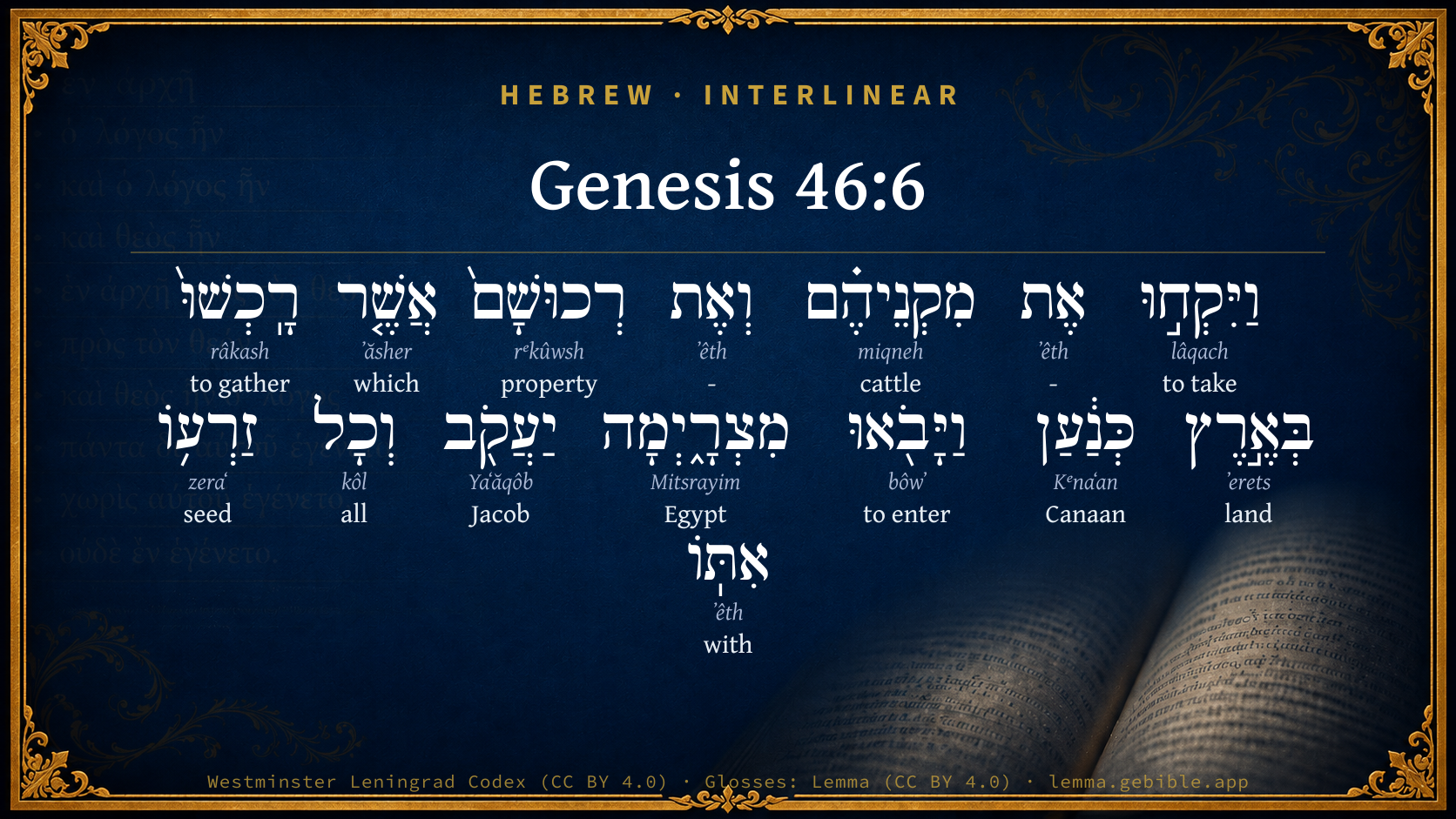
  1. וַיִּקְח֣וּ lâqach H3947 “and · to take” Conjunction + Verb, Qal, Sequential Imperfect, 3rd Person, Masculine, Plural
  2. אֶת ʼêth H853 “-” Particle, Direct Object
  3. מִקְנֵיהֶ֗ם miqneh H4735 “cattle · their” Noun, Common, Masculine, Singular, Construct + Suffix, Personal, 3rd Person, Masculine, Plural
  4. וְאֶת ʼêth H853 “and · -” Conjunction + Particle, Direct Object
  5. רְכוּשָׁם֙ rᵉkûwsh H7399 “property · their” Noun, Common, Masculine, Singular, Construct + Suffix, Personal, 3rd Person, Masculine, Plural
  6. אֲשֶׁ֤ר ʼăsher H834 “which” Particle, Relative
  7. בְּאֶ֣רֶץ ʼerets H776 “in/at · land of” Preposition + Noun, Common, Both, Singular, Construct
  8. כְּנַ֔עַן Kᵉnaʻan H3667 “Canaan” Noun, Proper
  9. וַיָּבֹ֖אוּ bôwʼ H935 “and · to enter” Conjunction + Verb, Qal, Sequential Imperfect, 3rd Person, Masculine, Plural
  10. מִצְרָ֑יְמָה Mitsrayim H4714 “Egypt · toward” Noun, Proper + Suffix, Demonstrative
  11. יַעֲקֹ֖ב Yaʻăqôb H3290 “Jacob” Noun, Proper
  12. וְכָל kôl H3605 “and · all of” Conjunction + Noun, Common, Masculine, Singular, Construct
  13. זַרְע֥וֹ zeraʻ H2233 “seed · his” Noun, Common, Masculine, Singular, Construct + Suffix, Personal, 3rd Person, Masculine, Singular
  14. אִתּֽוֹ ʼêth H854 “with · him” Preposition + Suffix, Personal, 3rd Person, Masculine, Singular

About this verse

These counts appear in no published source. They are computed here, from the morphology-tagged text and Lemma’s own curated glosses. What Lemma adds →

15
words
14
distinct lemmas
Pentateuch
section

Notable vocabulary

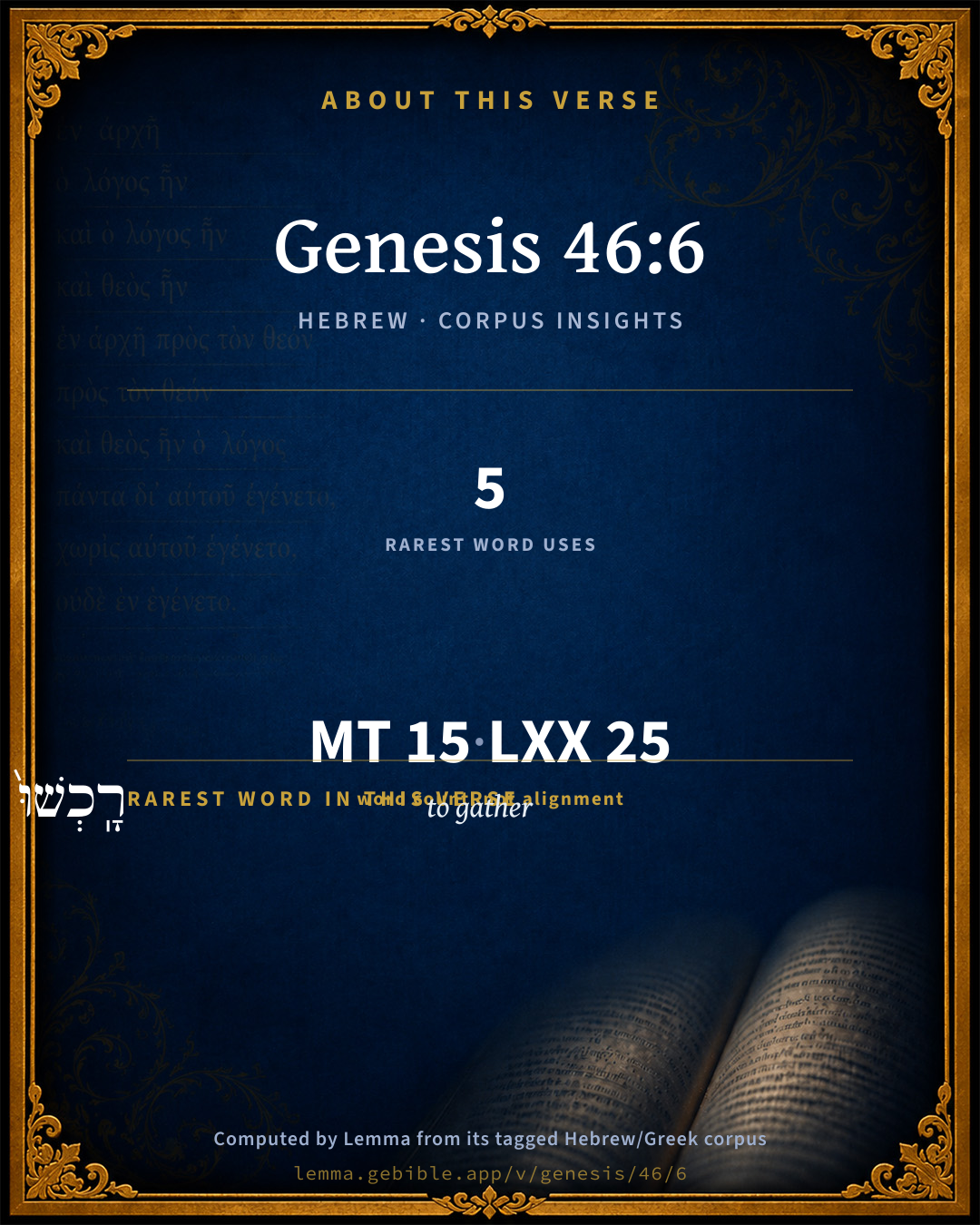
The rarest word here is רָֽכְשׁוּ֙ to gather H7408 — appearing just 5 times in the whole Hebrew Bible.

Shared distinctive vocabulary

רָֽכְשׁוּ֙ to gather H7408 occurs in 4 verses of the Hebrew Bible. Also found in:

Grammatical profile

  • 3 verbs
  • 8 nouns
  • 1 preposition
  • 3 particles

Verb forms

  • וַיִּקְח֣וּ Qal · Sequential Imperfect
  • רָֽכְשׁוּ֙ Qal · Perfect
  • וַיָּבֹ֖אוּ Qal · Sequential Imperfect

Hebrew & Septuagint length

In English translation the verse runs 27 words from the Hebrew and 33 from the Septuagint (LXX English) — closely comparable.

A rough comparison of the two English renderings, which tokenize alike — not a word-level alignment.

Word counts can differ between the Hebrew and the Greek without any difference in meaning — e.g. the Hebrew direct-object marker אֵת has no separate Greek word, and Greek often adds the article ὁ.

In the original languages it is 15 Hebrew tokens and 25 Greek tokens — but the two are counted differently (Hebrew bundles its prefixes and suffixes into one token; the Greek is in lemma form), so that isn’t a like-for-like length.

Cross-references

9

Topical passages linked to Genesis 46:6 in the Treasury of Scripture Knowledge — connected by theme and wording, ordered by reader-vote popularity; previews shown in the World English Bible.

  • Joshua 24:4 I gave to Isaac Jacob and Esau: and I gave to Esau Mount Seir, to possess it: and Jacob and his children went down into Egypt.
  • Psalms 105:23 Israel also came into Egypt. Jacob sojourned in the land of Ham.
  • Isaiah 52:4 For thus says the Lord Yahweh, My people went down at the first into Egypt to sojourn there: and the Assyrian has oppressed them without cause.
  • Acts 7:15 Jacob went down into Egypt, and he died, himself and our fathers,
  • Deuteronomy 26:5 You shall answer and say before Yahweh your God, A Syrian ready to perish was my father; and he went down into Egypt, and sojourned there, few in number; and he became there a nation, great, mighty, and populous.
  • Genesis 15:13 He said to Abram, "Know for sure that your seed will live as foreigners in a land that is not theirs, and will serve them. They will afflict them four hundred years.
  • Numbers 20:15 how our fathers went down into Egypt, and we lived in Egypt a long time; and the Egyptians dealt ill with us, and our fathers:
  • Deuteronomy 10:22 Your fathers went down into Egypt with seventy persons; and now Yahweh your God has made you as the stars of the sky for multitude.
  • 1 Samuel 12:8 When Jacob was come into Egypt, and your fathers cried to Yahweh, then Yahweh sent Moses and Aaron, who brought forth your fathers out of Egypt, and made them to dwell in this place.

Cross-references courtesy of OpenBible.info (CC BY 4.0).

Hebrew and Greek witnesses Masoretic Hebrew ↔ Greek Septuagint

The same verse in the two great witnesses to the Old Testament, shown verse-for-verse.

These are two independent witnesses, not word-aligned to each other, and the Septuagint is shown in lemma (dictionary) form.

Hebrew Genesis 46:6 Masoretic · Westminster Leningrad Codex

וַיִּקְח֣וּ אֶת מִקְנֵיהֶ֗ם וְאֶת רְכוּשָׁם֙ אֲשֶׁ֤ר רָֽכְשׁוּ֙ בְּאֶ֣רֶץ כְּנַ֔עַן וַיָּבֹ֖אוּ מִצְרָ֑יְמָה יַעֲקֹ֖ב וְכָל זַרְע֥וֹ אִתּֽוֹ

They took their cattle, and their goods, which they had gotten in the land of Canaan, and came into Egypt-- Jacob, and all his seed with him,

World English Bible · Public Domain

Greek LXX Genesis 46:6 Septuagint · lemma form

καί ἀναλαμβάνω ὁ ὑποἄρχω αὐτός καί πᾶς ὁ κτῆσις ὅς κτάομαι ἐν γῆ χανααν εἰςἔρχομαι εἰς αἴγυπτος ἰακώβ καί πᾶς ὁ σπέρμα αὐτός μετά αὐτός

And they took up their goods, and all their property, which they had gotten in the land of Chanaan; they came into the land of Egypt, Jacob, and all his seed with him.

LXX2012 (modern English Septuagint) · Public Domain

Hebrew: Westminster Leningrad Codex (CC BY 4.0). Greek: Septuagint (public domain); English from LXX2012 (modern English Septuagint) (Public Domain). How the Septuagint differs from the Hebrew →

Targum (Aramaic paraphrase)

2

The Targum is the ancient Jewish Aramaic paraphrase of the Hebrew Scriptures — an interpretive translation, not the Hebrew text itself. Onkelos (literal) and Pseudo-Jonathan (expansive) render the Torah, and Jonathan the Prophets. Coverage is partial: where no permissively-licensed English translation exists for a verse, only the Aramaic is shown. This is verse-level text, not a word-by-word alignment to the Hebrew.

  1. Targum Onkelos Torah (Genesis–Deuteronomy)
    וּדְבָרוּ יָת גֵּיתֵיהוֹן וְיָת קִנְיָנְהוֹן דִּי קְנוֹ בְּאַרְעָא דִּכְנַעַן וַאֲתוֹ לְמִצְרָיִם יַעֲקֹב וְכָל בְּנוֹהִי עִמֵּהּ

    (no public-domain English translation for this verse)

    Targum Onkelos — Aramaic: “Onkelos Genesis” (public domain); “Onkelos Exodus” (public domain); “Onkelos Leviticus” (public domain); “Onkelos Numbers” (public domain); “Onkelos Deuteronomy” (public domain). English: “Sefaria Community Translation” (CC0 1.0 (public-domain dedication)); “J.W. Etheridge. The Targums of Onkelos and Jonathan Ben Uzziel on the Pentateuch. London: Longmans, Green, 1862” (public domain). Text via Sefaria.

  2. Targum Pseudo-Jonathan Torah (Genesis–Deuteronomy)
    וְדַבְּרוּ יַת קִנְיָנֵיהוֹן וְיַת נִכְסֵיהוֹן דִי קָנוּ בְּאַרְעָא דִכְנָעַן וְאָתוֹ לְמִצְרַיִם יַעֲקב וְכָל בְּנוֹי עִמֵיהּ

    They took their possessions and the substance which they had gotten in the land of Kenaan, and came into Mizraim, Jakob and all his sons with him,

    Targum Pseudo-Jonathan — Aramaic: “Targum Jonathan on Genesis” (public domain); “Targum Jonathan on Exodus” (public domain); “Targum Jonathan on Leviticus” (public domain); “Targum Jonathan on Numbers” (public domain); “Targum Jonathan on Deuteronomy” (public domain). English: “The Targum of Jonathan ben Uzziel, trans. J. W. Etheridge, London, 1862” (public domain). Text via Sefaria.

Commentary

Notes on Genesis 46:6 from classic Christian and Jewish commentators (each source and its license shown beneath its notes). The classic Christian expositions comment on the surrounding passage and are grouped to its opening verse, so a note may address several verses; the Jewish commentaries on the Tanakh (Rashi and others) are per-verse, so they appear only where the commentator wrote on this verse.

Lemma curates 59 commentaries, every one of them public domain or Creative Commons licensed, each selected and text-cleaned for this edition rather than reprinted as found. About our sources →

Trapp's Complete Commentary

John Trapp

Gen 46:6 And they took their cattle, and their goods, which they had gotten in the land of Canaan, and came into Egypt, Jacob, and all his seed with him:

Ver. 6. And they took their cattle, and their goods.] Though Pharaoh sent to them they should not, yet, not willing to be much chargeable, they brought that they had. It is a happiness so to live with others as not to be much beholden; but rather helpful, than burdensome. He that receives a courtesy, we say, sells his liberty: and "the borrower is servant to the lender." {Pro 22:7} St Paul glories in this to the liberal Corinthians, that when he was present with them he was "chargeable to no man." {2Co 11:9} Oυ κατεναρκησα ουδενος; {a} dunned no man, I was no man’s parasite. He was not of those that "served not the Lord Jesus Christ, but their own bellies." {Rom 16:18} The Duke of Bavaria’s house is so pestered with friars and Jesuits that, notwithstanding the greatness of his revenue, he is very poor; as spending all his estate upon these Popish parasites. Such among the Turks are the Dervislars and Imailers, that under pretence of religion, live, like body lice, upon other men’s sweat and labours. {b}

{a} Nαρκη, torpedo piscis, cuius ea est natura ut propius accedentes seque tangentes obstupefaciat. Hinc καταναρκεω obstupeo cum alicuius incommodo. Pasor.

{b} Turk. Hist., fol. 477, 950. Heyl., Geog., p. 291.

John Trapp, A Commentary or Exposition upon All the Books of the Old and New Testament (1647–1656) — public domain. Text from a community e-Sword module.

Jamieson, Fausset & Brown

Robert Jamieson, A. R. Fausset & David Brown

goods, which they had gotten in the land--not furniture, but substance--precious things.

Jamieson, Fausset & Brown — Commentary Critical and Explanatory on the Whole Bible (1871) — public domain (CC PDM 1.0). Text via the HelloAO Bible API.

Ellicott's Commentary for English Readers

(6) Their goods.—These are not the vessels spoken of contemptuously by Pharaoh (Gen_45:20), but their personal property, of which they would naturally have much which they would not be willing to leave behind. Abraham had brought large wealth with him from Haran (Gen_12:5), some of which may have even come from Ur-Chasdim, and much had been gathered since. The patriarchs would leave their household stuff behind, but all valuables, and the records of their house, and their tôldôth, they would carefully carry with them.

They . . . came into Egypt.—For a full account of the scene depicted on the tomb of Khnum-hotep at Beni-hassan, and which at one time was identified with the arrival of the sons of Jacob, see Tomkins, Times of Abraham, 110-114.

A Bible Commentary for English Readers, edited by Charles John Ellicott (1878–1897) — public domain. Text from a community e-Sword module.

John Gill's Exposition

And they took their cattle, and their goods, which they had gotten in the land of Canaan,.... Some interpreters add, by way of explanation, and in Mesopotamia; much of Jacob's substance being yet there, though the greatest part was got in Canaan, and so that is put for the whole; and Jarchi supposes that Jacob gave all that he got in Padanaram to Esau for his part in the cave of Machpelah, and therefore mention is only made of his substance in Canaan; but there is no need of any such additions or suppositions, since the text only speaks of the substance of Jacob's sons, and what they had was only gotten in Canaan, into which they came very young; all which they brought with them as being their property, and not obliged to leave it behind to strangers; though they were bid not to regard their stuff, yet they were not willing to live upon others, but upon their own, and as much as they could independent of others; and that they might not be upbraided hereafter that they came into Egypt poor and destitute of everything:

and came into Egypt, Jacob, and all his seed with him; safe and well.

John Gill's Exposition of the Whole Bible (1746–1763) — public domain (CC PDM 1.0). Text via the HelloAO Bible API.

Matthew Poole's English Annotations

In the land of Canaan, and in Mesopotamia. But Canaan only is here mentioned, because here they got the far greatest part of them, which by a synecdoche is put for the whole.

Matthew Poole's English Annotations on the Holy Bible (1683–1685) — public domain. Text from a community e-Sword/MySword module.

Whedon's Commentary on the Bible

Daniel D. Whedon

6. Came into Egypt, Jacob, and all his seed — At first summarily expressed, yet afterwards (Gen_46:8-27) details are given.

Daniel D. Whedon (gen. ed.), Commentary on the Old and New Testaments (1874–1909) — public domain. Text from a community e-Sword module.

Rashi

Rabbi Shlomo Yitzchaki (Rashi)

אשר רכשו בארץ כנען WHICH THEY HAD GOTTEN IN THE LAND OF CANAAN — But all that he had gotten in Padan-aram he gave to Esau in payment for his share in the Cave of Machpelah. He said, “The possessions I obtained outside the land are of no value to me”. It is to this that the words refer (Genesis 50:5) “[Bury me in my burying-place] which כריתי” I obtained for myself by means of a כרי. He placed before him (Esau) piles of gold and silver like a heap (כרי) of corn and said to him, “Take these in exchange for your share in the Cave of Machpelah” (Midrash Tanchuma, Vayechi 6).

Rashi on the Tanakh — English translations: “The Judaica Press complete Tanach with Rashi, translated by A. J. Rosenberg” (CC BY 4.0); “Pentateuch with Rashi's commentary by M. Rosenbaum and A.M. Silbermann, 1929-1934” (public domain); “The Metsudah Tanach series, Lakewood, N.J” (CC BY 4.0); and “The Book of Joshua, Metsudah Publications, 1997” (CC BY 4.0). Text via Sefaria.

Lesson kit

Teaching starters — assembled from the data on this page, not authored interpretation. Every prompt links to the verse data it draws on. Edit before teaching.

Genesis, in the Pentateuch, opens this verse with 15 words (14 distinct Hebrew lemmas). Its most distinctive word is râkash (“to gather”). A historical commentator’s framing appears above. Read the whole chapter for the surrounding context.

Discussion questions

  1. The word râkash carries the sense “to gather.” How does it shape the verse?
  2. Genesis 12:5 shares the word «to gather» with this verse. How do the two illuminate each other?
  3. These translations render this verse differently. What is at stake in choosing one wording over another?
  4. The verb «וַיִּקְח֣וּ» is Qal Sequential Imperfect. How does its form color the action?
  5. Reading how Trapp's Complete Commentary and Jamieson, Fausset & Brown read this verse, where do the two commentators agree and where do they part?

Things to notice

Reading settings

Reading text

Shown beneath each verse's original-language words.

Old Testament
Old Testament edition

Read the OT as the Masoretic Hebrew (MT) or the Greek Septuagint (LXX).

English shown for the Greek Septuagint (in the Hebrew ↔ Greek comparison).

Comparing translations? Open the Compare panel on any verse page to stack up to four side by side.