
Ezekiel 33:22

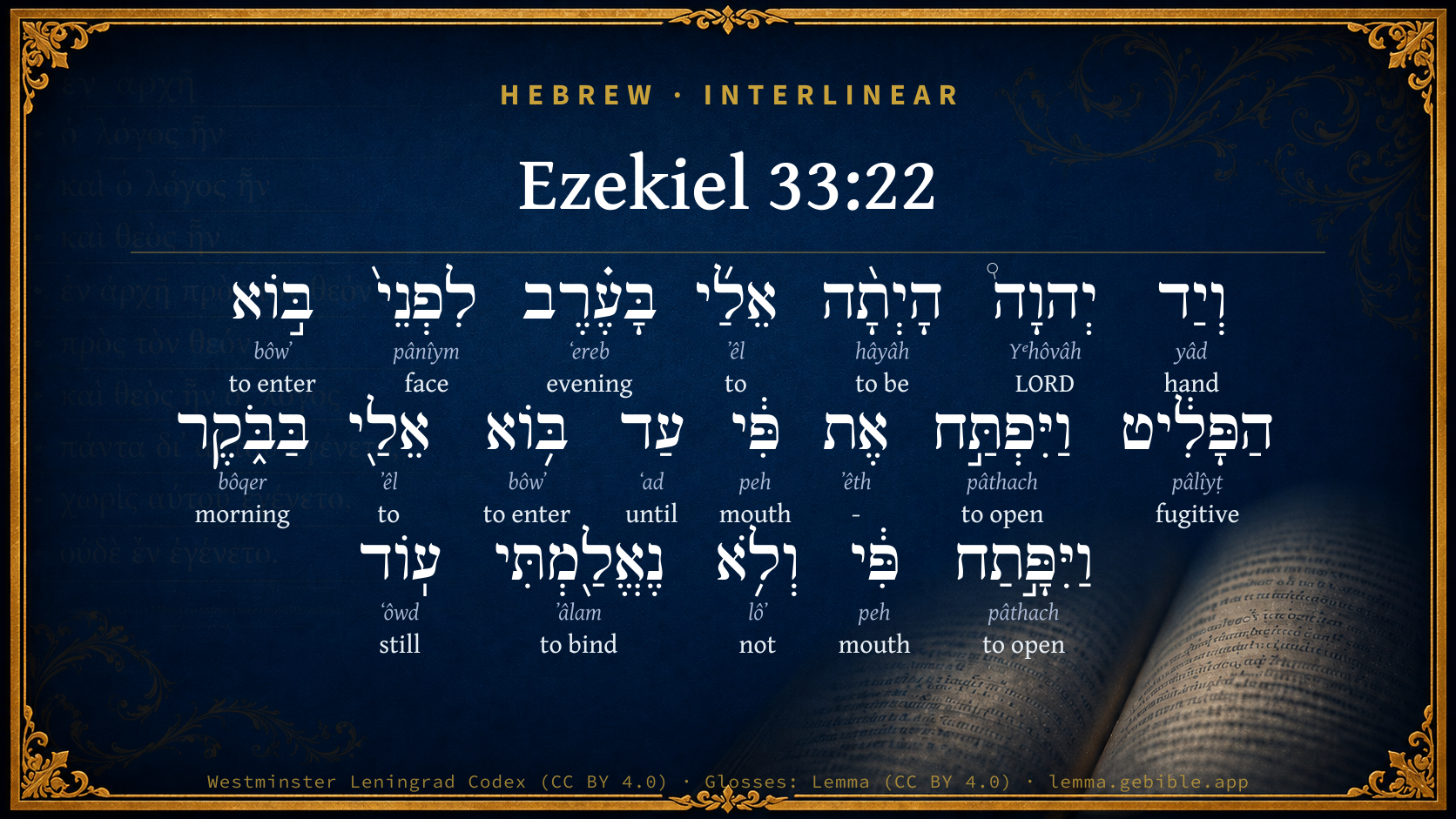
Hebrew (Westminster Leningrad Codex) Ezekiel 33:22 appears in the Hebrew Old Testament. The text above is from the Westminster Leningrad Codex. Each word links to its Strong’s number, a concise gloss, and parsing drawn from the Open Scriptures Hebrew Bible morphology. Click any word for its full Brown-Driver-Briggs (BDB) entry.
Download image
Cite this verse

Ezekiel 33:22 (World English Bible). Public Domain. Lemma interlinear Bible study tool, https://lemma.gebible.app/v/ezekiel/33/22.

Show BibTeX & RIS
BibTeX
RIS
English Translation
Now the hand of Yahweh had been on me in the evening, before he who was escaped came; and he had opened my mouth, until he came to me in the morning; and my mouth was opened, and I was no more mute.
World English Bible · Public Domain
Download a study sheet

One document with this verse’s original text, its word-by-word gloss line, the meaning frame, cross-references with their text, attributed commentary, and full source and license credits — printable, and it pastes into notes with its structure intact.

This verse Autodidact and up

Study sheet (.html) Plain text (.txt)

A passage Seminary Student

Up to 50 verses in one chapter. A passage sheet keeps up to 6 commentary sources and 12 cross-references per verse, in the order this page ranks them, and says so on the sheet whenever that leaves anything out. Ask for a single verse and you get the Autodidact verse sheet above.

Everything on this page stays free to read, with no account — the sheet is a download of what is already on screen, not access to it.

Want to remove ads? Support Godless Engineer
Compare translations 3

The same verse in 3 English versions, stacked beneath the original-language interlinear above. Click any original word for its lexicon entry.

Each is an independent rendering of the whole verse — the interlinear is not word-aligned to these translations.

Highlighted words mark where these versions differ — a whole-verse word diff, not a word-by-word alignment.

  • World English Bible Public Domain
    Now the hand of Yahweh had been on me in the evening, before he who was escaped came; and he had opened my mouth, until he came to me in the morning; and my mouth was opened, and I was no more mute.
  • King James Version Public Domain
    Now the hand of the LORD was upon me in the evening, afore he that was escaped came; and had opened my mouth, until he came to me in the morning; and my mouth was opened, and I was no more dumb.
  • unfoldingWord Literal Text CC BY-SA 4.0
    The hand of Yahweh had been on me in the evening before the fugitive came, and my mouth was opened by the time that he came to me in the dawn. So my mouth was open; I was no longer mute!

unfoldingWord Literal Text — © unfoldingWord, licensed CC BY-SA 4.0. Word-aligned USFM3 via Door43 (git.door43.org/unfoldingWord/en_ult).

Versions to compare (up to 4)

3 of 4 selected

Show all 18 translations

Every available English version of this verse, each an independent rendering of the whole verse.

  • World English Bible Public Domain
    Now the hand of Yahweh had been on me in the evening, before he who was escaped came; and he had opened my mouth, until he came to me in the morning; and my mouth was opened, and I was no more mute.
  • Berean Standard Bible Public Domain
    Now the evening before the fugitive arrived, the hand of the LORD was upon me, and He opened my mouth before the man came to me in the morning. So my mouth was opened and I was no longer mute.
  • Majority Standard Bible Public Domain
    Now the evening before the fugitive arrived, the hand of the LORD was upon me, and He opened my mouth before the man came to me in the morning. So my mouth was opened and I was no longer mute.
  • King James Version Public Domain
    Now the hand of the LORD was upon me in the evening, afore he that was escaped came; and had opened my mouth, until he came to me in the morning; and my mouth was opened, and I was no more dumb.
  • American Standard Version (1901) Public Domain
    Now the hand of Jehovah had been upon me in the evening, before he that was escaped came; and he had opened my mouth, until he came to me in the morning; and my mouth was opened, and I was no more dumb.
  • Revised Version (1885) Public Domain
    Now the hand of the LORD had been upon me in the evening, afore he that was escaped came; and he had opened my mouth, until he came to me in the morning; and my mouth was opened, and I was no more dumb.
  • Geneva Bible (1599) Public Domain
    Now the hand of the Lord had bene vpon me in ye euening afore hee that had escaped, came, and had opened my mouth vntill he came to me in the morning: and when hee had opened my mouth, I was no more dumme.
  • Douay-Rheims (1899) Public Domain
    And the hand of the Lord had been upon me in the evening, before he that was fled came: and he opened my mouth till he came to me in the morning, and my mouth being opened, I was silent no more.
  • Young's Literal Translation Public Domain
    And the hand of Jehovah hath been unto me in the evening, before the coming in of the escaped one, and He openeth my mouth till the coming in unto me in the morning, and opened is my mouth, and I have not been silent again.
  • Literal Standard Version CC BY-SA 4.0
    And the hand of YHWH has been to me in the evening, before the coming in of the escaped one, and He opens my mouth until [his] coming to me in the morning, and my mouth is opened, and I have not been silent again.
  • Unlocked Literal Bible CC BY-SA 4.0
    The hand of Yahweh had been on me in the evening before the fugitive came, and my mouth was opened by the time that he came to me in the dawn. So my mouth was open; I was no longer mute!
  • unfoldingWord Literal Text CC BY-SA 4.0
    The hand of Yahweh had been on me in the evening before the fugitive came, and my mouth was opened by the time that he came to me in the dawn. So my mouth was open; I was no longer mute!
  • Darby Bible Public Domain
    Now the hand of Jehovah had been upon me in the evening, before he that had escaped came; and he had opened my mouth against his coming to me in the morning; and my mouth was opened, and I was no more dumb.
  • World Messianic Bible Public Domain
    Now the LORD’s hand had been on me in the evening, before he who had escaped came; and he had opened my mouth until he came to me in the morning; and my mouth was opened, and I was no longer mute.
  • Webster's Bible Public Domain
    Now the hand of the LORD was upon me in the evening, before he that had escaped came; and had opened my mouth, until he came to me in the morning; and my mouth was opened, and I was no more dumb.
  • Free Bible Version CC BY-SA 4.0
    The previous evening before the messenger arrived the Lord had touched me so I could speak again. This was before the man came to see me in the morning. I wasn't mute any longer—I could speak again.
  • Bible in Basic English Public Domain
    Now the hand of the Lord had been on me in the evening, before the man who had got away came to me; and he made my mouth open, ready for his coming to me in the morning; and my mouth was open and I was no longer without voice.
  • JPS Tanakh (1917) Public Domain
    Now the hand of the LORD had been upon me in the evening, before he that was escaped came; and He had opened my mouth against his coming to me in the morning; and my mouth was opened, and I was no more dumb.

Literal Standard Version (2020), Covenant Press — licensed CC BY-SA 4.0. Text via the HelloAO Bible API (eBible.org). Unlocked Literal Bible (unfoldingWord) — licensed CC BY-SA 4.0. Text via the HelloAO Bible API (eBible.org). unfoldingWord Literal Text — © unfoldingWord, licensed CC BY-SA 4.0. Word-aligned USFM3 via Door43 (git.door43.org/unfoldingWord/en_ult). Free Bible Version, Dr. Jonathan Gallagher — licensed CC BY-SA 4.0. Text via the HelloAO Bible API (eBible.org).

Word by word

More ways to search: Search by grammar → Find every occurrence → Compare this word →

Practice this passage: Drill this verse → Learn its vocabulary →

נֶאֱלַ֖מְתִּי
ʼâlam
H481
“to bind”
Verb, Niphal, Perfect, 1st Person, Common, Singular
Part of Speech
Verb
Stem
Niphal
Form
Perfect
Person
1st Person
Gender
Common
Number
Singular
Full BDB Definition

Origin: a primitive root

TWOT: 102

to bind - (Niphal) - to be dumb - to be bound - (Piel) binding (participle)
  1. וְיַד yâd H3027 “and · hand of” Conjunction + Noun, Common, Both, Singular, Construct
  2. יְהוָה֩ Yᵉhôvâh H3068 “LORD” Noun, Proper
  3. הָיְתָ֨ה hâyâh H1961 “to be” Verb, Qal, Perfect, 3rd Person, Feminine, Singular
  4. אֵלַ֜י ʼêl H413 “to · me” Preposition + Suffix, Personal, 1st Person, Common, Singular
  5. בָּעֶ֗רֶב ʻereb H6153 “in/at the · evening” Preposition, Determined + Noun, Common, Masculine, Singular, Absolute
  6. לִפְנֵי֙ pânîym H6440 “to/for · face(s) of” Preposition + Noun, Common, Both, Plural, Construct
  7. בּ֣וֹא bôwʼ H935 “to enter” Verb, Qal, Infinitive Construct
  8. הַפָּלִ֔יט pâlîyṭ H6412 “the · fugitive” Particle, Definite Article + Noun, Common, Masculine, Singular, Absolute
  9. וַיִּפְתַּ֣ח pâthach H6605 “and · to open” Conjunction + Verb, Qal, Sequential Imperfect, 3rd Person, Masculine, Singular
  10. אֶת ʼêth H853 “-” Particle, Direct Object
  11. פִּ֔י peh H6310 “mouth · my” Noun, Common, Masculine, Singular, Construct + Suffix, Personal, 1st Person, Common, Singular
  12. עַד ʻad H5704 “until” Preposition
  13. בּ֥וֹא bôwʼ H935 “to enter” Verb, Qal, Infinitive Construct
  14. אֵלַ֖י ʼêl H413 “to · me” Preposition + Suffix, Personal, 1st Person, Common, Singular
  15. בַּבֹּ֑קֶר bôqer H1242 “in/at the · morning” Preposition, Determined + Noun, Common, Masculine, Singular, Absolute
  16. וַיִּפָּ֣תַח pâthach H6605 “and · to open” Conjunction + Verb, Niphal, Sequential Imperfect, 3rd Person, Masculine, Singular
  17. פִּ֔י peh H6310 “mouth · my” Noun, Common, Masculine, Singular, Construct + Suffix, Personal, 1st Person, Common, Singular
  18. וְלֹ֥א lôʼ H3808 “and · not” Conjunction + Particle, Negative
  19. עֽוֹד ʻôwd H5750 “still” Adverb

About this verse

These counts appear in no published source. They are computed here, from the morphology-tagged text and Lemma’s own curated glosses. What Lemma adds →

20
words
16
distinct lemmas
Prophets
section

Notable vocabulary

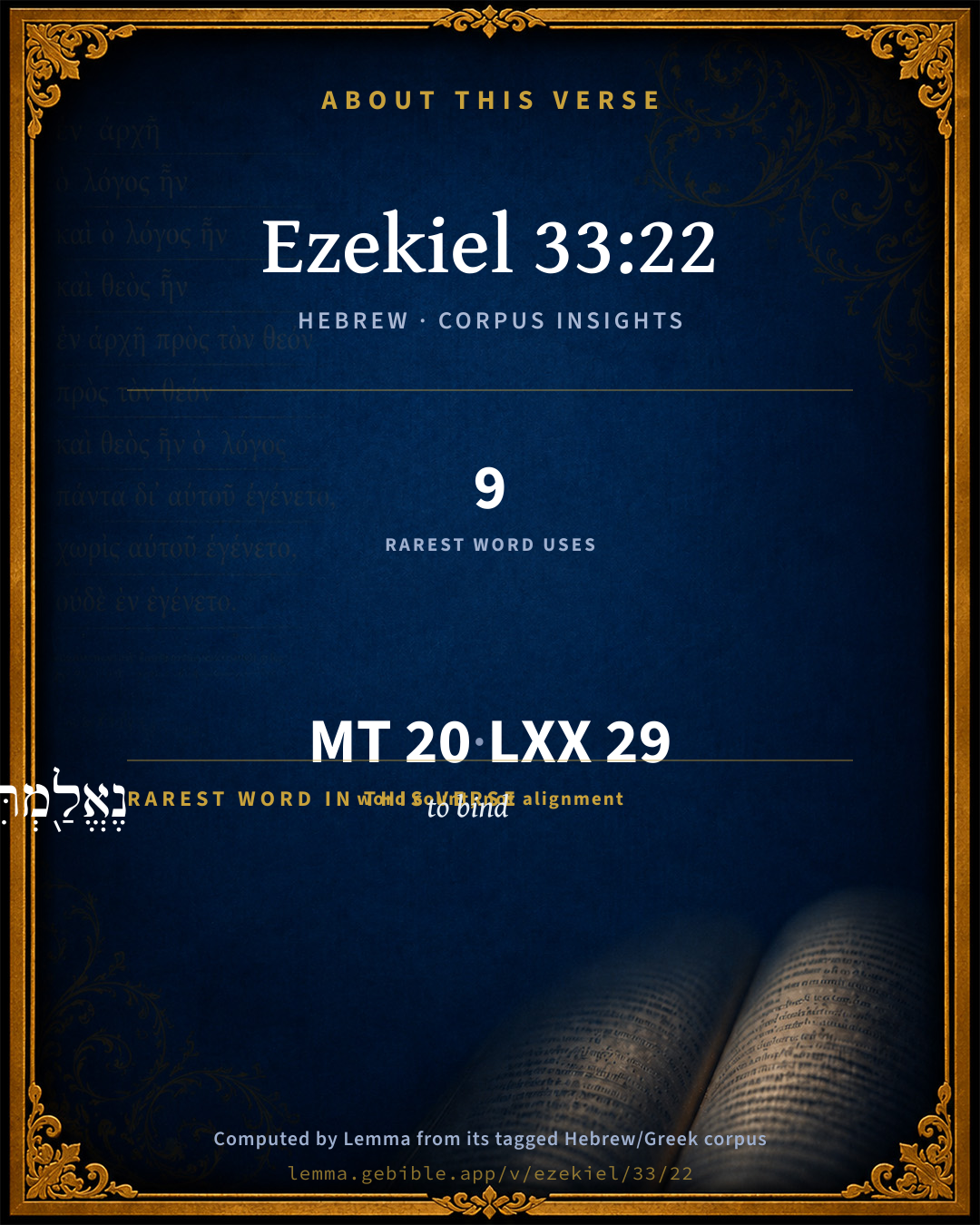
The rarest word here is נֶאֱלַ֖מְתִּי to bind H481 — appearing just 9 times in the whole Hebrew Bible.

Shared distinctive vocabulary

נֶאֱלַ֖מְתִּי to bind H481 occurs in 9 verses of the Hebrew Bible. Also found in:

Grammatical profile

  • 6 verbs
  • 8 nouns
  • 3 prepositions
  • 1 adverb
  • 2 particles

Verb forms

  • הָיְתָ֨ה Qal · Perfect
  • בּ֣וֹא Qal · Infinitive Construct
  • וַיִּפְתַּ֣ח Qal · Sequential Imperfect
  • בּ֥וֹא Qal · Infinitive Construct
  • וַיִּפָּ֣תַח Niphal · Sequential Imperfect
  • נֶאֱלַ֖מְתִּי Niphal · Perfect

Repetition

Words recur within this verse — often emphatic in Hebrew:

  • בּ֣וֹא to enter H935 ×2
  • וַיִּפְתַּ֣ח to open H6605 ×2
  • פִּ֔י mouth H6310 ×2
  • אֵלַ֜י to H413 ×2

Hebrew & Septuagint length

In English translation the verse runs 43 words from the Hebrew and 40 from the Septuagint (LXX English) — closely comparable.

A rough comparison of the two English renderings, which tokenize alike — not a word-level alignment.

Word counts can differ between the Hebrew and the Greek without any difference in meaning — e.g. the Hebrew direct-object marker אֵת has no separate Greek word, and Greek often adds the article ὁ.

In the original languages it is 20 Hebrew tokens and 29 Greek tokens — but the two are counted differently (Hebrew bundles its prefixes and suffixes into one token; the Greek is in lemma form), so that isn’t a like-for-like length.

Cross-references

7

Topical passages linked to Ezekiel 33:22 in the Treasury of Scripture Knowledge — connected by theme and wording, ordered by reader-vote popularity; previews shown in the World English Bible.

  • Ezekiel 1:3 the word of Yahweh came expressly to Ezekiel the priest, the son of Buzi, in the land of the Chaldeans by the river Chebar; and the hand of Yahweh was there on him.
  • Ezekiel 3:26–27 and I will make your tongue cleave to the roof of your mouth, that you shall be mute, and shall not be to them a reprover; for they are a rebellious house.
  • Ezekiel 24:26–27 that in that day he who escapes shall come to you, to cause you to hear it with your ears?
  • Ezekiel 37:1 The hand of Yahweh was on me, and he brought me out in the Spirit of Yahweh, and set me down in the midst of the valley; and it was full of bones.
  • Ezekiel 3:22 The hand of Yahweh was there on me; and he said to me, Arise, go forth into the plain, and I will there talk with you.
  • Ezekiel 40:1 In the five and twentieth year of our captivity, in the beginning of the year, in the tenth [day] of the month, in the fourteenth year after that the city was struck, in the same day, the hand of Yahweh was on me, and he brought me there.
  • Luke 1:64 His mouth was opened immediately, and his tongue freed, and he spoke, blessing God.

Cross-references courtesy of OpenBible.info (CC BY 4.0).

Hebrew and Greek witnesses Masoretic Hebrew ↔ Greek Septuagint

The same verse in the two great witnesses to the Old Testament, shown verse-for-verse.

These are two independent witnesses, not word-aligned to each other, and the Septuagint is shown in lemma (dictionary) form.

Hebrew Ezekiel 33:22 Masoretic · Westminster Leningrad Codex

וְיַד יְהוָה֩ הָיְתָ֨ה אֵלַ֜י בָּעֶ֗רֶב לִפְנֵי֙ בּ֣וֹא הַפָּלִ֔יט וַיִּפְתַּ֣ח אֶת פִּ֔י עַד בּ֥וֹא אֵלַ֖י בַּבֹּ֑קֶר וַיִּפָּ֣תַח פִּ֔י וְלֹ֥א נֶאֱלַ֖מְתִּי עֽוֹד

Now the hand of Yahweh had been on me in the evening, before he who was escaped came; and he had opened my mouth, until he came to me in the morning; and my mouth was opened, and I was no more mute.

World English Bible · Public Domain

Greek LXX Ezekiel 33:22 Septuagint · lemma form

καί γίγνομαι ἐπί ἐγώ χείρ κύριος ἑσπέρα πρίν ἔρχομαι αὐτός καί ἀναοἴγω ἐγώ ὁ στόμα ἕως ἔρχομαι πρός ἐγώ ὁ πρωΐ καί ἀναοἴγω ἐγώ ὁ στόμα οὐ συνἔχω ἔτι

Now the hand of the Lord had come upon me in the evening, before he came; and he opened my mouth, when he came to me in the morning: and my mouth was open, it was no longer kept closed.

LXX2012 (modern English Septuagint) · Public Domain

Hebrew: Westminster Leningrad Codex (CC BY 4.0). Greek: Septuagint (public domain); English from LXX2012 (modern English Septuagint) (Public Domain). How the Septuagint differs from the Hebrew →

Targum (Aramaic paraphrase)

1

The Targum is the ancient Jewish Aramaic paraphrase of the Hebrew Scriptures — an interpretive translation, not the Hebrew text itself. Onkelos (literal) and Pseudo-Jonathan (expansive) render the Torah, and Jonathan the Prophets. Coverage is partial: where no permissively-licensed English translation exists for a verse, only the Aramaic is shown. This is verse-level text, not a word-by-word alignment to the Hebrew.

  1. Targum Jonathan Prophets (Joshua–Malachi)
    וּנְבוּאָה מִן קֳדָם יְיָ הֲוַת עִמִי בְּרַמְשָׁא קֳדָם מֵיתֵי מְשֵׁיזְבָא וּפְתַח יַת פּוּמִי עַד מֵיתֵי לְוָתִי בְצַפְרָא וְאֶפְתַּח פּוּמִי וְלָא שַׁתְקֵית עוֹד:

    (no public-domain English translation for this verse)

    Targum Jonathan — Aramaic: “Mikraot Gedolot” (public domain). English: “Sefaria Community Translation” (CC0 1.0 (public-domain dedication)); “London "Chaldee Paraphrase," 1871” (public domain). Text via Sefaria.

Commentary

Notes on Ezekiel 33:22 from classic Christian and Jewish commentators (each source and its license shown beneath its notes). The classic Christian expositions comment on the surrounding passage and are grouped to its opening verse, so a note may address several verses; the Jewish commentaries on the Tanakh (Rashi and others) are per-verse, so they appear only where the commentator wrote on this verse.

Lemma curates 59 commentaries, every one of them public domain or Creative Commons licensed, each selected and text-cleaned for this edition rather than reprinted as found. About our sources →

Trapp's Complete Commentary

John Trapp

Eze 33:22 Now the hand of the LORD was upon me in the evening, afore he that was escaped came; and had opened my mouth, until he came to me in the morning; and my mouth was opened, and I was no more dumb.

Ver. 22. The hand of the Lord,] i.e., The Spirit of the Lord, which acted me and carried me out. {2Pe 1:21 1Co 12:3}

And my mouth was opened.] As God had promised. {Eze 24:27} And this happened before the messenger’s narration. This was much for the prophet’s honour.

John Trapp, A Commentary or Exposition upon All the Books of the Old and New Testament (1647–1656) — public domain. Text from a community e-Sword module.

Joseph Benson's Commentary

Eze 33:22. Now the hand of the Lord was upon me in the evening — I felt a sensible impulse of the prophetic spirit: see Eze 1:3. And had opened my mouth, until he came to me in the morning — Had so influenced my mind, that I found myself disposed and prepared to speak freely and with authority. Not that he had been utterly dumb before: for he had probably “been able to converse with the Jews concerning the predictions formerly delivered to them, and perhaps spake, or delivered in writing to them, the prophecies which he uttered concerning other nations; but he had received no further revelation from God respecting their affairs: in this sense he had been dumb.” — Scott. But now the Spirit moved him to speak, and continued so to do till the messenger came, whose information concerning the taking and burning of Jerusalem, which had been repeatedly and clearly foretold by the prophet, would give an indisputable authority and credit to all his predictions, and prepare the people’s minds to receive, with faith and a due regard, every future message which he was commissioned to deliver to them.

Joseph Benson's Commentary on the Old and New Testaments (1811–1818) — public domain. Text from a community e-Sword module.

Tyndale Open Study Notes

Tyndale Open Resources

33:22 The news of Jerusalem’s fall was a turning point for Ezekiel. His voice returned (see 3:26; 24:25-27), and he was finally able to speak freely. There was new hope for God’s people.

Tyndale Open Study Notes — © Tyndale Open Resources, licensed CC BY-SA 4.0. Text via the HelloAO Bible API.

Geneva Bible (1599)

Geneva Bible translators

I was endued with the Spirit of prophecy, Ezek. 8:1.

Whereby is signified that the ministers of God cannot speak till God give them courage, and open their mouths, Ezek. 24:27 and 29:21; Eph. 6:19.

Geneva Bible (1599) marginal notes — public domain. Text via Bolls.life.

Jamieson, Fausset & Brown

Robert Jamieson, A. R. Fausset & David Brown

in the evening--(see on Eze 33:2). Thus the capture of Jerusalem was known to Ezekiel by revelation before the messenger came.

my mouth . . . no more dumb--that is, to my countrymen; as foretold (Eze 24:27), He spake (Eze. 33:2-20) in the evening before the tidings came.

Jamieson, Fausset & Brown — Commentary Critical and Explanatory on the Whole Bible (1871) — public domain (CC PDM 1.0). Text via the HelloAO Bible API.

Adam Clarke's Commentary

Verse 22. My mouth was opened] They had now the fullest evidence that I had spoken from the Lord. I therefore spoke freely and fully what God delivered to me, Eze 24:27.

Adam Clarke's Commentary on the Bible (1810–1826) — public domain. Text from a community e-Sword/MySword module.

Ellicott's Commentary for English Readers

(22) Was upon me.—The sentence becomes clearer by translating this in the pluperf.: The hand of the Lord had been (already) upon me.

A Bible Commentary for English Readers, edited by Charles John Ellicott (1878–1897) — public domain. Text from a community e-Sword module.

The Cambridge Bible for Schools and Colleges

gen. ed. J. J. S. Perowne

22. Though the date is inserted here, it is probably to be understood as applicable to the whole chapter, for Eze_33:1-2 the prophet is commanded to speak publicly to the children of his people. In the evening he felt the hand of the Lord upon him, he fell into an excitation. Thoughts such as those in Eze_33:1-20 of the new Israel that God would create and of the conditions of belonging to it filled his mind. He was well aware that the city’s fall was inevitable, to him it was as good as fallen. And full of the new thoughts of the future he felt himself standing before his fellow exiles with an impulse strong upon him to speak to them of this future in the name of the Lord. In the morning the fugitives arrived with the confirmation of all his past predictions.

until he came to me] should come: against his coming, Exo_7:15.

no more dumb] i.e. silent, Psa_39:2; Isa_53:7.

The Cambridge Bible for Schools and Colleges (gen. ed. J. J. S. Perowne; Cambridge University Press, 1878–1918) — public domain. Text from a community e-Sword module.

John Gill's Exposition

Son of man, they that inhabit those wastes of the land of Israel,.... The places which were laid waste by Nebuchadnezzar's army, going and returning, in and about Jerusalem, and in several parts of Judea; these were they that were left in the land after the destruction, to people and plant it; or who, having fled to distant parts, were now returned, and took possession of it, though it was in a wretched condition, a mere waste or desert; and yet they were lifted up with it, and proud and haughty, as their language shows: for thus they speak,

saying, Abraham was one, and he inherited the land; he was but one, and had no child, when the promise of inheriting the land was made unto him; and he was but a single worshipper of God, and yet he had this favour and privilege:

but we are many; the land is given us for inheritance: so they oppose themselves to Abraham, and argue from the lesser to the greater; that if a single person was vouchsafed to inherit it, then much more many, and those of his seed; and to whom the land was particularly given for an inheritance, and who were now in the possession of it, as Abraham never was; and, being many, were able to defend their right, and secure themselves in the enjoyment of it; all which reasoning shows their pride and vanity, though they were under such humbling circumstances; their land being waste, their numbers lessened, and the enemy had but just left it, having made dreadful devastations in it; and which had had no influence upon them to reform them, or bring them to repentance, as the following verses show.

John Gill's Exposition of the Whole Bible (1746–1763) — public domain (CC PDM 1.0). Text via the HelloAO Bible API.

Albert Barnes' Notes on the Bible

Was upon me ... was opened - For was read “had been.” The prophet was under the hand of God in ecstatic trance on the evening preceding the arrival of the messenger, and continued in this state until his arrival.

Albert Barnes' Notes on the Bible (1834–1885) — public domain. Text from a community e-Sword/MySword module.

Matthew Poole's English Annotations

The hand of the Lord was upon me; the powerful influence of the prophetic Spirit inspired me, and prepared me for what followed.

Had opened my mouth; not that the prophet was dumb through impotence and inability to speak, for he had prophesied against many nations, but he was forbidden to say any thing of the Jews, to threaten, warn, counsel, or command, Eze 24:25-27; 29:21; but now the Spirit moved me to speak, and continued his motion till the messenger came, and ever after, for God did not command him silence any more.

Matthew Poole's English Annotations on the Holy Bible (1683–1685) — public domain. Text from a community e-Sword/MySword module.

Whedon's Commentary on the Bible

Daniel D. Whedon

22. Was upon me — R.V., “had been upon me.” (Compare Eze_33:2.)

Daniel D. Whedon (gen. ed.), Commentary on the Old and New Testaments (1874–1909) — public domain. Text from a community e-Sword module.

The Pulpit Commentary

Now the hand of the Lord. When the messenger arrived he found the prophet in a state of ecstasy. This was in the evening. In that prophetic ecstasy his mouth was opened, and the long silence broken, and though he had not heard the message with his outward ears, he had taken, as it were, that message as his text. It was not till his discourse was ended, and the morning came, that he himself heard the terrible tidings from the lips of the messenger. Then a change came over him. He was no more dumb. The long silence was broken. Had the silence lasted, we ask, from Eze_3:26 onward? Had the whole intervening period been one of simply symbolic action, and of written but unspoken prophecies? The words at first suggest that conclusion; but it is traveled by the facts; by the commands of Eze_12:10, Eze_12:23; by the order to "prophesy" in Eze_13:2; by the message to speak unto the elders in Eze_14:4; by the question, "Doth he not speak parables?" of Eze_20:49. I infer, therefore, that, though the silence had been dominant, it had not been unbroken. To some, at least, a message had been spoken. Others may have been allowed to read the written prophecies. The death of the prophet"s wife tended, probably, to the continuance of the silence, and it seems a legitimate inference from Eze_24:27 that it had continued from that date onward.

The Pulpit Commentary (1880–1919), ed. H.D.M. Spence-Jones & Joseph S. Exell — public domain. Text from a community e-Sword module.

John Wesley's Explanatory Notes

Opened my mouth - Not that the prophet was utterly dumb before, for he had prophesied against many nations, only he was forbidden to say anything of the Jews, But now the spirit moved him to speak, and continued his motion, 'till the messenger came, and ever after.

John Wesley, Explanatory Notes Upon the Whole Bible (1754–1765) — public domain. Text via the GEBible commentary corpus.

Rashi

Rabbi Shlomo Yitzchaki (Rashi)

and He opened my mouth as He says in the beginning of the Book (3:26): “and you shall become mute, and you shall not be a reprover to them.” Afterward, He said to him (24:25ff.): “on the day I take from them their strength, etc., the fugitive will come to you, etc., on that day, your mouth will be opened with the fugitive, and you will speak and no longer be mute.”

before [his] coming to me in the morning [Heb. עַד בּוֹא אֵלִי בַּבֹּקֶר,] i.e., when he had not yet (בְּעוֹד) come to me in the morning, like: before he came to me in the morning.

Rashi on the Tanakh — English translations: “The Judaica Press complete Tanach with Rashi, translated by A. J. Rosenberg” (CC BY 4.0); “Pentateuch with Rashi's commentary by M. Rosenbaum and A.M. Silbermann, 1929-1934” (public domain); “The Metsudah Tanach series, Lakewood, N.J” (CC BY 4.0); and “The Book of Joshua, Metsudah Publications, 1997” (CC BY 4.0). Text via Sefaria.

Lesson kit

Teaching starters — assembled from the data on this page, not authored interpretation. Every prompt links to the verse data it draws on. Edit before teaching.

Ezekiel, in the Prophets, opens this verse with 20 words (16 distinct Hebrew lemmas). Its most distinctive word is ʼâlam (“to bind”). A historical commentator’s framing appears above. Read the whole chapter for the surrounding context.

Discussion questions

  1. The word ʼâlam carries the sense “to bind.” How does it shape the verse?
  2. How does Genesis 37:7, which shares the word «to bind», read alongside this verse?
  3. What does the repetition of “to enter” (2× in this one verse) do in this verse?
  4. These translations render this verse differently. What is at stake in choosing one wording over another?
  5. «הָיְתָ֨ה» is a Qal Perfect verb. How does that grammatical form shape the action described?
  6. Compare how Trapp's Complete Commentary and Joseph Benson's Commentary read this verse. Where do they agree or differ?

Things to notice

Reading settings

Reading text

Shown beneath each verse's original-language words.

Old Testament
Old Testament edition

Read the OT as the Masoretic Hebrew (MT) or the Greek Septuagint (LXX).

English shown for the Greek Septuagint (in the Hebrew ↔ Greek comparison).

Comparing translations? Open the Compare panel on any verse page to stack up to four side by side.