Genesis 39:11

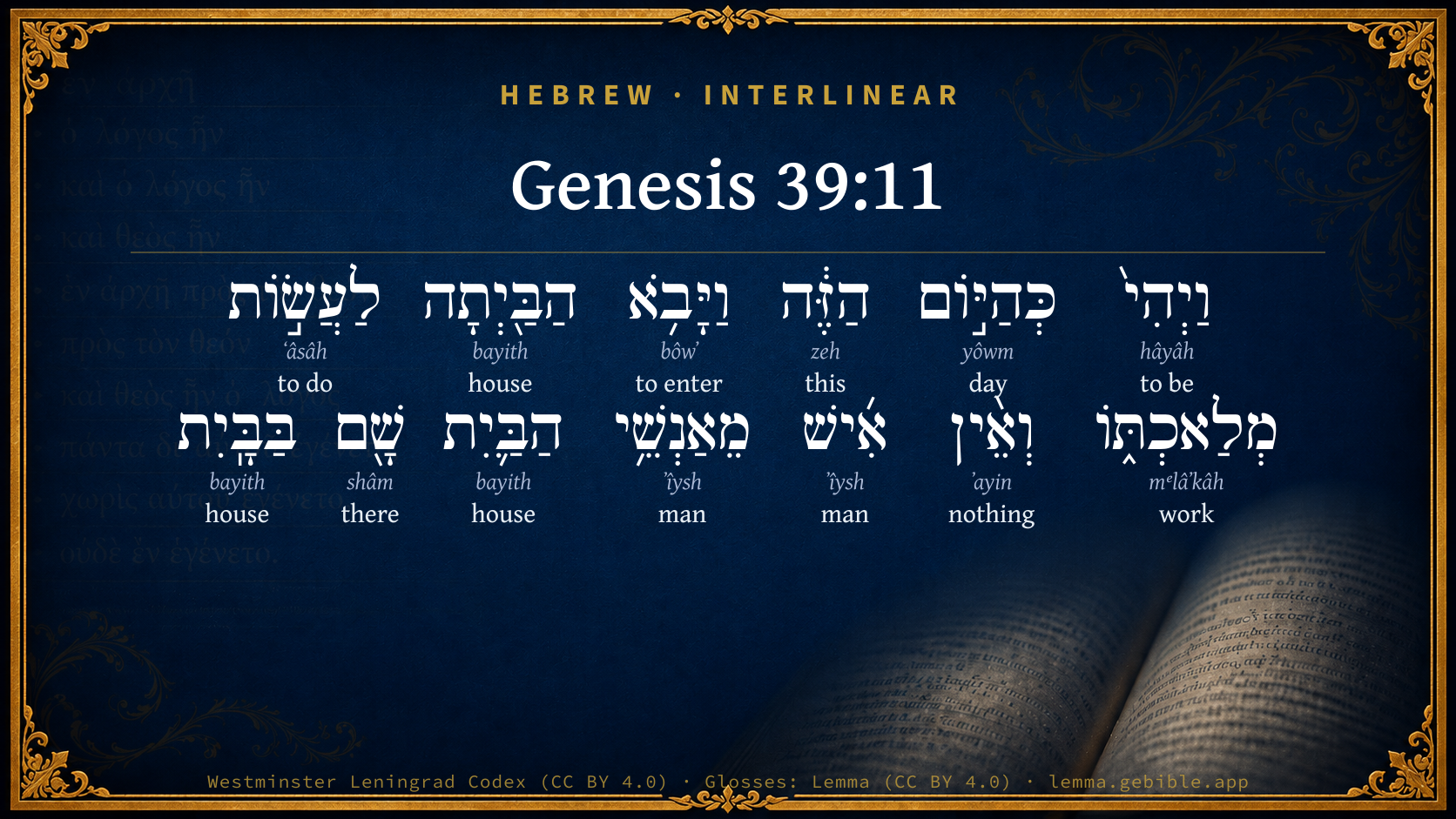
Hebrew (Westminster Leningrad Codex) Genesis 39:11 appears in the Hebrew Old Testament. The text above is from the Westminster Leningrad Codex. Each word links to its Strong’s number, a concise gloss, and parsing drawn from the Open Scriptures Hebrew Bible morphology. Click any word for its full Brown-Driver-Briggs (BDB) entry.
Download image
Cite this verse

Genesis 39:11 (World English Bible). Public Domain. Lemma interlinear Bible study tool, https://lemma.gebible.app/v/genesis/39/11.

Show BibTeX & RIS
BibTeX
RIS
English Translation
It happened about this time, that he went into the house to do his work, and there were none of the men of the house inside.
World English Bible · Public Domain
Download a study sheet

One document with this verse’s original text, its word-by-word gloss line, the meaning frame, cross-references with their text, attributed commentary, and full source and license credits — printable, and it pastes into notes with its structure intact.

This verse Autodidact and up

Study sheet (.html) Plain text (.txt)

A passage Seminary Student

Up to 50 verses in one chapter. A passage sheet keeps up to 6 commentary sources and 12 cross-references per verse, in the order this page ranks them, and says so on the sheet whenever that leaves anything out. Ask for a single verse and you get the Autodidact verse sheet above.

Everything on this page stays free to read, with no account — the sheet is a download of what is already on screen, not access to it.

Want to remove ads? Support Godless Engineer
Compare translations 3

The same verse in 3 English versions, stacked beneath the original-language interlinear above. Click any original word for its lexicon entry.

Each is an independent rendering of the whole verse — the interlinear is not word-aligned to these translations.

Highlighted words mark where these versions differ — a whole-verse word diff, not a word-by-word alignment.

  • World English Bible Public Domain
    It happened about this time, that he went into the house to do his work, and there were none of the men of the house inside.
  • King James Version Public Domain
    And it came to pass about this time, that Joseph went into the house to do his business; and there was none of the men of the house there within.
  • unfoldingWord Literal Text CC BY-SA 4.0
    Then it happened on such a day that he went into the house to do his work, and there were no other men of the house there in the house.

unfoldingWord Literal Text — © unfoldingWord, licensed CC BY-SA 4.0. Word-aligned USFM3 via Door43 (git.door43.org/unfoldingWord/en_ult).

Versions to compare (up to 4)

3 of 4 selected

Show all 18 translations

Every available English version of this verse, each an independent rendering of the whole verse.

  • World English Bible Public Domain
    It happened about this time, that he went into the house to do his work, and there were none of the men of the house inside.
  • Berean Standard Bible Public Domain
    One day, however, Joseph went into the house to attend to his work, and not a single household servant was inside.
  • Majority Standard Bible Public Domain
    One day, however, Joseph went into the house to attend to his work, and not a single household servant was inside.
  • King James Version Public Domain
    And it came to pass about this time, that Joseph went into the house to do his business; and there was none of the men of the house there within.
  • American Standard Version (1901) Public Domain
    And it came to pass about this time, that he went into the house to do his work; and there was none of the men of the house there within.
  • Revised Version (1885) Public Domain
    And it came to pass about this time, that he went into the house to do his work; and there was none of the men of the house there within.
  • Geneva Bible (1599) Public Domain
    Then on a certaine day Ioseph entred into the house, to doe his businesse: and there was no man of the houshold in the house:
  • Douay-Rheims (1899) Public Domain
    Neither is there any thing which is hot in my power, or that he hath not delivered to me, but thee, who art his wife: how then can I do this wicked thing, and I sin against my God?
  • Young's Literal Translation Public Domain
    and it cometh to pass about this day, that he goeth into the house to do his work, and there is none of the men of the house there in the house,
  • Literal Standard Version CC BY-SA 4.0
    and it comes to pass about this day, that he goes into the house to do his work, and there is none of the men of the house there in the house,
  • Unlocked Literal Bible CC BY-SA 4.0
    It came about one day that he went into the house to do his work. None of the men of the house were there in the house.
  • unfoldingWord Literal Text CC BY-SA 4.0
    Then it happened on such a day that he went into the house to do his work, and there were no other men of the house there in the house.
  • Darby Bible Public Domain
    that on a certain day he went into the house to do his business, and there was none of the men of the house there in the house.
  • World Messianic Bible Public Domain
    About this time, he went into the house to do his work, and there were none of the men of the house inside.
  • Webster's Bible Public Domain
    And it came to pass, about this time, that Joseph went into the house to do his business; and there was none of the men of the house there within.
  • Free Bible Version CC BY-SA 4.0
    But one day he went into the house to do his work and none of the other servants were there.
  • Bible in Basic English Public Domain
    Now one day he went into the house to do his work; and not one of the men of the house was inside.
  • JPS Tanakh (1917) Public Domain
    And it came to pass on a certain day, when he went into the house to do his work, and there was none of the men of the house there within,

Literal Standard Version (2020), Covenant Press — licensed CC BY-SA 4.0. Text via the HelloAO Bible API (eBible.org). Unlocked Literal Bible (unfoldingWord) — licensed CC BY-SA 4.0. Text via the HelloAO Bible API (eBible.org). unfoldingWord Literal Text — © unfoldingWord, licensed CC BY-SA 4.0. Word-aligned USFM3 via Door43 (git.door43.org/unfoldingWord/en_ult). Free Bible Version, Dr. Jonathan Gallagher — licensed CC BY-SA 4.0. Text via the HelloAO Bible API (eBible.org).

Word by word

More ways to search: Search by grammar → Find every occurrence → Compare this word →

Practice this passage: Drill this verse → Learn its vocabulary →

מְלַאכְתּ֑וֹ
mᵉlâʼkâh
H4399
“work · his”
Noun, Common, Feminine, Singular, Construct + Suffix, Personal, 3rd Person, Masculine, Singular
Part of Speech
Noun
Type
Common
Gender
Feminine
Number
Singular
State
Construct
Full BDB Definition

Origin: from the same as H4397

TWOT: 1068b

occupation, work, business - occupation, business - property - work (something done or made) - workmanship - service, use - public business - political - religious
  1. וַיְהִי֙ hâyâh H1961 “and · to be” Conjunction + Verb, Qal, Sequential Imperfect, 3rd Person, Masculine, Singular
  2. כְּהַיּ֣וֹם yôwm H3117 “like/as · the · day” Preposition + Particle, Definite Article + Noun, Common, Masculine, Singular, Absolute
  3. הַזֶּ֔ה zeh H2088 “the · this” Particle, Definite Article + Pronoun, Demonstrative, Masculine, Singular
  4. וַיָּבֹ֥א bôwʼ H935 “and · to enter” Conjunction + Verb, Qal, Sequential Imperfect, 3rd Person, Masculine, Singular
  5. הַבַּ֖יְתָה bayith H1004 “the · house · toward” Particle, Definite Article + Noun, Common, Masculine, Singular, Absolute + Suffix, Demonstrative
  6. לַעֲשׂ֣וֹת ʻâsâh H6213 “to do” Preposition + Verb, Qal, Infinitive Construct
  7. וְאֵ֨ין ʼayin H369 “and · nothing” Conjunction + Particle, Negative
  8. אִ֜ישׁ ʼîysh H376 “man” Noun, Common, Masculine, Singular, Absolute
  9. מֵאַנְשֵׁ֥י ʼîysh H376 “from · men of” Preposition + Noun, Common, Masculine, Plural, Construct
  10. הַבַּ֛יִת bayith H1004 “the · house” Particle, Definite Article + Noun, Common, Masculine, Singular, Absolute
  11. שָׁ֖ם shâm H8033 “there” Adverb
  12. בַּבָּֽיִת bayith H1004 “in/at the · house” Preposition, Determined + Noun, Common, Masculine, Singular, Absolute

About this verse

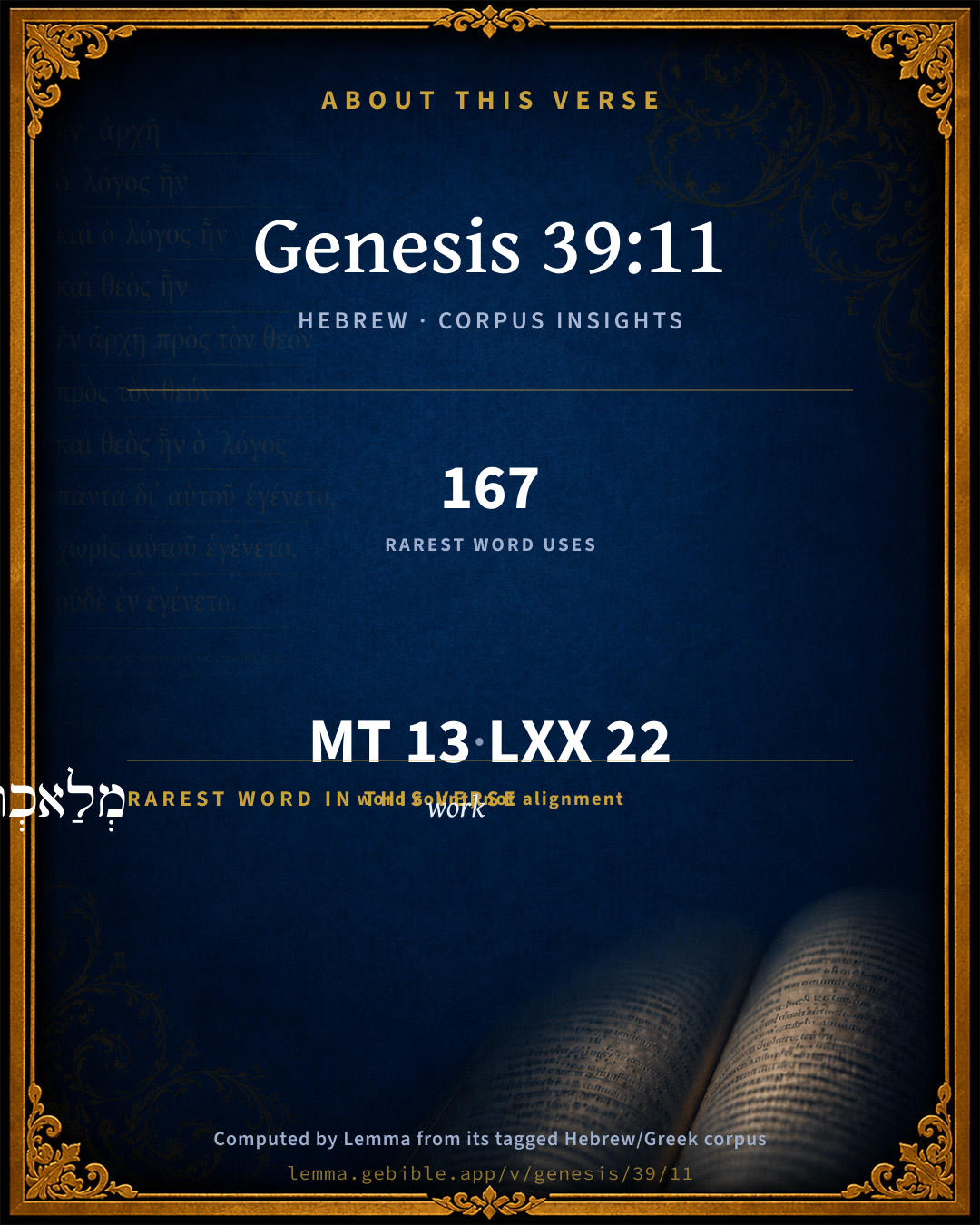
These counts appear in no published source. They are computed here, from the morphology-tagged text and Lemma’s own curated glosses. What Lemma adds →

13
words
10
distinct lemmas
Pentateuch
section

Grammatical profile

  • 3 verbs
  • 7 nouns
  • 1 pronoun
  • 1 adverb
  • 1 particle

Verb forms

  • וַיְהִי֙ Qal · Sequential Imperfect
  • וַיָּבֹ֥א Qal · Sequential Imperfect
  • לַעֲשׂ֣וֹת Qal · Infinitive Construct

Repetition

Words recur within this verse — often emphatic in Hebrew:

  • הַבַּ֖יְתָה house H1004 ×3
  • אִ֜ישׁ man H376 ×2

Hebrew & Septuagint length

In English translation the verse runs 26 words from the Hebrew and 27 from the Septuagint (LXX English) — closely comparable.

A rough comparison of the two English renderings, which tokenize alike — not a word-level alignment.

Word counts can differ between the Hebrew and the Greek without any difference in meaning — e.g. the Hebrew direct-object marker אֵת has no separate Greek word, and Greek often adds the article ὁ.

In the original languages it is 13 Hebrew tokens and 22 Greek tokens — but the two are counted differently (Hebrew bundles its prefixes and suffixes into one token; the Greek is in lemma form), so that isn’t a like-for-like length.

Cross-references

6

Topical passages linked to Genesis 39:11 in the Treasury of Scripture Knowledge — connected by theme and wording, ordered by reader-vote popularity; previews shown in the World English Bible.

  • Ephesians 5:3 But sexual immorality, and all uncleanness, or covetousness, let it not even be mentioned among you, as becomes saints;
  • Ephesians 5:12 For the things which are done by them in secret, it is a shame even to speak of.
  • Job 24:15 The eye also of the adulterer waits for the twilight, Saying, 'No eye shall see me.' He disguises his face.
  • Proverbs 9:17 "Stolen water is sweet. Food eaten in secret is pleasant."
  • Jeremiah 23:24 Can any hide himself in secret places so that I shall not see him? says Yahweh. Don't I fill heaven and earth? says Yahweh.
  • Malachi 3:5 I will come near to you to judgment; and I will be a swift witness against the sorcerers, and against the adulterers, and against the perjurers, and against those who oppress the hireling in his wages, the widow, and the fatherless, and who deprive the foreigner of justice, and don't fear me," says Yahweh of Hosts.

Cross-references courtesy of OpenBible.info (CC BY 4.0).

Hebrew and Greek witnesses Masoretic Hebrew ↔ Greek Septuagint

The same verse in the two great witnesses to the Old Testament, shown verse-for-verse.

These are two independent witnesses, not word-aligned to each other, and the Septuagint is shown in lemma (dictionary) form.

Hebrew Genesis 39:11 Masoretic · Westminster Leningrad Codex

וַיְהִי֙ כְּהַיּ֣וֹם הַזֶּ֔ה וַיָּבֹ֥א הַבַּ֖יְתָה לַעֲשׂ֣וֹת מְלַאכְתּ֑וֹ וְאֵ֨ין אִ֜ישׁ מֵאַנְשֵׁ֥י הַבַּ֛יִת שָׁ֖ם בַּבָּֽיִת

It happened about this time, that he went into the house to do his work, and there were none of the men of the house inside.

World English Bible · Public Domain

Greek LXX Genesis 39:11 Septuagint · lemma form

γίγνομαι δέ τοιοῦτος τις ἡμέρα εἰςἔρχομαι ιωσηφ εἰς ὁ οἰκία ποιέω ὁ ἔργον αὐτός καί οὐδείς εἰμί ὁ ἐν ὁ οἰκία ἔσω

it came to pass on a certain day, that Joseph went into the house to do his business, and there was no one of the household within.

LXX2012 (modern English Septuagint) · Public Domain

Hebrew: Westminster Leningrad Codex (CC BY 4.0). Greek: Septuagint (public domain); English from LXX2012 (modern English Septuagint) (Public Domain). How the Septuagint differs from the Hebrew →

Targum (Aramaic paraphrase)

2

The Targum is the ancient Jewish Aramaic paraphrase of the Hebrew Scriptures — an interpretive translation, not the Hebrew text itself. Onkelos (literal) and Pseudo-Jonathan (expansive) render the Torah, and Jonathan the Prophets. Coverage is partial: where no permissively-licensed English translation exists for a verse, only the Aramaic is shown. This is verse-level text, not a word-by-word alignment to the Hebrew.

  1. Targum Onkelos Torah (Genesis–Deuteronomy)
    וַהֲוָה כְּיוֹמָא הָדֵין וְעַל לְבֵיתָא לְמִבְדַּק בְּכִתְבֵי חָשְׁבְּנֵהּ וְלֵית אֱנַשׁ מֵאֲנָשֵׁי בֵיתָא תַּמָּן בְּבֵיתָא

    (no public-domain English translation for this verse)

    Targum Onkelos — Aramaic: “Onkelos Genesis” (public domain); “Onkelos Exodus” (public domain); “Onkelos Leviticus” (public domain); “Onkelos Numbers” (public domain); “Onkelos Deuteronomy” (public domain). English: “Sefaria Community Translation” (CC0 1.0 (public-domain dedication)); “J.W. Etheridge. The Targums of Onkelos and Jonathan Ben Uzziel on the Pentateuch. London: Longmans, Green, 1862” (public domain). Text via Sefaria.

  2. Targum Pseudo-Jonathan Torah (Genesis–Deuteronomy)
    וַהֲוָה בְּיוֹמָא הָדֵין וְעַל לְבֵיתָא לְמֵיבְחוּשׁ בְּפִנְקְסֵי חוּשְׁבָּנֵיהּ וְלֵית אֱנַשׁ מֵאִינְשֵׁי בֵיתָא תַּמָן בְּבֵיתָא

    it was on a certain day that he entered the house to examine the tablets of his accounts, and there was no man of the house within;

    Targum Pseudo-Jonathan — Aramaic: “Targum Jonathan on Genesis” (public domain); “Targum Jonathan on Exodus” (public domain); “Targum Jonathan on Leviticus” (public domain); “Targum Jonathan on Numbers” (public domain); “Targum Jonathan on Deuteronomy” (public domain). English: “The Targum of Jonathan ben Uzziel, trans. J. W. Etheridge, London, 1862” (public domain). Text via Sefaria.

Commentary

Notes on Genesis 39:11 from classic Christian and Jewish commentators (each source and its license shown beneath its notes). The classic Christian expositions comment on the surrounding passage and are grouped to its opening verse, so a note may address several verses; the Jewish commentaries on the Tanakh (Rashi and others) are per-verse, so they appear only where the commentator wrote on this verse.

Lemma curates 59 commentaries, every one of them public domain or Creative Commons licensed, each selected and text-cleaned for this edition rather than reprinted as found. About our sources →

Trapp's Complete Commentary

John Trapp

Gen 39:11 And it came to pass about this time, that [Joseph] went into the house to do his business; and [there was] none of the men of the house there within.

Ver. 11. To do his business.] To look up his bills of account, saith the Chaldee. Idleness is the devil’s opportunity, the hour of temptation. But let a man be never so busy about his lawful employments, he is to expect assaults. As he is not idle, so neither is Satan: but walks about, and spreads his snares for us in all places, and businesses; speaking a good word also in temptations that come from the flesh, which are therefore called "his messengers," {2Co 12:7} and by giving place to them, we "give place to the devil." {Eph 4:27}

And there was none of the men of the house there within.] Josephus saith that they were all gone forth to a feast; and she only left at home, as feigning herself sick. Sick she was, as likewise Amnon, with the lust of concupiscence, which the apostle calls παθος, a disease, {1Th 4:5} such as those which the physicians say are corruptio totius substantiae; the body and soul are both tainted and rotted by it. Other diseases consume only the matter of the body, but this, the holiness and honour of the body. {a} Other sicknesses sanctify us, but this profanes us, and lets the devil into our hearts. Behemoth lieth in the fens; {Job 40:21} that is, the devil in sensual hearts; as Gul. Paris. applieth it. And when the waters of the sanctuary flowed, the miry places could not be healed. {Eze 47:11}

{a} Quod sanitas in corpore, sanctitas in corde. - Bern.

John Trapp, A Commentary or Exposition upon All the Books of the Old and New Testament (1647–1656) — public domain. Text from a community e-Sword module.

John Calvin's Commentaries

11. And it came to pass about this time. That is, in the process of time, seeing she will not desist from soliciting holy Joseph, it happens at length, that she adds force to blandishments. Now, Moses here describes the crisis of the combat. Joseph had already exhibited a noble and memorable example of constancy; because, as a youth, so often tempted, through a constant succession of many days, he had preserved the even tenor of his way; and at that age, to which pardon is wont to be granted, if it break forth into intemperance, he was more moderate than almost any old man. But now when the woman openly raves, and her love is turned into fury, the more arduous the contest has become, the more worthy of praise is his magnanimity, which remains inflexible against this assault. Joseph saw that he must incur the danger of losing both his character and his life: he chose to sacrifice his character, and was prepared to relinquish life itself, rather than to be guilty of such wickedness before God. Seeing the Spirit of God proposes to us such an example in a youth, what excuse does he leave for men and women of mature age, if they voluntarily precipitate themselves into crime, or fall into it by a light temptation? To this, therefore, we must bend all our efforts, that regard for God alone, may prevail to subdue all carnal affections, and even that we may more highly value a good and upright conscience than the plaudits of the whole world. For no one will prove that he heartily loves virtue, but he who, being content with God as his only witness, does not hesitate to submit to any disgrace, rather than decline from the path of duty. And truly, since even among heathens such proverbs as these are current, “that conscience is a thousand witnesses,” and that it is “a most beautiful theater,” we should be greatly ashamed of our stupor, unless the tribunal of God stands so conspicuously in our view, as to cast all the perverse judgments of the world into the shade. Therefore, away with those vain pretexts, “I wish to avoid offense,” “I am afraid lest men should interpret amiss what I have done aright;” because God does not regard himself as being duly honored, unless we, ceasing to be anxious about our own reputation, follow wheresoever he alone calls us; not that he wishes us simply to be indifferent to our own reputation, but because it is an indignity, as well as an absurdity, that he should not be preferred to men. Let, then, the faithful, as much as in them lies, endeavor to edify their neighbors by the example of an upright life; and for this end, let them prudently guard against every mark of evil; but if it be necessary to endure the infamy of the world, let them through this temptation also, proceed in the direction of their divine vocation.

He hath brought in an Hebrew unto us. Here we see what desperation can effect. For the wicked woman breaks forth from love into fury. Whence it clearly appears what brutal impulses lust brings with it, when its reins are loosened. Certainly alien Satan has once gained the dominion over miserable men, he never ceases to hurry them hither and thither, until he drives them headlong by the spirit of giddiness and madness. We see, also, how he hardens to obstinacy the reprobate, whom he holds fast bound under his power. God, indeed, often inspires the wicked with terror, so that they commit their crimes with trembling. And it is possible that the signs of a guilty conscience appeared in the countenance and in the words of this impure woman: nevertheless, Satan confirms her in that degree of hardness, that she boldly adopts the design to ruin the holy youth; and, at the moment, contrives the fraud by which she may oppress him, though innocent, just as if she had long meditated, at leisure, on his destruction. She had before sought secrecy, that no witness might be present; now she calls her domestics, that, by this kind of prejudging of the case, she may condemn the youth before her husband. Besides, she involves her husband in the accusation, that she may compel him, by a sense of shame, to punish the guiltless. “It is by thy fault, (she says,) that this stranger has been mocking me.” What other course does she leave open to her husband, than that he should hasten, with closed eyes, to avenge her, for the sake of purging himself from this charge? Therefore, though all wicked persons are fearful, yet they contract such hardness from their stupor, that no fear hinders them from rushing obstinately forward into every abyss of iniquity, and insolently trampling upon the good and simple. And we must obscene this trial of the holy man, in order that we may take care to be clothed with that spirit of fortitude, which not even the iron-hardness of the wicked shall be able to break. Even this other trial was not a light one, that he receives so unworthy a reward of his humanity. He had covered the disgrace of the woman in silence, in order that she might have had opportunity to repent, if she had been curable; he now sees that, by his modesty, he has brought himself into danger of death. We learn, by his not sinking under the trial, that it was his sincere determination to yield himself freely to the service of God. And we must do the same, in order that the ingratitude of men may, by no means, cause us to swerve from our duty.

John Calvin's Commentaries (1540-1563) — public domain. Text from the Calvin Translation Society English edition (1840s-50s) via the Christian Classics Ethereal Library (ccel.org). Calvin's coverage is partial (roughly two-thirds of the Bible); uncommented books and verses are honest gaps, never fabricated. The 19th-century editor's footnotes and remarks are omitted so the notes are faithfully Calvin's own voice.

John Gill's Exposition

And it came to pass about this time,.... About a week, or a month, or rather a year, as Aben Ezra thinks, after she first began her solicitations to him. According to Josephus (r), it was a public festival, at which women used to attend; but she excused herself, pretending illness; and so Jarchi takes it to be some noted day at the idol's temple, to which all used to go; but she pretended she was sick, and could not go, knowing that Joseph would not be there, but at home, and therefore judged this a fit opportunity to attack him once more: and so it was:

that Joseph went into the house to do his business: to inspect the accounts, as the Targums of Onkelos and Jonathan paraphrase it, and settle them:

and there was none of the men of the house there within; being all gone to the public festival, or however there were none in that part of the house where Joseph was.

(r) Antiqu. l. 2. c. 4. sect. 3.

John Gill's Exposition of the Whole Bible (1746–1763) — public domain (CC PDM 1.0). Text via the HelloAO Bible API.

Matthew Poole's English Annotations

About this time, or, upon a certain day, which she thought convenient for the reason following.

To do his business, that which belonged to his charge; to cast up his accounts, as the Chaldee renders it, which requiring privacy, gave her this opportunity.

There was none of the men within, to wit, in that part of the house where Joseph was.

Matthew Poole's English Annotations on the Holy Bible (1683–1685) — public domain. Text from a community e-Sword/MySword module.

Whedon's Commentary on the Bible

Daniel D. Whedon

11. About this time — The time, or day, definite in the writer’s mind as that on which this event occurred.

Daniel D. Whedon (gen. ed.), Commentary on the Old and New Testaments (1874–1909) — public domain. Text from a community e-Sword module.

The Pulpit Commentary

Vers. 11, 12. And it came to pass about this time (literally, at this day, i.e. it one day happened), that Joseph went into the house to do his business (i.e. to attend to his accustomed duties); and there was none of the men of the house there within (or, in the hour). And she caught him by his garment (this was probably the long loose robe or mantle, with short sleeves, used in Oriental full dress), saying, Lie with me: and he left his garment in her hand, and fled, and got him out literally, and went forth into the place without, i.e. out of the house and into the street.

The Pulpit Commentary (1880–1919), ed. H.D.M. Spence-Jones & Joseph S. Exell — public domain. Text from a community e-Sword module.

Rashi

Rabbi Shlomo Yitzchaki (Rashi)

ויהי כהיום הזה AND IT CAME TO PASS ON A CERTAIN DAY — This means as much as “and it came to pass when a certain distinguished day arrived” — a day of merriment, a day of their sacred feast when they all went to the temple of their idols, — she said), “I shall find no day fitting to associate with Joseph as this day”. She therefore told her attendants I am sick and cannot go to the temple (Sotah 36b).

לעשות מלאכתו TO DO HIS WORK — Rab and Samuel differ as to what this means. One holds that it means, his actual house-work; the other that it means to associate with her, but a vision of his father’s face appeared to him and he resisted temptation and did not sin as is stated in Treatise Sotah 36b.

Rashi on the Tanakh — English translations: “The Judaica Press complete Tanach with Rashi, translated by A. J. Rosenberg” (CC BY 4.0); “Pentateuch with Rashi's commentary by M. Rosenbaum and A.M. Silbermann, 1929-1934” (public domain); “The Metsudah Tanach series, Lakewood, N.J” (CC BY 4.0); and “The Book of Joshua, Metsudah Publications, 1997” (CC BY 4.0). Text via Sefaria.

Radak

Rabbi David Kimhi (Radak)

ויהי כהיום הזה, a day, quite similar to this day, when she insistently urged him to sleep with her, occurred. Now a different day occurred when the house was empty of all its other occupants

לעשות מלאכתו, to perform specific chores which were part of his regular routine assigned to him, as explained by Onkelos.

Radak on the Tanakh — English translations: “Sefaria Community Translation” (CC0 1.0 (public-domain dedication)); “Eliyahu Munk, HaChut Hameshulash” (CC BY 4.0); “Rabbi Mike Feuer, Jerusalem Anthology” (CC BY 4.0); and “R. David Kimhi on the first book of Psalms, Translated by R.G. Finch, London, 1919” (public domain). Text via Sefaria.

Lesson kit

Teaching starters — assembled from the data on this page, not authored interpretation. Every prompt links to the verse data it draws on. Edit before teaching.

Genesis, in the Pentateuch, opens this verse with 13 words (10 distinct Hebrew lemmas). Its most distinctive word is mᵉlâʼkâh (“work”). A historical commentator’s framing appears above. Read the whole chapter for the surrounding context.

Discussion questions

  1. How does “work” (mᵉlâʼkâh) shape what this verse is saying?
  2. Ephesians 5:3 shares this passage’s theme. How do the two illuminate each other?
  3. “house” occurs 3× in this one verse. What is the effect of the repetition?
  4. The translations on this page render this verse differently — a whole-verse word diff, not a word-by-word alignment. What might account for the different wordings?
  5. The verb «וַיְהִי֙» is Qal Sequential Imperfect. How does its form color the action?
  6. Reading how Trapp's Complete Commentary and John Calvin's Commentaries read this verse, where do the two commentators agree and where do they part?

Things to notice

Reading settings

Reading text

Shown beneath each verse's original-language words.

Old Testament
Old Testament edition

Read the OT as the Masoretic Hebrew (MT) or the Greek Septuagint (LXX).

English shown for the Greek Septuagint (in the Hebrew ↔ Greek comparison).

Comparing translations? Open the Compare panel on any verse page to stack up to four side by side.