Genesis 24:63

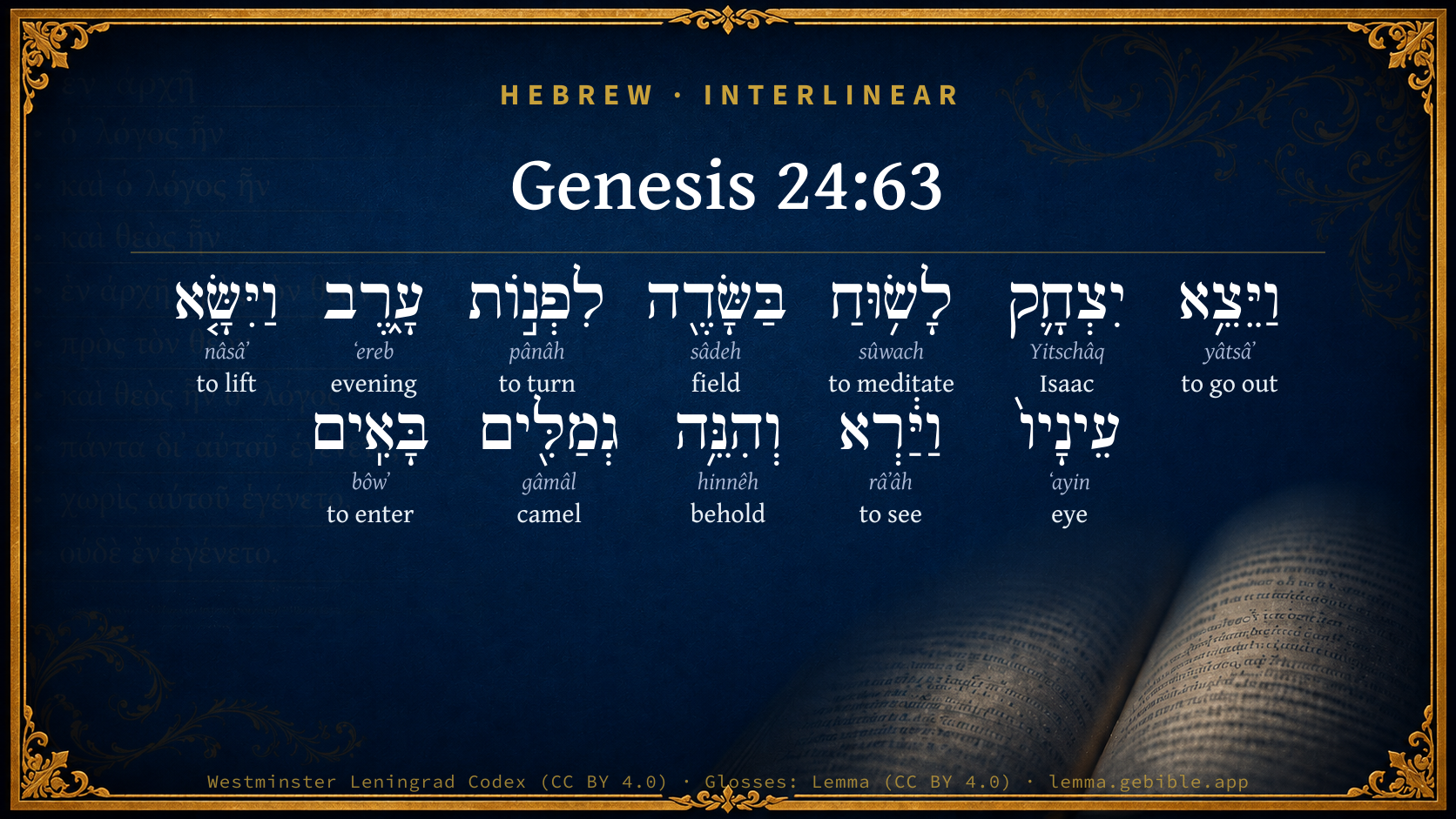
Hebrew (Westminster Leningrad Codex) Genesis 24:63 appears in the Hebrew Old Testament. The text above is from the Westminster Leningrad Codex. Each word links to its Strong’s number, a concise gloss, and parsing drawn from the Open Scriptures Hebrew Bible morphology. Click any word for its full Brown-Driver-Briggs (BDB) entry.
Download image
Cite this verse

Genesis 24:63 (World English Bible). Public Domain. Lemma interlinear Bible study tool, https://lemma.gebible.app/v/genesis/24/63.

Show BibTeX & RIS
BibTeX
RIS
English Translation
Isaac went out to meditate in the field at the evening. He lifted up his eyes, and saw, and, behold, there were camels coming.
World English Bible · Public Domain
Highlights
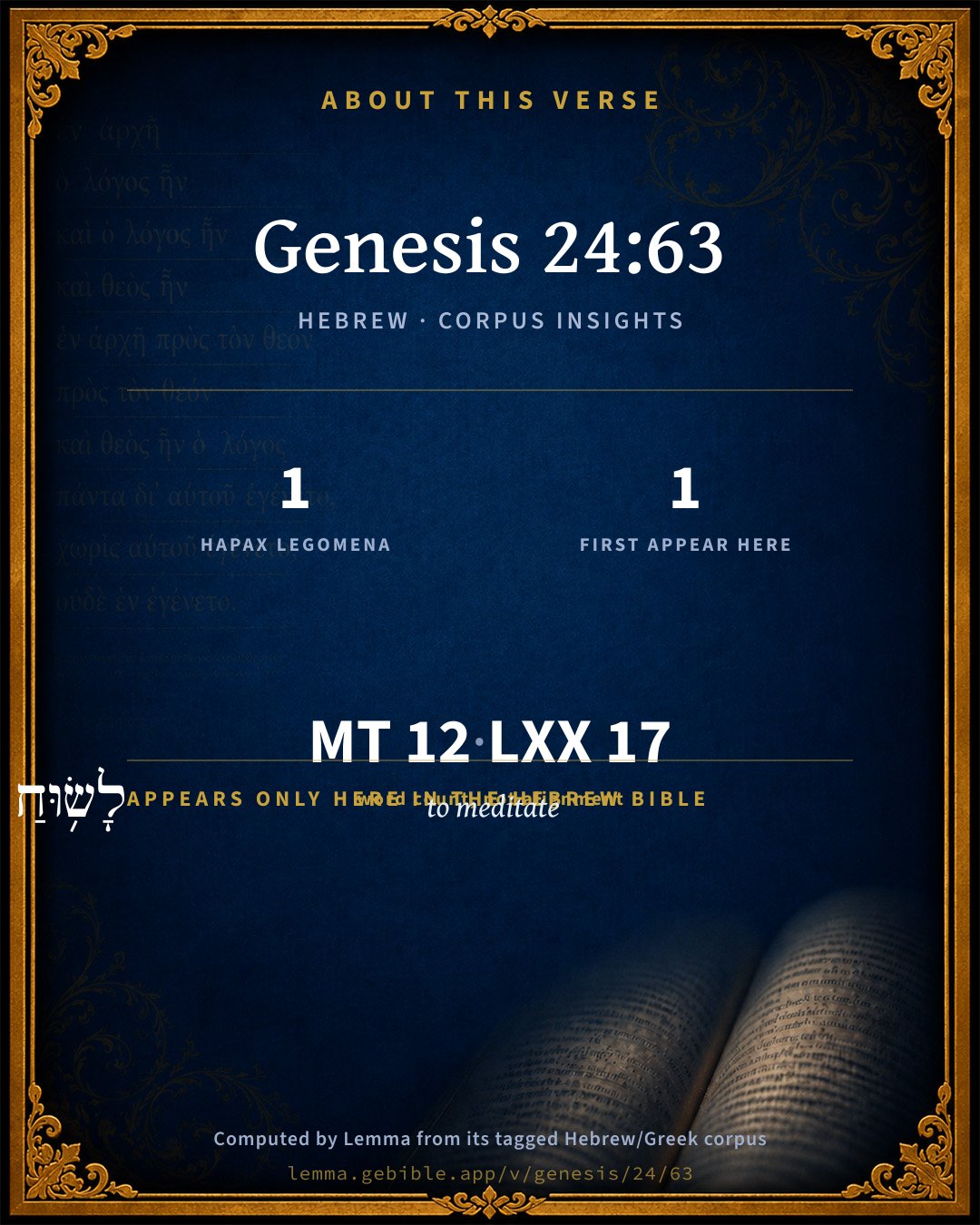
  • 1 hapax legomenon — only here in the Hebrew Bible
  • 1 first appearance in the Hebrew Bible
Full analysis ↓
Download a study sheet

One document with this verse’s original text, its word-by-word gloss line, the meaning frame, cross-references with their text, attributed commentary, and full source and license credits — printable, and it pastes into notes with its structure intact.

This verse Autodidact and up

Study sheet (.html) Plain text (.txt)

A passage Seminary Student

Up to 50 verses in one chapter. A passage sheet keeps up to 6 commentary sources and 12 cross-references per verse, in the order this page ranks them, and says so on the sheet whenever that leaves anything out. Ask for a single verse and you get the Autodidact verse sheet above.

Everything on this page stays free to read, with no account — the sheet is a download of what is already on screen, not access to it.

Want to remove ads? Support Godless Engineer
Compare translations 3

The same verse in 3 English versions, stacked beneath the original-language interlinear above. Click any original word for its lexicon entry.

Each is an independent rendering of the whole verse — the interlinear is not word-aligned to these translations.

Highlighted words mark where these versions differ — a whole-verse word diff, not a word-by-word alignment.

  • World English Bible Public Domain
    Isaac went out to meditate in the field at the evening. He lifted up his eyes, and saw, and, behold, there were camels coming.
  • King James Version Public Domain
    And Isaac went out to meditate in the field at the eventide: and he lifted up his eyes, and saw, and, behold, the camels were coming.
  • unfoldingWord Literal Text CC BY-SA 4.0
    And Isaac went to meditate in the field as it was turning toward evening, and he lifted his eyes and saw that, behold, camels were coming.

unfoldingWord Literal Text — © unfoldingWord, licensed CC BY-SA 4.0. Word-aligned USFM3 via Door43 (git.door43.org/unfoldingWord/en_ult).

Versions to compare (up to 4)

3 of 4 selected

Show all 18 translations

Every available English version of this verse, each an independent rendering of the whole verse.

  • World English Bible Public Domain
    Isaac went out to meditate in the field at the evening. He lifted up his eyes, and saw, and, behold, there were camels coming.
  • Berean Standard Bible Public Domain
    Early in the evening, Isaac went out to the field to meditate, and looking up, he saw the camels approaching.
  • Majority Standard Bible Public Domain
    Early in the evening, Isaac went out to the field to meditate, and looking up, he saw the camels approaching.
  • King James Version Public Domain
    And Isaac went out to meditate in the field at the eventide: and he lifted up his eyes, and saw, and, behold, the camels were coming.
  • American Standard Version (1901) Public Domain
    And Isaac went out to meditate in the field at the eventide. And he lifted up his eyes, and saw, and, behold, there were camels coming.
  • Revised Version (1885) Public Domain
    And Isaac went out to meditate in the field at the eventide: and he lifted up his eyes, and saw, and, behold, there were camels coming.
  • Geneva Bible (1599) Public Domain
    And Izhak went out. to pray in the fielde toward the euening: who lift vp his eyes and looked, and behold, the camels came.
  • Douay-Rheims (1899) Public Domain
    And he was gone forth to meditate in the field, the day being now well spent: and when he had lifted up his eyes, he saw camels coming afar off.
  • Young's Literal Translation Public Domain
    and Isaac goeth out to meditate in the field, at the turning of the evening, and he lifteth up his eyes, and looketh, and lo, camels are coming.
  • Literal Standard Version CC BY-SA 4.0
    and Isaac goes out to meditate in the field, at the turning of the evening, and he lifts up his eyes, and looks, and behold, camels are coming.
  • Unlocked Literal Bible CC BY-SA 4.0
    Isaac went out to meditate in the field in the evening. When he looked up and saw, behold, there were camels coming!
  • unfoldingWord Literal Text CC BY-SA 4.0
    And Isaac went to meditate in the field as it was turning toward evening, and he lifted his eyes and saw that, behold, camels were coming.
  • Darby Bible Public Domain
    And Isaac had gone out to meditate in the fields toward the beginning of evening. And he lifted up his eyes and saw, and behold, camels were coming.
  • World Messianic Bible Public Domain
    Isaac went out to meditate in the field at the evening. He lifted up his eyes and looked. Behold, there were camels coming.
  • Webster's Bible Public Domain
    And Isaac went out to meditate in the field at evening: and he lifted up his eyes, and saw, and behold, the camels were coming.
  • Free Bible Version CC BY-SA 4.0
    He went out into the fields one evening to think things over. He looked into the distance and saw camels coming.
  • Bible in Basic English Public Domain
    And when the evening was near, he went wandering out into the fields, and lifting up his eyes he saw camels coming.
  • JPS Tanakh (1917) Public Domain
    And Isaac went out to meditate in the field at the eventide; and he lifted up his eyes, and saw, and, behold, there were camels coming.

Literal Standard Version (2020), Covenant Press — licensed CC BY-SA 4.0. Text via the HelloAO Bible API (eBible.org). Unlocked Literal Bible (unfoldingWord) — licensed CC BY-SA 4.0. Text via the HelloAO Bible API (eBible.org). unfoldingWord Literal Text — © unfoldingWord, licensed CC BY-SA 4.0. Word-aligned USFM3 via Door43 (git.door43.org/unfoldingWord/en_ult). Free Bible Version, Dr. Jonathan Gallagher — licensed CC BY-SA 4.0. Text via the HelloAO Bible API (eBible.org).

Word by word

More ways to search: Search by grammar → Find every occurrence → Compare this word →

Practice this passage: Drill this verse → Learn its vocabulary →

לָשׂ֥וּחַ
sûwach
H7742
“to meditate”
Preposition + Verb, Qal, Infinitive Construct
Part of Speech
Preposition + Verb
Stem
Qal
Form
Infinitive Construct
Full BDB Definition

Origin: a primitive root

TWOT: 2255

(Qal) to meditate, muse, commune, speak, complain - meaning uncertain
  1. וַיֵּצֵ֥א yâtsâʼ H3318 “and · to go out” Conjunction + Verb, Qal, Sequential Imperfect, 3rd Person, Masculine, Singular
  2. יִצְחָ֛ק Yitschâq H3327 “Isaac” Noun, Proper
  3. בַּשָּׂדֶ֖ה sâdeh H7704 “in/at the · field” Preposition, Determined + Noun, Common, Masculine, Singular, Absolute
  4. לִפְנ֣וֹת pânâh H6437 “to turn” Preposition + Verb, Qal, Infinitive Construct
  5. עָ֑רֶב ʻereb H6153 “evening” Noun, Common, Masculine, Singular, Absolute
  6. וַיִּשָּׂ֤א nâsâʼ H5375 “and · to lift” Conjunction + Verb, Qal, Sequential Imperfect, 3rd Person, Masculine, Singular
  7. עֵינָיו֙ ʻayin H5869 “eyes · his” Noun, Common, Both, Dual, Construct + Suffix, Personal, 3rd Person, Masculine, Singular
  8. וַיַּ֔רְא râʼâh H7200 “and · to see” Conjunction + Verb, Qal, Sequential Imperfect, 3rd Person, Masculine, Singular
  9. וְהִנֵּ֥ה hinnêh H2009 “and · behold” Conjunction + Particle, Demonstrative
  10. גְמַלִּ֖ים gâmâl H1581 “camels” Noun, Common, Masculine, Plural, Absolute
  11. בָּאִֽים bôwʼ H935 “entering” Verb, Qal, Participle Active, Masculine, Plural, Absolute

About this verse

These counts appear in no published source. They are computed here, from the morphology-tagged text and Lemma’s own curated glosses. What Lemma adds →

12
words
12
distinct lemmas
Pentateuch
section

Notable vocabulary

1 hapax legomenon — a word that appears only here in the entire Hebrew Bible:

  • לָשׂ֥וּחַ to meditate H7742

First appearance in Scripture

This word makes its first canonical appearance in the Hebrew Bible here:

  • לָשׂ֥וּחַ to meditate H7742

Shared distinctive vocabulary

גְמַלִּ֖ים camel H1581 occurs in 52 verses of the Hebrew Bible. Also found in:

Grammatical profile

  • 6 verbs
  • 5 nouns
  • 1 particle

Verb forms

  • וַיֵּצֵ֥א Qal · Sequential Imperfect
  • לָשׂ֥וּחַ Qal · Infinitive Construct
  • לִפְנ֣וֹת Qal · Infinitive Construct
  • וַיִּשָּׂ֤א Qal · Sequential Imperfect
  • וַיַּ֔רְא Qal · Sequential Imperfect
  • בָּאִֽים Qal · Participle Active

Hebrew & Septuagint length

In English translation the verse runs 24 words from the Hebrew and 21 from the Septuagint (LXX English) — closely comparable.

A rough comparison of the two English renderings, which tokenize alike — not a word-level alignment.

Word counts can differ between the Hebrew and the Greek without any difference in meaning — e.g. the Hebrew direct-object marker אֵת has no separate Greek word, and Greek often adds the article ὁ.

In the original languages it is 12 Hebrew tokens and 17 Greek tokens — but the two are counted differently (Hebrew bundles its prefixes and suffixes into one token; the Greek is in lemma form), so that isn’t a like-for-like length.

Cross-references

10

Topical passages linked to Genesis 24:63 in the Treasury of Scripture Knowledge — connected by theme and wording, ordered by reader-vote popularity; previews shown in the World English Bible.

  • Psalms 119:15 I will meditate on your precepts, And consider your ways.
  • Joshua 1:8 This book of the law shall not depart out of your mouth, but you shall meditate thereon day and night, that you may observe to do according to all that is written therein: for then you shall make your way prosperous, and then you shall have good success.
  • Psalms 1:2 But his delight is in Yahweh's law; On his law he meditates day and night.
  • Psalms 104:34 Let your meditation be sweet to him. I will rejoice in Yahweh.
  • Psalms 143:5–6 I remember the days of old. I meditate on all your doings. I contemplate the work of your hands.
  • Psalms 77:11–12 I will remember Yah's deeds; For I will remember your wonders of old.
  • Psalms 119:27 Let me understand the teaching of your precepts! Then I will meditate on your wondrous works.
  • Psalms 119:48 I reach out my hands for your commandments, which I love. I will meditate on your statutes.
  • Psalms 139:17–18 How precious to me are your thoughts, God! How vast is the sum of them!
  • Psalms 145:5 Of the glorious majesty of your honor, Of your wondrous works, I will meditate.

Cross-references courtesy of OpenBible.info (CC BY 4.0).

Hebrew and Greek witnesses Masoretic Hebrew ↔ Greek Septuagint

The same verse in the two great witnesses to the Old Testament, shown verse-for-verse.

These are two independent witnesses, not word-aligned to each other, and the Septuagint is shown in lemma (dictionary) form.

Hebrew Genesis 24:63 Masoretic · Westminster Leningrad Codex

וַיֵּצֵ֥א יִצְחָ֛ק לָשׂ֥וּחַ בַּשָּׂדֶ֖ה לִפְנ֣וֹת עָ֑רֶב וַיִּשָּׂ֤א עֵינָיו֙ וַיַּ֔רְא וְהִנֵּ֥ה גְמַלִּ֖ים בָּאִֽים

Isaac went out to meditate in the field at the evening. He lifted up his eyes, and saw, and, behold, there were camels coming.

World English Bible · Public Domain

Greek LXX Genesis 24:63 Septuagint · lemma form

καί ἐκἔρχομαι ισαακ ἀδολεσχέω εἰς ὁ πεδίον ὁ πρός δείλη καί ἀναβλέπω ὁ ὀφθαλμός ὁράω κάμηλος ἔρχομαι

And Isaac went forth into the plain toward evening to meditate; and having lifted up his eyes, he saw camels coming.

LXX2012 (modern English Septuagint) · Public Domain

On this verse, The Cambridge Bible for Schools and Colleges discusses the Septuagint’s reading. Read the note in Commentary ↓

Hebrew: Westminster Leningrad Codex (CC BY 4.0). Greek: Septuagint (public domain); English from LXX2012 (modern English Septuagint) (Public Domain). How the Septuagint differs from the Hebrew →

Targum (Aramaic paraphrase)

2

The Targum is the ancient Jewish Aramaic paraphrase of the Hebrew Scriptures — an interpretive translation, not the Hebrew text itself. Onkelos (literal) and Pseudo-Jonathan (expansive) render the Torah, and Jonathan the Prophets. Coverage is partial: where no permissively-licensed English translation exists for a verse, only the Aramaic is shown. This is verse-level text, not a word-by-word alignment to the Hebrew.

  1. Targum Onkelos Torah (Genesis–Deuteronomy)
    וּנְפַק יִצְחָק לְצַלָּאָה בְחַקְלָא לְמִפְנֵי רַמְשָׁא וּזְקַף עֵינוֹהִי וַחֲזָא וְהָא גַּמְלַיָּא אָתָן

    (no public-domain English translation for this verse)

    Targum Onkelos — Aramaic: “Onkelos Genesis” (public domain); “Onkelos Exodus” (public domain); “Onkelos Leviticus” (public domain); “Onkelos Numbers” (public domain); “Onkelos Deuteronomy” (public domain). English: “Sefaria Community Translation” (CC0 1.0 (public-domain dedication)); “J.W. Etheridge. The Targums of Onkelos and Jonathan Ben Uzziel on the Pentateuch. London: Longmans, Green, 1862” (public domain). Text via Sefaria.

  2. Targum Pseudo-Jonathan Torah (Genesis–Deuteronomy)
    וּנְפַק יִצְחָק לְצַלָאָה בְּאַנְפֵּי בְרָא לְעִדוּנַי רַמְשָׁא וּזְקַף עֵינוֹהִי וַחֲמָא וְהָא גַמְלַיָא אָתִין

    And Izhak went forth to pray upon the face of the field at the time of evening; and he lifted up his eyes, and saw, and, behold, the camels were approaching.

    Targum Pseudo-Jonathan — Aramaic: “Targum Jonathan on Genesis” (public domain); “Targum Jonathan on Exodus” (public domain); “Targum Jonathan on Leviticus” (public domain); “Targum Jonathan on Numbers” (public domain); “Targum Jonathan on Deuteronomy” (public domain). English: “The Targum of Jonathan ben Uzziel, trans. J. W. Etheridge, London, 1862” (public domain). Text via Sefaria.

Commentary

Notes on Genesis 24:63 from classic Christian and Jewish commentators (each source and its license shown beneath its notes). The classic Christian expositions comment on the surrounding passage and are grouped to its opening verse, so a note may address several verses; the Jewish commentaries on the Tanakh (Rashi and others) are per-verse, so they appear only where the commentator wrote on this verse.

Lemma curates 59 commentaries, every one of them public domain or Creative Commons licensed, each selected and text-cleaned for this edition rather than reprinted as found. About our sources →

Trapp's Complete Commentary

John Trapp

Gen 24:63 And Isaac went out to meditate in the field at the eventide: and he lifted up his eyes, and saw, and, behold, the camels [were] coming.

Ver. 63. To meditate in the field.] Or to pray; there he had his oratory; there he used to pray secretly (but now more earnestly, upon so important an occasion) with deep meditation or soliloquy. Domitian, about the beginning of his empire, usually sequestered himself from company an hour every day; but did nothing the while but catch flies and kill them with a pen-knife. {a} God’s people can better employ their solitariness, and do never want company, as having God and themselves to talk with. And these secret meals are those that make the soul fat. It was a witty and divine speech of Bernard, that Christ, the soul’s spouse, is bashful, neither willingly cometh to his bride in the presence of a multitude.

{a} Sueton.

John Trapp, A Commentary or Exposition upon All the Books of the Old and New Testament (1647–1656) — public domain. Text from a community e-Sword module.

The Biblical Illustrator

Joseph S. Exell

Gen_24:63

Isaac went out to meditate in the field at the eventide

Meditation

Meditating was the same to Isaac that it is to us.

Under all skies, in all times, thought has flowed in the same channel and observed the same laws. It is those who love to meditate that are most open to impressions from nature. It is the open eye before which the vision passes. Notice:

I. THE MAN WHO MEDITATES. Isaacs meditations would be very different from those of a more stirring, energetic character; above all, very different from those of a mere secular man. A mans meditations are the pure outcome of what he is. The word itself is suggestive. It means to be in the midst of a matter, to have it in your very centre. Do not be afraid of losing yourself in meditation. The more you lose yourself in great themes the better. The dream is the way to reality, but let it be reality and impression and abiding results that you are seeking. The Hebrew word here rendered meditate means also to pray. The meditation of a devout spirit on almost anything will soon run into prayer.

II. MEDITATION AND NATURE. Isaac went out to the field to meditate. The variety of nature draws us out. We all tend to make self a prison, and this leading us out of ourselves is perhaps the main benefit of nature. Nature takes down our prison walls. The twitter of a bird in a bush can emancipate us. Nature whispers of the supernatural, and the fleeting preaches the eternal.

III. MEDITATION AND TIME. Isaac meditated in the evening. The evening is the darling hour of meditation. The quiet gloaming, with its glamour and mystery, its long shadows and dying light, whispers into the heart of man.

Meditation is the twilight of thought. Its region lies between this world and the next, between definite ideas and dimmest yearnings. No one ever loved Christ deeply--no one ever was strong or high or pure or deep in any way without meditation. (J. Leckie, D. D.)

Religious meditation

I. THE GREATNESS OF ITS OBJECTS.

1. It unfolds the volume of nature.

2. It discloses the principles and ends of the Divine govermnent.

3. It reveals the dispensations of grace.

4. It draws aside the veil of mortality, and directs our view into a future and eternal state.

II. ITS MORAL ADVANTAGES.

1. By meditation we shall acquire a competent knowledge of our own hearts.

2. It will enable us to form a just estimate of the world.

3. Meditation promotes holiness. As the architect, before he can erect an extensive edifice, must, in private, first prepare his plan; and as the philosopher, before he can enlighten the world with his discoveries by study, must first digest and arrange his system; so, before we can come forth into life as patterns of holiness, and skilful champions of the truth, we must, by meditation, have imbibed the principles of religion, and submitted our hearts to its influence. It is a practice that will produce repentance, by setting our sins before us, our secret sins in the light of our countenance. It will humble the mind, and destroy its love to sin. It will produce fear and love towards God, and faith in the Lord Jesus Christ. It places the soul under the Influences of the Divine Spirit, who transforms and renews it in the image of Christ. Thus changed, we shall come from retirement, as Moses from the mount, shining with the lustre of spiritual glory and beauty.

4. Meditation leads to a union with God. I will dwell in them, and walk in them. I and My Father will come in to him, and abide with him. But when are these words verified? Particularly in the hour of religious retirement.

5. Meditation prepares us for heaven. (R. Watson.)

Meditation

I. WHAT MEDITATION IS. Before I can define it I must distinguish it.

1. There is that which we call occasional meditation, which is an act by which the soul spiritualiseth every object about which it is conversant. A gracious heart is like an alembic, it can distil useful meditations out of all things it meeteth with. Look, as it seeth all things in God, so it seeth God in all things. So small a matter as a grain of mustard-seed may yield many spiritual applications.

2. There is set and solemn meditation. Now this is of several sorts, or rather, they are but several parts of the same exercise.

(1) There is a reflexive meditation, by which we wholly fall upon ourselves. This is nothing else but a solemn parley between a man and his own heart Psa_4:4).

(2) There is a meditation, which is more direct, and that is of two sorts--

(a) Dogmatical, whose object is the Word.

(b) Practical, whose object is our own lives.

These are the kinds of meditation. The definition may be formed thus: Meditation is that duty or exercise of religion whereby the mind is applied to the serious and solemn contemplation of spiritual things, for practical uses and purposes. I shall open the description by the parts of it.

1. It is a duty and exercise of religion.

(1) That it is a duty and exercise of religion appeareth by the evidence of Scripture, where it is commanded (Jos_1:8), This Book of the law shall not depart out of thy mouth, but thou shalt meditate therein day and night. It is made a character of a godly man (Psa_1:2), His delight is in the law of the Lord, and in His law doth he meditate day and night. It is commended in the practice and example of the saints that were most famous in Scripture; Isaac in the text, Moses and David. And as it is plain by the evidence of Scripture; so by the light of nature and reason. God that is a Spirit deserveth the most pure and spiritual worship, as well as such as is performed by the body. The thoughts are the eldest and noblest offspring of the soul, and the solemn consecration of them is fit for God.

(2) It is not a duty of an arbitrary concernment. It is not only a moral help that may be observed or omitted, but a necessary duty, without which all graces would languish and wither. Faith is lean and ready to starve unless it be fed with continual meditation on the promises; as David saith (Psa_119:92), Unless Thy law had been my delight, I should then have perished in my affliction. Thoughts are the caterers of the soul, that purvey for faith, and fetch in food and refresh it with the comfort of the promises. Hope is low, and doth not arise to such a fulness of expectation till by meditation we take a deliberate view of our hopes and privileges Gen_13:17).

II. THE NECESSITY AND PROFIT OF MEDITATION, OR MOTIVES TO PRESS TO THIS DUTY. I shall urge such as will serve also for marks; for when it is well performed, you will find these effects wrought in you. Meditation is the mother and nurse of knowledge and godliness, the great instrument in all the offices of grace; it helpeth on the work of grace upon the understanding, affections, and life, for the understanding of the doctrine of godliness, for the provoking of godly affections, and for the heavenly life.

1. In point of understanding it is of great advantage to us in the entertainment of the doctrines of religion.

(1) To give us a clearer and more distinct sight of them.

(2) That we may the better retain them.

(3) That they may be always more ready and present with us.

2. It is a great advantage to the work of grace upon the affections.

3. It is an advantage to the fruits of grace in the life; it maketh the heavenly life more easy, more sweet, more orderly and prudent.

III. RULES TO GUIDE YOU IN THIS WEIGHTY AFFAIR OF THE CHRISTIAN LIFE.

1. Whatever you meditate upon must be drawn down to application.

2. Do not pry further than God hath revealed; your thoughts must he still bounded by the Word.

3. When you meditate of God you must do it with great care and reverence; His perfections are matter rather of admiration than inquiry.

4. In meditating on common things, keep in mind a spiritual purpose. God hath endowed man with a faculty to discourse, and employ his mind on earthly objects to spiritual purposes (Ecc_3:11).

5. Take heed of creating a snare to your souls. Some sins are catching, like fire in straw, and we cannot think of them without infection and temptation; the very thoughts may beget a sudden delight and tickling, which may pass through us like lightening, and set us all on fire Eze_23:19).

6. Meditate of those things especially which you have most need of. There is the greatest obligation upon the heart. The matter is not arbitrary; there you will find most he]p, and there the benefit will be most sensible.

7. Whatever you meditate upon, take heed of slightness. Transient thoughts leave no impression. See that you meditate but of one thing at once.

8. Come not off from holy thoughts till you find profit by them, either sweet tastes and relishes of the love of God, or high affections kindled towards God, or strong resolutions begotten in yourselves.

9. Be thankful to God when He blesseth you in meditation, or else you will find difficulty in the next.

10. Do not bridle up the free spirit by the rules of method. That which God calleth for is religion, not logic.

11. Your success in the duty is not to be measured by the multitude and subtlety of the thoughts, but the sincerity of them.

12. You must begin and end all with prayer. Duties are subservient one to another. In the beginning you must pray for a blessing on the duty,, and in the end commend your souls and resolutions to God. There is no hope in your own promises, but Gods.

IV. THE LETS OR HINDRANCES OF MEDITATION, TOGETHER WITH THE HELPS AND MEANS THAT MAY QUICKEN YOU TO THE PERFORMANCE OF IT. The lets may be sooner discovered than remedied. The lets and hindrances are of several sorts, some common to this with other duties, and others more peculiar to the duty of meditation.

1. I begin with the first sort, such hindrances as are common to other duties, and they are four--sloth, love of pleasure, a guilty conscience, and an unwieldy mind. How shall we do to shake off this spiritual sloth? I answer--

(1) You must consider that a lazy spirit is most unfit for Christianity. The whole Christian life is carried on with much labour and diligence.

(2) It is better to take pains than to suffer pains, and to be found with the cords of duty than with the chains of darkness.

(3) There is nothing so hard in Gods service but He hath manifested love enough to sweeten it.

(4) There is no difficulty in religion wholly insuperable and too hard for an active and industrious spirit. Those that follow on after God do at length find Him to their comfort.

(5) A lazy, backward heart must be urged forward with the greater importunity.

2. Another let and hindrance is love of pleasures. Men that would pass their time in mirth are unwilling to be so solemn and serious. When childrens minds are set to play, it is irksome to hear of school or of their books; so when the heart is set for pleasure, it is a hard matter to bring the soul to religious performances. How shall we do to wean the soul from pleasures?

(1) Consider to love pleasure is to gratify the beast in us rather than the angel.

(2) Consider the sweetness of religious exercises is far better than that of carnal pleasures, as that heat is more manly that is gotten by exercise than by hovering over the fire.

3. The next general hindrance is a guilty conscience. What shall we do to remedy this?

(1) Get your conscience cleansed by the hearty application of the blood of Christ.

(2) There are matters comfortable that may be of excellent relief to the spirit (Heb_6:18; Psa_94:19).

4. Another let and hindrance is unwieldiness of spirit to spiritual and heavenly duties. This our Saviour bids His disciples have a care e!! Luk_21:34). What shall we do to help this?

(1) Learn a holy moderation and sobriety in outward businesses and pleasures. As the apostle says of prayer (Eph_6:18), Watching thereunto; the same rule holds good in meditation.

(2) Keep the body in a fit frame, that it may not be a clog to the soul, but a dexterous instrument. There is a sanctification of the body (1Th_5:23). There are hindrances that are peculiar to the duty of meditation. I shall name but two--barrenness of thoughts and inconstancy.

1. Leanness and barrenness of thoughts. Now to remedy this--

(1) You must not give way to it, but try and use constant exercise. The more we work, the more vigorous and free is the soul for the work of God.

(2) Get a good stock of sanctified knowledge. Let there be a treasure in your hearts (Mat_13:52).

(3) When the heart is barren, think of your own sins and corruptions, and the experiences of God to your own souls.

(4) You may season and affect your mind before meditation with some part of Gods Word. Reading is a good preparative, and when we have taken in food, we may exercise our depastion and digestion upon it.

2. A loose garish spirit, that is apt to skip and wander from thought to thought. There is a madness in man; his thoughts are light and feathery, tossed to and fro, and like the loose wards in a lock, only kept up whilst we are turning the key. This doth much discourage Christians, that they cannot keep up their affections and command their thoughts. How shall we help and remedy this?

(1) When you go to meditate, you should exercise a command and restraint upon yourselves. This is expressed in Scripture by trussing up the loins of your minds (Luk_12:30).

(2) Pray and call in the help of Gods Holy Spirit (Psa_86:11), Unite my heart to fear Thy name. Lord, make my heart one. He that could stay the sun can stay the fleeting of your thoughts.

(3) Dry up these swimming toys and fancies with the flame of heavenly love. Love unites the heart, and where we have a pleasure, there we can Psa_119:97).

(4) Let the course of your lives be grave and serious. The mind is according to the course of the life.

(5) Watch against the first diversion; how plausible soever it be, look upon it as an intruding that breaks the rank.

(6) When you come to meditate in Gods presence, do not bring the world with you; purge yourselves of all carnal affections (Eze_33:31), Their heart goeth after their covetousness. Always consider this: the prevailing lust will engross the thoughts. (T. Manton, D. D.)

The duty and advantage of solemn meditation

I shall first explain the duty, and then apply the subject.

I. I AM TO SHOW WHAT MEDITATION IS.

1. A choice of some spiritual subject to meditate upon. Many meditate upon sin with delight, and so ride post to hell with little din. He deviseth mischief upon his bed, he setteth himself in a way that is not good; he abhorreth not evil. Others employ their thoughts only in the meditation of things of the world. But he that would meditate aright must choose some spiritual subject to think upon. And it is needful we should select some one, and not abide in generals (Psa_63:6; Son_1:4).

2. A calling in of the heart front all other objects. The mind of man is too narrow to be taken up to purpose about many things at once, especially with thoughts of divers kinds; therefore prays David, Unite my heart to fear Thy name.

3. Employing the heart on the spiritual subject so chosen, to think upon it, study it, and seriously consider of it; to lay it before our understandings, so as to move our affections and improve our hearts.

II. LET US APPLY THE SUBJECT. I exhort you to make conscience of this duty of meditation, and particularly of fixed meditation, setting yourselves as solemly to it as to prayer and other duties. Motive

1. Consider it is the command of God. Commune with your own heart upon your bed. And meditate upon these things, says Paul to Timothy. Why do you perform other duties but because God commands you? Well, He that bids you do other duties, bids you do this also.

2. It is made desirable by the testimony which it hath from the practice of the people of God.

3. It is of notable use for a Christians improvement. It much increases knowledge: I have more understanding, says David, than all my teachers, for Thy testimonies are my meditation. It is the way to comfort under affliction. When Davids enemies plotted against him, thy servant, says he, did meditate in thy statutes. It makes a Christian tender in his way. I will meditate on Thy precepts, and have respect unto Thy ways. It gives a Christian a sweet relish of the goodness of God (Psa_63:5-6). (T. Boston, D. D.)

A lost art

The text brings before us the lost art of meditation. Here are three things that it is very difficult to get, indeed almost impossible--solitude, leisure, and a field. Solitude which shuts out the sight and sound and thought of the busy world, how can we get that in this great Babel? And leisure, who can find that in times of rush and whirl like ours? So it comes that meditation is almost a lost art, and with it goes, and must go, all great attainment in the religious life. There are but two things that can loose a man from the world, and set him free from its tyranny and put him outside and above it--those two are meditation and sleep. Now this is what meditation does for us. It gives us freedom from the littleness of earth; it is the unfolding within us of other and greater faculties; the escape from the prison of ourselves and our circumstances that we may soar into the heavens.

1. Man can only find himself in God; and he can only find God by meditation. A man has heights and depths and lengths and breadths which only God can reveal to him. We know how it is in the smaller round of our life. We are put into possession of ourselves by others. He who has most soul and heart is he who gives me not only most of himself, but most of myself. Charity, gratitude, faith, love, service, inspirations, do not these come from contact with those about us? We are like a musical instrument, we only know what can be got out of us when others play upon us. The clapper puts the bell in possession of itself. But God and God alone can put us in full possession of ourselves. Take, for instance, the faculty of reverence. Only by knowing God is reverence begotten. And only by meditation is it that we can know God and enter into any true relationship with Him. As I commune with Him my soul is bowed in lowliness. I may think of Him as all this without being solemnized and awed, for my thought is indeed a narrow and a shallow vessel to hold the glory of the Most High. But meditation is the way of revelation--it is the lifting of the veil that we may pass into the very Holy of Holies. So is it that God comes near to us and reveals Himself to us as our Gracious Father.

2. And briefly glance at the range of this truth--it covers everything. As a man finds himself in God, so does he find his brother. If God so loved us, we ought also to love one another.

3. So again, this meditation puts a man in possession of the world. The little things of earth sink down in that Presence into their true estimate.

4. Again, meditation puts a man in possession of all the ages. The past comes up and yields him its tribute. All these great saints of old do speak comfortably to us of the faithfulness and love of our God.

Take some other aspects of meditation.

1. It possesses what thought only sees. There is a well-known shop that I often pass, where the windows are filled with all manner of daintiest sweets set forth in most attractive shapes. I have seen a crowd of little children flattening their noses against the window-panes, and ragged, hungry men and women standing looking within. But out of the door with paper parcels have come tripping little children and happy men and women laden with good things, beaming and smiling, possessing what others only look at. Meditation does that. It is as I begin to let the truth sink down within me that my love is kindled and my faith is stirred, and all my soul goes out in triumphant possession of that which I have heard.

2. Again, meditation retains what hearing lightly loses. Photography can secure the picture in a second, but in a second it is lost. There is a process of developing and a process of fixing for which retirement and solitude and darkness are necessary. Then the picture is secured. Truth is mostly lost because it is heard only and not retained. Meditation has not come in to develop and fix it. There is, too, a process by which the photograph is eaten into the plate, bitten into it by means of some acid. That also is what meditation can do for us--we want the truth graven upon us, we want the name and the message and the word of Jesus our Master wrought thus into us.

3. Again, meditation turns into life and strength what otherwise is but a burden. A man can carry a sack of flour and yet be very hungry. He must eat the bread if he would live thereby. Yet it is not what a man eats, but what he digests, that administers to him. And digestion is not all; he must assimilate it, turn it into his very life and being, into his blood and bones and muscles.

4. Meditation is the source of sweet serenity. I have sometimes sat with some old man sagacious, experienced, successful, quick to perceive at a glance the right course. And in the eventide, after the days business is done, the son has come to talk over the days work--an order from such a firm--a mishap there--this matter to be arranged, and such a thing to be seen to, and such a possibility to be considered. To talk with the Lord of these things of earth, to wait for the light which He gives and the wisdom of His guidance, is indeed to be at peace.

5. Meditation kindles the fire. While I was musing, says the Psalmist, the fire kindled. To meditate upon the goodness of God, to muse upon the love of Jesus, to trace the unfailing bounty, to spell the sweet promises of His Word, is to kindle afresh the flame of our love and to send it leaping and surging heavenward.

6. Of meditation the Word of God is the best basis. Do not read the Bible only, it is not meant only to be read. Even searching the Scriptures may be a dull, dead exercise. Turn from the Word to Him that speaketh, and let the heart commune with Him. But hearing all this and believing it will avail us nothing unless we set ourselves to learn and master this art of meditation. (Mark Guy Pearse.)

Meditation at eventide

The active duties of life, the calls of necessary business, the means required for our daily subsistence, may take up much of our time and employ most of our thoughts; but there is also a season when the mind should unbend from the weariness and troubles of ordinary employments, should seek tranquillity and repose from the agitations of society, and when we should go forth in holy contemplation to meditate in the field at the eventide. At such a season there is much to awaken our serious consideration, and to keep our souls in congenial mood with the quiet and peaceful features of nature around us. When we wander forth at the eventide, or sit down absorbed in pensive meditation, we think of all that now convulses society and agitates the human breast; we think of the vanities and follies of the world, its strifes and animosities, its bitterness and woe, its incitements and excesses, its delusions and disappointments; and we look to the time when all these must soon end. When we go out at the eventide, we may in sweet meditation look upon the works of creation around us, and read many a lesson of instructive wisdom. Actuated by a fine perception, we may dwell with rapture and delight on every object, may see in every tree and plant and flower the constructive hand of Deity displayed; and, when thus we discern the finger of God in all things, the world itself becomes a temple, and all its various parts harmoniously set forth the praise and glory and power of God. When the burden and heat of the day have passed away, and we go forth at the eventide, we may well be insensibly carried away by contemplations on the character and nature of human life. We have seen during the day the sun shining over our he, ads in fullest power and brightest effulgence; and we are led to compare it to the noontide of human life, when the spirits of man are wrought up to the highest pitch, and his vigour and strength are put forth in the fullest exercise and liveliest animation. But we know how soon this passes away, and we feel ourselves intimately concerned in the lesson it teaches. (Archdeacon Fothergill.)

Meditation

The word meditate is most suggestive in its etymology. It means to be in the midst of a matter, to have it in-your very centre. Could anything more fitly express the most thorough kind of meditation? It would be a mistake to identify meditation with study which bus always a distinctly intellectual purpose. It is not analysis, it is not synthesis, it is no kind of intellectual process. It is letting the mind seethe and work and play about a subject, guided by conscience or emotion or desire or strong resolution, till it gets impressed with the subject, till the sap and taste of it flow into the soul. Nothing, however great, is yours till you get the substance of it into you by meditation. It remains entirely outside of you. Neither faith, nor love, nor hope can dispense with meditation. Faith gets no good of its objects, love is unable to love, hope forgets to burn and to soar, ceases to hope--if there is no meditation. By meditation we pasture on the sky, we draw the secret strength from all truth, we serve ourselves heir to all things. You can poison yourself by meditation if you will. You can soothe and chasten and elevate yourself. Make your choice. You must meditate, but you may do it earnestly, or dully and drowsily. You must meditate, but you may meditate on things that will make you strong and good, brave and free in the service of God, or on things that will make you a fit companion for devils. You may so meditate as to make life a triumph and full of blessing to your friends and the world. You will be a slave or a free man, a starveling dwarf or a giant, a blessing or a curse, according as you meditate. You cannot make yourself good or right by any direct effort of will alone, any more than a man can make himself strong by wishing it. But you can feed yourself by meditation. You can decide what you shall meditate on. The whole universe of God and His truth is there for you to feed upon, and meditation is not a hard, ungrateful task. There is nothing more natural, easy, and pleasant. It is only brooding. (J. Leckie, D. D.)

Nature helps meditation

What help, then, does nature give us in meditating? That she does give help you may have noticed from the aspect of companies gay, sprightly, and talkative, whom nature soon began to silence. Gradually the rattle of tongues died away, and each got isolated and absorbed in the world around; and yet it was no intentness of observation. It was no keenness of search. It was simply the hush of the spirit in a great, vast presence. The calm and quiet of nature infect the spirit. There is something that steals away the fret and worry and care. The babbling brook runs away with our fever and ache and burden. It cheats us out of our scheming and planning. It says to us, Come and be for a while like me. Nature whispers of the supernatural, and the fleeting preaches the eternal. Nature suggests thoughts to us, and breathes impressions that are beyond our explaining, A line of meditation is entered on, and we do not know how it rose. We never imagine that it was the wind sighing through the trees or the scent of the new mown hay. The sights and sounds of nature, her silence and repose, her vastness and variety, are always inviting us to meditation. Our old lines are broken and new presented to us--sometimes pressed upon us. We can only resist the solicitation by a sort of forced and obstinate prepossession. It is a short path into the infinite from any point of our aggressive and contagious surroundings. How can a man by any possibility escape being reminded of the perfect, the vast, the beautiful, the solid, the eternal of which nature is always speaking through her sameness and change? Nature cannot quite force a man to let his thoughts go in these directions, though she sometimes comes to the very edge of force with her sudden surprises, her golden effulgence, her far tremulous haze, her flashes and outbursts, her mountain peaks, and awful chasms and abysses. If any one goes through the world in a thoughtless vein, if he sleeps the journey as men sometimes do in everyday travel, he cannot blame nature. She has been perpetually calling him, inviting, coaxing, wooing, hinting, insinuating, admonishing, and threatening him, that he may reflect and meditate. (J. Leckie, D. D.)

Eventide constrains thought

The twilight speaks of the flight of time, of the evanescence of all worldly glory, the vanity of all mere earthly hopes. It whispers that all days will soon be over as this is. Does it not require a most determined perverseness to shut out thoughts like these? And what a hardening process a soul must go through that has often and often, thousands and thousands of times, deliberately refused to listen to these twilight voices, and, it may be, sometimes laughed away the solemn, tender feelings as if they were idle phantoms of the brain. The great event of evening is sunset. The sun droops toward the west. As he approaches the horizon he darts rays of marvellous brilliance. The clouds become transfigured, glorified. No mortal tongue can tell the enchanting beauty of many sunsets. It is a thing in the world that stands alone without rival. Its magnificence arrests the most heedless. Men stand transfixed by the celestial vision. I have seen a man with a heavy burden on his back arrested by it. That is nature constraining men to think, and filling them with vague and vast delight, mixed with regret and longings. The setting sun is an appeal to the love of pleasure and glory. It does say that there is glory somewhere. It tells of joy beyond imagination. (J. Leckie, D. D.)

Rules for contemplation

Conceive of things clearly and distinctly, in their own nature; conceive of things completely, in all their parts; conceive of things comprehensively, in all their properties and relations; conceive of things extensively, in all their kinds; conceive of things orderly, or in a proper method. (Dr. Watts.)

Meditation

Of all the angels, the cherub Contemplation soars nighest heaven. Of all moods of the mind, meditation is, in its serenity, depths, and seriousness, nearest what we could conceive to be the action of the soul of Him who seeth the end from the beginning, and things not as in their jagged edges, or protuberant parts, but as rounded holes. Meditation has not, perhaps, struck out very brilliant sparkles, but it has produced many solid orbs of truth. It is the intellect and imagination severed from the passions, and moving on without being either interrupted or falsely accelerated by their power. Of meditation, you may say that there is rest even in its motion, and motion even in its rest. It does not abruptly break, but silently eddies round, and gently solves great problems. It is the parent of all lofty resolves, genuine change of character, and of all continuous courses of worthy and energetic thoughts. Hence the masters of human nature, in history, in fiction, or in poetry, generally describe their heroes, ere conversion to the high purpose which gives them their ultimate fame, as being much alone and much in meditation. Hercules is meditating when Virtue and Pleasure meet him; and when his choice is made, Marius is meditating amidst the ruins of Carthage, when he forms his dread resolution to return and conquer Rome. Meditation, with such giants, is just the Antaean act of touching the ground, to derive strength for renewed endeavours. (G. Gilfilhan.)

Evening, the time for meditation

Morning is too fresh and hopeful; day, too bustling and summy; even night too sombre and uniform for the sweet serenities and gentle fluctuations of contemplation. It is an exercise especially suited to the evening, when day and night meeting form the conflux of two eternities; when thought tends (like the bat in the twilight air), not to fly onward or backward, but to trace circles, now narrowing and again enlarging; when an autumnal feeling pervades, in a less degree, the mind during all the seasons of the year; when the sun becomes more spiritual as he departs, and the stars and planets arise in the sky like thoughts and feelings in the mind--some cold and glittering as the former, and others warm and panting in their purple light, like the latter; when the exquisite sensation of moonlight approaching is conveyed, reminding you of the first dim dawning of love in the heart, or of some grand and new conception slowly lifting itself up in the horizon of the soul; when the tender shade over the landscape, the mild compromise between light and darkness, and the feeling of general repose, excite anew a luxurious emotion, half of sense and half of imagination, as different from the stern clearness of noonday thought as it is from the unearthly speculations and excursions of the lonely midnight mind--then is the time for meditation on all the themes dearest to man--on nature, poetry, the great characters and actions of the past, on the future life, on heaven, and on God. (G. Gilfilhan.)

Evening meditations

Most of us suppose we have some little plot of time railed off for God morning and evening, but how often does it get trodden down by the profane multitude of this worlds cares, and quite occupied by encroaching secular engagements. But evening is the time when many men are, and when all men ought to be, least hurried; when the mind is placid, but not yet prostrate; when the body requires rest from its ordinary labour, but is not yet so oppressed with fatigue as to make devotion a mockery; when the din of this worlds business is silenced, and as a sleeper wakes to a consciousness when some accustomed noise is checked, so the soul now wakes up to the thought of itself and of God. I know not whether those of us who have the opportunity have also the resolution to sequester ourselves evening by evening, as Isaac did; but this I do know, that he who does so will not fail of his reward, but will very speedily find that his Father who seeth in secret is manifestly rewarding him. What we all need above all things is to let the mind dwell on Divine things--to be able to sit down knowing we have so much clear time in which we shall not be disturbed, and during which we shall think directly under Gods eye--to get quite rid of the feeling of getting through with something, so that without distraction the soul may take a deliberate survey of its own matters. And so shall often Gods gifts appear on our horizon when we lift up our eyes, as Isaac lifted up his eyes and saw the camels coming with his bride. (M. Dods, D. D.)

Benefit of meditation

The Rev. Matthew Henry died in 1714, at the age of 52. His Commentary on the Bible will be a standing monument of his labour, piety, and zeal. He improved his time, and knew what it was by experience to enjoy communion with God. Of retirement and meditation he thus speaks:--It will do us good to be often left alone, and sitting alone; and if we have the art of improving solitude, we shall find we are never less alone than when alone. Meditation and prayer ought to be both our business and our delight when we are alone; while we have a God, a Christ, and a heaven to acquaint ourselves with and to secure an interest in, we need not want matter either for meditation or prayer, which, if they go together, will materially befriend each other. Our walks in the fields are then truly pleasant, when in them we apply ourselves to meditation and prayer. We there have a free and open prospect of the heavens above us, and the earth around us, and the hosts and riches of both; by the view of which we should be led to the contemplation of the Maker and Owner of all. As to the time for meditation, the same hour may be seasonable to one and unseasonable to another. I have always found, says Mr. Baxter, that the fittest time for myself is the evening from sunsetting till twilight. In another case, when an orator was asked what was most eminent in rhetoric and oratory, he gave this answer, Pronunciation, pronunciation, pronunciation. So, says Dr. Bates, if I should be asked what I think are the best means and way to advance the faculties, make the ordinances fruitful, increase grace, enlarge our comfort, and produce holiness, I should answer, Meditation, meditation, meditation. (Buck.)

Necessity of meditation

It is not enough to hear the Word, we must meditate upon it. If the bee went quickly from flower to flower it would never gather honey: but by resting there it secures great spoil. Meditation, like the harrow, covers the good seed, that it may not be dissipated by contact with the world. (J. G. Pilkington.)

Meditation before prayer

Meditation before prayer matures our conceptions, and quickens our desires. Our heart is like a watch that is soon run down, and needs constant winding up. It is an instrument that is easily put out of tune. And meditation is like the tuning of an instrument, and setting it for the harmony of prayer. What is the reason that in prayer there is such a slight discurrency in our thoughts, that our thoughts are like dust in the wind, carried to and fro; but only for want of meditation? What is the reason that our desires, like an arrow shot by a weak bow, do not reach the mark? But only this--we do not meditate before prayer; he that would but consider, before he comes to pray, the things that he is to pray for, pardon of sin, and the life of glory, how would this cause his prayers to ascend like incense towards God? The great reason why our prayers are ineffectual, is because we do not meditate before them. (H. G. Salter.)

Meditation and prayer

During his seclusion at Enderley, writes one of the biographers of Robert Hall, almost entirely without society, he spent much of his time in private devotion, and not infrequently set apart whole days for prayer and fasting--a practice which he continued to the end of life, deeming it essential to the revival and preservation of personal religion. When able to walk, be wandered in the fields and sought the shady grove, which often echoed with the voice of prayer, and witnessed the agony of his supplications. He was frequently so absorbed in these sacred exercises as to be unaware of the approach of persons passing by, many of whom recollected with deep emotion the fervour and importunity of his addresses at the mercy-seat, and the groanings which could not be uttered. His whole soul appears, indeed, to have been in a state of constant communion with God; his lonely walks amid the woodland scenery were rendered subservient to that end, and all his paths were bedewed with the tears of penitential prayer. Few men have spent more time in private devotion, or resorted to it with more relish, or had a deeper practical conviction of its benefits and its pleasures, as well as of its obligation as a duty binding upon all.

Influence of meditation

I lived alone, writes Channing, in mature life, speaking of his experience when a tutor at Richmond at the age of eighteen, too poor to buy books, spending my days and nights in an outbuilding, with no one beneath my roof except during the hours of school. There I toiled as I have never done since. With not a human being to whom I could communicate my deepest thoughts and feelings, I passed through intellectual and moral conflicts so absorbing as often to banish sleep and to destroy almost wholly the power of digestion. I was worn well-nigh to a skeleton. Yet I look back on those days and nights of loneliness and frequent gloom with thankfulness. If I ever struggled with my whole soul for purity, truth, and goodness, it was there. There, amidst sore trials, the great question, I trust, was settled within me, whether I would obey the higher or lower principles of my nature--whether I would be the victim of passion or the free child and servant of God. It is an interesting recollection that this great conflict was going on within me, and nay mind receiving an impulse toward the perfect, without a thought or suspicion of one person around me as to what I was experiencing.

Meditation, what it is

Whoever has pondered long over a plan which he is anxious to accomplish, without distinctly seeing at first the way, knows what meditation is. It was in this way that one of the greatest of English engineers, a man uncouth, and unaccustomed to regular discipline of mind, is said to have accomplished his most marvellous triumphs. He threw bridges over almost impracticable torrents, and pierced the eternal mountains for his viaducts. Sometimes a difficulty brought all the work to a pause; then he would shut himself up in his room, eat nothing, speak to no one, abandon himself intensely to the contemplation of that on which his heart was set, and at the end of two or three days would come forth serene and calm, walk to the spot, and quietly give orders which seemed the result of superhuman intuition.

Placid, pastoral Isaac

Crowded into a brief chapter or two, between the heroic life of Abraham and the adventurous life of Jacob, Isaac seems overshadowed by the father and the son. He is the longest lived of the patriarchs, with the shortest history. It is related of him chiefly that he dug wells--excellent wells, no doubt, and famous some of them, as Sitnah and Rehoboth and Beer-sheba; but, with this exception, he is notable chiefly as being the son of his father, and the father of his son. And yet the thought grows upon me at every resting-place among the labours of life, at every reminder of my personal ineffectiveness and unimportance--at every quiet Sunday evening pause between the work and strife of the week past and those of the week to come, how much comfort there is, here in this long, quiet, almost unrecorded interval between Abraham and Jacob, in pondering the peaceful story of a man who had neither the heroism of the one nor the subtlety of the other, but who, just as much as either of them, has this testimony, that he pleased God. When I think of my fathers life, crowded with great and noble deeds for the Church and for humanity, and think of my passing years and of their meagre record, it is comforting to remember that God requires to be served also by other men than heroes; it is pleasant to turn from Abraham, sitting in his tent-door in the heat of the fiery noon-day, to placid, pastoral Isaac, meditating in the field at eventide . . . In the margin of the chapter, we find over against the word meditate the alternative reading, Or, pray. We do not need this marginal note to assure us that this evening meditation of the shepherd-lever was a prayer. In so grave a crisis of life, the meditation of one who believes in God of course becomes a prayer. What anxious questions of a lifetimes joy or wretchedness were to turn on what might be the result of that far-away embassy of the faithful slave, Eliezer! (L. W. Bacon.)

Advantages of meditation

A garment that is double-dyed, dipped again and again will retain the colour a great while; so a truth which is the subject of meditation. (Philip Henry.)

The Biblical Illustrator, edited by Joseph S. Exell (c. 1880s–1900s) — public domain. Text from a community e-Sword module.

Joseph Benson's Commentary

Gen 24:63. He went out to meditate (or pray) in the field at the even-tide — Some think he expected his servants about this time, and went out on purpose to meet them. But it should seem he went out to take the advantage of a silent evening, and a solitary field, for meditation and prayer. Our walks in the field are then truly pleasant, when in them we apply ourselves to meditation and prayer: we there have a free and open prospect of the heavens above us, and the earth around us, and the hosts and riches of both, by the view of which we should be led to the contemplation of the Maker and Owner of all. Merciful providences are then doubly comfortable, when they find us in the way of our duty. It is probable Isaac was now praying for good success in this affair, and meditating upon that which was proper to encourage his hope in God concerning it; and now, when he sets himself, as it were, upon his watchtower, to see what God would answer him, he sees the camels coming.

Gen 24:64-65. She lighted off her camel, and took a veil, &c. — In token of humility, modesty, and subjection. The bride was wont to be veiled when she was introduced to her husband. Among the Arabs the women never appear in public without veils.

Joseph Benson's Commentary on the Old and New Testaments (1811–1818) — public domain. Text from a community e-Sword module.

Geneva Bible (1599)

Geneva Bible translators

This was the exercise of the godly fathers to meditate God’s promises, and to pray for the accomplishment thereof.

Geneva Bible (1599) marginal notes — public domain. Text via Bolls.life.

Adam Clarke's Commentary

Verse 63. Isaac went out to meditate] לשוח lasuach, to bend down the body, or the mind, or both. He was probably in deep thought, with his eyes fixed upon the ground. What the subject of his meditation was it is useless to inquire; he was a pious man, and could not be triflingly employed.

Adam Clarke's Commentary on the Bible (1810–1826) — public domain. Text from a community e-Sword/MySword module.

John Calvin's Commentaries

63. And Isaac went out. It appears that Isaac dwelt apart from his father; either because the family was too large, or because such was the custom. And perhaps Abraham had already married another wife; so that, for the sake of avoiding contentions, it would seem more convenient for him to have a house of his own. Thus great wealth has its attendant troubles. Doubtless, of all earthly blessings granted by God, none would have been sweeter to Abraham than that of living with his son. However, I by no means think that he was deprived of his society and assistance. For such was the piety of Isaac, that he undoubtedly studied to discharge every duty towards his father: this alone was wanting, that they did not live in the same house. Moses also relates how it happened that Isaac met with his wife before she reached his home. For he says, that Isaac went out in the evening to meditate or to pray. For the Hebrew word שוח (soach) may mean either. It is probable that he did this according to his custom, and that he sought a place of retirement for prayer, in order that his mind, being released from all avocations, might be the more at liberty to serve God. Whether, however, he was giving his mind to meditation or to prayer, the Lord granted him a token of his own presence in that joyful meeting.

John Calvin's Commentaries (1540-1563) — public domain. Text from the Calvin Translation Society English edition (1840s-50s) via the Christian Classics Ethereal Library (ccel.org). Calvin's coverage is partial (roughly two-thirds of the Bible); uncommented books and verses are honest gaps, never fabricated. The 19th-century editor's footnotes and remarks are omitted so the notes are faithfully Calvin's own voice.

Ellicott's Commentary for English Readers

(63) To meditate.—Many Jewish commentators translate to pray, and derive one of the three Jewish forms of prayer from this act of Isaac. But though the verb is rare, the substantive is used in Psa_104:34 of religious meditation; and this sense well agrees with the whole character of the calm, peaceful Isaac, already marked out as the type of the Lamb dumb before His slayers (Gen_22:7).

A Bible Commentary for English Readers, edited by Charles John Ellicott (1878–1897) — public domain. Text from a community e-Sword module.

The Cambridge Bible for Schools and Colleges

gen. ed. J. J. S. Perowne

63. to meditate] A strange and poetical word to be used in this context. It has given rise to very various renderings: LXX ἀδολεσχῆσαι, Lat. ad meditandum, Aq. ὁμιλῆσαι, Sym. λαλῆσαι, Syr. Pesh. “to walk about” (so Gesenius), with a slight variation of the reading. Rashi says the word means “prayer”; Ibn Ezra, “to walk between the shrubs”; Bötticher, “to fetch brushwood.” Many modern scholars, e.g. Knobel, Ewald, Strack, and Gunkel, render “to wail,” or “lament,” comparing the use of the same word in Psa_55:2; Psa_55:17 (“moan”), Psa_142:2 (“complaint”); and doubtless this rendering has the merit of agreeing with the mention of Isaac’s need of being comforted (Gen_24:67).

As the servant does not bring Rebekah to Abraham, there is good reason for the conjecture that Abraham’s death had occurred.

The Cambridge Bible for Schools and Colleges (gen. ed. J. J. S. Perowne; Cambridge University Press, 1878–1918) — public domain. Text from a community e-Sword module.

Haydock's Catholic Bible Commentary

To meditate on the obligations of the state on which he was about to enter, and on other pious subjects, free from noise and distraction. (Haydock) --- In profane authors, the word used by the Septuagint means to talk about trifles, &c. (Calmet) --- But the known piety of Isaac, and the authority of that version, forbid that we should take it here in that sense. (Haydock)

George Leo Haydock (1774–1849), Haydock's Catholic Family Bible and Commentary, 1859 edition — public domain. Excludes Psalms (Douay-Rheims chapter numbering differs from Protestant) and Deuterocanonical books (Catholic canon only).

Matthew Poole's English Annotations

To meditate; to converse with God, and with himself, by pious and profitable thoughts and ejaculations, and fervent prayers, as for other things, so particularly for God’s blessing upon this great affair, and so his prayers are eminently answered. He chooseth a solitary place, wherein he might more freely attend upon God without any interruption or distraction,

in the field at the eventide; that as he had begun the day with God, so he might close it with him, and commit himself to his protection. Compare Psa 55:17.

Matthew Poole's English Annotations on the Holy Bible (1683–1685) — public domain. Text from a community e-Sword/MySword module.

Whedon's Commentary on the Bible

Daniel D. Whedon

63. Went out to meditate — Some uncertainty hangs over the word שׂוח, here rendered meditate. The Syriac renders it walk, and Gesenius observes that “this is almost demanded by the nature of the context,” and suggests that the true reading may have been שׁושׂ, to go to and fro. The Targums, Samaritan and Arabic, read to pray. Knobel and Lange render, to lament, and suppose that he went out alone to lament the death of his mother. But שׂוחis probably equivalent to שׂיח, to talk (with one’s self;) to meditate; and our common version, which follows substantially the Septuagint, Aquilla, and the Vulgate, gives the true meaning. There is something beautiful and appropriate in the thought of this heir of the promises going out to meditate in the field at the eventide, and filled, doubtless, with anxious thoughts about the mission of his aged servant.

Daniel D. Whedon (gen. ed.), Commentary on the Old and New Testaments (1874–1909) — public domain. Text from a community e-Sword module.

The Pulpit Commentary

And Isaac went out to meditate jWcl; ; to think (LXX, Vulgate, Murphy, Kalisch); to pray (Onkelos, Samaritan, Kimchi, Luther, Keil); to lament (Knobel, Lange); doubtless to do all three, to commune with his heart and before God; not, however, about agricultural affairs, or the improvement of his property (Knobel), but concerning his deceased mother, whom he still mourned (ver. 67), though chiefly, it is probable, anent the marriage he contemplated (Keil)in the field at the eventide. Literally, at the turning of the evening cf. Deu_23:12; and for corresponding phrase, "when the morning draws on," (Exo_14:27; Jud_1:19:26; Psa_46:6) And he lifted up his eyes, and saw, and, behold, the camels were coming. The bride"s first glimpse of her intended spouse being, with artless simplicity though with dramatic picturesqueness, described in similar terms.

HOMILIES BY F. HASTINGS Ver. 63.

Isaac in the field.

Isaac went out to meditate in the field at eventide." Isaac was one of the less prominent among the patriarchs. He seems to have lacked energy of character, but there was great devoutness. His life was like a toned picture, lacking garish coloring, but having a depth of interest. Possibly the fact that an uplifted knife had once gleamed death upon him, and that he had so narrowly escaped, may have bad great influence in giving a sober tinge to his life. Not only so, but training by such a father as Abraham must have inculcated a ready obedience to God"s will, and a constant desire to know that will. In the passage above we have

I A GODLY HABIT INDICATED. "Went out to meditate to pray. There is a great difference between reverie and meditation. The one is aimless dreaming, the other, thought tending to an object. Prayer is the thought expressed. Meditation is the "nurse of prayer." Meditation stirs up the spiritual fire within. It brings us nearer to the Divine. It should be cultivated as a habit rather than be left to spasmodic impulses.

II A PLACE WELL ADAPTED TO PRAYER SELECTED. The field or open country, where we can get away from men, is the place for fellowship with God. A free prospect lets God"s power be more plainly seen. It is an advantage to get out to sea, and, leaning over the bulwark of a vessel, to realize the width of the world, the vastness of the universe and greatness of God. We should seek some place where we can specially realize the presence and power of God. "Enter into thy closet" is a command which many find it difficult to obey. At school, in business houses, there is little or no provision for solitary meditation; but with a book in hand the believer may in spirit get alone with God.

III THE TIME CHOSEN FOR PRAYER WAS MOST FITTING. Isaac went into the field at eventide. When the fret and toil of the day were over; when the sun was setting, glorified by crimson clouds, or shaded by the purplish haze; when the blossoms were closing, and flocks were being folded; when the moon was just showing, and the stars beginning to shine out; when a hush was over nature and entering into the soul then Isaac sought to pray; then he sought to realize the certainty of the Divine promises and the faithfulness of the Divine performance. The time accorded well with his own feelings. He still mourned for his mother (ver. 67). Sorrow makes solitude congenial. Moreover, he was anticipating a change of state. He knew his father had sent Eliezer to seek for him a wife from among his own kindred, and he may have been praying that God would send him a suitable partner for life. While he was praying the answer was approaching. By prayer Isaac was prepared also to bear with the selfishness and wrong-doing of others. In Genesis 26. we see how he avoided quarrelling with the Philistines. Gentleness made him great, and that gentleness was intensified by prayer. H.

The Pulpit Commentary (1880–1919), ed. H.D.M. Spence-Jones & Joseph S. Exell — public domain. Text from a community e-Sword module.

John Wesley's Explanatory Notes

He went out to meditate (or pray) in the field at the even tide - Some think he expected his servants about this time, and went out on purpose to meet them. But it should seem he went out to take the advantage of a silent evening, and a solitary field, for mediation and prayer. Our walks in the field are then truly pleasant, when in them we apply ourselves to meditation and prayer, we there have a free and open prospect of the heavens above us, and the earth around us, and the hosts and riches of both, by the view of which we should be led to the contemplation of the Maker and Owner of all. Merciful providences are then doubly comfortable, when they find us in the way of our duty: some think Isaac was now praying for good success in this affair, and meditating upon that which was proper to encourage his hope in God concerning it; and now when he sets himself, as it were, upon his watch-tower, to see what God would answer him, he sees the camels coming.

John Wesley, Explanatory Notes Upon the Whole Bible (1754–1765) — public domain. Text via the GEBible commentary corpus.

unfoldingWord translationNotes

Door43 World Missions Community

Isaac went out to meditate in the field in the evening

"One evening Isaac went out to the field to think." This must have been a long time after the servant and Rebekah left her home since they had to travel a long distance.

When he looked up and saw, behold, there were camels coming!

The word "behold" here alerts us to pay attention to the surprising information that follows. "When he looked up he was surprised to see camels coming"

Rebekah looked

"Rebekah looked up"

she jumped down from the camel

"she quickly got off the camel"

So she took her veil, and covered herself

"So she covered her face with her veil." This is a sign of respect and modesty towards the man she will marry. The full meaning of this can be made explicit. (See: Symbolic Action and Assumed Knowledge and Implicit Information)

veil

a piece of cloth used to cover a person's head, shoulders and face

translationWords

Isaac

meditate

Rebekah

lord

unfoldingWord translationNotes — © Distant Shores Media and the Door43 World Missions Community, licensed CC BY-SA 4.0. Source: git.door43.org/Door43/en_tn.

Rashi

Rabbi Shlomo Yitzchaki (Rashi)

לשוח TO MEDITATE — this means “to pray” (Genesis Rabbah 60:14), as we find (Psalms 102:1) “[A prayer of the afflicted …] when he poureth forth his plaint.

Rashi on the Tanakh — English translations: “The Judaica Press complete Tanach with Rashi, translated by A. J. Rosenberg” (CC BY 4.0); “Pentateuch with Rashi's commentary by M. Rosenbaum and A.M. Silbermann, 1929-1934” (public domain); “The Metsudah Tanach series, Lakewood, N.J” (CC BY 4.0); and “The Book of Joshua, Metsudah Publications, 1997” (CC BY 4.0). Text via Sefaria.

Radak

Rabbi David Kimhi (Radak)

ויצא יצחק, he left the town where he had spent the night. He went without knowing it, on the same route that Rivkah his wife to be was traveling on the way to meet him. He had gone out

לשוח בשדה, to walk among the bushes,

לפנות ערב, at the time when the sun turns down towards the horizon. This is the time of day when many people go for a walk among the shrubs and bushes. While he was thus walking, he raised his eyes looking further along the route he was walking on and he saw גמלים באים, and he veered off his path to walk toward them to check if this was Avraham’s servant Eliezer who was walking at the head. This is what Rivkah meant when she referred to the man who was walking לקראתנו, (verse 65). ותשא, she thought that possibly the man approaching might be Yitzchok; this is why she asked the servant, to find out if her assumption was correct.

Radak on the Tanakh — English translations: “Sefaria Community Translation” (CC0 1.0 (public-domain dedication)); “Eliyahu Munk, HaChut Hameshulash” (CC BY 4.0); “Rabbi Mike Feuer, Jerusalem Anthology” (CC BY 4.0); and “R. David Kimhi on the first book of Psalms, Translated by R.G. Finch, London, 1919” (public domain). Text via Sefaria.

Lesson kit

Teaching starters — assembled from the data on this page, not authored interpretation. Every prompt links to the verse data it draws on. Edit before teaching.

Genesis, in the Pentateuch, opens this verse with 12 words (12 distinct Hebrew lemmas). Its most distinctive word is sûwach (“to meditate”). A historical commentator’s framing appears above. Read the whole chapter for the surrounding context.

Discussion questions

  1. What does “to meditate” (sûwach) contribute to the verse as a whole?
  2. 1 word here appears nowhere else in the Hebrew Bible. Why might the author reach for such rare wording?
  3. This is the first place “to meditate” appears in Scripture (first appears here). What does its debut here establish?
  4. How does Genesis 12:16, which shares the word «camel», read alongside this verse?
  5. The translations on this page render this verse differently — a whole-verse word diff, not a word-by-word alignment. What might account for the different wordings?
  6. «וַיֵּצֵ֥א» is a Qal Sequential Imperfect verb. How does that grammatical form shape the action described?
  7. Compare how Trapp's Complete Commentary and The Biblical Illustrator read this verse. Where do they agree or differ?

Things to notice

Reading settings

Reading text

Shown beneath each verse's original-language words.

Old Testament
Old Testament edition

Read the OT as the Masoretic Hebrew (MT) or the Greek Septuagint (LXX).

English shown for the Greek Septuagint (in the Hebrew ↔ Greek comparison).

Comparing translations? Open the Compare panel on any verse page to stack up to four side by side.