Deuteronomy 13:2

Hebrew (Westminster Leningrad Codex) Deuteronomy 13:2 appears in the Hebrew Old Testament. The text above is from the Westminster Leningrad Codex. Each word links to its Strong’s number, a concise gloss, and parsing drawn from the Open Scriptures Hebrew Bible morphology. Click any word for its full Brown-Driver-Briggs (BDB) entry.
Download image
Cite this verse

Deuteronomy 13:2 (World English Bible). Public Domain. Lemma interlinear Bible study tool, https://lemma.gebible.app/v/deuteronomy/13/2.

Show BibTeX & RIS
BibTeX
RIS
English Translation
and the sign or the wonder come to pass, of which he spoke to you, saying, Let us go after other gods, which you have not known, and let us serve them;
World English Bible · Public Domain
Download a study sheet

One document with this verse’s original text, its word-by-word gloss line, the meaning frame, cross-references with their text, attributed commentary, and full source and license credits — printable, and it pastes into notes with its structure intact.

This verse Autodidact and up

Study sheet (.html) Plain text (.txt)

A passage Seminary Student

Up to 50 verses in one chapter. A passage sheet keeps up to 6 commentary sources and 12 cross-references per verse, in the order this page ranks them, and says so on the sheet whenever that leaves anything out. Ask for a single verse and you get the Autodidact verse sheet above.

Everything on this page stays free to read, with no account — the sheet is a download of what is already on screen, not access to it.

Want to remove ads? Support Godless Engineer
Compare translations 3

The same verse in 3 English versions, stacked beneath the original-language interlinear above. Click any original word for its lexicon entry.

Each is an independent rendering of the whole verse — the interlinear is not word-aligned to these translations.

Highlighted words mark where these versions differ — a whole-verse word diff, not a word-by-word alignment.

  • World English Bible Public Domain
    and the sign or the wonder come to pass, of which he spoke to you, saying, Let us go after other gods, which you have not known, and let us serve them;
  • King James Version Public Domain
    And the sign or the wonder come to pass, whereof he spake unto thee, saying, Let us go after other gods, which thou hast not known, and let us serve them;
  • unfoldingWord Literal Text CC BY-SA 4.0
    and the sign or the wonder comes about, which he spoke to you, saying, ‘Let us go after other gods’ (which you have not known) ‘and let us worship them,’

unfoldingWord Literal Text — © unfoldingWord, licensed CC BY-SA 4.0. Word-aligned USFM3 via Door43 (git.door43.org/unfoldingWord/en_ult).

Versions to compare (up to 4)

3 of 4 selected

Show all 18 translations

Every available English version of this verse, each an independent rendering of the whole verse.

  • World English Bible Public Domain
    and the sign or the wonder come to pass, of which he spoke to you, saying, Let us go after other gods, which you have not known, and let us serve them;
  • Berean Standard Bible Public Domain
    and if the sign or wonder he has spoken to you comes about, but he says, “Let us follow other gods (which you have not known) and let us worship them,”
  • Majority Standard Bible Public Domain
    and if the sign or wonder he has spoken to you comes about, but he says, “Let us follow other gods (which you have not known) and let us worship them,”
  • King James Version Public Domain
    And the sign or the wonder come to pass, whereof he spake unto thee, saying, Let us go after other gods, which thou hast not known, and let us serve them;
  • American Standard Version (1901) Public Domain
    and the sign or the wonder come to pass, whereof he spake unto thee, saying, Let us go after other gods, which thou hast not known, and let us serve them;
  • Revised Version (1885) Public Domain
    and the sign or the wonder come to pass, whereof he spake unto thee, saying, Let us go after other gods, which thou hast not known, and let us serve them;
  • Geneva Bible (1599) Public Domain
    And the signe and the wonder, which hee hath tolde thee, come to passe) saying, Let vs go after other gods, which thou hast not knowen, and let vs serue them,
  • Douay-Rheims (1899) Public Domain
    And that come to pass which he spoke, and he say to thee: Let us go and follow strange gods, which thou knowest not, and let us serve them:
  • Young's Literal Translation Public Domain
    and the sign and the wonder hath come which he hath spoken of unto thee, saying, Let us go after other gods (which thou hast not known), and serve them,
  • Literal Standard Version CC BY-SA 4.0
    and the sign and the wonder has come to pass, which he has spoken of to you, saying, Let us go after other gods (which you have not known) and serve them,
  • Unlocked Literal Bible CC BY-SA 4.0
    and if the sign or the wonder comes about, of which he spoke to you and said, 'Let us go after other gods, that you have not known, and let us worship them,'
  • unfoldingWord Literal Text CC BY-SA 4.0
    and the sign or the wonder comes about, which he spoke to you, saying, ‘Let us go after other gods’ (which you have not known) ‘and let us worship them,’
  • Darby Bible Public Domain
    and the sign or the wonder come to pass that he told unto thee, when he said, Let us go after other gods, whom thou hast not known, and let us serve them,
  • World Messianic Bible Public Domain
    and the sign or the wonder comes to pass, of which he spoke to you, saying, “Let’s go after other gods” (which you have not known) “and let’s serve them,”
  • Webster's Bible Public Domain
    And the sign or the wonder shall come to pass, of which he spoke to thee, saying, Let us go after other gods, which thou hast not known, and let us serve them;
  • Free Bible Version CC BY-SA 4.0
    and the sign or wonder happens. If after that they tell you, “Let's follow other gods that you don't know, and let's worship them,”
  • Bible in Basic English Public Domain
    And the sign or the wonder takes place, and he says to you, Let us go after other gods, which are strange to you, and give them worship;
  • JPS Tanakh (1917) Public Domain
    (13-3) and the sign or the wonder come to pass, whereof he spoke unto thee — saying: 'Let us go after other gods, which thou hast not known, and let us serve them';

Literal Standard Version (2020), Covenant Press — licensed CC BY-SA 4.0. Text via the HelloAO Bible API (eBible.org). Unlocked Literal Bible (unfoldingWord) — licensed CC BY-SA 4.0. Text via the HelloAO Bible API (eBible.org). unfoldingWord Literal Text — © unfoldingWord, licensed CC BY-SA 4.0. Word-aligned USFM3 via Door43 (git.door43.org/unfoldingWord/en_ult). Free Bible Version, Dr. Jonathan Gallagher — licensed CC BY-SA 4.0. Text via the HelloAO Bible API (eBible.org).

Word by word

More ways to search: Search by grammar → Find every occurrence → Compare this word →

Practice this passage: Drill this verse → Learn its vocabulary →

וְהַמּוֹפֵ֔ת
môwphêth
H4159
“and · the · sign”
Conjunction + Particle, Definite Article + Noun, Common, Masculine, Singular, Absolute
Part of Speech
Conjunction + Particle + Noun
Type
Common
Gender
Masculine
Number
Singular
State
Absolute
Full BDB Definition

Origin: from H3302 in the sense of conspicuousness

TWOT: 152a

wonder, sign, miracle, portent - wonder (as a special display of God's power) - sign, token (of future event)
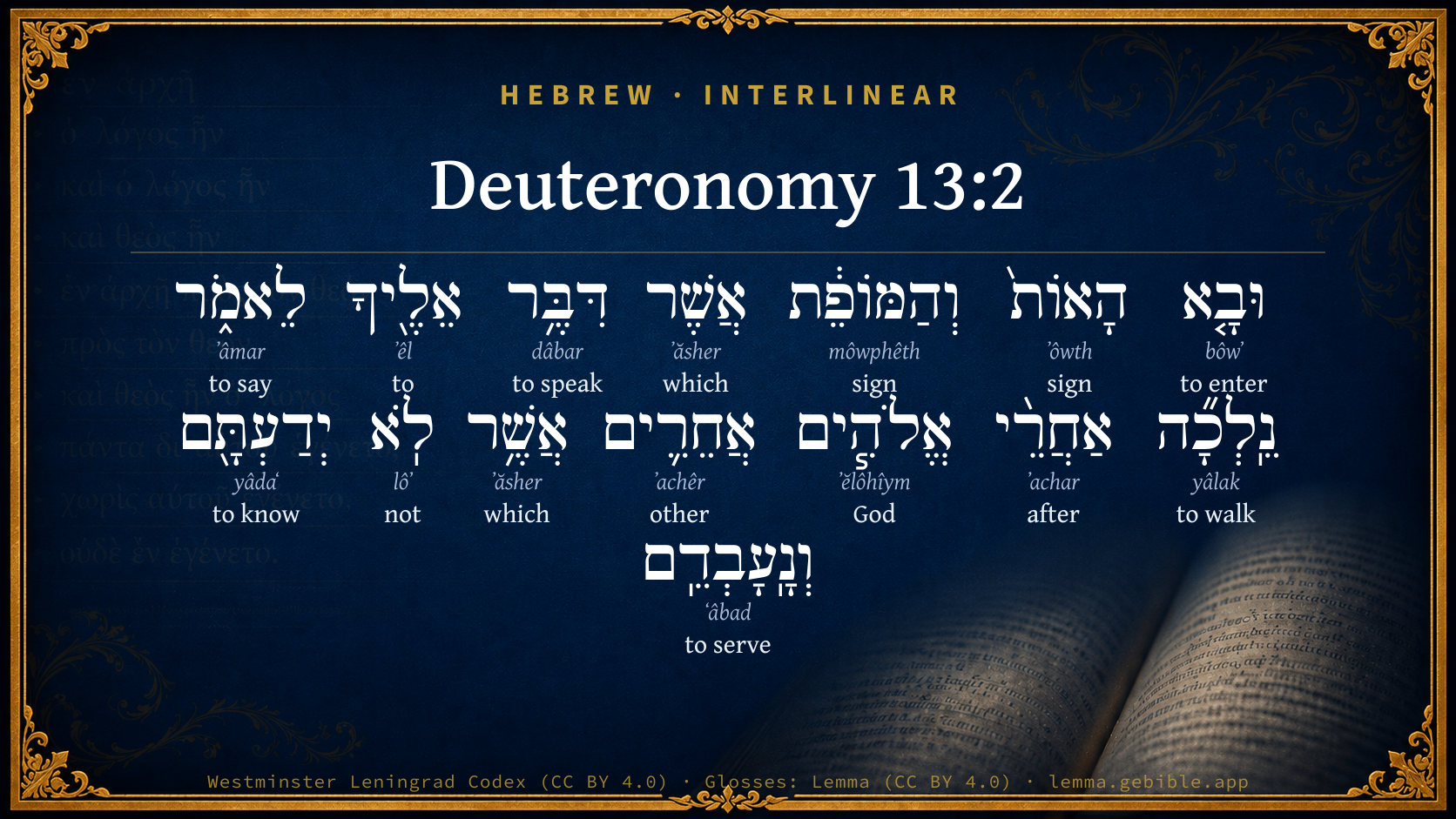
  1. וּבָ֤א bôwʼ H935 “and · to enter” Conjunction + Verb, Qal, Sequential Perfect, 3rd Person, Masculine, Singular
  2. הָאוֹת֙ ʼôwth H226 “the · sign” Particle, Definite Article + Noun, Common, Both, Singular, Absolute
  3. אֲשֶׁר ʼăsher H834 “which” Particle, Relative
  4. דִּבֶּ֥ר dâbar H1696 “to speak” Verb, Piel, Perfect, 3rd Person, Masculine, Singular
  5. אֵלֶ֖יךָ ʼêl H413 “to · you” Preposition + Suffix, Personal, 2nd Person, Masculine, Singular
  6. לֵאמֹ֑ר ʼâmar H559 “to say” Preposition + Verb, Qal, Infinitive Construct
  7. נֵֽלְכָ֞ה yâlak H3212 “to walk” Verb, Qal, Cohortative, 1st Person, Common, Plural
  8. אַחֲרֵ֨י ʼachar H310 “after” Preposition
  9. אֱלֹהִ֧ים ʼĕlôhîym H430 “God(s)” Noun, Common, Masculine, Plural, Absolute
  10. אֲחֵרִ֛ים ʼachêr H312 “other” Adjective, Adjective, Masculine, Plural, Absolute
  11. אֲשֶׁ֥ר ʼăsher H834 “which” Particle, Relative
  12. לֹֽא lôʼ H3808 “not” Particle, Negative
  13. יְדַעְתָּ֖ם yâdaʻ H3045 “to know · them” Verb, Qal, Perfect, 2nd Person, Masculine, Singular + Suffix, Personal, 3rd Person, Masculine, Plural
  14. וְנָֽעָבְדֵֽם ʻâbad H5647 “and · to serve · them” Conjunction + Verb, Hophal, Imperfect, 1st Person, Common, Plural + Suffix, Personal, 3rd Person, Masculine, Plural

About this verse

These counts appear in no published source. They are computed here, from the morphology-tagged text and Lemma’s own curated glosses. What Lemma adds →

15
words
14
distinct lemmas
Pentateuch
section

Shared distinctive vocabulary

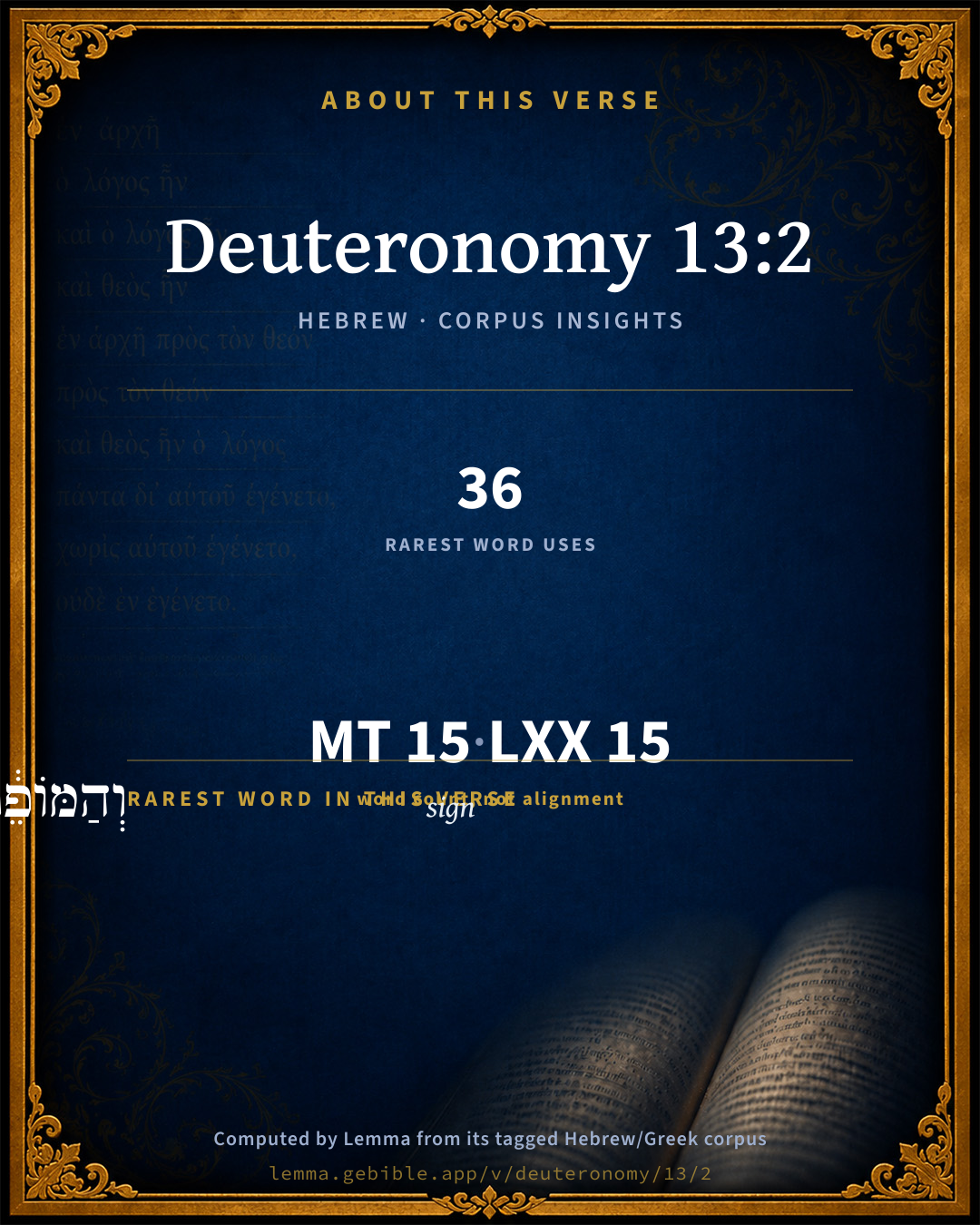
וְהַמּוֹפֵ֔ת sign H4159 occurs in 35 verses of the Hebrew Bible. Also found in:

Grammatical profile

  • 6 verbs
  • 3 nouns
  • 1 adjective
  • 2 prepositions
  • 3 particles

Verb forms

  • וּבָ֤א Qal · Sequential Perfect
  • דִּבֶּ֥ר Piel · Perfect
  • לֵאמֹ֑ר Qal · Infinitive Construct
  • נֵֽלְכָ֞ה Qal · Cohortative
  • יְדַעְתָּ֖ם Qal · Perfect
  • וְנָֽעָבְדֵֽם Hophal · Imperfect

Repetition

A word recurs within this verse — often emphatic in Hebrew:

  • אֲשֶׁר which H834 ×2

Hebrew & Septuagint length

In English translation the verse runs 32 words from the Hebrew and 26 from the Septuagint (LXX English) — closely comparable.

A rough comparison of the two English renderings, which tokenize alike — not a word-level alignment.

Word counts can differ between the Hebrew and the Greek without any difference in meaning — e.g. the Hebrew direct-object marker אֵת has no separate Greek word, and Greek often adds the article ὁ.

In the original languages it is 15 Hebrew tokens and 15 Greek tokens — but the two are counted differently (Hebrew bundles its prefixes and suffixes into one token; the Greek is in lemma form), so that isn’t a like-for-like length.

Cross-references

11

Topical passages linked to Deuteronomy 13:2 in the Treasury of Scripture Knowledge — connected by theme and wording, ordered by reader-vote popularity; previews shown in the World English Bible.

  • Deuteronomy 13:6 If your brother, the son of your mother, or your son, or your daughter, or the wife of your bosom, or your friend, who is as your own soul, entice you secretly, saying, Let us go and serve other gods, which you have not known, you, nor your fathers;
  • Deuteronomy 18:22 when a prophet speaks in the name of Yahweh, if the thing doesn't follow, nor happen, that is the thing which Yahweh has not spoken: the prophet has spoken it presumptuously, you shall not be afraid of him.
  • Jeremiah 28:9 The prophet who prophesies of peace, when the word of the prophet shall happen, then shall the prophet be known, that Yahweh has truly sent him.
  • Matthew 7:22–23 Many will tell me in that day, 'Lord, Lord, didn't we prophesy in your name, in your name cast out demons, and in your name do many mighty works?'
  • Matthew 24:24 For there will arise false christs, and false prophets, and they will show great signs and wonders, so as to lead astray, if possible, even the chosen ones.
  • 2 Corinthians 11:13–15 For such men are false apostles, deceitful workers, masquerading as Christ's apostles.
  • 2 Thessalonians 2:9–11 even he whose coming is according to the working of Satan with all power and signs and lying wonders,
  • Revelation 13:13–14 He performs great signs, even making fire come down out of the sky to the earth in the sight of people.
  • Exodus 7:22 The magicians of Egypt did in like manner with their enchantments; and Pharaoh's heart was hardened, and he didn't listen to them; as Yahweh had spoken.
  • Deuteronomy 13:13 Certain base fellows are gone out from the midst of you, and have drawn away the inhabitants of their city, saying, Let us go and serve other gods, which you have not known;
  • 1 Kings 13:3 He gave a sign the same day, saying, This is the sign which Yahweh has spoken: Behold, the altar shall be torn, and the ashes that are on it shall be poured out.

Cross-references courtesy of OpenBible.info (CC BY 4.0).

Hebrew and Greek witnesses Masoretic Hebrew ↔ Greek Septuagint

The same verse in the two great witnesses to the Old Testament, shown verse-for-verse.

These are two independent witnesses, not word-aligned to each other, and the Septuagint is shown in lemma (dictionary) form.

Hebrew Deuteronomy 13:2 Masoretic · Westminster Leningrad Codex

וּבָ֤א הָאוֹת֙ וְהַמּוֹפֵ֔ת אֲשֶׁר דִּבֶּ֥ר אֵלֶ֖יךָ לֵאמֹ֑ר נֵֽלְכָ֞ה אַחֲרֵ֨י אֱלֹהִ֧ים אֲחֵרִ֛ים אֲשֶׁ֥ר לֹֽא יְדַעְתָּ֖ם וְנָֽעָבְדֵֽם

and the sign or the wonder come to pass, of which he spoke to you, saying, Let us go after other gods, which you have not known, and let us serve them;

World English Bible · Public Domain

Greek LXX Deuteronomy 13:2 Septuagint · lemma form

ἐάν δέ ἀναἵστημι ἐν σύ προφήτης ἤ ἐνὑπνιάζω ἐνύπνιον καί δίδωμι σύ σημεῖον ἤ τέρας

and the sign or the wonder come to pass which he spoke to you, saying, Let us go and serve other gods, which you⌃ know not;

LXX2012 (modern English Septuagint) · Public Domain

Hebrew: Westminster Leningrad Codex (CC BY 4.0). Greek: Septuagint (public domain); English from LXX2012 (modern English Septuagint) (Public Domain). How the Septuagint differs from the Hebrew →

Targum (Aramaic paraphrase)

2

The Targum is the ancient Jewish Aramaic paraphrase of the Hebrew Scriptures — an interpretive translation, not the Hebrew text itself. Onkelos (literal) and Pseudo-Jonathan (expansive) render the Torah, and Jonathan the Prophets. Coverage is partial: where no permissively-licensed English translation exists for a verse, only the Aramaic is shown. This is verse-level text, not a word-by-word alignment to the Hebrew.

  1. Targum Onkelos Torah (Genesis–Deuteronomy)
    אֲרֵי יְקוּם בֵּינָךְ נְבִיָא אוֹ חָלֵם חֶלְמָא וְיִתֶּן לָךְ אָת אוֹ מוֹפְתָא

    (no public-domain English translation for this verse)

    Targum Onkelos — Aramaic: “Onkelos Genesis” (public domain); “Onkelos Exodus” (public domain); “Onkelos Leviticus” (public domain); “Onkelos Numbers” (public domain); “Onkelos Deuteronomy” (public domain). English: “Sefaria Community Translation” (CC0 1.0 (public-domain dedication)); “J.W. Etheridge. The Targums of Onkelos and Jonathan Ben Uzziel on the Pentateuch. London: Longmans, Green, 1862” (public domain). Text via Sefaria.

  2. Targum Pseudo-Jonathan Torah (Genesis–Deuteronomy)
    אֲרֵי יְקוּם בֵּינֵיכוֹן נְבִי שִׁקְרָא אוֹ מָרֵי חֲלִים חֶלְמָא דְזֵדָנוּתָא וְיִתֵּן לְכוֹן אָת אוֹ תִמְהָא

    When there may arise among you a false prophet or a dreamer of a profane dream, and he give you a sign or a miracle,

    Targum Pseudo-Jonathan — Aramaic: “Targum Jonathan on Genesis” (public domain); “Targum Jonathan on Exodus” (public domain); “Targum Jonathan on Leviticus” (public domain); “Targum Jonathan on Numbers” (public domain); “Targum Jonathan on Deuteronomy” (public domain). English: “The Targum of Jonathan ben Uzziel, trans. J. W. Etheridge, London, 1862” (public domain). Text via Sefaria.

Commentary

Notes on Deuteronomy 13:2 from classic Christian and Jewish commentators (each source and its license shown beneath its notes). The classic Christian expositions comment on the surrounding passage and are grouped to its opening verse, so a note may address several verses; the Jewish commentaries on the Tanakh (Rashi and others) are per-verse, so they appear only where the commentator wrote on this verse.

Lemma curates 59 commentaries, every one of them public domain or Creative Commons licensed, each selected and text-cleaned for this edition rather than reprinted as found. About our sources →

Trapp's Complete Commentary

John Trapp

Deu 13:2 And the sign or the wonder come to pass, whereof he spake unto thee, saying, Let us go after other gods, which thou hast not known, and let us serve them;

Ver. 2. And the sign or the wonder come to pass.] For so it may happen by divine permission, for the exposing and shame of hypocrites; as when Jannes and Jambres turned water into blood, or at least seemed to do so. {Exo 7:22}

John Trapp, A Commentary or Exposition upon All the Books of the Old and New Testament (1647–1656) — public domain. Text from a community e-Sword module.

Joseph Benson's Commentary

Deu 13:2-3. And the sign or wonder come to pass — God permitting Satan or his agents to do what is above the ordinary course of nature for thy trial. Saying, Let us go after other gods — That is, who, upon the sign’s coming to pass which he gave thee to confirm his doctrine, would persuade thee to go after other gods. Thou shalt not hearken unto that prophet — Shalt not receive his doctrine; but, though the event confirm the prediction, thou shalt look upon him as a liar, and teacher of false doctrine. For the Lord your God proveth you — That is, trieth your faith, love, and obedience, and examineth your sincerity by your constancy in his service, in opposition to all temptations to desert it. To know — Or make known publicly and openly, namely, that both you and others may know and see it, in order that the justice of his dispensations toward you, whether in judgment or mercy, may be evident and glorious. The reasonableness of what Moses here enjoins is manifest. For the existence and infinite perfections of the one living and true God, the truth and goodness of his religion, and the authority of his laws being already so fully demonstrated by evidences of all kinds, evidences continued, and beyond all exception; and, on the contrary, the gods of the heathen being so evidently either nonentities or false pretenders to divinity, and their worship so full of absurdity, folly, and the worst kinds of wickedness, it was not to be thought that a mere miracle, or a number of miracles or wonders, for the performance of which, if really performed, they could not account, or the fulfilling of a prediction, by any opposer of the true God, was a sufficient reason why they should abandon God’s worship, call in question the truth of his religion, or go after any other god. Moses properly teaches them that the true divinity of miracles and wonders ought to be judged of by the doctrines, designs, and purposes, for the abetting and confirming whereof they were wrought; that every pretender to miracles, who would seduce men to false and irrational principles of religion, was to be looked upon as an impostor, and notwithstanding all he could do or say, they were steadily to adhere to the service of Him who had given them so many proofs that he, and he alone, was the true God, and to his religion and worship, which had been so amply confirmed; concluding that God, by permitting such impostors, intended only to try their faith and sincerity. Compare 1Co 12:3; 1Jn 4:1-6. We may infer from hence, that the attempts of the Roman Catholics to prove their peculiar doctrines by miracles are vain; for they ought first to show them to be agreeable to reason and religion, before they attempt to prove them by miracles. For so long as they appear contrary to reason and Scripture, and repugnant to common sense, it will never be in the power of miracles, how numerous and stupendous soever, to establish the truth of them. Far less of their pretended miracles, which are nothing else but mere tricks and impostures.

Joseph Benson's Commentary on the Old and New Testaments (1811–1818) — public domain. Text from a community e-Sword module.

Geneva Bible (1599)

Geneva Bible translators

He showeth whereunto the false prophets tend.

Geneva Bible (1599) marginal notes — public domain. Text via Bolls.life.

John Gill's Exposition

And the sign and wonder come to pass whereof he spake unto thee,.... The sign he promised to give, or the miracle he proposed to do, to show the reality of his mission, and the truth of his doctrine, which is performed, or seemingly performed, by legerdemain, by magic art, or by the help of the devil; which the Lord sometimes suffered for the trial of the faith and obedience of his people, and for the hardening of others in their unbelief, and which issues in their destruction; see Th2 2:9,

saying, let us go after other gods (which thou hast not known), and let us serve them; other gods besides the one living and true God, the Creator of all things; strange gods, the idols of the people, as the Targum of Jonathan; such as they had never heard of, nor had any knowledge of, nor any benefit from, as they had of the Lord their God. Now the doctrines of these, and of their worship, are what the false prophet or dreamer is supposed to come with, and inculcate into the minds of the people; and for the confirmation of which, and in order to draw them into the reception of them, and act according to them, he proposed to give a sign or wonder.

John Gill's Exposition of the Whole Bible (1746–1763) — public domain (CC PDM 1.0). Text via the HelloAO Bible API.

Albert Barnes' Notes on the Bible

The Lord had said, “Thou shalt have none other gods but Me.” A prophet is here supposed who invites the people “to go after other gods.” To such a one no credit is under any circumstances to be given, even should he show signs and wonders to authenticate his doctrine. The standing rule of faith and practice had been laid down once for all - that the people were to hold fast. The prophet who propounded another rule could only be an impostor.

A different case is considered in Deu 18:18, etc.

Albert Barnes' Notes on the Bible (1834–1885) — public domain. Text from a community e-Sword/MySword module.

Haydock's Catholic Bible Commentary

To pass. The completion of a prophecy does not always prove, that the person who uttered it was a true prophet. Chance, a knowledge of natural causes, &c., may enable an impostor sometimes to hit upon the truth. God may also, for reasons known to himself, declare what will come to pass, by the mouth of a false prophet, or of a wicked man, as he did by Balaam and Caiphas. Judas wrought miracles before his apostacy. (Calmet) --- Yet if any who had been so highly favoured, should attempt to enforce by their preceding miracles, any false doctrine, let him be anathema, Galatians i. 8. --- Not. The Hebrews had inconvertible proofs of the existence of one God. They could not therefore acknowledge any other. (Haydock) --- Novelty in religion is a mark of idolatry or of heresy. (Worthington)

George Leo Haydock (1774–1849), Haydock's Catholic Family Bible and Commentary, 1859 edition — public domain. Excludes Psalms (Douay-Rheims chapter numbering differs from Protestant) and Deuterocanonical books (Catholic canon only).

Matthew Poole's English Annotations

And the sign or the wonder come to pass; which God may suffer for the reason after mentioned.

Saying: this word is to be joined with the beginning of Deu 13:1,

If there arise among you a prophet, or dreamer of dreams, saying, what there follows,

and giveth thee a sign, & c., to confirm his doctrine; such transpositions are frequent.

Matthew Poole's English Annotations on the Holy Bible (1683–1685) — public domain. Text from a community e-Sword/MySword module.

Rashi

Rabbi Shlomo Yitzchaki (Rashi)

ונתן אליך אות [IF THERE ARISE AMONG YOU A PROPHET …] AND GIVETH THEE A SIGN that will show itself in the heavens, just as it is stated in the case of Gideon who spoke to the angel, (Judges 6:17) “[If now I found grace in your sight], then show me a sign (אות)”, and then it further states, (Judges 6:39) “[let me prove, I pray thee, but this once with the fleece;] let it be dry only upon the fleece [and upon all the ground let there be dew]”.

או מופת OR A WONDER showing itself on the earth. — Nevertheless you shall not hearken unto him (although the sign or the wonder come to pass; cf. v. 3). But if you ask, why then does God give him the power to perform a sign? Scripture replies, (v. 4) “for the Lord your God trieth you, [to know whether you really love the Lord your God]” (Sifrei Devarim 84:1; cf. Sanhedrin 90a).

Rashi on the Tanakh — English translations: “The Judaica Press complete Tanach with Rashi, translated by A. J. Rosenberg” (CC BY 4.0); “Pentateuch with Rashi's commentary by M. Rosenbaum and A.M. Silbermann, 1929-1934” (public domain); “The Metsudah Tanach series, Lakewood, N.J” (CC BY 4.0); and “The Book of Joshua, Metsudah Publications, 1997” (CC BY 4.0). Text via Sefaria.

Ramban (Nachmanides)

Rabbi Moshe ben Nachman (Ramban / Nachmanides)

IF THERE ARISE IN THE MIDST OF THEE A PROPHET, OR A DREAMER OF DREAMS. Scripture calls him “a prophet” on the basis of his own claim, for it is he who claims, “G-d spoke with me while I was awake and I am His prophet sent to you [to command] that you [worship idols,” as mentioned in Verse 3]. But it is possible that Scripture alludes to that which is true [that the person does indeed possess certain prophetic powers], for there is a prophetic potential in the souls of some people by which they know of things to come without the person knowing whence it comes to him, but he will isolate himself and [then] a spirit will arrive within him saying, “Thus it will happen to that person in the future in a particular matter.” The philosophers call [that power of prophecy] kahin., a term referring to the power residing in man to be able to foretell the future. It is so explained by Shmuel ibn Tibbon in his list of “Foreign words.” They do not know its cause, but the matter is substantiated in the sight of witnesses. Perhaps the soul in its keenness cleaves to the pure intellect and concentrates on it. Such a person is called “prophet,” because he predicts events, and, therefore, the sign or wonder whereof he spoke comes to pass.

AND HE GIVE THEE ‘OTH’ (A SIGN) OR ‘MOFEITH’ (WONDER). A Sign [denotes a natural phenomenon serving as] a symbol of something similar that will take place afterwards, this being associated with the expression, every man with his own standard, ‘b’othoth’ (according to the ensigns). For when a prophet comes and says “The following [natural] matter is to represent something which is to take place” that is termed an oth (a sign), similar to what is stated, Therefore, the Eternal Himself shall give you an ‘oth’ (a sign) that G-d is with us, [the omen being] the name of the son of the prophet’s wife, [“Immanuel,” meaning “G-d is with us”] The word oth is thus derived from at hah [“coming,” since the oth represents something about to come]. A mofeith (a wonder), on the other hand, applies to something novel which the prophet does before us, making some change in the natural order of the world, similar to what is stated, to inquire of ‘hamofeith’ (the wonder) that was done in the Land; And I will show ‘moft him’ (wonders) in the heavens and in the earth, blood and fire. The word mofeith is thus a shortened form of mufleith (marvelous) (the wondrous works) of Him Who is perfect in knowledge. Ramban’s point is that the word mofeith is derived from mufleith with the letters lamed and aleph missing. — just like the expression ‘sheirith’ (the rest of) Israel drops the letter aleph which is found in she’eirith. [which is a shortened form of she’eirith]. The [Sacred] Language adopted the term to signify anything which is supernatural, just as it is stated, Thus Ezekiel shall be unto you ‘l’mofeith’ (for a wonder), and it is stated there, and thou shalt speak, and be no more dumb; so shall thou be ‘l’mofeith’ (for a wonder) unto them, Verse 27. seeing that his actions were wondrous in the eyes of the beholders. The word mofeith [a derivative from pele — wonder] is thus similar in sense to the following expression, and she is come down ‘p’la’im’ (wonderfully). So also: the signs ‘v’thimhaya’ (and wonders); how great are His signs, ‘v’thimhohie’ (and His wonders) how mighty they are!;, Verse 33. the signs ‘v’hamoft him’ (and the wonders), for the terms pele and teimah refer to the same topic. Now, in the departure from Egypt there were signs, these being the matters which Moses told them from the beginning, such as, by tomorrow shall this ‘sign’ be, and there were wonders which were done spontaneously without previously informing Pharaoh about them [such as the splitting of the Red Sea]. So also, what is ‘the sign’ that I shall go up to the House of the Eternal? [King Hezekiah asked of the prophet Isaiah] that he should give him foreknowledge [by means of a sign that he would recover from his illness]. And in connection with that very sign it states that [the king of Babylon sent his princes to Hezekiah] to inquire of ‘hamofeith’ (the wonder) that was done in the Land in order to learn how this novel matter had occurred among them. (a sign) is given before the event, while a mofeith (a wonder) is a supernatural event not announced beforehand. Hence Hezekiah asks for a sign that he will yet go up to the Sanctuary, while the king of Babylon seeks to inquire of the wonder which happened. Similarly, the rod which was turned to a serpent He referred to as a sign, 4:17. when He informed the children of Israel thereby [of the purpose of Moses’ mission], and He called it a wonder, Verse 21. The Israelites did not require a miracle to prove the existence of G-d; to them the miracle was an oth, demonstrating that redemption was at hand. Pharaoh, on the other hand, did not believe in the G-d of Israel; to him, the miracle was a mofeith, a wondrous act entirely apart from any significance for the future (Malbim). when He performed it before Pharaoh as an unannounced miracle. Likewise, Just as My servant Isaiah hath walked naked and barefoot for three years as ‘a sign’ and ‘a wonder’ upon Egypt and upon Ethiopia, so shall etc., [implying that the same act can be simultaneously an oth and a mofeith], because in this act of the prophet, there was a sign foretelling what was to come, and a wonder in the practice of the prophet in walking that way.If so, the meaning of the expression [before us], and he give thee a sign or a wonder is that he will say, “I am the prophet sent to you that you worship a particular idol, and this shall be ‘the sign’ for you: tomorrow there shall come the locust, the caterpillar, and the palmer-worm.” Or he shall show them “a wonder:” he will cast down a rod before them and it will become a serpent. Now, in the Sifre the Rabbis have said: 23. “A sign is [identical to] a wonder and a wonder is [identical to] a sign except that the Torah refers [to them] in two terms.” Perhaps the intent of the Rabbis was [not to state that the terms are identical in meaning but that] there is no difference between the two or distinction in their legal status, and [therefore] it would have been sufficient to mention one. But the Torah wanted to elaborate on the matter saying in effect “whatever sign he gives you, from whatever signs [exist] on earth.”Now, this man who calls himself “prophet” and commands [you] to worship idols is by way of the simple meaning of Scripture a prophet of an idol who says “The idol [Baal] Peor sent me to you declaring that he is god and he commanded that you worship him in a certain way.” It is he of whom Scripture further says, and he that shall speak in the name of other gods, that same prophet shall die, for all who prophesy in the name of other gods, do so in order that people worship them, because they are [that prophet’s] deities, and Scripture mentions him there, among the [general] false prophets. But what emerges from the words of our Rabbis is that the prophet mentioned here prophesies in the name of G-d, saying “The Glorious Name sent me that you worship [Baal] Peor because he was His partner in creation,” or that he [Baal-peor] is greater than all the gods before Him and He desires that they worship him. And the Rabbis of blessed memory have mentioned that even if he were to say that they should worship a certain idol but for one moment alone, for example, if he says, “Worship [Baal] Peor just this day alone and you will succeed in a certain project for such is the will before the Glorious Name” — that prophet is guilty of a capital offense. This, too, lies within the plain meaning of Scripture.Thus Scripture commanded that we hearken not at all to him who prophesies in the name of G-d to worship the idols, nor take note of the signs and wonders that he will make. And it mentions the reason. because we know from the exodus from Egypt which was an actual event — not a vision or a mirage — that the earth is the Eternal’s and He is the Creator, the One Who wills all, and the Omnipotent, and there is no god beside Him, and we further know from the Revelation on Mount Sinai that face to face He commanded us to walk in this way, not to worship anything at all beside Him, and that He has not given His glory to another [deity]. This is the sense of the expression, which the Eternal thy G-d commanded thee. Thus the prophet hath spoken perversion against the Eternal Who never commanded him so, or he spoke perversion against His Glory, for it is not proper to worship another god.

Ramban (Nachmanides) on the Tanakh — English translation: “Commentary on the Torah by Ramban (Nachmanides). Translated and annotated by Charles B. Chavel. New York, Shilo Pub. House, 1971-1976” (CC BY 4.0). Text via Sefaria.

Lesson kit

Teaching starters — assembled from the data on this page, not authored interpretation. Every prompt links to the verse data it draws on. Edit before teaching.

Deuteronomy, in the Pentateuch, opens this verse with 15 words (14 distinct Hebrew lemmas). Its most distinctive word is môwphêth (“sign”). A historical commentator’s framing appears above. Read the whole chapter for the surrounding context.

Discussion questions

  1. The word môwphêth carries the sense “sign.” How does it shape the verse?
  2. How does Exodus 4:21, which shares the word «sign», read alongside this verse?
  3. What does the repetition of “which” (2× in this one verse) do in this verse?
  4. The translations on this page render this verse differently — a whole-verse word diff, not a word-by-word alignment. What might account for the different wordings?
  5. «וּבָ֤א» is a Qal Sequential Perfect verb. How does that grammatical form shape the action described?
  6. Compare how Trapp's Complete Commentary and Joseph Benson's Commentary read this verse. Where do they agree or differ?

Things to notice

Reading settings

Reading text

Shown beneath each verse's original-language words.

Old Testament
Old Testament edition

Read the OT as the Masoretic Hebrew (MT) or the Greek Septuagint (LXX).

English shown for the Greek Septuagint (in the Hebrew ↔ Greek comparison).

Comparing translations? Open the Compare panel on any verse page to stack up to four side by side.