
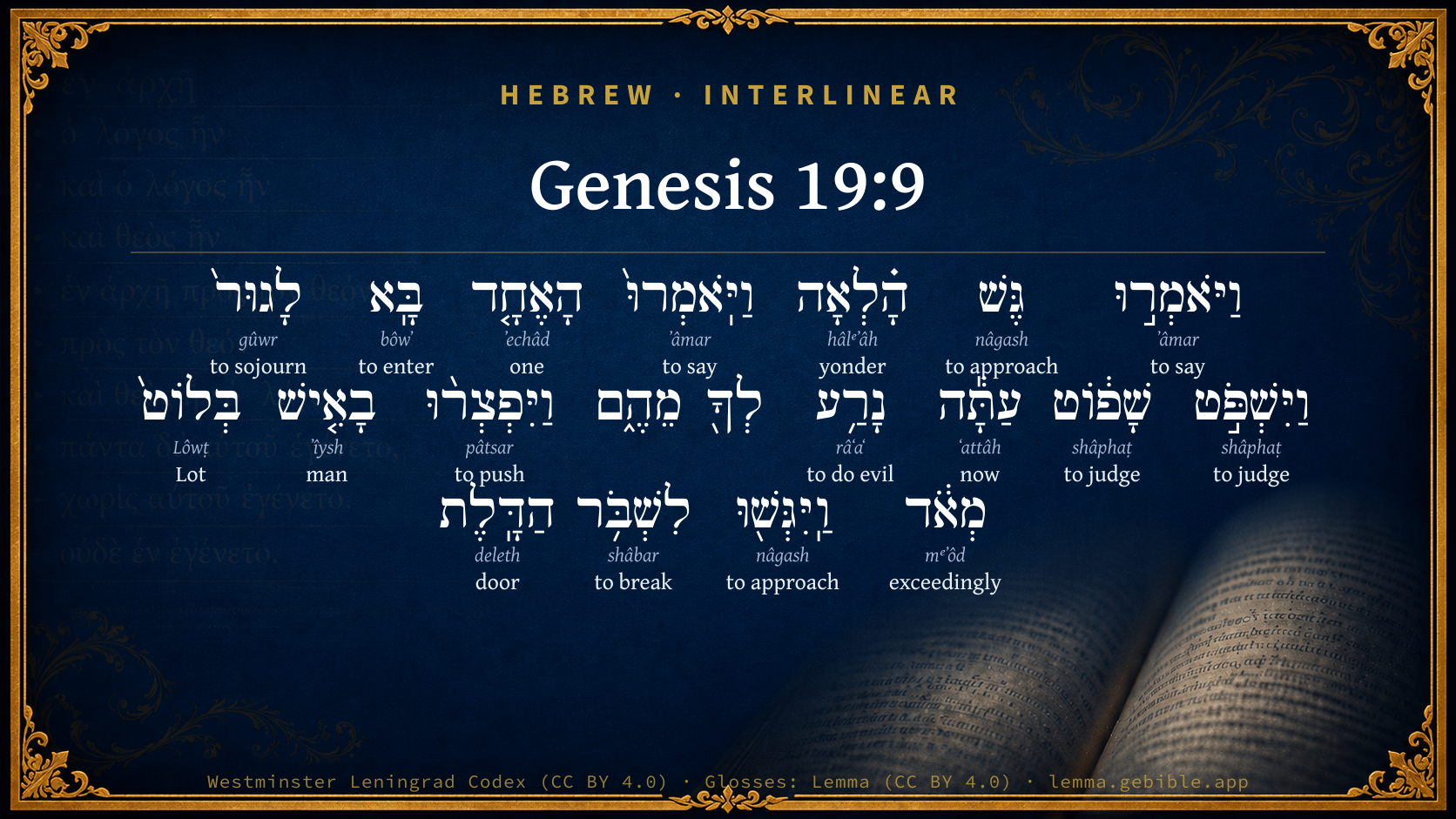
Genesis 19:9

Hebrew (Westminster Leningrad Codex) Genesis 19:9 appears in the Hebrew Old Testament. The text above is from the Westminster Leningrad Codex. Each word links to its Strong’s number, a concise gloss, and parsing drawn from the Open Scriptures Hebrew Bible morphology. Click any word for its full Brown-Driver-Briggs (BDB) entry.
Download image
Cite this verse

Genesis 19:9 (World English Bible). Public Domain. Lemma interlinear Bible study tool, https://lemma.gebible.app/v/genesis/19/9.

Show BibTeX & RIS
BibTeX
RIS
English Translation
They said, "Stand back!" They said, "This one fellow came in to live as a foreigner, and he appoints himself a judge. Now will we deal worse with you, than with them!" They pressed hard on the man, even Lot, and drew near to break the door.
World English Bible · Public Domain
Highlights
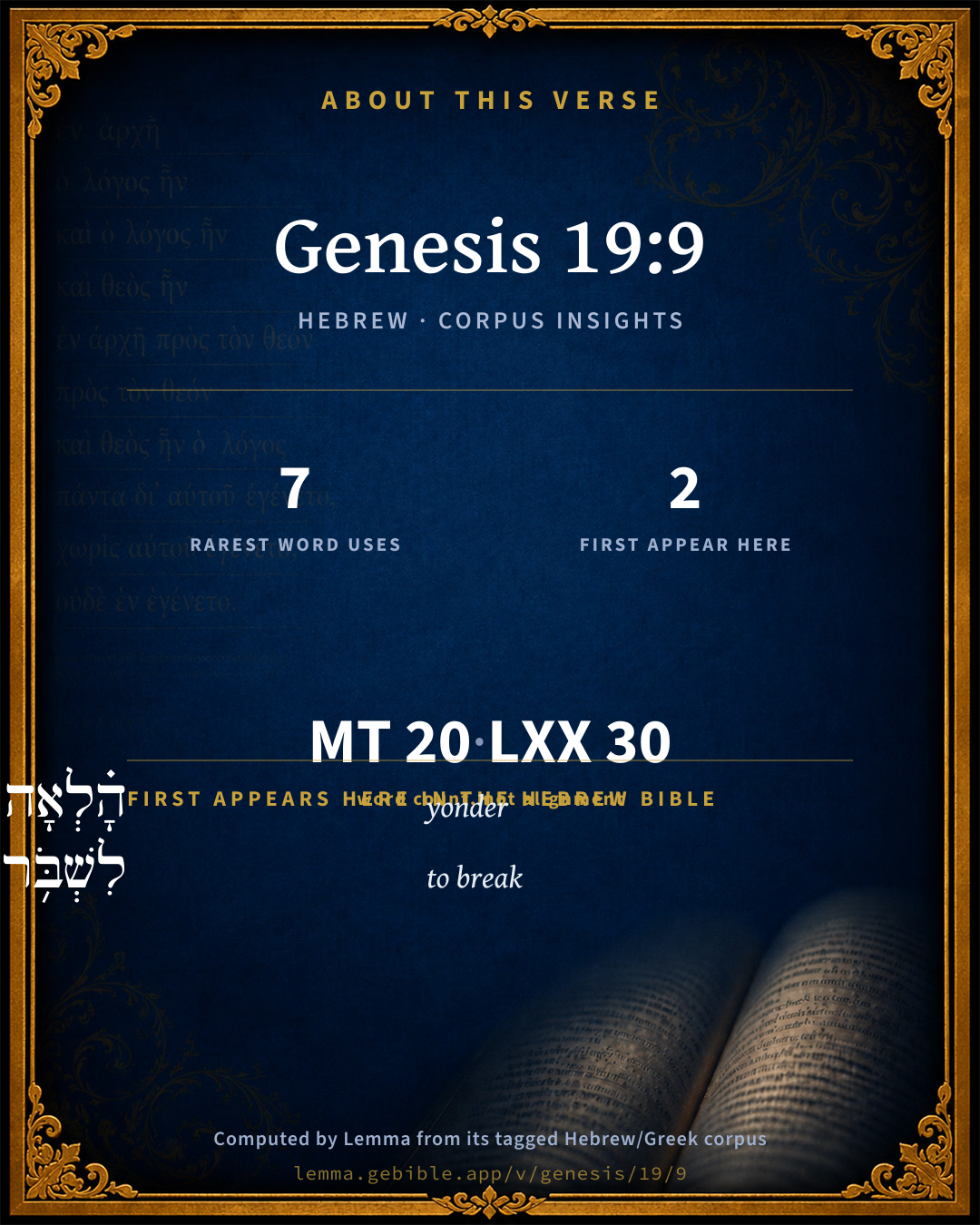
  • 2 first appearances in the Hebrew Bible
Full analysis ↓
Download a study sheet

One document with this verse’s original text, its word-by-word gloss line, the meaning frame, cross-references with their text, attributed commentary, and full source and license credits — printable, and it pastes into notes with its structure intact.

This verse Autodidact and up

Study sheet (.html) Plain text (.txt)

A passage Seminary Student

Up to 50 verses in one chapter. A passage sheet keeps up to 6 commentary sources and 12 cross-references per verse, in the order this page ranks them, and says so on the sheet whenever that leaves anything out. Ask for a single verse and you get the Autodidact verse sheet above.

Everything on this page stays free to read, with no account — the sheet is a download of what is already on screen, not access to it.

Want to remove ads? Support Godless Engineer
Compare translations 3

The same verse in 3 English versions, stacked beneath the original-language interlinear above. Click any original word for its lexicon entry.

Each is an independent rendering of the whole verse — the interlinear is not word-aligned to these translations.

Highlighted words mark where these versions differ — a whole-verse word diff, not a word-by-word alignment.

  • World English Bible Public Domain
    They said, "Stand back!" They said, "This one fellow came in to live as a foreigner, and he appoints himself a judge. Now will we deal worse with you, than with them!" They pressed hard on the man, even Lot, and drew near to break the door.
  • King James Version Public Domain
    And they said, Stand back. And they said again, This one fellow came in to sojourn, and he will needs be a judge: now will we deal worse with thee, than with them. And they pressed sore upon the man, even Lot, and came near to break the door.
  • unfoldingWord Literal Text CC BY-SA 4.0
    But they said, “Get back!” Then they said, “This one came to sojourn, and now he is judging! We will treat you worse than them!” Then they pressed hard against the man Lot and came near to break down the door.

unfoldingWord Literal Text — © unfoldingWord, licensed CC BY-SA 4.0. Word-aligned USFM3 via Door43 (git.door43.org/unfoldingWord/en_ult).

Versions to compare (up to 4)

3 of 4 selected

Show all 18 translations

Every available English version of this verse, each an independent rendering of the whole verse.

  • World English Bible Public Domain
    They said, "Stand back!" They said, "This one fellow came in to live as a foreigner, and he appoints himself a judge. Now will we deal worse with you, than with them!" They pressed hard on the man, even Lot, and drew near to break the door.
  • Berean Standard Bible Public Domain
    “Get out of the way!” they replied. And they declared, “This one came here as a foreigner, and he is already acting like a judge! Now we will treat you worse than them.” And they pressed in on Lot and moved in to break down the door.
  • Majority Standard Bible Public Domain
    “Get out of the way!” they replied. And they declared, “This one came here as a foreigner, and he is already acting like a judge! Now we will treat you worse than them.” And they pressed in on Lot and moved in to break down the door.
  • King James Version Public Domain
    And they said, Stand back. And they said again, This one fellow came in to sojourn, and he will needs be a judge: now will we deal worse with thee, than with them. And they pressed sore upon the man, even Lot, and came near to break the door.
  • American Standard Version (1901) Public Domain
    And they said, Stand back. And they said, This one fellow came in to sojourn, and he will needs be a judge: now will we deal worse with thee, than with them. And they pressed sore upon the man, even Lot, and drew near to break the door.
  • Revised Version (1885) Public Domain
    And they said, Stand back. And they said, This one fellow came in to sojourn, and he will needs be a judge: now will we deal worse with thee, than with them. And they pressed sore upon the man, even Lot, and drew near to break the door.
  • Geneva Bible (1599) Public Domain
    Then they said, Away hence, and they said, He is come alone as a stranger, and shall he iudge and rule? we will nowe deale worse with thee then with them. So they preassed sore vpon Lot himselfe, and came to breake the doore.
  • Douay-Rheims (1899) Public Domain
    But they said: Get thee back thither. And again: Thou camest in, said they, as a, stranger, was it to be a judge? therefore we will afflict thee more than them. 0 And they pressed very violently upon Lot: and they were even at the point of breaking open the doors.
  • Young's Literal Translation Public Domain
    And they say, `Come nigh hither;' they say also, `This one hath come in to sojourn, and he certainly judgeth! now, we do evil to thee more than `to' them;' and they press against the man, against Lot greatly, and come nigh to break the door.
  • Literal Standard Version CC BY-SA 4.0
    And they say, “Come near here”; they also say, “This one has come to sojourn, and he certainly judges! Now, we do evil to you more than [to] them”; and they press against the man, against Lot greatly, and come near to break the door.
  • Unlocked Literal Bible CC BY-SA 4.0
    They said, “Stand back!” They also said, “This one came here to live as a foreigner, and now he has become our judge! Now we will deal worse with you than with them.” They pressed hard against the man, against Lot, and came near to break down the door.
  • unfoldingWord Literal Text CC BY-SA 4.0
    But they said, “Get back!” Then they said, “This one came to sojourn, and now he is judging! We will treat you worse than them!” Then they pressed hard against the man Lot and came near to break down the door.
  • Darby Bible Public Domain
    And they said, Back there! And they said [again], This one came to sojourn, and he must be a judge? Now we will deal worse with thee than with them. And they pressed hard on the man -- on Lot; and drew near to break the door.
  • World Messianic Bible Public Domain
    They said, “Stand back!” Then they said, “This one fellow came in to live as a foreigner, and he appoints himself a judge. Now we will deal worse with you than with them!” They pressed hard on the man Lot, and came near to break the door.
  • Webster's Bible Public Domain
    And they said, Stand back. And they said again, This one man came in to sojourn, and he will needs be a judge: Now will we deal worse with thee than with them. And they pressed hard upon the man, Lot, and came near to break the door.
  • Free Bible Version CC BY-SA 4.0
    “Out of our way!” they shouted. “Who do you think you are, coming to live here and now trying to judge us? We'll do even worse things to you than we were going to do to these men!” They rushed forward at Lot and tried to break down the door.
  • Bible in Basic English Public Domain
    And they said, Give way there. This one man, they said, came here from a strange country, and will he now be our judge? now we will do worse to you than to them; and pushing violently against Lot, they came near to get the door broken in.
  • JPS Tanakh (1917) Public Domain
    And they said: 'Stand back.' And they said: 'This one fellow came in to sojourn, and he will needs play the judge; now will we deal worse with thee, than with them.' And they pressed sore upon the man, even Lot, and drew near to break the door.

Literal Standard Version (2020), Covenant Press — licensed CC BY-SA 4.0. Text via the HelloAO Bible API (eBible.org). Unlocked Literal Bible (unfoldingWord) — licensed CC BY-SA 4.0. Text via the HelloAO Bible API (eBible.org). unfoldingWord Literal Text — © unfoldingWord, licensed CC BY-SA 4.0. Word-aligned USFM3 via Door43 (git.door43.org/unfoldingWord/en_ult). Free Bible Version, Dr. Jonathan Gallagher — licensed CC BY-SA 4.0. Text via the HelloAO Bible API (eBible.org).

Word by word

More ways to search: Search by grammar → Find every occurrence → Compare this word →

Practice this passage: Drill this verse → Learn its vocabulary →

וַיִּפְצְר֨וּ
pâtsar
H6484
“and · to push”
Conjunction + Verb, Qal, Sequential Imperfect, 3rd Person, Masculine, Plural
Part of Speech
Conjunction + Verb
Stem
Qal
Form
Sequential Imperfect
Person
3rd Person
Gender
Masculine
Number
Plural
Full BDB Definition

Origin: a primitive root

TWOT: 1801

to press, push - (Qal) to push, press - (Hiphil) be insolent, display pushing (arrogance, presumption)
  1. וַיֹּאמְר֣וּ ʼâmar H559 “and · to say” Conjunction + Verb, Qal, Sequential Imperfect, 3rd Person, Masculine, Plural
  2. גֶּשׁ nâgash H5066 “approach” Verb, Qal, Imperative, 2nd Person, Masculine, Singular
  3. הָ֗לְאָה hâlᵉʼâh H1973 “yonder” Adverb
  4. וַיֹּֽאמְרוּ֙ ʼâmar H559 “and · to say” Conjunction + Verb, Qal, Sequential Imperfect, 3rd Person, Masculine, Plural
  5. הָאֶחָ֤ד ʼechâd H259 “the · one” Particle, Definite Article + Adjective, Cardinal number, Masculine, Singular, Absolute
  6. בָּֽא bôwʼ H935 “to enter” Verb, Qal, Perfect, 3rd Person, Masculine, Singular
  7. לָגוּר֙ gûwr H1481 “to sojourn” Preposition + Verb, Qal, Infinitive Construct
  8. וַיִּשְׁפֹּ֣ט shâphaṭ H8199 “and · to judge” Conjunction + Verb, Qal, Sequential Imperfect, 3rd Person, Masculine, Singular
  9. שָׁפ֔וֹט shâphaṭ H8199 “to judge” Verb, Qal, Infinitive Absolute
  10. עַתָּ֕ה ʻattâh H6258 “now” Adverb
  11. נָרַ֥ע râʻaʻ H7489 “to do evil” Verb, Hiphil, Imperfect, 1st Person, Common, Plural
  12. בָאִ֤ישׁ ʼîysh H376 “in/at the · man” Preposition, Determined + Noun, Common, Masculine, Singular, Absolute
  13. בְּלוֹט֙ Lôwṭ H3876 “in/at · Lot” Preposition + Noun, Proper
  14. מְאֹ֔ד mᵉʼôd H3966 “exceedingly” Adverb
  15. וַֽיִּגְּשׁ֖וּ nâgash H5066 “and · to approach” Conjunction + Verb, Qal, Sequential Imperfect, 3rd Person, Masculine, Plural
  16. לִשְׁבֹּ֥ר shâbar H7665 “to break” Preposition + Verb, Qal, Infinitive Construct
  17. הַדָּֽלֶת deleth H1817 “the · door” Particle, Definite Article + Noun, Common, Feminine, Singular, Absolute

About this verse

These counts appear in no published source. They are computed here, from the morphology-tagged text and Lemma’s own curated glosses. What Lemma adds →

20
words
15
distinct lemmas
Pentateuch
section

Notable vocabulary

The rarest word here is וַיִּפְצְר֨וּ to push H6484 — appearing just 7 times in the whole Hebrew Bible.

First appearance in Scripture

These words make their first canonical appearance in the Hebrew Bible here:

  • הָ֗לְאָה yonder H1973
  • לִשְׁבֹּ֥ר to break H7665

Shared distinctive vocabulary

וַיִּפְצְר֨וּ to push H6484 occurs in 7 verses of the Hebrew Bible. Also found in:

Grammatical profile

  • 11 verbs
  • 3 nouns
  • 1 adjective
  • 2 prepositions
  • 3 adverbs

Verb forms

  • וַיֹּאמְר֣וּ Qal · Sequential Imperfect
  • גֶּשׁ Qal · Imperative
  • וַיֹּֽאמְרוּ֙ Qal · Sequential Imperfect
  • בָּֽא Qal · Perfect
  • לָגוּר֙ Qal · Infinitive Construct
  • וַיִּשְׁפֹּ֣ט Qal · Sequential Imperfect
  • שָׁפ֔וֹט Qal · Infinitive Absolute
  • נָרַ֥ע Hiphil · Imperfect
  • וַיִּפְצְר֨וּ Qal · Sequential Imperfect
  • וַֽיִּגְּשׁ֖וּ Qal · Sequential Imperfect
  • לִשְׁבֹּ֥ר Qal · Infinitive Construct

Repetition

Words recur within this verse — often emphatic in Hebrew:

  • וַיֹּאמְר֣וּ to say H559 ×2
  • גֶּשׁ to approach H5066 ×2
  • וַיִּשְׁפֹּ֣ט to judge H8199 ×2

Hebrew & Septuagint length

In English translation the verse runs 47 words from the Hebrew and 44 from the Septuagint (LXX English) — closely comparable.

A rough comparison of the two English renderings, which tokenize alike — not a word-level alignment.

Word counts can differ between the Hebrew and the Greek without any difference in meaning — e.g. the Hebrew direct-object marker אֵת has no separate Greek word, and Greek often adds the article ὁ.

In the original languages it is 20 Hebrew tokens and 30 Greek tokens — but the two are counted differently (Hebrew bundles its prefixes and suffixes into one token; the Greek is in lemma form), so that isn’t a like-for-like length.

Cross-references

20

Topical passages linked to Genesis 19:9 in the Treasury of Scripture Knowledge — connected by theme and wording, ordered by reader-vote popularity; previews shown in the World English Bible.

  • Exodus 2:14 He said, "Who made you a prince and a judge over us? Do you plan to kill me, as you killed the Egyptian?" Moses was afraid, and said, "Surely this thing is known."
  • Genesis 13:12 Abram lived in the land of Canaan, and Lot lived in the cities of the plain, and moved his tent as far as Sodom.
  • 2 Peter 2:7–8 and delivered righteous Lot, who was very distressed by the lustful life of the wicked
  • Ecclesiastes 9:3 This is an evil in all that is done under the sun, that there is one event to all: yes also, the heart of the sons of men is full of evil, and madness is in their heart while they live, and after that they go to the dead.
  • Jeremiah 6:15 Were they ashamed when they had committed abomination? nay, they were not at all ashamed, neither could they blush: therefore they shall fall among those who fall; at the time that I visit them they shall be cast down, says Yahweh.
  • Daniel 3:19–22 Then was Nebuchadnezzar full of fury, and the form of his visage was changed against Shadrach, Meshach, and Abednego: [therefore] he spoke, and commanded that they should heat the furnace seven times more than it was wont to be heated.
  • Matthew 7:6 "Don't give that which is holy to the dogs, neither throw your pearls before the pigs, lest perhaps they trample them under their feet, and turn and tear you to pieces.
  • Acts 7:26–28 "The day following, he appeared to them as they fought, and urged them to be at peace again, saying, 'Sirs, you are brothers. Why do you wrong one another?'
  • Genesis 11:6 Yahweh said, "Behold, they are one people, and they have all one language; and this is what they begin to do. Now nothing will be withheld from them, which they intend to do.
  • 1 Samuel 17:44 The Philistine said to David, Come to me, and I will give your flesh to the birds of the sky, and to the animals of the field.
  • 1 Samuel 25:17 Now therefore know and consider what you will do; for evil is determined against our master, and against all his house: for he is such a worthless fellow that one can't speak to him.
  • Proverbs 9:7–8 He who corrects a mocker invites insult. He who reproves a wicked man invites abuse.
  • Proverbs 14:16 A wise man fears, and shuns evil, But the fool is hotheaded and reckless.
  • Proverbs 17:12 Let a bear robbed of her cubs meet a man, Rather than a fool in his folly.
  • Proverbs 27:3 A stone is heavy, And sand is a burden; But a fool's provocation is heavier than both.
  • Ecclesiastes 10:13 The beginning of the words of his mouth is foolishness; and the end of his talk is mischievous madness.
  • Isaiah 65:5 who say, Stand by yourself, don't come near to me, for I am holier than you. These are a smoke in my nose, a fire that burns all the day.
  • Jeremiah 3:3 Therefore the showers have been withheld, and there has been no latter rain; yet you have a prostitute's forehead, you refused to be ashamed.
  • Jeremiah 8:12 Were they ashamed when they had committed abomination? nay, they were not at all ashamed, neither could they blush: therefore shall they fall among those who fall; in the time of their visitation they shall be cast down, says Yahweh.
  • 1 Samuel 2:16 If the man said to him, They will surely burn the fat first, and then take as much as your soul desires; then he would say, No, but you shall give it me now: and if not, I will take it by force.

Cross-references courtesy of OpenBible.info (CC BY 4.0).

Hebrew and Greek witnesses Masoretic Hebrew ↔ Greek Septuagint

The same verse in the two great witnesses to the Old Testament, shown verse-for-verse.

These are two independent witnesses, not word-aligned to each other, and the Septuagint is shown in lemma (dictionary) form.

Hebrew Genesis 19:9 Masoretic · Westminster Leningrad Codex

וַיֹּאמְר֣וּ גֶּשׁ הָ֗לְאָה וַיֹּֽאמְרוּ֙ הָאֶחָ֤ד בָּֽא לָגוּר֙ וַיִּשְׁפֹּ֣ט שָׁפ֔וֹט עַתָּ֕ה נָרַ֥ע לְךָ֖ מֵהֶ֑ם וַיִּפְצְר֨וּ בָאִ֤ישׁ בְּלוֹט֙ מְאֹ֔ד וַֽיִּגְּשׁ֖וּ לִשְׁבֹּ֥ר הַדָּֽלֶת

They said, "Stand back!" They said, "This one fellow came in to live as a foreigner, and he appoints himself a judge. Now will we deal worse with you, than with them!" They pressed hard on the man, even Lot, and drew near to break the door.

World English Bible · Public Domain

Greek LXX Genesis 19:9 Septuagint · lemma form

εἶπον δέ ἀποἵστημι ἐκεῖ εἷς ἔρχομαι παραοἰκέω μή καί κρίσις κρίνω νῦν οὖν σύ κακόω μᾶλλον ἤ ἐκεῖνος καί παραβιάζομαι ὁ ἀνήρ ὁ λωτ σφόδρα καί ἐγγίζω συντρίβω ὁ θύρα

And they said to him, Stand back there, you came in to sojourn, was it also to judge? Now then we would harm you more than them. And they pressed hard on the man, even Lot, and they drew near to break the door.

LXX2012 (modern English Septuagint) · Public Domain

On this verse, The Cambridge Bible for Schools and Colleges discusses the Septuagint’s reading. Read the note in Commentary ↓

Hebrew: Westminster Leningrad Codex (CC BY 4.0). Greek: Septuagint (public domain); English from LXX2012 (modern English Septuagint) (Public Domain). How the Septuagint differs from the Hebrew →

Targum (Aramaic paraphrase)

2

The Targum is the ancient Jewish Aramaic paraphrase of the Hebrew Scriptures — an interpretive translation, not the Hebrew text itself. Onkelos (literal) and Pseudo-Jonathan (expansive) render the Torah, and Jonathan the Prophets. Coverage is partial: where no permissively-licensed English translation exists for a verse, only the Aramaic is shown. This is verse-level text, not a word-by-word alignment to the Hebrew.

  1. Targum Onkelos Torah (Genesis–Deuteronomy)
    וַאֲמָרוּ קְרֵב לְהַלָּא וַאֲמָרוּ חַד אֲתָא לְאִתּוֹתָבָא והָא דָיִין דִּינָא כְּעַן נַבְאֵשׁ לָךְ מִדִּילְהוֹן וּתְקִיפוּ בְגַבְרָא בְלוֹט לַחֲדָא וּקְרִיבוּ לְמִתְּבַר דָּשָׁא

    (no public-domain English translation for this verse)

    Targum Onkelos — Aramaic: “Onkelos Genesis” (public domain); “Onkelos Exodus” (public domain); “Onkelos Leviticus” (public domain); “Onkelos Numbers” (public domain); “Onkelos Deuteronomy” (public domain). English: “Sefaria Community Translation” (CC0 1.0 (public-domain dedication)); “J.W. Etheridge. The Targums of Onkelos and Jonathan Ben Uzziel on the Pentateuch. London: Longmans, Green, 1862” (public domain). Text via Sefaria.

  2. Targum Pseudo-Jonathan Torah (Genesis–Deuteronomy)
    וְאָמְרוּ קְרִיב לְהַלָא וְאָמְרוּ הֲלָא בִּלְחוֹדוֹהִי אָתָא דֵין לְאִתּוֹתָבָא בֵּינָן וְהָא אִיתְעֲבִיד דַיְינָא וְדָאִין לְכוֹלָנָא וּכְדוֹן נַבְאִישׁ לָךְ יַתִּיר מִדִלְהוֹן וְאַתְקִיפוּ בְּגַבְרָא בְּלוֹט לַחֲדָא וְקָרִיבוּ לְמִתְבַּר דָשָׁא

    And they said, Give up this. And they said, Did not this come alone to sojourn among us? and, behold, he is making himself a judge, and judging the whole of us. But now we will do worse to thee than to them. And they prevailed against the man, against Lot, greatly, and came near, to shatter the door.

    Targum Pseudo-Jonathan — Aramaic: “Targum Jonathan on Genesis” (public domain); “Targum Jonathan on Exodus” (public domain); “Targum Jonathan on Leviticus” (public domain); “Targum Jonathan on Numbers” (public domain); “Targum Jonathan on Deuteronomy” (public domain). English: “The Targum of Jonathan ben Uzziel, trans. J. W. Etheridge, London, 1862” (public domain). Text via Sefaria.

Commentary

Notes on Genesis 19:9 from classic Christian and Jewish commentators (each source and its license shown beneath its notes). The classic Christian expositions comment on the surrounding passage and are grouped to its opening verse, so a note may address several verses; the Jewish commentaries on the Tanakh (Rashi and others) are per-verse, so they appear only where the commentator wrote on this verse.

Lemma curates 59 commentaries, every one of them public domain or Creative Commons licensed, each selected and text-cleaned for this edition rather than reprinted as found. About our sources →

Trapp's Complete Commentary

John Trapp

Gen 19:9 And they said, Stand back. And they said [again], This one [fellow] came in to sojourn, and he will needs be a judge: now will we deal worse with thee, than with them. And they pressed sore upon the man, [even] Lot, and came near to break the door.

Ver. 9. Stand back, &c.] They set up the bristles at Lot’s admonition; a sure forerunner of destruction, as in Eli’s sons.

John Trapp, A Commentary or Exposition upon All the Books of the Old and New Testament (1647–1656) — public domain. Text from a community e-Sword module.

Tyndale Open Study Notes

Tyndale Open Resources

19:9 The men of the city were enraged by Lot’s attempts to curtail their wickedness. Lot had apparently not condemned them before, since they were amazed that he now judged them.

Tyndale Open Study Notes — © Tyndale Open Resources, licensed CC BY-SA 4.0. Text via the HelloAO Bible API.

Adam Clarke's Commentary

Verse 9. And he will needs be a judge] So his sitting in the gate is perhaps a farther proof of his being there in a magisterial capacity, as some have supposed.

Adam Clarke's Commentary on the Bible (1810–1826) — public domain. Text from a community e-Sword/MySword module.

John Calvin's Commentaries

9. And they said, Stand back. That Lot, with all his entreaties, than which nothing could be adduced more likely to soothe their rage, was thus harshly repelled, shows the indomitable haughtiness of this people. And, in the first place, they threaten that, if he persists in interceding, they will deal worse with him than with those whom he defends. Then they reproach him with the fact, that he, a foreigner, assumes the province of a judge. Every word proves the pride with which they swell. They place one man in opposition to a multitude, as if they would say, ‘By what right hast thou alone challenge to thyself authority over the whole city?’ They next boast that, while they are natives, he is but a stranger. Such is, at the present time, the boasting of the Papists against the pious ministers of God’s word: they allege against us, as a disgrace, the paucity of our numbers, in contrast with their own great multitude. Then they pride themselves upon their long succession, and contend that it is intolerable for them to be reproved by new men. But however contumaciously the wicked may strive, rather than submit to reason, let us know that they are exalted only to their own ruin.

John Calvin's Commentaries (1540-1563) — public domain. Text from the Calvin Translation Society English edition (1840s-50s) via the Christian Classics Ethereal Library (ccel.org). Calvin's coverage is partial (roughly two-thirds of the Bible); uncommented books and verses are honest gaps, never fabricated. The 19th-century editor's footnotes and remarks are omitted so the notes are faithfully Calvin's own voice.

Ellicott's Commentary for English Readers

(9) This one fellow came in to sojourn.—Heb. the one came to sojourn, as if an extraordinary concession had been made in Lot’s favour in allowing him to dwell within their walls. In ancient times the rights of citizenship were most jealously guarded, and the position of a sojourner made very bitter.

He will needs be a judge.—Heb., is ever acting as a judge. This suggests that Lot had previously reproved the men of Sodom, and agrees with 2Pe_2:8.

A Bible Commentary for English Readers, edited by Charles John Ellicott (1878–1897) — public domain. Text from a community e-Sword module.

The Cambridge Bible for Schools and Colleges

gen. ed. J. J. S. Perowne

9. Stand back] LXX ἀπόστα ἐκεί, Lat. recede illuc; cf. “give place,” Isa_49:20.

This one fellow] Lot is reminded of his solitariness and of his foreign extraction.

came in to sojourn] The people contrast Lot’s position as a sojourner (gêr) in the city with his claim to decide and play the judge.

The Cambridge Bible for Schools and Colleges (gen. ed. J. J. S. Perowne; Cambridge University Press, 1878–1918) — public domain. Text from a community e-Sword module.

John Gill's Exposition

And they said, stand back,.... Turn on one side, get away from the door, that we may come to it:

and they said again: to one another:

this one fellow came in to sojourn, and he will needs be a judge; this one man, and he a stranger and sojourner, no freeman or citizen of this city, sets himself against the whole body of the inhabitants, and takes upon him to judge what is right and wrong to be done; and if he is let alone in "judging he will judge" (m), as it may be rendered; he will take upon him this office, and continue to exercise it, and determine and decide all matters among us at his pleasure. This confutes the above notion of the Jews, that Lot was appointed a judge by the men of Sodom, yea, the president of the court for that day; See Gill on Gen 19:1,

now will we deal worse with thee than with them: the men in his house, both by abusing his body in their unnatural way, and by beating and bruising him, and pulling him in pieces, limb from limb; something of this kind they seem to threaten him with, and attempted to effect, as follows:

and they pressed sore upon the man, even Lot; not only with words in a bullying way, with menaces and threats, with oaths, and curses, and imprecations; for it is the same word that is used of Lot, pressing the angels with words and arguments to come into his house, Gen 19:3; but they rushed in upon him in a body, and pushed him away, and pulled him about, and would in all probability have torn him to pieces, had he not been rescued by the angels:

and came near to break the door: that which was shut, the door of the passage that led to the house.

(m) "judicabit judicando", Drusius.

John Gill's Exposition of the Whole Bible (1746–1763) — public domain (CC PDM 1.0). Text via the HelloAO Bible API.

Haydock's Catholic Bible Commentary

Thither; from whence thou camest, or into the house. Dost thou pretend to tell us what is wrong? We will treat thee more shamefully. (Menochius) While they are beginning to offer violence.

George Leo Haydock (1774–1849), Haydock's Catholic Family Bible and Commentary, 1859 edition — public domain. Excludes Psalms (Douay-Rheims chapter numbering differs from Protestant) and Deuterocanonical books (Catholic canon only).

Matthew Poole's English Annotations

Stand back, or, go further off, i.e. out of our way; stand not between us and the door; or, come hither, that so they might seize him, and proceed in the designed wickedness.

This one fellow came in to sojourn, and he will needs be a judge: q.d. One man, and he too but a stranger, presumeth to oppose the whole society of the native citizens. Heb. In judging he will judge. This busybody, if not restrained in time, will take authority to himself to censure, reprove, and condemn us from time to time.

Matthew Poole's English Annotations on the Holy Bible (1683–1685) — public domain. Text from a community e-Sword/MySword module.

Whedon's Commentary on the Bible

Daniel D. Whedon

9. Stand back — Hebrew, approach far off; or, draw near farther away. The coarse cry of a mob. Kalisch explains: “Approach nearer to us, farther away from the door.”

He will needs be a judge — This Lot, who forsooth came in to sojourn merely, will persist in playing the judge.

Daniel D. Whedon (gen. ed.), Commentary on the Old and New Testaments (1874–1909) — public domain. Text from a community e-Sword module.

The Pulpit Commentary

And they said, Stand back. jAposta ejkei (LXX); recede illuc (Vulgate); "Make way," i.e. for us to enter (Keil, Knobel, Gesenius); Approach hither (Baumgarten, Kalisch); Come near, farther off ("Speaker"s Commentary"). And they said again, This one fellow (literally, the one, an expression of the Sodomites" contempt) came in to sojourn, and he will heeds be a judge: literally, and shall he judge, judging; shall he continually play the judge, referring doubtless to Lot s daily remonstrances against their wickedness (cf. 2Pe_2:7, 2Pe_2:8) now will we deal worse with thee, than with them. And they premed Bore upon the man, even Lot (literally, upon Lot, who appears to have offered a sturdy resistance to their violence no less than to their clamors), and came near to break (rbv; to break to pieces, to shiver) the door.

The Pulpit Commentary (1880–1919), ed. H.D.M. Spence-Jones & Joseph S. Exell — public domain. Text from a community e-Sword module.

Scofield Reference Notes

C. I. Scofield

And they said

The world’s contempt for a worldly believer.

The Scofield Reference Bible (1917 edition), notes by C. I. Scofield — public domain. Text from a community e-Sword module.

unfoldingWord translationNotes

Door43 World Missions Community

Stand back!

"Step aside!" or "Get out of our way!"

This one came here to live as a foreigner

"This one came here as an outsider" or "This foreigner came to live here"

This one

"Lot." The men are speaking to each other. If this would be unclear in your language, you may have the men speak to Lot here, as in UDB.

and now

The speaker would not expect a foreigner to judge the people of that land. AT: "but even though he has no good reason to" (See: Idiom)

he has become our judge

Here "has become our judge" is an idiom that means Lot is acting as if he can tell the men what actions are right or wrong. AT: "he acts as if he has the authority to tell us what is right and what is wrong" (See: Idiom)

Now we

"Because you are telling us that what we are doing is wrong, we"

we will deal worse with you than with them

The men are angry that Lot said, "Do not act so wickedly" (Genesis 19:7), so they are threatening to act more wickedly than Lot had feared at first. AT: "we will act more wickedly with you than we will with them" (See: Idiom)

They pressed hard against the man, against Lot, and came near to break down the door

Possible meanings are 1) "They kept coming closer to the man, to Lot, until they were close enough to break down the door" or 2) they physically pushed Lot up against the wall or door of the house and were about to break the door down.

the man ... Lot

This is two ways of referring to Lot.

translationWords

alien

judge, judges

Lot

unfoldingWord translationNotes — © Distant Shores Media and the Door43 World Missions Community, licensed CC BY-SA 4.0. Source: git.door43.org/Door43/en_tn.

Rashi

Rabbi Shlomo Yitzchaki (Rashi)

ויאמרו גש הלאה AND THEY SAID, STEP BACK — Get you away over there — as much as to say, Take yourself aside and keep away from us. Similarly wherever the word הלאה occurs in Scripture it has the meaning of further away. For example: (Numbers 17:2) “Scatter (הלאה) yonder”; (1 Samuel 20:22) “Behold the arrows are beyond thee (הלאה)” Thus גש הלאה signifies, withdraw yourself further away (old French Retire-toi de nous). It is an expression of contempt, signifying, “we do not take any notice of you!” Of a similar character are: (Isaiah 65:5) “Stand by thyself (אל תגש בי) come not near unto me”, and (Isaiah 49:20) גשה לי “Give place to me that I may dwell” which means “withdraw aside for my sake (לי) that I may dwell where you are now”. — They really meant to say to Lot: “You intercede for these strangers; how dare you!” In reply to what he had said to them regarding his daughters they answered: “Get out of the way” — a somewhat gentle expression — whilst with regard to his advocacy for the strangers they retorted, האחד בא לגור THIS MAN CAME TO SOJOURN — You are the only strange man amongst us, for you have come to sojourn here, וישפוט שפוט and you make yourself a Reprover of us!

הדלת THE DOOR — This term דלת signifies the wooden frame-work which swings round on hinges to close and open the entrance (cf. Verse 11).

Rashi on the Tanakh — English translations: “The Judaica Press complete Tanach with Rashi, translated by A. J. Rosenberg” (CC BY 4.0); “Pentateuch with Rashi's commentary by M. Rosenbaum and A.M. Silbermann, 1929-1934” (public domain); “The Metsudah Tanach series, Lakewood, N.J” (CC BY 4.0); and “The Book of Joshua, Metsudah Publications, 1997” (CC BY 4.0). Text via Sefaria.

Ramban (Nachmanides)

Rabbi Moshe ben Nachman (Ramban / Nachmanides)

AND THEY PRESSED HARD (‘VAYIFTZERU’) UPON THE MAN, EVEN LOT. I have found this word vayiftzeru only in connection with words of pleading. If so, we will explain its usage here as follows: the men of Sodom begged him [Lot] exceedingly to open the door for them, and when he refused to do so, they approached in order to break it. It may be that he stood in front of the door, not letting them come near him, and they begged him to turn aside as they did not want to harm him. This is the meaning of their saying, Stand back, meaning “stand in another place.”

Ramban (Nachmanides) on the Tanakh — English translation: “Commentary on the Torah by Ramban (Nachmanides). Translated and annotated by Charles B. Chavel. New York, Shilo Pub. House, 1971-1976” (CC BY 4.0). Text via Sefaria.

Radak

Rabbi David Kimhi (Radak)

ויאמרו גש הלאה, they told him to get away from them, to leave and go someplace else.

נרע לך מהם, “we will treat you even worse than them.”

ויפצרו, they became very insistent, speaking very threateningly, beginning to assault him physically.

ויגשו לשבר הדלת, seeing that the door was locked.

Radak on the Tanakh — English translations: “Sefaria Community Translation” (CC0 1.0 (public-domain dedication)); “Eliyahu Munk, HaChut Hameshulash” (CC BY 4.0); “Rabbi Mike Feuer, Jerusalem Anthology” (CC BY 4.0); and “R. David Kimhi on the first book of Psalms, Translated by R.G. Finch, London, 1919” (public domain). Text via Sefaria.

Lesson kit

Teaching starters — assembled from the data on this page, not authored interpretation. Every prompt links to the verse data it draws on. Edit before teaching.

Genesis, in the Pentateuch, opens this verse with 20 words (15 distinct Hebrew lemmas). Its most distinctive word is pâtsar (“to push”). A historical commentator’s framing appears above. Read the whole chapter for the surrounding context.

Discussion questions

  1. The word pâtsar carries the sense “to push.” How does it shape the verse?
  2. 2 words make their first appearance in Scripture here. What does this debut establish?
  3. How does Genesis 19:3, which shares the word «to push», read alongside this verse?
  4. What does the repetition of “to say” (2× in this one verse) do in this verse?
  5. These translations render this verse differently; the difference is in the English rendering, not the original. What questions does that raise?
  6. «וַיֹּאמְר֣וּ» is a Qal Sequential Imperfect verb. How does that grammatical form shape the action described?
  7. Compare how Trapp's Complete Commentary and Tyndale Open Study Notes read this verse. Where do they agree or differ?

Things to notice

Reading settings

Reading text

Shown beneath each verse's original-language words.

Old Testament
Old Testament edition

Read the OT as the Masoretic Hebrew (MT) or the Greek Septuagint (LXX).

English shown for the Greek Septuagint (in the Hebrew ↔ Greek comparison).

Comparing translations? Open the Compare panel on any verse page to stack up to four side by side.