Genesis 44:32

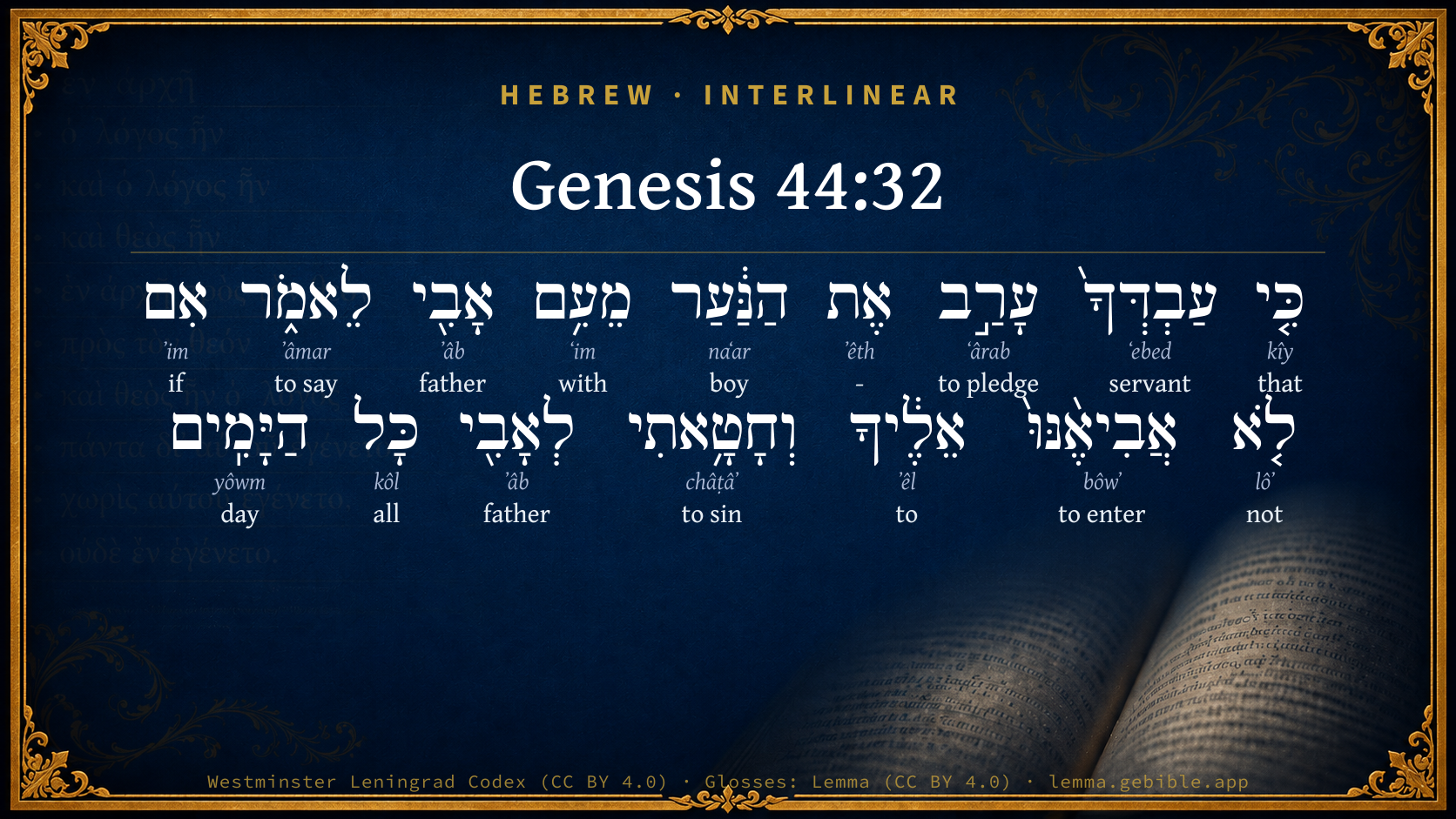
Hebrew (Westminster Leningrad Codex) Genesis 44:32 appears in the Hebrew Old Testament. The text above is from the Westminster Leningrad Codex. Each word links to its Strong’s number, a concise gloss, and parsing drawn from the Open Scriptures Hebrew Bible morphology. Click any word for its full Brown-Driver-Briggs (BDB) entry.
Download image
Cite this verse

Genesis 44:32 (World English Bible). Public Domain. Lemma interlinear Bible study tool, https://lemma.gebible.app/v/genesis/44/32.

Show BibTeX & RIS
BibTeX
RIS
English Translation
For your servant became collateral for the boy to my father, saying, 'If I don't bring him to you, then I will bear the blame to my father forever.'
World English Bible · Public Domain
Download a study sheet

One document with this verse’s original text, its word-by-word gloss line, the meaning frame, cross-references with their text, attributed commentary, and full source and license credits — printable, and it pastes into notes with its structure intact.

This verse Autodidact and up

Study sheet (.html) Plain text (.txt)

A passage Seminary Student

Up to 50 verses in one chapter. A passage sheet keeps up to 6 commentary sources and 12 cross-references per verse, in the order this page ranks them, and says so on the sheet whenever that leaves anything out. Ask for a single verse and you get the Autodidact verse sheet above.

Everything on this page stays free to read, with no account — the sheet is a download of what is already on screen, not access to it.

Want to remove ads? Support Godless Engineer
Compare translations 3

The same verse in 3 English versions, stacked beneath the original-language interlinear above. Click any original word for its lexicon entry.

Each is an independent rendering of the whole verse — the interlinear is not word-aligned to these translations.

Highlighted words mark where these versions differ — a whole-verse word diff, not a word-by-word alignment.

  • World English Bible Public Domain
    For your servant became collateral for the boy to my father, saying, 'If I don't bring him to you, then I will bear the blame to my father forever.'
  • King James Version Public Domain
    For thy servant became surety for the lad unto my father, saying, If I bring him not unto thee, then I shall bear the blame to my father for ever.
  • unfoldingWord Literal Text CC BY-SA 4.0
    For your servant guaranteed the young man to my father, saying, ‘If I do not bring him to you, then I will have sinned against my father all the days.’

unfoldingWord Literal Text — © unfoldingWord, licensed CC BY-SA 4.0. Word-aligned USFM3 via Door43 (git.door43.org/unfoldingWord/en_ult).

Versions to compare (up to 4)

3 of 4 selected

Show all 18 translations

Every available English version of this verse, each an independent rendering of the whole verse.

  • World English Bible Public Domain
    For your servant became collateral for the boy to my father, saying, 'If I don't bring him to you, then I will bear the blame to my father forever.'
  • Berean Standard Bible Public Domain
    Indeed, your servant guaranteed the boy’s safety to my father, saying, ‘If I do not return him to you, I will bear the guilt before you, my father, all my life.’
  • Majority Standard Bible Public Domain
    Indeed, your servant guaranteed the boy’s safety to my father, saying, ‘If I do not return him to you, I will bear the guilt before you, my father, all my life.’
  • King James Version Public Domain
    For thy servant became surety for the lad unto my father, saying, If I bring him not unto thee, then I shall bear the blame to my father for ever.
  • American Standard Version (1901) Public Domain
    For thy servant became surety for the lad unto my father, saying, If I bring him not unto thee, then shall I bear the blame to my father for ever.
  • Revised Version (1885) Public Domain
    For thy servant became surety for the lad unto my father, saying, If I bring him not unto thee, then shall I bear the blame to my father for ever.
  • Geneva Bible (1599) Public Domain
    Doubtlesse thy seruant became suertie for the childe to my father, and said, If I bring him not vnto thee againe, then I will beare the blame vnto my father for euer.
  • Douay-Rheims (1899) Public Domain
    Let me be tht proper servant, who took him into my trust, and promised, saying: If I bring him not again, I will be guilty of sin against my father for ever.
  • Young's Literal Translation Public Domain
    for thy servant obtained the youth by surety from my father, saying, If I bring him not in unto thee -- then I have sinned against my father all the days.
  • Literal Standard Version CC BY-SA 4.0
    for your servant obtained the youth by guarantee to my father, saying, If I do not bring him to you—then I have sinned against my father all the days.
  • Unlocked Literal Bible CC BY-SA 4.0
    For your servant became a guarantee for the boy to my father and said, 'If I do not bring him to you, then I will bear the guilt to my father forever.'
  • unfoldingWord Literal Text CC BY-SA 4.0
    For your servant guaranteed the young man to my father, saying, ‘If I do not bring him to you, then I will have sinned against my father all the days.’
  • Darby Bible Public Domain
    For thy servant became surety for the lad to my father, saying, If I bring him not to thee, then I shall be guilty toward my father all my days.
  • World Messianic Bible Public Domain
    For your servant became collateral for the boy to my father, saying, ‘If I don’t bring him to you, then I will bear the blame to my father forever.’
  • Webster's Bible Public Domain
    For thy servant became surety for the lad to my father, saying, If I bring him not to thee, then I will bear the blame to my father for ever.
  • Free Bible Version CC BY-SA 4.0
    In fact I gave myself as the guarantee for the boy to my father. I told him, ‘If I don't bring him back to you, then I will always carry the blame!’
  • Bible in Basic English Public Domain
    For I made myself responsible for the boy to my father, saying, If I do not give him safely back to you, let mine be the sin for ever.
  • JPS Tanakh (1917) Public Domain
    For thy servant became surety for the lad unto my father, saying: If I bring him not unto thee, then shall I bear the blame to my father for ever.

Literal Standard Version (2020), Covenant Press — licensed CC BY-SA 4.0. Text via the HelloAO Bible API (eBible.org). Unlocked Literal Bible (unfoldingWord) — licensed CC BY-SA 4.0. Text via the HelloAO Bible API (eBible.org). unfoldingWord Literal Text — © unfoldingWord, licensed CC BY-SA 4.0. Word-aligned USFM3 via Door43 (git.door43.org/unfoldingWord/en_ult). Free Bible Version, Dr. Jonathan Gallagher — licensed CC BY-SA 4.0. Text via the HelloAO Bible API (eBible.org).

Word by word

More ways to search: Search by grammar → Find every occurrence → Compare this word →

Practice this passage: Drill this verse → Learn its vocabulary →

עָרַ֣ב
ʻârab
H6148
“to pledge”
Verb, Qal, Perfect, 3rd Person, Masculine, Singular
Part of Speech
Verb
Stem
Qal
Form
Perfect
Person
3rd Person
Gender
Masculine
Number
Singular
Full BDB Definition

Origin: a primitive root

TWOT: 1686

to pledge, exchange, mortgage, engage, occupy, undertake for, give pledges, be or become surety, take on pledge, give in pledge - (Qal) - to take on pledge, go surety for - to give in pledge - to exchange - to pledge - (Hithpael) - to exchange pledges - to have fellowship with, share
  1. כִּ֤י kîy H3588 “that” Conjunction
  2. עַבְדְּךָ֙ ʻebed H5650 “servant · your” Noun, Common, Masculine, Singular, Construct + Suffix, Personal, 2nd Person, Masculine, Singular
  3. אֶת ʼêth H853 “-” Particle, Direct Object
  4. הַנַּ֔עַר naʻar H5288 “the · boy” Particle, Definite Article + Noun, Common, Masculine, Singular, Absolute
  5. מֵעִ֥ם ʻim H5973 “from · with” Preposition + Preposition
  6. אָבִ֖י ʼâb H1 “father · my” Noun, Common, Masculine, Singular, Construct + Suffix, Personal, 1st Person, Common, Singular
  7. לֵאמֹ֑ר ʼâmar H559 “to say” Preposition + Verb, Qal, Infinitive Construct
  8. אִם ʼim H518 “if” Conjunction
  9. לֹ֤א lôʼ H3808 “not” Particle, Negative
  10. אֲבִיאֶ֨נּוּ֙ bôwʼ H935 “to enter · him” Verb, Hiphil, Imperfect, 1st Person, Common, Singular + Suffix, Personal, 3rd Person, Masculine, Singular
  11. אֵלֶ֔יךָ ʼêl H413 “to · you” Preposition + Suffix, Personal, 2nd Person, Masculine, Singular
  12. וְחָטָ֥אתִי châṭâʼ H2398 “and · to sin” Conjunction + Verb, Qal, Sequential Perfect, 1st Person, Common, Singular
  13. לְאָבִ֖י ʼâb H1 “to/for · father · my” Preposition + Noun, Common, Masculine, Singular, Construct + Suffix, Personal, 1st Person, Common, Singular
  14. כָּל kôl H3605 “all of” Noun, Common, Masculine, Singular, Construct
  15. הַיָּמִֽים yôwm H3117 “the · days” Particle, Definite Article + Noun, Common, Masculine, Plural, Absolute

About this verse

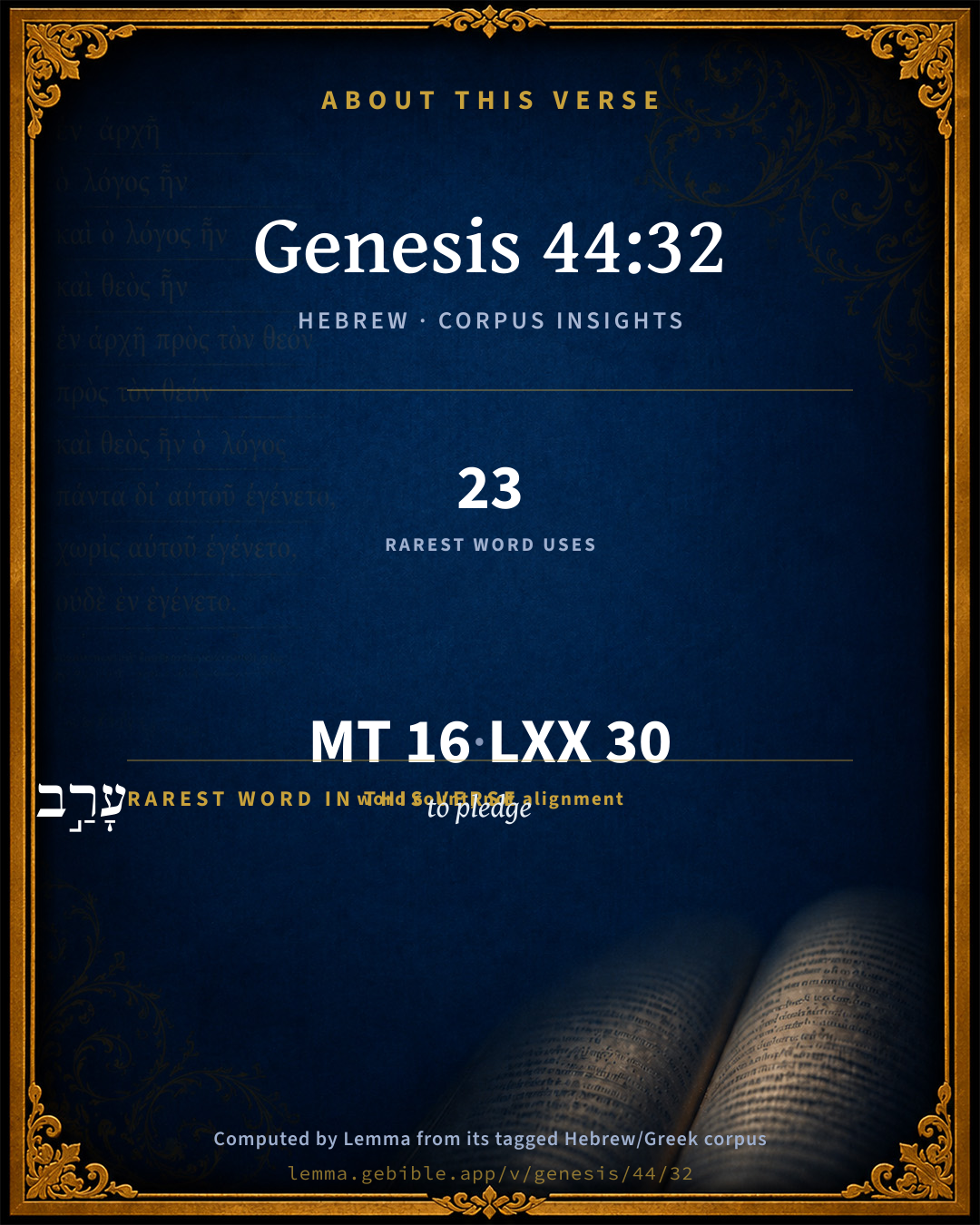
These counts appear in no published source. They are computed here, from the morphology-tagged text and Lemma’s own curated glosses. What Lemma adds →

16
words
15
distinct lemmas
Pentateuch
section

Notable vocabulary

The rarest word here is עָרַ֣ב to pledge H6148 — appearing just 23 times in the whole Hebrew Bible.

Shared distinctive vocabulary

עָרַ֣ב to pledge H6148 occurs in 23 verses of the Hebrew Bible. Also found in:

Grammatical profile

  • 4 verbs
  • 6 nouns
  • 2 prepositions
  • 2 conjunctions
  • 2 particles

Verb forms

  • עָרַ֣ב Qal · Perfect
  • לֵאמֹ֑ר Qal · Infinitive Construct
  • אֲבִיאֶ֨נּוּ֙ Hiphil · Imperfect
  • וְחָטָ֥אתִי Qal · Sequential Perfect

Repetition

A word recurs within this verse — often emphatic in Hebrew:

  • אָבִ֖י father H1 ×2

Hebrew & Septuagint length

In English translation the verse runs 29 words from the Hebrew and 34 from the Septuagint (LXX English) — closely comparable.

A rough comparison of the two English renderings, which tokenize alike — not a word-level alignment.

Word counts can differ between the Hebrew and the Greek without any difference in meaning — e.g. the Hebrew direct-object marker אֵת has no separate Greek word, and Greek often adds the article ὁ.

In the original languages it is 16 Hebrew tokens and 30 Greek tokens — but the two are counted differently (Hebrew bundles its prefixes and suffixes into one token; the Greek is in lemma form), so that isn’t a like-for-like length.

Cross-references

2

Topical passages linked to Genesis 44:32 in the Treasury of Scripture Knowledge — connected by theme and wording, ordered by reader-vote popularity; previews shown in the World English Bible.

  • Genesis 43:8–9 Judah said to Israel, his father, "Send the boy with me, and we will arise and go, so that we may live, and not die, both we, and you, and also our little ones.
  • Genesis 43:16 When Joseph saw Benjamin with them, he said to the steward of his house, "Bring the men into the house, and butcher an animal, and make ready; for the men will dine with me at noon."

Cross-references courtesy of OpenBible.info (CC BY 4.0).

Hebrew and Greek witnesses Masoretic Hebrew ↔ Greek Septuagint

The same verse in the two great witnesses to the Old Testament, shown verse-for-verse.

These are two independent witnesses, not word-aligned to each other, and the Septuagint is shown in lemma (dictionary) form.

Hebrew Genesis 44:32 Masoretic · Westminster Leningrad Codex

כִּ֤י עַבְדְּךָ֙ עָרַ֣ב אֶת הַנַּ֔עַר מֵעִ֥ם אָבִ֖י לֵאמֹ֑ר אִם לֹ֤א אֲבִיאֶ֨נּוּ֙ אֵלֶ֔יךָ וְחָטָ֥אתִי לְאָבִ֖י כָּל הַיָּמִֽים

For your servant became collateral for the boy to my father, saying, 'If I don't bring him to you, then I will bear the blame to my father forever.'

World English Bible · Public Domain

Greek LXX Genesis 44:32 Septuagint · lemma form

ὁ γάρ παῖς σύ ἐκδέχομαι ὁ παιδίον παρά ὁ πατήρ λέγω ἐάν μή ἄγω αὐτός πρός σύ καί ἵστημι αὐτός ἐναντίον σύ ἁμαρτάνω εἰμί πρός ὁ πατήρ πᾶς ὁ ἡμέρα

For your servant has received the boy in charge from his father, saying, If I bring him not to you, and place him before you, I shall be guilty towards my father for ever.

LXX2012 (modern English Septuagint) · Public Domain

Hebrew: Westminster Leningrad Codex (CC BY 4.0). Greek: Septuagint (public domain); English from LXX2012 (modern English Septuagint) (Public Domain). How the Septuagint differs from the Hebrew →

Targum (Aramaic paraphrase)

2

The Targum is the ancient Jewish Aramaic paraphrase of the Hebrew Scriptures — an interpretive translation, not the Hebrew text itself. Onkelos (literal) and Pseudo-Jonathan (expansive) render the Torah, and Jonathan the Prophets. Coverage is partial: where no permissively-licensed English translation exists for a verse, only the Aramaic is shown. This is verse-level text, not a word-by-word alignment to the Hebrew.

  1. Targum Onkelos Torah (Genesis–Deuteronomy)
    אֲרֵי עַבְדָּךְ מְעָרַב בְּעוּלֵימָא מִן אַבָּא לְמֵימָר אִם לָא אַיְתִנֵּהּ לְוָתָךְ וָאֱהִי חָטֵי לְאַבָּא כָּל יוֹמַיָּא

    (no public-domain English translation for this verse)

    Targum Onkelos — Aramaic: “Onkelos Genesis” (public domain); “Onkelos Exodus” (public domain); “Onkelos Leviticus” (public domain); “Onkelos Numbers” (public domain); “Onkelos Deuteronomy” (public domain). English: “Sefaria Community Translation” (CC0 1.0 (public-domain dedication)); “J.W. Etheridge. The Targums of Onkelos and Jonathan Ben Uzziel on the Pentateuch. London: Longmans, Green, 1862” (public domain). Text via Sefaria.

  2. Targum Pseudo-Jonathan Torah (Genesis–Deuteronomy)
    אֲרוּם עַבְדָךְ מְעָרַב בְּטַלְיָא מִן אַבָּא לְמֵימַר אִין לָא אַיְיתִינֵיהּ לְוָתָךְ וְנִתְחַיֵיב קֳדָם אַבָּא כָּל יוֹמַיָא

    Therefore thy servant became surety for the youth with my father, saying, If I restore him not to thee, let me be guilty before my father all the days.

    Targum Pseudo-Jonathan — Aramaic: “Targum Jonathan on Genesis” (public domain); “Targum Jonathan on Exodus” (public domain); “Targum Jonathan on Leviticus” (public domain); “Targum Jonathan on Numbers” (public domain); “Targum Jonathan on Deuteronomy” (public domain). English: “The Targum of Jonathan ben Uzziel, trans. J. W. Etheridge, London, 1862” (public domain). Text via Sefaria.

Commentary

Notes on Genesis 44:32 from classic Christian and Jewish commentators (each source and its license shown beneath its notes). The classic Christian expositions comment on the surrounding passage and are grouped to its opening verse, so a note may address several verses; the Jewish commentaries on the Tanakh (Rashi and others) are per-verse, so they appear only where the commentator wrote on this verse.

Lemma curates 59 commentaries, every one of them public domain or Creative Commons licensed, each selected and text-cleaned for this edition rather than reprinted as found. About our sources →

Trapp's Complete Commentary

John Trapp

Gen 44:32 For thy servant became surety for the lad unto my father, saying, If I bring him not unto thee, then I shall bear the blame to my father for ever.

Ver. 32. For thy servant became surety.] So did Christ for us; and therefore he must acquit us of all our sins, ere he could go to his Father. Lo, herein lies the strength of that reason, "He shall convince the world of righteousness, because I go to my Father." {Joh 16:10}

John Trapp, A Commentary or Exposition upon All the Books of the Old and New Testament (1647–1656) — public domain. Text from a community e-Sword module.

Tyndale Open Study Notes

Tyndale Open Resources

44:32-34 Judah was willing to give up his family, his future, and his freedom for others.

Tyndale Open Study Notes — © Tyndale Open Resources, licensed CC BY-SA 4.0. Text via the HelloAO Bible API.

The Cambridge Bible for Schools and Colleges

gen. ed. J. J. S. Perowne

32. surety] Cf. Gen_43:9.

The Cambridge Bible for Schools and Colleges (gen. ed. J. J. S. Perowne; Cambridge University Press, 1878–1918) — public domain. Text from a community e-Sword module.

John Gill's Exposition

For thy servant became surety for the lad unto my father,.... Which is another argument used for the release of Benjamin, though he should be detained for him, which he offers to be:

saying, if I bring him not unto thee, then I shall bear the blame unto my father for ever; See Gill on Gen 43:9.

John Gill's Exposition of the Whole Bible (1746–1763) — public domain (CC PDM 1.0). Text via the HelloAO Bible API.

The Pulpit Commentary

HOMILIES BY F. HASTINGS Ver. 32.

A surety.

thy servant became surety for the lad unto his father." The brethren of Joseph had been surprised on their second visit to Egypt at the cordiality of their reception. They started homewards with well-laden sacks and trembling gladness. They had not gone far when they were overtaken, their sacks searched, and the cup found. With depressed spirits and dreary forebodings they were brought back to the city, and into the presence of Joseph. Joseph had several motives in his strange treatment of his brethren. He may have desired in some way to punish them for their sin against himself by letting them taste some of the bitterness he had experienced when, ruthlessly torn from his home, he was sent a shrinking slave into a distant land. Human nature was strong in Joseph as in others. His brethren had to learn the nature of their own sin by suffering. They have also to learn that their lives were forfeited by sin to justice. He wished also to bring them to a state of humility, so that they should afterwards behave rightly to each other. He may have had doubts as to the safety of his own brother Benjamin with them. He tests thus their interest in their halfbrother, for they could have left with some sort of excuse Benjamin as a slave in Egypt. He tests also their regard for their father, and finds out also how they would look upon himself when he should reveal himself to them. Judah is the spokesman for the rest in the painful circumstances in which they are all placed. Joseph proposes to keep only Benjamin as a slave, but Judah draws near, and with deepest humility and heartfelt earnestness pleads with Joseph. Consider

I JUDAH"S PLEADING.

1. Judah pleads as surety for Benjamin, and as a brother. We find that it is Judah and not Reuben who pleads now for the life of a brother. Age has mellowed the fierce Judah. We cannot always tell from what a man is in his early years what he will be later on.

(1) Judah admits the wrong, attempts no excuse or extenuation. All evidence was against Benjamin. Judah and the rest cannot tell what to think of the act. He admitted it. We must admit our sin.

(2) Confessed that it was right that Benjamin and they should suffer. Some blame others for their circumstances and sins. To all appearance here Benjamin was alone to blame.

(3) He throws himself on the righteousness and compassion of Joseph. This is all we can do before God. He pleads the pain which it will cause to his father. His appeal is most pathetic. Read it, and the fount of tears must be touched. In all the volumes of fiction ever written there is nothing to surpass the tenderness and pathos of this pleading of Judah.

2. We learn from this position and pleading of Judah as to how we should approach God. We have sinned and can only throw ourselves on his mercy. We see also how Christ pleads for us. His pleading is real and earnest. He prayed on earth for his disciples. The present is a dispensation of mediation. Hence Christ still pleads as our surety in heaven.

II JUDAH"S OFFER. He is ready to be bound for Benjamin. It is one thing to talk, another to act. He had promised his father to bring Benjamin, (Gen_43:9) and he wishes to keep his word. He became surety, a guarantee, as one who is bound by signing a paper. He was answerable to his father. He is ready to give his service for Benjamin, his life for his brother. His faithfulness was thus proved. Christ is our surety. He makes himself one with us. (Heb_2:11) He sprang from Judah. (Heb_7:14) He became one with us in nature and in temptation, and was accepted as our substitute, was bound, abused, and crucified. He bore the curse for us. (Gal_3:13) He sacrificed himself for us. Christ died for us who were below him. We may see in the success of Judah"s pleading an indication of the success of Jesus" work. Joseph needed no entreaty to be merciful to Benjamin. He was nearer of kin to Benjamin than Judah was. So God is our Father. Joseph only wished to see the brethren in a fit state to be forgiven. They were entirely forgiven (vers. 5-15). He forgave freely, and wished them to forgive themselves. He knew very well that if they began to blame themselves too much, or to upbraid each other, they would never be happy. Forgiveness should produce peace.

1. Let us see ourselves in those suppliant brothers of Joseph.

2. Let us see in Judah how Christ pleads for us, and with what power. Certainly he excelled in his appeal, in wisdom, boldness, eloquence, tenderness, and self-sacrifice. How much more should we not praise Jesus for his power, his life, his love, sufferings, death, and present intercession.

3. Let us then trust him. What would have been thought of the others if they should have said to Judah, "You are not equal to being surety for him," or" You are not of sufficient standing, not above us, so as to speak in the name of the rest"? And is not Christ equal to the work of securing our salvation? If he can do it, shall we attempt to mar by our meddling? Full atonement is made, as well as powerful intercession offered. What we have to do is to trust Christ"s work. Let us give up hope of preparing ourselves. He is not like some who are sureties, and are unwilling to pay. He has paid. The law and justice have nothing to demand. Should either present a claim, point to the cross, for that answers all demands. Oh the mystery of redeeming love! Oh the simplicity and yet the depth of meaning contained in that work of Christ! It is a stumbling-block to the high-minded, but a salvation to the humble. H.

The Pulpit Commentary (1880–1919), ed. H.D.M. Spence-Jones & Joseph S. Exell — public domain. Text from a community e-Sword module.

Rashi

Rabbi Shlomo Yitzchaki (Rashi)

כי עבדך ערב את הנער FOR THY SERVANT BECAME SURETY FOR THE LAD — Should you ask why I enter into the contest (champion his cause) more strongly than my other brothers — then I tell you: I have more to lose; they all stand outside the matter (are less concerned with it than I am), but I have placed myself under a firm bond to be an outcast in both worlds.

Rashi on the Tanakh — English translations: “The Judaica Press complete Tanach with Rashi, translated by A. J. Rosenberg” (CC BY 4.0); “Pentateuch with Rashi's commentary by M. Rosenbaum and A.M. Silbermann, 1929-1934” (public domain); “The Metsudah Tanach series, Lakewood, N.J” (CC BY 4.0); and “The Book of Joshua, Metsudah Publications, 1997” (CC BY 4.0). Text via Sefaria.

Ramban (Nachmanides)

Rabbi Moshe ben Nachman (Ramban / Nachmanides)

FOR THY SERVANT BECAME SURETY FOR THE LAD. Judah is saying that his father will go down with sorrow to the grave on account of the lad, for “despite all that we have said to him, the aged father did not want to send him until I became surety for him, and he trusted me. Therefore, let thy servant, I pray thee, abide in his stead.” And if the explanation of the verse, And thy servants will bring down the gray hairs of thy servant our father…to the grave, is in line with the plain meaning thereof, [namely, that the responsibility will fall upon the brothers, as opposed to Ramban’s previous interpretation that “thy servants” is a euphemism for Joseph, then Judah] is saying that “we will have caused the death of the aged father by sorrow, for I was surety for the lad.”

Ramban (Nachmanides) on the Tanakh — English translation: “Commentary on the Torah by Ramban (Nachmanides). Translated and annotated by Charles B. Chavel. New York, Shilo Pub. House, 1971-1976” (CC BY 4.0). Text via Sefaria.

Radak

Rabbi David Kimhi (Radak)

כי עבדך ערב את הנער, I have guaranteed him; if you now do not want to forgive his presumed guilt, take me in his stead because I am more useful to you as a slave than he is.

Radak on the Tanakh — English translations: “Sefaria Community Translation” (CC0 1.0 (public-domain dedication)); “Eliyahu Munk, HaChut Hameshulash” (CC BY 4.0); “Rabbi Mike Feuer, Jerusalem Anthology” (CC BY 4.0); and “R. David Kimhi on the first book of Psalms, Translated by R.G. Finch, London, 1919” (public domain). Text via Sefaria.

Lesson kit

Teaching starters — assembled from the data on this page, not authored interpretation. Every prompt links to the verse data it draws on. Edit before teaching.

Genesis, in the Pentateuch, opens this verse with 16 words (15 distinct Hebrew lemmas). Its most distinctive word is ʻârab (“to pledge”). A historical commentator’s framing appears above. Read the whole chapter for the surrounding context.

Discussion questions

  1. What does “to pledge” (ʻârab) contribute to the verse as a whole?
  2. How does Genesis 43:9, which shares the word «to pledge», read alongside this verse?
  3. What does the repetition of “father” (2× in this one verse) do in this verse?
  4. These translations render this verse differently; the difference is in the English rendering, not the original. What questions does that raise?
  5. «עָרַ֣ב» is a Qal Perfect verb. How does that grammatical form shape the action described?
  6. Compare how Trapp's Complete Commentary and Tyndale Open Study Notes read this verse. Where do they agree or differ?

Things to notice

Reading settings

Reading text

Shown beneath each verse's original-language words.

Old Testament
Old Testament edition

Read the OT as the Masoretic Hebrew (MT) or the Greek Septuagint (LXX).

English shown for the Greek Septuagint (in the Hebrew ↔ Greek comparison).

Comparing translations? Open the Compare panel on any verse page to stack up to four side by side.