Genesis 12:14

Hebrew (Westminster Leningrad Codex) Genesis 12:14 appears in the Hebrew Old Testament. The text above is from the Westminster Leningrad Codex. Each word links to its Strong’s number, a concise gloss, and parsing drawn from the Open Scriptures Hebrew Bible morphology. Click any word for its full Brown-Driver-Briggs (BDB) entry.
Download image
Cite this verse

Genesis 12:14 (World English Bible). Public Domain. Lemma interlinear Bible study tool, https://lemma.gebible.app/v/genesis/12/14.

Show BibTeX & RIS
BibTeX
RIS
English Translation
It happened that when Abram had come into Egypt, the Egyptians saw that the woman was very beautiful.
World English Bible · Public Domain
Download a study sheet

One document with this verse’s original text, its word-by-word gloss line, the meaning frame, cross-references with their text, attributed commentary, and full source and license credits — printable, and it pastes into notes with its structure intact.

This verse Autodidact and up

Study sheet (.html) Plain text (.txt)

A passage Seminary Student

Up to 50 verses in one chapter. A passage sheet keeps up to 6 commentary sources and 12 cross-references per verse, in the order this page ranks them, and says so on the sheet whenever that leaves anything out. Ask for a single verse and you get the Autodidact verse sheet above.

Everything on this page stays free to read, with no account — the sheet is a download of what is already on screen, not access to it.

Want to remove ads? Support Godless Engineer
Compare translations 3

The same verse in 3 English versions, stacked beneath the original-language interlinear above. Click any original word for its lexicon entry.

Each is an independent rendering of the whole verse — the interlinear is not word-aligned to these translations.

Highlighted words mark where these versions differ — a whole-verse word diff, not a word-by-word alignment.

  • World English Bible Public Domain
    It happened that when Abram had come into Egypt, the Egyptians saw that the woman was very beautiful.
  • King James Version Public Domain
    And it came to pass, that, when Abram was come into Egypt, the Egyptians beheld the woman that she was very fair.
  • unfoldingWord Literal Text CC BY-SA 4.0
    Then it happened, when Abram came into Egypt, then the Egyptians saw the woman, that she very beautiful.

unfoldingWord Literal Text — © unfoldingWord, licensed CC BY-SA 4.0. Word-aligned USFM3 via Door43 (git.door43.org/unfoldingWord/en_ult).

Versions to compare (up to 4)

3 of 4 selected

Show all 18 translations

Every available English version of this verse, each an independent rendering of the whole verse.

  • World English Bible Public Domain
    It happened that when Abram had come into Egypt, the Egyptians saw that the woman was very beautiful.
  • Berean Standard Bible Public Domain
    So when Abram entered Egypt, the Egyptians saw that the woman was very beautiful.
  • Majority Standard Bible Public Domain
    So when Abram entered Egypt, the Egyptians saw that the woman was very beautiful.
  • King James Version Public Domain
    And it came to pass, that, when Abram was come into Egypt, the Egyptians beheld the woman that she was very fair.
  • American Standard Version (1901) Public Domain
    And it came to pass, that, when Abram was come into Egypt, the Egyptians beheld the woman that she was very fair.
  • Revised Version (1885) Public Domain
    And it came to pass, that, when Abram was come into Egypt, the Egyptians beheld the woman that she was very fair.
  • Geneva Bible (1599) Public Domain
    Nowe when Abram was come into Egypt, the Egyptians behelde the woman: for she was very faire.
  • Douay-Rheims (1899) Public Domain
    And when Abram was come into Egypt, the Egyptians saw the woman that she was very beautiful.
  • Young's Literal Translation Public Domain
    And it cometh to pass, at the entering of Abram into Egypt, that the Egyptians see the woman that she `is' exceeding fair;
  • Literal Standard Version CC BY-SA 4.0
    And it comes to pass, at the entering of Abram into Egypt, that the Egyptians see the woman that she [is] exceedingly beautiful;
  • Unlocked Literal Bible CC BY-SA 4.0
    It came about that when Abram entered into Egypt, the Egyptians saw that Sarai was very beautiful.
  • unfoldingWord Literal Text CC BY-SA 4.0
    Then it happened, when Abram came into Egypt, then the Egyptians saw the woman, that she very beautiful.
  • Darby Bible Public Domain
    And it came to pass when Abram came into Egypt, that the Egyptians beheld the woman that she was very fair.
  • World Messianic Bible Public Domain
    When Abram had come into Egypt, some Egyptians saw that the woman was very beautiful.
  • Webster's Bible Public Domain
    And it came to pass, that when Abram had come into Egypt, the Egyptians beheld the woman that she was very fair.
  • Free Bible Version CC BY-SA 4.0
    When Abram arrived in Egypt, the people there saw how beautiful Sarai was.
  • Bible in Basic English Public Domain
    And so it was that when Abram came into Egypt, the men of Egypt, looking on the woman, saw that she was fair.
  • JPS Tanakh (1917) Public Domain
    And it came to pass, that, when Abram was come into Egypt, the Egyptians beheld the woman that she was very fair.

Literal Standard Version (2020), Covenant Press — licensed CC BY-SA 4.0. Text via the HelloAO Bible API (eBible.org). Unlocked Literal Bible (unfoldingWord) — licensed CC BY-SA 4.0. Text via the HelloAO Bible API (eBible.org). unfoldingWord Literal Text — © unfoldingWord, licensed CC BY-SA 4.0. Word-aligned USFM3 via Door43 (git.door43.org/unfoldingWord/en_ult). Free Bible Version, Dr. Jonathan Gallagher — licensed CC BY-SA 4.0. Text via the HelloAO Bible API (eBible.org).

Word by word

More ways to search: Search by grammar → Find every occurrence → Compare this word →

Practice this passage: Drill this verse → Learn its vocabulary →

יָפָ֥ה
yâpheh
H3303
“beautiful”
Adjective, Adjective, Feminine, Singular, Absolute
Part of Speech
Adjective
Type
Adjective
Gender
Feminine
Number
Singular
State
Absolute
Full BDB Definition

Origin: from H3302

TWOT: 890a

fair, beautiful, handsome
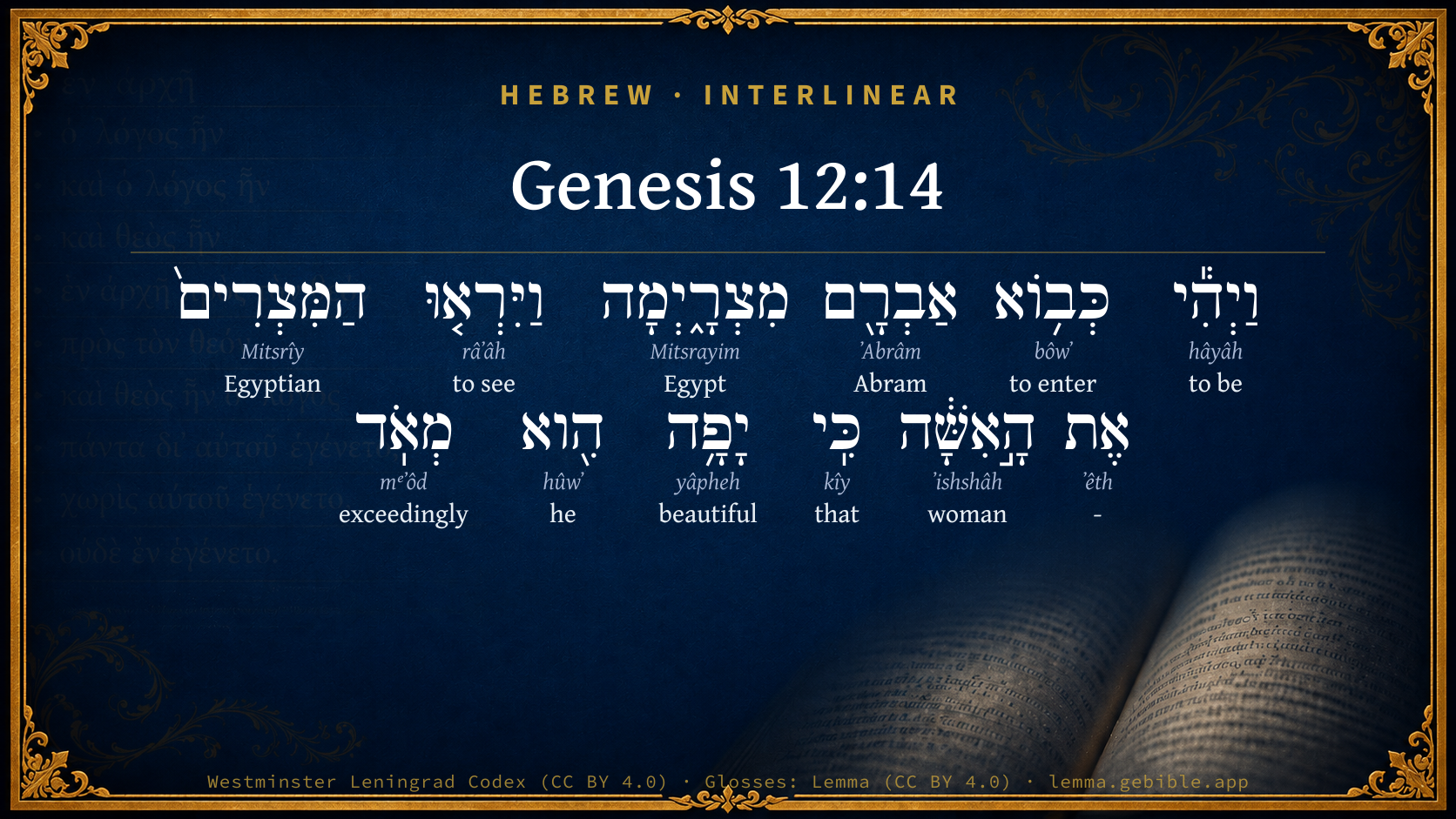
  1. וַיְהִ֕י hâyâh H1961 “and · to be” Conjunction + Verb, Qal, Sequential Imperfect, 3rd Person, Masculine, Singular
  2. כְּב֥וֹא bôwʼ H935 “like/as · to enter” Preposition + Verb, Qal, Infinitive Construct
  3. אַבְרָ֖ם ʼAbrâm H87 “Abram” Noun, Proper
  4. מִצְרָ֑יְמָה Mitsrayim H4714 “Egypt · toward” Noun, Proper + Suffix, Demonstrative
  5. וַיִּרְא֤וּ râʼâh H7200 “and · to see” Conjunction + Verb, Qal, Sequential Imperfect, 3rd Person, Masculine, Plural
  6. הַמִּצְרִים֙ Mitsrîy H4713 “the · Egyptians” Particle, Definite Article + Noun, Gentilic, Masculine, Plural, Absolute
  7. אֶת ʼêth H853 “-” Particle, Direct Object
  8. הָ֣אִשָּׁ֔ה ʼishshâh H802 “the · woman” Particle, Definite Article + Noun, Common, Feminine, Singular, Absolute
  9. כִּֽי kîy H3588 “that” Conjunction
  10. הִ֖וא hûwʼ H1931 “he” Pronoun, Personal, 3rd Person, Feminine, Singular
  11. מְאֹֽד mᵉʼôd H3966 “exceedingly” Adverb

About this verse

These counts appear in no published source. They are computed here, from the morphology-tagged text and Lemma’s own curated glosses. What Lemma adds →

12
words
12
distinct lemmas
Pentateuch
section

Shared distinctive vocabulary

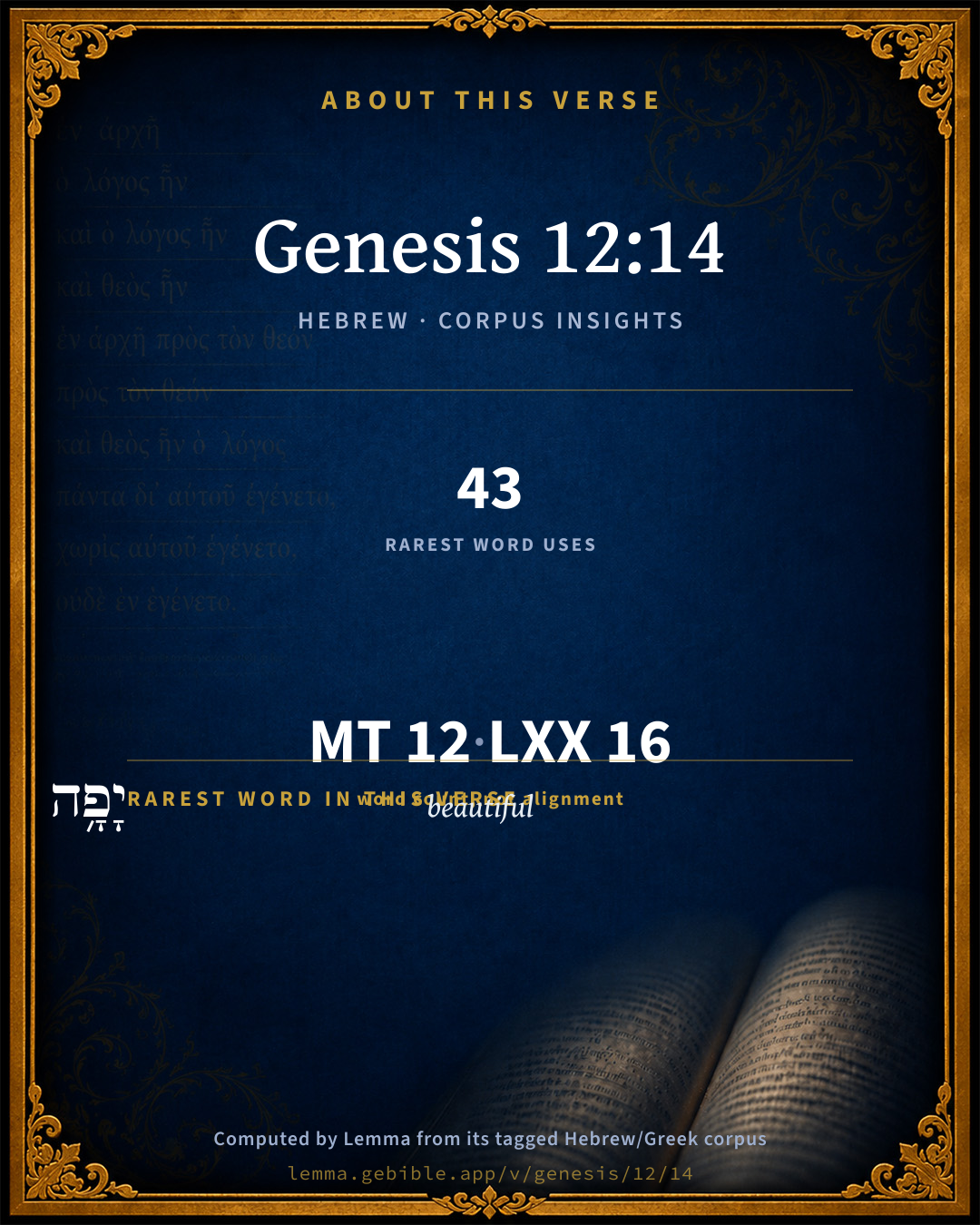
יָפָ֥ה beautiful H3303 occurs in 39 verses of the Hebrew Bible. Also found in:

Grammatical profile

  • 3 verbs
  • 4 nouns
  • 1 adjective
  • 1 pronoun
  • 1 conjunction
  • 1 adverb
  • 1 particle

Verb forms

  • וַיְהִ֕י Qal · Sequential Imperfect
  • כְּב֥וֹא Qal · Infinitive Construct
  • וַיִּרְא֤וּ Qal · Sequential Imperfect

Hebrew & Septuagint length

In English translation the verse runs 18 words from the Hebrew and 20 from the Septuagint (LXX English) — closely comparable.

A rough comparison of the two English renderings, which tokenize alike — not a word-level alignment.

Word counts can differ between the Hebrew and the Greek without any difference in meaning — e.g. the Hebrew direct-object marker אֵת has no separate Greek word, and Greek often adds the article ὁ.

In the original languages it is 12 Hebrew tokens and 16 Greek tokens — but the two are counted differently (Hebrew bundles its prefixes and suffixes into one token; the Greek is in lemma form), so that isn’t a like-for-like length.

Cross-references

4

Topical passages linked to Genesis 12:14 in the Treasury of Scripture Knowledge — connected by theme and wording, ordered by reader-vote popularity; previews shown in the World English Bible.

  • Genesis 3:6 When the woman saw that the tree was good for food, and that it was a delight to the eyes, and that the tree was to be desired to make one wise, she took of the fruit of it, and ate; and she gave some to her husband with her, and he ate.
  • Genesis 6:2 that God's sons saw that men's daughters were beautiful, and they took for themselves wives of all that they chose.
  • Genesis 39:7 It happened after these things, that his master's wife cast her eyes on Joseph; and she said, "Lie with me."
  • Matthew 5:28 but I tell you that everyone who gazes at a woman to lust after her has committed adultery with her already in his heart.

Cross-references courtesy of OpenBible.info (CC BY 4.0).

Hebrew and Greek witnesses Masoretic Hebrew ↔ Greek Septuagint

The same verse in the two great witnesses to the Old Testament, shown verse-for-verse.

These are two independent witnesses, not word-aligned to each other, and the Septuagint is shown in lemma (dictionary) form.

Hebrew Genesis 12:14 Masoretic · Westminster Leningrad Codex

וַיְהִ֕י כְּב֥וֹא אַבְרָ֖ם מִצְרָ֑יְמָה וַיִּרְא֤וּ הַמִּצְרִים֙ אֶת הָ֣אִשָּׁ֔ה כִּֽי יָפָ֥ה הִ֖וא מְאֹֽד

It happened that when Abram had come into Egypt, the Egyptians saw that the woman was very beautiful.

World English Bible · Public Domain

Greek LXX Genesis 12:14 Septuagint · lemma form

γίγνομαι δέ ἡνίκα εἰςἔρχομαι αβραμ εἰς αἴγυπτος ὁράω ὁ αἰγύπτιος ὁ γυνή ὅτι καλός εἰμί σφόδρα

And it came to pass when Abram entered into Egypt—the Egyptians having seen his wife that she was very beautiful—

LXX2012 (modern English Septuagint) · Public Domain

Hebrew: Westminster Leningrad Codex (CC BY 4.0). Greek: Septuagint (public domain); English from LXX2012 (modern English Septuagint) (Public Domain). How the Septuagint differs from the Hebrew →

Targum (Aramaic paraphrase)

2

The Targum is the ancient Jewish Aramaic paraphrase of the Hebrew Scriptures — an interpretive translation, not the Hebrew text itself. Onkelos (literal) and Pseudo-Jonathan (expansive) render the Torah, and Jonathan the Prophets. Coverage is partial: where no permissively-licensed English translation exists for a verse, only the Aramaic is shown. This is verse-level text, not a word-by-word alignment to the Hebrew.

  1. Targum Onkelos Torah (Genesis–Deuteronomy)
    וַהֲוָה כַּד עַל אַבְרָם לְמִצְרָיִם וַחֲזוֹ מִצְרָאֵי יָת אִתְּתָא אֲרֵי שַׁפִּירָא הִיא לַחֲדָא

    And it was that when Abram had entered into Mizraim, the Mizraee saw the woman that she was singularly fair;

    Targum Onkelos — Aramaic: “Onkelos Genesis” (public domain); “Onkelos Exodus” (public domain); “Onkelos Leviticus” (public domain); “Onkelos Numbers” (public domain); “Onkelos Deuteronomy” (public domain). English: “Sefaria Community Translation” (CC0 1.0 (public-domain dedication)); “J.W. Etheridge. The Targums of Onkelos and Jonathan Ben Uzziel on the Pentateuch. London: Longmans, Green, 1862” (public domain). Text via Sefaria.

  2. Targum Pseudo-Jonathan Torah (Genesis–Deuteronomy)
    וַהֲוָה כַּד עַל אַבְרָם לְמִצְרַיִם וְחָמוּן מִצְרָאֵי יַת אִנְתְּתָא אֲרוּם שַׁפִּירָא הִיא לַחֲדָא

    And it was when Abram had entered Mizraim, the Mizraee saw the woman to be very fair;

    Targum Pseudo-Jonathan — Aramaic: “Targum Jonathan on Genesis” (public domain); “Targum Jonathan on Exodus” (public domain); “Targum Jonathan on Leviticus” (public domain); “Targum Jonathan on Numbers” (public domain); “Targum Jonathan on Deuteronomy” (public domain). English: “The Targum of Jonathan ben Uzziel, trans. J. W. Etheridge, London, 1862” (public domain). Text via Sefaria.

Commentary

Notes on Genesis 12:14 from classic Christian and Jewish commentators (each source and its license shown beneath its notes). The classic Christian expositions comment on the surrounding passage and are grouped to its opening verse, so a note may address several verses; the Jewish commentaries on the Tanakh (Rashi and others) are per-verse, so they appear only where the commentator wrote on this verse.

Lemma curates 59 commentaries, every one of them public domain or Creative Commons licensed, each selected and text-cleaned for this edition rather than reprinted as found. About our sources →

Trapp's Complete Commentary

John Trapp

Gen 12:14 And it came to pass, that, when Abram was come into Egypt, the Egyptians beheld the woman that she [was] very fair.

Ver. 14. The Egyptians beheld the woman.] Pleasure is blamed, in Xenophon, for this, that she ever and anon looketh back upon her own shadow, and giveth her eyes leave to rove and range without restraint. An honest man, saith Plautus, should have continent eyes, hands, and tongue. {a} Nihil enim interest quibus membris cinoedi sitis posterioribus an prioribus , said Archelaus, the philosopher, to a wanton young gentleman. The eye (that light of all the members) is an ornament to the whole body. And yet that lightsome part of the body draweth too oft the whole soul into darkness. This Job knew, and therefore "made a covenant" {Job 31:1} to look to his looks; {b} sith of looking came lusting. Charles V., when the city of Antwerp thought to gratify him in a mask with the sight of certain fair maids brought in before him almost naked, he would not once look at them. {c} The young Lord Harrington, when he should meet with fair women in the streets, or elsewhere, would usually pull his hat over his eyes, as knowing that of our Saviour, "He that looks upon a woman, to lust after her," &c., whereupon immediately follows, "If thine eye offend thee," &c. {d} Eckius was sharply rebuked at a feast, by a modest matron, for his uncivil glances and behavior, in these words (as Melancthon relateth), Es tu doctor? Non existimo te in honesta familia, sed in lupanari educatum . Thou a doctor? I do not believe thou wast bred anywhere else but in a brothel house. {See Trapp on "Gen 6:2"}

{a} Decet habere oculos continentes, manus et linguam.

{b} Joh. Manlii, loc. com., p. 345.

{c} Saepe clausit fenestra, ne inspiceret formosiores feminas ,& c. - De Carolo V., Pareus Hist., pref. medul., p. 908.

{d} Joh. Manlii, loc. com., p. 327.

John Trapp, A Commentary or Exposition upon All the Books of the Old and New Testament (1647–1656) — public domain. Text from a community e-Sword module.

Tyndale Open Study Notes

Tyndale Open Resources

12:14-16 Abram was bound by the king’s gift to an unwanted agreement about Sarai that he could not prevent. His scheme had resulted in a terrible bind that endangered him, Sarai, and the promise. • Abram appeared to prosper from his deception, but the new possessions also caused crises. Abram and Lot had to separate (ch 13), and Hagar, an Egyptian maiden, became the mother of the Ishmaelites, perennial enemies of Israel (ch 16).

12:14-15 Sarai was 65 years old, but she lived to be 127; she was like a modern childless woman of about 35. She and Abram came from a noble family (see study note on 11:29), so she was regal in her person and dress. Pharaoh was attracted by her physical appearance and her political assets.

Tyndale Open Study Notes — © Tyndale Open Resources, licensed CC BY-SA 4.0. Text via the HelloAO Bible API.

Matthew Henry's Commentary

Here is, I. The danger Sarai was in of having her chastity violated by the king of Egypt: and without doubt the peril of sin is the greatest peril we can be in. Pharaoh's princes (his pimps rather) saw her, and, observing what a comely woman she was, they commended her before Pharaoh, not for that which was really her praise - her virtue and modesty, her faith and piety (these were no excellencies in their eyes), but for her beauty, which they thought too good for the embraces of a subject. They recommended her to the king, and she was presently taken into Pharaoh's house, as Esther into the seraglio of Ahasuerus (Est 2:8), in order to her being taken into his bed. Now we must not look upon Sarai as standing fair for preferment, but as entering into temptation; and the occasions of it were her own beauty (which is a snare to many) and Abram's equivocation, which is a sin that commonly is an inlet to much sin. While Sarai was in this danger, Abram fared the better for her sake. Pharaoh gave him sheep, oxen, etc. (v. 16), to gain his consent, that he might the more readily prevail with her whom he supposed to be his sister. We cannot think that Abram expected this when he came down into Egypt, much less that he had an eye to it when he denied his wife; but God brought good out of evil. And thus the wealth of the sinner proves, in some way or other, to be laid up for the just.

II. The deliverance of Sarai from this danger. For if God did not deliver us, many a time, by prerogative, out of those straits and distresses which we bring ourselves into by our own sin and folly, and which therefore we could not expect any deliverance from by promise, we should soon be ruined, nay, we should have been ruined long before this. He deals not with us according to our deserts.

1. God chastised Pharaoh, and so prevented the progress of his sin. Note, Those are happy chastisements that hinder us in a sinful way, and effectually bring us to our duty, and particularly to the duty of restoring that which we have wrongfully taken and detained. Observe, Not Pharaoh only, but his house, was plagued, probably those princes especially that had commended Sarai to Pharaoh. Note, Partners in sin are justly made partners in the punishment. Those that serve others' lusts must expect to share in their plagues. We are not told particularly what these plagues were; but doubtless there was something in the plagues themselves, or some explication added to them, sufficient to convince them that it was for Sarai's sake that they were thus plagued.

2. Pharaoh reproved Abram, and then dismissed him with respect.

(1.) The reproof was calm, but very just: What is this that thou hast done? What an improper thing! How unbecoming a wise and good man! Note, If those that profess religion do that which is unfair and disingenuous, especially if they say that which borders upon a lie, they must expect to hear of it, and have reason to thank those that will tell them of it. We find a prophet of the Lord justly reproved and upbraided by a heathen ship-master, Jon 1:6. Pharaoh reasons with him: Why didst thou not tell me that she was thy wife? intimating that, if he had known this, he would not have taken her into his house. Note, It is a fault too common among good people to entertain suspicions of others beyond what there is cause for. We have often found more of virtue, honour, and conscience, in some people than we thought they possessed; and it ought to be a pleasure to us to be thus disappointed, as Abram was here, who found Pharaoh to be a better man than he expected. Charity teaches us to hope the best.

(2.) The dismission was kind and very generous. He restored him his wife without offering any injury to her honour: Behold thy wife, take her, Gen 12:19. Note, Those that would prevent sin must remove the temptation, or get out of the way of it. He also sent him away in peace, and was so far from any design to kill him, as he apprehended, that he took particular care of him. Note, We often perplex and ensnare ourselves with fears which soon appear to have been altogether groundless. We often fear where no fear is. We fear the fury of the oppressor, as though he were ready to destroy, when really there is no danger, Isa 51:13. It would have been more for Abram's credit and comfort to have told the truth at first; for, after all, honesty is the best policy. Nay, it is said (Gen 12:20), Pharaoh commanded his men concerning him, that is, [1.] He charged them not to injure him in any thing. Note, It is not enough for those in authority to do no hurt themselves, but they must restrain their servants, and those about them, from doing hurt. Or, [2.] He appointed them, when Abram was disposed to return home after the famine, to conduct him safely out of the country, as his convoy. Probably he was alarmed by the plagues (Gen 12:17), and inferred from them that Abram was a particular favourite of Heaven, and therefore, through fear of their return, took special care he should receive no injury in his country. Note, God has often raised up friends for his people, by making men know that it is at their peril if they hurt them. It is a dangerous thing to offend Christ's little ones. Mat 18:6. To this passage, among others, the Psalmist refers, Psa 105:13-15, He reproved kings for their sakes, saying Touch not my anointed. Perhaps if Pharaoh had not sent him away, he would have been tempted to stay in Egypt and to forget the land of promise. Note, Sometimes God makes use of the enemies of his people to convince them, and remind them, that this world is not their rest, but that they must think of departing.

Lastly, Observe a resemblance between this deliverance of Abram out of Egypt and the deliverance of his seed thence: 430 years after Abram went into Egypt on occasion of a famine they went thither on occasion of a famine also; he was fetched out with great plagues on Pharaoh, so were they; as Abram was dismissed by Pharaoh, and enriched with the spoil of the Egyptians, so were they. For God's care of his people is the same yesterday, today, and for ever.

Matthew Henry's Commentary on the Whole Bible (1708–1710) — public domain (CC PDM 1.0). Text via the HelloAO Bible API.

Jamieson, Fausset & Brown

Robert Jamieson, A. R. Fausset & David Brown

when Abram was come into Egypt--It appears from the monuments of that country that at the time of Abram's visit a monarchy had existed for several centuries. The seat of government was in the Delta, the most northern part of the country, the very quarter in which Abram must have arrived. They were a race of shepherd-kings, in close alliance with the people of Canaan.

Jamieson, Fausset & Brown — Commentary Critical and Explanatory on the Whole Bible (1871) — public domain (CC PDM 1.0). Text via the HelloAO Bible API.

Ellicott's Commentary for English Readers

(14, 15) Pharaoh is not the name of a person, but was the title borne by all the Egyptian monarchs.

A Bible Commentary for English Readers, edited by Charles John Ellicott (1878–1897) — public domain. Text from a community e-Sword module.

John Gill's Exposition

And it came to pass, that, when Abram was come into Egypt,.... To the city of Heliopolis; for there it was that Abram had his abode, as Eupolemus (r) says, when upon the famine he went into Egypt, and where he conversed with the Egyptian priests, and taught them astrology, and other things belonging to it; and of this descent of Abram into Egypt, and teaching astrology, Artapanus (s), another Heathen writer, speaks; Abram, he says, having learned the science of astrology, went first into Phoenicia and taught it the Phoenicians, and afterwards went into Egypt, and taught it there.

The Egyptians beheld the woman, that she was very fair; Abram knew that Sarai was a fair woman; but in the eyes of the Egyptians she was very fair, exceeding fair, they not being used to see very beautiful women.

(r) Apud Euseb. ut supra. (Praepar. Evangel. c. 17. p. 418, 419.) (s) Apud ib. c. 18. p. 420.

John Gill's Exposition of the Whole Bible (1746–1763) — public domain (CC PDM 1.0). Text via the HelloAO Bible API.

Whedon's Commentary on the Bible

Daniel D. Whedon

14. Beheld — The Egyptian women were not veiled, like the Orientals. The pictorial representations in Egypt show the women unveiled, associating with men in all the freedom of modern civilization.

Daniel D. Whedon (gen. ed.), Commentary on the Old and New Testaments (1874–1909) — public domain. Text from a community e-Sword module.

The Pulpit Commentary

Vers. 14, 15. And it came to pass, that, when Abram was come into Egypt, the Egyptians beheld the woman that she was very fair. The princes also literally, and the pronces (yrec; mas. of Sarah), chief men or courtiers, who, in accordance with the ancient custom of Egypt that no slave should approach the priestly person of Pharaoh, were sons of the principal priests (vide Havernick, of Pharaoh. The official title of the kings of Egypt (cf. Caesar, the designation of the Roman emperors, and Czar, that of the Emperor of Russia), who are never introduced in the Pentateuch, as in later books, by their individual names; (1Ki_3:1 1Ki_9:4) an indirect evidence that the author of Genesis must at least have been acquainted with the manners of the Egyptian Court. The term Pharaoh, which continued in use till after the Persian invasion under the Greek empire the Egyptian rulers were styled Ptolemies is declared by Josephus to signify "king" ("Ant.," 8:6, 2), which agrees with the Koptic Pouro (Piouro; from ouro, to rule, whence touro, queen), which also means king. Modern Egyptologers, however, in. cline to regard it as corresponding to the Phra of the inscriptions (Rosellini, Lepeius, Wilkinson), or to the hieroglyphic Peraa, or Perao, "the great house (M. de Rouge, Brugsch, Ebers), an appellation which belonged to the Egyptian monarchs, and with which may be compared "the Sublime Porte," as applied to the Turkish sultans (cf. Canon Cook in "Speaker"s Commentary," vol. 1. p. 47?). The particular monarch who occupied the Egyptian throne at the time of Abram"s arrival has been conjectured to be Necao (Josephus, "Bell. Jud:," 5:9:4), Ramessemenes (Syncellus, p. 101), Pharethones (Euseb., "Praep. Ev.," 9:8), Apappus (Wilkinson, "Anc. Egypt.," vol. 1. p. 13, note 5, Dr. Bitch"s edition), Achthoes, the sixth king of the eleventh dynasty (Osburn, "Men. Hist. of Egypt," vol. 1: Ge 7. p. 375), Salatis or Saitas, the first king of the fifteenth dynasty, whose reign commenced B.C. 2080 (Stuart Peele in "Smith"s Dict.," art. Pharaoh), a monarch belonging to the sixteenth dynasty of shepherd kings (Kalisch), and a Pharaoh who flourished between the middle of the eleventh and thirteenth dynasties, most probably one of the earliest Pharaohs of the twelfth (Canon Cook in "Speaker"s Commentary," vol. 1. p. 447). Amid such conflicting testimony from erudite archaeologists it is apparent that nothing can be ascertained with exactitude as to the date of Abram"s sojourn in Egypt; though the last-named writer, who exhibits the latest results of scholarship on the question, mentions in support of his conclusion a variety of considerations that may be profitably studied. Saw her. So that she must have been unveiled, which agrees with monumental evidence that in the reign of the Pharaohs the Egyptian ladies exposed their faces, though the custom was discontinued after the Pemian conquest (vide Hengstenberg"s "Egypt and the Books of Moses," p. 199). And commended her before Pharaoh: and the woman was taken. Capta (Targum of Jonathan), rapta (Arab.), abducta (Pagnini), capta et deducta (Rosenm all implying more or less the idea of violence, which, however, besides being not warranted by the text, was scarcely likely in the circumstances, the king being perfectly honorable in his proposals, and Abram and Sarai by their deception having rendered it impossible to object without divulging their secret. Into Pharaoh"s house. Or harem, with a view to marriage as a secondary wife. Cf. the Papyrus D"Orbiney, now in the British Museum, but belonging to the age of Rameses II, in which the Pharaoh of the time, acting on the advice of his counselors, sends two armies to fetch a beautiful woman by force, and then to murder her husband. A translation by M. Renouf will be found in The Tale of the Two Brothers, in "Records of the Past," vol. 2. p. 138.

The Pulpit Commentary (1880–1919), ed. H.D.M. Spence-Jones & Joseph S. Exell — public domain. Text from a community e-Sword module.

Kretzmann's Popular Commentary

Paul E. Kretzmann

Abraham’s Stratagem Exposed

v. 14. And it came to pass that, when Abram was come into Egypt, the Egyptians beheld the woman that she was very fair.

v. 15. The princes also of Pharaoh saw her, and commended her before Pharaoh; and the woman was taken into Pharaoh’s house. What Abram had feared came to pass, and at the same time the weakness of his scheme was exposed, for he had apparently not taken into consideration how he could keep his wife for himself and save her honor. The report of Sarai’s beauty soon spread; the Egyptian princes praised her in the presence of Pharaoh, the ruler of Egypt, and without much ceremony she was taken to Pharaoh’s harem.

v. 16. And he entreated Abram well for her sake; and he had sheep, and oxen, and he asses, and menservants, and maidservants, and she asses, and camels. These were the rich gifts of Pharaoh to the supposed brother of the woman whom he coveted for his wife, or one of his wives. These presents placed Abram into a peculiar predicament, for he must have felt that he was obtaining them under false pretenses, and yet he could not refuse them without exposing his scheme.

v. 17. And the Lord plagued Pharaoh and his house with great plagues because of Sarai, Abram’s wife. It was, literally, great blows which the Lord inflicted, and apparently of a kind as to shield the honor of Sarai. Cf Gen 20:4-6. In some manner also it was revealed to Pharaoh what the real situation was.

v. 18. And Pharaoh called Abram and said, What is this that thou hast done unto me? Why didst thou not tell me that she was thy wife?

v. 19. Why saidst thou, She is my sister? So I might have taken her to me to wife. Now, therefore, behold thy wife, take her, and go thy way. When Pharaoh summoned Abram, the reproaches which he heaped upon him were well taken, and Abram was unable to say anything in his defense. The last words of the king were spoken in great anger: Take and go!

v. 20. And Pharaoh commanded his men concerning him; and they sent him away, and his wife, and all that he had. The orders of Pharaoh were carried out in the sense in which they were given. His men saw to it that Abram and Sarai and all their possessions were safely, but surely, taken to the borders of the country. It was probably only a kind of reverential fear of the God of Abram which restrained Pharaoh from taking revenge upon Abram in a very summary way. But we see here that the Lord turns even the mistakes and weaknesses of His believers to their advantage, guarding and protecting them against the various dangers into which their own foolishness tends to plunge them. The lesson teaches us that we, as the Lord’s strangers and pilgrims here on earth, should make use of all circumspection, and constantly keep before our eyes the goal which He wants us to reach.

Paul E. Kretzmann, Popular Commentary of the Bible (1921–1924) — public domain. Text from a community e-Sword module.

unfoldingWord translationNotes

Door43 World Missions Community

It came about that

Possible meanings are 1) This phrase is used here to mark where the action starts, and if your language has a way for doing this, you could consider using it here, or 2) "And that was what happened" .

The princes of Pharaoh saw her

"Pharaoh's officials saw Sarai" or "the king's officials saw her"

the woman was taken into Pharaoh's household

This can be stated in active form. AT: "Pharaoh took her into his household" or "Pharaoh had his soldiers take her into his household" (See: Active or Passive)

the woman

Sarai

Pharaoh's household

Possible meanings are 1) "Pharoah's family," that is, as a wife, or 2) "Pharaoah's house" or "Pharaoh's palace," a euphemism for Pharaoh making her one of his wives. (See: Euphemism)

for her sake

"for Sarai's sake" or "because of her"

translationWords

Abraham

Egypt

prince

Pharaoh

ewe

donkey

camel

unfoldingWord translationNotes — © Distant Shores Media and the Door43 World Missions Community, licensed CC BY-SA 4.0. Source: git.door43.org/Door43/en_tn.

Rashi

Rabbi Shlomo Yitzchaki (Rashi)

ויהי כבא אברם מצרימה AND IT CAME TO PASS WHEN ABRAM WAS COME INTO EGYPT —It should have said, “when they were come into Egypt”; but the use of the singular teaches us that he hid her in a chest, and when they demanded the custom dues they opened it and discovered her (Genesis Rabbah 40:5).

Rashi on the Tanakh — English translations: “The Judaica Press complete Tanach with Rashi, translated by A. J. Rosenberg” (CC BY 4.0); “Pentateuch with Rashi's commentary by M. Rosenbaum and A.M. Silbermann, 1929-1934” (public domain); “The Metsudah Tanach series, Lakewood, N.J” (CC BY 4.0); and “The Book of Joshua, Metsudah Publications, 1997” (CC BY 4.0). Text via Sefaria.

Lesson kit

Teaching starters — assembled from the data on this page, not authored interpretation. Every prompt links to the verse data it draws on. Edit before teaching.

Genesis, in the Pentateuch, opens this verse with 12 words (12 distinct Hebrew lemmas). Its most distinctive word is yâpheh (“beautiful”). A historical commentator’s framing appears above. Read the whole chapter for the surrounding context.

Discussion questions

  1. How does “beautiful” (yâpheh) shape what this verse is saying?
  2. Genesis 12:11 shares the word «beautiful» with this verse. How do the two illuminate each other?
  3. The translations on this page render this verse differently — a whole-verse word diff, not a word-by-word alignment. What might account for the different wordings?
  4. The verb «וַיְהִ֕י» is Qal Sequential Imperfect. How does its form color the action?
  5. Reading how Trapp's Complete Commentary and Tyndale Open Study Notes read this verse, where do the two commentators agree and where do they part?

Things to notice

Reading settings

Reading text

Shown beneath each verse's original-language words.

Old Testament
Old Testament edition

Read the OT as the Masoretic Hebrew (MT) or the Greek Septuagint (LXX).

English shown for the Greek Septuagint (in the Hebrew ↔ Greek comparison).

Comparing translations? Open the Compare panel on any verse page to stack up to four side by side.