
2 Samuel 9:10

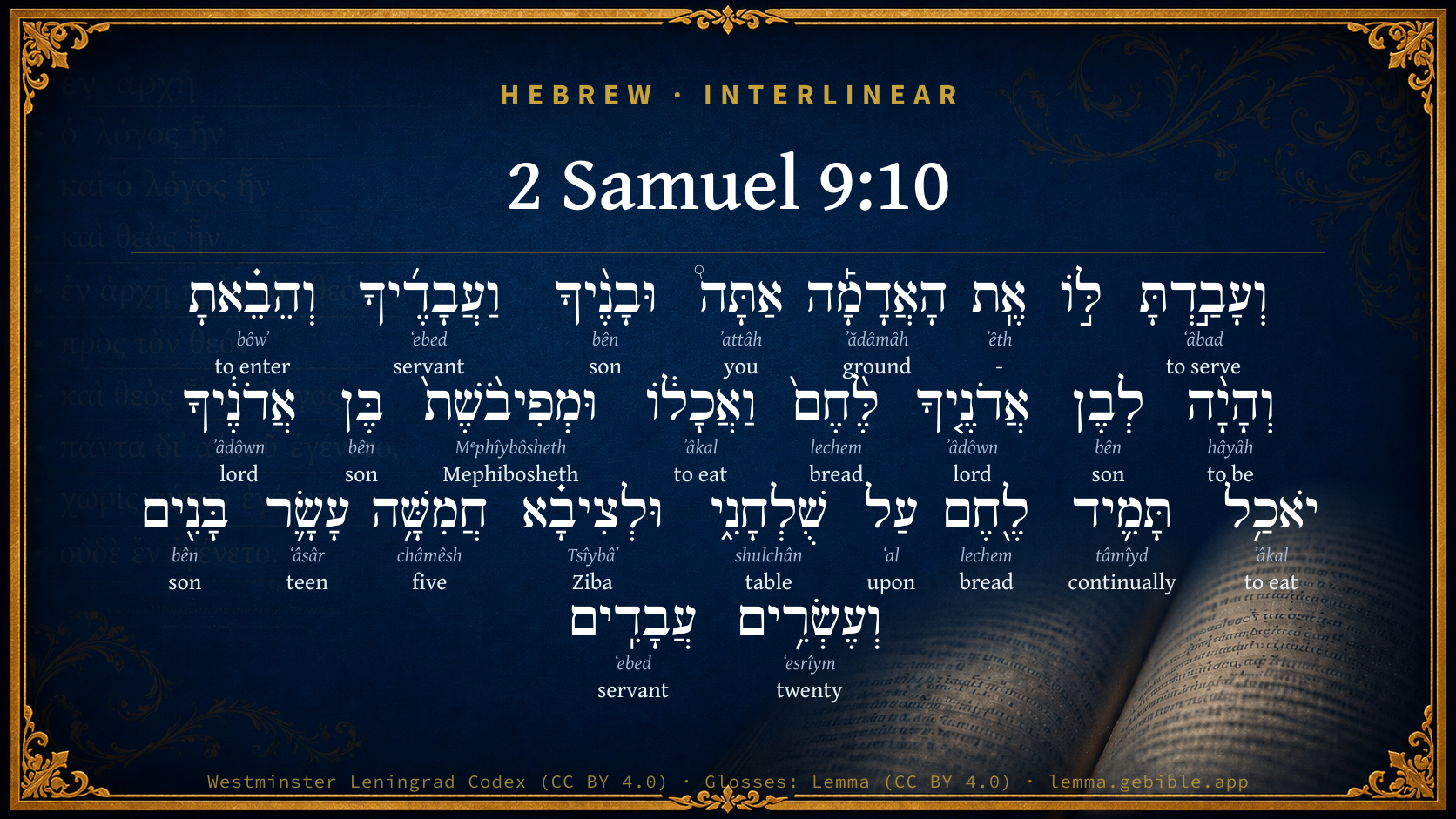
Hebrew (Westminster Leningrad Codex) 2 Samuel 9:10 appears in the Hebrew Old Testament. The text above is from the Westminster Leningrad Codex. Each word links to its Strong’s number, a concise gloss, and parsing drawn from the Open Scriptures Hebrew Bible morphology. Click any word for its full Brown-Driver-Briggs (BDB) entry.
Download image
Cite this verse

2 Samuel 9:10 (World English Bible). Public Domain. Lemma interlinear Bible study tool, https://lemma.gebible.app/v/2-samuel/9/10.

Show BibTeX & RIS
BibTeX
RIS
English Translation
You shall till the land for him, you, and your sons, and your servants; and you shall bring in [the fruits], that your master's son may have bread to eat: but Mephibosheth your master's son shall eat bread always at my table." Now Ziba had fifteen sons and twenty servants.
World English Bible · Public Domain
Download a study sheet

One document with this verse’s original text, its word-by-word gloss line, the meaning frame, cross-references with their text, attributed commentary, and full source and license credits — printable, and it pastes into notes with its structure intact.

This verse Autodidact and up

Study sheet (.html) Plain text (.txt)

A passage Seminary Student

Up to 50 verses in one chapter. A passage sheet keeps up to 6 commentary sources and 12 cross-references per verse, in the order this page ranks them, and says so on the sheet whenever that leaves anything out. Ask for a single verse and you get the Autodidact verse sheet above.

Everything on this page stays free to read, with no account — the sheet is a download of what is already on screen, not access to it.

Want to remove ads? Support Godless Engineer
Compare translations 3

The same verse in 3 English versions, stacked beneath the original-language interlinear above. Click any original word for its lexicon entry.

Each is an independent rendering of the whole verse — the interlinear is not word-aligned to these translations.

Highlighted words mark where these versions differ — a whole-verse word diff, not a word-by-word alignment.

  • World English Bible Public Domain
    You shall till the land for him, you, and your sons, and your servants; and you shall bring in [the fruits], that your master's son may have bread to eat: but Mephibosheth your master's son shall eat bread always at my table." Now Ziba had fifteen sons and twenty servants.
  • King James Version Public Domain
    Thou therefore, and thy sons, and thy servants, shall till the land for him, and thou shalt bring in the fruits, that thy master's son may have food to eat: but Mephibosheth thy master's son shall eat bread alway at my table. Now Ziba had fifteen sons and twenty servants.
  • unfoldingWord Literal Text CC BY-SA 4.0
    And you shall work the land for him, you and your sons and your servants, and you shall bring, that will be bread for the son of your master, that he may eat it. And Mephibosheth, the son of your master, shall eat bread continually at my table.” (Now to Ziba 15 sons and 20 servants.)

unfoldingWord Literal Text — © unfoldingWord, licensed CC BY-SA 4.0. Word-aligned USFM3 via Door43 (git.door43.org/unfoldingWord/en_ult).

Versions to compare (up to 4)

3 of 4 selected

Show all 18 translations

Every available English version of this verse, each an independent rendering of the whole verse.

  • World English Bible Public Domain
    You shall till the land for him, you, and your sons, and your servants; and you shall bring in [the fruits], that your master's son may have bread to eat: but Mephibosheth your master's son shall eat bread always at my table." Now Ziba had fifteen sons and twenty servants.
  • Berean Standard Bible Public Domain
    You and your sons and servants are to work the ground for him and bring in the harvest, so that your master’s grandson may have food to eat. But Mephibosheth, your master’s grandson, is always to eat at my table.” Now Ziba had fifteen sons and twenty servants.
  • Majority Standard Bible Public Domain
    You and your sons and servants are to work the ground for him and bring in the harvest, so that your master’s grandson may have food to eat. But Mephibosheth, your master’s grandson, is always to eat at my table.” Now Ziba had fifteen sons and twenty servants.
  • King James Version Public Domain
    Thou therefore, and thy sons, and thy servants, shall till the land for him, and thou shalt bring in the fruits, that thy master's son may have food to eat: but Mephibosheth thy master's son shall eat bread alway at my table. Now Ziba had fifteen sons and twenty servants.
  • American Standard Version (1901) Public Domain
    And thou shalt till the land for him, thou, and thy sons, and thy servants; and thou shalt bring in `the fruits', that thy master's son may have bread to eat: but Mephibosheth thy master's son shall eat bread alway at my table. Now Ziba had fifteen sons and twenty servants.
  • Revised Version (1885) Public Domain
    And thou shalt till the land for him, thou, and thy sons, and thy servants; and thou shalt bring in the fruits, that thy master’s son may have bread to eat: but Mephibosheth thy master’s son shall eat bread alway at my table. Now Ziba had fifteen sons and twenty servants.
  • Geneva Bible (1599) Public Domain
    Thou therefore and thy sonnes and thy seruantes shall till the lande for him, and bring in that thy masters sonne may haue foode to eate. And Mephibosheth thy masters sonne shall eate bread alway at my table (nowe Ziba had fifteene sonnes, and twentie seruants)
  • Douay-Rheims (1899) Public Domain
    Thou therefore and thy sons and thy servants shall till the land for him: and thou shalt bring in food for thy master's son, that he may be maintained: and Miphiboseth the son of thy master shall always eat bread at my table. And Siba had fifteen sons and twenty servants.
  • Young's Literal Translation Public Domain
    and thou hast served for him the land, thou and thy sons, and thy servants, and hast brought in, and there hath been to the son of thy lord bread, and he hath eaten it; and Mephibosheth son of thy lord doth eat continually bread at my table;' and Ziba hath fifteen sons and twenty servants.
  • Literal Standard Version CC BY-SA 4.0
    and you have served the land for him, you and your sons, and your servants, and have brought in, and there has been bread for the son of your lord, and he has eaten it; and Mephibosheth, son of your lord, continually eats bread at my table”; and Ziba has fifteen sons and twenty servants.
  • Unlocked Literal Bible CC BY-SA 4.0
    You, your sons, and your servants must till the land for him and you must harvest the crops so that your master's grandson will have food to eat. For Mephibosheth, your master's grandson, must always eat at my table.” Now Ziba had fifteen sons and twenty servants.
  • unfoldingWord Literal Text CC BY-SA 4.0
    And you shall work the land for him, you and your sons and your servants, and you shall bring, that will be bread for the son of your master, that he may eat it. And Mephibosheth, the son of your master, shall eat bread continually at my table.” (Now to Ziba 15 sons and 20 servants.)
  • Darby Bible Public Domain
    And thou, and thy sons, and thy servants, shall till the land for him, and thou shalt bring in [the fruits], that thy master's son may have food to eat. And Mephibosheth thy master's son shall eat bread at my table continually. Now Ziba had fifteen sons and twenty servants.
  • World Messianic Bible Public Domain
    Till the land for him—you, your sons, and your servants. Bring in the harvest, that your master’s son may have bread to eat; but Mephibosheth your master’s son will always eat bread at my table.” Now Ziba had fifteen sons and twenty servants.
  • Webster's Bible Public Domain
    Thou therefore, and thy sons, and thy servants, shall till the land for him, and thou shalt bring in the fruits, that thy master's son may have food to eat: but Mephibosheth thy master's son shall eat bread always at my table. Now Ziba had fifteen sons and twenty servants.
  • Free Bible Version CC BY-SA 4.0
    You and your sons and workers are to farm the ground for him and bring in the produce, so that your master's grandson will have food to eat. But Mephibosheth, your master's grandson, will always eat at my table.” Ziba had fifteen sons and twenty workers.
  • Bible in Basic English Public Domain
    And you and your sons and your servants are to take care of the land for him, and get in the fruit of it, so that your master's son may have food: but Mephibosheth, your master's son, will have a place at my table at all times. Now Ziba had fifteen sons and twenty servants.
  • JPS Tanakh (1917) Public Domain
    And thou shalt till the land for him, thou, and thy sons, and thy servants; and thou shalt bring in the fruits, that thy master's son may have bread to eat; but Mephibosheth thy master's son shall eat bread continually at my table.' Now Ziba had fifteen sons and twenty servants.

Literal Standard Version (2020), Covenant Press — licensed CC BY-SA 4.0. Text via the HelloAO Bible API (eBible.org). Unlocked Literal Bible (unfoldingWord) — licensed CC BY-SA 4.0. Text via the HelloAO Bible API (eBible.org). unfoldingWord Literal Text — © unfoldingWord, licensed CC BY-SA 4.0. Word-aligned USFM3 via Door43 (git.door43.org/unfoldingWord/en_ult). Free Bible Version, Dr. Jonathan Gallagher — licensed CC BY-SA 4.0. Text via the HelloAO Bible API (eBible.org).

Word by word

More ways to search: Search by grammar → Find every occurrence → Compare this word →

Practice this passage: Drill this verse → Learn its vocabulary →

וּלְצִיבָ֗א
Tsîybâʼ
H6717
“and · to/for · Ziba”
Conjunction + Preposition + Noun, Proper
Part of Speech
Conjunction + Preposition + Noun
Type
Proper
Full BDB Definition

Origin: from the same as H6678

TWOT: None

Ziba = "statue" - a servant of Saul whom David made steward of Jonathan's son Mephibosheth
  1. וְעָבַ֣דְתָּ ʻâbad H5647 “and · to serve” Conjunction + Verb, Qal, Sequential Perfect, 2nd Person, Masculine, Singular
  2. אֶֽת ʼêth H853 “-” Particle, Direct Object
  3. הָאֲדָמָ֡ה ʼădâmâh H127 “the · ground” Particle, Definite Article + Noun, Common, Feminine, Singular, Absolute
  4. אַתָּה֩ ʼattâh H859 “you” Pronoun, Personal, 2nd Person, Masculine, Singular
  5. וּבָנֶ֨יךָ bên H1121 “and · sons · your” Conjunction + Noun, Common, Masculine, Plural, Construct + Suffix, Personal, 2nd Person, Masculine, Singular
  6. וַעֲבָדֶ֜יךָ ʻebed H5650 “and · servants · your” Conjunction + Noun, Common, Masculine, Plural, Construct + Suffix, Personal, 2nd Person, Masculine, Singular
  7. וְהֵבֵ֗אתָ bôwʼ H935 “and · to enter” Conjunction + Verb, Hiphil, Sequential Perfect, 2nd Person, Masculine, Singular
  8. וְהָיָ֨ה hâyâh H1961 “and · to be” Conjunction + Verb, Qal, Sequential Perfect, 3rd Person, Masculine, Singular
  9. לְבֶן bên H1121 “to/for · son of” Preposition + Noun, Common, Masculine, Singular, Construct
  10. אֲדֹנֶ֤יךָ ʼâdôwn H113 “lords · your” Noun, Common, Masculine, Plural, Construct + Suffix, Personal, 2nd Person, Masculine, Singular
  11. לֶּ֨חֶם֙ lechem H3899 “bread” Noun, Common, Both, Singular, Absolute
  12. וַאֲכָל֔וֹ ʼâkal H398 “and · to eat · him” Conjunction + Verb, Qal, Sequential Perfect, 3rd Person, Masculine, Singular + Suffix, Personal, 3rd Person, Masculine, Singular
  13. וּמְפִיבֹ֨שֶׁת֙ Mᵉphîybôsheth H4648 “and · Mephibosheth” Conjunction + Noun, Proper
  14. בֶּן bên H1121 “son of” Noun, Common, Masculine, Singular, Construct
  15. אֲדֹנֶ֔יךָ ʼâdôwn H113 “lords · your” Noun, Common, Masculine, Plural, Construct + Suffix, Personal, 2nd Person, Masculine, Singular
  16. יֹאכַ֥ל ʼâkal H398 “to eat” Verb, Qal, Imperfect, 3rd Person, Masculine, Singular
  17. תָּמִ֛יד tâmîyd H8548 “continually” Noun, Common, Masculine, Singular, Absolute
  18. לֶ֖חֶם lechem H3899 “bread” Noun, Common, Both, Singular, Absolute
  19. עַל ʻal H5921 “upon” Preposition
  20. שֻׁלְחָנִ֑י shulchân H7979 “table · my” Noun, Common, Masculine, Singular, Construct + Suffix, Personal, 1st Person, Common, Singular
  21. חֲמִשָּׁ֥ה châmêsh H2568 “five” Adjective, Cardinal number, Masculine, Singular, Absolute
  22. עָשָׂ֛ר ʻâsâr H6240 “teen” Adjective, Cardinal number, Masculine, Singular, Absolute
  23. בָּנִ֖ים bên H1121 “sons” Noun, Common, Masculine, Plural, Absolute
  24. וְעֶשְׂרִ֥ים ʻesrîym H6242 “and · twenty” Conjunction + Adjective, Cardinal number, Both, Plural, Absolute
  25. עֲבָדִֽים ʻebed H5650 “servants” Noun, Common, Masculine, Plural, Absolute

About this verse

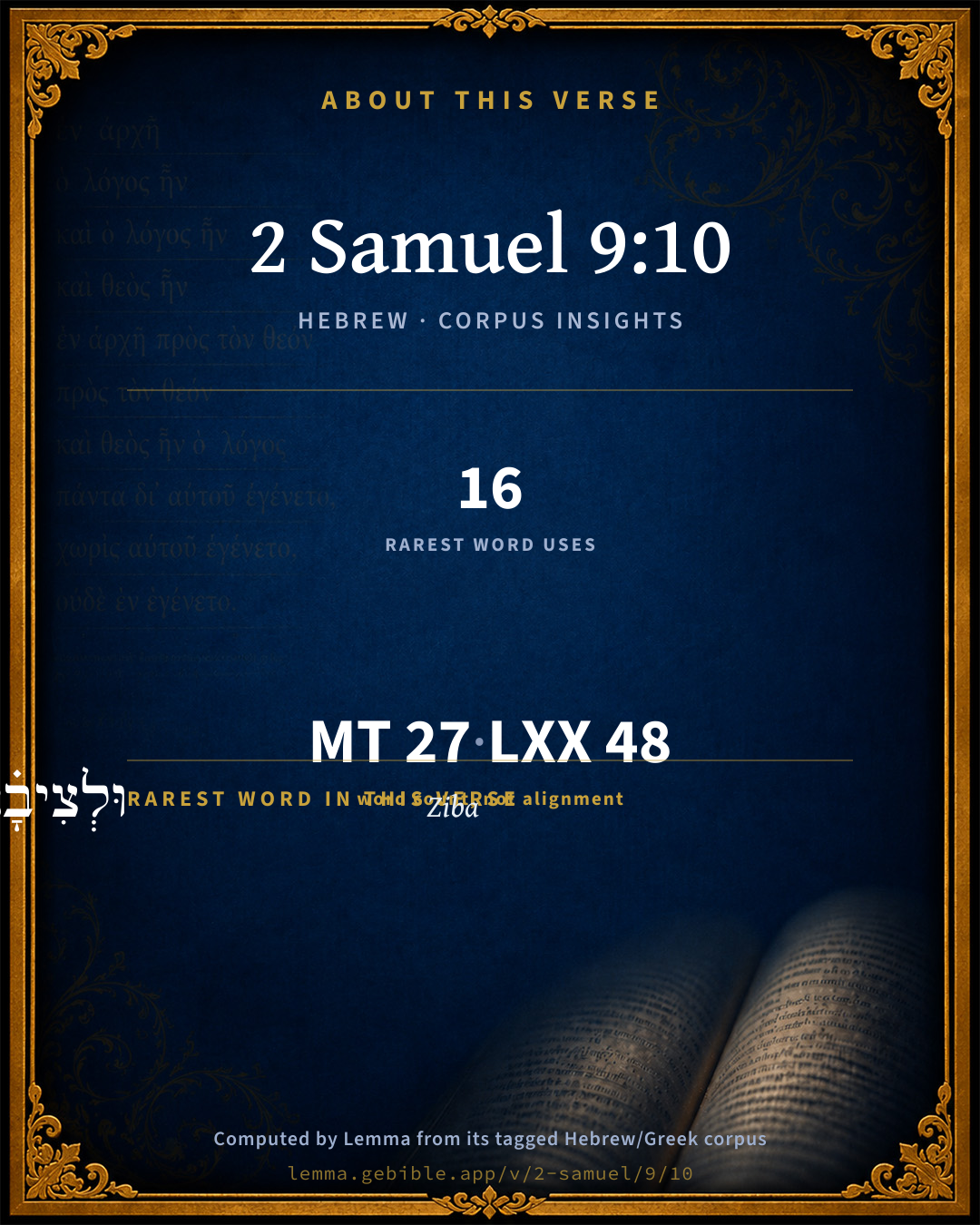
These counts appear in no published source. They are computed here, from the morphology-tagged text and Lemma’s own curated glosses. What Lemma adds →

27
words
19
distinct lemmas
Historical
section

Notable vocabulary

The rarest word here is וּלְצִיבָ֗א Ziba H6717 — appearing just 16 times in the whole Hebrew Bible.

Shared distinctive vocabulary

וּלְצִיבָ֗א Ziba H6717 occurs in 13 verses of the Hebrew Bible. Also found in:

Grammatical profile

  • 5 verbs
  • 15 nouns
  • 3 adjectives
  • 1 pronoun
  • 2 prepositions
  • 1 particle

Verb forms

  • וְעָבַ֣דְתָּ Qal · Sequential Perfect
  • וְהֵבֵ֗אתָ Hiphil · Sequential Perfect
  • וְהָיָ֨ה Qal · Sequential Perfect
  • וַאֲכָל֔וֹ Qal · Sequential Perfect
  • יֹאכַ֥ל Qal · Imperfect

Repetition

Words recur within this verse — often emphatic in Hebrew:

  • וּבָנֶ֨יךָ son H1121 ×4
  • וַעֲבָדֶ֜יךָ servant H5650 ×2
  • אֲדֹנֶ֤יךָ lord H113 ×2
  • לֶּ֨חֶם֙ bread H3899 ×2
  • וַאֲכָל֔וֹ to eat H398 ×2

Hebrew & Septuagint length

In English translation the verse runs 50 words from the Hebrew and 53 from the Septuagint (LXX English) — closely comparable.

A rough comparison of the two English renderings, which tokenize alike — not a word-level alignment.

Word counts can differ between the Hebrew and the Greek without any difference in meaning — e.g. the Hebrew direct-object marker אֵת has no separate Greek word, and Greek often adds the article ὁ.

In the original languages it is 27 Hebrew tokens and 48 Greek tokens — but the two are counted differently (Hebrew bundles its prefixes and suffixes into one token; the Greek is in lemma form), so that isn’t a like-for-like length.

Cross-references

5

Topical passages linked to 2 Samuel 9:10 in the Treasury of Scripture Knowledge — connected by theme and wording, ordered by reader-vote popularity; previews shown in the World English Bible.

  • 2 Samuel 9:7 David said to him, "Don't be afraid of him; for I will surely show you kindness for Jonathan your father's sake, and will restore you all the land of Saul your father; and you shall eat bread at my table continually."
  • 2 Samuel 19:28 For all my father's house were but dead men before my lord the king; yet you set your servant among those who ate at your own table. What right therefore have I yet that I should cry any more to the king?
  • 2 Samuel 9:11–13 Then said Ziba to the king, According to all that my lord the king commands his servant, so shall your servant do. As for Mephibosheth, [said the king], he shall eat at my table, as one of the king's sons.
  • 2 Kings 25:29 and changed his prison garments. [Jehoiachin] ate bread before him continually all the days of his life:
  • Luke 14:15 When one of those who sat at the table with him heard these things, he said to him, "Blessed is he who will feast in the Kingdom of God!"

Cross-references courtesy of OpenBible.info (CC BY 4.0).

Hebrew and Greek witnesses Masoretic Hebrew ↔ Greek Septuagint

The same verse in the two great witnesses to the Old Testament, shown verse-for-verse.

These are two independent witnesses, not word-aligned to each other, and the Septuagint is shown in lemma (dictionary) form.

Hebrew 2 Samuel 9:10 Masoretic · Westminster Leningrad Codex

וְעָבַ֣דְתָּ לּ֣וֹ אֶֽת הָאֲדָמָ֡ה אַתָּה֩ וּבָנֶ֨יךָ וַעֲבָדֶ֜יךָ וְהֵבֵ֗אתָ וְהָיָ֨ה לְבֶן אֲדֹנֶ֤יךָ לֶּ֨חֶם֙ וַאֲכָל֔וֹ וּמְפִיבֹ֨שֶׁת֙ בֶּן אֲדֹנֶ֔יךָ יֹאכַ֥ל תָּמִ֛יד לֶ֖חֶם עַל שֻׁלְחָנִ֑י וּלְצִיבָ֗א חֲמִשָּׁ֥ה עָשָׂ֛ר בָּנִ֖ים וְעֶשְׂרִ֥ים עֲבָדִֽים

You shall till the land for him, you, and your sons, and your servants; and you shall bring in [the fruits], that your master's son may have bread to eat: but Mephibosheth your master's son shall eat bread always at my table." Now Ziba had fifteen sons and twenty servants.

World English Bible · Public Domain

Greek LXX 2 Samuel 9:10 Septuagint · lemma form

καί ἐργάζομαι αὐτός ὁ γῆ σύ καί ὁ υἱός σύ καί ὁ δοῦλος σύ καί εἰςφέρω ὁ υἱός ὁ κύριος σύ ἄρτος καί ἐσθίω αὐτός καί μεμφιβοσθε υἱός ὁ κύριος σύ ἐσθίω διά πᾶς ἄρτος ἐπί ὁ τράπεζα ἐγώ καί ὁ σιβα εἰμί πεντεκαίδεκα υἱός καί εἴκοσι δοῦλος

And you, and your sons, and your servants, shall till the land for him; and you shall bring in bread to the son of your lord, and he shall eat bread: and Memphibosthe the son of your lord shall eat bread continually at my table. Now Siba had fifteen sons and twenty servants.

LXX2012 (modern English Septuagint) · Public Domain

Hebrew: Westminster Leningrad Codex (CC BY 4.0). Greek: Septuagint (public domain); English from LXX2012 (modern English Septuagint) (Public Domain). How the Septuagint differs from the Hebrew →

Targum (Aramaic paraphrase)

1

The Targum is the ancient Jewish Aramaic paraphrase of the Hebrew Scriptures — an interpretive translation, not the Hebrew text itself. Onkelos (literal) and Pseudo-Jonathan (expansive) render the Torah, and Jonathan the Prophets. Coverage is partial: where no permissively-licensed English translation exists for a verse, only the Aramaic is shown. This is verse-level text, not a word-by-word alignment to the Hebrew.

  1. Targum Jonathan Prophets (Joshua–Malachi)
    וְתִפְלַח לֵיהּ יַת אַרְעָא אַתְּ וּבְנָךְ וְעַבְדָיִךְ וְתֵיעוּל וִיהֵי לְבַר רִבּוֹנָךְ מָזוֹן וְיִתְפַּרְנֵס וּמְפִיבֹשֶׁת בַר רִבּוֹנָךְ אָכֵיל תְּדִירָא לַחְמָא עַל פְּתוֹרִי וּלְצִיבָא חַמְשַׁת עֲסַר בְּנִין וְעַסְרִין עַבְדִין:

    (no public-domain English translation for this verse)

    Targum Jonathan — Aramaic: “Mikraot Gedolot” (public domain). English: “Sefaria Community Translation” (CC0 1.0 (public-domain dedication)); “London "Chaldee Paraphrase," 1871” (public domain). Text via Sefaria.

Commentary

Notes on 2 Samuel 9:10 from classic Christian and Jewish commentators (each source and its license shown beneath its notes). The classic Christian expositions comment on the surrounding passage and are grouped to its opening verse, so a note may address several verses; the Jewish commentaries on the Tanakh (Rashi and others) are per-verse, so they appear only where the commentator wrote on this verse.

Lemma curates 59 commentaries, every one of them public domain or Creative Commons licensed, each selected and text-cleaned for this edition rather than reprinted as found. About our sources →

Trapp's Complete Commentary

John Trapp

2Sa 9:10 Thou therefore, and thy sons, and thy servants, shall till the land for him, and thou shalt bring in [the fruits], that thy master’s son may have food to eat: but Mephibosheth thy master’s son shall eat bread alway at my table. Now Ziba had fifteen sons and twenty servants.

Ver. 10. Shall till the land for him.] Hic Ziba instituitur colonus partiarius. Here Ziba is far intrusted, but he proved treacherous; being neither good egg nor good bird, as they say.

That thy master’s son may have food to eat.] That is, Food in his house for his family to eat, and enough besides to defray his other necessary charges; so Josephus.

John Trapp, A Commentary or Exposition upon All the Books of the Old and New Testament (1647–1656) — public domain. Text from a community e-Sword module.

Joseph Benson's Commentary

2Sa 9:10-13. Mephibosheth shall eat bread alway at my table — Now David declares publicly what he had said privately to Mephibosheth. His family was to be maintained by the fruit of the estate that David gave him, though he himself was to eat always with David. And he was lame on both his feet — Or, though he was lame, &c. This defect and blemish did not hinder him from being entertained by the king with the greatest kindness; which procured him, though despicable in his person, honour from the people, as one in great favour with the king.

Joseph Benson's Commentary on the Old and New Testaments (1811–1818) — public domain. Text from a community e-Sword module.

Geneva Bible (1599)

Geneva Bible translators

Be ye provident overseers and governors of his lands, that they may be profitable.

Geneva Bible (1599) marginal notes — public domain. Text via Bolls.life.

Jamieson, Fausset & Brown

Robert Jamieson, A. R. Fausset & David Brown

Ziba had fifteen sons and twenty servants--The mention of his sons and the slaves in his house was to show that Mephibosheth would be honored with an equipage "as one of the king's sons."

Jamieson, Fausset & Brown — Commentary Critical and Explanatory on the Whole Bible (1871) — public domain (CC PDM 1.0). Text via the HelloAO Bible API.

Adam Clarke's Commentary

Verse 10. Thou therefore, and thy sons - shall till the land] It seems that Ziba and his family had the care of the whole estate, and cultivated it at their own expense, yielding the half of the produce to the family of Mephibosheth. Ziba was properly the hind, whose duty and interest it was to take proper care of the ground, for the better it was cultivated the more it produced; and his half would consequently be the greater.

Adam Clarke's Commentary on the Bible (1810–1826) — public domain. Text from a community e-Sword/MySword module.

The Cambridge Bible for Schools and Colleges

gen. ed. J. J. S. Perowne

10. shall till the land] This arrangement suggests that Ziba was already in occupation of the land, so that the only change to him would be that Mephibosheth would now receive the fruits instead of David.

that thy master’s son, &c.] Though Mephibosheth himself was to be a guest at the royal table, he would require the revenues of this estate for the support of his family and household. It may be inferred from the number of Ziba’s servants that they would be considerable.

The Cambridge Bible for Schools and Colleges (gen. ed. J. J. S. Perowne; Cambridge University Press, 1878–1918) — public domain. Text from a community e-Sword module.

John Gill's Exposition

Thou therefore, thy sons, and thy servants,.... Which were many, and whose numbers are after given:

shall till the land for him; manure it, plough it, sow it, and reap it:

and thou shall bring in the fruits; the corn, and oil, and wine, the land produces:

that thy master's son may have food to eat; meaning either Micha, the son of Mephibosheth, since Mephibosheth seems to be distinguished from him, and opposed to him in the next clause: and who would stand in no need of food from any other quarter, being a guest at the king's table continually; or else Mephibosheth, who by this means would have a sufficiency for his son and servants, and in which Ziba's family and servants would have a share:

but Mephibosheth thy master's son shall eat always at my table; wherefore the land was to be tilled not for him personally, but for his family, and for what uses he should think fit to put the produce of it to:

now Ziba had fifteen sons and twenty servants: who were enough to cultivate a considerable quantity of land.

John Gill's Exposition of the Whole Bible (1746–1763) — public domain (CC PDM 1.0). Text via the HelloAO Bible API.

Albert Barnes' Notes on the Bible

Fifteen sons ... - See 2Sa 19:17, marginal reference.

Albert Barnes' Notes on the Bible (1834–1885) — public domain. Text from a community e-Sword/MySword module.

Haydock's Catholic Bible Commentary

Servants under him, though all belonged to Miphiboseth. (Haydock)

George Leo Haydock (1774–1849), Haydock's Catholic Family Bible and Commentary, 1859 edition — public domain. Excludes Psalms (Douay-Rheims chapter numbering differs from Protestant) and Deuterocanonical books (Catholic canon only).

Matthew Poole's English Annotations

That thy master’s son may have food to eat, i.e. that he may have wherewith to buy food for all his family, and all manner of provisions (which oft come under the title of food and bread) necessary for himself and them.

It is probable he had been the chief steward to manage Saul’s lands; whereby he had great opportunities to enrich himself, which also he was very intent and resolved upon, either directly or indirectly, as the following history of him shows; and therefore it is not strange that he was so rich.

Matthew Poole's English Annotations on the Holy Bible (1683–1685) — public domain. Text from a community e-Sword/MySword module.

The Pulpit Commentary

That thy master"s son may have food to eat. Instead of "son," Hebrew ben, some commentators prefer the reading of a few Greek versions, namely, "house," Hebrew, beth. But the difficulty which they seek to avoid arises only from extreme literalness of interpretation. Though Mephibosheth ate at the king"s table, he would have a household to maintain for he had a wife and son and other expenses; and his having "food to eat" includes everything necessary, as does our prayer for "daily bread." He would live at Jerusalem as a nobleman and Ziba would cultivate his estates, paying, as is usual in the East, a fixed proportion of the value of the produce to his master. Ziba had fifteen sons and twenty servants (slaves). He had evidently thriven; for, beginning as a slave in Saul"s household, he had now several wives and many slaves of his own, and had become a person of considerable importance. He would still remain so, though somewhat shorn both of wealth and dignity in becoming only Mephibosheth"s farmer.

The Pulpit Commentary (1880–1919), ed. H.D.M. Spence-Jones & Joseph S. Exell — public domain. Text from a community e-Sword module.

Lesson kit

Teaching starters — assembled from the data on this page, not authored interpretation. Every prompt links to the verse data it draws on. Edit before teaching.

2 Samuel, in the Historical, opens this verse with 27 words (19 distinct Hebrew lemmas). Its most distinctive word is Tsîybâʼ (“Ziba”). A historical commentator’s framing appears above. Read the whole chapter for the surrounding context.

Discussion questions

  1. How does “Ziba” (Tsîybâʼ) shape what this verse is saying?
  2. How does 2 Samuel 9:2, which shares the word «Ziba», read alongside this verse?
  3. What does the repetition of “son” (4× in this one verse) do in this verse?
  4. The translations on this page render this verse differently — a whole-verse word diff, not a word-by-word alignment. What might account for the different wordings?
  5. «וְעָבַ֣דְתָּ» is a Qal Sequential Perfect verb. How does that grammatical form shape the action described?
  6. Compare how Trapp's Complete Commentary and Joseph Benson's Commentary read this verse. Where do they agree or differ?

Things to notice

Reading settings

Reading text

Shown beneath each verse's original-language words.

Old Testament
Old Testament edition

Read the OT as the Masoretic Hebrew (MT) or the Greek Septuagint (LXX).

English shown for the Greek Septuagint (in the Hebrew ↔ Greek comparison).

Comparing translations? Open the Compare panel on any verse page to stack up to four side by side.